

















Key takeaways:
-
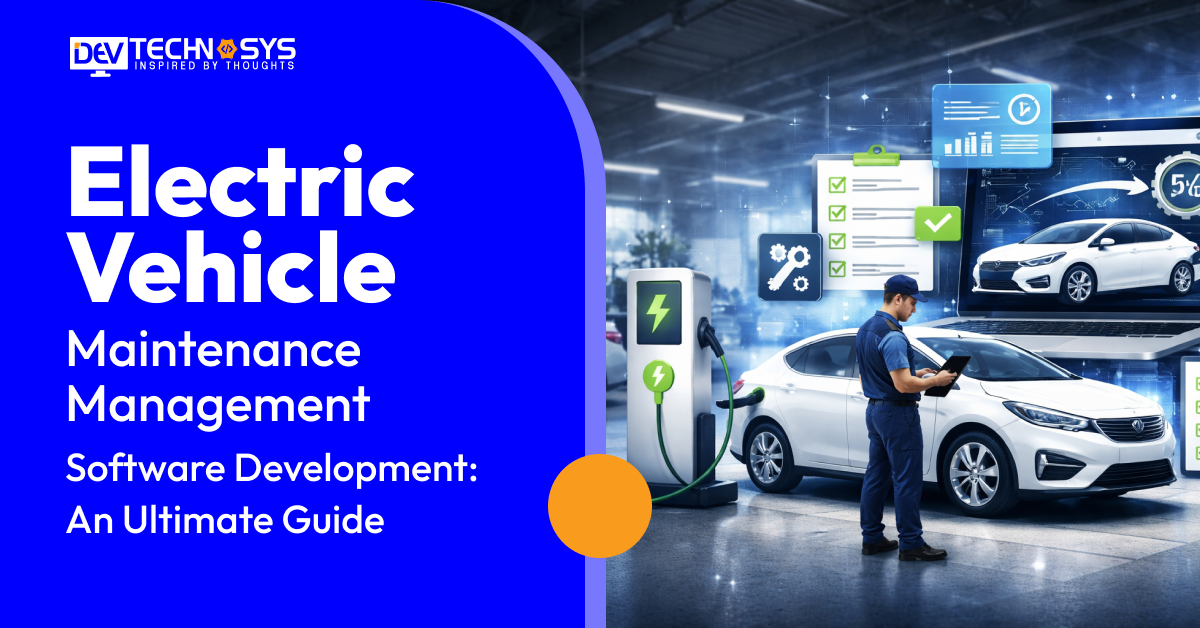
- Electric vehicle maintenance management software is designed to streamline operations. Such software empowers fleet managers, service centers, and individual owners to monitor, track, and optimize EV performance seamlessly.
- The electric vehicle fleet management market size will grow from $24.92 billion in 2025 to $26.29 billion in 2026.
- The cost to develop electric vehicle maintenance management software ranges from $8,000 to $30,000, depending on features and functionality.
- EV management software allows users and fleet managers to access vehicle data, track maintenance, and receive notifications on smartphones or tablets.
The automotive industry continues to evolve as the world is shifting from traditional fuel-based vehicles to electric vehicles. EVs are proving to be a better and more sustainable transportation choice.
However, many find maintaining these vehicles quite challenging. It includes battery health monitoring, software updates, routine inspection schedules, and compliance with regulatory and security standards. This is where electric vehicle software development comes in, solving all issues related to EV fleet maintenance and management.
EV maintenance software makes operations easier. It helps fleet managers, individual owners, and service centers in optimizing EVs’ performance with ease. Automated maintenance scheduling allows businesses to reduce downtime and costs while increasing their EVs lifespan.
But what exactly goes into electric vehicle maintenance management software development? That’s exactly what we will be discussing in this blog. Let’s dive in and see why an EV maintenance management system is a strategic step toward efficiency, reliability, and a greener future.
What is Electric Vehicle Maintenance Management Software?
Electric Vehicle (EV) Maintenance Management Software is an online platform that makes monitoring, optimizing, and maintaining electric vehicle fleets and charging infrastructure a lot easier.
An EV asset management software tracks battery health, reduces energy costs, manages charging schedules, and provides proactive on-board diagnostics (OBD-II) to minimize downtime. It often integrates telematics for real-time data on state-of-charge (SoC) and state-of-health (SoH).
Electric Vehicle Fleet Management Market Overview
- The electric vehicle fleet management market size has grown strongly in recent years.
- It will grow from $24.92 billion in 2025 to $26.29 billion in 2026 at a compound annual growth rate (CAGR) of 5.5%.
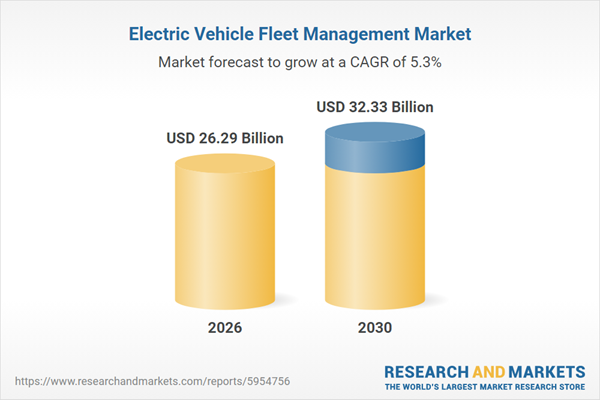
- It will grow to $32.33 billion in 2030 at a compound annual growth rate (CAGR) of 5.3%.
- North America was the largest region in the electric vehicle fleet management market in 2025.
How Does Electric Vehicle Maintenance Management Software Work?
Electric Vehicle Maintenance Management Software tracks electric vehicle performance, predicts issues, and automates maintenance schedules, ensuring your EV stays in top-notch condition. It ensures your EV operates efficiently while lowering downtime and repair costs.
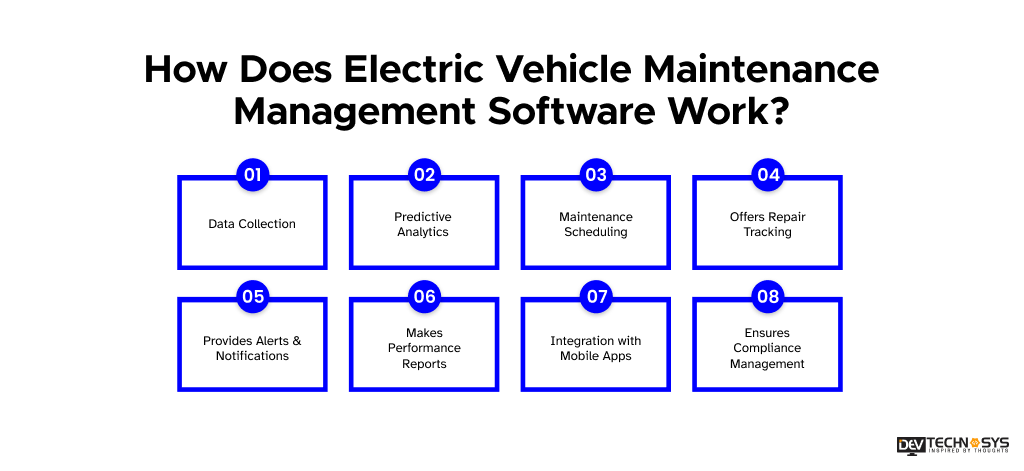
- Data Collection: An EV charging management software gathers real-time information from EV sensors. It includes battery status, motor performance, and charging cycles.
- Predictive Analytics: It makes an analysis of data gathered and points out possible issues before they escalate. Predictive analysis reduces downtime and repair costs.
- Maintenance Scheduling: Automates service reminders and schedules preventive maintenance, which keeps electric vehicles in fine-tuned condition.
- Offers Repair Tracking: It keeps records and tracks of each EV’s repairs, service history, and part replacements.
- Provides Alerts & Notifications: EV service management software sends real-time alerts, notifying people about major issues, next maintenance, or performance glitches of the EV.
- Makes Performance Reports: Electric mobility software solutions include detailed dashboards and reporting tools for fleet management, operational insights, and compliance purposes.
- Integration with Mobile Apps: With this software, Feet managers and users can easily access vehicle data and maintenance history, and receive notifications on smartphones or tablets.
- Ensures Compliance Management: Ensures vehicles meet safety, regulatory, and warranty requirements through automated record-keeping and reminders.\
What are the Top 10 Electric Vehicle Maintenance Management Softwares?
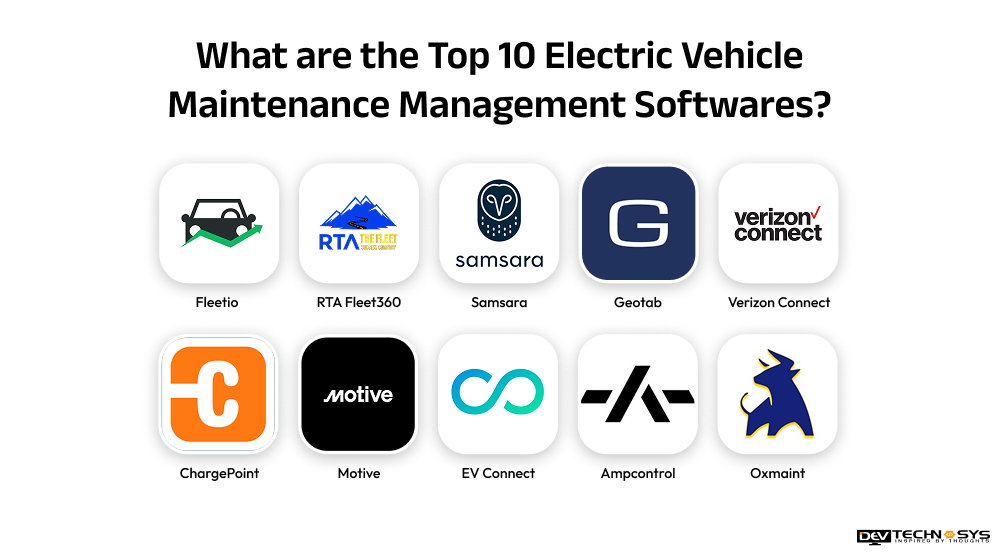
Electric Vehicle Maintenance Management Software helps businesses efficiently monitor, maintain, and optimize EV performance using real-time data and predictive analytics. These platforms streamline fleet operations, reduce downtime, and enhance overall vehicle lifecycle management in the rapidly growing electric mobility ecosystem.
Software |
Launch / Founding Year |
Key Capabilities |
Platform Availability |
| RTA Fleet360 | 2010 | Predictive/preventive maintenance, work orders, asset tracking | Web, Mobile |
| Fleetio | 2012 | Maintenance scheduling, inspections, and reminders | Web, iOS, Android |
| Samsara | 2015 | Telematics, diagnostics, real‑time alerts + maintenance tracking | Web, iOS, Android |
| Geotab | 2000 | EV telematics, Battery Management System (BMS), vehicle diagnostics | Web, iOS, Android |
| Verizon Connect | 2018 | Enterprise telematics & compliance with maintenance tools | Web, iOS, Android |
| Motive | 2010 | ELD, driver safety, compliance + maintenance workflows | Web, iOS, Android |
| ChargePoint | 2007 | EV charging & fleet charging optimization platform | Web, iOS, Android |
| EV Connect | 2010 | EV charging management, real‑time charging insights | Web, iOS, Android |
| Ampcontrol | 2020 | EV charger & telematics monitoring, energy management | Web, API integrations |
| Oxmaint | 2020 | AI‑powered fleet maintenance & CMMS workflows | Web, Mobile |
1. RTA Fleet360
RTA Fleet360 is an advanced fleet maintenance management software focused on preventive maintenance, cost tracking, and asset lifecycle management. It offers features like work order automation, real-time data integration, and analytics dashboards. Businesses looking to develop software like this should focus on predictive maintenance, reporting tools, and seamless telematics integrations.
Industry Insights:
According to rtafleet.com, the RTA Fleet360 was named “Fleet Management Software of the Year” by AutoTech Breakthrough Awards in October 2025.
2. Fleetio
Fleetio is a cloud-based fleet management platform designed to simplify vehicle maintenance, inspections, and operations. Key features include work order management, inventory tracking, mobile accessibility, and integrations with telematics systems.
For Fleetio like electric vehicle maintenance management software development, focus on user-friendly interfaces, automation workflows, and centralized fleet data management.
3. Samsara
Samsara is a connected operations platform offering real-time GPS tracking, AI-powered analytics, and vehicle diagnostics. Its features include driver monitoring, safety tools, and predictive maintenance insights. When developing software like Samsara, prioritize IoT integration, real-time data processing, and AI-driven analytics for smarter fleet and EV management.
4. Geotab
Geotab is a powerful telematics and EV fleet GPS tracking software that provides deep insights into vehicle performance, driver behavior, and compliance. It supports open APIs, customization, and large-scale data processing. To develop software like Geotab, focus on scalable architecture, big data analytics, and flexible API integrations.
5. Verizon Connect
Verizon Connect is an enterprise-grade fleet management solution offering GPS tracking, compliance tools, route optimization, and maintenance alerts. Its features help improve safety, efficiency, and operational visibility.
Developing electric vehicle maintenance management software like this requires robust telematics, real-time tracking, and compliance-focused functionality for large-scale fleet operations.
How to Build an Electric Vehicle Maintenance Management Software in Simple Steps?
Electric vehicle maintenance management software development helps businesses efficiently monitor EV performance, automate maintenance, and reduce operational downtime. With the rise of electric mobility, such solutions are essential to enabling predictive maintenance, improving fleet efficiency, and enabling data-driven decision-making.
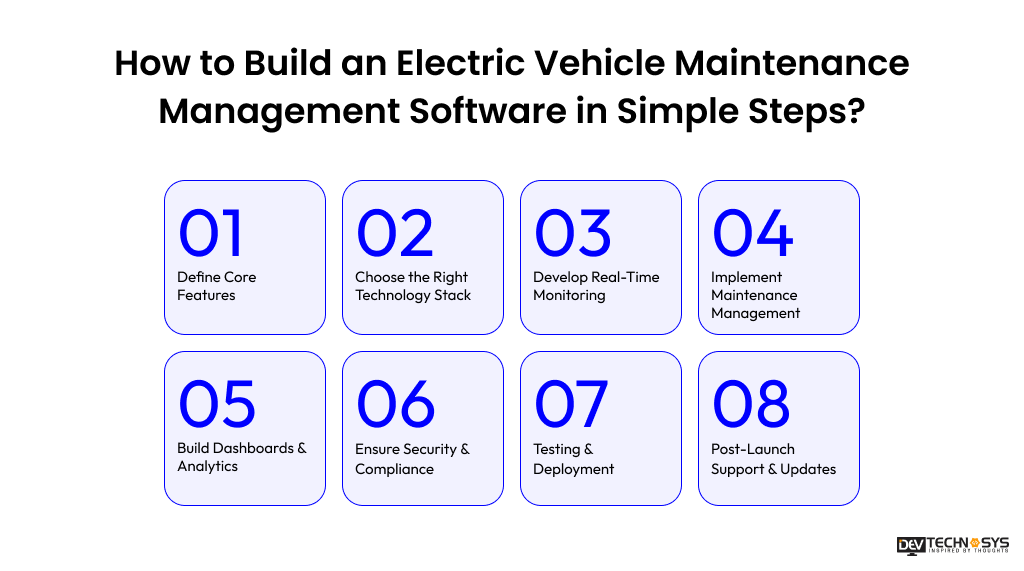
Step 1: Define Core Features
Wondering how to build EV maintenance software? Well, start by identifying essential features for your EV maintenance software. Include real-time monitoring of battery health, motor performance, and charging cycles.
Add predictive maintenance alerts, repair tracking, automated scheduling, and performance analytics. Also, incorporate user management for fleet managers or individual owners to ensure seamless vehicle operations and efficient maintenance planning.
Industry Insights:
According to IEA, with EV adoption growing over 20% annually, feature-rich Fleet Management Systems (FMS) are crucial to manage increasing fleet complexity efficiently.
Step 2: Choose the Right Technology Stack
Building a cloud-based fleet management system (FMS) requires selecting a robust technology stack for optimal performance. Use React.js, Angular, or Flutter for mobile frontend development.
Backend options for EV charging app development include Node.js, Python Django, or Java Spring Boot.
Store data in MySQL, PostgreSQL, or MongoDB, and host on cloud platforms like AWS, Google Cloud, or Azure. Integrate IoT APIs and payment gateways for a complete system.
Component |
Technology Options |
| Frontend (Web) | React.js, Angular, Vue.js |
| Frontend (Mobile) | Flutter, React Native, Swift (iOS), Kotlin (Android) |
| Backend | Node.js, Python (Django/Flask), Java (Spring Boot) |
| Database | PostgreSQL, MySQL, MongoDB |
| Cloud & Hosting | AWS, Google Cloud Platform, Microsoft Azure |
| IoT & Telematics | MQTT, Azure IoT Hub, AWS IoT Core |
| APIs & Integration | RESTful APIs, GraphQL APIs |
| Data Analytics | Power BI, Tableau, Google Analytics |
| Security | SSL/TLS Encryption, OAuth 2.0, JWT Authentication |
| DevOps & Deployment | Docker, Kubernetes, Jenkins, GitHub Actions |

Step 3: Develop Real-Time Monitoring
Integrate IoT sensors to collect critical vehicle data in real time, including battery levels, motor efficiency, and charging status. Use predictive analytics to identify potential issues early.
This helps you prevent costly repairs, reduce downtime, and ensure vehicles operate at peak efficiency. Real-Time data processing and monitoring also support accurate reporting and maintenance decision-making.
Step 4: Implement Maintenance Management
Automate preventive maintenance scheduling based on vehicle usage and diagnostics. Track repair history, part replacements, and service logs for every vehicle. Generate automated notifications and reminders for upcoming maintenance or critical alerts. This ensures timely service, extends vehicle lifespan, and provides fleet managers with full visibility into operational health.
Step 5: Build Dashboards & Analytics
Create interactive dashboards displaying key vehicle metrics, performance trends, and maintenance insights. Include charts and visual reports for cost analysis, downtime, and operational efficiency.
Analytics helps fleet managers predict potential issues, optimize maintenance schedules, and make data-driven decisions to improve reliability, reduce costs, and enhance fleet performance over time.
Step 6: Ensure Security & Compliance
For electric vehicle maintenance management software development, developers should implement strong security measures, including data encryption and secure authentication protocols. Ensure compliance with regional EV regulations, multi-factor authentication (MFA), automotive standards, and data privacy laws.
Introduce role-based access control for fleet managers, admins, and technicians to prevent unauthorized access. Secure design reduces vulnerabilities and builds user trust while maintaining regulatory adherence.
Step 7: Testing & Deployment
Conduct thorough functional, performance, and security testing before launch. Test IoT integration, EV charging and maintenance integration, predictive algorithms, and notification systems for reliability.
Deploy the app on cloud infrastructure and release mobile versions for iOS and Android. Comprehensive testing ensures the software is stable, scalable, and able to handle large fleets efficiently without disruptions.
Step 8: Post-Launch Support & Updates
After deployment, provide continuous support with regular bug fixes, software updates, and system monitoring. Enhance predictive algorithms with new vehicle data and add features like energy consumption tracking or remote diagnostics.
Continuous improvement ensures the software adapts to evolving EV technologies, maintains operational efficiency, and delivers a seamless experience for fleet managers and users.
Industry Insights:
Hitachi Zero Carbon states that predictive maintenance is becoming standard, aiming to reduce unexpected downtime and repair costs.
What Key Features Are Required For Vehicle Maintenance Management Software Development?
Electric vehicle maintenance management software development requires a robust set of features to ensure efficient fleet operations, reduce downtime, and optimize maintenance processes.
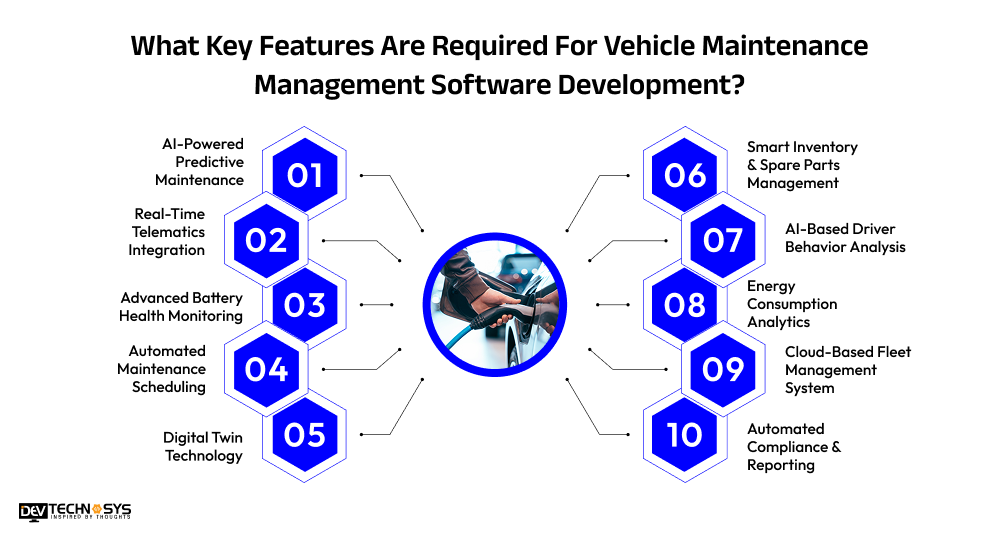
By integrating AI in EV maintenance, real-time monitoring, automation, and analytics, businesses can enhance vehicle performance and streamline maintenance workflows..
Command Center Features |
Mobile Application Features |
Integrated Telematics Features |
| Fleet Dashboard & Monitoring | User Login & Profile Management | Real-Time Vehicle Tracking |
| Maintenance Scheduling | Maintenance Alerts & Reminders | GPS & Route Tracking |
| Work Order Management | Service History Access | Battery Health Monitoring |
| Inventory & Parts Management | Push Notifications | Vehicle Diagnostics Data |
| Analytics & Reporting | In-App Support & Chat | Charging Status Monitoring |
| Cost & Expense Tracking | Offline Data Access | Driver Behavior Tracking |
| Compliance Management | Document Upload & Management | Predictive Maintenance Insights |
| Role-Based Access Control | Real-Time Updates | Sensor Data Integration |
| Vendor Management | Mobile Inspections | Energy Consumption Tracking |
| Performance Monitoring | Dashboard View | Fault Detection & Alerts |
1. AI-Powered Predictive Maintenance
Automotive software development involves adding machine learning algorithms to analyze vehicle data and predict potential failures before they occur, helping reduce downtime, optimize maintenance schedules, and improve overall fleet efficiency through proactive decision-making.
2. Real-Time Telematics Integration
It is one of the crucial features of EV maintenance management system. Integrating IoT sensors and telematics systems provides live data on vehicle location, performance, battery status, and diagnostics. It enables fleet managers to monitor operations and respond instantly to issues.
3. Digital Twin Technology
Creates a virtual replica of vehicles to simulate performance, monitor conditions, and predict failures, allowing businesses to test scenarios and optimize maintenance strategies without affecting real-world operations.
4. Automated Maintenance Scheduling
Automatically schedules preventive maintenance based on usage data, mileage, and diagnostics, sending alerts and reminders to ensure timely servicing and minimize operational disruptions.
5. Advanced Battery Health Monitoring
An electric vehicle service management system tracks battery performance, charging cycles, temperature, and degradation levels to ensure optimal efficiency, extend battery lifespan, and prevent unexpected failures in electric vehicles.
6. Smart Inventory & Spare Parts Management
Tracks spare parts availability, usage patterns, and reorder levels, ensuring timely procurement and reducing delays in maintenance operations while optimizing inventory costs.
7. AI-Based Driver Behavior Analysis
Analyzes driving patterns such as speed, braking, and acceleration to identify risky behavior, improve safety, reduce wear and tear, and enhance overall vehicle performance.
8. Energy Consumption Analytics
Monitors energy usage across vehicles, providing insights into efficiency, charging patterns, and cost optimization, helping businesses reduce operational expenses and improve sustainability.
9. Cloud-Based Fleet Management System
Enables centralized access to vehicle data, maintenance records, and analytics through cloud infrastructure, ensuring scalability, real-time updates, and seamless collaboration across teams and locations.
10. Automated Compliance & Reporting
Generates real-time compliance reports, tracks regulatory requirements, and maintains audit trails, ensuring vehicles meet safety and legal standards while reducing manual effort and administrative overhead.
Want a chatbot demo or pricing? Fill the form and talk to our experts today.
Pick what you need below — you can select more than one — then tap Get detail to continue.
-
Chatbot demo dashboard
-
Cost to develop an app
-
Industry report
-
Case study
Why Businesses Should Invest in EV Predictive Maintenance Software Development?
EV predictive maintenance software is transforming how businesses manage vehicle performance by enabling proactive, data-driven maintenance strategies. Electric vehicle software development solutions help reduce costs, improve reliability, and ensure efficient fleet operations in the rapidly evolving electric mobility landscape.
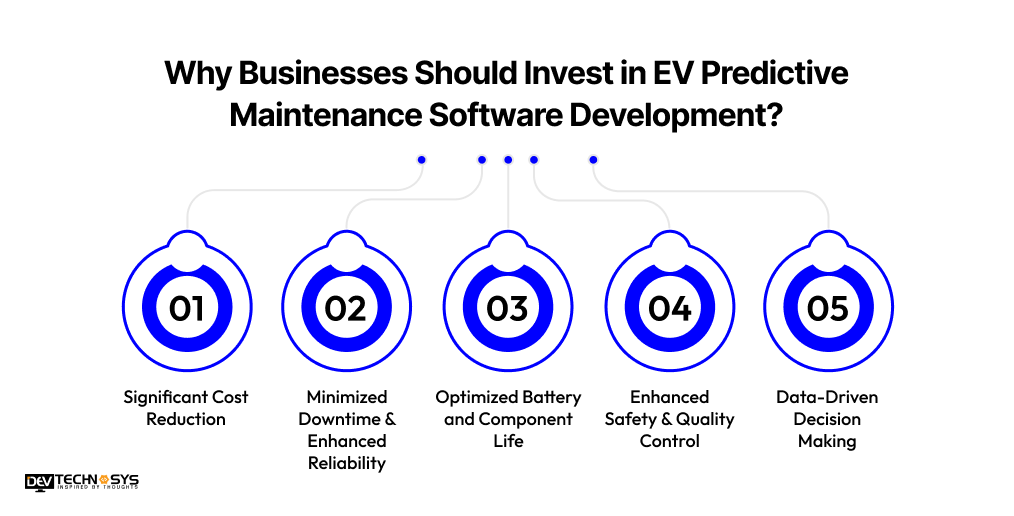
1. Significant Cost Reduction
EV fleet maintenance solutions help reduce the overall cost of upkeep by identifying issues early and preventing major failures. It minimizes unnecessary repairs, lowers operational expenses, and avoids premature capital investments, making fleet management more cost-efficient.
2. Minimized Downtime & Enhanced Reliability
By predicting potential failures before they occur, businesses can avoid unexpected breakdowns and costly disruptions. It ensures higher vehicle uptime, improves operational efficiency, and enhances reliability, allowing fleets to run smoothly without interruptions or delays.
3. Optimized Battery and Component Life
One of the major business benefits of EV fleet maintenance software is continuous monitoring of battery health, temperature, and performance. It allows for timely adjustments that extend the lifespan of critical components. It reduces replacement frequency, lowers costs, and ensures electric vehicles operate efficiently over longer periods.
4. Enhanced Safety & Quality Control
Early detection of faults helps prevent safety incidents and ensures consistent vehicle performance. This improves overall reliability, reduces risks, and maintains quality standards, which is essential for both EV fleet operations and manufacturing environments.
5. Data-Driven Decision Making
Predictive maintenance software provides actionable insights into vehicle performance and maintenance trends. It enables teams to make informed decisions based on real-time data, improving efficiency and eliminating reliance on fixed or outdated maintenance schedules.
What is the Cost to Build a Vehicle Maintenance Management Software?
The cost to build a vehicle maintenance management software starts from $8,000 for a single platform with basic functionalities. The mid-level EV fleet-tracking software development will cost between $15,000 to $22,000, with features like real-time tracking, maintenance scheduling, analytics dashboards, and basic telematics integration.
Development Level |
Estimated Cost |
Key Features Included |
| Basic (MVP) | $8,000 – $12,000 | User login, vehicle records, basic maintenance scheduling, manual data entry, simple dashboard |
| Mid-Level | $12,000 – $20,000 | Real-time tracking, automated maintenance alerts, analytics dashboard, basic telematics integration |
| Advanced | $20,000 – $30,000+ | AI-based predictive maintenance, IoT integration, battery monitoring, advanced analytics, cloud-based system, and role-based access |
If you want to develop an electric vehicle fleet management software for multiple platforms with advanced functionalities such as real-time telematics, AI-based predictive maintenance, and battery analytics, expect the cost to build a vehicle maintenance management software to reach $30,000 or higher.
1. Feature Complexity
The complexity of features impacts the cost to create a vehicle maintenance management software. Basic functionalities like maintenance reminders are affordable, while advanced features such as predictive maintenance, automation, and analytics dashboards require more development time, skilled resources, and testing, increasing the overall budget.
Feature Level |
Estimated Cost |
| Basic | $5,000 – $7,000 |
| Medium | $7,000 – $9,000 |
| Advanced | $9,000 – $11,000+ |
2. Fleet Size & Scalability
Larger fleets require scalable architecture, robust databases, and efficient data processing systems. As the number of vehicles increases, the software must handle more data, real-time updates, and performance demands, leading to higher infrastructure and development costs.
Fleet Size |
Cost Impact |
| Small (1–20 vehicles) | Low ($3,000–$6,000) |
| Medium (20–100 vehicles) | Medium ($7,000–$10,000) |
| Large (100+ vehicles) | High (10,000–$13,000+) |
3. Platform Selection
Choosing between web, mobile, or cross-platform development affects cost. A single platform is cheaper than developing for Android, iOS, and the web simultaneously. Multi-platform development raises the cost to make a vehicle maintenance management software. It happens due to additional design, coding, testing, and maintenance requirements across multiple environments.
Platform Type |
Estimated Cost |
| Web Only | $8,000 – $12,000 |
| Mobile Only | $10,000 – $15,000 |
| Cross-Platform | $15,000 – $21,000+ |
Industry Insights:
Cross-platform frameworks (Flutter, React Native) reduce costs by 35% to 40% compared to building separate native apps, but still cost more than a web-only solution.
4. Integration Requirements
Experts who offer software development services will integrate third-party services like GPS tracking, IoT devices, payment gateways, ERP, and CRM systems to increase complexity of app. Each integration requires APIs, testing, and maintenance, which adds to development time and cost, especially when dealing with real-time data synchronization.
Integration Type |
Cost Impact |
| Basic | $2,000 – $5,000 |
| Medium | $5,000 – $10,000 |
| Advanced | $10,000 – $18,000+ |
5. Development Team Location
Development costs vary by region. If you hire dedicated developers from countries like India or Southeast Asia, then development will be more cost-effective than hiring from the US or Europe. Hourly rates, expertise levels, and communication factors all influence the final development budget and project timeline.
Region |
Estimated Project Cost |
| India | $8,000 – $12,000 |
| Eastern Europe | $12,000 – $18,000 |
| US/UK | $18,000 – $25,000+ |
6. Maintenance & Updates
Software maintenance cost can impact the overall development cost. Post-launch maintenance includes bug fixes, performance optimization, feature upgrades, and security updates. Regular updates ensure smooth functionality and user satisfaction but require a dedicated team and ongoing cost, typically adding a recurring monthly or yearly cost.
Maintenance Type |
Monthly Cost |
| Basic Support | $900 – $2,000 |
| Standard Maintenance | $2,000 – $5,000 |
| Advanced Support | $4,000 – $7,000+ |
Profitable Revenue Models for EV Service Management Software
Monetizing EV Service Management Software involves implementing strategic revenue models that ensure consistent income while delivering value to users. Let’s take a look at some of the top monetization strategies for EV maintenance softwares.
1. Subscription-Based Model (SaaS)
This is the most common and scalable model where users pay a recurring monthly or yearly fee. Pricing can be based on fleet size, features, or number of users. It ensures predictable revenue and long-term customer retention for EV service platforms.
2. Per Vehicle Pricing
Charge customers based on the number of EVs they manage on the platform. This model works well for fleet operators, allowing businesses to scale pricing as their fleet grows while keeping entry costs low for smaller users.
3. Pay-Per-Service Model
Users are charged only when they use specific services such as diagnostics, maintenance scheduling, or repairs. This flexible pricing approach attracts users who prefer not to commit to subscriptions and pay only for what they use.
4. Commission-Based Model
Earn a commission by connecting users with third-party service providers like EV repair centers, charging stations, or spare part vendors. Each successful transaction or booking generates a percentage-based revenue for the platform.
5. Freemium Model
Offer basic features for free while charging for advanced functionalities like analytics, automation, and reporting. This model helps attract a large user base and later convert free users into paying customers through premium upgrades.
What are the Common Pitfalls to Avoid When Developing an Electric Vehicle Fleet Management Software?
Design and security play a critical role in the success of EV fleet management software. A seamless user experience and robust data protection ensure higher adoption, operational efficiency, and long-term user trust.
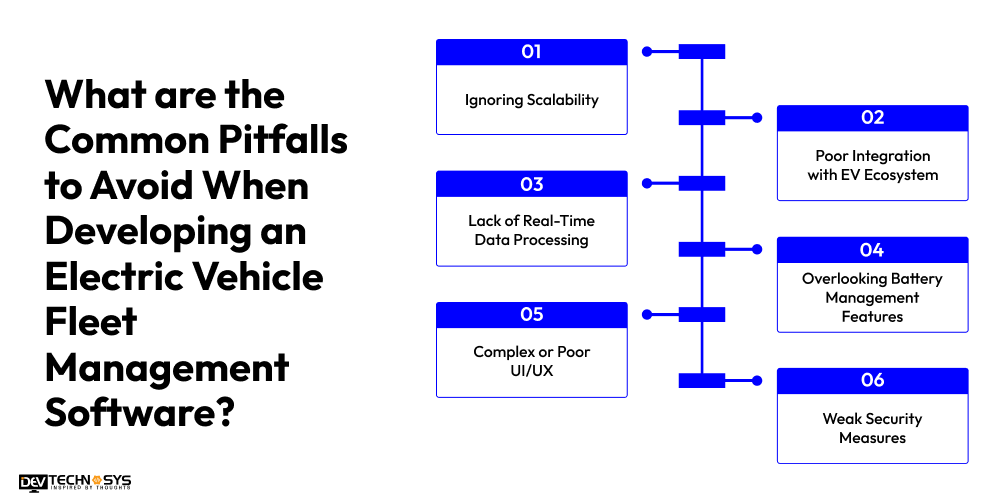
1. Ignoring Scalability
Many businesses hires custom software development company to build software only for the current fleet size, not future growth. As fleets expand, the system may fail to handle increased data, users, and real-time operations, leading to performance issues and costly redevelopment later.
2. Poor Integration with EV Ecosystem
Failing to integrate with charging stations, telematics, IoT devices, and battery management systems limits functionality. A disconnected system reduces efficiency and prevents real-time insights, which are critical for EV fleet performance and optimization.
3. Lack of Real-Time Data Processing
EV fleet software must process real-time data like battery status, location, and diagnostics. Delays or inaccuracies can lead to poor decision-making, operational inefficiencies, and increased downtime for vehicles.
4. Overlooking Battery Management Features
Battery health, charging cycles, and degradation tracking are core to EV operations. Ignoring these features reduces the software’s value and prevents users from optimizing vehicle performance and lifespan.
5. Complex or Poor UI/UX
UI/UX plays an important role in electric vehicle maintenance management software development. A complicated or unintuitive interface can frustrate fleet managers and drivers, reducing overall efficiency.
6. Weak Security Measures
EV fleet management software handles sensitive data such as vehicle location, user credentials, and financial transactions. Weak security measures can lead to data breaches, cyberattacks, and compliance issues.
Conclusion
Developing Electric Vehicle Maintenance Management Software requires a strategic blend of advanced technology, user-centric design, and scalable architecture. As EV adoption continues to grow globally, investing in robust maintenance software will be key to staying competitive and driving long-term success. If you are a business looking to build EV repair and diagnostics software, contact a top software development company. Stay tuned for more updates.
Frequently Asked Questions
Find answers to the most common questions related to this article.
Electric vehicle maintenance management software is a digital solution designed to monitor, manage, and optimize EV fleet performance. It includes features like maintenance scheduling, battery health tracking, real-time diagnostics, and reporting tools to improve efficiency, reduce downtime, and extend vehicle lifespan.
The development cost typically ranges from $8,000 to $30,000 for basic to mid-level EV fleet maintenance solutions, while advanced or enterprise-grade platforms can exceed $50,000. The cost depends on features, integrations, platform selection, and development team location.
Key features include maintenance scheduling, battery monitoring, real-time tracking, alerts, analytics dashboards, reporting, and third-party integrations. Advanced systems may also include AI-based predictive maintenance, IoT connectivity, and automation tools for improved fleet performance.
Developing EV maintenance software usually takes 3 to 6 months for a basic version. More complex platforms with advanced features, integrations, and multi-platform support may take 6 to 12 months or longer, depending on project scope and team size.
Common technologies include cloud computing, IoT, GPS tracking, AI/ML for predictive analytics, and modern frameworks like React, Angular, and Node.js. These technologies help build scalable, secure, and high-performance EV management solutions.
EV software can generate revenue through subscription plans, per-vehicle pricing, commission-based services, and premium feature upgrades. Many platforms also use freemium models or API integrations to create multiple revenue streams and maximize profitability.