















Key takeaways:
-
- EMV-based compliance ensures the process through which point-of-sale systems accept secure transactions based on chip cards, with established payment specifications and an authentication process already in place.
- For contactless payment acceptance, NFC-compatible hardware must be provided, appropriate EMV kernels chosen, and support included to cover all appropriate payment network requirements.
- The payment security standards, including PCI DSS, PCI PTS, and PCI PIN Security, help protect sensitive payment information and strengthen POS security.
- Implementation and certification of EMV involve hardware selection, kernel integration, payment gateway connectivity, security testing, and applicable approval procedures.
- Reliable point-of-sale payment processing must have proper error handling, transaction monitoring, duplicate prevention, and recovery mechanisms incorporated in order to balance transaction failures or interruptions against user experience.
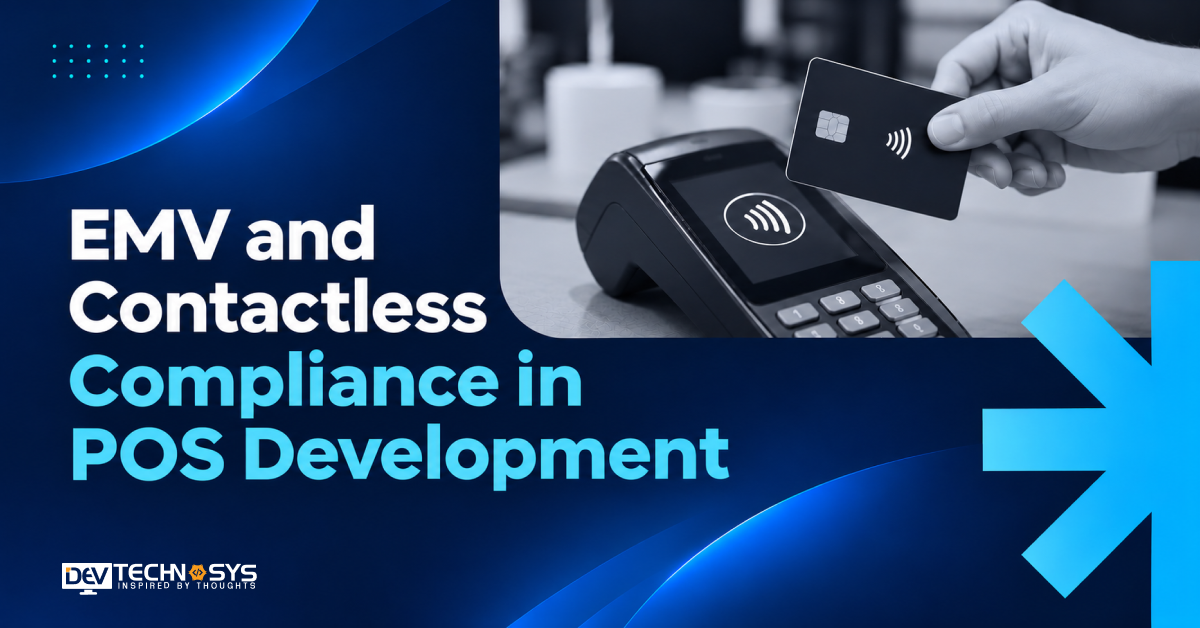
Financial transactions are made easier through digital payment systems. It is now typical for consumers to make purchases through chip cards, contactless cards, cell phones, and smart wristwatches. However, because such developments in payment technology are also complicated, modern POS systems need to follow both EMV compliance and contactless technology regulations.
EMV technology lays down the principles of using chip-based payments with enhanced security features, while contactless technology allows customers to make payments by simply waving their card or NFC-enabled gadget near a payment reader.
This blog is intended to outline the basic principles of EMV and contactless compliance in POS development, the technical architecture, and the necessary security and implementation steps for ensuring compliance with the mentioned technologies.
Understanding EMV and Contactless Compliance in POS Systems
What Is EMV Compliance?
The term EMV compliance denotes compliance with the required standards and requirements to process transactions made with EMV payments. Unlike magnetic stripe cards, the EMV card uses encryption to authorize transactions and to eliminate some kinds of fraud.
Once the customer inserts the EMV card into the POS terminal, the chip begins to interact with the terminal and delivers information about the transaction and processes authentication.
From the perspective of the POS developer, the EMV process means the devices needed for reading cards have to be compatible, the EMV kernel has to be suitable, and the PIN has to be protected if needed.
What Is Contactless Payment Compliance?
The technology of contactless payment means that users can carry out transactions without being required to input or swipe the physical card. This technology relies on Near Field Communication (NFC), which enables short-distance communication between the card or mobile device and the POS terminal.
EMV contactless specifications allow transaction processing via contactless chip cards and NFC-capable devices such as smartphones and wearable devices.
The POS system that has contactless technology must provide the compatible reader interface, contactless kernel and processing information, and requirements of the payment network.
EMV vs. Contactless Payments: Key Differences
Comparison |
EMV Contact Chip |
EMV Contactless |
| Payment method | Card insertion | Tap card or device |
| Communication | Physical chip interface | NFC communication |
| Hardware | EMV chip reader | NFC-enabled reader |
| Processing | Contact EMV kernel | Contactless kernel |
| Customer experience | Insert and remove card | Tap and complete payment |
Both technologies support secure card-present transactions, but they require different terminal interfaces and processing configurations.
Planning a Pos Project?
Get a tailored development cost estimate in a few simple steps.
- 3 quick steps
- 100% free
- Reply in 1 business day
2 Minutes Read
Key EMV and Contactless Standards POS Developers Must Follow
POS developers must understand the standards governing payment interoperability, terminal security, and transaction processing before selecting their implementation approach.
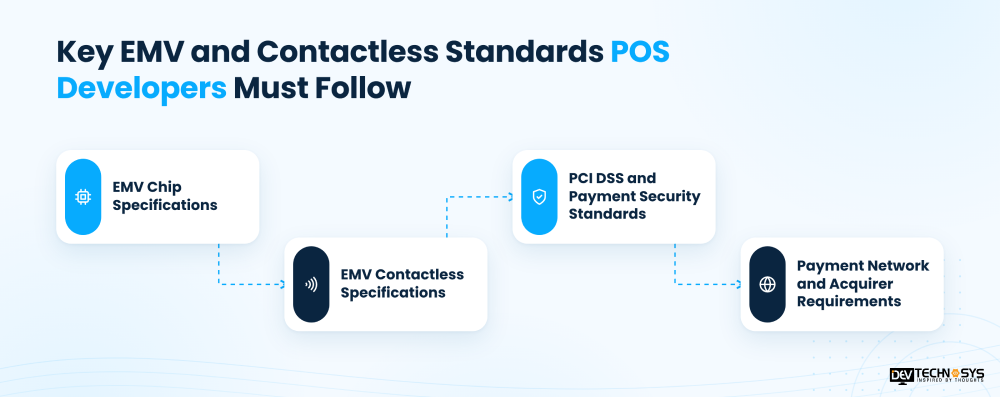
1. EMV Chip Specifications
EMVCo issues guidelines providing details on the exchange of information between chip cards and terminals during the payment process. The specifications specify the standards for card verification, application identification, and payment processing,
in addition to other safety requirements. Programmers must check that the application used in the approved payment terminal meets the specified EMV contact specifications and transaction application requirements.
2. EMV Contactless Specifications
EMV contactless specifications explain the communication of contactless payment cards and NFC devices with their acceptance terminals.
It also encompasses an Entry Point used to control contactless application selection and one or more contactless kernels responsible for processing transactions following the specifications of the payment system.
Developers of POS have to confirm that the terminal in focus contains the proper contactless interfaces, kernels, and payment network configurations.
3. PCI DSS and Payment Security Standards
PCI DSS stands for Payment Card Industry Data Security Standard and establishes both technical and operational requirements to protect payment account data.
It can be applied to organizations that either store, process, or exchange cardholder data or other sensitive authentication data, and to the systems that can influence the safety of the cardholder data environment.
Among the standards related to this one, you can name the following ones:
- PCI PTS: this set of standards defines safety-related requirements for payment devices.
- PCI PIN Security: this standard addresses the issues of secure PIN processing.
- PCI P2PE: this standard deals with point-to-point encryption.
- PCI Secure Software: this standard set of rules defines security measures regarding the software for payment solutions.
Each of these standards covers a different aspect of payment security and cannot be considered interchangeable certifications.
4. Payment Network and Acquirer Requirements
Payment networks like Visa and Mastercard require additional setup and acceptance criteria. Acquirers and payment processors may define terminal setups, accepted transaction modes, verification processes, and acceptance terms.
Hence, developers must ensure that they clarify which requirements apply to them through the acquirer and payment processor before designing the POS framework.
How EMV and Contactless Transactions Work in POS Systems
Understanding the transaction lifecycle helps developers design reliable payment workflows and identify potential processing failures.
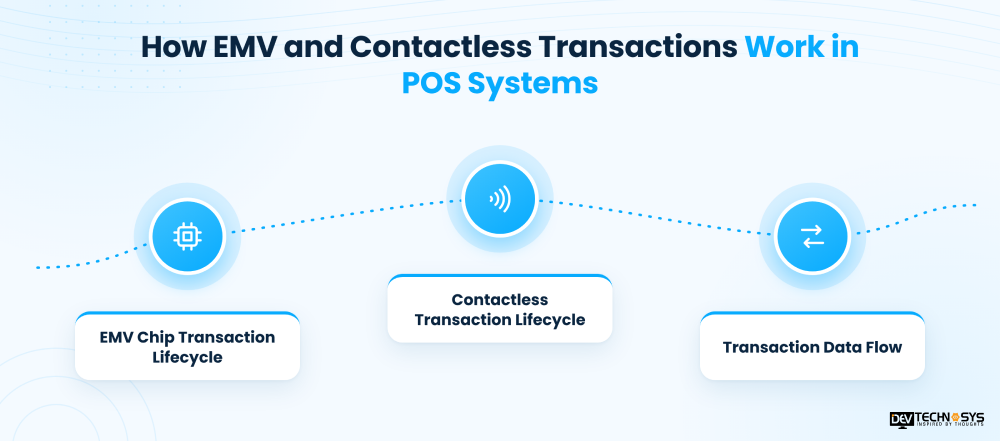
1. EMV Chip Transaction Lifecycle
An EMV chip transaction generally follows these steps:
- Card insertion: The cardholder inserts the card with the chip into the POS terminal.
- Application selection: The POS terminal identifies payment applications supported by the card and selects the appropriate application.
- Data processing: The exchange of transaction-specific data takes place between the terminal and card.
- Cardholder verification: The cardholder will be verified by online or offline PIN or another verification as required by the issuer.
- Transaction risk management: The terminal and card conduct their business with respect to card processing.
- Cryptographic information generation: This information is generated from transaction-specific cryptographic software on the card.
- Authorization: If necessary, the POS will request authorization through the payment processor and acquiring network to the issuer.
- Transaction completion: The terminal processes the response and does whatever is required in its transaction based on the result.
2. Contactless Transaction Lifecycle
Contactless payments follow a similar processing journey but use NFC communication.
- The client touches a contactless card or NFC-compliant device to the terminal.
- The NFC reader links with the payment method.
- The Entry Point discovers the correct payment app.
- The appropriate contactless kernel completes the transaction.
- The terminal carries out the necessary risk management measures and cardholder verification.
- The payment information is sent for approval, if necessary.
- The Point of Sale shows the transaction and produces the receipt.
3. Transaction Data Flow
A typical online card-present transaction follows this path:
Payment Card or Mobile Wallet → POS Terminal → Payment Gateway or Processor → Acquirer → Card Network → Issuer
Evaluation of an authorization request by the issuer takes place, followed by the response of approval or declination through the payment network.
The payment terminal will need to change the state of the transaction, show the result, and log the necessary payment reference for reconciliation.
The developer needs to take care of situations of reversals, timeouts, requests sent multiple times, and communication problems with the network.

Essential Security and Compliance Requirements
Payment security must be considered throughout the mobile POS app development lifecycle rather than added after implementation.
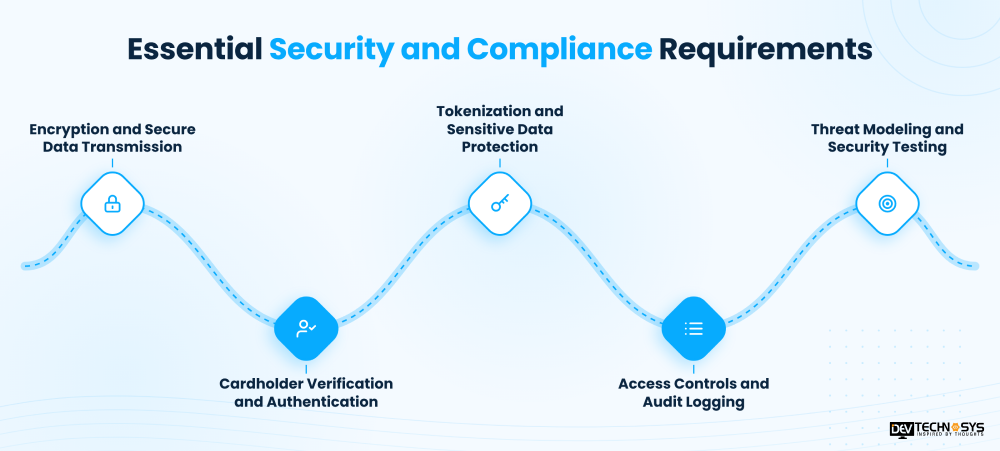
1. Encryption and Secure Data Transmission
POS systems should ensure that payment data is safe during the transmission and processing phase. It is important for developers to deploy secure communication protocols, manage the encryption keys properly, and use valid payment terminals.
Also, when needed, a validated point-to-point encryption solution can be employed to protect user data from the moment it is registered to the moment it arrives at the company’s secure environment.
2. Cardholder Verification and Authentication
Cardholder verification is an essential stage in determining whether the individual using the payment device is authorized for it. According to a variety of aspects related to the terminal itself, card, payment network, and transaction, different types of verification are provided, such as:
- Online PIN
- Offline PIN
- Signature (if possible)
- No-CVM transactions
- Consumer Device Cardholder Verification Method (CDCVM).
The terminal should be capable of accepting the mentioned verification methods and utilizing the appropriate payment application rule.
3. Tokenization and Sensitive Data Protection
Tokenization replaces sensitive payment credentials with alternative values used in supported payment methods. Tokenization minimizes the risk of revealing actual card information in POS software and backend systems.
However, tokenization does not entirely eliminate the need for PCI DSS compliance. Developers must also refrain from keeping sensitive authentication data after it has been processed.
4. Access Controls and Audit Logging
POS API integration must have role-based permission mechanisms that limit access to functions that facilitate payment processing.
For instance, while a cashier can do the actual selling, only authorized managerial staff may process a refund or check transaction records.
Audit logs will need to store pertinent security events and operations, but should not capture potentially sensitive information about the payments.
5. Threat Modeling and Security Testing
Before deploying, the developers must identify any possible threats, like:
- Interfering with terminals.
- Changing software without authorization.
- Stealing payment information.
- Using credentials improperly.
- Again conducting the same transactions.
- Sending sensitive information through a faulty API.
All the tests must be performed on both the POS application and the payment systems linked to it.
Step-by-Step Implementation of EMV and Contactless Compliance
A structured implementation process helps businesses avoid expensive hardware changes and certification delays.
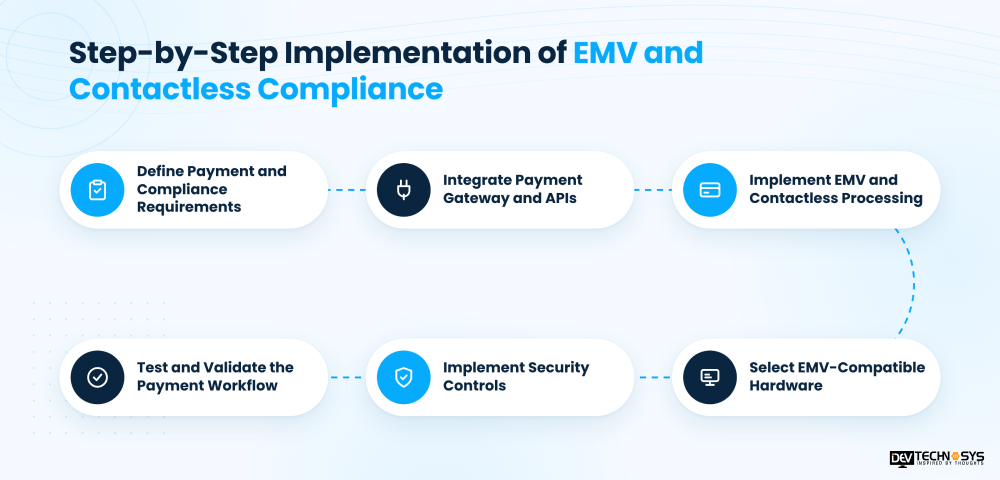
1. Define Payment and Compliance Requirements
Find out the intended market, supported payment network, transaction type, and acquiring partners. Ascertain whether the POS is designed to accommodate chip cards, contactless cards, mobile wallets, refunds, PIN entries, and other transaction processes.
2. Integrate Payment Gateway and APIs
Link your POS software with the payment gateway integration services by using the integration method it endorses. Define the transaction approvals, refunds, reversals, status changes, and errors. Employ transaction ID procedures and idempotency where applicable to minimize the probability of multiple processing.
3. Implement EMV and Contactless Processing
Integrate the respective EMV processing elements through the terminal SDK or payment solution. Implement application selection, transaction settings, verification procedures, and contactless processing according to appropriate guidelines.
4. Select EMV-Compatible Hardware
Select terminals with required chip/EMV specifications, approved devices, supported kernels, PIN entry requirements, and maintenance procedures.
5. Implement Security Controls
Secure encryption at rest data security, access permissions, key management, and logging. Make sure payment data is handled only by authorized people.
6. Test and Validate the Payment Workflow
Perform testing of successful, declined, interrupted, and reversed transactions. Seems like chip insertion, contactless communication, cardholder check, authorization replies, and reconciliation need to be tested.
EMV Certification, Testing, and Approval Process
Testing and approval are essential before deploying an EMV-enabled POS product. The process involves different levels of validation, and requirements depend on the terminal, payment system, and acquiring environment.
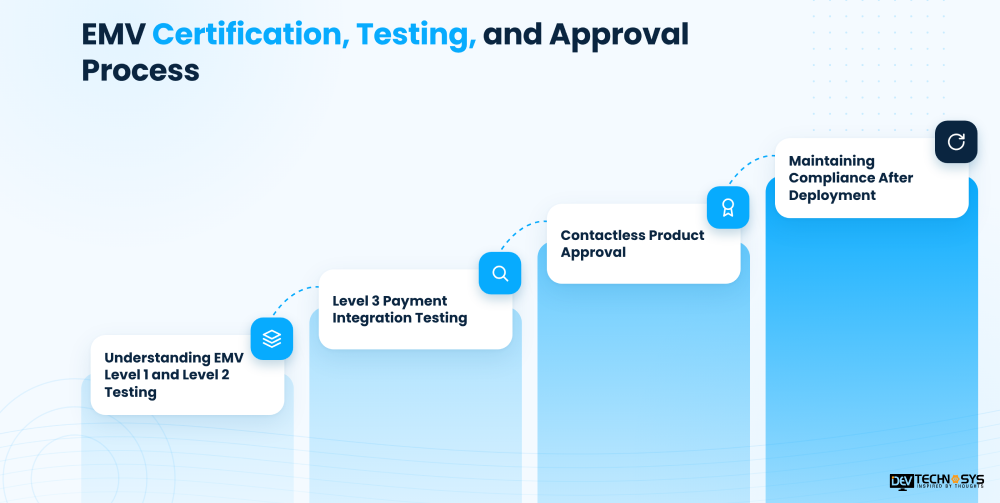
1. Understanding EMV Level 1 and Level 2 Testing
The testing performed at EMV Level 1 checks the communication interface between the payment device and the terminal. This type of testing includes electrical and mechanical properties as part of the investigation.
On the other hand, EMV Level 2 testing looks into the payment kernel or application that is responsible for performing the steps of EMV transactions.
Both types of testing ensure compliance of a given product with EMV specifications and standards.
2. Level 3 Payment Integration Testing
Testing at level three focuses primarily on how the acceptance solution is incorporated into the payment system environment.
The operations of the terminal, payment software development solutions, and acquiring infrastructure must be interdependent according to the standards set in each payment system.
The requirements for testing at level three have been established in each respective payment system or coinciding agreement.
3. Contactless Product Approval
The approval process for contactless products from EMVCo is comprised of product registration, laboratory testing, analysis, and approval.
The approval process could involve validating the reader that has the capability of contactless payments, the Entry Point, and at least one kernel that applies in each case.
The developers must, therefore, clarify the approval process with their terminal provider, lab, acquirer, and card network they intend to use.
4. Maintaining Compliance After Deployment
Compliance is not something that finishes when a POS system is introduced. Software updates, firmware updates, kernel replacements, and hardware modifications can all affect existing compliance approvals.
Businesses need to keep track of the versions of their software, keep track of updates from vendors, perform regression testing, and determine if any changes require further compliance testing or approval.
Common Compliance Challenges and Failure Recovery
EMV and contactless POS compliance implementation can introduce technical and operational challenges.
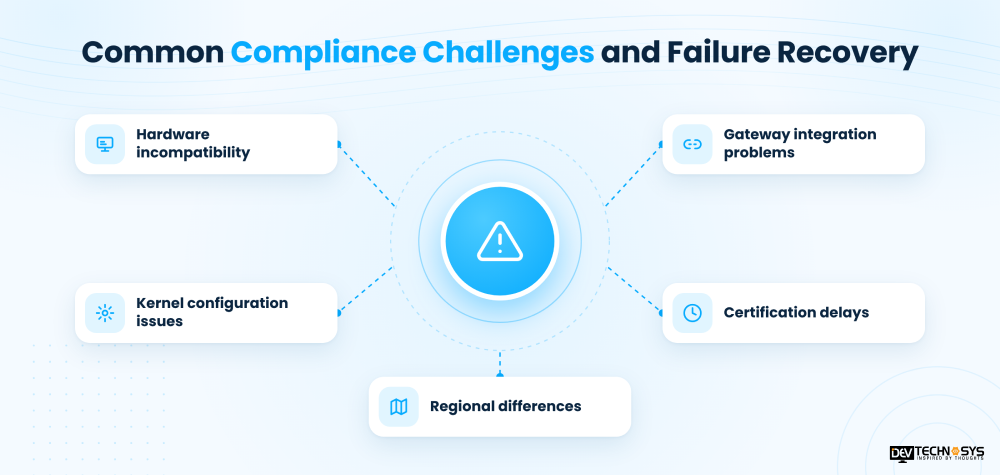
Common Implementation Challenges
- Hardware incompatibility: The selected terminal might not be compatible with the required contactless kernel or payment application.
- Kernel configuration issues: Wrong settings may lead to transaction failure.
- Gateway integration problems: API issues or errors with response mapping could prevent transactions from being completed.
- Certification delays: Missing documentation or unsuccessful test cases may cause delays in implementation.
- Regional differences: Payment gateway software development and acquirer-specific requirements may vary in different regions.
Failure Scenarios and Recovery Strategies
Failure scenario |
Recommended recovery |
| NFC communication failure | Ask the customer to retry or use another supported payment method |
| Card authentication failure | Decline or restart according to terminal rules |
| Authorization timeout | Check transaction status before retrying |
| Duplicate payment request | Apply idempotency controls and verify transaction references |
| Network interruption | Preserve transaction state and follow processor-defined recovery procedures |
A critical development principle is to avoid blindly retrying a payment when the authorization outcome is unknown. The system should first determine whether the original transaction was processed.
Conclusion
It is crucial to comply with EMV and contactless payment norms while designing POS payment systems that ensure security, reliability, and interoperability. Companies can create POS solutions that meet current payment requirements by using compatible devices, incorporating validated payment functionality, and complying with security measures.
Dev Technosys, a POS software development company, can assist a business in constructing a cutting-edge POS solution that is safe and has a modern architecture and scalable features.
Frequently Asked Questions
Find answers to the most common questions related to this article.
The process of ensuring EMV compliance refers to ensuring that the required standards for secure chip card payments are followed. This requires the use of compatible point-of-sale (POS) devices, proper EMV software, authentication of transactions, and integration with payment processing companies.
The EMV contact card payment is the method by which the merchant processing the card payment asks the customer to insert their card. In contrast, the contactless payment method simply requires the customer to tap the card machine using a card embedded with NFC technology.
Requirements vary depending on the terminal as well as the environment in which the payment is made. Such requirements include EMV Level 1 and EMV Level 2 tests, Level 3 testing by payment service providers, the process of contactless approval, and adherence to PCI security regulations.
NFC facilitates communication between a payment card or contactless device and a point-of-sale terminal. The terminal executes the payment with the help of the respective contactless application and kernel, and proceeds with the transaction authorization process.
The time required for development varies depending on the hardware used, the payment processor to integrate, the existing architecture of a point of sale, security standards, and certification procedures applied. Utilizing certified terminals and already available payment SDKs can make the implementation much easier.