










Key takeaways:
-
- User role complexity is the key cost driver for education CRM Software Development Cost in 2027 and beyond. Businesses must implement role-based access control for students, faculty, administrators, and alumni.
- According to Business Research Insights, the highest education CRM software market is expected to increase to USD 13.83 billion by 2035.
- Core integrations include learning management systems, secure payment gateways, communications channels, AI tutor chatbots, and AI agents.
- Hourly rates for hiring a dedicated developer range from $10 to $25 per hour depending on the selected CRM development services.
- Businesses should evaluate the lending workflow when choosing software.
- ISO, GDPR, FERPA, CCPA, and State Privacy Laws are regulatory compliance requirements that education CRM software must follow.
CRM in the education industry helps monitor scholarships and track enrollment status. The management tools accounted for 48% of the total market expansion. This is not mere data but an influential factor that edtech and educational organizations are looking forward to for a digital transformation. Most of them are implementing AI in CRM to solve critical learning challenges.
An education CRM resolves admission workflows, promotes interactive learning, and reduces the cost of infrastructure. If you are wondering how much education CRM software development costs then consider the complexity, platform choice, integrations, and compliance requirements.
From a startup to an enterprise-grade solution, price depends on cost drivers. Additional expenses may add up if you choose integration with artificial intelligence technology.
This guide explains the cost, factors affecting school management software development cost, ways to reduce cost, and total cost of ownership.
How Much Does Education CRM Software Development Cost?
Data workflow, integrations, migration, platforms, and project scope determine student portal development cost. Even after discussing it with experts, something will always add to the cost.
The simple solution is to estimate the cost according to preliminary requirements. This also helps businesses to select goal-oriented education CRM software development services.
Education CRM type |
Estimated development cost |
Development timeline |
| Basic Education CRM | 4,999–12,000 | 1–2 months |
| Operational Education CRM | 12,000–25,000 | 2–3 months |
| Analytical Education CRM | 20,000–40,000 | 3–4 months |
| Collaborative Education CRM | 25,000–45,000 | 3–5 months |
| Education CRM with AI Chatbots | 30,000–55,000 | 4–6 months |
| Education CRM with AI Agents | 45,000–70,000 | 5–7 months |
| Advanced AI-Powered Education CRM | 65,000–89,999+ | 6–9+ months |
Note: These are indicative custom development estimates. Costs can overlap depending on the selected features, AI model/API usage, integrations, and architecture.
What are the Technical Factors That Affect Education CRM Development Costs?
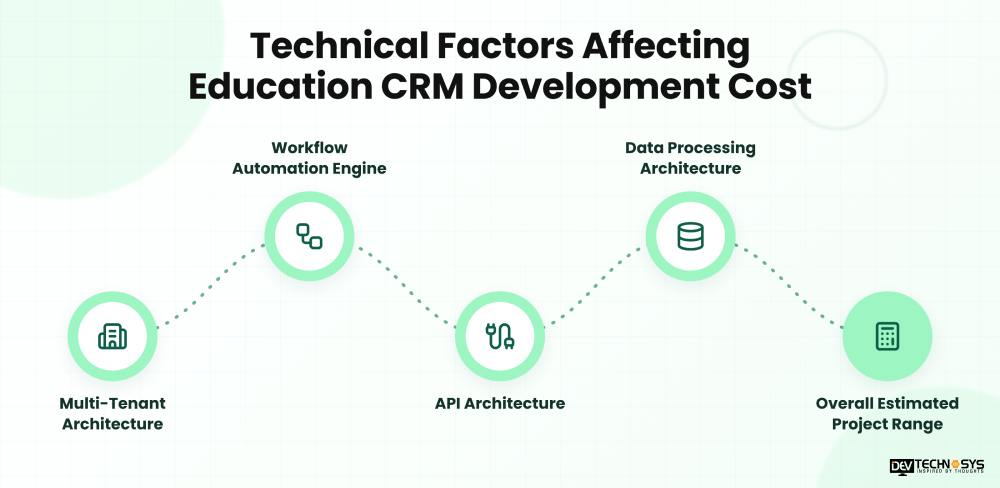
An education CRM’s technical architecture depends on the workflow automation engine, APIs, and data processing capabilities. For example, a startup might need a basic AI tutor chatbot integrated with a CRM built with minimal features.
University management software development cost may range from $67000 or above, depending on the features you want. That’s why understanding the technical factors is important.
Technical component |
Development cost range |
| Multi-Tenant Architecture | 4,999–20,000 |
| Workflow Automation Engine | 5,000–18,000 |
| API Architecture | 4,999–22,000 |
| Data Processing Architecture | 5,000–25,000 |
| Overall estimated project range | 4,999–89,999+ |
Education CRM Development Cost Breakdown by Features
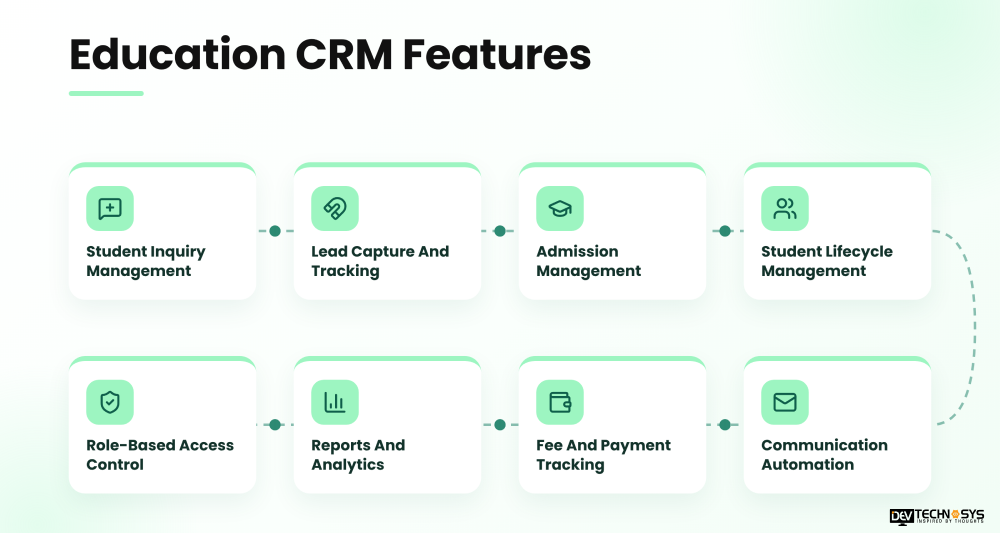
Businesses should understand school management software development cost based on the features they select for an education CRM. This should be one of the most important sections because it explains how the development budget is allocated. For example, student lifecycle management might cost more than $5,000, while analytics could cost less than $3,000.
CRM module |
Estimated development cost |
| Student Inquiry Management | 2,000–5,000 |
| Lead Capture And Tracking | 2,000–5,000 |
| Admission Management | 4,000–9,000 |
| Student Lifecycle Management | 3,000–7,000 |
| Communication Automation | 3,000–8,000 |
| Fee And Payment Tracking | 3,000–7,000 |
| Reports And Analytics | 2,000–6,000 |
| Role-Based Access Control | 2,000–5,000 |
Education CRM Development Cost by Technology Stack
Before proceeding to CRM Integration with ERP Systems or the development process, decision makers must discuss the tech stack and relevant technologies that could impact an initial development budget.
A university or an edtech business might be searching for a cloud-based solution, AI-powered automation, and advanced analytics. These should be built within a strong architectural layer, made possible by the right technology stack.
Technical layer |
Possible technologies |
Estimated development cost |
| Frontend development | React.js, Angular, Vue.js | $1,000–6,000 |
| Backend development | Node.js, Python, Java, Laravel | $2,000–10,000 |
| Database development | PostgreSQL, MySQL, MongoDB | $800–5,000 |
| Cloud infrastructure | AWS, Microsoft Azure, Google Cloud | $500–5,000 |
| API development | REST APIs, GraphQL | $1,000–7,000 |
| Authentication and security | OAuth 2.0, OpenID Connect, JWT | $800–4,000 |
| Analytics and reporting | Power BI, custom dashboards | $1,000–6,000 |
| AI integration | OpenAI APIs, Python AI frameworks, LangChain | $2,000–12,000 |
| Overall project budget | Complete technology stack | $4,999–89,999+ |
Hidden Costs of Education CRM Software Development
If you are looking for an answer to: what are the yearly running costs of a custom education CRM? Costs range from $4,999 to $89,999+ depending on infrastructure requirements, AI capabilities, integrations, and operational needs.
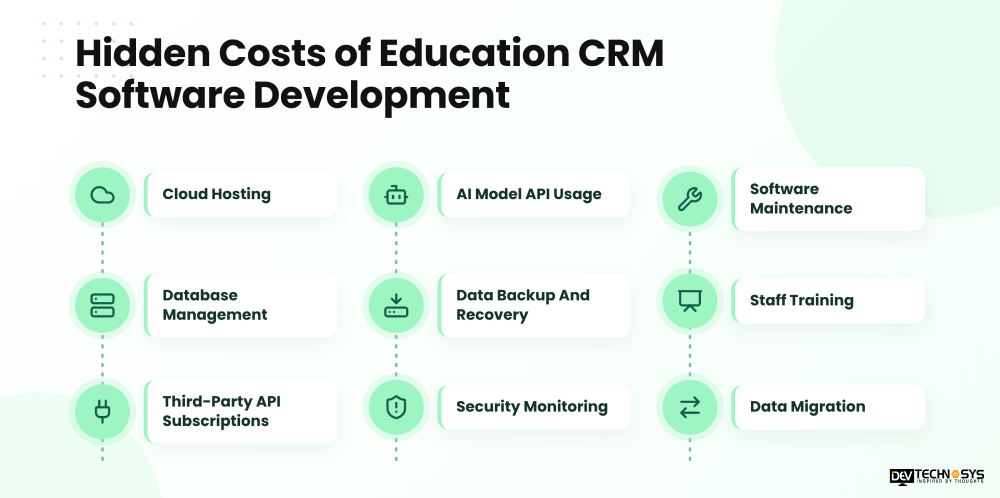
But you should also know about the hidden costs associated with an education CRM. These can include third-party API subscriptions, the required database type, or security monitoring.
Education CRM Hidden Cost Component |
Why is it required? |
Estimated cost |
| Cloud Hosting | Application servers, computing resources, and infrastructure scaling | 100–1,000+/month |
| Database Management | Database optimization, storage expansion, and performance monitoring | 100–500/month |
| Third-Party Api Subscriptions | Email, SMS, payment gateway, and external service integrations | 50–500+/month |
| Ai Model Api Usage | AI chatbot responses, lead qualification, and AI agent execution | 100–1,000+/month |
| Data Backup And Recovery | Automated backups, recovery storage, and disaster recovery | 50–300/month |
| Security Monitoring | Threat detection, vulnerability monitoring, and security tools | 50–300/month |
| Software Maintenance | Bug fixes, framework upgrades, compatibility updates, and technical support | 15–25% of initial development cost/year |
| Staff Training | Training administrators, counselors, and faculty members | 500–2,000 one-time |
| Data Migration | Cleaning, mapping, and transferring existing student records | 1,000–5,000 one-time |
Service Options
What Can We Build or Improve for You?
Start with your current setup and the workflows you want to improve.
Custom CRM platform
A tailored web or mobile CRM with customer records, pipelines, tasks, dashboards and role-based access.
Your core CRM systemIntegration & automation
Connect enquiry channels and business systems. Automate assignments and follow-up tasks.
Improving your existing CRMCRM modernization & AI
Migrate legacy data, improve existing modules and add suitable AI-assisted workflows with review controls.
Upgrade your current CRMHow to Calculate Total Cost of Ownership (TCO) of Education CRM Software?
The initial cost of student information system app development differs from the TCO. This is because initially you focus on essential features and functionality, while later you focus on long-term goals.
For an education CRM software, total cost of ownership includes recurring operational expenses, software maintenance, infrastructure, and planned upgrades over a specific period. The best tenure is about 3 years to evaluate the overall expenses, whether you are choosing custom development or improving the current system.
Education CRM Total Cost Formula
TCO = initial development cost + (annual operating and maintenance cost X ownership period in years) + planned upgrades & additional requirements.
TCO Example: Three-Year Education CRM Ownership Cost
Suppose an educational institution invests $40,000 in school management software development with key features such as admission automation, student management, and reporting dashboards. Third-party services, software maintenance, and fewer upgrades might also be required. Then the estimated expense would be:
Cost component |
Estimated expense |
| Initial CRM development | $40,000 |
| Cloud hosting ($400/month × 3 years) | $14,400 |
| Third-party APIs and AI services ($250/month × 3 years) | $9,000 |
| Security, backup, and monitoring ($200/month × 3 years) | $7,200 |
| Software maintenance (15% annually × 3 years) | $18,000 |
| Planned feature upgrades | $8,000 |
| Total three-year TCO | $96,600 |
Does Developer Location Change the Education CRM Software Development Cost?
Yes, choosing a developer’s location changes the entire game of CRM software development cost. For example, hourly rate to build a CRM is $100 in the United States while it goes down to $25 in India. Charges of expertise, taxes, and more are applicable. Therefore, it is essential to select a cost effective location for education IT solutions.
Developer location |
Average hourly development cost |
| USA | 80–150 USD |
| UK | £45–£95 GBP |
| Canada | C70–C150 CAD |
| Australia | A90–A180 AUD |
| Germany | €45–€90 EUR |
| Poland | zł120–zł260 PLN |
| India | ₹5,200 INR |
How to Reduce Education CRM Software Development Cost?
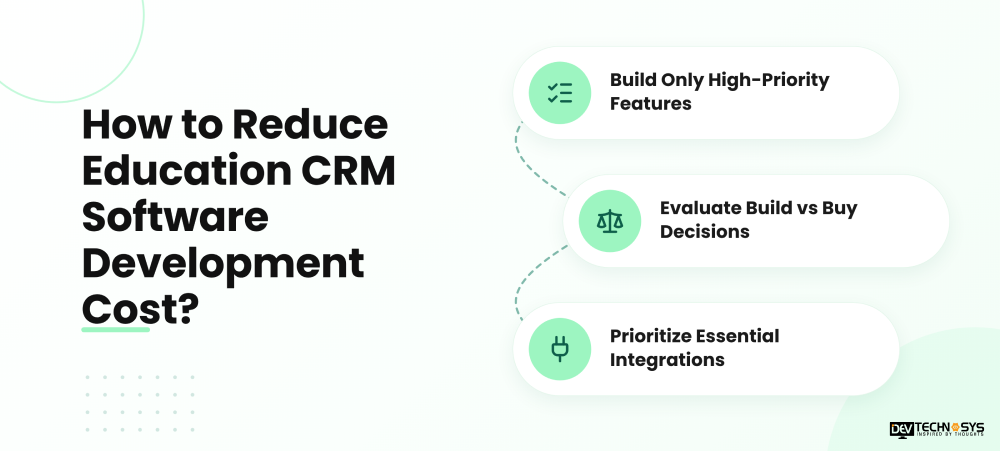
Whether you choose CRM development services or CRM implementation services, understanding how to reduce costs can help you maintain a long-term investment plan. Below are some effective strategies you can use to make better choices.
1. Build Only High-Priority Features
You don’t need to deliver every benefit at once. You can update the solution as needed. So, prioritize core features. The coaching institute software development cost saving opportunity is that you will be investing in those features that will deliver measurable value.
Development phase |
Features to prioritize |
Business objective |
| Phase 1: Core CRM | Student profiles, lead management, admission tracking, user roles | Centralize student information |
| Phase 2: Workflow automation | Email/SMS notifications, application workflows, follow-ups | Reduce manual administrative work |
| Phase 3: Advanced capabilities | AI lead scoring, predictive analytics, advanced reporting | Improve operational decisions |
| Phase 4: Expansion | Multi-campus support, advanced integrations, custom modules | Support institutional growth |
2. Evaluate Build vs Buy Decisions
We all forget that an in-depth understanding of build vs buy is essential. You require a build solution when the existing processes are manual, or you have an updated system. Now, buy is required when you are a small to mid-level business that is planning for an expansion.
The build process requires a higher cost of development and maintenance. If you partner with one of the top education CRM development companies, then you can clearly understand the differences from the experts. They have the essential knowledge to help you upgrade the system or create a new one.
Evaluation Factor |
Ready-made CRM |
Custom Education CRM |
| Customization | Limited by platform | Designed around institutional workflows |
| Integration flexibility | Depends on available APIs | Can support institution-specific integrations |
| Ownership | Vendor-controlled platform | Greater control over custom-developed solution |
| Scalability | Depends on vendor plans | Can be designed around growth requirements |
| Maintenance | Often included in subscription | Requires a dedicated maintenance arrangement |
3. Prioritize Essential Integrations
Analyze how much does integrating a CRM with an SIS and LMS cost? The cost starts from $15000 and can go upto $50,000+ per year depending on the complexity of the data architecture. Instead of integrating all the possible solutions, choose wisely according to the business operation.
Integration |
Business Requirement |
Priority |
| Student Information System (SIS) | Synchronize student records | High |
| Learning Management System (LMS) | Access academic and course information | High |
| Payment Gateway | Process admission and tuition payments | High |
| Email and SMS APIs | Automate student communication | High |
| ERP | Connect finance and administrative operations | Based on Requirements |
| AI Analytics | Support predictive admission and student engagement | If Required |

What is the Cost of Security and Compliance for Education CRM Software Development?
Security practices such as encryption at rest or specific compliance directly affect cost. The platform handles a large volume of sensitive information of students, teachers, and institutions that needs to be protected.
For example, a US-based CRM must comply with the Family Educational Rights and Privacy Act (FERPA) while GDPR data protection when the data is accessed in the European region. Implementing these requirements involves security testing, performance monitoring, and documentation of critical data.
From the investment perspective, data encryption, role-based access control (RBAC), multi-factor authentication (MFA), audit logging, and secure API communication are essential security components that increase cost. But if these are not implemented properly, then the system will be at a high risk of security vulnerabilities.
Expert Insight: When planning to develop an education CRM, always consider security and compliance to avoid penalties. It is better to partner with a CRM software development company to effectively strategize and build a solution.
Mohit Nag, CRM Expert, Dev Technosys
Why Choose Dev Technosys for Education CRM Development?
For complex software development like an education CRM, choosing the right technology partner matters. The experts have a thorough understanding of business workflows, database engineering, integration capabilities, and secure application development.
Dev Technosys is a CMMI Level 3 certified company that effectively plans and develops CRM solutions based on specific goals. We integrate AI-powered chatbots and agents to automate repetitive student engagement activities into the existing software.
This allows organizations to respond to queries fast. Also, our engineers carefully evaluate technical and compliance requirements to build a strong & secure architecture for custom CRM development. We understand that a CRM or AI-integrated solution requires consistent monitoring. Thus, we provide ongoing maintenance and support.
Conclusion
Before evaluating cost, businesses must create a CRM implementation roadmap for integration, custom development, or architectural improvements. This allows decision-makers to find out the cost drivers that influence the project budget. Some may collaborate with other companies or connect with investors, for which a clear approach is important.
This blog, however, provides a detailed insight into the costs associated with education CRM software development, trying to help businesses solve critical challenges.
Frequently Asked Questions
Find answers to the most common questions related to this article.
PostgreSQL and MySQL are suitable for managing structured student records, admission applications, and payment information. MongoDB can support flexible document-oriented data. For multi-institution platforms, developers can implement shared-database or separate-database tenant architectures depending on isolation and scalability requirements.
AI chatbots primarily respond to student inquiries, answer admission questions, and provide course information. AI agents can perform multi-step activities, such as qualifying leads, scheduling appointments, updating CRM records, and initiating follow-up workflows through authorized tools and APIs.
The cost to build a CRM for a University ranges from $ 4,999 to $89,999+. This price includes integration requirements, security, user roles, and compliance. Choosing automation may cost more compared to developing a basic CRM. Decision makers should evaluate the cost and the factors affecting it prior to building a solution to strategically plan for long-term investment goals.
The yearly running costs of a custom education CRM is around 10% of the initial development cost. These expenses include app/software maintenance, technical support, and security updates. This percentage is simply an estimate. However, the final cost depends on the solution complexity and other factors.
The basic implementation could be approximately $70,000, while an enterprise-grade solution might cost $ 65,000 or more. The major cost driver is the database compatibility, API availability, data synchronization frequency, and authentication requirements.
Buying Slate is a cost-effective solution that comes with standard capabilities. For an admissions CRM, the initial development cost is $4999+. The choice highly depends on the operational workflow of an organization. Some of them require software to manage admissions, while others need an entire solution from student enrollment to solve their learning queries.