


















Key takeaways:
-
- A CRM implementation roadmap helps experts integrate key features to help businesses improve sales & revenue.
- CRM software helps businesses track day-to-day operations without switching between multiple platforms.
- CRM implementation costs start at $4,999. It can be customized to meet the needs of a growing US business.
- US businesses increasingly develop CRM software, including AI capabilities that simplify operations.
- Consider data security and compliance during the CRM implementation process to avoid vulnerabilities.
- The choice between integrating with the existing system and building a custom solution should depend on business size, workflows, and automation requirements.
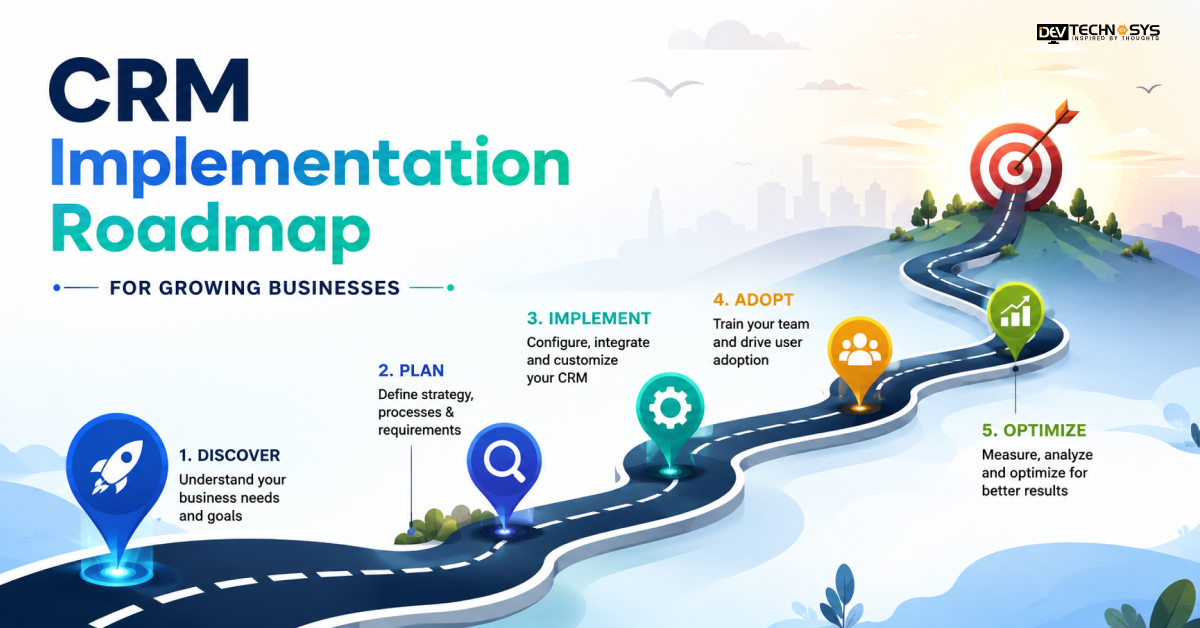
CRM software’s core function is to streamline communication, centralize customer data, and track interactions. Businesses often build software to automate workflows or get real-time analytics. To evaluate the importance of such a solution, a CRM implementation roadmap helps. This empowers teams to assess existing processes and build better strategies for overall business success. A structured roadmap drives sales and improves efficiency.
Questions to Consider Before Choosing CRM Implementation Services
- What Business Problems Will Customer Relationship Software Solve?
- Is The Current Data Scattered or Structured?
- How Will CRM Implementation Roadmap Work?
- How Much Will It Cost For Automation?
- Does Software Implementation Require Employee Training?
- Does The Business Only Want to Focus on Sales or Want to Improve Overall Business Operations?
- What Would Be The Architecture of a CRM?
- How to Choose the Right CRM
- Should You Partner With a CRM Software Development Company or Hire Dedicated Developers?
This blog answers all these questions in detail. Let’s start by understanding the key challenges it solves.
Service Options
What Can We Build or Improve for You?
Start with your current setup and the workflows you want to improve.
Custom CRM platform
A tailored web or mobile CRM with customer records, pipelines, tasks, dashboards and role-based access.
Your core CRM systemIntegration & automation
Connect enquiry channels and business systems. Automate assignments and follow-up tasks.
Improving your existing CRMCRM modernization & AI
Migrate legacy data, improve existing modules and add suitable AI-assisted workflows with review controls.
Upgrade your current CRMKey Challenges that a CRM Software Solves for U.S. Businesses
Modern businesses are seeking to meet evolving customer demands, which requires a cost-effective solution that can deliver long-term ROI. Businesses often experience critical challenges:
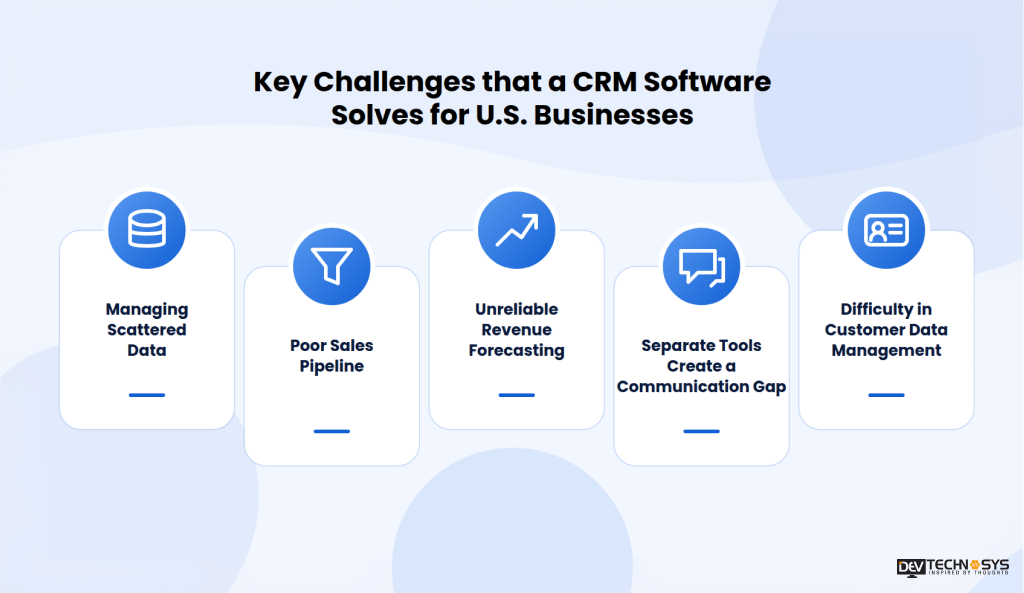
1. Managing Scattered Data
Growing businesses often face scattered data across emails, spreadsheets, or internal business systems. This makes it hard for teams to coordinate and work systematically.
CRM software centralizes the information by giving access to an interactive dashboard. Teams can easily track total leads, conversions, and marketing.
2. Poor Sales Pipeline
Growing businesses often get confused about active or delayed leads when they manage data manually. Not every lead becomes a closed project. Without proper details, the sales team spends longer hours waiting for the right prospect.
A CRM lets employees check lead scoring based on factors such as customer requirements and buying intent. Choosing the right CRM software development company helps businesses to improve their sales pipeline.
3. Unreliable Revenue Forecasting
Most growing businesses lack a realistic view of the revenue they are generating or could generate from a lead. This information is usually based on assumptions.
Some datasets are incomplete, while others are duplicates; this manual work creates a problem. CRM software provides structured information and aligns the sales pipeline with deal values, historical conversion rates, and opportunity analysis.
4. Separate Tools Create a Communication Gap
Moving from a startup to a growing organization often requires different tools and programs, which increases manual administrative work. Data flows across accounting software, the website, customer support, and the sales team, but it isn’t clearly organized. CRM allows information to move smoothly across departments, resolving communication issues.
5. Difficulty in Customer Data Management
Manual data entry often creates vulnerabilities because information is spread across channels. Growing businesses need to spend a good amount of money to protect sensitive data. CRM software like HubSpot already has features such as role-based access control, encryption, and authentication that safeguard the data.
Industry Insight: The global CRM market size is expected to reach USD 320.99 billion by 2034. This data shows the growing importance of simplified solutions that help businesses to manage, organize, and monitor operations.
What are the Steps to Create a CRM Implementation Roadmap for Your Business?
Understanding what your business actually needs is key to implementing CRM software correctly. Discuss your project with a CRM development company to define implementation steps, configure, integrate, test, and launch the solution.
The three main pillars are scalability, security, and automation, which help avoid unnecessary expenses. Here are five key stages for creating a practical CRM implementation roadmap for your business.
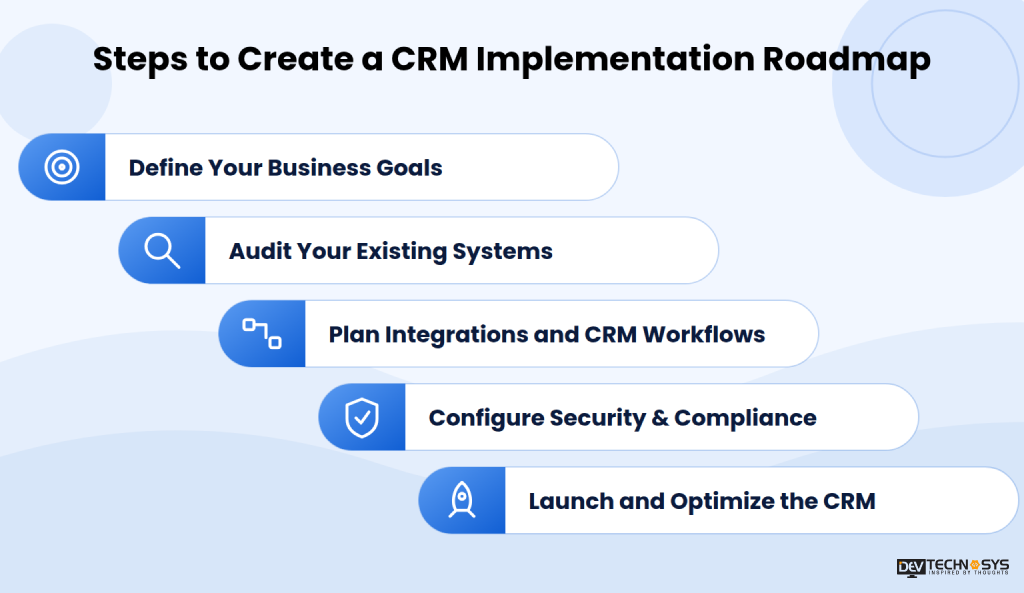
1. Define Your Business Goals
The first step when selecting CRM implementation services is understanding your requirements. Businesses should start by identifying CRM software features and cost, and what problems it should solve.
Growing businesses may struggle with scattered customer data, missed follow-ups, poor sales visibility, manual reporting, or disconnected teams. Discuss the pros, cons, and ROI that the CRM would generate with the project manager.
Communicate project reports, milestones, and timeline. If your business operates manually, understand the automated workflows and how they will benefit internal teams.
2. Audit Your Existing Systems
The next important part is to perform an audit. This means that the existing system will be checked for vulnerabilities, improvements, required integrations, and the current technology environment. Discuss whether data gets duplicated or lost, or which tools are being used by the teams.
If you need a custom solution, experts provide all details once your requirements are clear. Before selecting or building a CRM, evaluate your current technology environment. Identify where customer data is stored, which tools your teams currently use, and where information gets duplicated or lost.
3. Plan Integrations and CRM Workflows
After reviewing the system/requirements, it’s time to integrate:
- ERP software
- Accounting systems
- Email platforms
- Marketing automation tools
- Customer support systems
- Payment platforms
- Communication tools
- E-commerce platforms
A potential workflow can be checked after this step, which could be:
New Lead → Lead Assignment → Qualification → Follow-Up → Sales Opportunity → Conversion
Please note that integrations and workflows will follow the specified requirements.
After this process, users can handle tasks through a centralized dashboard. Regular operations will be automated, allowing employees to focus on other logical activities.
4. Configure Security & Compliance
An important part of CRM implementation is configuring security and regulatory compliance. Common requirements include data encryption, ISO, RBAC, SOC 2, and PCI DSS. Building this multi-layered defense model maximizes data protection.
Engineers at a CMMI Level 3-certified company ensure essential configurations safeguard sensitive information. Strong authentication protects payment details, purchase history, and internal business data.
5. Launch and Optimize the CRMmobile
From growing businesses to enterprises, a phased approach for launch and optimization is implemented. Experts determine metrics such as:
- CRM adoption rate
- Lead conversion rate
- Sales cycle length
- Follow-up response time
- Customer retention
- User productivity
- Revenue generated through CRM-driven processes
This helps the team identify areas for improvement and whether the solution meets the requirements. Before deployment, if a client requests additional integrations or features, those are also included and tested.
Industry Insight: According to a ResearchGate article, the primary reason for CRM adoption is that it streamlines business operations. It also states that a successful CRM implementation is only possible when requirements are listed properly.
How Much Does CRM Implementation Cost for a Growing Business?
The first thing businesses should understand is that this isn’t a subscription; it’s the actual cost of CRM implementation. The custom CRM software development cost starts at $4,999 and can go up to $80,000 depending on the business size and requirements. This budget includes AI integration, security, compliance, and customization if you already use a CRM. The cost breakdown can be:
CRM Implementation Complexity |
Estimated Cost |
| Basic CRM Implementation | $4999 |
| Mid-level CRM Implementation | $11,000 – $52,000 |
| Enterprise-grade CRM Implementation | $46,000 – $79,999 |
Expert Advice: For a growing business, plan CRM implementation around workflow requirements, scaling needs, business size, and overall budget. Partnering with an experienced CRM Software Development company will help you to fill the gaps and expand the business without any hidden costs. – Mohit Nag, CTO, Dev Technosys
Industry-wise CRM Solutions Along with TCO
Before choosing to understand a real estate CRM software development guide or for any other industry, know the total revenue the solution could generate. The table lists important industries and estimated costs.
Industry |
CRM Solution Typically Needed |
Estimated Implementation Cost |
Estimated Annual Operating Cost |
Estimated 3-Year TCO |
| Healthcare CRM Software Solutions | Patient/customer management, appointment workflows, referral tracking, communication, EHR integration, role-based access | 35,000–80,000+ | 15,000–35,000+ | 80,000–185,000+ |
| Real Estate | Lead management, property inquiry tracking, agent assignment, follow-ups, property pipeline, marketing automation | 10,000–35,000+ | 6,000–18,000+ | 28,000–75,000+ |
| Financial Services | Lead/account management, advisor workflows, document tracking, compliance, secure communication | 40,000–80,000+ | 18,000–40,000+ | 94,000–160,000+ |
| Insurance | Lead management, policyholder profiles, renewal reminders, agent workflows, claims/customer-service integration | 30,000–70,000+ | 15,000–35,000+ | 75,000–140,000+ |
| Retail & E-commerce | Customer profiles, purchase history, loyalty, abandoned-cart follow-up, marketing automation, e-commerce integration | 15,000–50,000+ | 8,000–25,000+ | 39,000–100,000+ |
| Manufacturing | B2B account management, distributor management, quotation tracking, sales pipeline, ERP integration | 30,000–75,000+ | 15,000–35,000+ | 75,000–145,000+ |
| SaaS & Technology | Lead scoring, account management, sales pipeline, subscription data, product usage, support integration | 15,000–55,000+ | 10,000–30,000+ | 45,000–115,000+ |
| Professional Services | Lead management, client onboarding, project/account management, proposals, communication tracking | 9,999–30,000+ | 6,000–18,000+ | 28,000–66,000+ |
| Education | Student/prospect management, admissions pipeline, parent communication, enrollment follow-ups, marketing automation | 12,000–40,000+ | 7,000–20,000+ | 33,000–80,000+ |
| Automotive | Lead management, test-drive scheduling, customer profiles, vehicle interest, service reminders, dealership integration | 15,000–45,000+ | 8,000–22,000+ | 39,000–89,000+ |
| Travel & Hospitality | Guest profiles, booking inquiries, personalized offers, loyalty, communication, reservation integration | 15,000–50,000+ | 8,000–25,000+ | 39,000–100,000+ |
| Logistics & Transportation | Customer/account management, quotation requests, shipment communication, carrier relationships, ERP/TMS integration | 25,000–65,000+ | 12,000–30,000+ | 61,000–125,000+ |
Industry Insight: Dev Technosys has been listed as a top CRM software development company for custom solutions by PCTechmag. Our capabilities include building robust solutions with a focus on security & compliance.
How Do You Measure CRM Implementation Success and ROI?
Modern businesses focus on revenue even in CRM implementation. They want to get the most out of their spend. Customer relationship software generates maximum business value when implemented the right way. The exact KPIs are mentioned here:
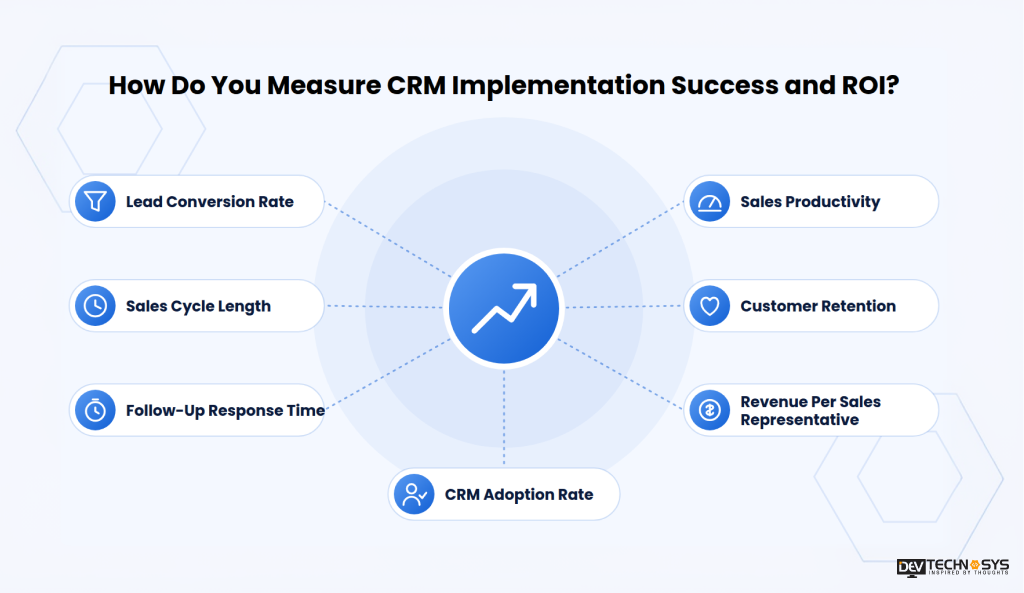
1. Lead Conversion Rate
Calculate this by comparing the qualified leads you got before and after CRM implementation. The solution improves lead generation by determining high-value leads and automating follow-ups. This supports regular sales operations, allowing employees to focus on the next step after achieving a lead.
2. Sales Cycle Length
This is calculated as the time it takes for a lead to close. A general lead might convert in 30 to 60 days, depending on the follow-up schedule and ongoing conversation. If it takes more than 40 days, the business will likely lose it. Implementing CRM helps close deals faster and increases conversion chances.
3. Follow-Up Response Time
Compared with CRM software, manual response times are higher. The solution can reply quickly, even outside business hours. From this data, ROI can be calculated, as high-intent leads are worked on instantly rather than those who are simply taking an inquiry for a product or a service.
4. Sales Productivity
This KPI is measured by the reduction in employees ‘ time after CRM implementation. They can then focus on other conversion strategies, follow-ups, or resolving specific customer queries. If salespeople spend the same amount of time before and after CRM implementation, it can affect ROI.

5. Customer Retention
This parameter clarifies the CRM vs ERP differences, as the first allows sales representatives to improve customer retention by regularly analyzing customer check-ins, purchases, and interactions. If retention improves after CRM integration, businesses can evaluate the resulting ROI.
6. Revenue Per Sales Representative
Consider the opportunities received after the CRM data migration strategy, such as average deal value, closed deals, and time spent on each lead. Revenue can be calculated according to the administrative workload handled by a sales representative.
7. CRM Adoption Rate
ROI can be calculated from the time without and with a CRM software development process. Also check total active users of the solution, use of automation pipeline, and percentage of employees using CRM workflows.
Overall CRM ROI
A simple way to explain it is:
CRM ROI = (Financial Gains from CRM − CRM Investment) ÷ CRM Investment × 100
Security and Compliance to Consider For a CRM Implementation
Data protection and regulatory compliance are mandatory factors for a CRM implementation roadmap. Businesses can evaluate whether the system is secure from vulnerabilities.
1. Data Encryption
Cybersecurity experts encrypt CRM data both at rest and in transit. This helps ensure only authorized users on the network can access the information. Data encryption also protects sensitive data across connected systems such as payment gateways, ERP platforms, marketing tools, and customer support applications.
2. Automated Backups
When a business plans to build custom CRM software, decision-makers must also consider automated backups. This helps when data is lost due to human error, a security attack, or any technical issue.
Software engineers must define the process so they can execute the recovery procedure when needed. Businesses can even add this feature during a CRM implementation to reduce the risk of data deletion.
3. Global Privacy Laws
A growing business might also operate online in California, Europe, or other regions, so it should implement region-specific privacy laws. Engineers implement GDPR, CCPA/CPRA, and other regional privacy laws to determine how customer data will be collected, processed, and used to improve the customer experience.
4. PCI DSS & SOC 2
If a growing business is working with Healthcare CRM software solutions, it may process payments through credit/debit cards. PCI DSS masks sensitive cardholder information to protect it from vulnerabilities. However, SOC 2 focuses on data availability, confidentiality, and privacy. Experts implement both to protect the customer and business data from intruders.
5. ISO 27001
CRM customization processes are often used by international users, which is why ISO standards are relevant. If the existing system does not comply with this standard, it must be added to support risk management, access control, and security governance. Though it will not directly save the data, it will configure permissions and policies.
How to Choose a CRM Development Company?
When selecting a vendor, focus on the firm’s expertise and experience. It should have a dedicated development team to meet the project’s specific requirements. Below are some of the points to guide you in choosing the right company.
1. Workflow Understanding
Discuss your sales lifecycle, data, the teams that will share information, and your current tools. This is also important for implementing an AI Workflow in the existing system.
This allows businesses to support their decisions regarding lead conversion. Check whether the vendor can understand your business workflow or only recommends what they can actually do.
2. Technology Expertise
A CRM partner should be able to answer questions about the technology or tech layer they will implement. They should also explain what security architecture needs to be modified or added.
The vendor should have relevant knowledge in Zendesk, Zoho CRM, Microsoft Power BI, node.js, react.js, or a similar stack. A company with more than eight years of experience across multiple projects can be trusted.
3. Check out Case Studies
Reviewing the portfolio, reviews, and case studies of a CRM development company will give you a clear sense of its industry knowledge. You will understand the challenges experts overcome while building reliable solutions. This step will help you select the best company to create an effective CRM rollout plan.
Final Thoughts
Implementing customer relationship software blindly because competitors are doing it is not a good strategy. Instead, businesses should focus on the specific challenges their internal teams and decision-makers face. A phased CRM implementation approach by a custom CRM software development company helps businesses to manage sales activities, datasets, and regular operations as the business grows.
The biggest mistake that growing businesses should avoid is implementing all the features at once. Add them as needed. This process helps save costs and deliver strong outcomes for an organization.
Frequently Asked Questions
Find answers to the most common questions related to this article.
Yes, businesses should customize their CRM to meet evolving market and consumer needs. An outdated system is incapable of managing workflow complexity, while an up-to-date system allows employees to work on every task efficiently. They can check analytics and insights from a centralized dashboard without spending much time in work discussions.
Growing businesses can improve CRM adoption by understanding where automation is actually required. For example, to respond to customer queries or manage employee payroll. Kindly note that AI or automation is not made for every business. Thus, the problem should be specified first to implement the right strategy within the budget. Managers of each department should list the metrics for which CRM adoption is required to simplify the process.
If a CRM implementation fails, then a business experiences a financial loss and loses its competitive edge. Basically, it stops supporting regular operations then users have to work manually. The solution fails when a business implements a poor CRM deployment strategy. A CRM rollout plan is very important to check for existing systems or specific business requirements.
Using an existing CRM is the best choice, as a custom solution requires a higher investment. You would need to develop the architecture and necessary features from scratch. Growing businesses should choose integrations in the existing system. If they currently do all their work manually, decision-makers can consider building a new solution.