

















Quick Summary:
The real estate CRM software development cost ranges from $4,999 to $89,999, depending on business requirements, automation needs, and system complexity. A basic CRM solution is suitable for small real estate agencies, while advanced platforms require higher investments for workflow automation, lead intelligence, and enterprise-level integrations.
Cost Impacted by Project or Development Complexity:
-
- Basic Real Estate CRM ($4,999 – $15,000): Covers essential tools such as lead management, contact databases, property listings, and task scheduling.
- Intermediate CRM Solutions ($15,000 – $40,000): Support growing agencies with automated follow-ups, sales pipeline tracking, team collaboration, and email integration.
- Advanced Enterprise CRM ($40,000 – $89,999): Includes AI-powered lead scoring, predictive sales insights, marketing automation, and third-party property integrations.
Cost Based on Real Estate CRM Types:
-
- Lead Management CRM: $4,999 to $18,000
- Property Management CRM: $10,000 to $30,000
- Real Estate Sales CRM: $12,000 to $35,000
- Brokerage CRM Platform: $20,000 to $55,000
- Custom Enterprise CRM: $45,000 to $89,999
Cost Based on Different Regions/Countries:
-
- The Real Estate CRM development cost in the USA typically ranges from $20,000 to $89,999, depending on customization and integration requirements.
- The Real Estate CRM development cost in Australia generally falls between $15,000 and $65,000, influenced by business workflows and technical specifications.
- The Real Estate CRM development cost in Canada can range from $12,000 to $70,000, depending on platform capabilities, automation, and deployment scale.
Additional Cost:
-
- Ongoing Maintenance: Annual support, software updates, bug fixes, and performance optimization may cost approximately 10% to 20% of the initial development budget.
- Integration and Data Security: Connecting property portals, payment gateways, email services, and telephony tools can increase expenses. Data encryption, access controls, secure cloud hosting, and privacy compliance may also require additional investment.
In the current competitive property market, it is no longer sufficient to manage leads, manage property inquiries, and organize sales teams with the help of spreadsheets or other disconnected tools.
Real estate CRM software makes it possible for brokers, agents, and property developers to centralize their operations, automate their follow-ups, and build better relationships with their clients. However, the related costs will vary based on the business model, needed features, integration requirements, and goals for the future.
The real estate CRM software development cost usually falls between $4,999 and $89,999, which makes it possible to get from basic lead generation systems to complex solutions that can provide AI-powered insights or advanced automation.
It is important to understand the above factors in order to be able to prioritize the features, allocate the budget properly, and consider a solution that can help the business achieve its objectives without excessive complexity.
What is Real Estate CRM Software?
A real estate CRM ( Customer Relationship Management) application is a software tool that assists real estate firms in organizing leads, listings, communications, and sales tasks all in one integrated interface.
It allows the organization of business processes and activities through automation of follow-ups with clients, contact organization, and generation of reports. Real estate agents, brokers, investors, and property managers use CRM applications to boost customer relations and improve organizational processes.
Service Options
Who Can Benefit From Our Real Estate CRM Development?
The real estate industry focuses on improving the client experience, optimizing property management processes, and providing integrated sales solutions.
How Do You Manage Property Leads?
Collect buyer inquiries, follow property interests, and develop relationships all on one platform.
For Real Estate Agents And BrokersProblems With Tracking Sales Activity?
Automate follow-ups, manage your listings, and control the closing of deals without having to perform manual work.
For Real Estate Agencies And Sales ManagersNeed Integrated Property Systems?
Integrate your CRM with listing services, marketing tools, and all the necessary systems.
For Property Networks and Technology TeamsHow Much Does It Cost To Develop a Real Estate CRM Software?
The cost to build a real estate CRM software varies from $4,999 to $89,999 depending on its complexity, functionality, and customization level. For instance, a simple CRM that offers features such as lead tracking will cost somewhere between $4,999 and $15,000, and more advanced real estate IT solutions with automation features, property management, and reporting may cost somewhere between $15,000 and $45,000. As for advanced CRMs with third-party integrations, AI features, and customized workflows, they may get as expensive as $45,000 to $89,999.
Real Estate CRM Type |
Features Included |
Estimated Development Cost |
| Basic CRM | Contact management, lead tracking, property listings | $4,999 – $15,000 |
| Mid-Level CRM | Lead automation, reporting, property management, email integration | $15,000 – $45,000 |
| Advanced CRM | AI-powered insights, workflow automation, third-party integrations | $45,000 – $70,000 |
| Enterprise CRM | Custom dashboards, advanced analytics, multi-user roles, scalable architecture | $70,000 – $89,999 |
Planning a Real Estate Crm Project?
Get a tailored development cost estimate in a few simple steps.
- 3 quick steps
- 100% free
- Reply in 1 business day
2 Minutes Read
What are the Costs of Different Types of Real Estate CRM Software?
Various types of real estate Customer Relationship Management (CRM) software meet different business requirements, from managing leads for residential properties to managing lease agreements for commercial real estate, brokerage firms, real estate investments, and rental properties. Each type of real estate CRM software comes with special features, automation options, and integrations.
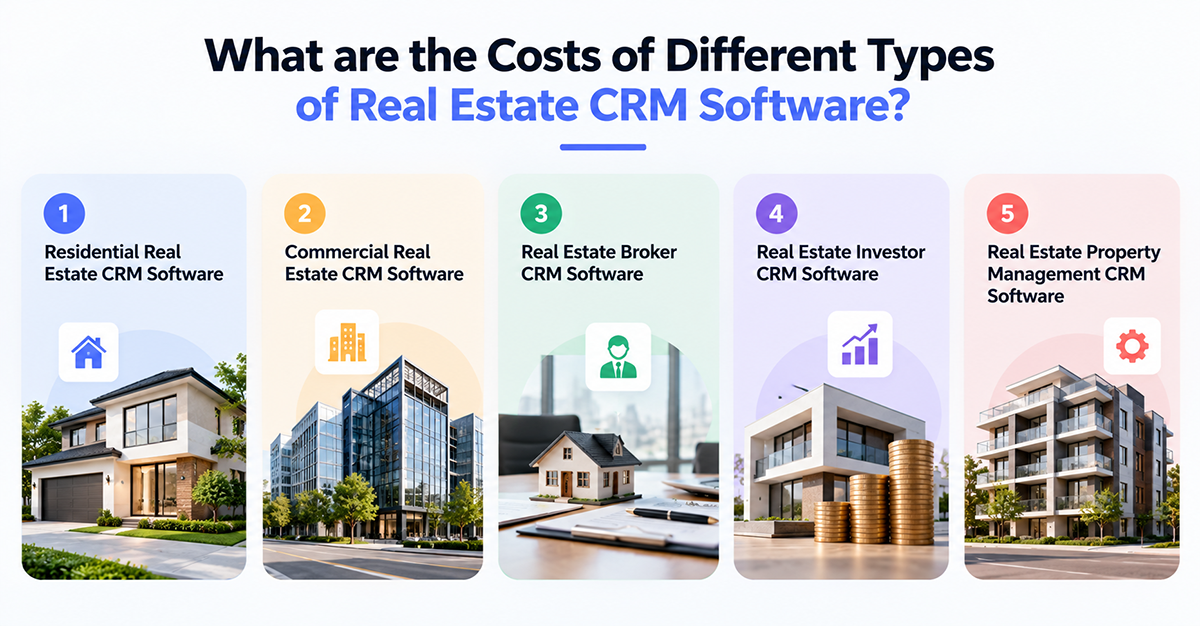
1. Residential Real Estate CRM Software
With help from residential real estate CRM software, agents can oversee property listings, inquiries from buyers, communication with clients, and property visits. The cost of development varies from $4,999 to $24,999 and depends on lead management, listing integration, automatic follow-up, reporting, and customization.
2. Commercial Real Estate CRM Software
Commercial real estate CRM software facilitates commercial properties’ selling, leasing, tenant relations, and leasing tracking. The price can vary from $19,999 to $59,999, which varies due to differences in lease management, etc.
Industry Insights:
“NAR’s 2026 report found 48% of agents use AI daily or weekly, increasing demand for AI-enabled CRM features.”
3. Real Estate Broker CRM Software
Real estate broker CRM software enables agencies to manage their agents, sales processes, commissions, client relationships, and employee productivity.
The cost of development would be in the range of $9,999 to $39,999, depending on the level of workflow automation and real estate app features such as the commission calculation tool, dashboards, performance reports, and the ability to integrate with third-party applications.
4. Real Estate Investor CRM Software
Real estate investor CRM software helps real estate investors oversee their investments by keeping track of various investment opportunities, deals, properties, and returns.
The cost of development varies from $24,999 to $69,999 and would depend on the financial analytics features, investment tracking, portfolio management, market information integration, and the features of predictive reporting.
5. Real Estate Property Management CRM Software
Real estate property management CRM solutions aid in handling tenants, rent payments, maintenance requests, lease renewals, and property files. Real estate app development cost can vary from $29,999 to $89,999 depending on the functionalities like tenant portals, automated invoicing, accounting modules, maintenance flow management, advanced analytics, and multi-property management capabilities.
Real Estate CRM Software Type |
Description |
Development Cost |
| Residential Real Estate CRM | Manages property listings, buyer leads, and client follow-ups. | $4,999 – $24,999 |
| Commercial Real Estate CRM | Handles commercial leases, tenants, and property transactions. | $19,999 – $59,999 |
| Real Estate Broker CRM | Tracks agents, sales pipelines, and commissions. | $9,999 – $39,999 |
| Real Estate Investor CRM | Manages investment deals, property portfolios, and returns. | $24,999 – $69,999 |
| Property Management CRM | Streamlines rent collection, maintenance, and lease renewals. | $29,999 – $89,999 |
Market Insights:
“Tata Realty and Salesforce reported a 10% conversion increase and 30% improvement in lead qualification after deploying AI-powered customer engagement.”
What Factors Affect Real Estate CRM Software Development Cost?
The cost to develop a real estate CRM software is determined by different factors like features, design, technology, integrations, security, and proficiency of the team.
Having an understanding of those criteria gives businesses the amount that they will need, the necessary features to keep, as well as a plan for a CRM system according to their needs and requirements.
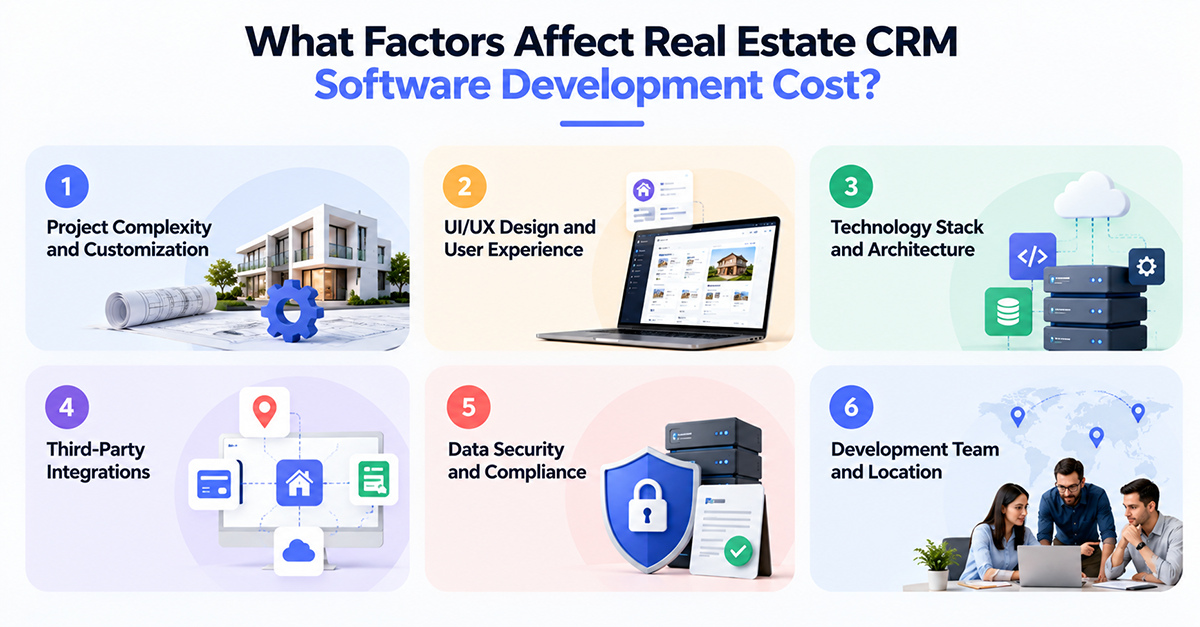
1. Project Complexity and Customization
The complexity level of the project determines the duration of the work involved and the cost incurred. A simple CRM system involving only contact storage, lead management, and property listings needs fewer resources.
However, specialized tasks such as developing workflows for matching properties and automated follow-up messages, checking commissions, and tracking activities with customers working across several branches will need additional coding.
Cost-affecting factor |
Description |
Estimated cost impact |
| Basic CRM functionality | Lead management, contact records, and property listings | 0–10% |
| Advanced automation | Automated follow-ups, lead scoring, and workflow automation | 10–25% |
| Complex customization | Commission management, multi-branch operations, and custom business workflows | 25–30% |
2. UI/UX Design and User Experience
The UI/UX design has an effect on the cost of the real estate chatbot development depending on the number of screens and interface complexity. Standard layouts involve a smaller budget than fully customized dashboards, interfaces designed for particular types of users (agents, managers), and responses for mobile devices. The need for usability testing increases the cost of the project but improves user acceptance.
Cost-affecting factor |
Description |
Estimated cost impact |
| Standard interface design | Predefined layouts and basic navigation | 0–5% |
| Custom dashboards | Personalized dashboards for agents, managers, and administrators | 5–15% |
| Advanced user experience | Responsive mobile interfaces, interactive visualizations, and usability testing | 15–25% |
3. Technology Stack and Architecture
There are effects of the technology stack and architecture on development costs in terms of licensing, infrastructure, and implementation. The choice of open-source technologies can lead to licensing savings.
The need for particular technologies makes having highly skilled developers inevitable. Building complicated database structures, utilizing cloud hosting, and creating scalable architecture help to spend more money at the beginning but bring considerable profits.
Cost-affecting factor |
Description |
Estimated cost impact |
| Standard technology stack | Established frameworks and conventional database architecture | 0–5% |
| Cloud infrastructure | Cloud deployment, database configuration, and environment setup | 5–15% |
| Scalable architecture | Microservices, high availability, and advanced performance optimization | 15–30% |
4. Third-Party Integrations
Integrating third-party services adds more expenses as a result of the availability of APIs, licensing charges associated with them, and the technical complexity of the integration process.
Thus, connecting the property portal, email service, payment gateways, telephone services, as well as marketing tools will require further all kinds of development and testing. In addition, creating custom APIs and synchronizing data in real time is usually more expensive than the average integration implementation.
Cost-affecting factor |
Description |
Estimated cost impact |
| Basic integrations | Standard email services and commonly available APIs | 0–5% |
| Multiple service integrations | Property portals, telephony, payment gateways, and marketing platforms | 10–20% |
| Complex integrations | Custom APIs, legacy systems, and real-time data synchronization | 20–35% |

5. Data Security and Compliance
Security policies impact expenses for existing safeguards and compliance approaches. In this way, simple access control and encryption require fewer resources compared to advanced permissions, audit trails, and security control measures. Compliance with local rules may require additional testing, assessments, and documentation while increasing the cost of a HubSpot-like CRM.
Cost-affecting factor |
Description |
Estimated cost impact |
| Basic security measures | User authentication, role-based access, and standard encryption | 0–5% |
| Enhanced security | Audit logs, secure backups, advanced permissions, and monitoring | 5–15% |
| Advanced compliance requirements | Specialized compliance assessments, penetration testing, and additional privacy controls | 15–30% |
6. Development Team and Location
Costs of development are influenced by the team’s experience, the team’s organizational structure, and the rates of payment per hour of work. Senior developers, architects, and security specialists usually charge more, but they are capable of making fewer expensive mistakes. Offshore teams can save money, but communication, management of the project, and quality of the product should still stand high on the priority list.
Cost-affecting factor |
Description |
Estimated cost impact |
| Standard development team | Mid-level developers working with an established project scope | 0–10% |
| Experienced specialists | Senior developers, solution architects, and security experts | 10–25% |
| Specialized or larger team | Multiple specialist teams, intensive QA, and accelerated delivery | 20–30% |
What are the Hidden Costs of Real Estate CRM Software Development?
The existence of hidden real estate CRM software development costs may adversely affect your overall budget. There are many things to consider when developing software, including planning for maintenance, third-party integration, cloud hosting, data security, compliance, and user training, in order to avoid going over budget in the long run and ensure software effectiveness and reliability.
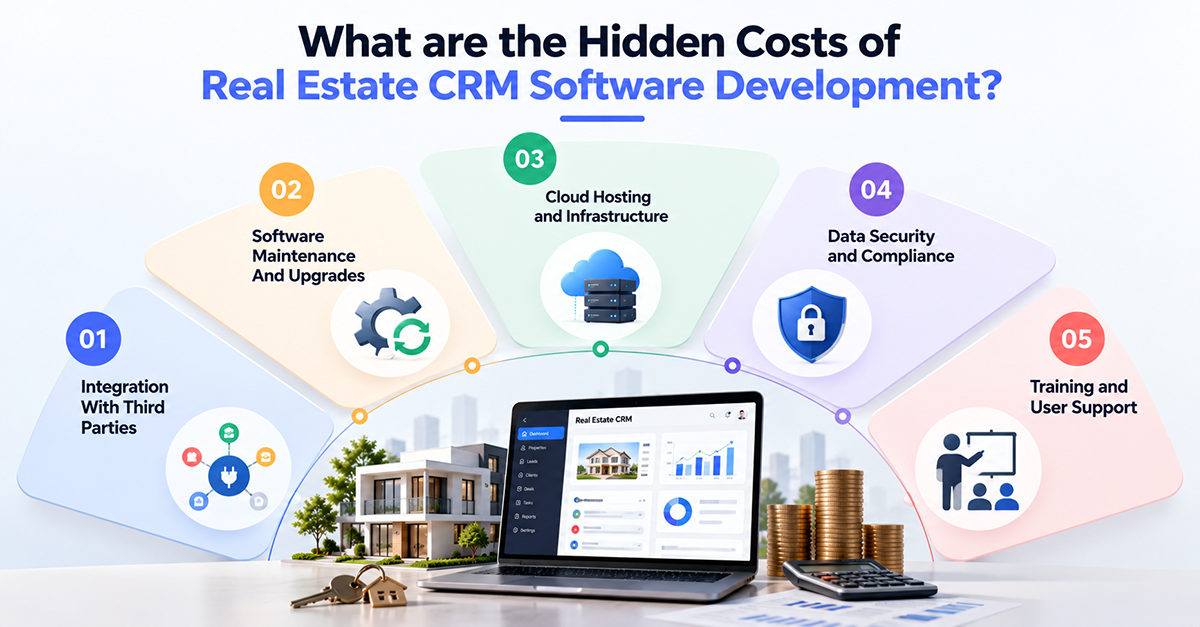
1. Integration With Third Parties
The integration of the real estate CRM software with MLS integration crm, property listing portals, payment gateways, email services, and marketing tools can increase software development costs.
The costs incurred by subscribing to the API and the complexity of integrating them and maintaining compatibility can introduce unplanned expenses during the software lifecycle.
2. Software Maintenance And Upgrades
Once the CRM software is implemented, it needs constant maintenance, fixing bugs, implementing security patches, optimizing the performance of the software, and enhancing its features.
These costs to build CRM software for real estate are incurred constantly to provide the platform with reliable operation and to keep its performance free of any possible technical issues.
3. Cloud Hosting and Infrastructure
Hosting costs depend on the size of the database, traffic, and storage requirements, as well as the capabilities of the server. Additionally, cloud solutions, backup systems, monitoring solutions, and bandwidth will add to the costs as the real estate CRM software expands.
4. Data Security and Compliance
In safeguarding confidential customer information, encryption, limited access, safety checks, and adherence to regulations must be in place. There may be additional costs to comply with regulations like GDPR based on the geographical reach of the business market.
5. Training and User Support
People employed in the business require training to effectively use the features of the customer relationship management tool. They also require continued assistance with the technological aspects of the tool.
Service Options
What Real Estate CRM Solutions Can We Develop for Your Business?
Let’s define your basic or advanced requirements for your real estate business and build as per your custom needs.
Custom Real Estate CRM Software
Custom CRM software development solutions that fulfill business requirements and manage property listings, client relationships, and sales pipeline.
Create Your Property CRMReal Estate Integration & Automation
Integrate and automate tasks, such as lead assignments, property portals, and streamline follow-ups across the overall sales team.
Automate Your Sales WorkflowCRM Upgrades & AI Solutions
Improve or upgrade the existing real estate CRM with AI-based functionalities like predictive insights, personalized recommendations, and AI lead scoring.
Upgrade Your CRM PlatformWhat Are the Security and Compliance Requirements for Real Estate CRM Software?
Real estate CRM software should have strong security features for securing sensitive information of clients, financial data, and property information. The use of data encryption, access control, alternative methods of identification, and security audits will ensure that customer data is safe from unwanted interference.
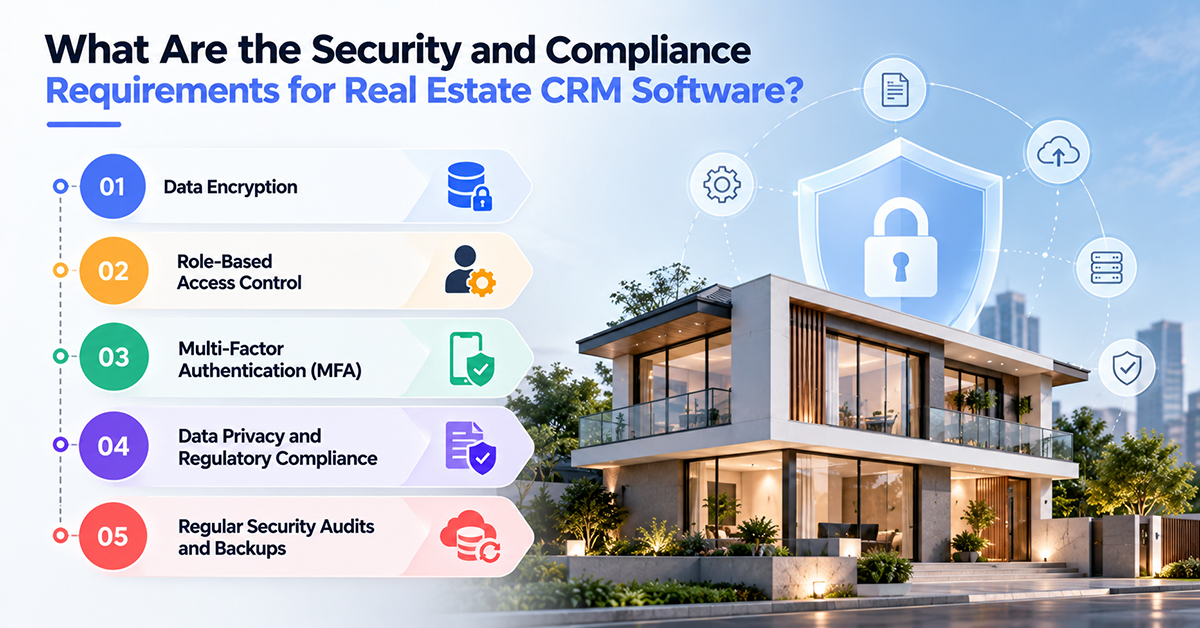
1. Data Encryption
Encryption is a term used for protecting sensitive data from access by unauthorized individuals. For instance, in real estate and related businesses, the data to be protected by encryption refers to clients’ information, transactions, reports, and properties. It is important for the best real estate CRM system to provide data encryption during data transfer and storage as well.
2. Role-Based Access Control
Access control based on roles provides users with access to information that is necessary for their job performance. The best real estate CRM systems allow different roles to be defined and provide different users with different levels of access. The use of role-based access control improves the internal security of businesses.
3. Multi-Factor Authentication (MFA)
MFA is understood as the mechanism for increasing the protection of users’ accounts by requiring users to validate their identity in several different ways. In real estate, MFA can be done by having users sign in with the use of passwords and specific software applications for validation of login and sign-in keys.
4. Data Privacy and Regulatory Compliance
Companies using a real estate CRM must ensure compliance with all necessary GDPR data protection legislation, for example, GDPR for relevant European personal data and India’s Digital Personal Data Protection Bill, 2023, to name a few.
Businesses should also adhere to measures such as consent management, data handling measures, data retention plans, and procedures for responding to privacy requests.
5. Regular Security Audits and Backups
Through periodic audits of the system, identification of weaknesses and errors in the real estate CRM and threats can occur. Automated backup mechanisms can minimize losses associated with accidental deletion, system failures, and cyber attacks. Security checks, timely updates, access monitoring, and recovery procedures will allow for building data protection and system resilience.
How Long Does It Take to Develop Real Estate CRM Software?
Real estate CRM software can take anywhere from 3 to more than 5 months to create, depending on the complexity of the project, features requested, and other aspects of development.
A basic real estate CRM with lead management features could take about 3 months, while the development of a more complex CRM solution with workflow automation, integration with third-party applications, and custom dashboards could take 5 months or more.
Development Stage |
Key Activities |
Estimated Timeline |
| Planning and Requirement Analysis | Define business goals, features, and technical requirements | 2–3 weeks |
| UI/UX Design | Create wireframes, dashboards, and interface designs | 2–3 weeks |
| Software Development | Build core CRM features, property management, and lead tracking | 6–10 weeks |
| Third-Party Integrations | Integrate property portals, email, and other external tools | 2–4 weeks |
| Testing and Quality Assurance | Identify bugs, test functionality, and verify security | 2–3 weeks |
| Deployment and Launch | Configure hosting, deploy the CRM, and perform final checks | 1–2 weeks |
| Total Estimated Timeline | Depends on project complexity and overlapping activities | 3–5+ months |
Fact: Metrigy reports 18.7% of surveyed organizations plan CRM adoption by the end of 2026, indicating further potential demand for CRM implementation services.
How to Reduce the Real Estate CRM Software Development Cost?
Cut down on the real estate CRM software development cost by emphasizing only key functionalities, selecting scalable solutions, and utilizing existing integrations. Focus on an MVP approach for a smooth CRM software development process while avoiding undue modifications.
By collaborating with a skilled development team, it’s possible to manage expenses prudently and guarantee effective operations and further development of the company.
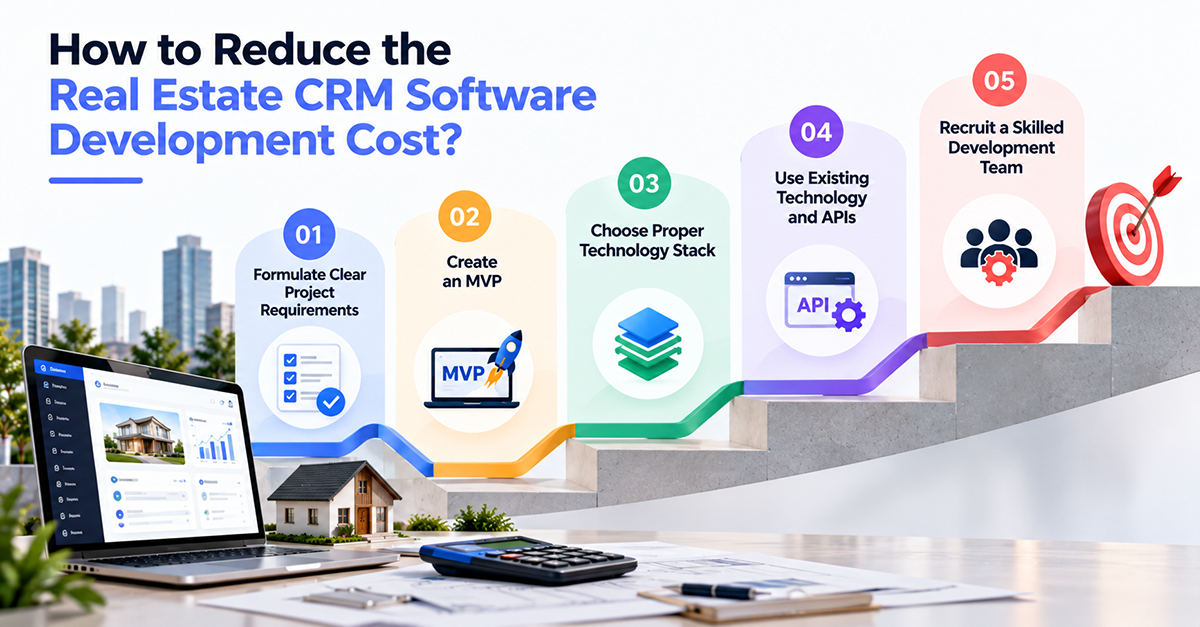
1. Formulate Clear Project Requirements
Determine the main CRM functions like managing leads, displaying properties, communicating with clients, and reporting. Set the business objectives clearly and establish the most necessary features for execution.
It is useful to define the project scope correctly so as not to over-develop the product, avoid wasting time fixing bugs, and keep the costs of the real estate app development services under control.
2. Create an MVP
Produce a minimum viable product (MVP) that includes the necessary functions and only then move on to advanced features. The launch of a simple CRM system will help a business assess users’ needs, get feedback, and work on improvements gradually without wasting money for unneeded features at the very start.
3. Choose Proper Technology Stack
Pick up cost-efficient technologies that will help to develop the required product on time. The use of well-known frameworks, free tools, and proven cloud software will reduce financial expenses and shorten the proptech software development process. The right technology stack makes maintenance easy and helps with future upgrades.
4. Use Existing Technology and APIs
Instead of creating each function from beginning to end, make use of common application technology and third-party service providers to manage things like email marketing, payments, maps, and communication.
Existing app components may help avoid massive amounts of development work, cut down engineering costs, and speed things up while providing your real estate CRM with necessary features.
5. Recruit Skilled Development Team
Hire a professional property management app development company with a background in the real estate CRM industry. Highly talented specialists will be able to detect possible savings, eliminate technical mistakes, and optimize processes. Compare criteria such as skills, connections, and pricing in order to find the team that can offer you decent quality for reasonable money.
Custom Real Estate CRM vs. Ready-Made CRM: Which Is Better?
The choice between custom vs. off-the-shelf real estate CRM depends on the specific needs of your business, available finances, and future expansion plans.
Pre-built CRM solutions offer quick deployment and low initial costs, while custom CRM solutions have specialized features and allow more flexibility in function as well as better alignment of business processes. To choose the best option, it is important to evaluate your needs for scalability, integrations, and long-term costs.
Comparison Factor |
Custom Real Estate CRM |
Ready-Made CRM |
| Initial Cost | Higher development investment | Lower upfront cost |
| Development Time | Typically 3–5+ months | Quick setup and deployment |
| Customization | Fully tailored to business needs | Limited to available features |
| Scalability | Can grow with business requirements | Depends on the provider’s plans |
| Integration | Custom integrations with existing systems | Supports predefined integrations |
| Data Control | Greater control over data and infrastructure | Depends on the vendor’s policies |
| Maintenance | Requires ongoing technical support | Often managed by the provider |
| Best For | Businesses with specialized workflows | Small businesses needing quick implementation |
Total Cost of Ownership (TCO) of Real Estate CRM Software
The real estate CRM total cost of ownership extends beyond just the one-time development expense. Essentially, it refers to the overall expenses incurred during the deployment, operation, maintenance, and upgrading of the software, covering its entire life cycle. Understanding the TCO helps in better budgeting for the real estate firm and in deriving ROI over time.
1. Key Components of Real Estate CRM Software TCO
- Initial Development Costs: The costs associated with UI/UX design, frontend and backend development, database configuration, testing, and deployment costs.
- Third-party Integration Costs: Expenses incurred in the integration of portals such as 99acres and Magicbricks, WhatsApp Business API, email marketing tools, payment gateways, etc., with each other.
- Cloud Hosting and Infrastructure Expenses: Monthly or yearly expenses regarding servers, database hosting, storage, backups, and bandwidth.
- Support and Maintenance Costs: Ongoing costs concerning bug fixing, security updates, and performance monitoring, as well as technical support.
- Security Costs and Compliance: Expenses concerning data protection, access rights, security audits, and compliance with privacy requirements.
- Training and Onboarding Expenses: Costs incurred for employee training, creation of documentation, and the process of onboarding new agents or administrators.
2. Estimated Total Cost of Ownership
The yearly operating expense of a personalized real estate CRM system is often 15-25% of its initial design costs, with the exclusion of costs associated with significant feature upgrades and infrastructure changes. These expenses vary based on various factors, including the number of users, data volume, integration specifics, and level of support.
For example, if the property listing app development costs $30,000, the annual maintenance charge could range between $4,500 and $7,500. Furthermore, one should also account for hosting fees, third-party subscriptions, and further upgrades.
3. How to Optimize Real Estate CRM TCO
Long-term costs in CRM can be managed by focusing on important features, creating an MVP, choosing a scalable cloud solution, automating maintenance, and calculating the costs of third-party subscriptions prior to production. A good CRM solution allows reducing costs while giving room for further development.
Final Words!
Creating a real estate CRM system demands thorough preparation, implementing necessary functionalities, and efficient company goals. No matter if you are developing basic lead management tools or using advanced automation solutions and analytics, development costs depend on different complexities, integrations, and personalization options.
Hiring an experienced real estate CRM software development company will help you create secure, scalable, and efficient real estate CRM solutions that will boost customer relations.
Frequently Asked Questions
Find answers to the most common questions related to this article.
The real estate CRM software development cost ranges from $4,999 to $89,999 or thereabouts, depending on the characteristics, complexity, and integrations. Basic solutions require lower budgets, while advanced platforms with automation, analytics, and mobile apps are significantly pricier.
Some of the features that impact the development costs include lead management, property listings, automated follow-ups, WhatsApp integration, reporting dashboards, and AI-driven recommendations. Other features such as advanced functionality, third-party integrations, user permissions, and customization will make the work more complicated and will require more time and a larger real estate CRM budget.
In general, it takes about 3 to 5+ months to develop real estate CRM software depending on how complex the project is, what features it has, what integrations it needs, and how much customization it requires. A simple CRM might take 6 - 10 weeks to make, but more sophisticated solutions used in large enterprises and equipped with advanced automation and mobile applications will naturally take a bit more time to develop and test.
When it comes to the cost of maintaining real estate CRM software, these expenses will amount to approximately 10 – 20% of the original software development budget. The cost will consist of bug fixes, security updates, server hosting, performance optimization, functionality upgrades, and providing technical support.
The costs for the integration of property portals such as 99acres and Magicbricks into the real estate CRM can range from around $500 to $5,000 and above for each integration. The costs entail considerations like the availability of API technology, lead synchronization requirements, complexity of integration, additional terms of the partnership agreement with the portal, and ongoing maintenance requirements.