


















Quick Cost Summary for Financial Fraud Detection Software Development
- Overall Cost Range:
Financial fraud detection software development typically costs $30,000- $150,000+. It depends on detection capabilities, software complexity, integrations, security requirements, compliance, data volume, and deployment needs.
Cost by Complexity:
-
-
- Basic Fraud Detection Software: $30,000–$75,000
Transaction monitoring, rule-based fraud detection, alerts, user authentication, basic reporting, and suspicious activity tracking. - Mid-Level Fraud Detection Software: $75,000–$115,000
Real-time transaction monitoring, risk scoring, behavioral analysis, automated alerts, dashboard analytics, API integrations, and role-based access control (RBAC).
- Basic Fraud Detection Software: $30,000–$75,000
-
- Advanced Fraud Detection Software: $115,000–$150,000+
AI-powered fraud detection, machine learning models, real-time anomaly detection, predictive analytics, multi-channel monitoring, automated workflows, and enterprise-grade security.
- Advanced Fraud Detection Software: $115,000–$150,000+
-
Key Cost Factors:
- Software complexity, detection methods, AI/ML capabilities, data sources, third-party integrations, UI/UX, security, compliance, cloud infrastructure, data volume, and scalability.
Development Timeline:
- A financial fraud detection software solution generally takes 4-7+ months to design, develop, test, integrate, and launch, depending on its complexity.
Regional Cost Rates:
- Plan for cloud hosting, third-party APIs, AI/ML model training, security testing, compliance audits, data migration, maintenance, technical support, monitoring, and ongoing model updates.
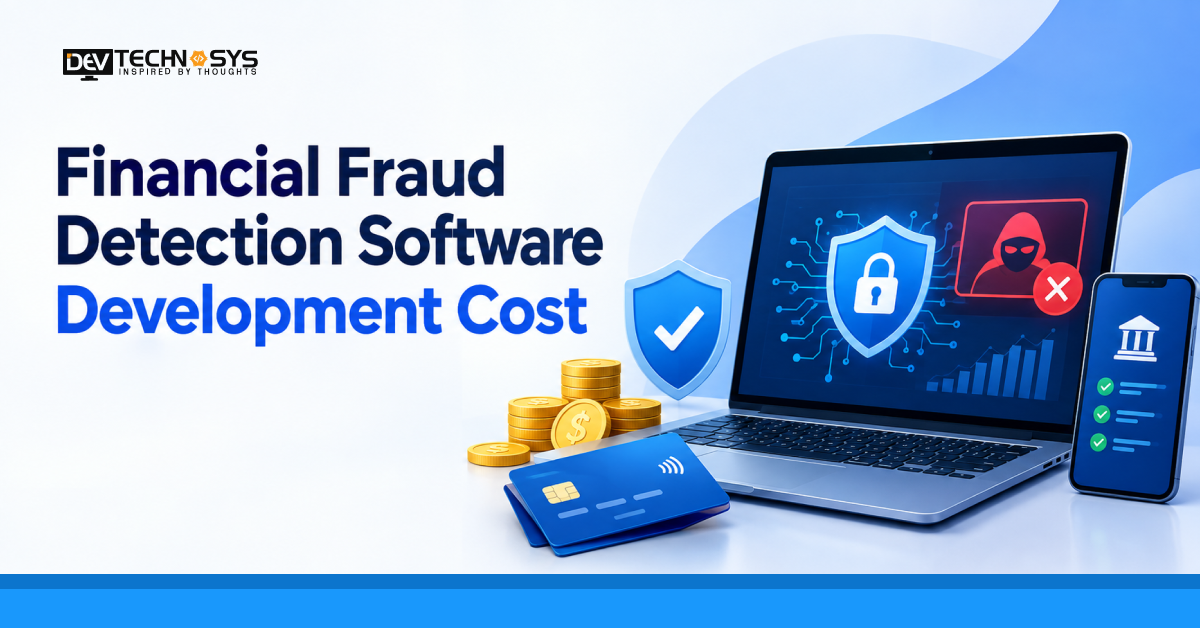
Any suspicious transaction can take place within a few seconds. But if it is detected late, it costs businesses more than the transaction itself. With growing digital banking, fintech platforms, online payments, and financial services, financial fraud detection software has become essential.
Financial fraud detection software development helps businesses identify threats before they turn into serious financial losses. But the real question is: How much does financial fraud detection software development cost?
The standard cost to develop fraud detection software ranges from $30,000 to $1,50,000. The final development budget depends on features, software complexity, AI/ML, integrations, security, compliance, and scalability.
From average development cost breakdown to hidden expenses, this guide covers all cost-related information. This will help enterprises estimate their project budget efficiently and decisively.
Why Financial Fraud Detection Software Is No Longer Optional for Businesses
Earlier, financial threats were limited to theft of cash, cheques, and debit or credit cards. But in this era of digitization, fraudsters are using sophisticated techniques to exploit weak points in financial systems. So the common threats now are fake identities, hacked accounts, and AI-generated verification bypasses.
In such scenarios, a financial business needs faster ways to detect threats before they become major. Real-time fraud monitoring for fintech platforms shouldn’t be manual only; it must include automated fraud detection. A reliable, automated fraud prevention system can:
- Identify suspicious transactions in real time
- Reduce exposure to fraudulent activities
- Analyze transaction and behavioral data
- Centralize alerts and relevant transaction information
- Monitor fraud risks across financial services
- Protect customers and their financial information
- Support growing transaction volumes without manual intervention
According to Research and Markets, the financial fraud detection software market was valued at $19.45 billion in 2025. It is expected to reach $36.99 billion by 2030 at a CAGR of 13.7%.
How Much Does It Cost to Build Financial Fraud Detection Software?
The standard financial fraud detection software development cost ranges from $30,000 to $1,50,000. The overall development budget is determined by the platform’s complexity. The complexity of the platform depends on the number of features, integrations, and security needs. It also depends on the fraud detection capabilities required to monitor and prevent financial threats effectively. We will now understand the software development cost breakdown in this way:
- Basic Software: $30,000-$75,000
A basic fraud detection platform is much less complex to build due to limited but core integrations. It integrates rule-based transaction monitoring, suspicious-transaction alerts, basic risk scoring, user authentication, fraud reporting, and an admin dashboard.
- Mid-Level Software: $75,000-$115,000
A mid-tier fraud detection software combines simple and advanced integrations, making it moderately complex to build. It includes real-time monitoring, behavioral analysis, automated risk assessment, transaction pattern detection, API integrations, and role-based access control
- Advanced Software: $115,000-$150,000
High-level fraud detection software comes with modern technologies, the latest integrations, and other advancements, making it difficult to develop. It involves AI/ML, real-time anomaly detection, predictive risk scoring, adaptive fraud models, multi-channel monitoring, automated decision-making, and enterprise-grade security.
Software Level |
Estimated Cost |
Best Suited For |
Key Capability |
Development Complexity |
| Basic | $30,000–$75,000 | Small financial businesses & startups | Detects common fraud patterns and flags suspicious activity | Low |
| Mid-Level | $75,000–$115,000 | Growing fintechs, banks & payment businesses | Supports faster risk evaluation and more sophisticated fraud prevention | Medium |
| Advanced | $115,000–$150,000+ | Banks, enterprises & high-volume financial platforms | Enables intelligent, adaptive fraud prevention at scale | High |
Planning a Mobile Banking App Project?
Get a tailored development cost estimate in a few simple steps.
- 3 quick steps
- 100% free
- Reply in 1 business day
2 Minutes Read
Financial Fraud Detection Software Cost by Detection Method
Risk-Based Authentication (RBA), anomaly detection, KYC detection, rule-based detection, and hybrid detection are among the top financial fraud detection methods. The fraud detection software development cost varies according to these methods. Top financial fraud detection software companies help businesses choose and implement the right detection approach based on their:
- Fraud Risk Engine
- Transaction volume
- Security requirements
- Budget
Based on a guide by Stripe, the right detection combination can enhance fraud identification. It also reduces false positives and unnecessary manual reviews.
Have a look at a quick comparison of the five most commonly used approaches:
Detection Method |
Cost Level |
Ideal For |
How It Helps |
| Rule-Based Detection | Low | Startups & small financial businesses | Flags known fraud scenarios using predefined conditions |
| Machine Learning Detection | Moderate–High | Fintechs & growing payment platforms | Identifies complex fraud patterns from historical data |
| Behavioral Biometrics | High | Banking & high-security platforms | Detects unusual user behavior and interaction patterns |
| Anomaly Detection | High | High-volume transaction platforms | Spots activities that deviate from established normal behavior |
| Hybrid Detection | High–Very High | Banks & enterprise financial systems | Combines multiple detection techniques for broader fraud coverage |
Expert Insight:
For a cost-conscious MVP, rule-based detection is usually the simplest starting point. Businesses handling complex or high-volume transactions may benefit from machine learning, anomaly detection, behavioral biometrics, or a hybrid architecture as their fraud-prevention needs grow.
Narayan Das (Project Manager at Dev Technosys)
Financial Fraud Detection Platform Development Cost By Industry Type
Banking, BNPL, lending, crypto, and insurance are the major industries dealing with financial risks. Each sector has to face different fraud risks, transaction volumes, compliance requirements, and integration needs. Like a banking app requires robust security and regulatory controls, whereas eCommerce focuses on payment and account fraud prevention. We have compared fintech software development requirements for fraud detection across different industries.
Industry |
Cost Level |
Primary Fraud Concerns |
Typical Requirement |
| Banking & Financial Services | High–Very High | Account takeover, payment fraud, identity theft | Real-time transaction monitoring and risk analysis |
| Payment & Fintech | High–Very High | Payment fraud, unauthorized transactions, account takeover | Real-time payment monitoring, risk scoring, and transaction verification |
| Ecommerce & Retail | Moderate–High | Payment fraud, chargebacks, fake accounts | Checkout and transaction fraud prevention |
| Insurance | Moderate–High | False claims, identity fraud, application fraud | Claim and customer behavior analysis |
| Crypto & Digital Assets | High–Very High | Wallet fraud, account takeover, transaction manipulation | Blockchain and transaction monitoring |
| Lending & BNPL | Moderate–High | Loan application fraud, synthetic identities, income manipulation | Applicant verification and credit-risk assessment |
How Much Does Fraud Detection Software Cost by Development Level?
The financial fraud detection software development cost depends heavily on the development level or type you choose. An MVP, full-scale, and enterprise-grade are the levels of development that businesses choose according to their budget, goal, and scope.
- Developing an MVP costs less and focuses on essential fraud monitoring and validation.
- A full-scale development provides broader functionality, integrations, security, and production-ready fraud prevention.
- An enterprise-level solution prioritizes deeper integrations, stronger security, advanced behavioral analytics, and greater scalability.
Generally, it takes approximately 4 to 7+ months to develop financial fraud detection software. The final timeline depends on the required functionality and technical complexity. In this section, we will learn about the financial fraud detection software cost by development level and stages.
Development Requirement |
MVP |
Full-Scale |
Enterprise-Grade |
| Requirement Analysis | 1 week | 1–2 weeks | 2–3 weeks |
| UI/UX Design | 1–2 weeks | 2–3 weeks | 3–4 weeks |
| Architecture & Tech Planning | 1 week | 1–2 weeks | 2–3 weeks |
| Backend Development | 4–5 weeks | 6–8 weeks | 8–10+ weeks |
| Frontend & App Development | 3–4 weeks | 5–7 weeks | 7–9+ weeks |
| API & Third-Party Integration | 2–3 weeks | 3–4 weeks | 4–6 weeks |
| Security & Compliance Testing | 1–2 weeks | 2–3 weeks | 3–4 weeks |
| QA, Deployment & Launch | 1–2 weeks | 2–3 weeks | 3–4 weeks |
| Total Timeline | 4–5 months | 5–6 months | 6–7+ months |
| Development Cost | $30,000–$75,000 | $75,000–$115,000 | $115,000–$150,000+ |
| Post-Launch Maintenance | Ongoing | Ongoing | Ongoing |
Financial Fraud Detection Software Development Cost by Feature
Fintech fraud detection software development cost also depends on its feature set. The average cost of core features ranges between $3,500 and $8,000, while advanced features range from $7,000 to $14,000. This is not about the number of features, but about the complexity of the fraud scenarios the system needs to handle. Usually, core features manage transaction monitoring, alerts, investigation, and administration. Whereas advanced features handle automation, behavioral analysis, intelligent decision-making, and enterprise-scale fraud prevention.
Core Fraud Detection Software Features
Core Feature |
Short Description |
Estimated Cost |
| User & Account Management | Manages user profiles, account access, and activity. | $3,500–$4,500 |
| Transaction Monitoring | Monitors transactions to flag suspicious activity. | $4,000–$5,500 |
| Fraud Rule Management | Creates and manages a rules engine for known fraud scenarios. | $4,000–$5,000 |
| Risk Scoring | Assigns risk scores based on fraud indicators. | $4,500–$6,000 |
| Suspicious Activity Alerts | Sends alerts when activity crosses risk thresholds. | $3,500–$4,500 |
| Transaction Review | Helps analysts review transaction and user details. | $4,000–$5,000 |
| Fraud Case Management | Creates, assigns, tracks, and closes fraud cases. | $4,500–$6,000 |
| Admin Dashboard | Displays transactions, alerts, cases, and risk data. | $4,500–$6,000 |
| Fraud Reports & Analytics | Generates reports on fraud trends, alerts, and cases. | $4,000–$5,500 |
| Transaction & User History | Provides historical transaction and user activity records. | $3,500–$5,000 |
Advanced Fraud Detection Software Features
Advanced Feature |
Short Description |
Estimated Cost |
| Behavioral Fraud Detection | Analyzes unusual user behavior and activity patterns. | $8,000–$11,000 |
| Anomaly Detection | Identifies activity that deviates from normal patterns. | $8,000–$12,000 |
| Account Takeover Detection | Detects suspicious logins, devices, and account changes. | $8,000–$12,000 |
| Multi-Channel Fraud Detection | Monitors fraud risks across multiple digital channels. | $9,000–$13,000 |
| Adaptive Risk Scoring | Adjusts risk scores using changing risk signals. | $9,000–$13,000 |
| Automated Fraud Investigation | Prioritizes suspicious cases and reduces manual reviews. | $10,000–$14,000 |
| Fraud Network Detection | Identifies links between accounts, devices, and transactions. | $10,000–$14,000 |
| Automated Decisioning | Approves, declines, blocks, or reviews risky transactions. | $8,000–$12,000 |
| Real-Time Risk Evaluation | Transaction risk analysis during the payment process. | $9,000–$13,000 |
| Fraud Case Prioritization | Ranks cases by risk, severity, and investigation needs. | $7,000–$10,000 |
7 Key Factors Affecting Financial Fraud Detection Software Development Cost
Tech stack, third-party APIs, security, development team & location are some of the common factors impacting fraud detection software pricing. The following seven factors provide a practical way to estimate where your investment is likely to go.
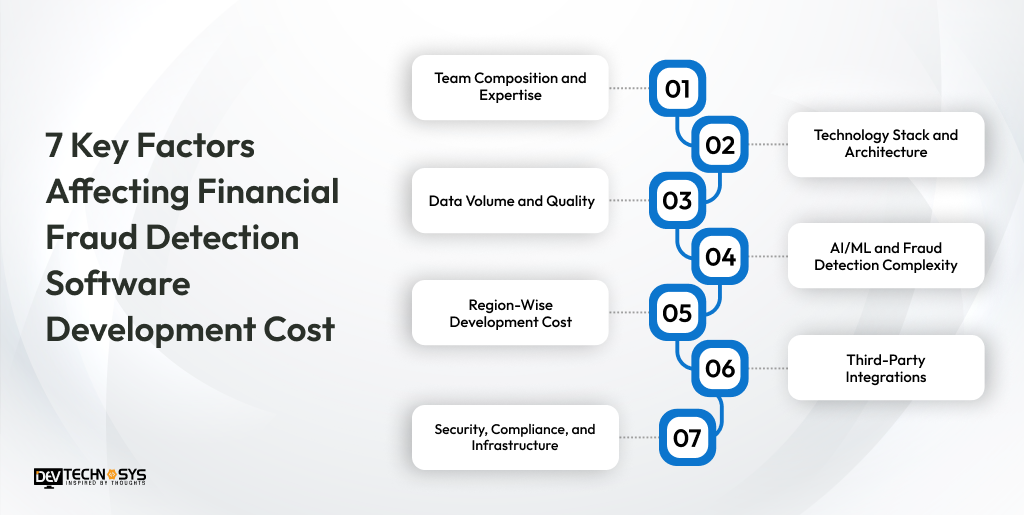
1. Team Composition and Expertise
Fintech software development companies in USA include:
- Business analysts
- UI/UX designers
- Frontend and backend developers
- Artificial Intelligence (AI)/Machine Learning (ML) engineers
- QA engineers
- Cybersecurity specialists
- Project managers.
A larger team with specialized fraud-detection expertise generally increases the fraud detection system development cost. However, it can support more complex requirements.
2. Technology Stack and Architecture
The selection of databases, programming languages, frameworks, cloud services, and architecture impacts financial fraud detection system cost. For example, microservices architecture can support scalable fraud detection systems. Cloud computing offers infrastructure for high-volume transaction processing.
3. Data Volume and Quality
A fraud detection system relies significantly on transaction and behavior data. A payment software development company states that large datasets demand better data storage, data processing, and data analytics. The processes of data mining, big data analytics, feature engineering, and ETL pipelines could also demand additional efforts.
4. AI/ML and Fraud Detection Complexity
The expense of a rule-based system is lower compared to a system that uses machine learning, deep learning, predictive analytics, or neural networks. Additionally, sophisticated systems need to undergo several processes that increase fraud detection software development pricing. It includes processes such as data preparation, modeling, testing, monitoring, and enhancement, among others.
5. Region-Wise Development Cost
The rate to hire dedicated software developers differs based on geography. When businesses work with developers from the US or Australia, they will most likely incur higher rates compared to those that work with developers from India. This is why geographic location affects the cost of developing financial fraud detection software.
Region |
Approx. Developer Rate |
Relative Cost Level |
| USA | $80–$150+/hour | Very High |
| UK | $70–$130/hour | High |
| Australia | $60–$120/hour | High |
| UAE | $50–$100/hour | Moderate–High |
| India | $20–$80/hour | Low–Moderate |
6. Third-Party Integrations
Businesses should link software with banking systems, payment gateways, Know Your Customer services, credit bureaus, ID verification solutions, and other financial applications. It involves extra fraud prevention software development cost and testing effort. Integration and REST APIs will make it easier, though the cost of licensing third-party software may appear to be extra.
7. Security, Compliance, and Infrastructure
The data used in such systems is very sensitive. Security becomes an important component of cost to consider in the development of financial fraud detection software. Some security-related costs include:
- End-to-end encryption
- Database encryption
- Tokenization
- Access controls
- Security testing
- Compliance testing
- Continuous monitoring
Cost Driver |
Estimated Cost |
Budget Pressure |
What Drives the Cost |
| Team Composition & Expertise | $5,000–$20,000 | High | Specialized Artificial Intelligence (AI) and domain expertise |
| Technology Stack & Architecture | $5,000–$15,000 | Medium–High | Custom and scalable architecture |
| Data Volume & Quality | $3,000–$12,000 | Medium | Data preparation and processing needs |
| Development Region | $8,000–$30,000 | High | Developer rates and talent availability |
| AI/ML & Fraud Detection Complexity | $8,000–$25,000 | Very High | Model complexity and real-time detection |
| Third-Party Integrations | $3,000–$15,000 | Medium–High | Number and complexity of external APIs |
| Security, Compliance & Infrastructure | $5,000–$20,000 | High | Compliance, security, and cloud requirements |
How Do Security & Compliance Affect the Fraud Monitoring Software Development Cost?
According to the best fraud detection software development companies, security and compliance significantly affect the real-time fraud detection software cost. Businesses should allocate approximately $5,000 to $20,000 for security and compliance requirements. Strong data protection, access controls, testing, and regulatory requirements add development effort and certification expenses. Here, we have explained the cost structure of important security measures and compliance needed for real-time fraud detection.
Security Measures Needed for Financial Fraud Detection Software
Security Measure |
Purpose |
Estimated Cost |
| End-to-End Encryption | Secures data during transmission | $1,000–$3,000 |
| Database Encryption | Protects stored financial and customer data | $800–$2,500 |
| Tokenization | Replaces sensitive payment data with tokens | $1,500–$4,000 |
| Multi-Factor Authentication (MFA) | Adds an extra layer of user security | $500–$2,000 |
| Role-Based Access Control (RBAC) | Restricts access based on user roles | $800–$2,500 |
| API Security & Authentication | Secures third-party integrations and APIs | $1,000–$3,000 |
| Security Testing & Penetration Testing | Identifies vulnerabilities before launch | $2,000–$5,000 |
Important Compliance Requirements for Financial Fraud Detection Software
Security & Compliance Requirement |
Purpose |
Estimated Cost |
| ISO 27001 | Strengthens information security management and controls | $2,000–$4,000 |
| ISO Compliance | Supports standardized quality, security, and operational processes | $1,500–$3,000 |
| SOC 1 | Supports controls related to financial reporting processes | $1,500–$3,000 |
| SOC 2 | Validates security, availability, and data protection controls | $2,000–$5,000 |
| GDPR | Protects personal data and privacy requirements | $1,500–$3,500 |
| CCPA | Supports consumer privacy and data protection requirements | $1,000–$3,000 |
| Security Testing & Penetration Testing | Identifies vulnerabilities before deployment | $2,000–$4,000 |
| Encryption & Access Controls | Protects sensitive financial data and restricts unauthorized access | $1,500–$3,500 |
Note: Security and compliance under SOC 1, CCPA, ICO27001, and GDPR frameworks are part of our engineering culture, not a separate department.
Planning a Mobile App?
Get a tailored development cost estimate in 3 simple steps — app basics, features, timeline, and your contact details.
- 3 quick steps
- 100% free
- Reply in 1 business day
2 Minutes Read
What Are The Hidden Costs That Affect The Financial Fraud Detection Software Development Budget?
Even after businesses estimate every aspect of development, several hidden costs emerge and disrupt the budget. This includes storage, retraining, disaster recovery, and several other costs that impact the transaction monitoring software development budget. These costs usually appear during development, scaling, and ongoing operations. Considering these expenses helps businesses avoid unexpected budget increases.
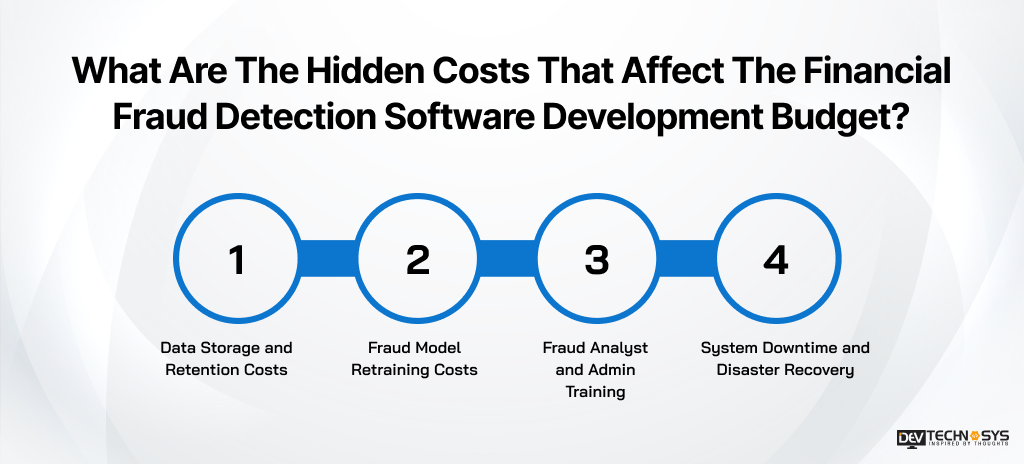
1. Data Storage and Retention Costs
Companies that build fraud detection software generate systems that store large volumes of transaction, user, alert, and investigation data. With the growing data, businesses also require additional storage, backup, archival, and retention capabilities. This significantly increases the ongoing infrastructure expenses.
2. Fraud Model Retraining Costs
With evolving technologies, attackers change their fraud patterns with new techniques. That’s why AI/ML-based systems require regular model retraining, feature updates, validation, and performance monitoring. This helps maintain suspicious transaction detection accuracy over time but increases the budget.
3. Fraud Analyst and Admin Training
Advanced fraud monitoring software generally includes training for fraud analysts, administrators, and compliance teams. With training, users can easily understand alerts, case workflows, risk scores, and investigation tools. However, fraud analyst and admin training can create additional implementation costs.
4. System Downtime and Disaster Recovery
Financial fraud detection software must remain available when transactions are being processed. Due to this, businesses might demand backup environments, disaster recovery systems, failover mechanisms, and recovery testing. This helps them minimize operational disruption during outages or unexpected failures.
How Do False Positives Affect Financial Fraud Detection Software Development Cost?
A false positive is a situation where a true or legitimate transaction and user are mistakenly flagged as fraudulent. These false alerts usually increase the cost of manual reviews, delay genuine transactions, and elevate unnecessary customer support work. That’s why top fintech fraud detection companies create a well-designed artificial intelligence and machine learning fraud detection system. These systems use accurate risk scoring and behavioral analysis to reduce false positives while maintaining strong fraud detection.
False Positive Scenario |
What It Can Cost the Business |
| A genuine transaction gets blocked | Lost revenue and a frustrated customer |
| Low-risk alerts flood the fraud team | Analysts spend valuable time investigating harmless activity |
| Customers are asked to verify too often | Extra friction can reduce trust and retention |
| Payments are delayed for verification | Customers may abandon purchases or switch providers |
| Support tickets increase | More staff time is needed to resolve fraud-related complaints |
| Legitimate accounts are temporarily restricted | Lost customer activity and additional recovery work |
| Fraud analysts face alert fatigue | Critical suspicious transactions may receive slower attention |
| High false-positive rates require constant tuning | Additional development and optimization effort |
| Risk controls become overly aggressive | Businesses may lose genuine customers while trying to prevent fraud |
| Poor detection accuracy affects customer trust | Higher churn and potential long-term revenue loss |
Industry Insight:
Excessive false positives can erode customer trust and lead to abandoned transactions, while unnecessary alerts can also increase costly manual reviews.
What Does It Cost a Business to Operate Without Fraud Detection Software?
Every budget sheet includes the cost of fraud detection software. But it doesn’t contain the cost of not having it. If automated fraud monitoring is not available, businesses depend on manual checks, which lead to delayed investigations. As transaction volumes grow, this approach can leave suspicious activity unnoticed for longer. This can increase the potential financial and operational impact of fraud.
Without Automated Fraud Detection |
Potential Business Impact |
| Suspicious transactions remain unnoticed | Greater exposure to financial losses |
| Fraud investigations take longer | Higher operational workload |
| Manual transaction reviews increase | More staff time and expenses |
| Account takeover may go undetected | Customer accounts and trust can be affected |
| Fraud patterns are identified late | Slower response to emerging threats |
| More fraudulent payments reach processing | Higher risk of chargebacks and reversals |
| Customers experience security issues | Increased churn and reputational damage |
| Fraud monitoring depends heavily on manual checks | Limited ability to monitor transactions at scale |
| Emerging fraud techniques are harder to identify | Greater exposure to new and evolving threats |
| Suspicious activity is discovered after the damage occurs | Higher recovery and investigation costs |
| Fraud teams lack centralized risk visibility | Slower decisions and fragmented investigations |
The Bigger Cost: Delayed Fraud Response
The biggest problem is not always a single fraudulent transaction. It can be the time between the first warning sign and the moment a business responds. A modern fraud monitoring system can continuously;
- Evaluate transactions
- Identify unusual patterns
- Assign risk levels
- Send alerts for further investigation.
For banks, fintech companies, and other high-volume financial platforms, investing in fraud detection software can be a risk-control expense. The right system helps businesses detect threats earlier, reduce manual effort, and protect revenue as transaction volumes increase.
Free App Idea Reality Check: Let's Stress-Test Your Concept
Share your app idea with us. Within 3 business days, we'll uncover UX gaps, feature opportunities, and potential development challenges, so you can build with confidence. No strings attached.
Build vs Buy vs Partner: Comparing Software Costs, Flexibility, and Long-Term Value
How you decide to develop software will influence your budget just as much as the features you pick. In general, businesses have three choices for developing software. They can develop a software package themselves, purchase one, or collaborate with top financial fraud detection software companies. These three methods have their unique upfront cost, level of customization, time for implementation, and recurring costs. Comparing all these elements will help you make an informed decision.
Approach |
Estimated Initial Cost |
Time to Launch |
Customization |
Long-Term Cost Outlook |
| Build | $80,000–$250,000+ | 6–12+ months | Very High | Higher maintenance and development investment |
| Buy | $10,000–$50,000+ | 1–4 months | Low–Medium | Recurring licensing, subscription, and customization costs |
| Partner | $30,000–$150,000+ | 3–8 months | High | Moderate, depending on support and feature expansion |
How to Reduce Fraud Detection Software Development Cost Without Cutting Corners?
Decreasing the custom fraud detection software cost doesn’t mean removing essential security and fraud detection system features. It means using a smarter approach to control unnecessary development work and reuse proven components. In this approach, businesses focus on the areas that directly improve fraud detection and business value. Here are practical ways to reduce costs without compromising software quality or protection.
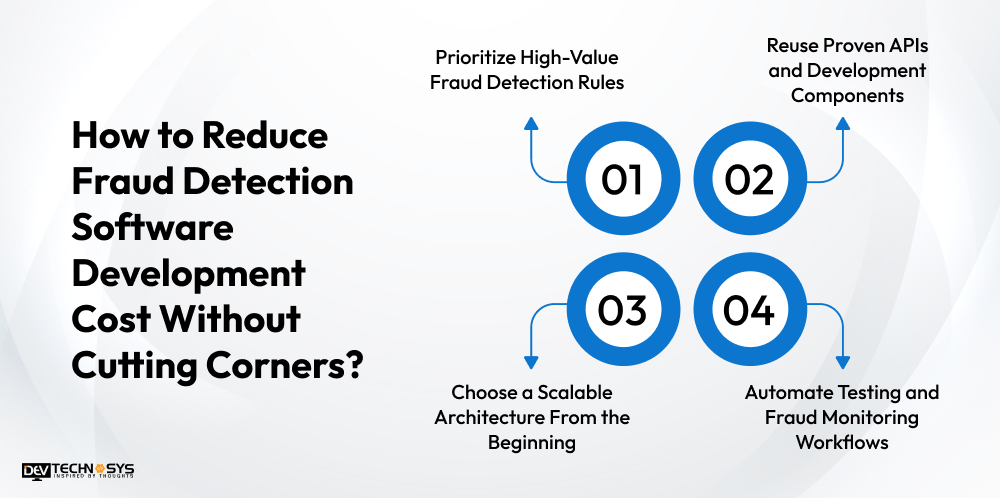
1. Prioritize High-Value Fraud Detection Rules
There is no need to address each fraud detection scenario from day one. Businesses must start with the identification of fraud patterns that create the greatest risk. Also, they should prioritize the corresponding detection rules. This makes developers focus resources on high-impact functionality rather than building complex capabilities.
2. Reuse Proven APIs and Development Components
Developing every single component from scratch can increase AI fraud detection software cost and timeline. Enterprises can integrate reliable third-party services for identity verification, payment processing, notifications, data enrichment, and other supporting functions. Reusing tested components allows the development team to spend more time on the fraud detection logic
3. Choose a Scalable Architecture From the Beginning
If the architecture is poorly planned, it can become expensive as transaction volumes increase. Businesses can even use a modular or microservices-based architecture. This way, they can make individual components easier to update and scale. This can reduce the need for major system restructuring as the fraud monitoring platform grows.
4. Automate Testing and Fraud Monitoring Workflows
Manual testing and repetitive operational processes can consume significant development resources. Automated testing can identify software issues earlier, while automated workflows can reduce repetitive tasks such as alert handling and data validation. This improves development efficiency while helping maintain consistent system performance.
From Fraud Risk to Real-Time Protection: Why Choose Dev Technosys?
When opting for one of the companies to build fraud prevention software, businesses require more than expertise. They also need someone who knows about transaction security, fraud detection possibilities, scaling, and associated challenges.
Dev Technosys specializes in developing secure and scalable software solutions tailored to the client’s needs. As opposed to simply stating the capabilities, we believe project results show the true picture much better.
Our projects related to financial technologies have enabled clients to achieve some tangible results, such as:
- Up to 30% faster fraud alert processing time,
- 40% decrease in the number of manually processed transactions,
- 95%+ accuracy in fraud transaction monitoring.
This data is relevant to the solutions we have implemented for our clients. It may vary according to transaction volume, solution architecture, fraud detection policies, integrations, data availability, and client needs.
Frequently Asked Questions
Find answers to the most common questions related to this article.
Yes. To distinguish legitimate activity from suspicious transactions, financial fraud detection software can use:
Risk scoring
Behavioral analysis
Anomaly detection
Adaptive rules
Once the false positives are reduced, businesses can lower manual review workloads and prevent unnecessary transaction declines. It also provides customers with a more convenient and seamless payment experience.
Yes. A properly designed fraud detection platform can be built to process high transaction volumes. For this, businesses can use scalable architecture, real-time processing, optimized databases, and distributed infrastructure. The required architecture depends on transaction volume, response-time requirements, data complexity, integration needs, and the number of users and financial channels.
The average financial fraud detection software development cost can be estimated from $30,000 to $1,50,000. The final AI and machine learning fraud detection software cost is determined by the platform’s complexity and other factors. These factors include platform choice, security & compliance, backend infrastructure, after-launch support, third-party integrations, and so on.
Financial fraud detection software can identify several fraud types, including:
Payment fraud
Account takeover
Identity theft
Transaction fraud
Card fraud
Loan application fraud
Synthetic identity fraud
Suspicious account activity
The detection of the exact fraud type depends on the rules, risk models, data sources, and detection methods integrated into the platform.
Yes. Financial fraud detection software can be integrated with existing banking, payment, transaction processing, identity verification, and CRM systems. They are connected through APIs and other integration methods. The integration effort and cost depend on the number of systems involved. Also, it depends on API availability, data formats, security requirements, and the complexity of the existing infrastructure