


















Quick Fintech Software Development Cost Summary
- Overall Cost Range:
Fintech software development cost in 2026–2027 typically ranges from $30,000 to $150,000+, depending on the software type, features, security, integrations, and compliance requirements.
Cost Breakdown by Complexity:
-
-
- Basic/MVP Software: $30,000–$60,000
Essential features such as user registration, dashboards, basic payments, and account management.
-
- Mid-Level Software: $60,000–$100,000
Advanced payments, financial API integrations, analytics, automation, and stronger security.
-
- Advanced Fintech Software: $100,000–$150,000+
Complex financial workflows, real-time transactions, AI capabilities, enterprise integrations, and advanced compliance.
-
Key Cost Factors:
The main factors affecting fintech software development cost are features, UI/UX design, financial APIs, third-party integrations, cybersecurity, regulatory compliance, cloud infrastructure, and development platforms.
Development Timeline:
Building fintech software typically takes 3 to 12+ months, depending on the project scope, number of platforms, integrations, and compliance requirements.
Regional Cost Rates:
Fintech development rates vary by location. India can be 40–60% more cost-effective than the US or Western Europe while offering access to experienced fintech development teams.
Additional Costs:
Beyond development, businesses should budget for annual maintenance, cloud hosting, API usage, security monitoring, compliance audits, technical support, and feature upgrades.
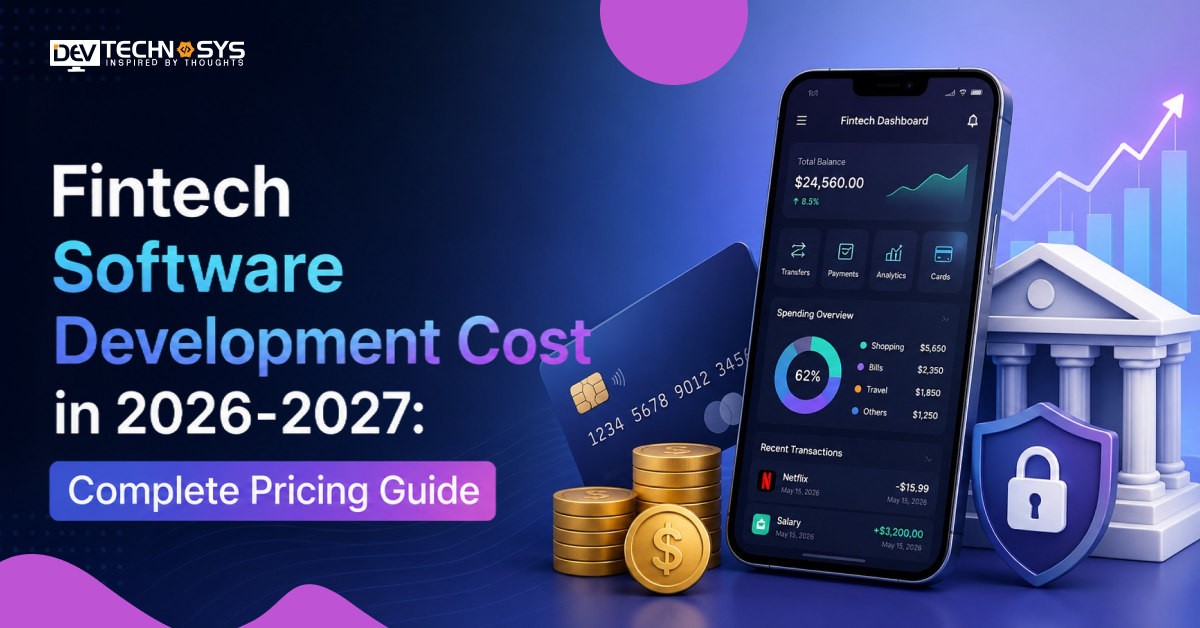
Operating banks while visiting branches, standing in queues, dealing with paperwork, filling forms, and waiting days is outdated. In 2026-2027, banks have been transformed into fintech software that makes banking accessible anytime, anywhere. It allows users to make payments, invest, and manage finances seamlessly through a smartphone.
This transition has led financial institutions, fintech businesses, and startups to invest in developing fintech software. But the first question that comes to mind is: How much does it cost to build fintech software?
The standard fintech software development cost can be estimated from $30,000 to $1,50,000. The overall development expenses depend on:
- Software type
- Number of features
- Integrations
- Security
- Compliance requirements
Whether planning to build an MVP or an enterprise-grade fintech software, understanding the cost structure is mandatory. The fintech software development cost breakdown 2026-2027 includes cost factors, timeline, additional expenses, and more. This guide will help you plan your investment confidently.
What is Fintech Software and Why Does Its Development Matter in 2026-2027?
Fintech software is a digital-first financial solution. It allows users and businesses to manage, perform, and automate financial activities online. It can strengthen:
- Digital banking
- Receiving payments
- Loan lending
- Investment management
- Insurance
- Wealth management
- Money transfers and other financial services
Developing banking software with enterprise-grade security engineering in 2026-2027 is becoming increasingly important. Now, businesses can focus on delivering faster, more convenient, secure, and personalized financial experiences.
Fintech Software Development Matters in 2026-2027 Due To:
- Digital-First Financial Services
- Faster Transactions
- Better Customer Experience
- Improved Security
- Business Automation
- Regulatory Readiness
- Scalable Growth
Industry Insight:
According to Mordor Intelligence, the fintech software market was valued at USD 278.31 billion in 2025. It is now predicted to reach USD 652.80 billion by 2030.
What Is the Cost of Fintech Software Development: Cost by Complexity, Business Size, and Scope
The average fintech software development cost ranges between $30,000 and $1,50,000. The overall development budget is determined by the three main segments:
- Platform complexity
- Size of the Enterprise
- Type of Scope
We will understand fintech software cost estimation by complexity, size, and scope one by one:
1. Fintech Software Development Pricing By Complexity
As per fintech software development companies, the cost to develop fintech software is affected by the complexity involved in development. The complexity is estimated by the number of features, integrations, and security needs. Understand it this way:
- A basic app follows an MVP structure and has limited but core additions, making it less complex to develop.
- A mid-level app combines both basic and advanced integrations, making it moderately complex to build.
- An advanced app with high-tech features, AI, modern technologies, and the latest integrations is highly complex to build.
Development Level |
What You Get |
Typical Features & Integrations |
Estimated Cost |
| Basic / MVP Fintech Software | A focused solution with essential financial functionality | User registration, profiles, dashboards, basic payments, transaction history, notifications, essential security | $30,000–$75,000 |
| Mid-Level Fintech Software | A more scalable platform with advanced financial workflows | Payment gateways, financial APIs, KYC/AML integration, analytics, automated transactions, multi-factor authentication | $75,000–$110,000 |
| Advanced Fintech Software | A feature-rich and enterprise-ready financial ecosystem | AI-driven features, real-time transactions, fraud detection, advanced analytics, multiple API integrations, automation, risk management | $110,000–$150,000+ |
2. Fintech Software Development Price By Business Size
The size and level of the business is crucial in determining the fintech software development cost estimate. A fintech software development company suggests that the business size determines what requirements are needed and how much.
- A startup or small business usually focuses on developing an MVP to test its idea in the market.
- A growing, mid-level application requires more integrations and automation.
- An enterprise usually demands a highly scalable microservices architecture, advanced security, and extensive regulatory support.
Business Size |
Typical Requirements |
Estimated Development Cost |
| Startup / Small Business | MVP development, core financial features, basic integrations, essential security | $30,000–$70,000 |
| Growing Business | Advanced features, financial APIs, automation, analytics, multiple integrations | $70,000–$115,000 |
| Enterprise | Scalable architecture, real-time processing, advanced security, complex integrations, regulatory compliance | $115,000–$150,000+ |
3. Fintech Software Development Quote By Scope Type
The scope is another major factor that determines the final cost to build fintech software. Usually, a software project with limited functionality requires fewer development resources. Whereas a feature-rich platform with complex financial workflows needs significantly more time and expertise.
Project Scope |
Development Scope |
Estimated Cost |
| MVP Development | Core features, basic UI/UX, user accounts, essential payments, and limited integrations | $30,000–$50,000 |
| Custom Fintech Software | Advanced features, multiple APIs, payment integrations, analytics, automation, and enhanced security | $50,000–$90,000 |
| Advanced Fintech Platform | AI capabilities, real-time processing, fraud detection, complex integrations, and regulatory compliance | $90,000–$120,000+ |
| Enterprise Fintech Ecosystem | Multi-platform infrastructure, high-volume transactions, extensive integrations, advanced security, and enterprise compliance | $120,000–$150,000+ |
Planning a Mobile App?
Get a tailored development cost estimate in 3 simple steps — app basics, features, timeline, and your contact details.
- 3 quick steps
- 100% free
- Reply in 1 business day
2 Minutes Read
Fintech Software Development Cost by App Type: Complete 2026–2027 Breakdown
Every software development firm believes that the fintech software development cost estimate 2026- 2027 varies by type. BNPL, insuretech, neobank, and crypto wallet are among the most common types of fintech software. The overall cost varies because each platform serves different purposes. Each needs separate financial APIs, security controls, compliance workflows, and user-facing features. Here is the practical fintech software development cost breakdown by type.
Fintech App Type |
Primary Purpose |
Development Cost |
Complexity |
Major Cost Driver |
| Neobank | Digital banking without traditional branches | $80,000–$150,000 | High | Banking APIs, KYC/AML, card management, transaction infrastructure |
| Payment App | Send, receive, and manage digital payments | $45,000–$90,000 | Medium | Payment gateways, transaction processing, wallets, fraud controls |
| BNPL App | Split purchases into manageable installments | $50,000–$100,000 | Medium–High | Credit assessment, repayment engine, merchant integrations |
| Robo-Advisor | Automate investment and portfolio management | $60,000–$120,000 | High | Investment algorithms, risk profiling, market-data APIs |
| Insurtech App | Digitize insurance, policy, and claims management | $50,000–$130,000 | Medium–High | Policy workflows, claims processing, insurer integrations |
| Lending App | Manage digital loans from application to repayment | $50,000–$110,000 | Medium–High | Credit scoring, eligibility checks, KYC, lending APIs |
| Crypto Wallet | Store, send, receive, and manage digital assets | $40,000–$100,000 | High | Blockchain integration, transaction security, token support |
Total Cost of Ownership: What Your Fintech App Really Costs Over 3 Years
Understanding total cost of ownership (TCO) means getting the full cost structure to run a fintech software after launch. It generally includes the initial development cost along with every recurring expense for three years. Many businesses focus on launch costs and overlook what it takes to run the software afterward.
The formula to calculate TCO is:
TCO = Development Cost + (Annual Compliance + Annual Infrastructure + Annual Support + Annual Feature Updates) × 3 years
It is time to analyze what exactly goes into the ongoing fintech software cost:
Cost Category |
Typical Annual Cost |
Why It Recur |
| Compliance Renewals (PCI DSS, SOC 2 audits) | $8,000–$25,000 | Certifications expire and require periodic re-audits |
| Cloud Hosting & Infrastructure Scaling | $6,000–$40,000 | Infrastructure costs increase as users and transaction volumes grow |
| Third-Party API & Data Provider Fees | $4,000–$20,000 | Payment rails, KYC checks, banking APIs, and data services often charge based on usage |
| Security Monitoring & Penetration Testing | $5,000–$15,000 | Fintech applications require recurring security checks and testing |
| Bug Fixes & Maintenance | 15–20% of build cost | Software requires ongoing maintenance, updates, and technical fixes |
| Feature Updates & Iteration | $10,000–$50,000 | New features and improvements help the platform adapt to business and user needs |
Have a look at the 3-year Total Cost of Ownership (TCO) breakdown:
Year |
What It Covers |
Estimated Cost |
| Year 1 (Build) | Development, testing, launch, and initial compliance | $30,000–$150,000+ |
| Year 2 (Maintenance) | Hosting, security, maintenance, and compliance updates | $18,000–$53,000 |
| Year 3 (Growth) | Scaling, security testing, updates, and new features | $25,000–$75,000 |
Expert Advice:
Budget 20 to 25% of year-one costs for post-launch expenses before development starts. Ask your dev partner for a written year-two cost estimate, not just a build quote. Founders who plan TCO upfront typically spend 15 to 20% less over three years than those who treat it as an afterthought.
Mohit Nag (CTO at Dev Technosys)
7 Key Factors That Influence Fintech Software Development Cost
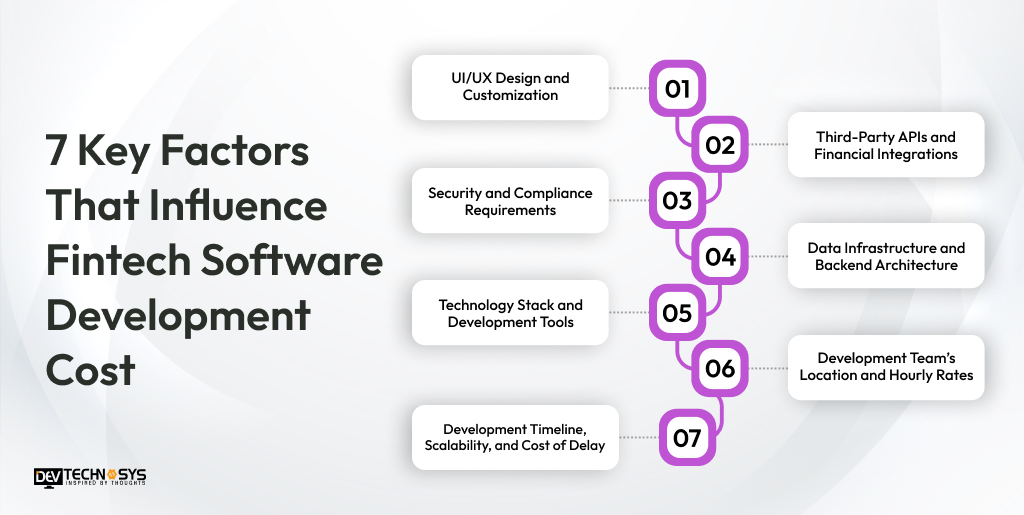
UI/UX, APIs, security measures, and backend infrastructure are among the major factors impacting the cost to develop banking software. Many top fintech software development companies believe that every project has different requirements. Some requirements can keep the development budget low, while others increase it. In this section, we are explaining some of these factors, showing their impact on fintech development cost.
1. UI/UX Design and Customization
Developing and designing a simple interface for financial technology solutions with standard screens is less expensive. Custom dashboards, personalized user journeys, interactive financial charts, and accessibility features demand more effort for development and design. With the growing customized screens and users, the overall fintech software development cost rises.
2. Third-Party APIs and Financial Integrations
Some of the common third-party API integrations in a fintech platform include:
- Payment gateways
- Banking APIs
- KYC providers
- Credit bureaus
- Accounting systems
Integrating each of them needs proper development, testing, security validation, and ongoing management. More fintech API, banking API, and third-party API means the fintech software cost increases.
3. Security and Compliance Requirements
Every fintech software manages sensitive financial and personal data of users. They need stronger protection than any standard business application. A fintech app requires data encryption, multi-factor authentication, fraud detection, secure transaction processing, and audit trails. It also demands compliance requirements such as PCI DSS, KYC, and AML. All these increase development time, effort, and cost.
4. Data Infrastructure and Backend Architecture
A fintech software needs a strong backend architecture that includes:
- Real-time transactions
- High transaction volumes
- Complex databases
- Analytics
- Data synchronization
- Backup requirements
Also, fintech or loan management software development demands an infrastructure that can process large volumes securely and reliably. A scalable data infrastructure and backend architecture can increase development, cloud, and testing expenses.
5. Technology Stack and Development Tools
Major companies that build fintech software select strong technologies for frontend, backend, databases, cloud infrastructure, and deployment. This requires specialized frameworks, enterprise-grade platforms, advanced cloud services, technologies, and experienced developers. This selection can affect both development efforts and fintech software development expenses while providing the scalability fintech software needs.
6. Development Team’s Location and Hourly Rates
A developer’s per-hour rates vary depending on their location, expertise, and project requirements. You can hire dedicated software developers from the US, UK, Australia, North America, and Western Europe. The per-hour cost of developers in these regions is higher. Whereas developers from Asia, Latin America, Eastern Europe, and Africa are less expensive. Developers’ location and hourly prices can affects the final development budget.
7. Development Timeline, Scalability, and Cost of Delay
Longer development timelines generally require more engineering hours, testing, project management, and infrastructure spending. Building for future scalability can also require additional architectural and performance work up front. Delaying the launch may further increase business costs through postponed revenue, customer acquisition, and market opportunities. This makes timeline planning an important cost consideration.
Fintech Software Development Cost: 7 Major Cost Factors
Cost Factor |
Estimated Cost |
Budget Impact |
Key Cost Area |
Planning Priority |
| UI/UX Design & Customization | $5,000–$20,000 | Moderate–High | Interface, user journeys, dashboards | High |
| Third-Party APIs & Financial Integrations | $4,000–$12,000 | Moderate | Banking, payment, KYC, financial APIs | High |
| Security & Compliance Requirements | $6,000–$21,000 | High | Data protection, PCI DSS, KYC/AML | Critical |
| Data Infrastructure & Backend Architecture | $10,000–$25,000 | High | Databases, APIs, cloud, scalability | Critical |
| Fintech Technology Stack & Development Tools | $5,000–$15,000 | Moderate | Frameworks, cloud services, development tools | Medium–High |
| Development Team’s Location & Hourly Rates | $10,000–$23,000 | High | Developer expertise and team composition | High |
| Development Timeline, Scalability & Cost of Delay | $6,000–$10,000 | Moderate | Development hours, scalability planning, launch timing | High |
How Much Do Fintech Security and Compliance Requirements Cost?
The average cost to implement security measures and compliance for fintech software ranges between $5,000 and $20,000. It is a crucial investment in fintech software development to protect financial data, secure transactions, and reduce regulatory risks. Here, we have explained the key compliance and security requirements that influence fintech software development rates.
Key Security Measures That Add to Development Cost
In 2026-2027, fintech software requires more than just a basic security login. It must protect sensitive financial data, prevent fraud, comply with industry regulations, and maintain reliable access for users. We have mentioned some of the major security measures that increase the fintech software development budget.
- End-to-End Encryption
- Multi-factor authentication (MFA)
- Tokenization
- Fraud detection
- Role-based access control (RBAC)
- Audit trails
- Secure API integration
- Security monitoring
- Penetration testing
- AES-256 encryptionSSL/TLS
- Two-factor authentication (2FA)
- OAuth 2.0
- Identity and access management (IAM)
Key Fintech Software Compliance Requirements and Costs
Requirement |
Estimated Cost |
Purpose |
| PCI DSS | $3,000–$10,000 | Protect payment card and transaction data |
| ISO 27001 | $3,000–$10,000 | Strengthen information security management systems |
| SOC 1 & SOC 2 | $3,000–$15,000 | Ensure financial and security controls |
| GDPR & CCPA | $2,000–$7,000 | Protect personal data and privacy rights |
| KYC & AML | $3,000–$12,000 | Verify customers and prevent financial crime |
| PSD2 | $3,000–$10,000 | Secure payments and support open banking API |
| RBI Guidelines | $3,000–$10,000 | Meet Indian payment and fintech regulations |
| NIST Framework | $2,000–$8,000 | Identify and manage cybersecurity risks |
Note: We follow ISO 27001, SOC 1, SOC 2, CCPA, and GDPR-aligned practices as a matter of course across projects of every size and scope.
Why Security & Compliance Should Be Planned Early and What If It Is Addressed Later?
It is mandatory to plan security and compliance from the very beginning of your fintech project. If you define the requirements during the planning stage, it helps development teams to build everything directly into the architecture.
If businesses take security and compliance as an afterthought or address it later, they have to face:
- Costly redesigns
- Additional testing
- Integration changes
- Delayed launches
- Difficulties obtaining required certifications or approvals
They may also risk data breaches, regulatory penalties, legal action, reputational damage, and loss of customer trust.
Hidden Costs of Fintech Software Development Every Business Should Know
Fintech software development pricing models don’t always cover every expense that appears throughout the process. These hidden costs arise when requirements change, regulations evolve, or the product nears launch. These unexpected expenses can affect your final budget if they are not considered early. We will now learn about some of these hidden expenses that affect the fintech software development cost for startups or enterprises.
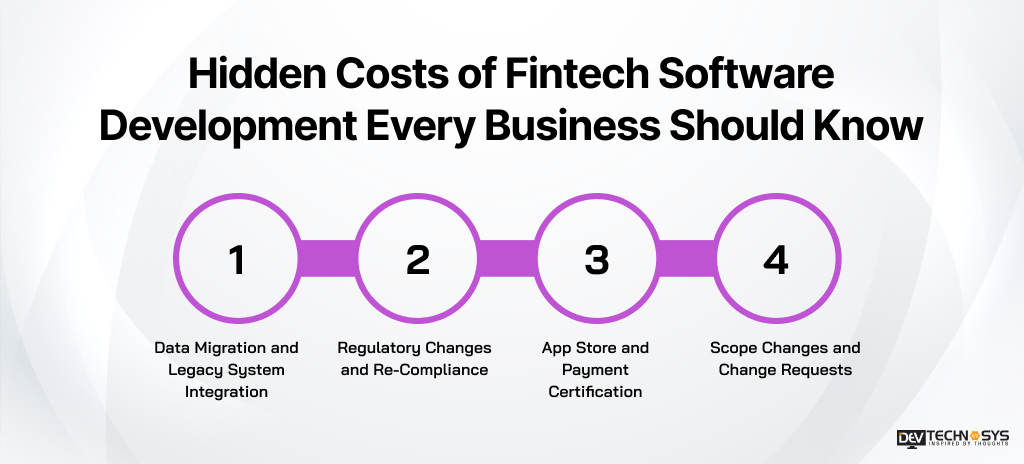
1. Data Migration and Legacy System Integration
Transferring customer, transaction, or financial records from an existing system to a new one is quite complicated. It demands data cleaning, transformation, validation, and custom integration work. If the legacy system is poorly documented, it requires additional analysis and troubleshooting.
2. Regulatory Changes and Re-Compliance
Existing requirements need to be updated to comply with the new financial regulations. These might require software modifications, additional audits, documentation, and compliance testing after development begins. These updates can also affect product workflows, security controls, and reporting processes.
3. App Store and Payment Certification
Before going live, some specific fintech solutions necessitate additional certification, review, or approval. These are provided by app stores, payment processors, and other third-party providers before launch. To meet these requirements, businesses have to deal with extra development, testing, and documentation.
4. Scope Changes and Change Requests
New features, redesigned workflows, additional integrations, or changes should be requested before development. Implementations after the project starts can increase development hours and extend the project timeline. Even minor changes may affect testing, documentation, and previously completed functionality.
Planning a Mobile Banking App Project?
Get a tailored development cost estimate in a few simple steps.
- 3 quick steps
- 100% free
- Reply in 1 business day
2 Minutes Read
How Development Timeline Affects Your Fintech Software Development Budget?
The standard time taken by the best fintech software developers to build fintech software is between 3 and 7+ months. The development timeline also determines the cost to create fintech software. This is because longer projects require more design, development, testing, project management, and refinement. We will now understand how the development timeline influences the financial software development budget.
Development Stage |
Basic App |
Mid-Level App |
Enterprise App |
| Requirement Analysis | 1–2 weeks | 2–3 weeks | 3–4 weeks |
| UI/UX Design | 2–3 weeks | 3–4 weeks | 4–6 weeks |
| Architecture & Tech Planning | 1–2 weeks | 2–3 weeks | 3–4 weeks |
| Backend Development | 4–6 weeks | 6–8 weeks | 8–12 weeks |
| Frontend & App Development | 4–6 weeks | 6–8 weeks | 8–12 weeks |
| API & Third-Party Integration | 2–3 weeks | 3–5 weeks | 5–8 weeks |
| Security & Compliance Testing | 2–3 weeks | 3–4 weeks | 4–6 weeks |
| QA, Deployment & Launch | 2–3 weeks | 3–4 weeks | 4–6 weeks |
| Total Timeline | 3–4 months | 4–6 months | 7+ months |
| Development Cost | $30,000–$60,000 | $60,000–$100,000 | $100,000–$150,000+ |
| Post-Launch Maintenance | 15–20% annually | 15–20% annually | 15–20% annually |
Build vs Buy vs Partner: Which Fintech Development Approach is More Cost-Efficient?
While investing in developing fintech software, enterprises have to choose between:
- Build the solution from scratch by an in-house team
- Buy an existing platform
- Partner with a fintech development company
Choosing to build with an in-house team can offer the utmost customization. However, it increases development costs significantly and requires more time and technical resources. Buying can reduce the development timeline but limits flexibility. Also, it makes you dependent on third-party platforms.
Whereas partnering with an experienced, reliable fintech or payment software development company is the choice of millions. It allows businesses to combine custom development with access to specialized expertise.
Most importantly, the right choice between build vs buy vs partner depends on your budget, scalability & compliance needs, and business goals. Here we explain the difference between the three.
Comparison Factor |
Build by In-House Team |
Buy a Ready-Made Solution |
Partner With Dev Technosys |
| Initial Cost | High | Low–Medium | Medium |
| Typical Investment | $100,000–$250,000+ | $20,000–$70,000+ | $30,000–$150,000+ |
| Time to Market | 6–12+ months | 1–4 months | 3–9+ months |
| Customization | Complete | Limited | High |
| Feature Control | Full control | Vendor-defined | Business-specific |
| Technical Expertise | Requires internal hiring | Included with platform | Experienced development team |
| Scalability | Built and managed internally | Depends on vendor | Planned around business growth |
| Security & Compliance | Internal responsibility | Provider-dependent | Addressed within the development scope |
| Integrations | Fully customizable | Limited to available options | Custom integrations based on requirements |
| Maintenance | Internal team manages updates | Usually provider-managed | Development and ongoing support available |
| Product Ownership | Full ownership | Depends on licensing terms | Custom software ownership |
| Best For | Enterprises with strong technical teams | Businesses needing rapid deployment | Startups, fintechs, and growing businesses |
Free App Idea Reality Check: Let's Stress-Test Your Concept
Share your app idea with us. Within 3 business days, we'll uncover UX gaps, feature opportunities, and potential development challenges, so you can build with confidence. No strings attached.
How to Reduce Fintech Development Costs Without Cutting Corners?
Businesses think reducing fintech software development expenses means removing essential security, compliance, or financial features. The best fintech software development companies take a different approach. Here, developers control development effort, avoid unnecessary rework, and build only what your users and business actually need. We have explained 4 essential strategies that reduce the budget without compromising security, scalability, and reliability.
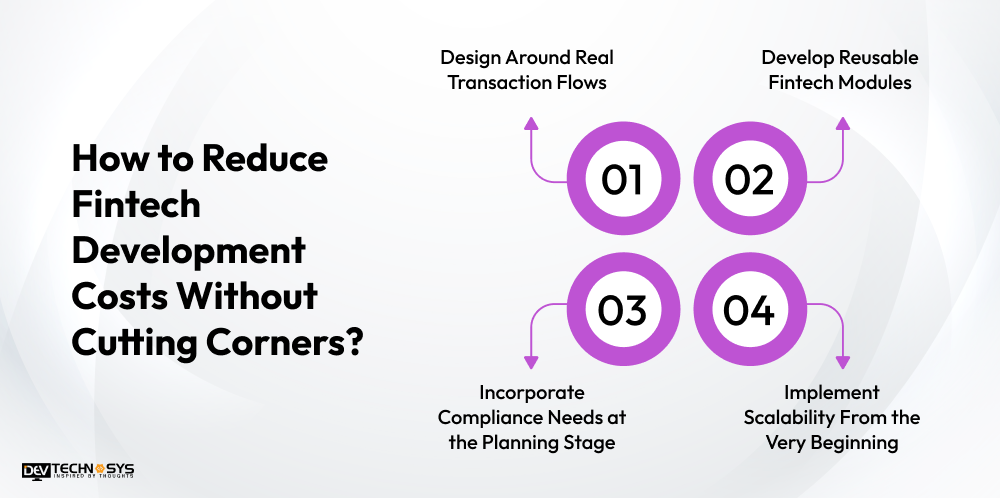
1. Design Around Real Transaction Flows
Rather than developing every single feature in the beginning, find out the features that users actually need. Analyze the main journey from signup to payment and avoid adding unnecessary screens or functions. This way, you can reduce unnecessary screens, workflows, and backend processes.
2. Develop Reusable Fintech Modules
Develop reusable modules that include authentication, payment processing, notifications, user profiles, transaction history, and reporting. With modular design, duplicate development effort will be minimized. It will be easier to add new features in the future without redesigning the old components.
3. Incorporate Compliance Needs at the Planning Stage
Incorporating compliance needs after development is completed may become costly because of additional design and development effort. Define compliance requirements for KYC, AML, PCI DSS, data privacy, audit trails, and financial data security in advance to minimize effort.
4. Implement Scalability From the Very Beginning
You do not have to develop an enterprise infrastructure from the very beginning. However, the architecture should be scalable enough for your business needs in the future. A flexible Cloud-native architecture for fintech software enables you to scale your system as transaction volume grows.
Why Dev Technosys Can Be The Right Fintech Software Development Partner?
When selecting one among the top fintech development companies, it is recommended to check their past experience and results. Dev Technosys has been working on various fintech and payments solutions that have achieved significant success, including:
- A 35% increase in transaction processing speed
- A 30% reduction in operational effort
- A 40% increase in customer involvement
- 99%+ transaction security
The data is provided based on performance standards achieved in previous fintech and payment projects. Even Live Translate Now has acknowledged Dev Technosys as one of the top fintech app development companies.
UABPay
Built a Convenient Digital Payment Platform with Fund Transfers, Bill Payments & Scan-and-Pay in 34 Weeks
How we partnered with UABPay to develop a secure and user-friendly payment platform that brings fund transfers, bill payments, mobile top-ups, cash management, and scan-and-pay services together in one convenient application.
UABPay
Payment & Digital Wallet Platform
34 Weeks
$
Challenge
Needed a simple and responsive payment platform that could support multiple financial transactions while making onboarding, navigation, and everyday payment activities easier for users.
Solution
Developed a mobile payment platform with fund transfers, cash-in/cash-out, bill payments, scan-and-pay, mobile top-ups, and online shopping capabilities, supported by a scalable backend and database architecture.
Results
- Enabled multiple payment services through one platform
- Simplified fund transfers and bill payments
- Added convenient scan-and-pay functionality
- Supported mobile top-ups and cash-in/cash-out
- Delivered the platform within 34 weeks
Frequently Asked Questions
Find answers to the most common questions related to this article.
The average cost to make fintech software in 2026-2027 is estimated at $30,000 to $1,50,000. The final budget is determined by the platform’s complexity, business size, scope, and several factors. Some of the factors include platform choice, UI/UX, security, backend architecture, tech stack, and so on. A simple MVP app is less costly than a fully featured, advanced app.
Yes, because a limited budget doesn’t mean you have to sacrifice quality. The best custom fintech software companies offer a strategic approach that never lets it happen. You should invest in critical security like data encryption, secure authentication, fraud monitoring, and access controls. Start using reusable components, scalable architecture, and carefully selected integrations. This can help manage development costs without compromising security.
One common mistake almost every entrepreneur makes is focusing only on the initial development quote. This way, they overlook expenses related to compliance updates, financial integrations, infrastructure, security testing, and future enhancements. Estimating the complete Total Cost of Ownership (TCO) from the beginning provides a clearer picture of the investment. This is really beneficial to prevent unexpected budget increases later.
Yes. Fintech software can be tailored to the regulations and financial practices of different markets globally. This can include local payment methods, currencies, data privacy requirements, KYC/AML processes, and regulatory standards. Building compliance requirements into the architecture from the beginning makes it easier to adapt the platform. This makes it easier to expand into new countries or financial markets.
If fintech software is properly planned, it can scale as users and transaction volumes increase. Cloud infrastructure, optimized databases, modular APIs, and scalable fintech software architecture can support growth. There is no need to rebuild the entire system again. However, scaling may require additional infrastructure, performance optimization, security testing, and architectural improvements as transaction volumes increase.