

















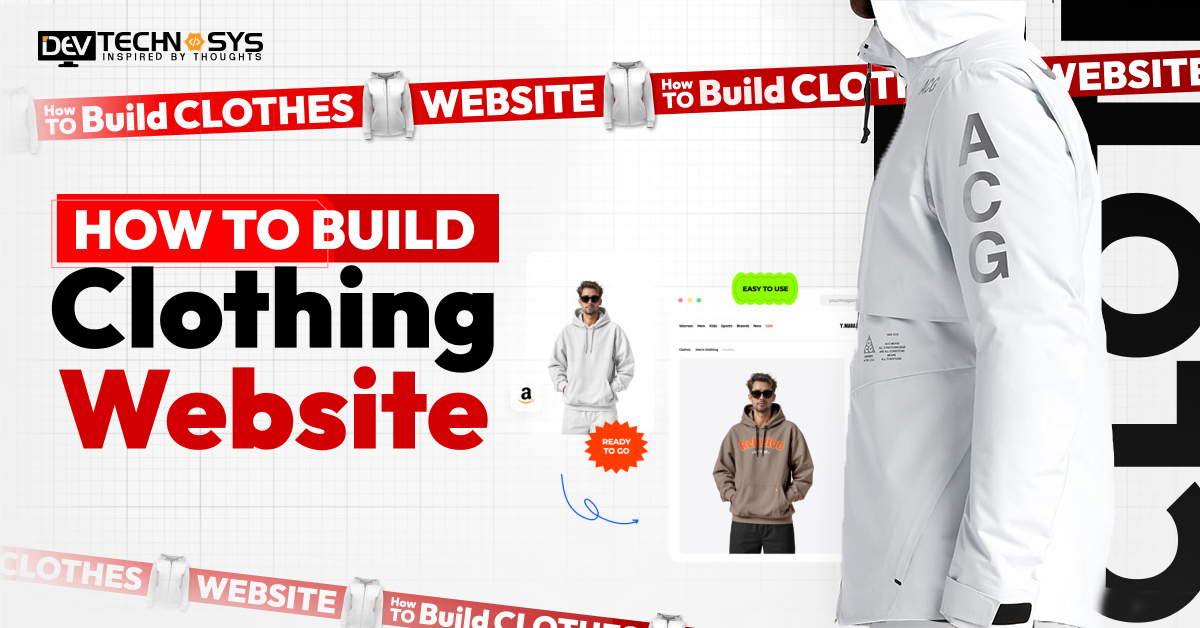
Creating an online clothing store in today’s digital-first marketplace is a smart choice for fashion brands, entrepreneurs, and retail enterprises seeking to expand their online presence and attract new customers.
According to Statista, the global fashion e-commerce market is projected to reach $1.2 trillion by 2027, underscoring the significant potential for brands to capitalize on online retail.
An effective clothing website enables businesses to showcase their products in a visually appealing manner, while also providing customers with the ideal shopping experience they desire, specifically seamless shopping experiences.
Whether your business is a start-up fashion brand or an established brand, building a clothing website requires careful planning, technology, and creative expression.
In this blog, we will take you through the step-by-step process to build a clothing website, from selecting a platform to adding important features to optimize it for performance.
What is a Clothing Website?
A clothing website is an online experience designed to allow users to explore, purchase, and learn about multiple types of clothing. Clothing and apparel websites will typically be divided into multiple categories of clothing, like men’s, women’s, and kids, with sizing, color, and brand filters available too.
Clothing websites can often provide product descriptions, product visuals, reviews, and a secure option to pay, providing users with an online clothing store shopping experience.
Want a chatbot demo or pricing? Fill the form and talk to our experts today.
Pick what you need below — you can select more than one — then tap Get detail to continue.
-
Chatbot demo dashboard
-
Cost to develop an app
-
Industry report
-
Case study
Why Do Entrepreneurs Want to Build a Clothing Website?
Entrepreneurs around the world are using the internet to grow and scale their fashion businesses in the digital age. Developing a clothing website is more than just a fad.
It is a smart choice that will provide benefits long into the future. Below are five compelling reasons to own a fashion e-commerce website development company to start their own online clothing storefront.
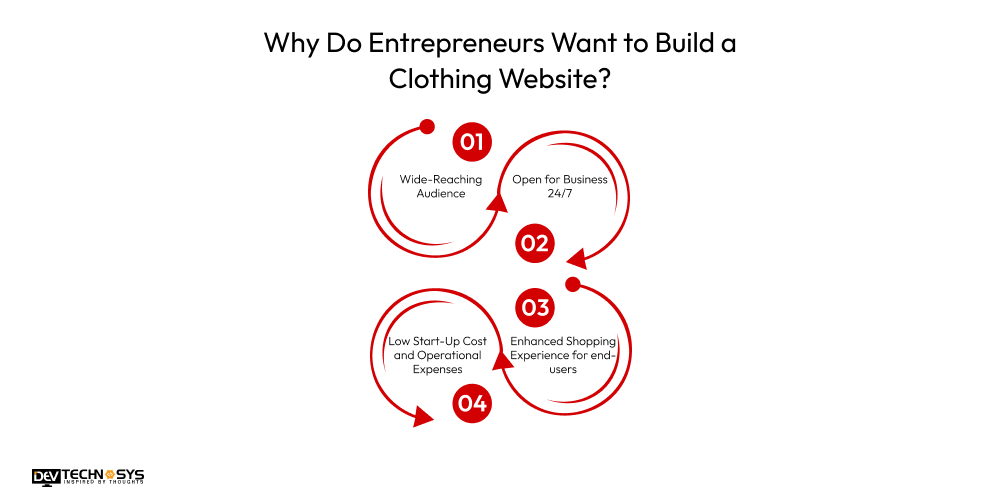
1. Wide-Reaching Audience
With the overhead of your own physical store, you only have a local audience. When you own your own online clothing website, you can sell your products to customers near and far without geographic constraints. More audience equals more visibility, and more visibility means more revenue opportunities!
2. Open for Business 24/7
Unlike a typical retail store, your clothing website is open 24/7. Customers can shop and browse anytime of the day or night! This leads to more business opportunities, better customer convenience, where and when they want, and no extra operational costs!
3. Low Start-Up Cost and Operational Expenses
Owning a physical fashion store means incurring significant expenses for rent, payroll, inventory, and space (if you have a storefront net sq. ft. inventory).
It is a no-brainer that an online store will significantly reduce your start-up and operational expenses and often can offer a level of automation around inventory, orders, and payments, allowing entrepreneurs to increase profit margins!
4. Enhanced Shopping Experience for end-users
Today’s modern clothing website, even a small business (with the right development partner), can now incorporate many features with the use of highly sophisticated tools & frameworks.
Examples include prospective use of AI-based fashion product recommendation engine, size guides, virtual try-ons, etc. The entrepreneur can utilize these tools to create a better user experience, to help ensure repeat customers, and convert standard site visitors more often into paying customers.
5 Stages to Build a Clothing Website
To start a clothing website, it takes planning and work. Hiring a professional web development company can make this process easier while delivering quality. Here are the five stages of building your clothing website with a partnering development team:
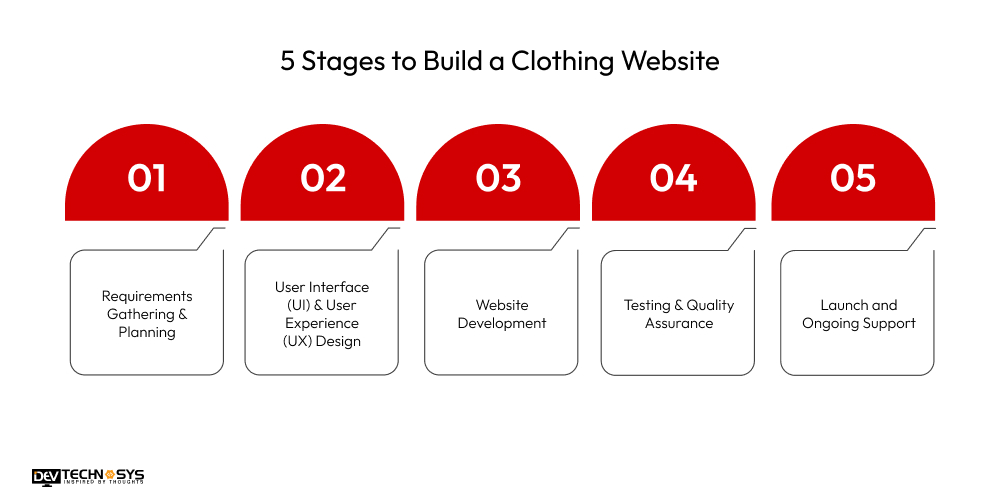
1. Requirements Gathering & Planning
This phase involves a series of meetings with the website development company that builds the site. The team will listen to your business objectives and determine the target audience, features you want to be included, and preferred design style.
The team will also perform a competitor analysis and market research to understand current market trends and functionality. After requirements are gathered, a plan is developed, scope is defined, milestones are established, and an appropriate budget and timeline are derived.
2. User Interface (UI) & User Experience (UX) Design
Once you have a plan, you are ready to visually design the look of the website. The designers will produce wireframes, mockups, and user journeys that use your brand designs prior to any visual programming being completed.
The team will create a clothing brand website design to ensure the site’s usability is user-friendly, clean, versatile, and intuitive across all devices. Using layouts that are visually engaging will welcome customers wanting to explore products and provide more satisfying shopping experiences.
3. Website Development
In this stage, hiring dedicated developers transforms the accepted design into a real working website. The Front-End developer creates the user interface, and the Front-End interacts with technologies like HTML, CSS, and JavaScript.
The Back-End developer has the responsibility to develop the database, integrate payment gateway functions, product management systems, and create the Admin panel functions at the Back-End. Custom-built items can be created at this stage too – for instance, a clothing size prediction tool or an AI-based product suggestion system.

4. Testing & Quality Assurance
Once the website is built, it enters the testing phase, where all intended functions are rigorously tested to check that it works, does not have any bugs, is secure, and most importantly, performs well using the latest versions of all browsers and devices.
A website can be tested in many ways – by testing the functionality of all functions, responsiveness, and on many mobile devices. Quality assurance at a dedicated testing stage checks that all elements of your website have been fully updated according to industry standards and are intended to create a quality user experience from the customer’s viewpoint.
5. Launch and Ongoing Support
After successful testing of the build and all functions are working, it can be deployed live onto your server. Hire web developers to offer post-launch support for maintenance of your website, along with future software upgrades, backups, and support, whenever it’s needed. This is to support your website, meaning you stay secure, load fast, and work with current trends.
Key Features of an e-Commerce Clothing Website
Examine the essential features of an e-commerce clothing website that can help you enhance the user-friendliness of your business.
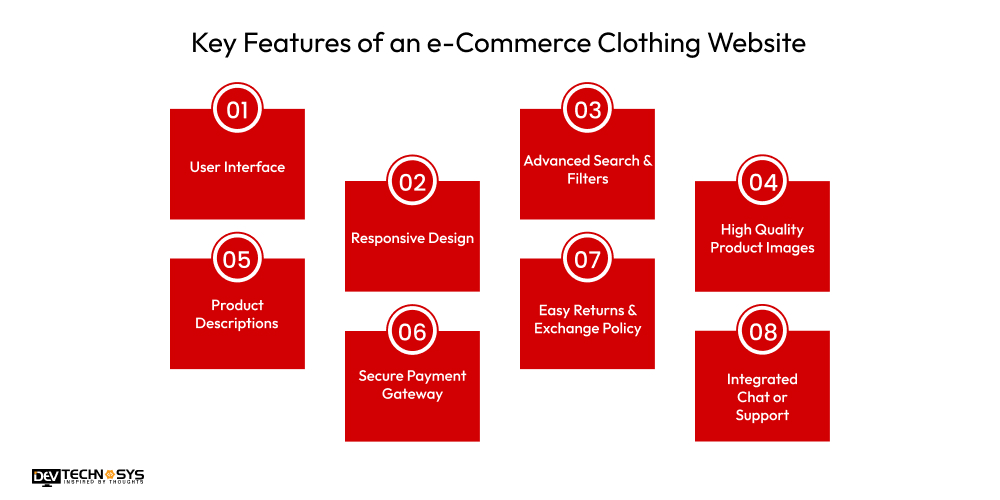
1. User Interface
User interface refers to how the user interacts with the website. Clothing ecommerce website features offer a clean and intuitive layout, which will create ease of use for users.
It allows users to browse the various categories seamlessly, view the products, and apply filters, making it a smooth and enjoyable shopping experience for all visitors.
2. Responsive Design
Mobile, tablet, and desktop all have their unique formats, responsive design will allow the website to look and perform correctly on all displays, which will only improve the accessibility of the item and usability on the go.
3. Advanced Search & Filters
Users can filter results by size, color, brand, price, and style. This is a time saver and allows users to find the clothing items they are looking for or browsing for based on their style.
4. High Quality Product Images
Providing authentic, multiple-angle zoomable images showcasing products in detail allows users to see how the fabric looks, the fit, and small design features before they purchase. Online visuals are important to develop buyer trust.
5. Product Descriptions
Depending on the offer, each listing can include information about the fabric, size, washing instructions, and fit. This information provides clarity to shoppers, lowers the chances of returning items they shopped for, and raises satisfaction levels.
6. Secure Payment Gateway
Having integrations with all of the trusted payment options like credit cards, UPI, and wallets helps promote safe and recorded transactions, which will ensure every checkout is secure and encrypted. That builds trust for similar traffic and reduces cart abandonment.
7. Easy Returns & Exchange Policy
Clear policies offer great assurance to potential shoppers. Hassle-free returns and/or exchanges create brand loyalty and encourage shoppers who want to try your brand for the first time to buy with confidence.
8. Integrated Chat or Support
Factors like live chat, FAQs, or chatbot software help customers answer their questions instantly. This increases user satisfaction, helps make a purchasing decision, and creates a frictionless customer shopping experience.
Advanced Features for Your Clothing Website
Here is the list of advanced features of a clothing website that are a must in 2025 if you’re about to make a clothing website that you want to go viral. Having this is ideal advice.
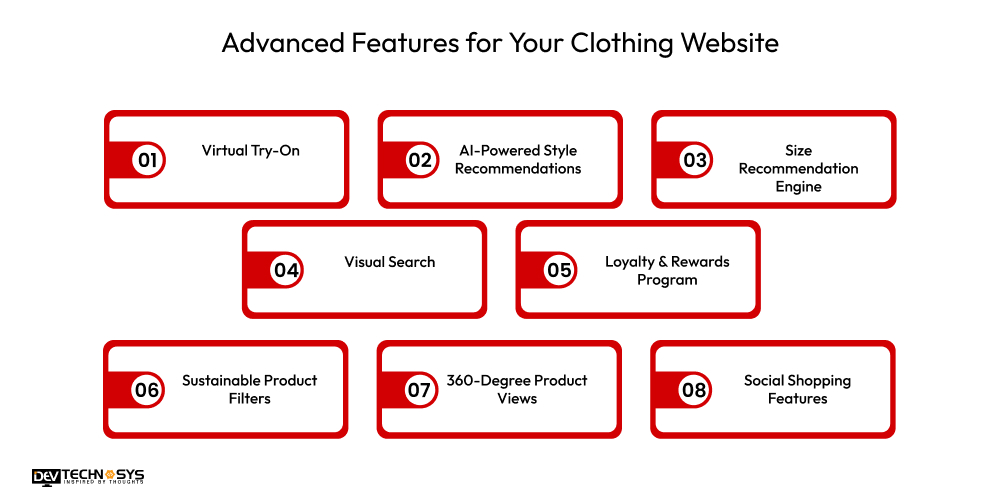
1. Virtual Try-On
AR or augmented reality lets users see how clothing will look on them, hopefully increasing their confidence in fit and style before they make a purchase.
2. AI-Powered Style Recommendations
AI can recommend outfits based on browsing behavior, users’ previously searched clothing, and what’s trending with other users. This helps to create a unique shopping experience and has the possibility to create better conversion rates.
3. Size Recommendation Engine
AI-driven tools expose the best size by making recommendations to the user based on inputs, previous purchase history, and where the particular brand’s sizing chart falls. This will help reduce return rates drastically.

4. Visual Search
Shoppers upload images to find similar clothing immediately instead of using general terms. An online fashion merchandising setup helps speed up the searching process and links clothing items being searched with higher accuracy.
5. Loyalty & Rewards Program
Gamified point systems can help encourage repeat purchasing for loyal customers by providing incentives such as discounts, exclusive deals, or early access to collections.
6. Sustainable Product Filters
Eco-minded shoppers can search by sustainability credentials such as organic fabric, ethical sourcing, or low carbon footprint, enabling an easy pathway to reflect personal values in purchases.
7. 360-Degree Product Views
A website with a virtual fitting room technology allows users to engage in a full 360-degree examination of clothing items, affording a closer inspection of every possible detail and enabling more informed decisions.
8. Social Shopping Features
Discoverable, shoppable Instagram feeds, or TikTok videos that allow users to shop directly from styled outfits as if one post rolls into another, create an alluring pathway for instant fashion gratification.
How Much Does it Cost to Build a Clothing Website?
The cost to develop a clothing website ranges from $8,000 and up as a Builder’s site, to upwards of $25,000 (and up) or more. The website development cost will be driven primarily by the level of complexity, quality of design, and scope of features.
For example, a basic website can be built on platforms like Shopify or WooCommerce, with standard eCommerce features for around $8000-$15,000. An example of a custom clothing website with advanced features, such as intelligent AI recommendations, AR try-on, and inventory automation, can cost between $15,000 – $ 25,000 or more.
Here are the major factors that influence the custom clothing website development cost:
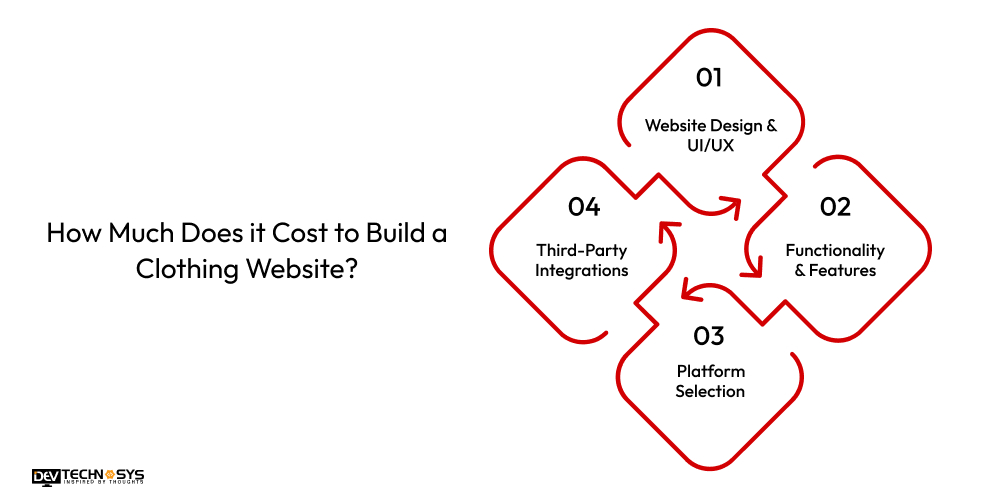
1. Website Design & UI/UX
A unique, eye-catching design catering to your brand will typically cost more than utilizing a pre-designed template. Responsive and mobile-friendly designs also come with additional costs, but are fundamentally important for engaging users.
2. Functionality & Features
The more features you add (e.g., size recommendation tool, virtual try-on, product filtering, multi-language, etc.), the higher the custom clothing website development cost will be. More features typically mean more time and also require specialized developers to execute advanced functionalities.
3. Platform Selection
Using platforms such as Shopify or BigCommerce can lessen your costs due to the included eCommerce tools provided out of the box. Realistically, custom builds on frameworks like Laravel, React, or Magento will also cost more to build out upfront; however, they give flexibility and scalability.
4. Third-Party Integrations
The process of doing direct integrations with payment gateways (PayPal, Stripe…), CRMs, and shipping APIs or apparel inventory management systems adds to the dev time and total web development cost, especially when your API alterations require additional customization.
The cost to build a clothing website allows for a lot of variables. Start-ups can start with even the bare minimum version to grow from, while brands with large operations can pay for the premium level features to enhance customer experience.
Case Study- Fashion Porters
Fashion Porters is our outstanding eCommerce fashion platform developed for Anas Siddiqui from Pakistan. The solution we delivered include web and mobile applications that enables remote body measurement technology, personalized apparel shopping, and seamless user experiences. The project was delivered by a compact and efficient team comprising a project coordinator, graphic designer, and two developers, ensuring efficient collaboration and successful execution.
Mohit Nag (CTO)
How Dev Technosys Can Help You Build a Clothing Website?
Designing a clothing website is about having the proper balance of design, user-friendly functionality, and technology in today’s competitive fashion landscape to be known.
In setting up the platform and including all of the value-added features, each step is a building block towards your overall success. Dev Technosys is a premier clothing design software development company that builds high-performing, value-competitive, custom clothing eCommerce websites, unique to your brand.
Whether we build as a start-up or scale, our team can help turn your vision into an impactful, fashionable, user-friendly online store that ultimately drives sales.
Frequently Asked Questions
1. What Are The Best Platforms To Build A Clothing Website?
The popular platforms are Shopify, WooCommerce, and Magento. Shopify is easy to use, WooCommerce offers flexibility with WordPress, and Magento is best to develop a clothing website.
2. How Long Does It Take to Create an Online Clothing Store?
The time to build a clothing website depends on the level of complexity. Basic websites take 2-4 weeks to build, while customized websites that offer advanced features can take 2-3 months, or much longer.
3. Do I Need Technical Skills To Build A Clothing Website?
There is not necessarily a requirement for technical skills to build a clothing website; however, should you like to add advanced features, like any specialized platform, we would highly recommend engaging a development team to support you with your design.