
















Key takeaways:
-
- Quickly scaling IT resources increases or decreases to meet changing business demands.
- Software development outsourcing can range from $10,000 to $100,000. The final cost depends on project complexity, location, models, and technology used.
- Factors that influence IT offshoring costs include project complexity, technology stack, geographic location, team size, engagement model, and maintenance expenses.
- In 2026, IT outsourced operations expenses vary significantly by region, with North America charging the highest, followed by Eastern Europe and Latin America.
Outsourcing or hiring skilled IT professionals to handle partial technological needs is very common for businesses. In 2026, the IoT market will have grown significantly, reaching an estimated $600 to $800 billion, indicating high demand for skilled IT professionals worldwide. It strikes a balance between budget maintenance and technology investment without bearing the full burden of in-house development costs.
However, having a limited budget makes businesses reconsider before even starting. It is difficult for businesses to estimate the monthly cost of IT outsourcing. There’s no thumb rule to tell the exact cost of third-party services, as it varies from company to company.
So, how much does IT outsourcing cost per month, and how can you find out? Easy! Know the factors that can influence the entire development process and IT outsourcing pricing. This blog will take an informative ride through IT offshoring expense and uncover several hidden factors that can influence the overall financial implications. So get ready to be surprised, let’s begin!
What is IT Outsourcing?
IT Outsourcing means hiring technical professionals to manage specific IT functions and projects. Affordable IT outsourcing services allow organizations to focus on other crucial aspects, reduce development costs, and increase digital transformation.
The main agenda of IT outsourcing is to free up in-house employees and utilize their time and energy in more critical tasks. Moreover, outsourced services provide scalability and efficiency, enabling businesses to meet the rising needs and challenges within their technological landscape.
Why Businesses Outsource IT Services in 2026?
In 2026, outsourcing information technology services allows businesses to acquire strategic growth, access specialized skills and techniques, scale, and 24/7 technical support. Outsourcing IT development reduces costs and risks, especially in times of global talent shortages and increasing tech complexity.
- Access to Specialized Talent: When facing talent shortages, organizations can do IT outsourcing to overcome talent shortages by providing access to global experts in advanced technologies such as AI, cloud computing, cybersecurity, and DevOps, without the challenges of long-term hiring.
- Cost Efficiency & Predictability: Outsourcing IT services minimizes expenses related to recruitment, training, and infrastructure. It also ensures transparent pricing models that enable better cost control and predictable IT budgets.
- Focus on Core Business: Through IT operation outsourcing, internal teams are freed from day-to-day technical management, allowing businesses to focus on strategic initiatives, innovation, and core growth objectives.
- Scalability & Flexibility: Quickly scaling IT resources increases or decreases to meet changing business demands. This flexibility helps organizations control costs and adapt to workload errors without long-term infrastructure or hiring commitments.
- Enhanced Security & Compliance: Leveraging provider expertise to stay ahead of cyber threats, regulations, and data protection laws, according to experts at an IT platform development company.
- 24/7 Operations & Faster Delivery: IT staffing from different regions to utilize global time zones for continuous development. It also ensures 24/7 support and quicker market entry.
- Innovation & Digital Transformation: Gaining insights and capabilities for adopting new technologies and accelerating digital initiatives. By partnering with experienced providers, businesses can modernize legacy systems and improve operational efficiency.
How Much Does IT Outsourcing Cost?
The exact cost of IT project development outsourcing is difficult to pinpoint. How much does IT outsourcing cost per month depends on whether you are hiring one professional or a dedicated software team. Software development outsourcing can range from $10,000 to $100,000.
IT outsourcing is best viewed as a cost distribution based on percentages, influenced by multiple factors. The final cost depends on project complexity, location, models, and technology used. Here’s the table highlighting the estimated IT offshoring expense.
| Outsourcing Model | Estimated Cost | Cost Distribution (%) |
| IT Staff Augmentation | $2,200 – $4,000 | Engineering 70% · Management 10% · QA 10% · Tools 10% |
| Dedicated Software Team | $7,000 – $40,000 | Engineering 55% · PM 15% · QA 15% · Infra 15% |
| Software Development Outsourcing | $10,000 – $100,000 | Engineering 50% · PM 15% · QA 15% · Infra 10% · Support 10% |
What Factors Influence the Cost of IT Outsourcing?
It is difficult to pinpoint the exact cost of outsourcing IT services because various factors influence it. Here’s the complete third-party service cost breakdown, including the factors that affect IT costs. Let’s check them out!
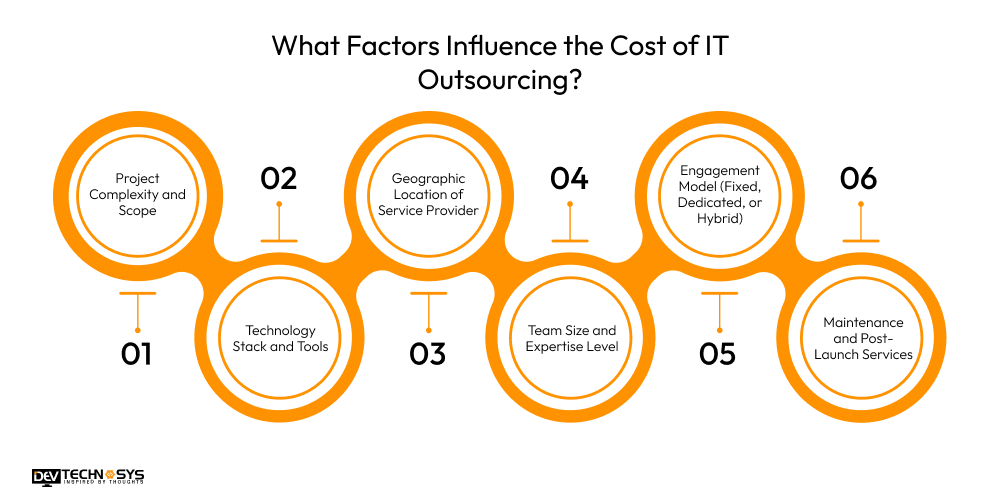
1. Project Complexity and Scope
The overall complexity of the project can highly impact the IT outsourcing cost in USA. Simple projects require limited resources, thus lowering the price. On the other hand, enterprise-grade systems with advanced architecture, security layers, and third-party integration can increase IT outsourcing pricing for startups and enterprises. Unclear and frequent changes are also a key reason for cost enhancement.
| Project Type | Scope Description | Cost Impact (%) | Timeline |
| Simple | Basic features, limited integrations | 10% – 20% | 1–2 months |
| Medium | Custom workflows, APIs | 20% – 30% | 3–5 months |
| Complex | Enterprise-scale, AI, high scalability | 35% – 50% | 6–12 months |
2. Technology Stack and Tools
Another factor that increases the cost of IT outsourcing is the choice of technology stack for the project. The programming languages, databases, frameworks, and third-party tools you select directly impact the outsourcing expenses.
Use of advanced technologies such as AI, blockchain, cloud computing, and big data requires skilled professionals, thereby increasing costs. Licensing fees and proprietary tools also contribute to the final budget.
| Technology Category | Cost Impact (%) | Complexity Level |
| Open-source frameworks | 10% – 15% | Low |
| Cloud platforms & DevOps | 15% – 25% | Medium |
| AI, Blockchain, IoT | 25% – 40% | High |
3. Geographic Location of Service Provider
According to a top web development company, the developer’s geographic location is also a key driver of Offshoring expense in 2026. Regions such as North America and Western Europe charge more per hour.
Whereas, IT outsourcing cost in India and Eastern Europe are more affordable, which is ideal for startups and medium-scale businesses. Thus, Asia and Eastern Europe are the popular outsourcing destinations for businesses in 2026.
| Region | Cost Share (%) | Skill Availability |
| India / Southeast Asia | 10% – 15% | High |
| Eastern Europe | 15% – 20% | High |
| North America / Western Europe | 20% – 25% | Very High |
Want a chatbot demo or pricing? Fill the form and talk to our experts today.
Pick what you need below — you can select more than one — then tap Get detail to continue.
-
Chatbot demo dashboard
-
Cost to develop an app
-
Industry report
-
Case study
4. Team Size and Expertise Level
Larger teams mean increased third-party service cost, but faster delivery times. With the involvement of experienced solution architects, cybersecurity experts, and senior developers, expect the rates to be on the higher side. However, investing in skilled development professionals often reduces long-term costs by minimizing errors, rework, and technical debt.
| Team Structure | Expertise Level | Cost Impact (%) |
| Small Team (2–3 members) | Junior/Mid | 15% – 25% |
| Medium Team (4–6 members) | Mid/Senior | 30% – 40% |
| Large Dedicated Team | Senior + Architect | 45% – 60% |
5. Engagement Model (Fixed, Dedicated, or Hybrid)
The outsourcing engagement model plays a major role in determining the costs of outsourcing IT consulting services. Fixed IT outsourcing price model suits clearly defined projects. Dedicated teams also offer flexibility for changes and evolving requirements at a higher monthly cost. Hybrid models balance cost control with scalability and adaptability, varying in both aspects.
| Engagement Model | Flexibility | Cost Influence (%) |
| Fixed Price | Low | 12% – 20% |
| Dedicated Team | High | 25% – 35% |
| Hybrid Model | Medium–High | 35% – 45% |
6. Maintenance and Post-Launch Services
Post-deployment services are an ongoing process that includes bug fixes, performance optimization, security updates, and feature enhancements. Maintenance services are necessary to ensure application stability and user satisfaction over the long term. Long-term maintenance contracts and 24/7 support increase total development costs.
| Service Type | Cost Allocation (%) | Impact Level |
| Basic Maintenance | 10% – 15% | Low |
| Security Updates & Optimization | 15% – 20% | Medium |
| 24/7 Support & Scalability | 20% – 25% | High |
Average IT Outsourced Operations Expense by Region (2026)
In 2026, IT outsourced operations expense vary significantly by region, with North America and Western Europe charging the highest, followed by Eastern Europe and Latin America. Asia-Pacific regions such as India, Vietnam, and the Philippines offer affordable IT outsourcing services.
The costs of hiring IT experts are mainly driven by talent pools, demand, and tech maturity, with Asia bearing vast talent and Eastern Europe offering a quality/cost balance. Let’s take a look at the IT offshoring expense breakdown from region to region.
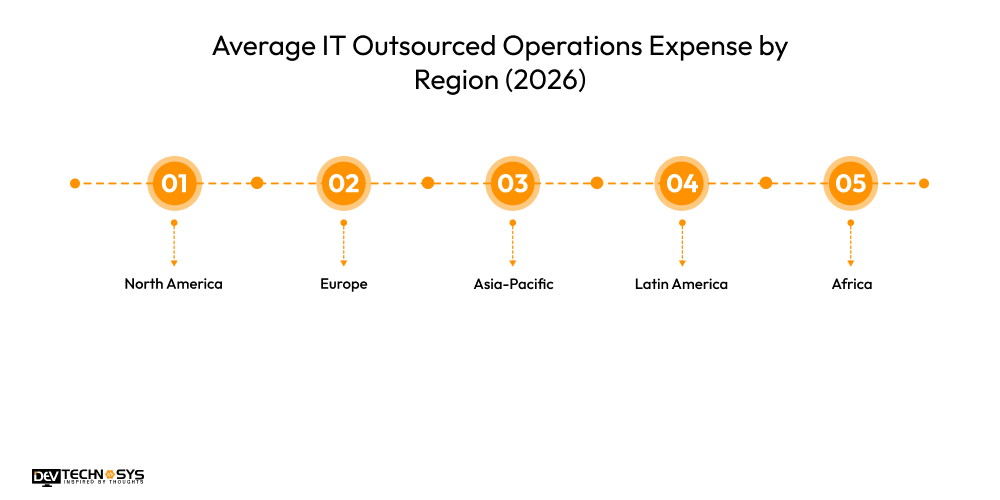
1. North America:
North America remains the most expensive region for IT outsourcing in 2026, with the average IT outsourcing cost in USA ranging between $20,000 to $40,000. While small-scale projects cost up to $30K, enterprise-level projects can cost up to $40K or more. The higher costs are driven by advanced technical expertise, strict compliance standards, and strong demand for specialized skills.
| Project Size | Average Cost |
| Small-Scale Project | $20,000 – $30,000 |
| Mid-Scale Project | $30,000 – $40,000 |
| Enterprise-Level | $35,000 – $40,000 |
2. Europe:
Europe shows a wide variation in outsourced operations expenses. The IT outsourcing cost in UK can range as low as $15K to as high as $38K, depending on various factors like strong technical expertise and strict regulatory standards. Eastern Europe is more cost-efficient, offering comparatively lower rates while maintaining high quality, making it a popular choice for businesses seeking value and reliability.
| Project Size | Average Cost |
| Small-Scale Project | $15,000 – $22,000 |
| Mid-Scale Project | $22,000 – $32,000 |
| Enterprise-Level | $30,000 – $38,000 |
3. Asia-Pacific:
Asia-Pacific is one of the most cost-effective IT staffing services outsourcing regions, especially countries like India, Vietnam, and the Philippines. The average IT outsourcing cost in India can range from $7,000 to $30,000, supported by a large talent pool and growing technical maturity. Due to lower development rates, it is the go-to project outsourcing destination for businesses.
| Project Size | Average Cost |
| Small-Scale Project | $7,000 – $15,000 |
| Mid-Scale Project | $15,000 – $25,000 |
| Enterprise-Level | $22,000 – $30,000 |
4. Latin America:
Latin America provides strong nearshore advantages for North American businesses, with IT Outsourced operations pricing typically lower than in North America. Similar time zones, cultural alignment, and a growing pool of skilled professionals make the region an attractive option for long-term and collaborative outsourcing partnerships.
| Project Size | Average Cost |
| Small-Scale Project | $10,000 – $18,000 |
| Mid-Scale Project | $18,000 – $28,000 |
| Enterprise-Level | $25,000 – $35,000 |
5. Africa:
Africa is an emerging IT outsourcing destination, offering comparatively lower costs than North America. On average, African IT firms charge $18,000 to $30,000. Although the ecosystem is still developing, the region is attracting attention for its affordability, expanding tech talent, and growing investment in digital infrastructure.
| Project Size | Average Cost |
| Small-Scale Project | $7,000 – $12,000 |
| Mid-Scale Project | $12,000 – $20,000 |
| Enterprise-Level | $18,000 – $30,000 |

Engagement Models and Their Cost Implications
Want to know about IT outsourcing price models? You have arrived at the right place. In this section, we will discuss the IT outsourcing price model and see how different types of models impact IT outsourcing prices:
1. Fixed-Price Model
The fixed-price model is best suited for projects with well-defined requirements, scope, and timelines. The total cost will be stated upfront, helping businesses make strategic budget plans. This model reduces the financial risk factor but provides limited flexibility. For any change in features, design, or functionality, you need to pay additional costs and timeline adjustments. Fixed models are best for small or one-time projects with clear outcomes mentioned from the start.
Cost Implications: Predictable budgeting, low financial risk, limited flexibility, and potentially higher initial pricing to cover uncertainties.
2. Dedicated Team Model
The dedicated team model is when you hire a remote team of developers, designers, and project managers to work on a single project specifically. Monthly costs varies based on various factors like size, technology stack, and expertise level. Although this model provides long-term cost savings, efficiency, and better control over development, it demands higher ongoing investments. It is ideal for long-term, large, and evolving projects that require continuous improvements.
Cost Implications: Medium to high monthly cost, excellent scalability, cost-efficient for long-term projects, and minimal overhead for hiring and training.
3. Time and Material Model
The time-and-materials model charges clients based on the actual hours worked and resources used during development. This approach is highly flexible, allowing businesses to adjust priorities, add features, or refine requirements as the project progresses. Although cost predictability is lower compared to fixed pricing, it offers transparency, faster iteration, and is well-suited for agile development, startups, or innovation-driven projects with changing needs.
Cost Implications: Variable cost, high flexibility, pay-as-you-go pricing, best suited for projects with changing requirements or agile workflows.
Are there any Hidden Costs to Consider in IT Outsourcing?
Besides the main cost, there are additional hidden costs that affect the cost of outsourcing IT operations. These hidden factors may or may not be discussed upfront, but keeping them under consideration is crucial. Let’s see what these factors are:
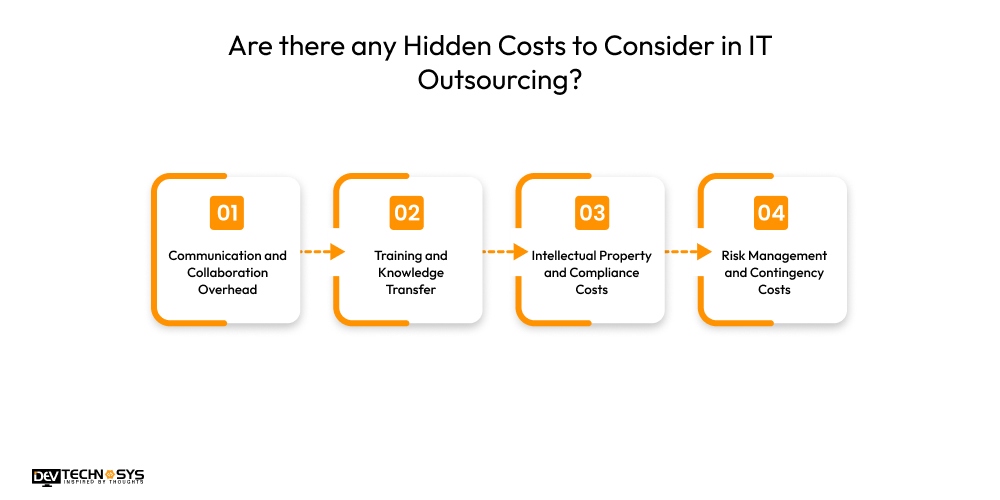
1. Communication and Collaboration Overhead
IT outsourcing often involves distributed teams across different time zones and cultures. Additional costs may arise from frequent coordination meetings, extended project management efforts, the use of collaboration tools, and slower decision-making cycles. If not managed well, miscommunication can also lead to rework, increasing overall project expenses.
| Cost Element | Estimated Cost Range |
| Project Coordination & Management | $1,500 – $6,000 |
| Meetings & Time-Zone Alignment | $1,000 – $4,500 |
| Collaboration Tools & Licenses | $800 – $3,000 |
| Rework Due to Miscommunication | $1,200 – $5,500 |
2. Training and Knowledge Transfer
Outsourced teams need time to understand your business domain, workflows, and internal systems. This includes onboarding sessions, documentation, process alignment, and ongoing knowledge sharing. The effort invested in training and knowledge transfer can indirectly increase costs, especially during the initial project phases.
| Cost Element | Estimated Cost Range |
| Team Onboarding & Initial Training | $1,500 – $7,000 |
| Documentation & Process Setup | $1,200 – $5,500 |
| Knowledge Transfer Sessions | $1,000 – $4,000 |
| Ongoing Training & Support | $800 – $3,500 |
3. Intellectual Property and Compliance Costs
According to a top mobile app development company, protecting intellectual property and meeting regulatory requirements may require legal agreements, compliance audits, security certifications, and data protection measures. These safeguards are essential but are often overlooked during budgeting, particularly in industries that handle sensitive data.
| Cost Element | Estimated Cost Range |
| Legal Contracts & NDAs | $1,000 – $4,500 |
| Data Security & Protection Measures | $2,000 – $8,000 |
| Compliance Audits & Certifications | $1,500 – $7,000 |
| IP Protection Management | $1,000 – $3,500 |
4. Risk Management and Contingency Costs
Unexpected risks such as scope creep, vendor dependency, quality issues, or geopolitical and operational disruptions can impact budgets. Organizations usually allocate contingency funds to manage these uncertainties, ensure business continuity, and avoid project delays or service interruptions.
| Cost Element | Estimated Cost Range |
| Contingency Budget Allocation | $2,000 – $10,000 |
| Vendor Risk Mitigation | $1,500 – $6,000 |
| Scope Change Handling | $1,200 – $5,500 |
| Business Continuity Planning | $1,000 – $4,500 |
How to Optimize Costs of Outsourcing It Professionals in 2026?
Optimizing IT costs in 2026 needs more than simple hourly cost deduction toward a more ” value-driven” approach. Try to focus on automation, efficiency, and strategic partnership. Key trends show that leveraging AI-driven tools, nearshore talent, and outcome-based contracts can reduce costs by 30% to 40%.
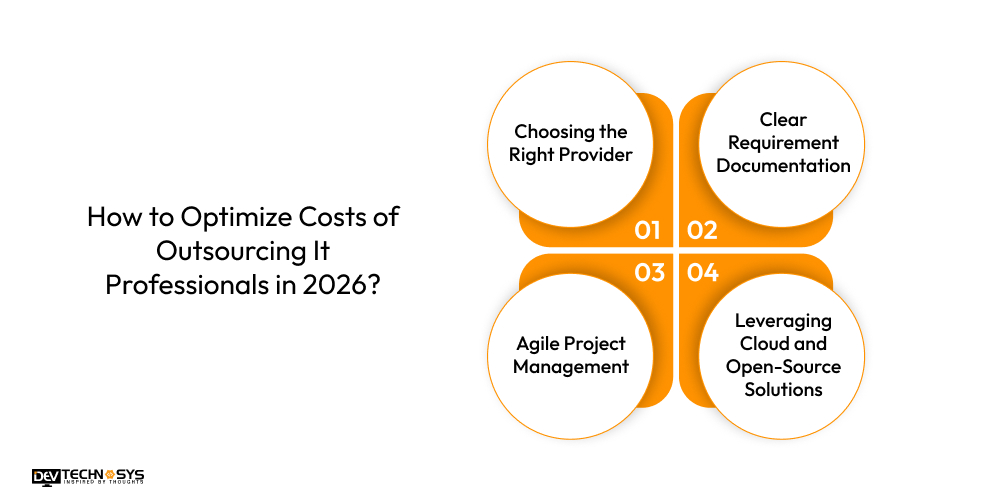
1. Choosing the Right Provider
- Prioritize Specialization: Hire dedicated developers with deep expertise in areas like AI, cybersecurity, or specific cloud platforms. This specialization is beneficial, so businesses generally prefer them over all-purpose vendors.
- Evaluate AI Maturity: Select partners that integrate AI coding assistants (e.g., GitHub Copilot, Cursor) into their workflows. Teams not using these tools operate at a 30-40% productivity disadvantage.
- Use a Hybrid Model: Combine in-house and outsourced teams to retain control over critical, strategic tasks while outsourcing routine work, which balances costs and security.
- Nearshoring for Collaboration: For US-based firms, nearshore partners in Latin America or Eastern Europe often prove cheaper in the long run than offshoring to Asia due to fewer, if any, time zone differences, reducing lag time and communication costs.
2. Clear Requirement Documentation
- Create Comprehensive Documentation: 47% of project failures are due to poor requirements gathering. Detailed, written specifications (using tools like Confluence or Jira) are essential to prevent scope creep and expensive rework.
- Define “Definition of Done” (DoD): Every job, feature, or sprint should have its acceptance criteria well defined and documented. By ensuring that work is only deemed finished when it satisfies predetermined criteria, a clearly defined DoD helps prevent misunderstandings, rework, and paying for deliverables that are only partially completed.
- Use Visuals: Hire a software development company that employs wireframes, flow diagrams, and user journey maps to reduce ambiguity, which lowers the time spent on clarifications.
- Live Documentation: In 2026, static Word docs are obsolete. Use real-time collaborative, AI-powered tools that sync with project management platforms.
3. Agile Project Management
- Shift to Outcome-Based Contracts: Instead of old-fashioned time and material based models, adopt outcome-based contracts. This approach ensures paying for predictable results like service levels, features added, and system performance, increasing both efficiency and accountability.
- Iterative Development: Adopt Scrum or Kanban-like agile methods to divide projects into smaller, manageable sprints. Continuous feedback helps identify issues early, minimizes rework, and reduces overall development costs while improving delivery speed.
- Monitor Key Performance Metrics: Monitor operational metrics for resolution. Major metrics options include first-contact resolution rate, ticket recurrence rate, and mean time. These insights help uncover inefficiencies, improve service quality, and optimize outsourcing spend.
- Ensure a 4-Hour Overlap Minimum: Between outsourced and in-house development teams, try to maintain at least four hours of gap on a daily basis. It accelerates decision-making, reduces communication delays, and prevents productivity loss that happens because of zone gaps.
4. Leveraging Cloud and Open-Source Solutions
- Cloud-as-Necessary Model: Shift from “cloud-first” to a “cloud-as-necessary” model is one of the most effective ways to cut down the unnecessary SaaS subscriptions and over-provisioned computing.
- Automated Cloud Cost Optimization: One method is to implement auto-scaling to match resources to demand. Automated cloud technology ensures that you don’t have to pay for idle capacity.
- Use Ephemeral Environments: Another way to cut the development cost to 40% to 60% will be to utilize temporary development environments. They shut down immediately when left on.
- Leverage Open-Source & No-Code: Utilize open-source software to eliminate licensing fees and leverage low-code/no-code platforms. The power apps can ensure faster, lower-cost application development.
- Spot Instances: You can get a 50-90% discount on cost if you use spot instances or preemptible VMs for non-critical workloads to secure discounts. This is an effective way to optimize the IT offshoring expense.
Conclusion
Besides saving development cost, project outsourcing also offers strategic advantages. The rapid access to state-of-the-art technologies, systems, procedures, and expertise of reputable outsourcing firms can help small enterprises with limited resources react more quickly to the rapidly changing IT landscape.
If you are looking for a top IT outsourcing company to build your dream IT project, then Dev Technosys can be your best bet. With 150+ dedicated IT experts and 1500+ successful projects, we deliver projects with excellence.