
















“Where Technology Meets Energy Efficiency”
The petrochemical industry of Saudi Arabia has developed significantly over the past few years. In 2026, it will progress even more. The digital transformation in Saudi Arabia improves operational efficiency, safety, and regulatory compliance. As companies adopted modern technologies into their operations, the demand for custom petrochemical applications kept increasing.
But developing an advanced petrochemical app requires the latest technologies and development expertise, and, most importantly, a strong financial strategy. Before diving into Petrochemical mobile app development, it’s crucial to know the PetroChemical app development cost Saudi Arabia. This blog provides a detailed breakdown of the petrochemical logistics & supply chain app development cost. So, without further delay, let’s dive in!
Present and Future Statistics of PetroChemical App Market In Saudi Arabia
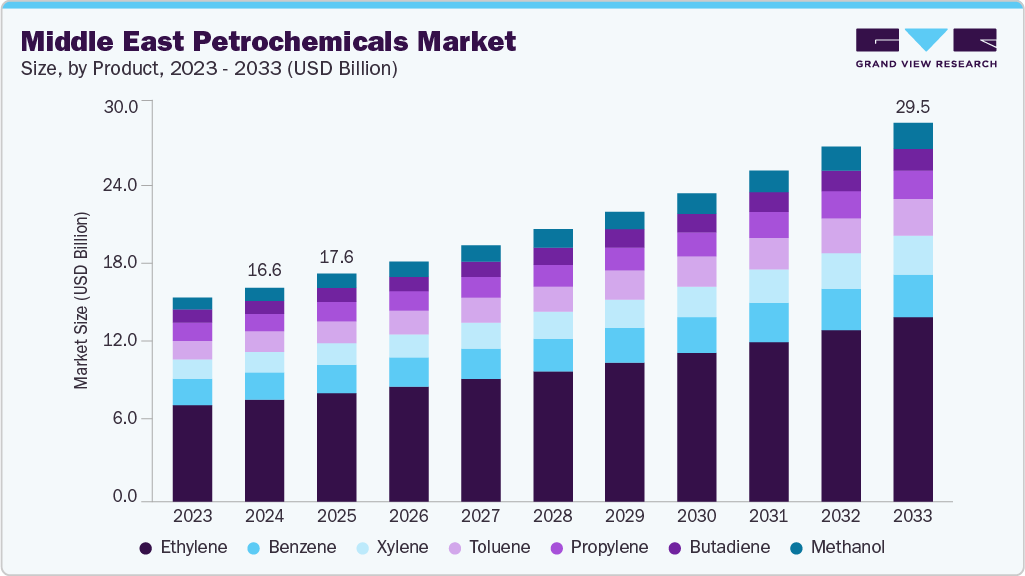
- The Middle East petrochemicals market size was estimated at USD 16.6 billion in 2024 and is expected to reach USD 17.6 billion in 2025.
- The Middle East petrochemicals market is expected to grow at a compound annual growth rate of 7% from 2025 to 2033 to reach USD 29.46 billion by 2033.
- By Product, the methanol segment is expected to witness the fastest growth of 1% from 2025 to 2033.
- Some of the key players operating in the Middle East petrochemicals market include SABIC, Exxon Mobil Corporation, Chevron Lummus Global (CLG), Kinetic Technologies, Linde PLC, Sipchem Company, Saudi Arabian Oil Co., Tasnee, INEOS AG, and Shell Global.
How Much Does it Cost to Develop Petrochemical App Saudi Arabia?
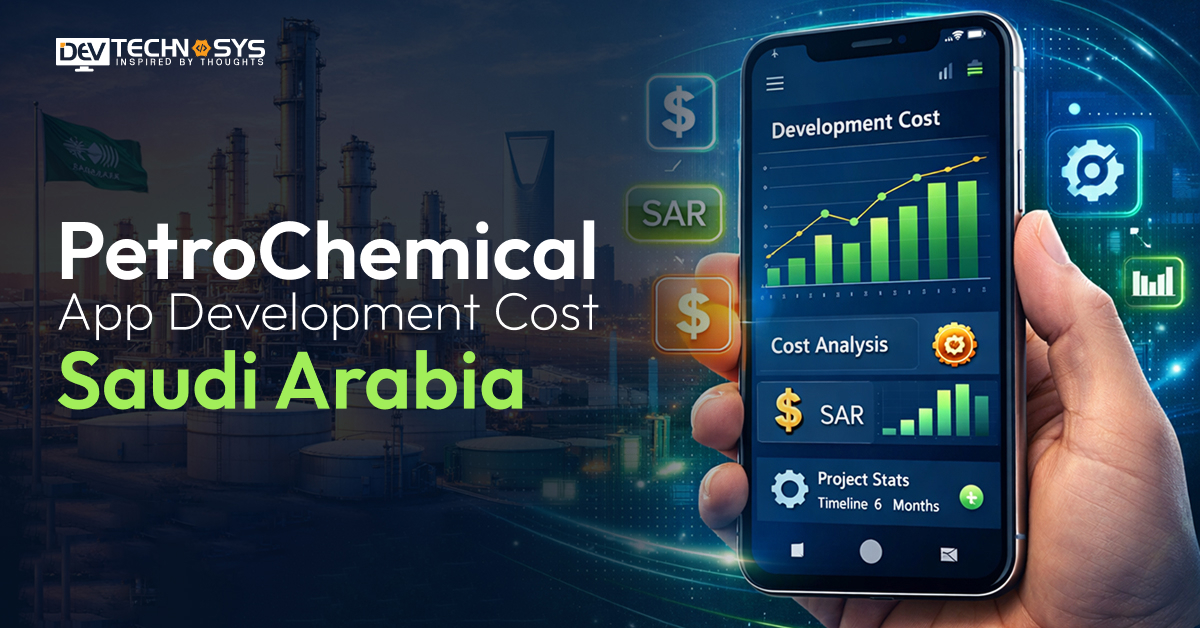
The petrochemical mobile app development cost depends heavily on the features, platform, design, security, and maintenance factors. In general, the cost to develop petrochemical app Saudi Arabia ranges from 30008 SAR to 93775 SAR. The basic PetroChemical app development cost Saudi Arabia can range between 30008 SAR and 45012 SAR.
However, for the custom petrochemical app development cost KSA, involving advanced features like interactive dashboards and field force enablement can exceed 93775 SAR. Here is the most detailed table explaining the cost to build a petrochemical plant in Saudi Arabia in detail.
| App Type | Estimated Cost (SAR) | Timeline |
| Basic App | SAR 30,008 to 45,000 | 6 to 8 weeks |
| Standard App | SAR 45,000 to 70,000 | 10 to 14 weeks |
| Advanced App | SAR 70,000 to 93,775 | 16 to 20 weeks |
What Are the Factors Affecting the Cost to Build PetroChemical App in Saudi Arabia?
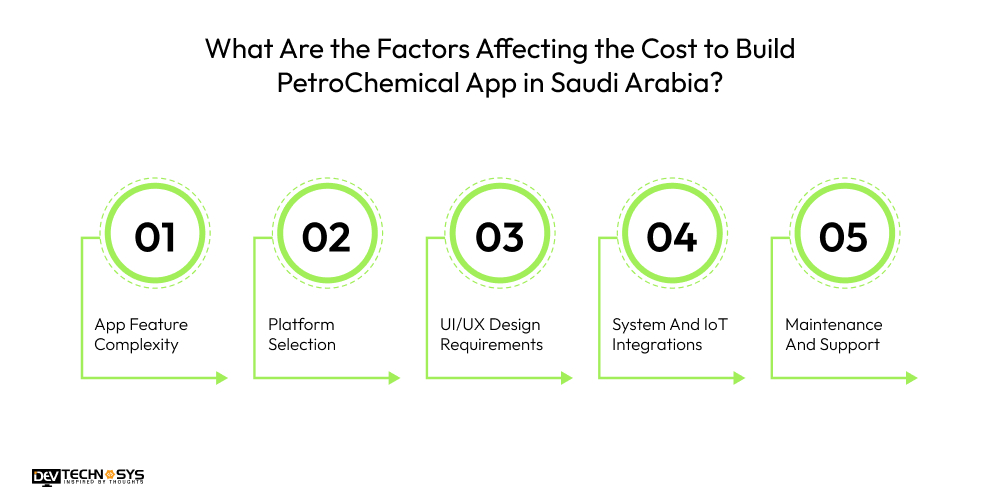
PetroChemical app development cost Saudi Arabia differs depending on various factors. From features to maintenance, we will discuss every crucial factor that can influence the total cost to build petrochemical app in Saudi Arabia in this section. Take a look:
1. App Feature Complexity
The more complex the app features, such as real-time monitoring, predictive analytics, or safety compliance modules, the higher the PetroChemical app development cost Saudi Arabia will be due to increased backend logic, testing requirements, and longer development timelines.
| Level | Cost (SAR) | Timeline |
| Basic Features | 30,008 – 38,500 | 5 – 7 weeks |
| Moderate Features | 38,501 – 56,000 | 8 – 11 weeks |
| Advanced Features | 56,001 – 75,000 | 12 – 16 weeks |
2. Platform Selection
Choosing a single platform reduces the petrochemical plant management app cost, while building for multiple platforms or including web dashboards increases the oil & gas app development cost Saudi Arabia because of additional coding, testing, deployment, and ongoing platform-specific maintenance efforts.
| Platform Type | Cost (SAR) | Timeline |
| Single Platform | 32,000 – 45,500 | 6 – 8 weeks |
| Dual Platform | 45,501 – 62,000 | 9 – 13 weeks |
| Mobile + Web | 62,001 – 82,000 | 14 – 18 weeks |
3. UI/UX Design Requirements
Industrial app development pricing Saudi Arabia can be influenced by design customizations. Simple dashboards lower design costs, whereas customized interfaces, data visualizations, and role-based user experiences increase expenses by requiring advanced design work, usability testing, and multiple design iterations.
| Design Level | Cost (SAR) | Timeline |
| Standard UI | 30,500 – 41,000 | 4 – 6 weeks |
| Custom UI/UX | 41,001 – 58,500 | 6 – 9 weeks |
| Advanced Dashboards | 58,501 – 78,000 | 10 – 14 weeks |

4. System And IoT Integrations
Integrating the app with IoT sensors, SCADA systems, ERP software, or legacy infrastructure increases complexity, requiring specialized development skills, secure data handling, and extensive testing. Hire dedicated developers to provide IoT integrations. It significantly raises the overall petrochemical app development cost Saudi Arabia.
| Integration Scope | Cost (SAR) | Timeline |
| Limited APIs | 34,000 – 47,000 | 6 – 8 weeks |
| ERP / SCADA Sync | 47,001 – 66,000 | 9 – 13 weeks |
| Complex IoT Sensors | 66,001 – 88,000 | 14 – 19 weeks |
5. Maintenance And Support
Post-launch maintenance includes bug fixes, security updates, performance monitoring, and feature enhancements. Ongoing support contracts add to the cost to build petrochemical maintenance and monitoring app, but are essential for system stability and long-term operational efficiency.
| Support Level | Cost (SAR) | Duration |
| Basic Maintenance | 36,000 – 48,000 | 12 months |
| Standard Maintenance | 48,001 – 68,000 | 12 months |
| Premium Support | 68,001 – 90,000 | 12 months |
What Are the 3 Practical Case Studies on Pricing Strategies?
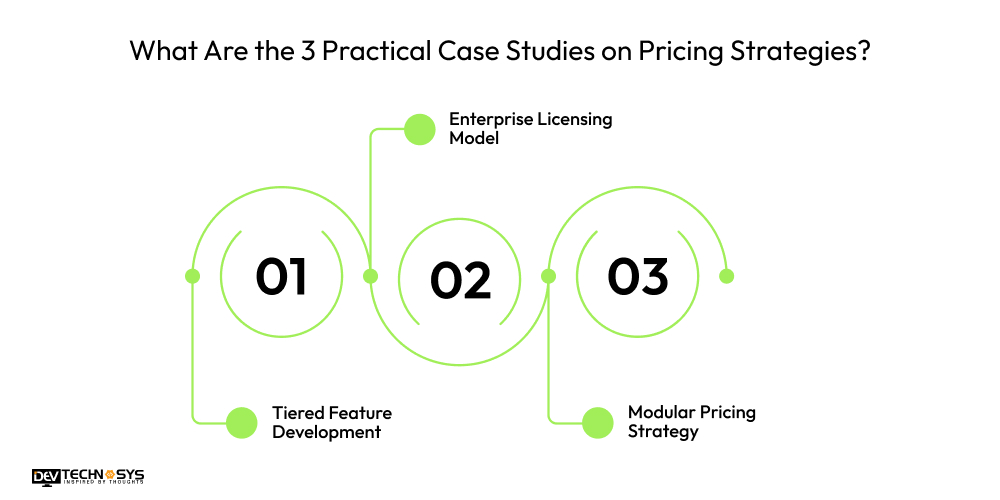
If you want to see real petrochemical app development projects with estimated costs, take a look at these case studies, including pricing and the tools used in the app development process. Let’s explore the detailed description of these case studies.
1. Tiered Feature Development
A petrochemical or industrial app launches with core operational features at a lower initial cost, then adds advanced modules like analytics, IoT integrations, or compliance tools in phases. This approach minimizes upfront investment and aligns spending with actual business growth. Hire mobile app developers to incorporate this pricing strategy.
| Development Phase | Cost (SAR) | Timeline |
| Phase 1 (MVP) | 30,008 – 42,000 | 5 – 7 weeks |
| Phase 2 (Growth) | 42,001 – 62,000 | 8 – 11 weeks |
| Phase 3 (Advanced) | 62,001 – 93,775 | 12 – 16 weeks |
2. Enterprise Licensing Model
A fixed annual or multi-year license fee is charged for enterprise-wide usage. This strategy suits large petrochemical companies seeking predictable app development and maintenance costs, full feature access, and long-term system stability.
| License Scope | Cost (SAR) | Timeline |
| Single-Site License | 35,000 – 50,000 | 6 – 8 weeks |
| Multi-Site License | 50,001 – 72,000 | 10 – 13 weeks |
| Enterprise-Wide License | 72,001 – 93,775 | 14 – 18 weeks |
3. Modular Pricing Strategy
Each functional module, such as safety management, inventory control, analytics, or compliance reporting, is priced separately. Clients pay only for required modules, reducing initial investment and improving customization flexibility.
| Module | Cost (SAR) | Timeline |
| Core Platform | 30,008 – 40,000 | 4 – 6 weeks |
| Safety Management Module | 10,000 – 18,000 | 3 – 4 weeks |
| Inventory & Asset Module | 12,000 – 20,000 | 3 – 5 weeks |
| Analytics Module | 15,000 – 25,775 | 4 – 6 weeks |
How to Reduce the Petrochemical IoT App Development Cost in Saudi Arabia?
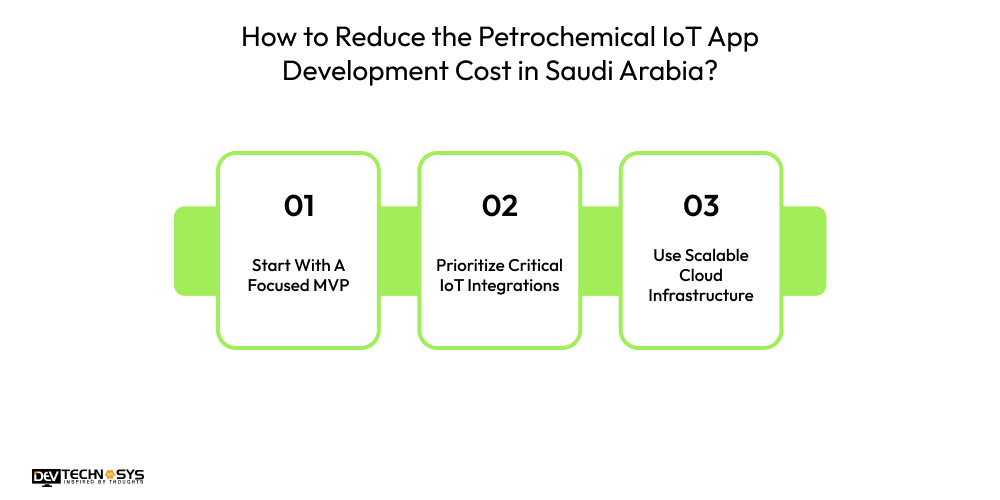
Now that we know how much does petrochemical app development cost in Saudi Arabia, it’s time to learn the methods to reduce the Industrial automation app development cost. Here are some of the top strategies to reduce petrochemical app development cost Saudi Arabia.
1. Start With A Focused MVP
Begin Petrochemical operations management app development cost with only essential IoT features like sensor data visualization, alerts, and basic dashboards. A focused MVP to develop an app like GasBuddy reduces upfront costs, shortens timelines, validates real use cases early, and avoids unnecessary spending.
2. Prioritize Critical IoT Integrations
Integrate only mission-critical sensors and operational systems initially, which reduces the Petrochemical production monitoring software cost in KSA. Limiting integrations reduces development complexity, testing effort, and infrastructure costs, allowing businesses to expand connections gradually as operational needs and budgets grow.
3. Use Scalable Cloud Infrastructure
Adopting petrochemical digital transformation solutions KSA and cloud-based IoT platforms, along with pay-as-you-use pricing, minimizes upfront infrastructure investment. Scalable cloud services help manage data efficiently, reduce Industrial automation app development cost, operational costs, and support future growth without expensive hardware upgrades.
How Dev Technosys Will Help With PetroChemical App Development?
Through this blog, we tried to break down the petrochemical app development cost Saudi Arabia. We hope it will help businesses create a better cost strategy or development budget.
If you are a business looking for a petrochemical app to build in Middle East, then contact Dev Technosys, a custom fuel delivery app development company. With expertise in IoT integration, real-time analytics, and scalable architectures, the team ensures reliable, cost-effective, and future-ready applications.
Frequently Asked Questions
Find answers to the most common questions related to this article.
The cost to develop a petrochemical app in Saudi Arabia typically ranges between SAR 30,008 and SAR 93,775, depending on feature complexity, IoT integrations, security requirements, platform selection, and scalability needs.
Major cost-driving factors include real-time data processing, IoT and SCADA integrations, security and compliance standards, UI/UX complexity, platform coverage, backend infrastructure, and ongoing maintenance requirements.
Petrochemical app development usually takes between six and twenty weeks, depending on app complexity, system integrations, testing scope, security implementation, and the number of platforms or industrial modules involved.
Yes, IoT integration increases development costs due to sensor connectivity, real-time data handling, backend scalability, security layers, and extensive testing required for reliable performance in industrial petrochemical environments.