


















The global telecom software development industry is rapidly growing, with projections for growth from 9.3 billion USD in 2024 to 28.5 billion USD in 2030 and a CAGR of 20.4%. This is due to the demand for new 5 G infrastructure, automated networks, and better customer service experiences. Notably, the demand to invest in telecom software development has increased over the years.
So if you’re also an entrepreneur you must know several factors must be considered when investing in telecommunications software development. These factors include issues such as project complexity, desired features, technology stack, and team capabilities. Understanding how these factors can streamline your costs and sources of funds, resources, and planning ensures your solutions are suited to meet your needs. So, are you ready to know telecom software development costs now? Let’s go!
Understanding Telecom Software
Telecom software is software and digital solutions that allow telecom companies to manage their operations, customer service, billing, and network systems easily and efficiently.
It controls everything from calls and data being traversed over the network to secure transactions and payments. Telecom software provides a means of virtually unwinding our world’s communication and connectivity.
Today, modern telecom software employs more advanced cloud-based technologies like IoT, AI, and Cloud Computing, driving organizations to agile, scalable, and customer-centric operations.
As such, in a world so engrossed in technology, it’s vital for providers to keep up with the evolution and growth of telecommunication software. Being competitive, innovative, and ready for the future means investing in telecom software today.
Market Stats on Telecom Software
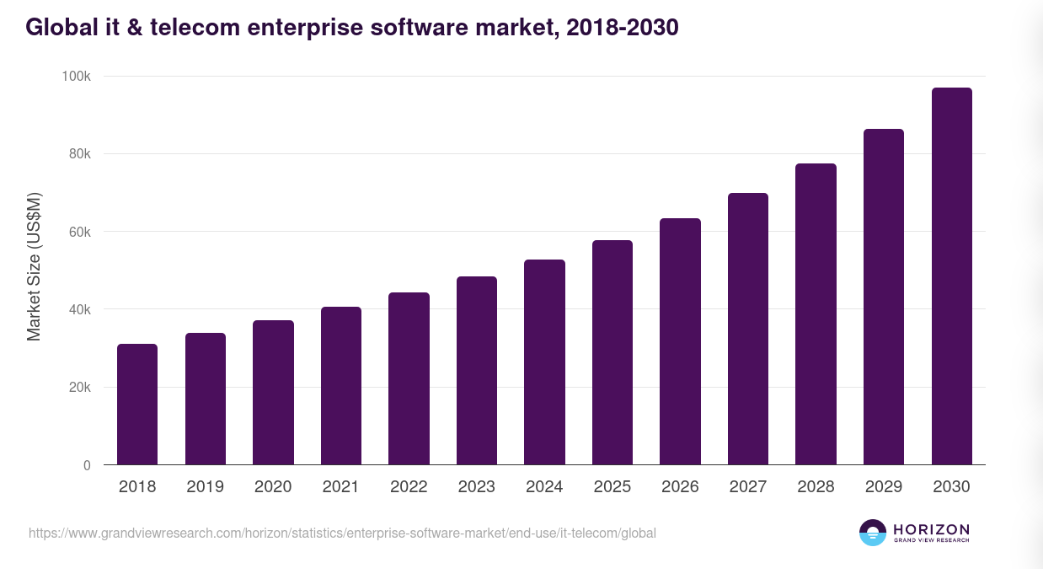
- According to Grand View Research, the IT & Telecom enterprise software segment generated $52.67 billion in revenue in 2024, and is forecast to reach $96.8 billion by 2030, growing at a 10.9% CAGR.
- The global telecom cloud market is estimated to reach nearly $169.5 billion by 2025, growing at a CAGR of 24.6%, and with 60% of telecom operators already on cloud technologies.
- In 2023, the global telecom industry posted approximately $1.7 trillion in revenue, with over 8 billion mobile subscriptions and growing investment in cloud & automation.
- The global market for telecom billing solutions is estimated at $15 billion by 2025, growing at a 9% CAGR, indicating increasing use of digital invoicing solutions.
- Telecom operators are estimated to spend more than $250 billion globally on 5G infrastructure by 2025, speaking directly to the scale of modernization.
- The global telecommunications CRM software market was valued at $8.5 billion in 2023 and expected to reach $20.3 billion by 2032, for a CAGR of 10.1%.
- In 2023, the telecommunications services market–part of Telecom IT services–is estimated at $742.12 billion, expected to reach $3,485.67 billion by 2031 at a combined CAGR of 26.45%.
- The global telecommunication API market is expected to grow at a 17.5% CAGR from 2021 to 2027, a clear illustration of increasing modular integration with telecom developer platforms.
- The global telecom software market is expected to rise to $86 billion by 2027, indicating an accelerated move toward software-led transformation in telecom.
- The IoT revenues for telecom operators are expected to surpass $1.8 trillion globally by 2026, indicating the enormous opportunity that connected devices and services.
Average Telecom Software Development Costs
The average telecom software development cost will be different for each company based on project requirements and business goals. On average, companies can expect to spend $8000– $30,000 on mid-level telecom solutions.
On the lower end of the spectrum might be a smaller project with basic functionality, while the top end may be a complete enterprise-grade telecom software solution with higher complexity, advanced features and integrations, a higher level of security, etc.
The cost to build telecom software can also vary greatly depending on whether you are hiring an in-house team, working with a local or telecom software development company or team, or hiring an offshore team directly. In addition, post-launch services (support, updates, maintenance, etc.) are also usually charged separately from development.
Software Level |
Average Development Cost (USD) |
Key Features |
| Basic | $8,000 – $16,000 | Call management, basic user interface, simple reporting |
| Medium | $16,000 – $25,000 | Billing & invoicing, analytics dashboard, moderate integrations, improved UI/UX |
| Advanced | $25,000- $30,000+ | Enterprise-grade features, advanced security, multi-system integrations, real-time analytics, CRM integration |
Consequently, it is always a good idea to have an affordable cost to build telecom software and plan because telecommunications software development is usually a more significant long-term commitment when you consider the levels of support that can be needed after launch, in addition to the cost to develop telecom software.
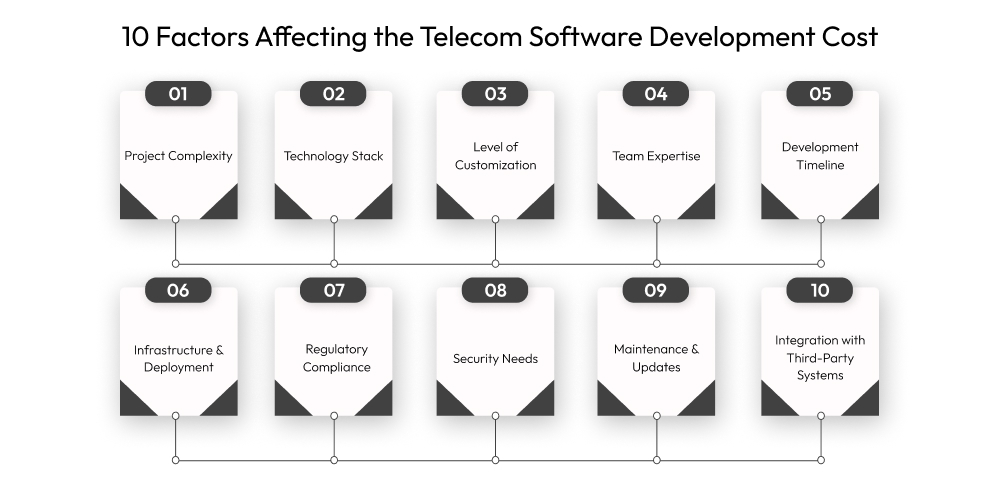
10 Factors Affecting the Telecom Software Development Cost
Now that you know the average telecom software development cost, it is important for you to go through these amazing factors that affect the cost vividly. Here is the list of 10 factors affecting the cost to build telecom software:
1. Project Complexity
The complexity of telecom software will always have a significant contribution to the development costs. Features like Real-time Data processing, Network Management, VoIP, and Analytical charts powered by Artificial Intelligence are difficult to build, require developers to research not only to develop the telecom software requested, but to be able to run and use each of the end products into an overall telecom application, which can run independently for each task specifically.
Bonus Read: Develop a VoIP Calling App
When complexity is high, there will be additional coding, testing, and deployment; therefore, various resources will be required for these individual tasks, which results in much inefficiency and an overall cost to make telecom software that was not factored in, like the simple applications or basic functionality.
Level |
Approximate Cost Impact (USD) |
| Basic | $8000 – $12,000 |
| Medium | $12,000 – $20,000 |
| Advanced | $20,000 – $30,000 |
2. Technology Stack
The technology stack, which will be the languages, frameworks, and commercial or open-source tools to be used, can influence the cost of custom software development. Working with a bubble-like AI, IoT, and Blockchain within the telecom software will increase costs up front as it will require more licensing, development, integration, and specific expertise.
Selecting between commercial and open source will lower their initial investment with telecom software, but can increase the ongoing maintenance costs and upkeep in terms of scalability, performance, and long-term project requirements.
Level |
Approximate Cost Impact (USD) |
| Basic | $8,000 – $11,000 |
| Medium | $11,000 – $20,000 |
| Advanced | $20,000 – $30,000 |
3. Level of Customization
A highly customized telecom solution, specific to the business needs and requirements, will be more than traditional off-the-shelf sourced software. However, they require more coding to be developed, unique API’s, customized UI/UX, and custom integrations.
For example, a telecom provider requiring a customized billing module or advanced CRM tools will be paying different rates than a provider that is implementing packaged solutions. The more applicable customizations are requested, the greater the overall cost to develop telecom software.
Level |
Approximate Cost Impact (USD) |
| Basic | $8,000 – $12,000 |
| Medium | $12,000 – $22,000 |
| Advanced | $22,000 – $30,000 |
4. Team Expertise
By utilizing experienced (senior developers, specialists, telecom software experienced, with skill sets that have a varying degree of knowledge around AI and IoT, can all increase the cost to develop telecom software.
Offshore or freelance developers may lower costs, but might increase quality concerns. A balanced team made up of project managers, QA testers, and engineers adds cost to your overall software development services budget, but likely delivers more expected value and builds efficiencies.
Level |
Approximate Cost Impact (USD) |
| Basic | $8,000 – $11,000 |
| Medium | $11,000 – $20,000 |
| Advanced | $20,000 – $30,000 |
5. Development Timeline
Fewer deadlines increase the cost to develop telecom software as the dev team is likely having to work extra hours, or additional people are being brought on to meet the deadlines to deliver the project. If a project should take six months of work, then the costs to deliver it will increase over thirty-six months.
The longer period may have less upfront costs but probably incurs more indirect costs, like allocating resources for how they work, support, and team engagements while the project is being worked on.
Level |
Approximate Cost Impact (USD) |
| Basic | $8,000 – $10,000 |
| Medium | $10,000 – $18,000 |
| Advanced | $18,000 – $30,000 |
6. Infrastructure & Deployment
The enterprise product development cost will vary based on potential deployment choices. While cloud-based solutions may have lower up-front costs, you may find yourself paying for subscriptions a lot quicker. On-premises solutions will need far greater upfront costs in servers and ongoing maintenance.
However, there may be indirect costs in tech labor and ruling costs, and justifying when the journey is to grid and move closer to on-the-go service deployments that provide much. Additionally, the cost of integrating telecom software with your current IT systems, databases, and networking equipment could increase significantly based on your compatibility and scalability needs.
Level |
Approximate Cost Impact (USD) |
| Basic | $8,000 – $11,000 |
| Medium | $11,000 – $20,000 |
| Advanced | $20,000 – $30,000 |
7. Regulatory Compliance
Telecom software will have regulations such as GDPR, FCC rules, or some regional telecom standards to comply with. To comply means further upfront investment for security, encryption, data management, and auditing. Lastly, you may need to hire legal compliance or consult experts.
The chance of non-compliance and industry penalties is high, so the cost to develop telecom software associated downstream is likely pulled toward investment to align and keep business moving effectively in roles that fit compliance expectations.
Level |
Approximate Cost Impact (USD) |
| Basic | $8,000 – $10,000 |
| Medium | $10,000 – $18,000 |
| Advanced | $18,000 – $30,000 |

8. Security Needs
Telecom software also handles sensitive data about users, call records, financial transactions, etc. Security measures like firewalls, intrusion detection, end-to-end encryption, multi-factor authentication, etc., can easily add to the cost of software product development.
The more security layers you add, the more time and skilled resources you will need to develop them. Again, telecom companies must build everything in a secure way to avoid data breaches, fraud, and regulatory fines.
Level |
Approximate Cost Impact (USD) |
| Basic | $8,000 – $11,000 |
| Medium | $11,000 – $20,000 |
| Advanced | $20,000 – $30,000 |
9. Maintenance & Updates
Post-launch costs meant to maintain efficiency often control costs to build telecom software. The cost to develop telecom software often includes updates against new vendors, updates for new hardware, bug fixes, performance optimization, etc.
To be efficient, you will need regular operational updates to keep the telecom software up-to-date. You will also need to plan for ongoing adaptation of telecom software to other devices, operating systems, network standards, etc.
Companies must be aware of their long-term support contracts as well; if there are none, they will either need to sign one or take the time to ensure continuous performance, usability, and regulatory compliance throughout the software’s lifecycle.
Level |
Approximate Cost Impact (USD) |
| Basic | $8,000 – $12,000 |
| Medium | $12,000 – $22,000 |
| Advanced | $22,000 – $30,000 |
10. Integration with Third-Party Systems
The cost to develop telecom software can also be affected by any third-party systems’ integrations. This would include calling directly into CRMs, billing, cloud systems, or AI services, etc. Telecom software’s multiple integrations add significant costs.
All integrations can require great development times, software testing services, and documentation to ensure seamless systemic performance. Each additional third-party service increases costs not just because of licensing fees but also additional time for API resourcing, customization, and compatibility.
Typically, the more integrations that are in scope, the more costs and therefore the more overall investment from the telecom provider to develop their software.
Level |
Approximate Cost Impact (USD) |
| Basic | $8,000 – $12,000 |
| Medium | $12,000 – $22,000 |
| Advanced | $22,000 – $30,000 |
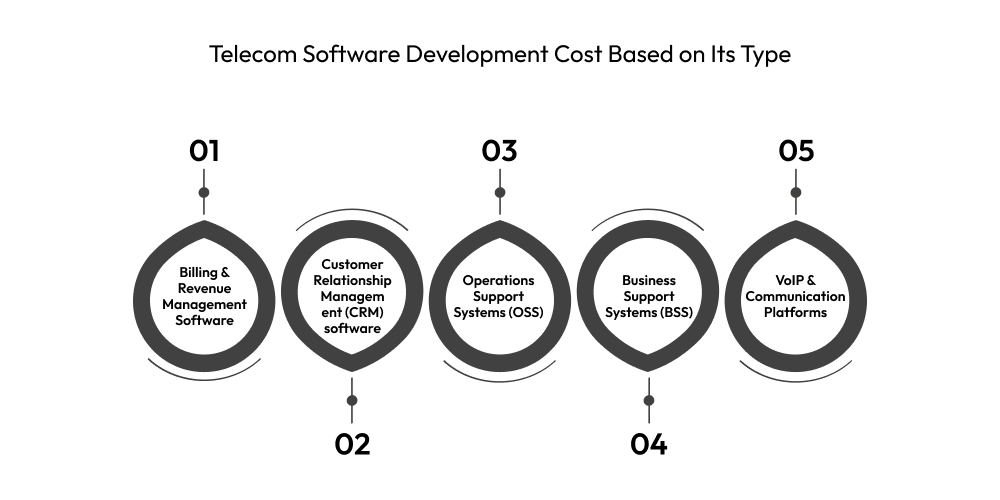
Telecom Software Development Cost Based on Its Type
Many people start building but forget about what is actually suitable for their business, and in the end, they end up regretting it. We don’t want you to go through that. So to help you, we have covered the different types of telecom software with their cost, so you can finalize your chosen one depending on your requirements.
1. Billing & Revenue Management Software
This software is designed for organizations that provide telecommunication to automate invoicing, manage subscriptions, detect fraud, and enable accurate revenue accounting. It promotes easy management of financial operations and builds customer confidence by allowing transparent, accurate invoice billing.
Cost: The cost to build billing management software generally sits within the range of $8,000 to $28,000, depending on features and integrations.
2. Customer Relationship Management (CRM) software
Telecom CRMs can streamline customer interactions, provide service requests and process tracking, and contribute to customer satisfaction. Some commonly offered functions may include ticket management, chatbots, a self-service portal, and personalized communication functions that enhance service efficiency while reducing customer churn.
Cost: The CRM Software development cost varies from $10,000 to over $30,000 if built with advanced AI-driven or omnichannel features.
3. Operations Support Systems (OSS)
OSS provides the organization with management of telecom network infrastructure, service provisioning, and service performance management. OSS ensures finite resources are used efficiently while enabling the timely offering and monitoring of service through hardware integration and resource tracking available in real-time.
Cost: The cost to develop OSS software ranges from $10,000 to $27,000, depending on the system complexity, integration requirements, and how many users can join.
4. Business Support Systems (BSS)
A BSS system helps a telecom provider benefit from enhanced customer management ability, order processing, billing operations, and revenue assurance. The BSS can usually be integrated directly into the OSS, which provides a complete operational ecosystem, providing all of the necessary tools for telecom providers.
Cost: The Business support system development tends to range between $8,000 $28,000, depending on the level of customization and compliance to be developed.
5. VoIP & Communication Platforms
VoIP solutions are used to provide internet-based calling, video conferencing, instant messaging, and collaboration platforms. VoIP & Communication solutions are vital for telecom providers that offer communications to businesses and consumers.
Cost: VoIP & communication software development cost typically range from $10,000 to $25,000 to develop, but can always rise with advanced features like AI Routing, IVR, and high-tier encryption.
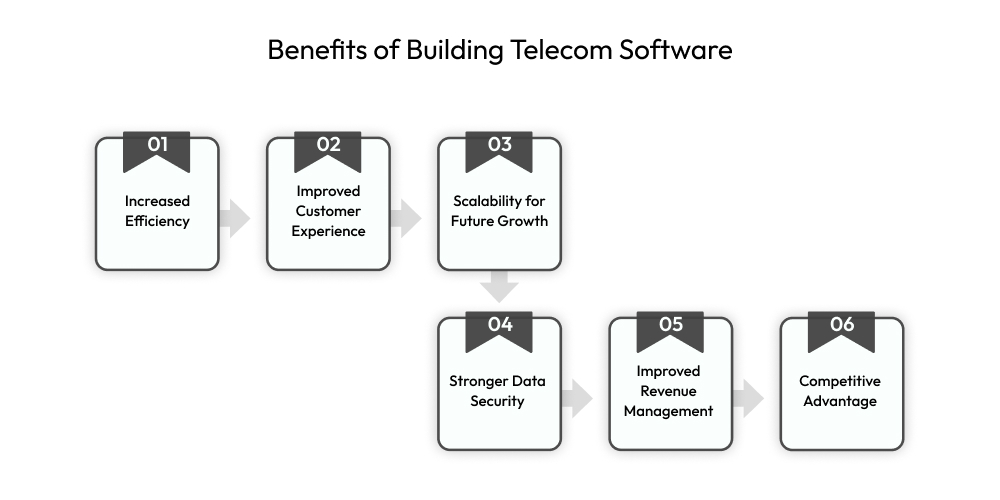
Benefits of Building Telecom Software
In an interconnected economy, telecom companies are consistently striving to create new technologies and make existing processes as seamless as possible for customers.
Building telecom software will allow telecom companies more control, a better experience for customers, and a future-ready experience. Here are the four benefits of investing in telecom and Saas development services.
1. Increased Efficiency
Telecom software can automate core processes within organizations such as billing, customer management, and network monitoring. Software can reduce manual processes and operational workflow, ultimately saving time and resources, improving productivity, and increasing cost-effectiveness.
2. Improved Customer Experience
Today’s Telecom software solutions have integrated CRMs, self-serve portals, and chatbots to enhance communication and responsiveness. Customers will be able to be aware of how their services are performing, usage, and adjust services with less nuisance, and can effectively manage and fix issues quickly if needed. This ultimately leads to customer satisfaction and loyalty in the market.
3. Scalability for Future Growth
Custom telecom software is designed with scalability in mind, allowing providers to add new features, support more users, or integrate advanced technologies like AI and IoT without overhauling the system.
4. Stronger Data Security
Telecom software provides strong security protocols, including end-to-end encryption, fraud detection, and intrusion prevention, which ensure sensitive customer data remains private, protects against cyberattacks, and conforms to regulatory compliance.
5. Improved Revenue Management
With smart billing and revenue management systems, telecom providers can measure usage accurately, minimize revenue leaks, and offer pricing flexibility. This provides an additional improvement in profitability and the viability of the business for the long term.
6. Competitive Advantage
Very custom telecom software allows differentiation in the market through unique features, personalization services, and new product iterations. Getting a leg up on competitors by outpacing them will help firm the foothold in the market and keep as many customers as possible.
Want a chatbot demo or pricing? Fill the form and talk to our experts today.
Pick what you need below — you can select more than one — then tap Get detail to continue.
-
Chatbot demo dashboard
-
Cost to develop an app
-
Industry report
-
Case study
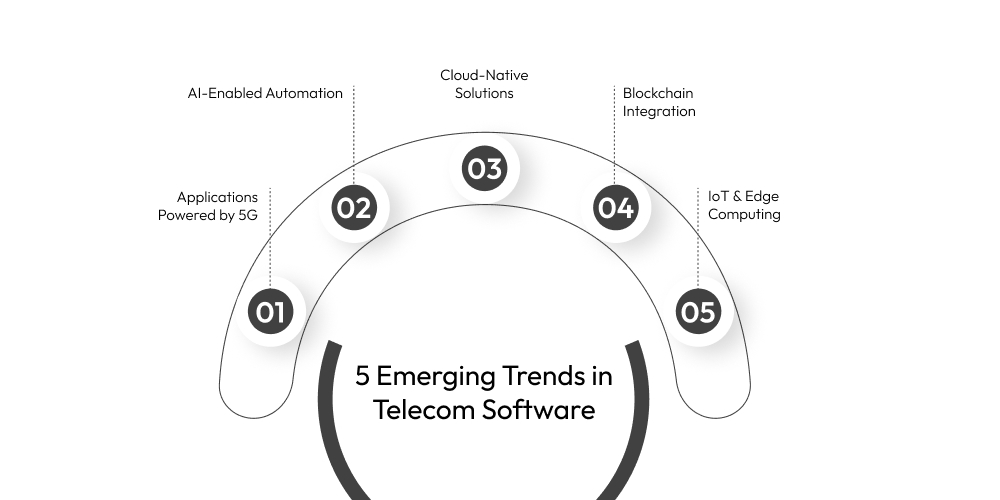
5 Emerging Trends in Telecom Software for 2025
Telecom and the technology embedded into it are changing rapidly, as are the expectations of customers. Here are the five main areas of emerging trends that are shaping Telecom Software for 2025:
1. Applications Powered by 5G
As 5G networks continue to roll out across the world, telecom software will continue to evolve to support applications that take advantage of the ultra-fast connectivity, low latency, and near real-time communication capabilities that come with 5G. Expect to see progress in products, services, and solutions leveraging set IoT technologies, smart cities, and immersive digital experiences.
2. AI-Enabled Automation
Artificial intelligence in one form or another is starting to change all facets of telecom operations, including predictive analytics/location, automated customer service, and intelligent network management.
AI in telecom means that usage decreases the need for humans and relies more on the improvement of efficiency with artificial intelligence to speed up the processes and improve decision-making capabilities.
3. Cloud-Native Solutions
While cloud-based telecom software is not new, the flexibility, scalability, and reduced on-premise infrastructure are appealing. By 2025, more providers will move to cloud-native solutions for faster deployments, easier upgrades, and increased service reliability.
4. Blockchain Integration
Blockchain in the telecom industry is capturing interest as a solution for secure transactions, fraud elimination, and transparent billing and accounting practices.
Telco companies are now looking to capture the blockchain benefit as a way to build trust, eliminate revenue leakage, and create a more efficient and effective financial function.
5. IoT & Edge Computing
Telecom software is now integrated with, or has functions that support, IoT and edge computing, which facilitates smart devices, autonomous vehicles, and instant monitoring. These integrations will support the increased data speed and enhance the customer experience when utilized across sectors.
7 Steps to Choosing the Right Telecom Software for Your Business
Choosing the right telecom software can truly transform a business that is looking to streamline its operations, improve the customer experience, or establish a scalable process or platform.
There are so many types of telecom software; determining which solution is right for your business requires careful planning and consideration. We will provide seven steps to consider as you think through your selection.
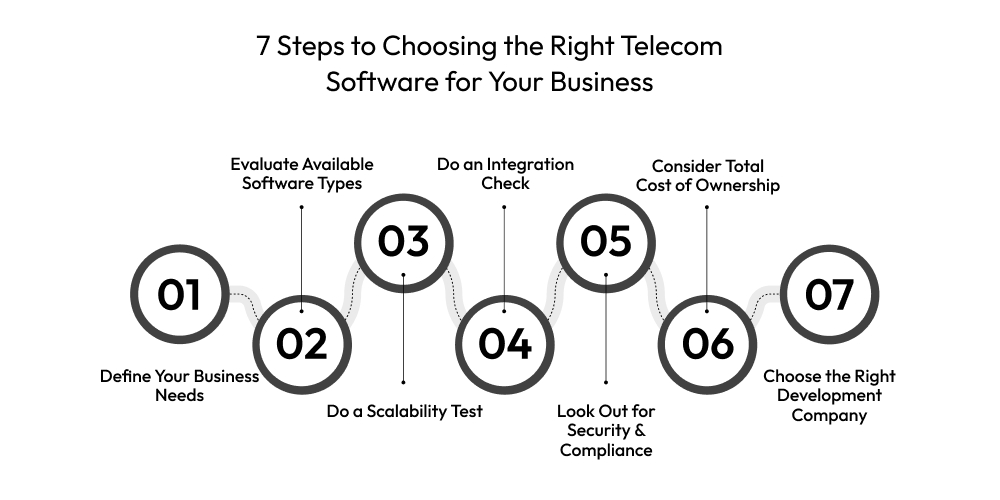
1. Define Your Business Needs
The first step is to establish your software product development company‘s business needs. Do you need a better way to manage billing, a tool for customer engagement, or a way to monitor the network? By establishing clear objectives, you will better inform the type of software your business will need.
2. Evaluate Available Software Types
Telecom software includes Billing & Revenue Management, CRM, OSS, BSS, and VoIP. Each software type is designed for specific tasks; find the software that directly solves your business problems.
3. Do a Scalability Test
Your telecom software should be able to evolve with your business. Make sure your solution can scale without significant re-development, and add more users, services, and advanced functionalities.
4. Do an Integration Check
Make sure the software you choose integrates with your existing systems – CRMs, ERPs, cloud platforms. Poor integration leads to inefficiencies, data silos, and unnecessary costs.
5. Look Out for Security & Compliance
Telecom software deals with sensitive data. When looking for development features, encryption, fraud detection, and breach alerts are crucial. Ensure the software is compliant with regional and international telecom regulations.
6. Consider Total Cost of Ownership
Look beyond the initial cost to build telecom software. Think about maintenance, support, licensing, and hidden costs like training and data migration. Understanding the total ongoing cost now can help you avoid unaccounted-for costs in the future.
7. Choose the Right Development Company
Finally, work with an experienced custom software development company. Who is reliable and will provide a solid design, delivery on time, and ongoing support based on your business goals?
5 Ways to Reduce Telecom Software Development Cost
Nobody is going to tell you this, but we are! Here is the list of ways you can reduce telecom software development cost in 2025. Try now.
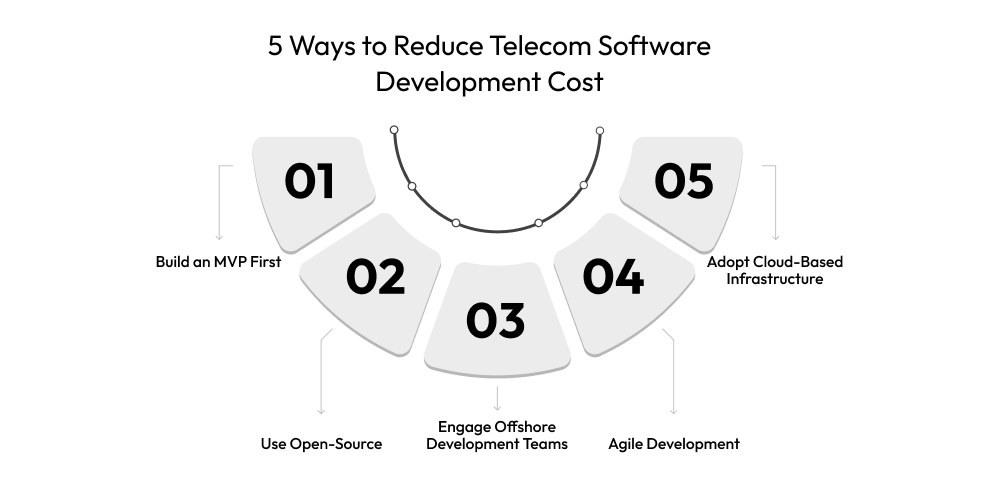
1. Build an MVP First
Instead of creating a full-blown telecom solution from the ground up, we recommend you choose to develop a Minimum Viable Product (MVP). Not only is this a good way to minimize your investment, test your ideas commercially, and solicit feedback from customers, but it also allows you to build advanced features later when costs are reasonable, and you will not have made any unnecessary upfront custom telecom software development costs.
2. Use Open-Source
Open-source frameworks, libraries, and platforms will save you considerable money in licensing fees. Many of the Telecom Ready open-source solutions are enterprise-grade and will work to develop a reliable and scalable foundation for your final product at an astonishingly lower cost to develop telecom software.
This enables you to build quality development while minimizing your use of proprietary technologies, affording you an effective use of resources and capital that benefits you whether you are a startup or an enterprise.
3. Engage Offshore Development Teams
Engaging developers from offshore regions will save money and massively reduce custom telecom software development costs. Developers from a mobile app development company can deliver the same level of expertise as an expensive consultant at a lower hourly rate.
Working with offshore teams from Vietnam, India, the Philippines, or Eastern Europe is just as effective and is much more affordable than using expensive developers as in-house teams or expensive consultants from onshore teams.
4. Agile Development
Agile development methodologies permit you to break up work into (5) sprints, thereby allowing for working code to be released efficiently and incorporating testing feedback.
By scaling testing throughout the telecom app development stages, there is a reduction in rewrites, reduced errors, and no cost overruns, and improved efficiency – instead of spending money to deliver everything upfront on a fixed schedule, using agile development implementations will allow you to deliver the A features and improved to B or C on schedule and fueled by limited iteration; ultimately affording the developer more budgeting control compared to the old style of developing code from initial requirements.
5. Adopt Cloud-Based Infrastructure
When using the cloud for telecom software, it means you’re not outlying heavy upfront costs for servers and hardware. Cloud models charge via subscription or pay-as-you-go plans, giving businesses the option for limitless scalability.
This means businesses will save money on infrastructure commitments, maintenance subscriptions, and upgrades, while ensuring seamless operations to market with a fraction of the telecom software development cost.
Develop Telecom Software with Dev Technosys!
In 2025, the telecom industry is growing with 5G, IoT, and new AI-focused developments. Investing in telecom software is no longer an option; it’s a must to remain competitive and scalable, and provide an end-user smooth customer experience. Dev Technosys is a leading software and mobile app development agency that creates end-to-end telecom solutions.
We create telecom software tailored to the requirements and challenges of businesses and their customers. We have over 15 years of experience, talented developers, and a proven track record, which makes us credible and the obvious choice when looking to develop secure, scalable, and future-proof telecom software that will increase growth, efficiency, and customer satisfaction. Choose wisely. Choose Dev Technosys.
Frequently Asked Questions
Q1. What Is The Average Cost To Develop Telecom Software?
A. The cost to develop telecom software is around $8000 to $30000. The cost per project depends on the size of the project, project features, and project complexity. Smaller or basic applications are on the lower range of costs, and enterprise telecom systems are on the higher end of the range.
Q2. How Long Does It Take To Create Telecom Software?
A. To create telecom software timelines can vary from as short as 3 months to a year or longer, depending on the project complexity, integrations into existing systems, and the features that are required to be included. Simple software solutions can take a shorter time period, while developing more enterprise platforms or specify that it will take much longer.
Q3. If I Outsource Telecom Software Development, Will It Reduce Costs?
A. Yes, outsourcing a skilled set of developers located offshore will have a cost impact vs. using in-house staff. It will provide access to expertise that might not be available and will also provide access to competitive pricing.
Q4. Are There Hidden Costs When Making Telecom Software?
A. Hidden costs may include maintenance, updates, licensing, third-party integrations, and scaling. Businesses should plan a long-term budget beyond initial telecom application development to ensure seamless operations and software lifecycle management.
Q5. Can Startups Afford Telecom Software Development?
A. Yes, startups can afford telecom software by building MVPs, using open-source technologies, and outsourcing development. Starting small and scaling gradually reduces upfront investment while ensuring quality telecom solutions.