


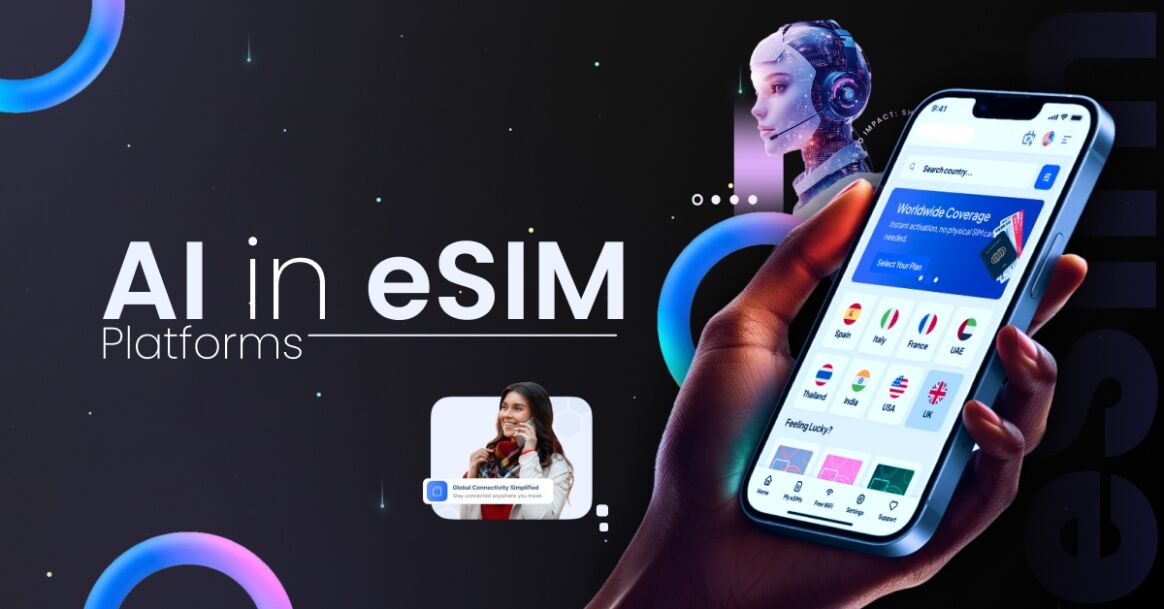
In today’s hyper-connected world, the fusion of Artificial Intelligence (AI) and eSIM technology is transforming the way devices connect and communicate.
As the backbone of modern digital ecosystems, eSIM platforms are rapidly evolving to meet the growing demands of IoT, 5G, and next-generation networks.
By integrating AI, these platforms gain intelligent decision-making capabilities, optimizing connectivity, enhancing security, and enabling seamless global mobility.
From smart homes to industrial automation, AI-powered eSIM solutions are unlocking unprecedented levels of efficiency, adaptability, and scalability.
As 5G expands and IoT devices proliferate, the synergy between AI and eSIM is not just enhancing connectivity; it’s redefining it.
This transformation marks a critical step toward a smarter, more agile, and always-connected future where machines and networks operate in perfect harmony across borders and technologies.
Overview of eSIM
In simple words, the eSIM is like a virtual SIM that enables users to access worldwide locations without carrying physical SIMs or purchasing SIMs of different countries. An eSIM app like Saily enables global coverage, virtual phone numbers, data plans, and provides flexibility to switch between multiple network services.
What is the Role of AI in eSIM Platforms?
Artificial Intelligence is transforming eSIM platforms by enabling intelligent network selection, predictive management, automation, and enhanced security.
This synergy powers scalable, reliable, and adaptive connectivity, crucial for IoT ecosystems, global mobility, and next-gen 5G use cases in an increasingly connected digital landscape.

1. Intelligent Network Selection
AI enables real-time evaluation of available networks based on signal strength, latency, cost, and usage patterns. It automatically selects the optimal network, ensuring seamless connectivity and improved performance, especially in multi-network and roaming environments.
2. Predictive Connectivity Management
AI solutions for eSIM connectivity analyze historical data to forecast connectivity issues and performance degradation. Connect with a professional mobile app development agency to integrate AI, which enables early intervention, reduces downtime, and improves the reliability of IoT and mobile connections across dynamic network conditions.
3. Automated Lifecycle Management
AI automates the eSIM lifecycle, including provisioning, activation, updates, and profile switching. This reduces manual intervention, streamlines operations, and accelerates large-scale deployments, especially in IoT environments where managing thousands of devices is challenging.
4. Security and Anomaly Detection
AI in embedded SIM technology enhances security by continuously monitoring behavior to detect anomalies, potential breaches, or fraud in real time. Machine learning models identify patterns outside the norm, enabling faster threat detection and mitigation without human input.
5. Context-Aware Decision Making
AI leverages contextual data, such as device location, movement, and usage, to make smarter connectivity decisions. Create a mobile app for eSIM with AI to ensure optimal performance by aligning network selection and configurations with current operational environments and user behavior.
6. Energy Efficiency Optimization
By analyzing data usage patterns and connectivity needs, AI helps optimize device energy consumption. This is crucial for battery-powered IoT devices, allowing them to connect only when necessary and conserving power intelligently.
7. Dynamic Roaming Management
AI dynamically manages international roaming by selecting the best available local network based on real-time conditions. It ensures cost-effective, uninterrupted service for global travelers and cross-border IoT deployments.
8. Traffic and Load Balancing
AI in mobile connectivity apps distributes data traffic across networks based on capacity, congestion, and demand. This intelligent load balancing improves performance, reduces bottlenecks, and ensures a consistent user experience across devices and geographies.
9. Personalized User Experience
AI customizes connectivity profiles based on individual user behavior, device type, and service preferences. Develop an eSIM app with AI, which enhances satisfaction by delivering more relevant data plans, improved service quality, and adaptive configurations.
10. Fault Prediction and Self-Healing
AI predicts potential faults in connectivity or hardware by analyzing patterns in telemetry data. It can trigger automated recovery actions, such as switching profiles or restarting services, to maintain continuous operation with minimal human intervention.
AI-Based Use Cases and Applications
Let’s explore the AI-driven use cases and applications for eSIM platforms:
1. Smart Cities
Smart cities can use AI-enhanced eSIM platforms to improve the efficiency of their systems. AI facilitates advanced integrated intelligent network switching, real-time data analytics, and remote eSIM provisioning. This guarantees secure, seamless, and scalable connections for thousands of geographically dispersed IoT sensors and devices.
2. Connected Vehicles
Artificial intelligence-enabled embedded SIM cards facilitate tailored and context-aware connectivity to autonomous and connected automobiles.
These innovations offer seamless communication for the systems that need constant connectivity to V2I services, along with navigation and entertainment. The crucial safety systems that support next-generation innovations for vehicle and highway safety.
3. Industrial IoT (IIoT)
The integration of AI and eSIM technologies empowers industrial settings to accomplish predictive maintenance, operational efficacy, and secure device oversight. eSIMs enable flexible, remote network access wherever factories, supply chains, and remote locations are situated, while AI models study sensor data for early fault detection.
4. Consumer Devices
Wearables, smartphones, and tablets benefit from AI-driven eSim platforms that optimize network usage, minimize power consumption, and customize connectivity.
According to the artificial intelligence development company, AI observes the user and autonomously picks the optimal network and data plan, improving battery life and overall performance.
5. Global Roaming
For travelers abroad and IoT cross-border implementations, AI chooses the best local network based on price and quality. This provides seamless worldwide connectivity and significantly reduces roaming expenses for travelers while eliminating manual provisioning through real-time automated decision-making in the eSIM environment.
You can reach out anytime; we are available 24/7. Our team provides a quick response.

eSIM in the Era of IoT and 5G
1. Role of eSIM in IoT
Contemporary smart travel technology is fundamental to scaling the Internet of Things (IoT). eSIMs facilitate remote provisioning, centralized management, and adaptable connectivity to billions of connected devices.
Bonus read: Cost To Develop an eSIM App
Unlike traditional SIMs, eSIMs can be changed and updated remotely and, thus, can be deployed and operated seamlessly across multiple environments without the need for physical access.
Key Use Cases Include:
- Smart Meters: Automatic utility monitoring and data transmission without manual SIM changes.
- Automotive IoT: Real-time connectivity for vehicle diagnostics, navigation, and infotainment.
- Wearables: Compact and always-connected smartwatches, fitness bands, and health monitors.
- Industrial IoT: Remote asset tracking, predictive maintenance, and intelligent operations in factories and supply chains.
2. Role of eSIM in 5G
In the 5G landscape, eSIMs enable faster onboarding and seamless activation across high-speed networks. AI enabled eSIM for seamless 5G connectivity supports rapid deployment of new devices and services without physical SIM swaps, which is essential for the low-latency, high-throughput demands of 5G.
Key Advantages Include:
- Support for Network Slicing: eSIM and 5G connectivity enable dynamic allocation of virtual networks tailored to specific applications (e.g., autonomous vehicles, healthcare).
- Private Networks: Enterprises can use eSIMs to securely connect to dedicated 5G private networks, improving control, speed, and data protection.
5 key benefits and opportunities: AI in eSIM Apps
Offering various types of benefits and opportunities by integrating eSIM with artificial intelligence. Let’s explore them in detail:
1. Operational Efficiency
With the help of automated operations such as remote diagnostics, automated provisioning, and AI-based regular monitoring, the manual or human operations are eliminated. These tasks can easily manage or operate the large-scale fleet devices and streamline the support and logistics services.
2. Enhanced User Experience
AI in eSIM apps helps users to easily connect to the best networks based on real-time conditions and switch networks. It offers better service quality mainly on mobile devices, wearables, and other IoT devices. These advanced features and services can enhance the user experience and easily adapt to new technologies.
3. Scalability and Flexibility
The eSIM solutions with AI provide scalability and flexibility for users. These eSIM platforms can handle the high-loaded operations easily with no impact on the overall performance of the platform. Users can run eSIM services from any device or anywhere, and they easily switch their networks based on their travel.
4. Monetization Models
In this fourth benefit, artificial intelligence in eSIM platforms offers various types of monetization opportunities to enable businesses to generate new revenue streams.
It includes a freemium model, subscription plans, transaction fees, in-app advertising, additional features, and more. These monetization models help businesses create money-making opportunities.
5. Data-Driven Insights
When integrating eSIM with AI, it can observe the users’ data such as habits, preferences, behaviors, network performance, demographics, and much more.
These valuable data help businesses to identify new areas for improvement and offer personalized recommendations to users. Share these features with a travel app development company to integrate into your platform at a lower budget.

Challenges and Considerations: AI in eSIM Platforms
Here we provide the challenges and considerations when implementing AI in eSIM apps:
1. Data Privacy and Security
The AI systems need a vast amount of data for representations, but how they collect the users’ and platforms’ overall data raises some concerns about security.
Bonus read: Telecom Software Development Cost
There is a lot of sensitive information about users included, and it is difficult to maintain the users’ data. Make sure to implement robust security measurements such as GDPR, encryption techniques, and more.
2. AI Model Accuracy
The AI decisions in eSIM platforms must be accurate, fair, and relevant, but poor training and biased decisions can lead to wrong decisions, affect performance, and more. These can also lead to a poor user experience and the possibility of ethical standards in various regions and industries.
3. Integration Complexity
Businesses can connect with an experienced travel app development services provider for integrating AI with existing telecom infrastructure, and eSIM platforms can be technically complex and costly.
It requires cloud computing, edge processing, real-time data pipelines, and skilled personnel, posing a barrier for smaller operators or those in developing markets.
4. Regulatory and Compliance Issues
AI-driven eSIM solutions must navigate complex telecom regulations across countries, especially regarding roaming, data residency, and AI usage. Non-compliance can lead to service restrictions or legal penalties, requiring careful alignment with local laws and international standards.
5. Standardization
The AI-based eSIM platforms can lack a universal standard, such as compatibility issues in devices, carriers, data plans, and systems. Need to implement or establish protocols for universal accessibility, seamless performance, integration, and reliable networks. So, these can help businesses to access a multi-network environment and more.
Future Outlook: AI in eSIM Platforms
1. Evolution Toward 6G
As 6G emerges, AI-driven eSIMs will play a key role in enabling ultra-low latency, high-speed, and intelligent connectivity. They’ll support real-time applications like holographic communication, immersive XR, and autonomous systems in a hyper-connected digital world.
2. Integration with Blockchain
Blockchain can enhance eSIM security and transparency by enabling decentralized identity, secure provisioning, and tamper-proof data exchange. Combined with AI, it creates a trusted and autonomous connectivity ecosystem for devices and users across networks and geographies.
3. AI at the Edge
Deploying AI directly on devices or edge nodes will allow for faster decision-making and reduced reliance on the cloud. Edge AI in eSIM platforms will support real-time responsiveness in critical IoT and 5G applications like autonomous driving and remote surgeries.
4. Continuous Learning Systems
The future of AI and eSIM technology will continuously learn from network behavior, usage trends, and device performance. With the help of a GPS tracking app development company, it can enhance reliability, optimize connectivity over time, and enable proactive issue resolution without human intervention.
5. Expansion of Private Networks
Enterprises will increasingly adopt AI-enabled eSIMs for secure, high-performance private 5G networks. These networks will support advanced use cases in manufacturing, logistics, and healthcare, offering dedicated connectivity optimized through intelligent orchestration and real-time analytics.
Conclusion
It’s time to say goodbye. We hope that you have gained the right information about AI in eSIM platforms, including its benefits, challenges, role, and future trends. Nowadays, AI is highly demanded in every sector, and it makes it easy for businesses or users to run multiple tasks simultaneously without any performance impact.
Do you have your own eSIM platform? Ready to integrate AI? Then, directly connect with an AI development company to receive AI-powered eSIM connectivity solutions at a lower cost.
Frequently Asked Questions
Q1. Why AI is Important in Managing eSIMs in IoT and 5G Environments?
A. With billions of IoT devices and complex 5G networks, AI helps manage scale, automate operations, and optimize connectivity in real-time based on data-driven insights.
Q2. How Does AI Help in Optimizing Network Selection for eSIM Devices?
A. AI algorithms analyze signal strength, latency, bandwidth, cost, and policy to intelligently select the optimal network for connectivity in real time. These networking selection accuracy increases the user’s overall experience.
Q3. Are There Regulatory Frameworks Supporting AI and eSIM Integration?
A. Organizations like GSMA define eSIM standards, and AI integration must align with telecom regulations (e.g., GDPR, HIPAA, etc.) for data handling and cross-border connectivity.
Q4. How Does AI in eSIM Platforms Benefit Enterprise IoT Solutions?
A. Enterprises can automate connectivity management, reduce operational costs, enforce network policies, and gain real-time analytics across distributed IoT fleets.
Q5. Can AI and eSIMs Help in Rural or Underserved Connectivity Areas?
A. Yes, AI can identify and switch to the best available network, even in low-signal areas, improving service availability for remote or rural users.


