




















Key Takeways:
It may cost between $30,000 and $150,000+ to develop software that serves supply chain management needs. This price is dependent on various factors like complications, integrations, features, and scalability. A low-end supply chain management application will cost around $30,000-60,000, a mid-range one will cost $60,000-$100,000, and a fully baked application will cost $100,000-$150,000 or more.
Cost Based on Complexity of Development:
-
- Basic Software ($30,000-60,000): This involves inventory tracking, procurement management, order processing, supplier management, basic reporting, and access control.
- Mid-sized Software Application ($60,000-100,000): This software includes warehouse operations, transportation planning, demand forecasting, real-time tracking, analytic dashboards, and workflow automation.
- High-End Software ($100,000-150,000+): The advanced software involves AI forecasting, Internet of Things connectivity, predictive analytics, multiple location handling, high-level automation, and CRM integration.
Cost Based on SCM Software Types::
-
- Inventory Management Software: $30,000 to $60,000
- Warehouse Management Software: $40,000 to $80,000
- Transportation Management Software: $50,000 to $90,000
- Procurement Management Software: $35,000 to $70,000
- End-to-End SCM Platform: $80,000 to $150,000+
Cost of Different Geographical Areas/Countries:
-
- The cost of SCM software development in USA is in the range of $80,000 to $150,000, which depends on the features and integrations of the product and its technical complexity.
- The costs in Australia are lower, as they are around $70,000 to $135,000, influenced by the technology used, scalability, and the requirements of the project.
- The price of development in Canada is around $60,000 to $125,000, according to the development scale, integrations needed for the custom software development, and the need for security.
Additional costs:
-
- In terms of maintenance, it will cost you approximately 15% to 20% of the initial development cost every year to maintain your custom SCM software, which includes updates, fixes, extra security, and optimization.
- Costs associated with the cloud infrastructure, which is comprised of hosting, storage, database, monitoring, APIs, and backup, can appear every month depending on the usage, volume of data, and scalability.
The supply chain software development cost depends on far more than just how many functions are desired. The cost may be affected by various factors, such as real-time visibility into inventories, warehouse automation, route optimization, demand planning, Internet of Things connection, analytics based on artificial intelligence, etc.
For example, it is much cheaper to create a basic SCM solution than it is to work on an enterprise-level SCM system that is loaded with advanced automation, predictive intelligence, multi-location support, and complex integrations.
Moreover, there are other additional aspects affecting the price of the software apart from development. These elements include difficulties in the interface design of the software, the tech stack used, the number of security measures needed, the deployment model, the number of specialists involved in the process, maintenance costs, etc.
It is important to be aware of these challenges before getting started on development to be able to draw a realistic budget and avoid surprises.
What is Supply Chain Management Software?
The software for managing supply chains is a tech solution that supports planning, supervision, and fine-tuning the entire supply chain operation. This software brings together procurement, inventory control, warehouse operations, transportation, and demand forecasting in one system.
One can find modern SCM software combining AI, cloud computing, IoT technologies, supply chain automation, and real-time data collection and analysis. Companies use this software to optimize working processes, minimize their costs, and create effective and reliable supply chains.
Planning a Supply Chain Project?
Get a tailored development cost estimate in a few simple steps.
- 3 quick steps
- 100% free
- Reply in 1 business day
2 Minutes Read
How Much Does Supply Chain Management Software Development Cost in 2026?
The cost to develop supply chain management software in 2026 is usually about $30,000 – $150,000+. This always depends on the number of functions, complexity, and the need for integration.
The cost of simple supply chain software can range from $30,000 to $70,000, while the average one starts at $70,000 to $100,000. More advanced enterprise-level solutions with many features may cost over $150,000.
It is also necessary to consider the place of development, the technology stack, the skills and qualifications of the team, and the technical support policy.
Software Complexity |
Estimated Cost |
Development Timeline |
Typical Features |
| Basic SCM Software | $30,000–$70,000 | 2–4 Months | Inventory, orders, procurement, basic reporting |
| Mid-Level SCM Software | $70,000–$100,000 | 4–6 Months | Warehouse management, logistics, analytics, integrations |
| Advanced SCM Software | $100,000–$150,000+ | 6–8 Months | AI forecasting, IoT, automation, real-time tracking |
| Enterprise SCM Platform | $150,000+ | 8+ Months | Multi-location operations, advanced AI, ERP integration, predictive analytics, custom workflows |
Supply Chain Software Development Cost by Type
Various types of supply chain software fulfill different operational needs, which causes development costs to differ greatly. For example, some supply chain solutions have features and functions for inventory, warehouse, transportation, purchasing, as well as for the entire SCM process.
Thus, knowing where cost differences come from can help businesses to choose a perfect solution and build a realistic supply chain software development budget.
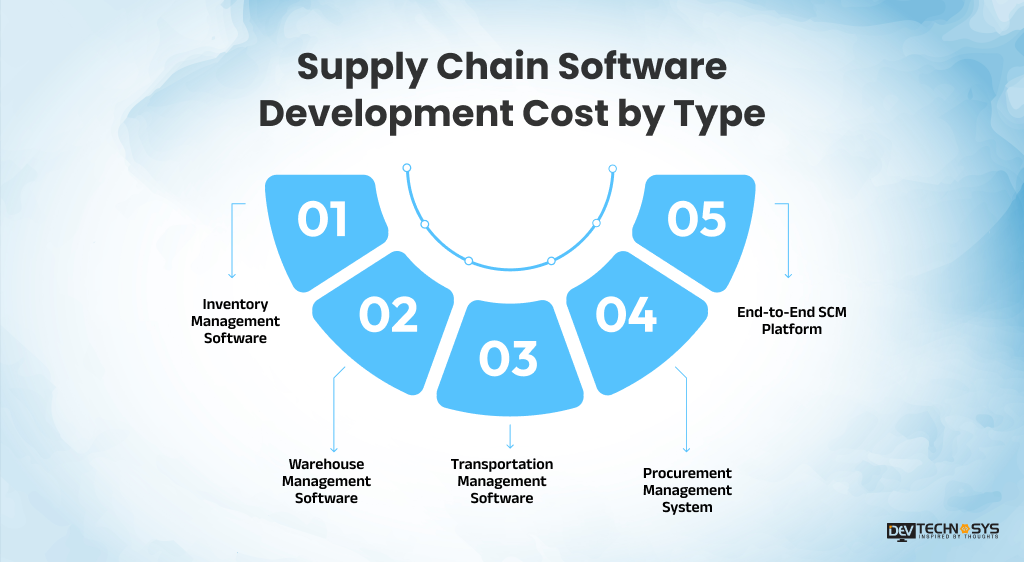
1. Inventory Management Software
Inventory control software can cost between $30,000 and $60,000 to create, depending on its features and its integration needs. Some of the distinct features include stock control, inventory alerts, barcode scanning, purchase orders, and reporting.
Based on this, if additional features such as demand prediction, multi-location inventory, automated replenishment, and real-time synchronization are needed, the cost of developing the program can increase.
2. Warehouse Management Software
Warehouse management software development is relatively more expensive than inventory management software, with the cost range being $40,000 to $80,000.
The basic features of warehouse management software involve receiving inventory, picking, packing, dispatching, warehouse tracking, and barcode management. However, the price may go up when a firm decides to use various technologies such as IoT, robotic technology, and real-time supply chain analytics.
3. Transportation Management Software
Transportation management program development has been estimated at $50,000–90,000 depending on the needed features. The program should include such functionalities as route planning, carrier management, shipment tracking, fleet monitoring, and delivery scheduling, but adding other features such as GPS, a telematics system, freight API integration, and route optimization technology makes the program even more expensive.
4. Procurement Management System
The cost of developing procurement management systems generally ranges from $35,000 to $70,000, depending on the challenge of the workflow. Standard features to be included are supplier management, purchase requests and approvals, purchase orders, tracking invoices, and reporting.
More sophisticated systems may require more technical expertise and development resources as they include features such as supplier analytics and automatic approvals.
5. End-to-End SCM Platform
It may take between $80,000 and over $150,000 to develop a complete supply chain management system connecting all processes involved in procurement, inventory, warehousing, transportation, and supplier relations.
The availability of such features as AI forecasting, IoT connection, automation, real-time visibility, ERP integration services, predictive analytics, and enterprise security may increase the cost of the system even more.
SCM Software Type |
Estimated Development Cost |
Typical Cost Drivers |
| Inventory Management Software | $30,000–$60,000 | Stock tracking, barcode scanning, alerts, reporting |
| Warehouse Management Software | $40,000–$80,000 | Picking, packing, IoT, automation, multi-warehouse support |
| Transportation Management Software | $50,000–$90,000 | GPS, route optimization, fleet tracking, carrier APIs |
| Procurement Management Software | $35,000–$70,000 | Supplier management, approvals, purchase orders, spend analytics |
| End-to-End SCM Platform | $80,000–$150,000+ | AI, IoT, automation, ERP integration, real-time visibility |
What Factors Impact The Total Supply Chain Software Development Cost?
The total cost of supply chain management software is determined by a variety of technical and business factors. Considering the software’s complexity, features offered, integrability, the technologies used, security, and development skills involved can help organizations to set realistic budgets for SCM development.
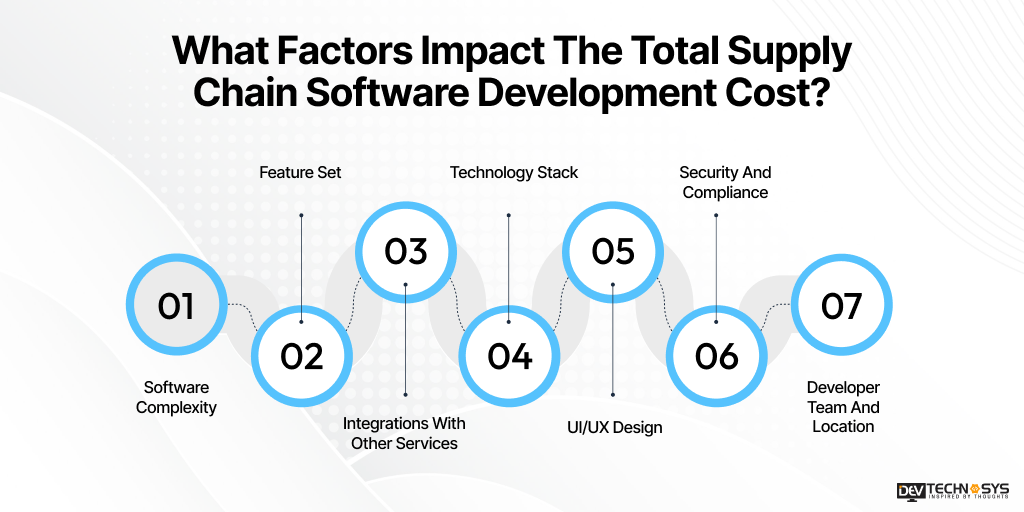
1. Software Complexity
The complexity of your SCM solution has a direct relationship with development effort, microservices architecture, and the need for testing. The more basic your solution is, the lower the price will be.
In contrast, sophisticated solutions with AI-based forecasting, automation, real-time visibility, and multi-level workflows will require highly qualified developers and will take longer to develop.
Complexity |
Cost Impact |
Cost Effect |
| Basic | 5–10% | Simple architecture and workflows |
| Moderate | 10–20% | More modules and custom logic |
| Advanced | 20–30% | AI, automation, real-time processing |
| Enterprise | 30–35% | Complex architecture and scalability |
2. Feature Set
Each component in your SCM solution influences hours of development, design, database logic, testing, and maintenance. Core components, such as procurement, inventory management, warehouse, delivery, and reporting, are generally easy and inexpensive to put together.
More advanced capabilities, such as demand forecasting, routing optimization, vendor analytics, automated workflows, and predictive analysis, therefore have a higher cost to build supply chain management software.
Feature Scope |
Cost Impact |
Cost Effect |
| Core Features | 5–10% | Essential SCM functionality |
| Standard Modules | 10–20% | Adds warehouse and logistics |
| Advanced Features | 20–30% | Adds optimization and automation |
| AI in Supply Chain Management | 25–35% | Requires predictive intelligence |
3. Integrations With Other Services
Integrating various systems such as ERP, CRM, payment systems or gateways, GPS, IoT devices, Carrier APIs, marketplaces, and warehouses can significantly affect the cost to build supply chain management software.
Every integration entails API analysis, authorization, data mapping, data synchronization logic, troubleshooting, and testing. Some proprietary APIs or poorly documented ones would require extra man-hours for engineering, expanding both the timeline and the budget.
Integration Scope |
Cost Impact |
Cost Effect |
| Basic APIs | 5–10% | Limited external connectivity |
| Multiple APIs | 10–20% | More data synchronization |
| ERP/WMS/TMS | 15–25% | Complex system integration |
| Multi-System | 25–35% | Extensive enterprise connectivity |
4. Technology Stack
The choice of front-end, back-end, database engine, cloud infrastructure, AI, and analytics technologies influences the manufacturing software development cost.
Modern scalable technologies may demand specific expertise, affecting hourly rates of development. However, the right choice of a technology stack might save on costs in the long run due to improved performance and enhanced maintainability.
Technology |
Cost Impact |
Cost Effect |
| Standard Stack | 5–10% | Lower development complexity |
| Cloud Architecture | 10–15% | Adds cloud infrastructure |
| AI/ML | 15–25% | Requires specialized expertise |
| IoT & Microservices | 20–30% | Adds real-time infrastructure |
5. UI/UX Design
The creation of a sophisticated user interface for SCM involves elaborate UX research, information architecture, interactive dashboards, tailored screens based on user roles, responsive layouts, and usability testing.
The creation of simple user interfaces tends to be less expensive than that of customized dashboards for planners, warehouse managers, drivers, suppliers, and top managers.
Design Scope |
Cost Impact |
Cost Effect |
| Basic UI | 3–7% | Simple screens and layouts |
| Standard Dashboards | 7–12% | Interactive business dashboards |
| Custom UX | 12–18% | More design iterations |
| Multi-Role UI | 18–25% | Multiple specialized interfaces |
6. Security And Compliance
Security requirements influence logistics management software development cost substantially, as they are vital for enterprise SCM platforms engaged in handling operational and financial data.
The implementation of encryption, role-based access control, audit trails, secure APIs, identity management, and testing for vulnerabilities and other compliance requirements entails higher costs to create supply chain management software, as well as more complex implementation.
Security Level |
Cost Impact |
Cost Effect |
| Standard Security | 5–10% | Basic access protection |
| Advanced Security | 10–15% | Encryption and MFA |
| Enterprise Security | 15–20% | Advanced monitoring and auditing |
| Extensive Compliance | 20–30% | Regulatory controls and assessments |
7. Developer Team And Location
Developer expertise, team composition, and location have a direct effect on hourly rates and total cost to create supply chain management software. An experienced ERP software development company specializing in SCM, cloud, AI, IoT, and enterprise integrations might charge more but will significantly decrease technical risks and reduce time spent on development. Therefore, the geographical location of a team can result in quite different price estimates.
Team Type |
Cost Impact |
Cost Effect |
| Offshore Team | 5–15% | Lower development rates |
| Nearshore Team | 10–20% | Moderate development rates |
| Onshore Team | 20–35% | Higher regional rates |
| Specialized Team | 25–30% | Premium technical expertise |
Note: The total cost includes all relevant factors, applicable cost types, associated expenses, and additional components considered together.
Hidden Cost Drivers in Supply Chain Management Software Development
The overall investment needed to develop and run supply chain management software can be influenced greatly by hidden costs. In addition to fleet management app development costs, an organization must include costs in its budget plans associated with items such as cloud infrastructure, services from third-party vendors, data migration, security, compliance, maintenance, and training employees. Identifying these costs early will help avoid unanticipated financial strains.
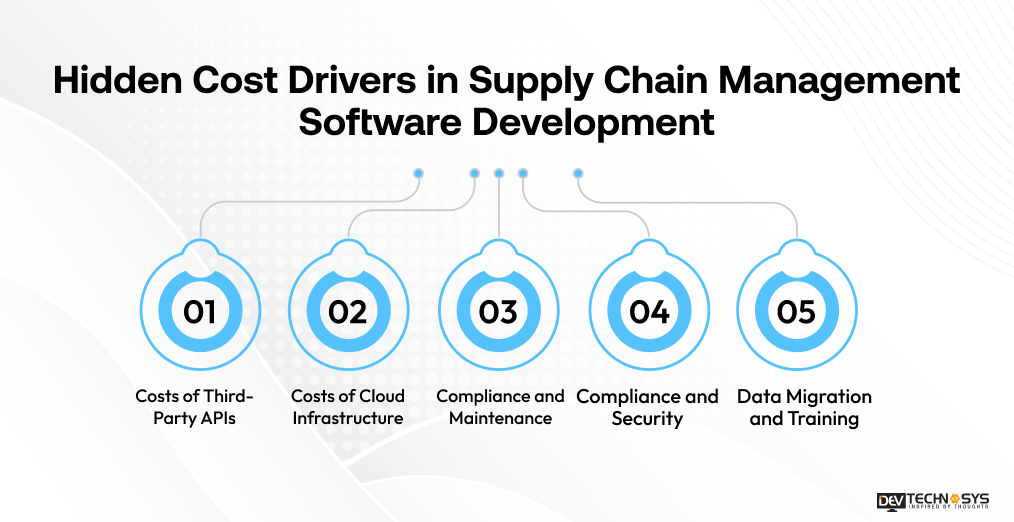
1. Costs of Third-Party APIs
If external ERP, logistics, maps, payment, transport, and analytics services are used, an organization may incur subscription, transaction, and usage fees.
These charges could impact an organization’s budget after launch. Companies must consider the fee model of the APIs, limits that may apply, scalability, and future needs before the integration is done.
2. Costs of Cloud Infrastructure
Costs of cloud hosting vary according to the number of users, transactions, storage needs, and real-time data processing. Advanced SCM systems may require additional computing, databases, storage space, backups, monitoring, and bandwidth. Deploying a scalable infrastructure and monitoring resources will eliminate the risk of unpredictable costs for cloud services.
3. Compliance and Maintenance
The initial budgeting process can fail to properly anticipate the cost of maintaining an SCM platform after its launch. Services like bug fixing, providing supply chain software security updates, developing hardware/software upgrades and optimizations, and improving features need constant resources to perform these tasks. With a good plan in place, a company will know how to conduct maintenance in an effective way.
Expert Says:
As per our CTO, Parmod Jangid, the maintenance cost lies between 10% and 20% of the total cost of SCM development, based on the type of maintenance required.
4. Compliance and Security
Being compliant with security and other requirements is another associated cost during the software life cycle. Conducting all SCM software security checks, performing penetration testing, upgrading system data encryption, and preparing documentation can require experts. Such expenses are especially relevant when the system deals with sensitive data.
5. Data Migration and Training
The data migration process means that companies have to deal with the old data as well. All processes of cleaning, mapping, validating, and testing the data will surely require significant resources. Moreover, the employees have to be trained to use the new system effectively.
Free App Idea Reality Check: Let's Stress-Test Your Concept
Share your app idea with us. Within 3 business days, we'll uncover UX gaps, feature opportunities, and potential development challenges, so you can build with confidence. No strings attached.
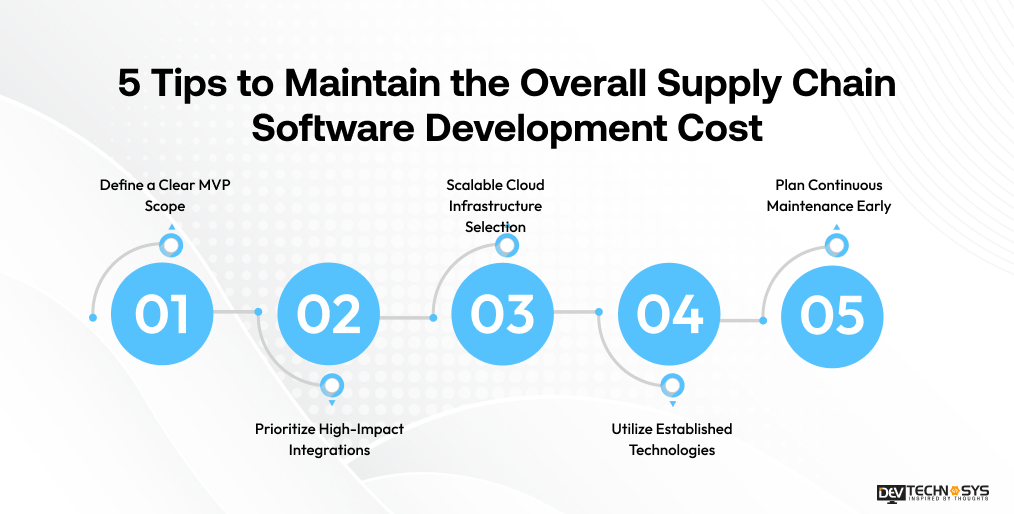
5 Tips to Maintain the Overall Supply Chain Software Development Cost
SCM software development costs are best controlled via the implementation of proper strategies and not merely by cutting down on development budgets. By determining the right priorities, adopting flexible technology solutions for SCM projects, avoiding unproductive integration processes, reusing available tools, and devising plans for maintenance.
1. Define a Clear MVP Scope
Begin by gathering the most basic possible functions of the SCM system, such as ordering, bookkeeping, inventory, and reporting. It is better not to start building sophisticated processes before making sure that the business and user processes are clear and validated. The simpler an MVP is, the less development time will be required, and the lower customization costs will be.
2. Prioritize High-Impact Integrations
Integrate only the systems that support main processes of the supply chain. Attempting to connect any existing ERP, WMS, TMS, marketplace, or shipping system will drastically increase the cost to make supply chain management software. Prioritizing the most important APIs means that only those systems will be integrated, which will allow one to make it as uncomplicated as possible.
3. Scalable Cloud Infrastructure Selection
A modular cloud-based structure can assist with the management of infrastructure and upkeep costs as the platform advances in capacity. The adept use of microservices, cloud-managed services, automated deployment, and scalable databases prevents firms from over-investing in infrastructure. This assists firms in increasing their computing resources as per demand rather than having to make expensive infrastructure investments right away.
4. Utilize Established Technologies
The employment of established frameworks, reusable components, APIs, libraries, and development tools could shorten the engineering time considerably. Limiting custom development aids with minimizing the amount of coding, testing, and support needed.
The choice of technologies supported by large developer communities and long-term support leads to a reduction in future transition costs and simplifies the process of finding qualified personnel.
5. Plan Continuous Maintenance Early
When budgeting for software development, launching it and maintaining it should start being considered as early as possible. This would mean employing automated monitoring, making regular updates to ensure security, optimizing performance, bug tracking, and preventive maintenance to detect issues before they become costly.
Security and Compliance Requirements for Supply Chain Management Software
When creating supply chain management software, security and compliance must be a priority. Incorporating strong encryption, access restrictions, authentication, frequent security audits, data protection, and the implementation of data privacy regulations significantly strengthens the security of business data.
Compliance with these measures guarantees a reduction in cybersecurity threats, protection of business operations, and establishing trust with suppliers, partners, and customers.
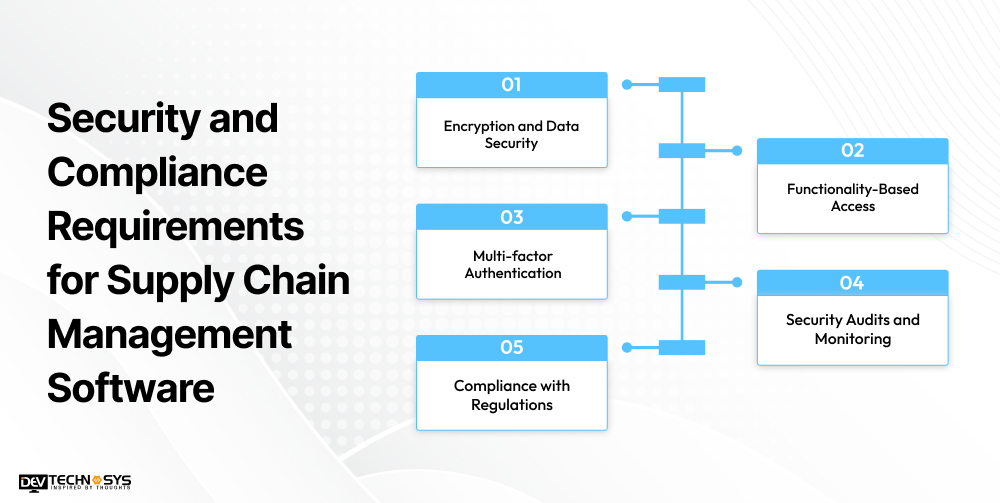
1. Encryption and Data Security
Supply chain software uses sensitive data, such as vendor information, stock details, client information, and transaction data. The use of encryption is very important. It protects data during transit and when inactive. Strong encryption ensures protection of sensitive information in the supply chain.
2. Functionality-Based Access
Functionality-based access allows administrators to decide which information and functionalities may be accessed by each user. Warehouse workers could have access to stock data, while managers may access reporting and analysis. This security requires the minimum possible access and contributes to information security.
3. Multi-factor Authentication
Multi-factor authentication enables adding an extra layer of protection by requiring that multiple methods are used for user identification verification. Thus, combining simple passwords with codes to verify user identity and biometric identification can enhance security. This function is especially useful for supply chain systems accessing employee accounts.
4. Security Audits and Monitoring
Regular security audits and ongoing monitoring allow for the detection of weaknesses, suspicious activities, and risks in supply chain management software.
The organization should regularly perform vulnerability assessments, penetration tests, and system monitoring. Maintaining detailed audit logs is also beneficial for organizations to investigate incidents, monitor user activity, and improve system security levels.
5. Compliance with Regulations
Supply chain management software may have to comply with data protection, privacy, financial, and other industry-specific regulations. Using various compliance requirements, such as GDPR, SOC 2, PCI-DSS, and ISO 27001, according to the company’s location, industry, and business practices. In this way, implementing compliance into the software development process can help companies avoid penalties, protect clients’ information, and establish their reputation.

Custom vs. Ready-Made Supply Chain Software
Companies can select the right supply chain software for their budget, their operational needs, and their plans for future growth from either custom or off-the-shelf software. While custom options are more adaptable and can be scaled up better, off-the-shelf programs can be implemented more quickly and less expensively and come with necessary features for typical supply chain activities.
Factor |
Custom Software |
Ready-Made Software |
| Cost | Higher initial cost | Lower initial cost |
| Features | Fully customizable | Pre-built features |
| Development Time | Longer | Faster |
| Scalability | Highly scalable | Depends on provider |
| Integration | Flexible integrations | Limited options |
| Maintenance | Customized maintenance | Vendor-managed |
| Best For | Complex business needs | Standard business needs |
| Control | Full control | Limited control |
Tech Stacks Used in Supply Chain Management Software
It is important to select the correct technology stack to create safe, scalable, and efficient software for supply chain management. These include technologies such as React, Node.js, Python, PostgreSQL, and AWS, as well as APIs, AI, IoT, and various tools for analytics.
Technology Layer |
Common Technologies |
Purpose |
| Frontend | React.js, Angular, Vue.js | Building interactive dashboards and user interfaces |
| Mobile App | Flutter, React Native, Swift, Kotlin | Developing Android and iOS supply chain applications |
| Backend | Node.js, Python, Java, .NET | Handling business logic, APIs, and application operations |
| Database | PostgreSQL, MySQL, MongoDB | Storing inventory, supplier, order, and transaction data |
| Cloud | AWS, Microsoft Azure, Google Cloud | Hosting, scalability, storage, and infrastructure management |
| APIs | REST, GraphQL | Connecting SCM software with ERP, CRM, logistics, and third-party platforms |
| AI & ML | TensorFlow, PyTorch, Scikit-learn | Demand forecasting, predictive analytics, and intelligent automation |
| Big Data | Apache Kafka, Apache Spark | Processing and analyzing large volumes of supply chain data |
| IoT | MQTT, AWS IoT, Azure IoT | Connecting and monitoring sensors, vehicles, and warehouse equipment |
| DevOps | Docker, Kubernetes, Jenkins, GitHub Actions | Deployment, scalability, automation, and continuous integration |
| Security | OAuth 2.0, JWT, SSL/TLS | Authentication, authorization, and secure data transmission |
| Analytics & BI | Power BI, Tableau, Looker | Creating reports, dashboards, and supply chain performance insights |
ROI of Supply Chain Management Software
Supply chain management software investment is much more than development cost. A smartly developed solution has the potential to yield long-term profits as a result of enhanced operational efficiency, decreased waste, automation of repetitive tasks, and real-time insight into the processes involved in the AI-powered supply chain.
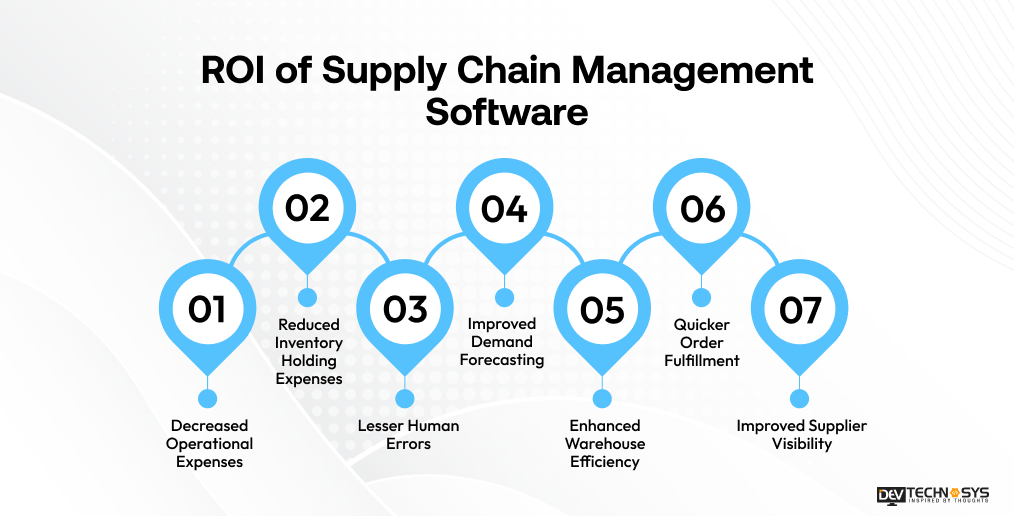
1. Decreased Operational Expenses
Automation enables the elimination of manual tasks throughout procurement, inventory management, order processing, reporting, and logistics. This can lead to decreased manual input and improved resource efficiency in a firm, leading to reduced labor costs and improved productivity.
2. Reduced Inventory Holding Expenses
Real-time tracking of inventory allows businesses to keep stock levels in check. Improving visibility over stock levels can allow them to minimize storage and unnecessary purchase expenses and still have key stock items available for use when they are needed.
3. Lesser Human Errors
Performing data entry manually can result in various inventory problems resulting from inaccuracies in the data entered, including shipment delays and reporting errors. According to the logistics software development company, automated data collection and processing provided by supply chain software result in fewer mistakes in companies’ operations.
4. Improved Demand Forecasting
Sophisticated supply chain software applications use historical data, market trends, and analytics in order to improve demand forecasting. More effective forecasting allows businesses to organize the purchase and manufacturing processes in a better way.
5. Enhanced Warehouse Efficiency
The features of warehouse automation software make it possible to make warehouse functions of product movement, order picking, packing, and storage more efficient. Employees will be able to apply the method and easily find existing items and track inventory, which will lead to better results in this process, more efficient space usage, and lower expenses.
6. Quicker Order Fulfillment
Thanks to having the order processing automated, it has become possible to make the delivery process faster. Fulfillment would no longer be delayed, and all the operations of the fulfillment process would take less time.
7. Improved Supplier Visibility
The availability of centrally stored data about suppliers makes it easier for businesses to control various parameters related to suppliers, including pricing, supply time frames, fulfillment status, and product availability.
Conclusion
To sum up, investment in supply chain management software development is a great way for companies to optimize their operations, achieve better visibility, minimize costs, and base their decisions on data analytics. An effective solution can bring suppliers, warehouses, logistics, and customers together into one platform.
The costs of the development process depend on the program’s functionality, types of technologies used, integrations, and customizations chosen. Nonetheless, the benefits will definitely outweigh the costs. It is important to choose the right approach to development and a reliable supply chain software development company.
Frequently Asked Questions
Find answers to the most common questions related to this article.
The cost to develop supply chain management software can go anywhere between $30,000 and $150,000 depending on its complexity and SCM software features included; it is important to consider the development location as well. While simple solutions are less costly, systems of a higher tier come with a considerable price tag.
There are many supply chain software cost factors determining the cost to develop supply chain management software: software complexity, number of features and user roles, reports from third parties, tech stack, UI/UX design, security requirements, amount of customization, testing, maintenance, and also the place of development.
The development of supply chain management software might take around three to twelve months, based on the scope of the project and its complexity. A simple MVP version might need three to five months for its development, while a fully-featured enterprise solution with many supply chain software integrations may require much more time.
Companies can minimize supply chain software development costs by starting with an MVP, figuring out which core functionalities to prioritize, opting for the right technologies, utilizing cloud-based infrastructure, thoughtfully planning integrations, and hiring a professional development team. Having a well-clarified scope contributes to reducing time, revisions, and unforeseen expenses.
The supply chain software maintenance cost usually equates to approximately 10-20% of the total amount spent on the initial development. Costs incurred may include such items as fixing bugs, updating security, performance improvements, infrastructure maintenance, technical support, adding new features, and compatibility updates to keep software effective and up to the mark.