
















Key takeaways:
-
- Custom AI model development typically costs between $8k–$30k or more.
- Monetize through automation, personalization, AI-driven products, and premium service offerings.
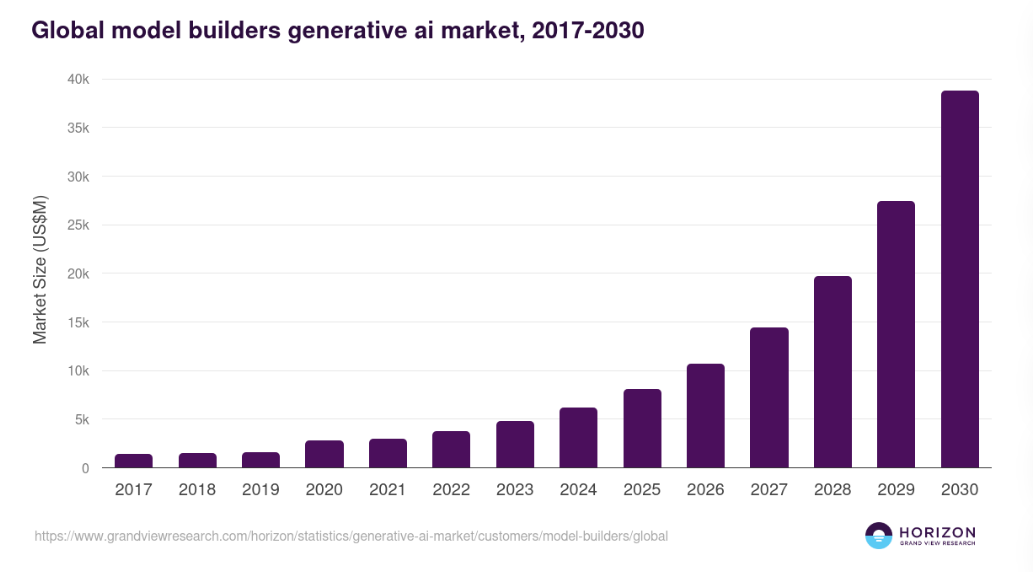
- The generative AI market is expected to reach $38.74 globally by 2030.
- Custom AI offers personalization, data security, efficiency, and strong brand differentiation.
Imagine having a business sidekick that never sleeps, never complains, and can whip up genius ideas faster than you can say “funding round.”
No, it’s not your over-caffeinated intern, it’s your very own custom generative AI model.
This isn’t some off-the-shelf robot spitting generic answers.
Nope.
This is your brand’s secret weapon, trained on YOUR data, tuned to YOUR tone, and ready to outthink your competition before they’ve even had their morning coffee.
And here’s the kicker: AI is set to pump $15.7 trillion into the global economy by 2030.
The smart ones?
They’ll be the businesses building custom AI now. So, buckle up, founder; we’re about to show you how to build a Generative AI model that’ll make your investors jealous.
Yes, you heard it right, it’s not that difficult, you just need an expert guide that we compiled for you.
What is a Custom Generative AI Model?
A custom generative AI model is an AI system designed and trained specifically for a business’s unique needs. Unlike generic models, it uses domain-specific data to generate tailored outputs, improve accuracy, and optimize performance.
Generative AI development solutions can power personalized content creation, automation, predictive analysis, and innovative solutions aligned with business goals, ensuring a competitive advantage.
Generative AI Market Size & Forecast
- According to Grand View Research, the global market segment focused on “model builders” generated USD 6.14 billion in 2024 and is projected to grow to USD 38.74 billion by 2030, at a compound annual growth rate (CAGR) of 37%.
- Investment into generative AI through venture capital reached USD 49.2 billion in 2025, the first half of that year, meaning this total surpassed the full year of USD 44.2 billion in 2024.
- McKinsey estimates that generative AI will produce an annual global economic impact of between USD 2.6 trillion and USD 4.4 trillion.
- A global survey has shown that 74% of organizations are already experiencing ROIs from generative AI solutions, with 86% seeing a reportable increase of at least 6% in annual revenues.
- EY India believes that generative AI could increase productivity in India’s USD 254 billion IT industry.
- In financial services, the productivity improvement is estimated to be 34–38% by 2030, while productivity in banking functions could rise to as high as a predicted 46%, especially in customer service and workflow automation.
Why Every Business Needs A Custom Generative AI Model in 2030?
Without any further ado, in this blog, we want you to go through these amazing reasons that let every business understand the need for a custom generative AI model in 2030.
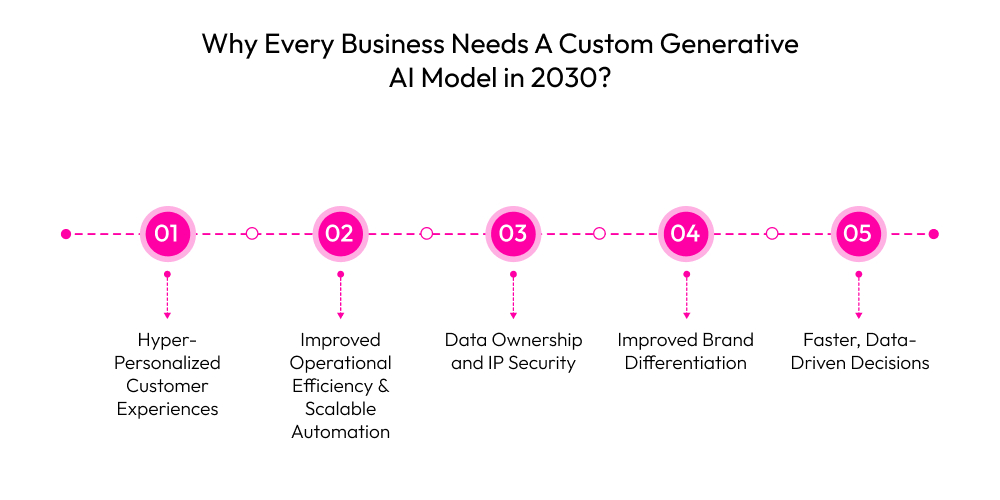
1. Hyper-Personalized Customer Experiences
Problem:
Off-the-shelf AI tools provide a broad solution regardless of individual customer characteristics, which often ignore subtle differences in your customers’ behavior.
Solution:
A custom generative AI model built with your business data will provide truly unique user journeys, whether that’s in marketing, sales, or product engagement.
Generative AI in business takes into account customer history, preferences, and behaviors to provide ultra-specific content and product recommendations that engage customers in real-time. It can help to improve onboarding experiences, reduce churn, increase customer lifetime value, and improve conversion rates.
Market Stat:
McKinsey reports personalization yields a 5-8x return on investment in marketing, and increases revenues by more than 10%. Custom AI could be the ultimate source of competitive advantage.
2. Improved Operational Efficiency & Scalable Automation
Problem:
Manual processes and generic AI Bots struggle to account for or automate domain-specific business processes, leading to operational inefficiencies and delays in work.
Solution:
An AI business ideas model can be integrated into your business process workflows to help automate and eliminate repetitive tasks, such as content creation, responding to support tickets, internal reporting, or even internal HR documentation, thereby saving time and reducing human error.
The more you train the model by using your internal documentation and historical operational activity, the more effective and better suited it will be for your team’s unique needs.
Market Stat: Gartner estimates that by 2026, operational AI will increase business process efficiency by 25%.
3. Data Ownership and IP Security
Problem:
Using third-party AI systems creates inherent risks to your business’s data and intellectual property, especially when you provide training data to multi-client AIs.
Solution:
Custom generative AI models anchor all data outputs to your safe and secure environment, governed by your privacy policies and regulated by other industry standards like GDPR or HIPAA. You fully own and govern the behavior of your models, training inputs, content, and outputs, while keeping proprietary methodology and customer insights shielded.
Market Stat: IBM said 81% of businesses think that data privacy and ownership are critical to their competitive positioning.
4. Improved Brand Differentiation
Problem:
Brands that use the same AI service providers yield very similar content, responses, and experiences, making it difficult to credibly build a differentiated brand position.
Solution:
Generative AI implementation can be tuned to reflect your brand’s voice, tone, visual aesthetics, and cultural identity to ensure that every visit is a true reflection of your values and your distinct position in the market.
With this approach, you can develop an app like Leonardo.Ai with differentiated customer experiences across every platform and channel that generic tools or services do not allow.
Market Stat:
Deloitte’s research said that 73% of high-growth companies embed AI in their brand and marketing strategy to create differentiated markets.
5. Faster, Data-Driven Decisions
Problem:
Off-the-shelf models do not readily integrate with your internal data systems or your business performance KPIs, which puts insights in a frail but recognisable disconnect.
Solution:
Custom generative AI models can be interfaced with your databases, CRMs, and analytics tools to provide data-driven insights, forecasts of trends, and contextual decision assistance. It learns and adapts to your business over time, making your decisions faster, smarter, and based on proprietary insights.
Market Stat:
Per PwC, AI-generated insights and automation will add upwards of $15.7 trillion to the global economy by 2030. Don’t get left behind.
Expert Guide:
A custom generative AI model is not just a technology upgrade; it’s a need to strategically integrate. It provides personalization, protects data, powers automation, and gives your brand a competitive voice. Don’t just adopt AI. Own it.
6 Key Businesses That Can Build Custom Generative AI Models
Custom generative AI models are changing the way all businesses operate for a more efficient, smarter, and personalized solution. While AI can be of benefit to almost every industry, there are certain types of businesses that stand to gain the most from developing and deploying their own custom models. Below are six reasons that can greatly benefit from the use of this technology:
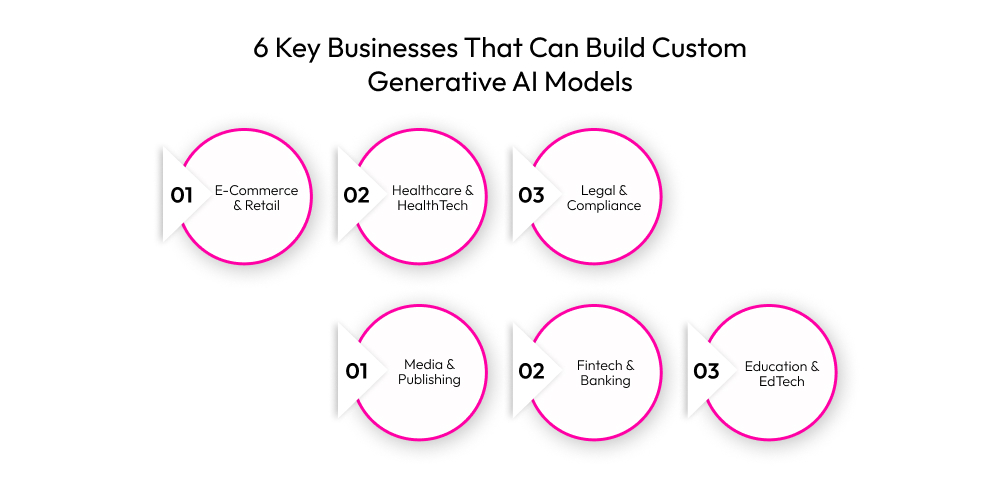
1. E-Commerce & Retail
E-commerce businesses can leverage custom generative AI to create personalized shopping processes, product suggestions, automated customer service, and dynamic content data such as product descriptions or promotional emails.
A custom-built generative AI model trained on your specific customer behavior and purchase data can lead to more engagement and conversions and less manual work.
2. Healthcare & HealthTech
In healthcare, speed and accuracy are often required. Custom AI models can be utilized to create health reports, curate patient histories, or support diagnosis by assessing medical data.
HealthTech platforms can employ AI models to provide semi-automated treatment recommendations, automate standard administrative processes, and improve lines of patient communication – while always maintaining data privacy and compliance.
3. Legal & Compliance
Legal entities and compliance organisations create significant quantities of contracts, case files, and compliance documents. A custom generative AI model can be trained on legal terms, jurisdictions, and internal templates to create contracts, summarize case documents, and maintain compliance standards, saving valuable time spent on repetitive actions.
4. Media & Publishing
Media companies can leverage custom AI to draft content from scratch, translate content, or provide unique repurposing for a variety of platforms.
Whether it is rolling out a draft article, creating posting statements for social media, or drafting video scripts, the ideal AI model trained upon your required brand tone and knowledge of audience preferences can prove invaluable for scaling content output while continuing to maintain quality.
With media firms increasing production in such a manner, submitting each draft to a plagiarism checker prior to publication guarantees that any article or script created is completely unique, thereby preserving copyright ownership and editorial quality on all platforms.
5. Fintech & Banking
Fintech companies build a Generative AI model for making financial reports, automating the customer experience, identifying fraud, and providing real-time information to customers. With a custom AI, you will have a unique solution that understands your business rules, financial products, and risk assessment approach/strategy.
With the help of a Generative AI development services provider, you will have a reliable platform on which to base your decisions and your interaction with your clients.
6. Education & EdTech
Educational institutions and EdTech companies can leverage AI generative systems to create unique lesson plans, quizzes, feedback, and study material.
Because a custom model can recognize each student’s learning style, learning language, and skill level, it allows for a richer and better education for students of all ages and backgrounds.
Want a chatbot demo or pricing? Fill the form and talk to our experts today.
Pick what you need below — you can select more than one — then tap Get detail to continue.
-
Chatbot demo dashboard
-
Cost to develop an app
-
Industry report
-
Case study
Amazing Generative AI Applications
Entering the world of generative AI will allow your business to spur innovation or infuse creativity into your industry. They can create high-quality, meaningful, and realistic content inside multiple media types. We will discuss some of the key applications you can use generative AI for:
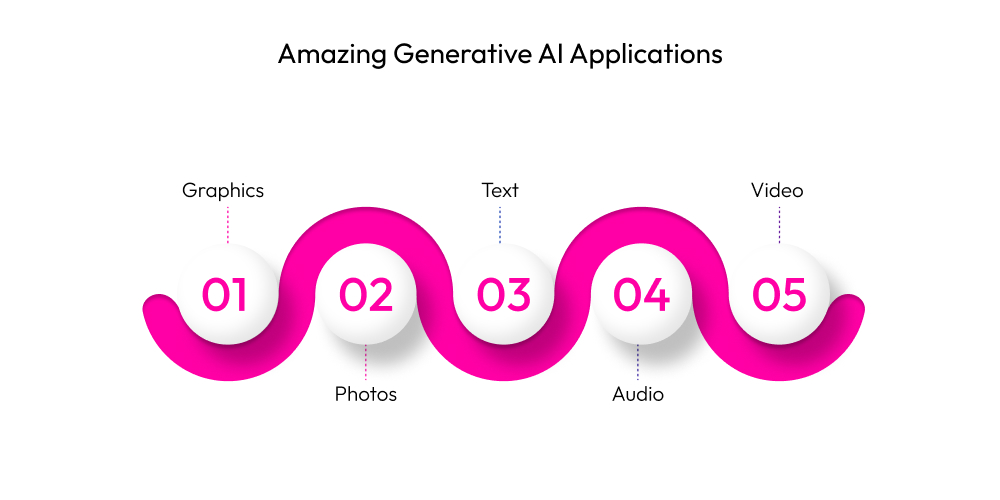
1. Graphics
Generative AI can quickly produce beautiful digital art, illustrations, and 3D models in seconds. Whether that is a marketing creative asset, a character, or an environmental asset in a game, or an advertising-specific asset for an eCommerce product, AI tools are rapidly changing how artists work while providing an endless array of design possibilities.
2. Photos
AI can create high-definition photos and high-resolution photos, and it can even take a photo and apply various filters. Companies are now able to create realistic and hyper-realistic images instantly, restore old photographs, and scan and enhance images or images of materials right outside their own facilities for future advertising.
3. Text
Natural language processing services enable AI to write articles, scripts, marketing copy, or even personalized messages. Businesses leverage this to automate production of content, to answer customer inquiries, and to build engaging storytelling at scale.
4. Audio
Generative AI is revolutionizing the audio industry, from original music production to realistic voiceover. It can emulate voices, generate sound design, and even create complex soundscapes for films, podcasts, and virtual environments.
5. Video
AI video generation models are allowing the production of short films, animations, and commercial-style videos with no formal production crews. It is also useful for video-related tasks, like upscaling resolution, pulling video special effects, and even producing synthetic video content.
6 Stages to Build a Generative AI Model for Your Business
Hooray! You have reached the most important section of this blog, which is the process to build a custom Generative AI model. So without wasting a little bit of time, let’s take you towards the impressive, well-detailed guide to building a generative AI model from experts.
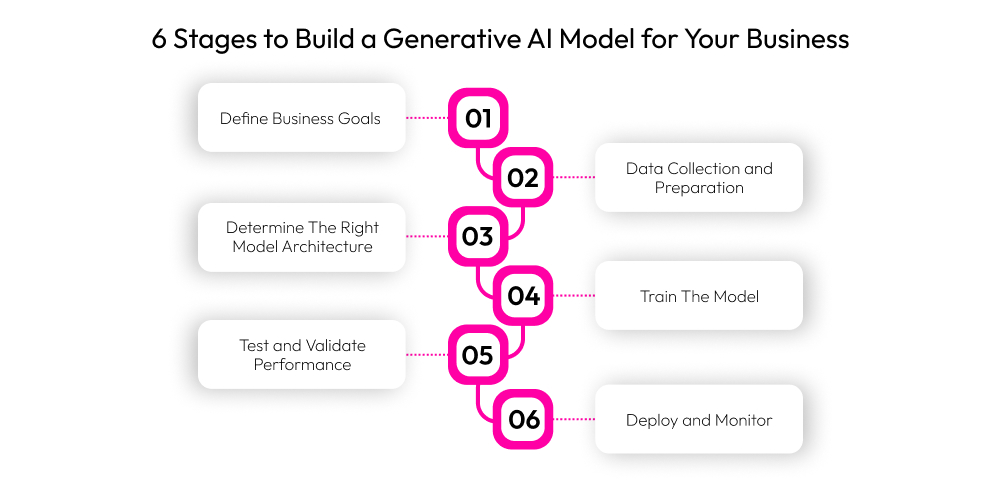
1. Define Business Goals
In the first stage to make a Generative AI Model, before getting started, you should define your intentions in terms of the problems you want the Generative AI model to solve. Whether you are working with content, automation, or predictive analytics, etc., the clearer you are about “what,” the more focused development can be.
If necessary, a professional Generative AI development company can help you develop your ideas more specifically so that they can be actionable and achievable based on your business.
2. Data Collection and Preparation
The data is the “engine” behind any AI model. Work in partnership with your AI development company to develop custom Generative AI models and collect the correct datasets, in terms of both quality and quantity, relevant to your project.
The content can take the form of text, images, audio, or other formats based on your needs. Proper cleaning, tagging, and organizing of the data provides confidence that the model will learn accurately, providing reliable and precise outputs to conduct your overall business operations.
3. Determine The Right Model Architecture
With the help of your AI consulting services partner, you will explore the optimal architecture, be it GPT, LLaMA, or a model built from scratch to serve your goals. The decision will affect Performance, scalability, and throughput (the amount of data the model can learn in a specific timeframe).
By selecting the best architecture, you verify that the model can process the intended data type, deliver your desired end results, and ultimately grow as your business grows.
4. Train The Model
Move to the fourth stage to build a custom Generative AI model. Training the model involves feeding the prepared data you have specified into the chosen AI architecture, allowing the model to learn the ideal patterns to generate accurate outputs. At this stage, it is important to note that training will require strong computational requirements and complex optimization.
An experienced company creating an AI model from scratch will have access to more advanced facilities and methods of training the model. This process will ensure that the model optimally meets your performance measures while averting or minimizing bias and other errors.
5. Test and Validate Performance
Moving to the fifth stage to make a Generative AI Model, the model will undergo extensive testing to see how accurately, reliably, and relevantly it can perform. AI developers will run the model against multiple datasets, including some datasets it has never seen before, to determine how well it adapts.
This custom Generative AI model development process will identify weaknesses, aid in optimizing embedded algorithms, and ensure the model proves and is optimized for use in real-world conditions, not only ensuring that it produces consistent and accurate results but can reliably do so for your specific business application.
6. Deploy and Monitor
Once the model is verified and validated, it will be scaled into your organizational and/or business systems. Your machine learning development company will ensure proper scaling and provide you with solutions to continuously monitor the model.
By continuously tracking the model, you can identify problems, optimize and enhance the model’s Performance, and amend the model as required by changing business needs. For continuous Performance, have regular maintenance to ensure efficiency, accuracy, and focus on the competitive advantage in your industry.
How Do Custom Generative AI Models Differ from Pre-Built Models?
Custom Generative AI models are designed to accommodate a unique layer of specificity for your unique business situation, and capabilities are flexible, while pre-built AI models present a more generalized approach with very little flexibility and specificity.
What are Custom Generative AI Models?
A Custom Generative AI Model is an AI system that is trained, or fine-tuned, to be tailored to your specific organization, industry, or problem statement. Custom Generative AI Models utilize unique proprietary datasets and business-specific rules to generate an aligned business outcome to achieve your unique goals.
Key Features
- Developed from scratch or tuned from a base model
- Employs organization’s private domain data
- Includes unique rules, brand voice, compliance requirements, etc.
- Greater control over accuracy, tone, and behavior
Examples of Use Cases:
- E-commerce: A product description generator that develops personalized descriptions, uses brand voice, and optimizes for the stores SEO strategy
- Health Care: It is an AI that generates a patient discharge summary following the hospital’s specific medical and compliance rule
- Financial Sector: It is an investment recommendation engine that has learned the bank’s proprietary investment market analysis and the bank’s own risk profiles for each customer
- Education: AI tutor that has been trained on the university curriculum and can answer course-specific questions.
What are Pre-Built Generative AI Models?
A Pre-Built Generative AI Model is a generic AI solution you can run with almost no customization. Pre-built generative AI models generally leverage large, unrestricted datasets, and can serve an assortment of general purposes right out of the box.
Key Features:
- Ready to use, requires no/low customization
- Trained on off-the-shelf data from the internet
- Faster to deploy, but less capable of addressing niche problems
- Limited ability to specify the output and/or any level of domain accuracy
Examples of Use Cases:
- Marketing: Using a pre-built AI, like ChatGPT, to generate social media posts for any industry.
- Customer Support: Automating your FAQs with a general chatbot trained on public training data.
- Content Creation: Generating blog topic ideas, captioning, and/or generic copy writing.
- Prototyping: Trying out AI capabilities quickly before investing in customized builds.
Quick Comparison Table
Feature |
Custom Generative AI |
Pre-Built Generative AI |
| Data Source | Proprietary & domain-specific | Public & general datasets |
| Accuracy | High for niche tasks | Moderate for niche tasks |
| Speed to Deploy | Weeks to months | Immediate |
| Cost | Higher initial investment | Lower upfront cost |
| Control & Flexibility | Full customization | Limited customization |
| Scalability | Tailored scaling options | General-purpose scaling |

The Future of Custom AI: Trends Shaping Tomorrow
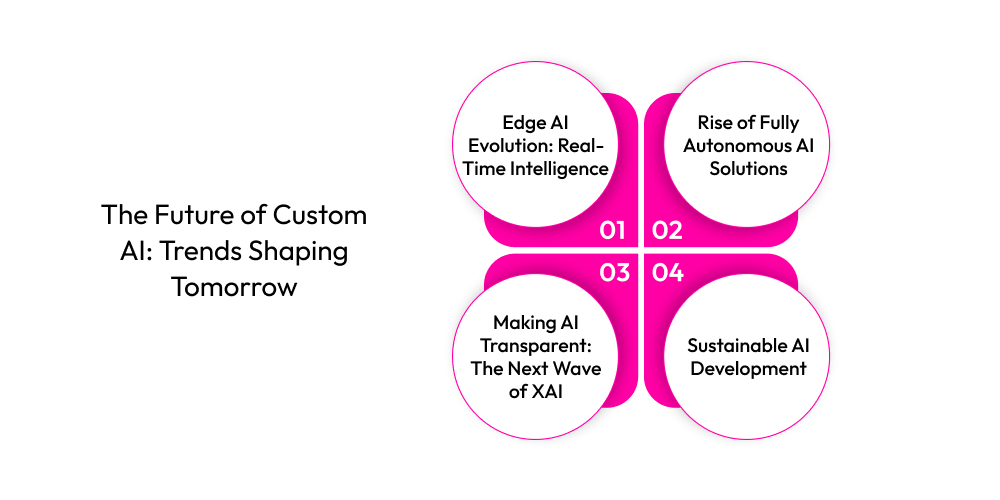
1. Edge AI Evolution: Real-Time Intelligence
AI processing is getting closer to the point of sourcing the data, meaning faster, more efficient decision-making across multiple industries, e.g., healthcare, basic manufacturing, or simply driving autonomous fleets on public roads.
2. Rise of Fully Autonomous AI Solutions
From smart warehouses to fully autonomous vehicle fleets, AI will be used with less and less human intervention, driving even more efficiency with precision.
3. Making AI Transparent: The Next Wave of XAI
Explainable AI will become ubiquitous, allowing companies and learners, not just researchers, an understanding of the reasoning behind a decision made by massive datasets.
4. Sustainable AI Development
The emphasis will shift towards designing energy-efficient AI architectures and environmentally-friendly computation methods that exploit high-performance characteristics.
Frameworks and Tools to Create a Generative AI Model for your Business
Generating a custom generative AI model requires a combination of heavy-duty frameworks and an array of tools that are relevant to your business goals, data needs, and technical skills. Below is a high-level category-based breakdown to help you evaluate the right technology stack for innovation, scalability, and precision.
1. Core Model Development & Training Tools
These will be the foundation of your AI model creation (everything from model creation development to training, validation, and optimization). For example, a retail brand can leverage Hugging Face to fine-tune the models for personalized product descriptions.
Tool |
What It Does & Example |
Advantages |
Limitations |
| TensorFlow | Comprehensive ML library by Google; used for tasks like custom language generation in enterprise chatbots. | Highly scalable, large ecosystem, strong production readiness. | Requires steep learning for new developers. |
| PyTorch | Flexible deep learning framework used for rapid prototyping of text, image, or speech-based models. | Intuitive design, strong research community. | May require extra work for production deployment. |
| Hugging Face | Repository of pre-trained generative models; enables quick fine-tuning with proprietary datasets. | Cuts development time, massive open-source model library. | Dependent on available base architectures. |
| LangChain | Framework for connecting LLMs with custom data sources and tools. | Great for multi-step workflows and AI agents. | Needs infrastructure for large-scale use. |
| NVIDIA NeMo | Toolkit for building and fine-tuning massive generative models on GPUs. | High-performance optimization for large AI workloads. | High GPU costs for |
2. Data Processing & Management Tools
Large, domain-specific datasets are essential for high-quality AI output. These tools process and prepare data for model training in scalable, distributed environments.
Tool |
What It Does & Example |
Advantages |
Limitations |
| Apache Spark | Distributed processing engine to clean and prepare billions of training records. | Handles huge datasets efficiently, fast execution. | Setup and optimization require skilled engineers. |
| Anaconda | AI development distribution for managing packages, dependencies, and environments. | Simplifies project setup, widely adopted in data science. | Can be resource-heavy for small-scale projects. |
| Dask | Parallel computing library for scaling Python code to big data. | Easy integration with the Python ecosystem. | Less mature community compared to Spark. |
3. Experiment Tracking & Visualization Tools
Tracking model performance and experiment history ensures better results and faster improvements. These tools keep your AI development organized and transparent.
Tool |
What It Does & Example |
Advantages |
Limitations |
| Weights & Biases | Tracks metrics, hyperparameters, and performance over multiple training runs. | Cloud dashboards, great for team collaboration. | Premium features require subscription. |
| MLflow | Manages end-to-end ML workflow, including experiment tracking and model deployment. | Open-source, versatile, supports multiple platforms. | Initial setup can be time-consuming. |
| Jupyter Notebooks | Interactive coding space for building, testing, and documenting AI models. | Excellent for experimentation and sharing insights. | Not designed for production workloads. |
Common Mistakes in Custom Generative AI Model Development and How to Prevent Them
Yes, you haven’t thought about this, but it is also true that this is a very important segment to think of. Many businesses avoid or skip this part, but it will help your business become successful asap. Know these common mistakes in generative AI model development, and of course, how you can prevent them.
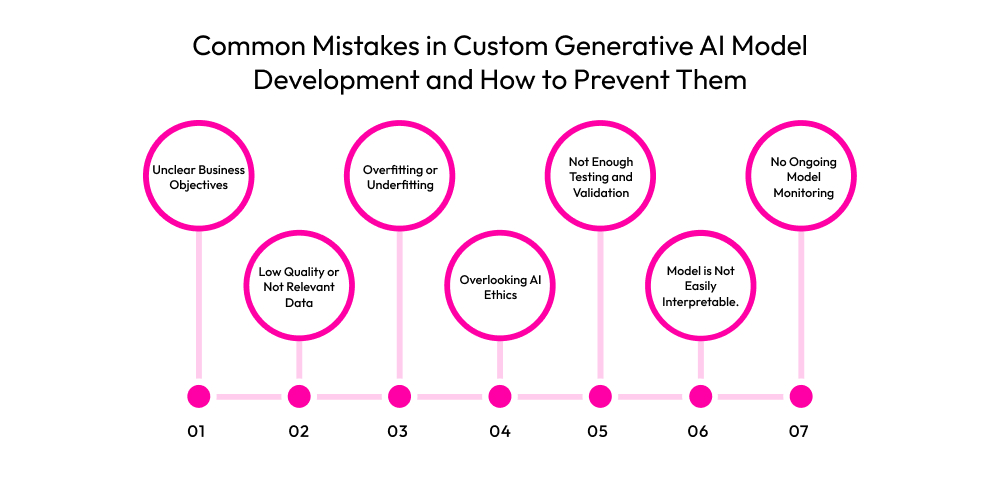
1. Unclear Business Objectives
Success is highly dependent on a defined purpose; wasting time and/or resources can come from a lack of a clear, measurable purpose. Anytime you begin to develop a model, think through the specific business problem it aims to solve.
2. Low Quality or Not Relevant Data
Remember that a model is only as useful as the data it learns from. From the characteristics of accuracy and relevance to the process of cleaning, low-quality and/or irrelevant data will lead to skewed or misleading results.
3. Overfitting or Underfitting
The right training, not too much and not too little. Validation sets and tuning techniques will help you formulate a proper action plan.
4. Overlooking AI Ethics
Ignoring fairness, bias, and compliance could hurt brand trust. Start incorporating ethical checks into your development cycle immediately.
5. Not Enough Testing and Validation
If you don’t test well, you will miss flaws that you can’t see. Your tests should check the model across multiple datasets and multiple conditions to verify reliability.
6. Model is Not Easily Interpretable.
If your stakeholders don’t know the logic behind the AI’s decisions, adoption is compromised. Use explainable AI techniques to enhance transparency.
7. No Ongoing Model Monitoring
AI models degrade as data patterns and conditions change. If not monitored and retrained, they will be less than effective and relevant over time.
Challenges Associated with Custom Generative AI Model
Many of you must be taking a step back because you must be wondering if AI development isn’t easy. There are many challenges during the development.
Hey, we get you to trust us! We get the doubts. So to help you in that genre, here is a list of challenges that you will encounter during generative AI model development with solutions also. Let’s go!
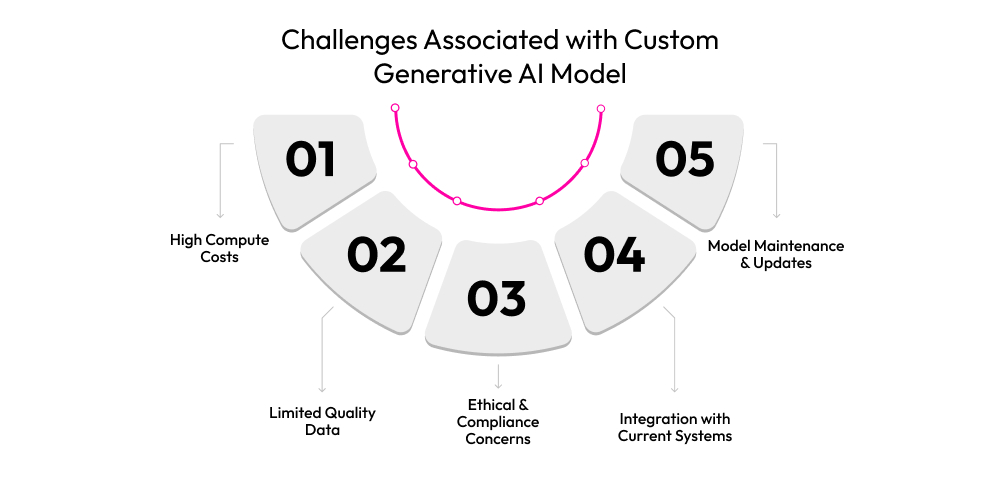
1. Challenge – High Compute Costs
Creating an AI app requires a lot of compute power, which can be cost-prohibitive for small to mid-sized businesses. Hardware, cloud storage, and processing costs can affect budgets fast.
Solution
Using cloud-based AI services and scalable infrastructure allows a business to pay for what they use when they use it. Optimizing model architectures and utilizing transfer learning allows for flexible requirements, therefore getting the most out of computing without driving costs high while maintaining accuracy.
2. Challenge – Limited Quality Data
Generative AI models require a large amount of quality data. Businesses do not always have access to domain-specific data or high-quality data and may receive unpredictable outputs from their models because of it.
Solution
Companies can overcome this limitation by leveraging synthetic data generation, purchasing licensed datasets, or collaborating with their data provider.
Fine-tuning the pre-trained foundation models with smaller, curated datasets will allow for the fine-tuned content to be current and relevant, and ensure quality without the task of collecting empirical data from scratch.
3. Challenge – Ethical & Compliance Concerns
Data generated from AI models can be harmful, biased, or non-compliant without intention, which has the potential to lead to reputational and legal issues.
Solutions
To combat this challenge during the development process, fairness audits, bias detection websites, and content filters can be employed to help ensure compliance with legal and industry regulations.
Using and monitoring the model’s outputs, as well as routinely updating the model, have the potential to maintain ethical standards and compliance with an ever-evolving standard of compliance.
4. Challenge – Integration with Current Systems
The best generative AI model outcomes can be underused if it does not integrate with the current workflows, tools, and platforms.
Solution
Businesses must prioritize API architectures and modular frameworks to ensure seamless integration. In addition to using an API based architecture, IT teams should be involved. Early involvement of IT teams may help to customize the generated model and platform to their current systems and ensure seamless adoption without disrupting ongoing operations and workflows.
5. Challenge Model Maintenance & Updates
AI models can degrade and lose relevance if they are not updated with fresh data and retrained on a consistent basis, which could result in outdated or irrelevant output.
Solution
A continuous learning pipeline allows for a permanently adapted model that is in line with new business demands and market shifts. Regular updates/retraining, feedback loops, and ongoing performance evaluations will help keep your model accurate, reliable, and useful for the long term.
How Much Does It Cost to Build a Generative AI Model for Your Business?
To build an AI system is certainly an investment that can ignite innovation, automation, and personalization. The reality, though, is that the cost to develop a Generative AI model can vary widely for multiple reasons.
You can expect to pay on average $8,000 to $30,000+, depending on the level of complexity, data farming, and your feature needs. Consider the following six primary factors that can impact the cost to develop a Generative AI model.
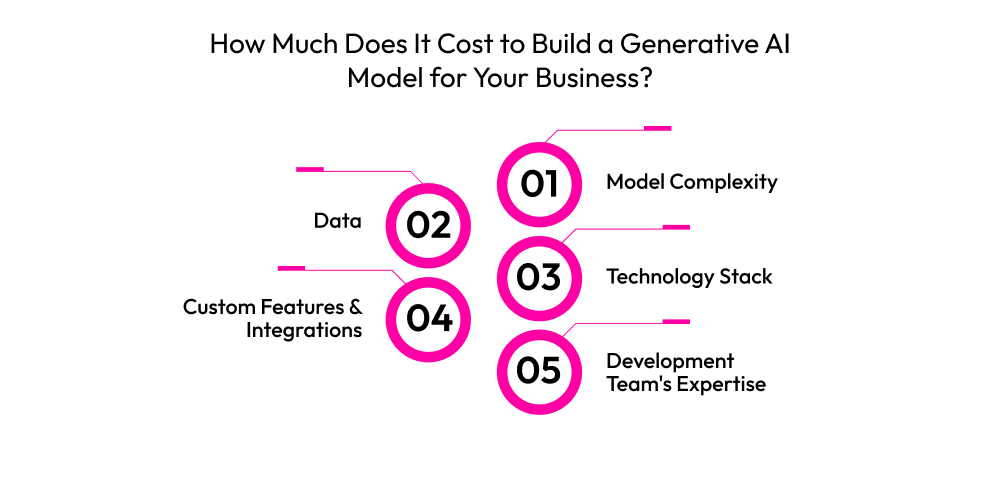
1. Model Complexity
The complexity of your AI model (which may be as simple as a basic chatbot or as complex as a reasoning-driven content generation engine) clearly will increase the cost to develop a Generative AI model variability. Clearly, simple models require far less time to develop; so too will be the case for less-complex models.
The time, however, that it will take to develop a complex, multi-functional model will be extensive. Thus, the more complex the model, the higher the custom Generative AI model development cost.
Complexity Level |
Estimated Cost Range |
| Basic | $8,000 – $12,000 |
| Moderate | $12,000 – $20,000 |
| High / Complex | $20,000 – $30,000+ |
2. Data
Any generative AI is data hungry. Like an excellent cook or gardener, it will require time and human intervention to acquire the suitable datasets, curate them, and annotate them.
Furthermore, your data must be ethically sourced. If the model will be learning from domain-specific data, expect to add the cost of domain-specific experts to your total cost to build artificial intelligence project.
Data Need |
Estimated Cost Range |
| Public Datasets | $500 – $2,000 |
| Custom Curated Data | $3,000 – $8,000 |
| Expert-Led Data Curation | $8,000 – $15,000+ |
3. Technology Stack
Another factor that affects the Generative AI model development cost is the type of AI frameworks, programming languages, and cloud infrastructure you select. Higher-end platforms such as AWS, Azure or Google Cloud come with higher usage costs, but these may be worth it for the scalability and reliability.
Stack Type |
Estimated Cost Range |
| Open-Source | $0 – $2,000 (setup) |
| Mid-Tier Cloud | $2,000 – $5,000/year |
| Enterprise Cloud | $5,000 – $15,000+/year |
4. Custom Features & Integrations
The more customized the model is for your needs, including integrations into existing CRM, ERP, or analytics tools, the higher the Generative AI model development costs. Custom features such as multilingual support, performance masking, or real-time learning add to the cost to build an app like Imagine.
Feature Type |
Estimated Cost Range |
| Basic Integration | $1,000 – $3,000 |
| Advanced Features | $5,000 – $10,000 |
| Enterprise Integrations | $10,000 – $20,000+ |
5. Development Team’s Expertise
Finding a Generative AI development company or team of AI engineers, data scientists, and ML specialists can also increase the cost to build a Generative AI model, but they are able to provide a better quality of deliverables. Rates also depend on how you hire, i.e., outsourced, fully in-house, or a hybrid.
Hiring Model |
Estimated Cost Range |
| Outsourced | $10 – $25/hour |
| In-House | $80 – $150/hour |
| Hybrid | $60 – $120/hour |

Ready To Build Your Game-Changing AI With Dev Technosys?
Hopefully, you liked this blog and now you know how to build a custom generative AI model for your business. However, do you know what is more important than starting this amazing journey? Having a partner like Dev Technosys.
Not kidding! Dev Technosys is a leading AI development company that builds a Generative AI model that thinks, learns, and builds along with your business.
Whether you’re a Generative AI startup looking to disrupt the market or an enterprise looking to make smarter automation decisions, our custom Generative AI models are built to deliver impact, innovation, and measurable results. From brainstorming to deployment, we will turn your idea into a powerhouse of possibilities. So why settle for a generic solution when you can have a custom solution? Let’s make your AI world a reality today!
Most Searched Questions!
Q1. What Are The Key Steps To Build A Generative AI Model?
- Define Problem And Objectives
- Gather And Clean Datasets
- Choose AI Architecture
- Train And Fine-Tune Model
- Test And Validate Performance
- Deploy And Monitor Usage
Q2. How Much Does It Cost To Build A Generative AI Model?
A. The cost to build a Generative AI model varies from $8000 to $30,000.However here are the factors that affects the cost overall:
- Complexity Of Model
- Size And Quality Of Dataset
- Chosen Ai Framework
- Developer Expertise Level
- Integration Requirements
- Maintenance And Updates
3. How Long Does It Take To Create A Generative AI Model?
- Dataset Preparation: 2–6 Weeks
- Model Design: 3–5 Weeks
- Training And Tuning: 4–8 Weeks
- Testing: 2–3 Weeks
- Deployment: 1–2 Weeks
4. What Industries Can Benefit From Custom Generative AI Models?
- E-Commerce And Retail
- Healthcare And Pharma
- Finance And Banking
- Education And E-Learning
- Entertainment And Gaming
- Manufacturing And Logistics
5. What Are The Advantages Of A Custom Generative AI Model Over Pre-Built Models?
- Tailored To Business Needs
- Higher Data Privacy
- Better Accuracy And Relevance
- Scalability Options
- Brand-Specific Outputs
- Long-Term Competitive Advantage
6. What Are Foundation Models In Generative AI?
- Large-Scale AI Models
- Base Model
- Self-Supervised Learning
- General-Purpose Capabilities
- Multi-Modal Input
- Massive Computing Infrastructure