













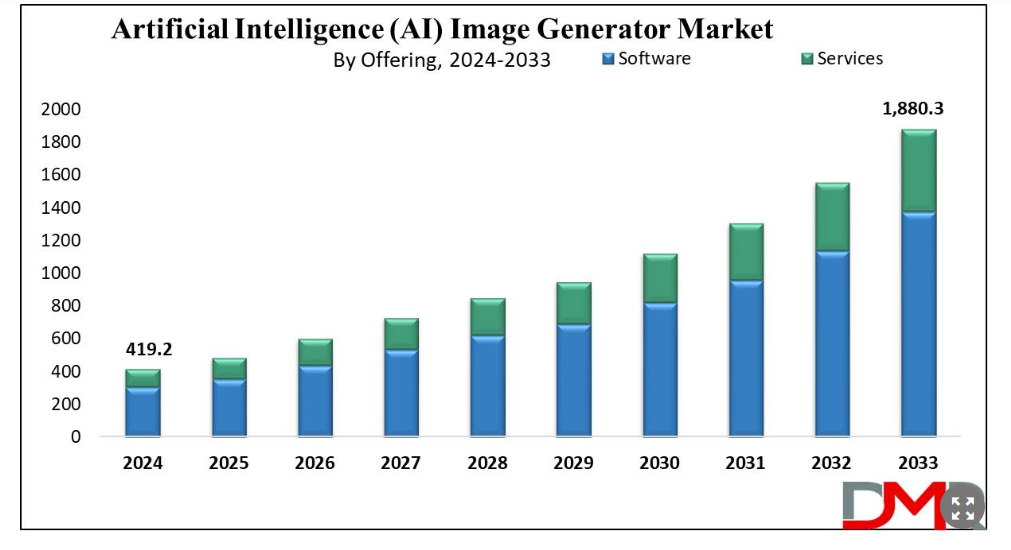
Artificial intelligence is transforming the digital world, and there is perhaps no place where this is more true than in visual content creation. The global market for AI image generators, worth around $419.2 million in 2024, is expected to rise to $1.88 billion by 2033, growing at a strong CAGR of 18.1%.
This skyrocketing growth, fueled by the unrelenting need for original media, marketing, and commerce images, offers a golden opportunity. Apps like Leonardo.Ai are leading the charge, allowing users to grab text and secure it into breathtaking visuals more easily than ever before. If you’re considering breaking into this hot industry and creating your image generator AI, this blog is your one-stop shop.
We’ll take you through the six pivotal phases to develop an app like Leonardo.Ai, from initial idea to successful launch, so you can avoid the pitfalls and capitalize on the experience of an AI development company. So are you ready to get this blog started?
What is Leonardo.Ai?
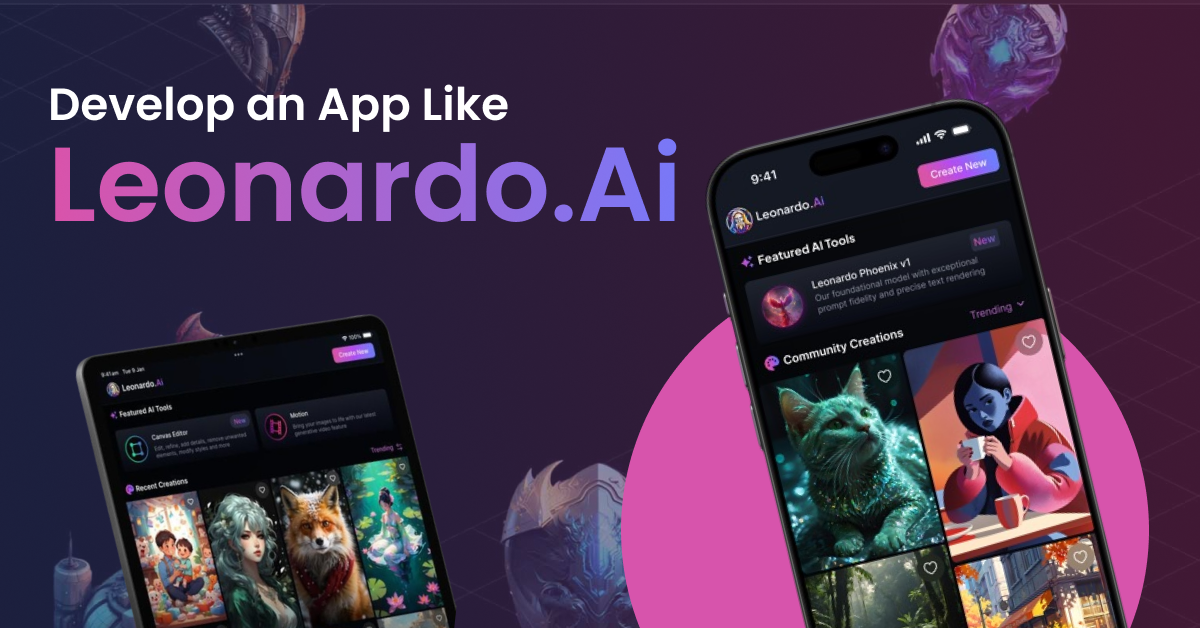
Leonardo.Ai is a leading AI-based platform that creates high-quality images and art assets based on text-based instructions. It was established in 2022 by Ethan Smith, JJ Fiasson, and Jachin Bhasme.
This platform’s strength lies in giving its users extensive creative control over their AI-based creations, with multiple AI models and customizations available. Leonardo.Ai was bought by Canva in July 2024.
Top 10 Leonardo.AI. Alternatives
Discover the best AI image generators offering powerful AI art generation, advanced editing tools, unique styles, and creative features for artists, designers, and content creators.
Rank |
AI Image Generator App |
Launch Date |
Founder/Company |
USP |
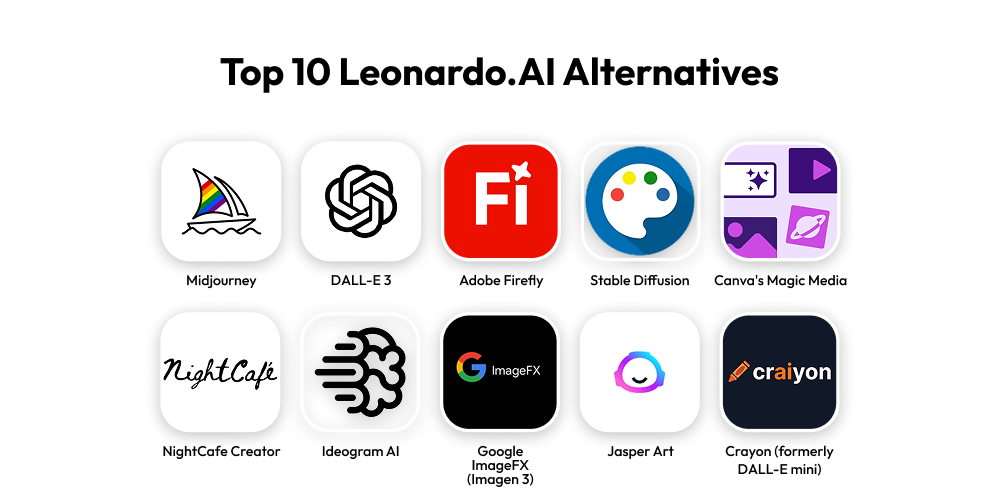
| 1 | Midjourney | Mid-2022 | David Holz (CEO of Mid Journey, Inc.) | Produces exceptionally high-quality, often artistic, and aesthetically pleasing images; strong community on Discord. |
| 2 | DALL-E 3 | November 2022 (DALL-E 2, DALL-E 3 integrated into Chat GPT) | OpenAI | Advanced understanding of complex text prompts, seamlessly integrated with ChatGPT for conversational image generation. |
| 3 | Adobe Firefly | March 2023 | Adobe | Generative AI integrated into Adobe’s Creative Cloud suite (Photoshop, Illustrator), trained on Adobe Stock for commercial safety and respecting artists’ work. |
| 4 | Stable Diffusion | August 2022 | Stability AI (CEO: Emad Mostaque) | Open-source, highly customizable, and allows for local deployment, offering extensive control and flexibility to users. |
| 5 | Canva’s Magic Media | 2023 (AI features integrated) | Melanie Perkins, Cliff Obrecht, Cameron Adams (Canva) | User-friendly interface, seamless integration with Canvas border design suite, ideal for beginners and quick visual projects. |
| 6 | NightCafe Creator | November 2019 | Angus Russell | Versatile platform offering various AI art algorithms and models (including Stable Diffusion), strong community features, and daily free credits. |
| 7 | Ideogram AI | August 2023 | Ideogram AI (co-founders: Mohammad Norouzi, Chitwan Saharia, William Chan, Jonathan Ho, Shaan Singh) | Excellent at rendering accurate text within generated images, offers a limited free plan with daily credits. |
| 8 | Google ImageFX (Imagen 3) | February 2024 (ImageFX), Imagen models earlier | Produces high-quality, realistic images with detailed results, including text, and is integrated with Google Gemini. | |
| 9 | Jasper Art | 2022 (part of Jasper AI) | Dave Rogenmoser, John Phillip Morgan, Chris Hull (Jasper) | Creates original, royalty-free images as part of a broader AI content generation suite, combining concepts, attributes, and styles. |
| 10 | Crayon (formerly DALL-E mini) | Mid-2022 (gained popularity) | Boris Dayma | Open-source and provides unlimited access to image generation, known for its creative and sometimes quirky outputs. |
Market Stats on AI Image Generator
- The global online AI Image Generator market was estimated to be worth $419.2 million in 2024 and is expected to reach $1.88 billion by 2033. This represents an expected compound annual growth rate (CAGR) of 18.1%.
- The AI Image Generator market in the United States will reach an estimated $131.2 million in 2024 at a CAGR of 17.0% over the expected forecast period.
- North America is expected to be the AI Image Generator market leader, with a revenue share of 36.1% in 2024.
- Midjourney had 20.4 million Discord server users, up from 16 million in June 2023.
- DALL-E, in large part due to DALL-E 3, has a substantial market share (25-30% is the estimated market share).
- Leonardo.Ai will likely not be left behind, as since its launch in 2022, it has already reached 29 million users and created more than one billion artwork creations.
- ChatGPT integration services have left a notable mark on the AI Image Generator market. Over 130 million ChatGPT users have collectively generated over 700 million images.
- The broader Generative AI market was valued at $14.59 billion in 2024 and is projected to reach $283.37 billion by 2034, with a CAGR of 34.6%.
- Since 2022, more than 15 billion AI-generated images have been created worldwide.
- The market value of AI image editors reached 80.4 million dollars in 2024 and grew an impressive 441% on the G2 platform, year over year.
Why Entrepreneurs Want to Develop An App Like Leonardo.AI?
Before we take you through the process to develop an AI photo enhancer app we would like you to go through these amazing reasons for investing in this market Here are five key reasons:
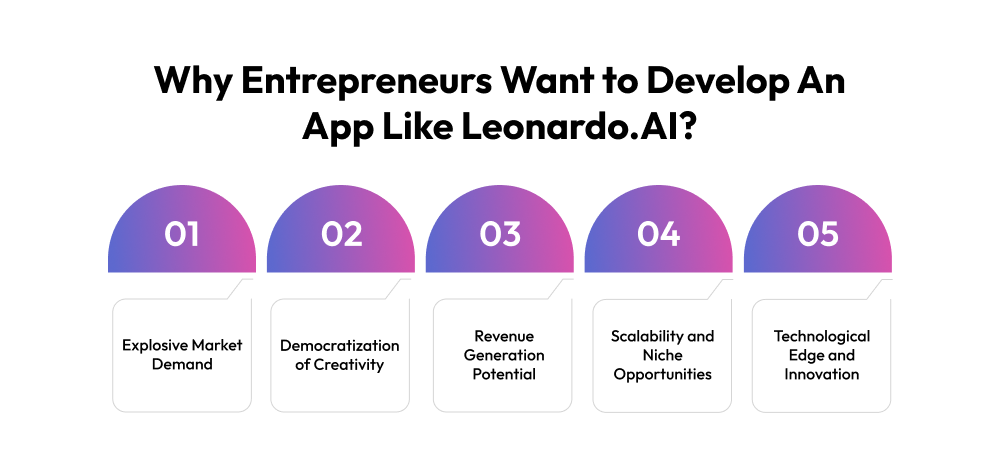
1. Explosive Market Demand:
Interest in AI-generated graphics is increasing, from marketing and design to entertainment and e-commerce. With tools like Leonardo.Ai, businesses and users can efficiently capture attention through high-quality, distinctive visuals at lower resource expenditures than traditional means.
2. Democratization of Creativity:
Apps like Discord help the non-skilled audience materialize their ideas and visions into reality. An app that provides intuitive controls and sophisticated generating power has to be put in the hands of the many to unlock creativity aimed at self-expression. The new innovative users will achieve the creation of unique content.
3. Revenue Generation Potential:
Monetization options are plentiful. Subscription (tires, enhanced features, and faster generation), credit packs for pay-per-usage, API access for businesses, and ideally, use an integrated marketplace to sell generated art. The recurring revenue is a very enticing model.
4. Scalability and Niche Opportunities:
As AI technology develops, so does the opportunity for further specialization; a single app can always grow in the future by adding new models (for instance, specific art styles, 3D assets, and animations), connecting to other platforms or software, or targeting niche segments such as game developers, architects, or fashion designers.
5. Technological Edge and Innovation:
The AI space is an emerging industry that is regularly evolving. If you develop an app like Synthesia, you will be at an innovative frontier where you can continue to adopt new and innovative AI models (for example, Stable Diffusion, DALL-E, etc.), continually enhance features, or keep pace with other competitors while staying in a high-growth category.
Want a chatbot demo or pricing? Fill the form and talk to our experts today.
Pick what you need below — you can select more than one — then tap Get detail to continue.
-
Chatbot demo dashboard
-
Cost to develop an app
-
Industry report
-
Case study
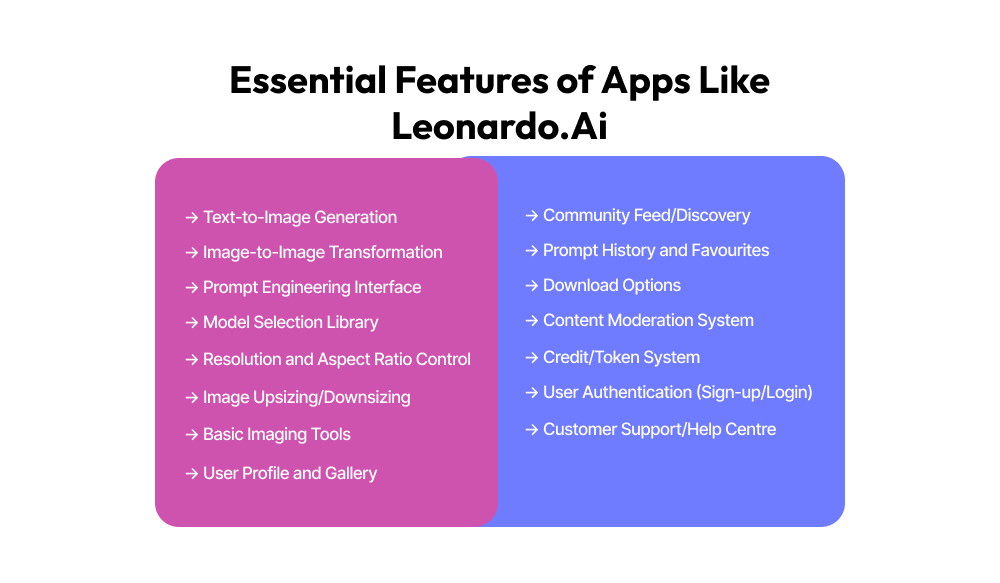
15 Essential Features of Apps Like Leonardo.Ai
Now that you know some incredible reasons to invest in generative ai like leonardo.ai you must know about its functions. Here is the list of some of the amazingly designed features.
-
Text-to-Image Generation:
Leonardo.Ai alternatives allow users to specify text prompts to build a variety of images and turn descriptive words into visual art and graphics.
-
Image-to-Image Transformation
Users will upload an image, then use a text prompt, or styling to modify an image’s appearance and content.
-
Prompt Engineering Interface:
A field for users to compose a variety of text prompts that are detailed in their descriptions to make clear to the AI what image they wish to obtain.
-
Model Selection Library:
Leonardo.Ai app for Android offers a list of pre-trained AI models (for example, stable diffusion variations) from which the user can select, which will affect the style of the image.
-
Resolution and Aspect Ratio Control:
Users can customize the image size and orientation to fit their particular needs for display or use.
-
Image Upsizing/Downsizing:
The program will have an ability to upsize/downsize images files (and resolutions) that have been generated and optimize them for use across various platforms.
-
Basic Imaging Tools:
Basic editing tools will be available for users to access to crop and/or rotate their generated images with some very basic color adjusting tools.
-
User Profile and Gallery:
Leonardo.Ai alternatives provide a dedicated area for users to save, organize, and showcase their generated creations.
-
Community Feed/Discovery:
A public gallery for users to view, like, and comment on other related images generated by others and provide inspiration for new image creation.
-
Prompt History and Favourites:
Leonardo.Ai alternatives allows users to go back and revisit previous prompts or save prompts to their favourites if they want to use them again later.
-
Download Options:
Free AI image generators allow users to download their generated image files in a range of common file formats (e.g. JPG, PNG).
-
Content Moderation System:
Automatically and/or manually manage the filtering of unacceptable, inappropriate, and/or harmful content generated or uploaded by users.
-
Credit/Token System:
Manage usage by charging users for generating image files by deducting some amount of credits or tokens they have registered.
-
User Authentication (Sign-up/Login):
Leonardo.Ai alternatives provide secure identity verification for users as part of the process for secure registration of new users and sign-on for existing users.
-
Customer Support/Help Centre:
Information resources and channels for users to access for assistance, report issues, give feedback, or for other user requirements.
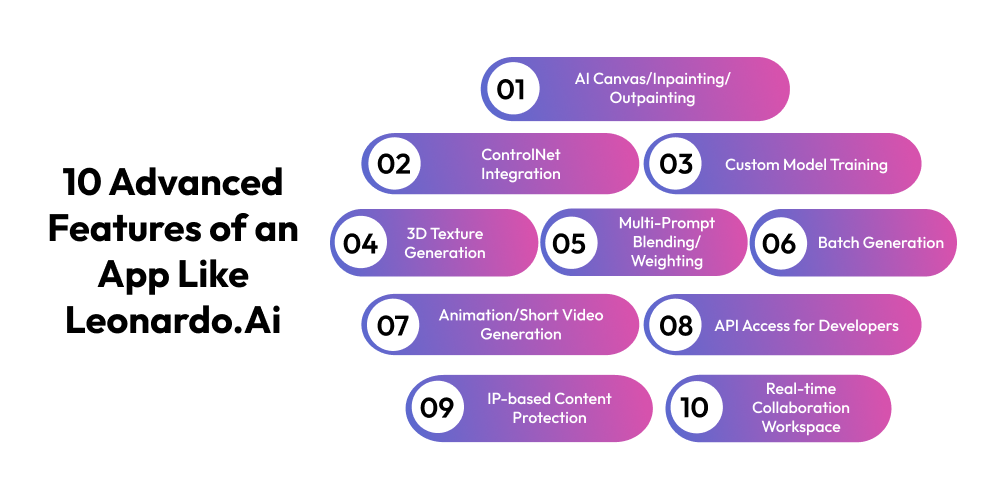
10 Advanced Features of an App Like Leonardo.Ai
The section above contains the essential features for any generative AI, but this list has some of the most user-friendly yet advanced features of apps like Leonardo.ai that you must know about.
-
AI Canvas/Inpainting/Outpainting:
Users can add and subtract things to images, or also modify the bounds of a given image. Fabrication from nothing, for example, with AI that can blend things in, is fantastic.
-
ControlNet Integration:
ControlNet gives you extra controls over image generation and allows the integration of input-able images for your ai guidance models like poses, depth maps or edge detection.
-
Custom Model Training:
With custom model training you can train your own ai model using your own image data sets, thus allowing your results to come out in your desired styles.
-
3D Texture Generation:
Leonardo.AI mobile app has the ability to generate usable seamless textures directly from a text prompt or existing images for 3D models.
-
Multi-Prompt Blending/Weighting:
The user can merge multiple text prompts with a range of emphasis into one single prompt thus creating imagery that is complex and layered with nuance.
-
Batch Generation:
Through this functionality, users will be able to generate multiple images from one prompt with a single click which saves time and creates even more availability of styles.

-
Animation/Short Video Generation:
The ability to construct short animated sequences or video clips from your generated images or prompts. The inclusion of motion provides another layer to your images and content.
-
API Access for Developers:
Developers will have access to a programmatic interface where external applications can use your image generation capabilities directly through the API.
-
IP-based Content Protection:
Advanced features that help protect the user generated content equally across the site. Giving users the option of licensing to protect from unlawful use of their contents.
-
Real-time Collaboration Workspace:
Allowing multiple users to work on an image generation project in real-time, sharing prompts and using similar assets at the same time together.
6 Stages to Develop An App Like Leonardo.AI
Now the time has come when you must learn about the step by step guide to create an app like Leonardo.Ai with an expert guide. Here is everything you need to note down.
1. Discovery & Planning:
In this first phase, to make an app like leonardo.ai, you must conduct a comprehensive market assessment to determine specific niche selling points and specific target customer demographics. During this phase, you’ll want to choose AI Models suitable for your purposes, as well as choose a cloud service.
The outcomes of the initial phase will be project-management timelines, technology stack, and outline any potential costs, and agreement with the AI Development company on communication channels to ensure a smooth development process will take place!
2. AI Model Training And Selection
In the second stage to develop an app like Leonardo.Ai where you must select pre-trained generative AIs and train them using large and diverse datasets to get the AI trained to develop your desired artistic styles, quality, and capability to produce specific content.
This will take lots of data curation, augmentation, and training (re-training) to mitigate biases and make the texts coherent. The AI development company will choose the model parameters that are suitable to provide the quickest inference at the lowest cost, which is most important for a positive user experience.
3. Backend Development & API Integration
Hire professional developers from generative AI development company to design and develop a robust and scalable backend that can manage image generation user requests, user authentication, and storage and processing, integrate the selected AI models via API for optimal communication, manage job queues for image generation, and choose a database structure for storing user data, generated images and project settings. This phase should focus on security, reliability and low latency as to not interfere with the user experience.
4. Frontend Development & UI/UX Design:
Move to the fourth stage to create an app like Leonardo.Ai, build easy-to-use, intuitive UIs, for mobile and web applications. Design engaging user experiences, focusing on easy prompt input, style selection, image preview, and editing functionality.
Responsiveness and usability are very important. Using panels for image galleries, image downloads, and sharing will quickly enhance engagement and user flow. Accessibility and performance should be top of mind to maximize creative workflow for users.
5. Testing, Deployment & Optimization:
Let’s come to the second last stage to build an app like Leonardo.Ai, testing will be required to thoroughly test functionality, performance, security, and AI model output quality to catch and fix all bugs.
Hire mobile app development company to deploy the application to a cloud platform (for example AWS, Azure, GCP), configuring auto-scaling and monitoring.
You will continuously optimize the AI models to enhance the quality and speed of generative output. You will continuously optimize the overall system for performance, cost-effectiveness, and user experience based on real-world usage and feedback.
6. Post Launch Support & Iteration:
In the last stage to develop an app like Leonardo.Ai, provide continuous maintenance, bug fixes, and technical support to users. Monitor, application performance, server performance, application user engagement metrics, and user feedback – plus track and monitor any output from the application.
Collect any user feedback to discuss with the team for the next Leonardo.Ai clone app development process. The feedback should also highlight future updates and enhancements, such as changing the AI generated models, styles, features etc..
Cost to Develop an App Like Leonardo.Ai: AI Image Generator
Cost to build an App Like Leonardo.Ai , it is a highly complex endeavor, and costs can vary tremendously based on various considerations. Overall, you’re looking at the potential of a significant investment, the cost to build an app like Leonardo.Ai likely between $8,000 and $30,000+ for a solid, feature-rich platform.
Below Are 8 Factors That Affects The Cost To Build An App Like Leonardo.Ai:
1. AI Model Type & Training:
This is probably the largest AI app development cost factor. Creating or fine-tuning advanced generative AI models (like Stable Diffusion) all require significant compute resources, large datasets, and specialized AI/ML engineers (the more unique or high-fidelity output you are looking for, the greater this cost to build an app like Leonardo).
Component |
Estimated Cost |
| Pre-trained model integration | $2,000 – $5,000 |
| Custom model fine-tuning (e.g., Stable Diffusion) | $5,000 – $15,000 |
| Dataset preparation & curation | $1,000 – $3,000 |
| AI/ML engineers & compute resources | $3,000 – $10,000 |
| Total | $8,000 – $33,000 |
2. Feature Set (Basic vs. Advanced):
The number of features, and sophistication, will impact the cost to build an app like Leonardo.Ai. Simple text-to-image is cheaper than including AI Canvas (inpainting/out painting), ControlNet (for example), custom model training, or 3D texture generation, which increase Leonardo.Ai app development cost.
Features Included |
Estimated Cost |
| Basic text-to-image generation | $3,000 – $5,000 |
| AI Canvas (inpainting, outpainting) | $3,000 – $6,000 |
| ControlNet or guided generation tools | $2,000 – $5,000 |
| 3D Texture generation, custom model upload | $3,000 – $7,000 |
| Total | $5,000 – $20,000+ |
3. Platform (Web, iOS, Android, or All):
If developing only for one platform (i.e., web only), the costs are much less. If you are building native apps for both iOS and Android (two separate code bases), the Leonardo.Ai clone app development time, and complexity, increases significantly, which often leads to increased cost to build an app like WOMBO Dream.
Platform |
Estimated Cost |
| Web-only (Responsive or PWA) | $4,000 – $8,000 |
| Native iOS or Android | $6,000 – $12,000 |
| Cross-platform (Flutter/React Native) | $7,000 – $13,000 |
| Web + iOS + Android (Separate codebases) | $10,000 – $20,000+ |
| Total | $4,000 – $20,000+ |
4. UI/UX Design Sophistication:
A clear and aesthetically pleasing interface will ultimately drive user adoption. Highly customized UI/UX with complex animations, transitions and seamless workflows and experiences will obviously take many more design hours, increasing cost to develop an app like Leonardo.Ai. In contrast to distinct and custom designs, there are many templates available that may be easier on the budget, and assist in user adoption.
UI/UX Scope |
Estimated Cost |
| Basic UI using templates | $1,000 – $2,000 |
| Custom UI/UX with transitions & animations | $3,000 – $6,000 |
| Interactive design prototypes | $1,500 – $3,000 |
| Total | $1,000 – $9,000 |
5. Backend Technologies/Infrastructure & Scalability:
A functional backend that can process the heavy computational requirements of AI generation, management of user data, and community activities is necessary.
Leonardo.Ai app development cost for cloud-based technology infrastructure, databases, scaling for future growth will all greatly affect video editing app development cost as well.
Component |
Estimated Cost |
| Cloud-based servers (AWS, GCP, etc.) | $2,000 – $5,000 |
| Scalable AI computation infra setup | $3,000 – $7,000 |
| User authentication & database setup | $2,000 – $4,000 |
| API development and integration | $2,000 – $4,000 |
| Total | $7,000 – $20,000 |
6. Size & Location of Development Team:
The various hourly rates charged for app developers, AI/ML engineers, UX/UI designers, and QA testers vary in all countries or regions of the world (i.e., N. America and/or Europe compared to Asia).
As team size increases, development will progress within a larger schedule and your hourly costs will be greater; a smaller team, however, will typically lead to longer timelines.
Development Team Scope |
Estimated Cost (Hourly Rate × Time) |
| Freelancers or small offshore team | $25 – $50/hour → $8,000 – $15,000 |
| Mid-size Indian/Eastern European firm | $40 – $70/hour → $12,000 – $25,000 |
| US/UK/Western European firm | $80 – $150/hour → $20,000 – $50,000 |
| Total | $8,000 – $50,000+ |

7. Third-party services/integrations:
Engaging external services such as payment integrations, stock images, and stock images database like DepositPhotos, social media API, and/or third-party integrations for customer metrics, etc.
involve additional complexity and increased Leonardo.Ai app development cost. These features and options; each additional integration will require additional coding/testing, which will add to the project cost to build an app like Imagine.
Integration Type |
Estimated Cost |
| Payment gateways (Stripe, PayPal) | $500 – $1,500 |
| Social login & sharing (Google, Facebook, etc.) | $500 – $1,000 |
| Analytics & user tracking tools | $500 – $1,500 |
| Stock image APIs / AI marketplaces | $1,000 – $3,000 |
| Total | $2,000 – $7,000 |
8. Maintenance, Updates & Support:
Finally, after an app launch developers and companies face ongoing costs associated with bug fixes and security update, AI model retraining, feature Leonardo.Ai clone app development, and user/customer support.
This continued investment will help you maintain a competitive product, workable product, and security product; and will contribute to any long-term budgeting.
Post-Launch Services |
Estimated Cost (Annual) |
| Bug fixes & performance optimization | $1,000 – $3,000 |
| AI model retraining or version upgrades | $2,000 – $5,000 |
| Feature enhancements | $3,000 – $7,000 |
| Technical/user support | $1,000 – $3,000 |
| Total (per year) | $7,000 – $18,000/year |
How Does Leonardo.AI App Make Money?
Leonardo.Ai, an AI image generator app, primarily monetizes through a multi-faceted approach centered on usage and premium features:
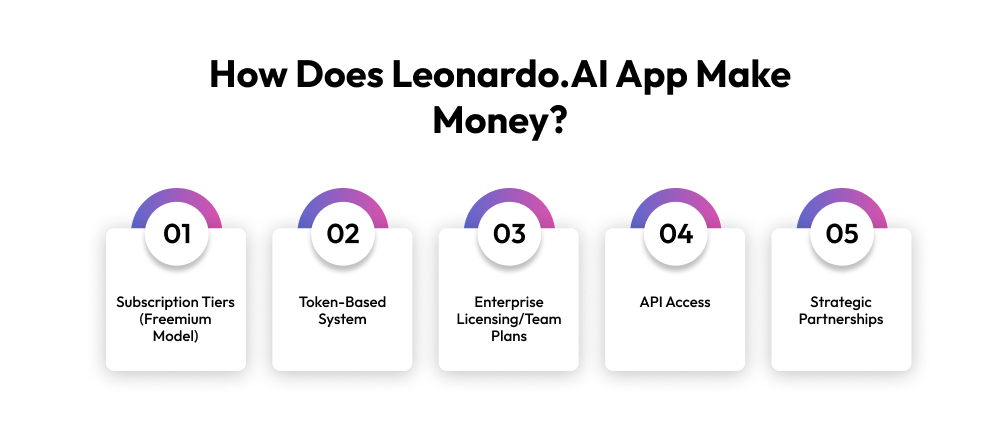
1. Subscription Tiers (Freemium Model):
They offer a free plan that allows users to experience the platform (e.g. 150 daily tokens), and paid subscription tiers (Apprentice, Artisan, Maestro, etc.) which unlock higher daily limits for tokens, faster generation, private image generations, higher concurrent generations, and an ability to train/hold more custom AI models.
2. Token-Based System:
Even under paid plans, a token system governs the use of features such as image generation, upscaling, background removal, 3D texture generation, etc. According to the AI development company in USA, more complex or resource-intensive actions require more tokens, creating incentives for users with high usage to either upgrade or purchase more token packs.
3. Enterprise Licensing/Team Plans:
Leonardo.Ai markets “Leonardo for Teams,” offering tailored solutions for businesses and organizations that require customized features, larger-scale use, collaboration tools, and intellectual property protection.
4. API Access:
If you build an app like Lensa, you can access advanced functions through an API to embed image generation features into your own apps or workflows. Pricing structures likely accompany this based on API calls or volume of use.
5. Strategic Partnerships:
While not a direct monetization of the app itself, Leonardo.Ai leverages strategic partnerships (e.g., with Google Cloud, Canva) that can lead to increased user acquisition, expanded service offerings, and potentially revenue-sharing agreements or acquisition opportunities.
How Dev Technosys Can Help You Build an AI Image Generator App Like Leonardo Ai?
Dev Technosys offers a robust pathway to create an AI app like Leonardo.Ai. Our expertise in generative AI, machine learning, and deep learning allows for the development of sophisticated features like realistic image creation, diverse art styles, and advanced editing capabilities.
By leveraging their deep understanding of AI models and a client-centric approach, Dev Technosys can transform your vision into a cutting-edge application that stands out in the competitive digital landscape, empowering users with unprecedented creative control and efficiency. We focus on delivering a high-quality, scalable, and user-friendly product tailored to your specific needs and market demands.
FAQ
Q1. What is Leonardo.AI?
Leonardo.Ai is an AI-powered image generation app that creates high-quality visuals from text prompts using machine learning and deep neural networks.
Q2. How Does An AI Image Generator Work?
AI image generators use deep learning models like GANs or diffusion models to convert text inputs into realistic or artistic images based on trained datasets.
Q3. What Tech Stack Is Required To Develop An App Like Leonardo.Ai?
You’ll need Python, TensorFlow/PyTorch, cloud services (AWS/GCP), a frontend framework, and image processing libraries like OpenCV or PIL.
Q4. How Much Does It Cost To Develop An App Like Leonardo.Ai?
The cost to develop an app like Leonardo.Ai varies from $8,000 to $30,000+, depending on features, tech stack, developer rates, and third-party integrations.
Q5. Can I Monetize An Ai Image Generator App?
Yes, you can monetize through subscriptions, pay-per-download, API access, or offering premium features for advanced image customization and resolution.