








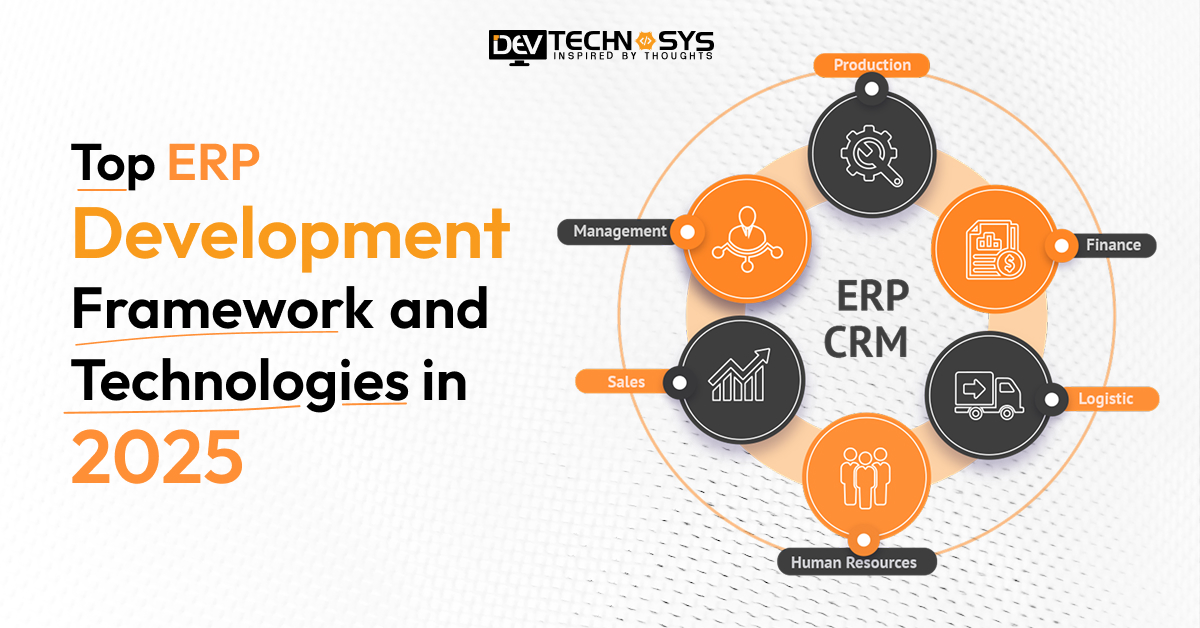
“Create business efficiency by developing an ERP system with latest tools.”
Consider, you are running a business and need to implement ERP systems. At first, you may require the latest and advanced ERP development frameworks and technologies that can customize your business model into a smarter platform. To implement them, it is crucial to have a thorough knowledge on these tools which you can get through a reliable source.
There are several custom ERP development tools available helping businesses to deploy unique and interactive ERP modules. We are providing all the necessary frameworks and technologies in this blog which you can choose based on your requirements.
So, let’s start our journey and first understand the need of using these tools for developing modern ERP systems.
What is the Need of ERP Development Frameworks and Technologies?
Building reliable and integrated systems requires the use of ERP software development frameworks and technology. They give businesses the scalable, effective, and safe solutions:
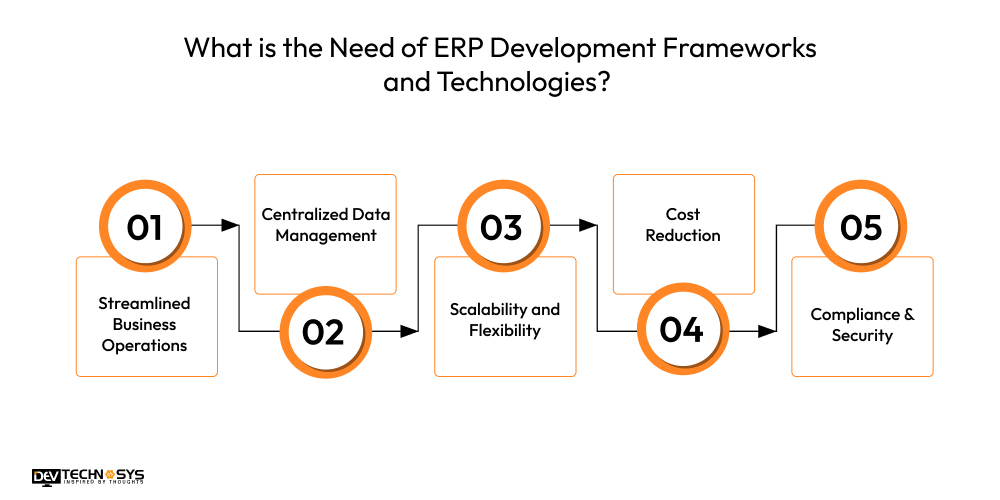
1. Streamlined Business Operations
Finance, sales, inventories, and procurement are just a few of the essential company operations that ERP systems automate and integrate. As a result, workflow efficiency is increased, manual labor is decreased, and redundancies are removed by hiring ERP development companies.
2. Centralized Data Management
Data from several departments is combined into a single system via ERP solutions. This centralization facilitates real-time decision-making, guarantees consistency, and increases data accuracy. An enterprise product development company may promote interdepartmental cooperation and get rid of data silos.
3. Scalability and Flexibility
In order to accommodate growing workloads and user demands, modern ERP systems are made to scale with enterprises. By using Top ERP frameworks businesses can add or modify functionality because of their support for modular integration.
4. Cost Reduction
ERP solutions lower operating and administrative expenses by automating processes and optimizing workflows. You can hire software developers to optimize resource allocation, save time, and reduce errors. This leads to considerable cost reductions and increased profitability over time.
5. Compliance & Security
By upholding precise audit trails and reporting standards, ERP technology assists firms in complying with industry rules. They provide strong encryption, user access control, and data protection. It is beneficial to hire ERP developers that guarantee regulatory compliance and protect critical company data.
Things to Consider for Selecting ERP Development Technologies
Selecting the appropriate ERP development frameworks and technologies is essential to create a system that supports long-term growth. These key variables guarantee security, performance, and adaptability:
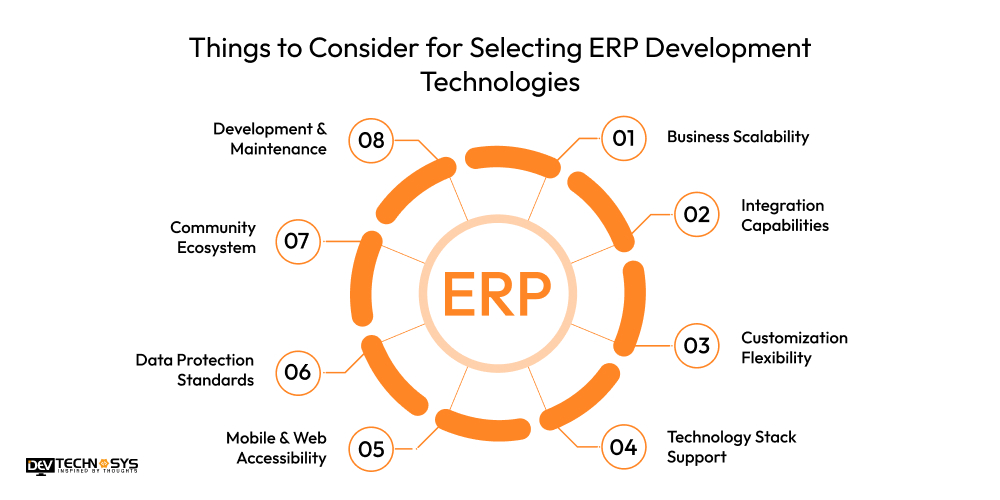
1. Business Scalability
The technology should support your current operations and be scalable with future growth. These software development trends must handle increased users, data volume, and process complexity without performance loss.
2. Integration Capabilities
ERP solutions should easily integrate with third-party systems like CRMs, eCommerce, or legacy tools. Strong APIs and connectors ensure smooth data flow and unified operations.
3. Customization Flexibility
There are various best ERP technologies that must allow for feature tailoring to meet specific business workflows. High customization support ensures the ERP adapts to your unique needs.
4. Technology Stack Support
Choose technologies that align with your team’s expertise and make use of CRM development services. A solid stack ensures better performance, security, and easier updates.
5. Mobile & Web Accessibility
Modern ERPs should be accessible across devices via responsive web or native mobile apps. This supports real-time access and decision-making from anywhere.
6. Data Protection Standards
Latest ERP development platforms ensure the technology complies with data security regulations like GDPR or HIPAA. Features like encryption, role-based access, and backups are essential.
7. Community Ecosystem
A strong developer community means better support, documentation, and implementing web portal development solutions. It reduces development time and helps troubleshoot issues faster.
8. Development & Maintenance
Consider the ease of development, testing, and long-term maintenance of the chosen tech. Technologies with robust tools and frameworks reduce overhead and downtime.
Category-Wise ERP Development Frameworks and Technologies
Various ERP development frameworks and technologies like databases, frontend frameworks, backend platforms, and new technologies, are used in the creation of ERP systems. Every category makes a distinct contribution to the system’s intelligence, scalability, and performance. An overview of the main technologies and tools used in ERP development is provided below:
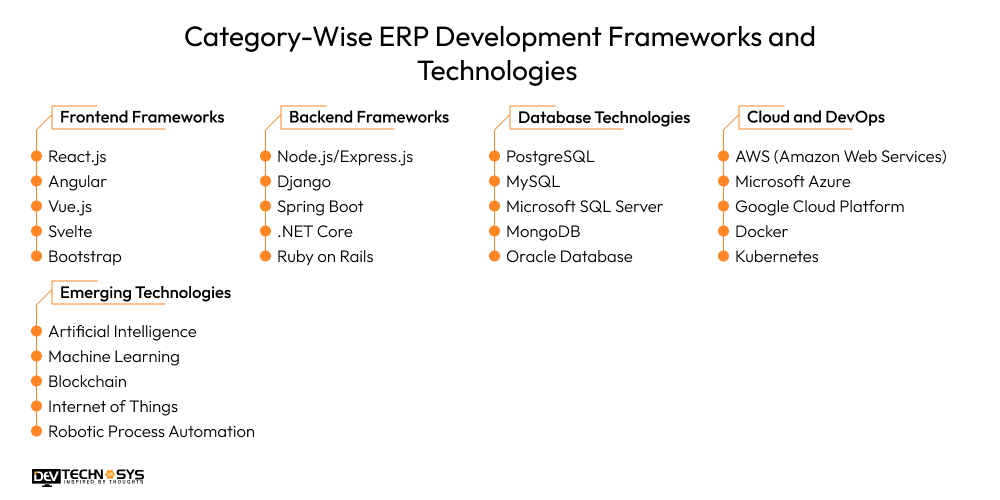
1. Frontend Frameworks
React.js
Meta maintains a JavaScript library for creating component-based user interfaces. Perfect for highly interactive, dynamic, and responsive ERP dashboards. Supports virtual DOM for state management and quick UI rendering.
Angular
Google maintains a complete front-end framework built on TypeScript. Provides dependency injection, routing, and two-way data binding right out of the box. Ideal for sophisticated user interface requirements in large-scale ERP applications.
Vue.js
A JavaScript progressive framework that is renowned for its adaptability. Lightweight and simple to develop an ERP system with responsive mechanisms. Combines React and Angular capabilities to provide a well-rounded development experience.
Svelte
A frontend framework built on a compiler that generates optimized vanilla JS during the construction process. It is perfect for ERP interfaces that prioritize performance because it has no runtime overhead. Reduces boilerplate and uses reactive syntax to make coding simpler.
Bootstrap
A front-end CSS framework featuring a grid system and pre-styled elements. This is one of the best open-source ERP frameworks that uses mobile-first design to expedite the creation of ERP user interfaces. Simple to modify and works well with JS frameworks.

2. Backend Frameworks
Node.js/Express.js
ERP backend technologies combining the JavaScript framework and runtime allows you to create quick, event-driven servers. Perfect for real-time settings and scalable ERP APIs. Incredibly extendable for microservices, lightweight, and modular.
Django
High-level Python web ERP development frameworks with an emphasis on clean design and quick development. Includes security measures, an ORM, and an admin panel built in. Ideal for quick MVP development and data-intensive ERP systems.
Spring Boot
Backend framework with a Java foundation intended for enterprise-level applications. Various ERP development trends support strong security layers, microservices, and RESTful APIs. Utilized in intricate business logic ERP systems on a wide scale.
.NET Core
Microsoft’s cross-platform framework for creating contemporary backend systems. Offers robust connection with Microsoft products, scalability, and good performance. In business settings, Windows-based ERP solutions are preferred.
Ruby on Rails
Ruby-based convention-over-configuration web framework. Perfect for CRUD-heavy systems and quick ERP prototyping. Focuses on code readability and developer productivity.
Want a chatbot demo or pricing? Fill the form and talk to our experts today.
Pick what you need below — you can select more than one — then tap Get detail to continue.
-
Chatbot demo dashboard
-
Cost to develop an app
-
Industry report
-
Case study
3. Database Technologies
PostgreSQL
A sophisticated, open-source SQL database that is renowned for its scalability and dependability. Supports transactional integrity, indexing, and sophisticated searches. A well-liked option for ERP systems that need personalized analytics and reporting.
MySQL
A popular relational database that is open-source and has a robust community. Easy to use, effective, and suitable for ERP applications of a moderate size. Compatible with the majority of cloud services and backend frameworks.
Microsoft SQL Server
Microsoft’s enterprise-level RDBMS with reporting and BI capabilities. A software product development company can integrate well with ERP systems built on.NET. Provides integration capabilities, performance optimization, and robust security.
MongoDB
JSON-like documents are stored in a document-based, NoSQL database. Provides a flexible schema that is perfect for ERP components that are dynamic and modular. It has a strong read/write performance and scales easily.
Oracle Database
A powerful, high-performing RDBMS made for enterprise applications. Supports security, high availability, and powerful analytics. Ideal for complex workloads and mission-critical ERP systems.
4. Cloud and DevOps
AWS (Amazon Web Services)
A full-featured cloud service platform with tools for computation, storage, and machine learning. Scalable infrastructure for big data management and ERP application hosting. Include services such as RDS, S3, Lambda, and EC2.
Microsoft Azure
Microsoft’s cloud platform is deeply integrated with the Windows and.NET ecosystems. Supports AI capabilities, DevOps tools, and hybrid cloud. Perfect for implementing ERP systems that are compatible with the Microsoft stack.
Google Cloud Platform
Provides big data analytics services, AI/ML tools, and cloud computing. Incredibly performance-focused and scalable for predictive intelligence-enabled ERP systems. It comprises CMS development services like Firebase, BigQuery, and Compute Engine.
Docker
Applications with dependencies are packaged using a containerization platform. Guarantees uniform ERP implementation across environments. Increases infrastructure portability and development speed.
Kubernetes
Docker container management at scale with an orchestration tool. Automates ERP microservices’ deployment, scaling, and monitoring. Guarantees load balancing and high availability.

5. Emerging Technologies
Artificial Intelligence
Makes intelligent recommendations, predictive insights, and intelligent automation possible. Used in chatbots, smart analytics, and ERP for anomaly identification. Uses data-driven insight to inform decisions.
Machine Learning
Learns patterns and gets better over time by using algorithms. Utilized in ERP for process optimization, sales forecasting, and demand forecasting. Increases productivity by adjusting to data patterns.
Blockchain
Technology for decentralized ledgers enabling safe, open transactions. These top new technology trends increase traceability and confidence in ERP use cases like contracts and supply chains. Minimizes manual verification procedures and fraud.
Internet of Things
Enables real-time data sharing between ERP systems and physical devices. Supports applications such as smart logistics, predictive maintenance, and asset tracking. Enhances automation and operational visibility.
Robotic Process Automation
ERP development technologies automates routine processes including processing invoices, creating reports, and entering data. Reduces human error and increases productivity by integrating with ERP systems. Perfect for regular workflows and back-office activities.
A Brief Look at the Comparison
Databases, cloud platforms, front-end frameworks, back-end technologies, and new technologies are the Modern tech stack for ERP software development. All improve user experience, security, scalability, and performance. To assist you grasp their significance in ERP system development, the table below offers a ERP framework comparison of their applications, functions, and essential descriptions.
| Technology | Use | Working | Description |
| React.js | Frontend UI | Builds reusable UI components for dynamic views | Maintained by Meta; ideal for scalable, responsive ERP dashboards |
| Angular | Frontend UI | Uses two-way data binding and TypeScript | Google-backed; powerful for large-scale enterprise applications |
| Vue.js | Frontend UI | Lightweight reactive binding with component structure | Easy-to-integrate, great for quick UI prototyping and ERP SPAs |
| Svelte | Frontend UI | Compiles components to highly efficient JS at build time | No runtime; faster and simpler for performance-critical ERP frontends |
| Bootstrap | Frontend Design Framework | Offers prebuilt responsive CSS/JS components | Ideal for rapidly designing consistent ERP interfaces across devices |
| Node.js/Express.js | Backend Server | Non-blocking, event-driven server environment | Excellent for building scalable ERP APIs and real-time applications |
| Django | Backend Framework | Python-based with built-in admin panel, ORM, and security | Quick ERP prototyping with strong conventions and extensibility |
| Spring Boot | Backend Framework | Java-based framework for microservices and RESTful APIs | Robust and secure for large-scale ERP backend systems |
| .NET Core | Backend Framework | Cross-platform and modular runtime for C# applications | Microsoft-supported; ideal for enterprise-grade ERP platforms |
| Ruby on Rails | Backend Framework | Convention-over-configuration MVC framework | Developer-friendly and fast for building ERP MVPs and CRUD systems |
| PostgreSQL | Relational Database | ACID-compliant open-source SQL database | Supports advanced queries and analytics for ERP data management |
| MySQL | Relational Database | Reliable open-source SQL with wide community support | Good for standard ERP operations and moderate transaction volumes |
| Microsoft SQL Server | Relational Database | Enterprise-grade database with BI and reporting tools | Integrated well with .NET-based ERP ecosystems |
| MongoDB | NoSQL Database | Document-oriented storage using JSON-like BSON | Flexible schema, good for modular ERP data storage |
| Oracle Database | Relational Database | High-performance, secure RDBMS with advanced features | Best for large enterprise ERP systems needing scalability and reliability |
| AWS | Cloud Hosting & Services | Offers on-demand compute, storage, and AI/ML tools | Scalable, reliable infrastructure for ERP deployment and analytics |
| Microsoft Azure | Cloud Hosting & Services | Integrates with Microsoft ecosystem, supports hybrid cloud | Strong enterprise support, ideal for .NET and Windows-based ERP systems |
| Google Cloud Platform | Cloud Hosting & Services | High-performance compute and AI tools with global coverage | Preferred for AI-enhanced ERP and big data processing |
| Docker | Containerization | Packages applications and dependencies in portable containers | Ensures consistent ERP deployment across environments |
| Kubernetes | Container Orchestration | Manages containerized workloads and scaling | Automated deployment, scaling, and management of ERP microservices |
| Artificial Intelligence | Smart Automation & Insights | Enables predictive analytics, smart workflows | Enhances ERP with demand forecasting, fraud detection, and intelligent automation |
| Machine Learning | Pattern Recognition & Prediction | Learns from data to automate and optimize decisions | Used in ERP for dynamic pricing, sales forecasting, and inventory management |
| Blockchain | Secure Transactions | Decentralized ledger to record and verify transactions | Adds transparency and trust in ERP areas like supply chain and contracts |
| Internet of Things | Connected Devices | Integrates ERP with real-time data from physical assets | Enables smart manufacturing, asset tracking, and maintenance alerts |
| Robotic Process Automation | Workflow Automation | Automates repetitive, rule-based tasks | Reduces manual work in ERP functions like data entry, invoicing, and reporting |
Top 5 Use Cases of ERP Systems
ERP system development platforms are flexible instruments that facilitate departmental business process integration. They improve decision-making, data visibility, and operational efficiency:
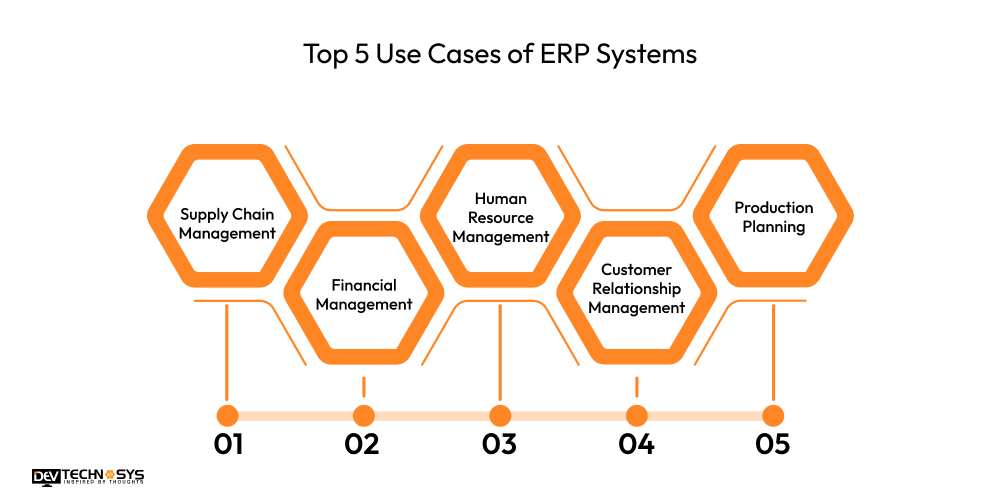
1. Supply Chain Management
ERP solutions streamline every aspect of the supply chain, from transportation and delivery to inventory and procurement. By offering real-time data, they assist companies in anticipating demand and cutting down on delays. Better vendor cooperation and more economical operations result from this.
- Inventory Optimization: An electronics company uses ERP to automate stock reordering based on real-time inventory levels and sales trends.
- Vendor Coordination: A retail chain integrates ERP with supplier portals to track shipments and streamline procurement processes.
2. Financial Management
Financial data is centralized by ERP software, which also automates accounting, reporting, invoicing, and budgeting. It improves compliance, accuracy, and real-time cash flow and financial health visibility. Use of MVP development services help businesses to easily meet regulatory standards.
- Automated Invoicing: A service-based firm uses ERP to generate and send invoices automatically, reducing billing errors and delays.
- Real-time Budgeting: A manufacturing business uses ERP dashboards to monitor expenses and adjust budgets in real time for each department.
3. Human Resource Management
HR operations including hiring, payroll, attendance, and performance reviews are managed by ERP software development tools. They provide labor law compliance, employee data tracking, and workflow automation. Employee satisfaction and workforce management both improve as a result.
- Payroll Automation: A healthcare provider uses ERP to manage employee salaries, tax deductions, and direct deposits accurately.
- Performance Tracking: A software company utilizes ERP to monitor employee goals, performance reviews, and training progress.
4. Customer Relationship Management
ERP’s integrated CRM modules keep tabs on sales activity, support requests, and customer interactions. You can hire dedicated developers that assist companies in understanding consumer behavior, enhancing client interaction, and customizing services. This increases sales effectiveness and customer retention.
- Sales Pipeline Management: A SaaS company tracks leads, customer interactions, and conversion rates through integrated ERP-CRM modules.
- Support Ticket Tracking: An eCommerce platform manages customer service requests and resolutions via ERP to ensure faster response times.
5. Production Planning
ERP software technology stack manages production schedules, materials, and resources to optimize industrial processes. Through careful design, they minimize waste and allow for real-time tracking of manufacturing steps. This leads to efficient use of resources and on-time delivery.
- Material Requirement Planning (MRP): A furniture manufacturer uses ERP to align raw material purchases with production schedules.
- Capacity Planning: An automotive parts maker uses ERP to forecast labor and machine capacity needed for upcoming production cycles.
Let’s Summarize!!
For creating the latest ERP systems for domains that are growing to get future benefits, you need smart and efficient ERP development frameworks and technologies. Businesses can search for these tools on their own or approach a reliable and experienced custom software development company in USA. So, it will be easy to prepare a suitable tech stack for developing ERP software.
Additionally, you need to prepare a budget listing the cost of implementation and the process through which money can be earned. By following these two major things, you can easily improve business growth and gather users in millions.
FAQs
1. Which are the Popular ERP Development Frameworks and Technologies?
Popular ERP frameworks in 2025 include Node.js, Spring Boot, and.NET Core for backend development, and React.js and Vue.js for frontend development. These frameworks provide speedier development, flexible architecture, and scalability.
2. How to Choose the Right Tech Stack for my ERP System?
- Consider your industry-specific needs.
- Choose technologies that easily integrate with existing tools.
- Opt for frameworks with strong security standards.
3. Is Cloud-Based ERP Better Than On-Premise Solutions?
Yes, in terms of scalability, reduced upfront expenses, and real-time accessibility, cloud-based ERP is generally superior for the majority of enterprises. Additionally, it provides remote collaboration, improved disaster recovery, and smooth upgrades.
4. What Database is Best for ERP Applications?
The requirements of the project will determine which database is ideal, but PostgreSQL, MySQL, Oracle, and Microsoft SQL Server are excellent options. PostgreSQL is preferred because of its sophisticated features and open-source dependability.
5. Can AI be Integrated Into ERP Systems?
Integrating AI into contemporary ERP systems is increasingly common. It provides intelligent decision support, automates repetitive operations, and improves forecasting. Demand forecasting, anomaly detection, and intelligent inventory control are common applications of AI.
6. How Secure are Modern ERP Technologies?
With features like role-based access, data encryption, and adherence to GDPR and ISO requirements, modern ERP systems are extremely safe. To stop breaches, they use multi-factor authentication, firewalls, and intrusion detection.