












Key Takeaways:
-
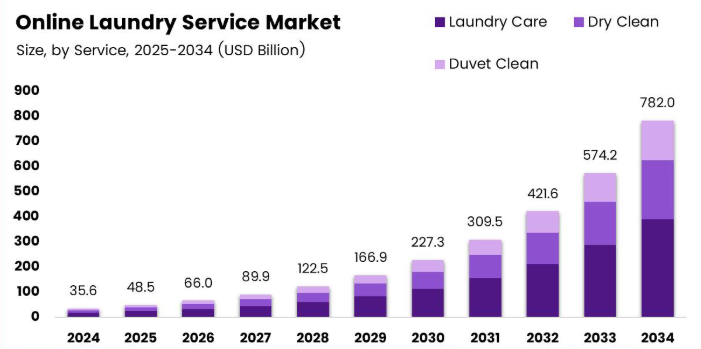
- The global laundry applications market was valued at around $35.6 billion in 2024, projected to grow to around $782.0 billion by the end of 2034.
- Integrated advanced features such as real-time tracking, secure payment options, user profiles, and more.
- Offer the best money-making techniques such as the freemium model, subscription plans, transaction fees, and partnerships.
Washing and drying clothes have never been easier thanks to apps like DexterPay.
With them, doing laundry has been made exceedingly simple. No lines to stand in and no coins to fumble around for: just a screen to tap and pay.
Easy, right?
But do you know what goes on in the development of an app like DexterPay?
For business owners or tech entrepreneurs, the app is an on-demand service. One that increases customer satisfaction, efficiency, and most importantly, revenue.
From tracking machines in real time, to contactless payments and a simple interface: This blog covers everything you need to build a laundry app like DexterPay. It includes features, technology, cost prediction, and other expert advice that will assist you in succeeding in the competitive market.
Market Analysis of Global Laundry Applications
- As per the recent survey, the laundry applications market is estimated to be around $35.6 billion in 2024, and this is expected to increase to around $782.0 billion at the end of 2034.
- Compared sector-wise, the residential sector holds the highest market share, around 63.5% in 2023.
- According to a global study, the laundry apps market is expected to grow at a CAGR of 36.2% from 2024 to 2034.
- In 2024, the laundry care segment will dominate the revenue share, with around 47.6% and it can increase over the upcoming years.
- North America holds the highest revenue as compared to other regions, around 35.3% and is valued at around $12.4 billion.
What is DexterPay?
An application called DexterPay was developed for Dexter laundry systems and enables users to pay for laundry directly on their mobile phones. The app eliminates payment through coins and cards. Rather, DexterPay users get touchless payment options. With DexterPay, users can also see available washing machines, get cycle updates, and monitor their usage in real time. DexterPay has also modernized laundromats while enhancing their productivity, providing users with state-of-the-art solutions that make laundry more convenient.
DexterPay’s Success Story
- The DexterLive cloud-management system was launched in 2014. It involves DexterPay, which enables users to pay for laundry and perform other laundry operations.
- The DexterPay allows laundry owners to accept cashless payments, offers users a cycle tracking feature, and eliminates coin dependency.
- DexterPay is backwards compatible with older Dexter equipment (C‑series, A‑series), making adoption easier for existing laundromat owners.
- With DexterPay, operators reduce overhead: fewer coin collections, less maintenance, and direct bank deposits for mobile payments.
- Offers loyalty programs and promotions via the app, helping store owners increase return visits and average vend per customer.
Different Types of Laundry Applications
Businesses have different options for laundry applications; the type of app suits their project requirements and demand. So, let’s explore the wide variety of laundry applications:
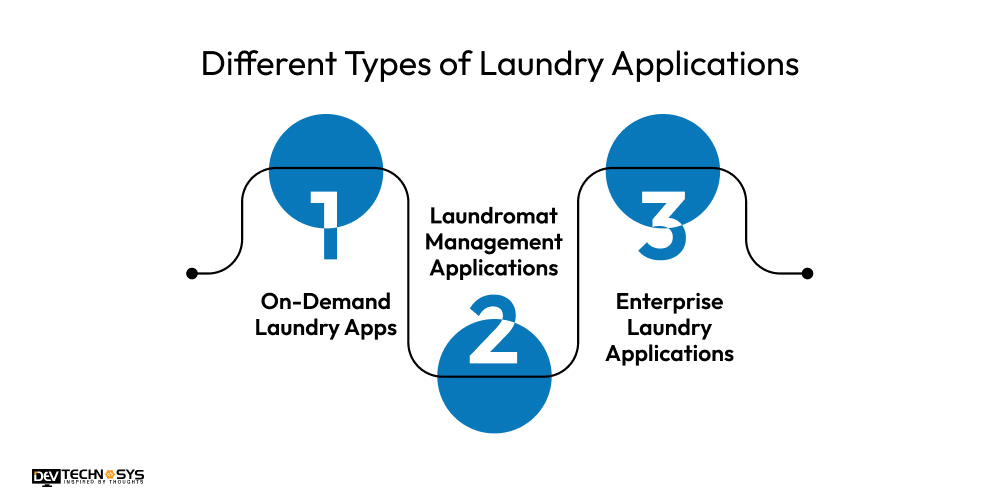
1. On-Demand Laundry Apps
Laundry apps link users with nearby laundry service providers to arrange pick-up, laundering, and delivery. Users set orders in real-time with live service offerings. These apps prioritize busy users and guarantee time efficiency by saving time with real-time service confirmations, doorstep laundry service, instant payment, and customer support.
2. Laundromat Management Applications
Apps like DexterPay and mobile payment systems integrate to help laundromat owners automate tasks like appliance usage, payments, and customer interactions. Users get real-time access to device status, payment systems, and machine availability. Payment processing becomes easier while owners are losing less to manual work and gaining more positive customer interactions in self-serve laundrettes.
3. Enterprise Laundry Applications
Designed for hotels, universities, and hospitals, these apps simplify and organize bulk laundry supervision and control. They are equipped with order tracking, staff management, billing, and inventory systems. High operational productivity with timely goods delivery, smooth routine workflows, and custom flexible enterprise systems are a plus for enterprise applications focused on high-volume laundering.
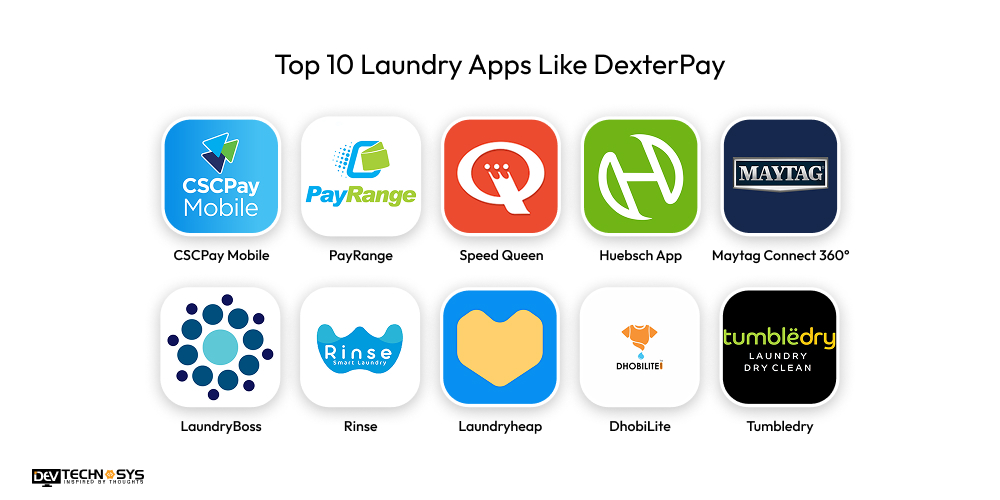
Top 10 Laundry Apps Like DexterPay
Explore the best laundry apps and understand their features and specifications to get an idea and implement them in your project. Find out the top trending laundry service apps:
| App Name | Downloads | Rating | Launch Year | Platform |
| CSCPay Mobile | 1M+ | 3.7 | 2018 | Android, iOS |
| PayRange | 1M+ | 4.7 | 2015 | Android, iOS |
| Speed Queen | 500K+ | 3.5 | 2017 | Android, iOS |
| Huebsch App | 100K+ | 3.8 | 2019 | Android, iOS |
| Maytag Connect 360° | 100K+ | 3.6 | 2020 | Android, iOS |
| LaundryBoss | 100K+ | 3.2 | 2019 | Android, iOS |
| Rinse | 1M+ | 4.5 | 2015 | Android, iOS |
| Laundryheap | 3M+ | 4.5 | 2014 | Android, iOS |
| DhobiLite | 500K+ | 4.3 | 2015 | Android, iOS |
| Tumbledry | 500K+ | 4.2 | 2020 | Android, iOS |
You can reach out anytime; we are available 24/7. Our team provides a quick response.
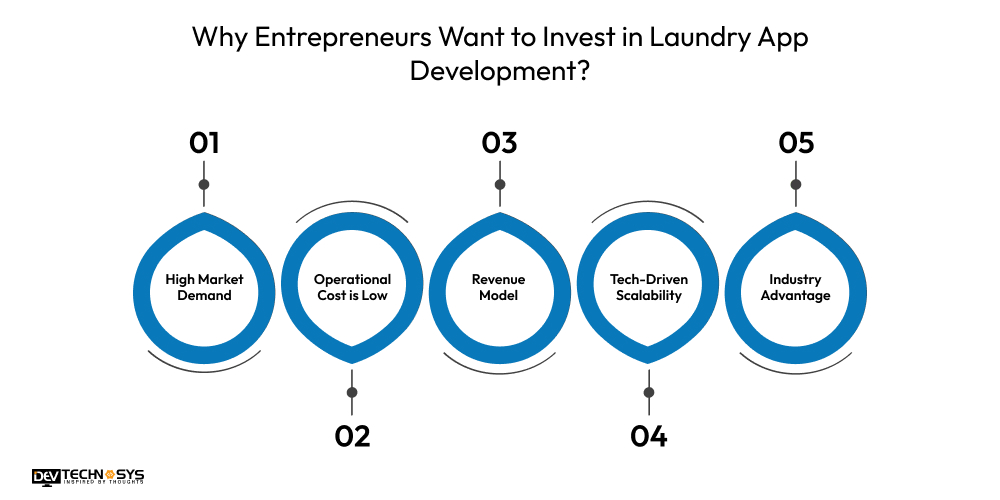
Why Entrepreneurs Want to Invest in Laundry App Development?
Investing in the on-demand laundry delivery app development is a highly profitable opportunity for businesses and expanding it to global audiences. As we also show the market analysis of laundry applications, we can see how rapidly it grows. So, let’s observe the benefits of laundry app development solutions:
1. High Market Demand
Laundering clothes is an important, necessary, and usual service offered today. Because of urbanization and busy lifestyles, consumers want access to affordable, time-conserving solutions. Apps provide easy access to laundering services, thus increasing demand. Due to the subscription models, integration of payment, auto delivery, and automation services is required.
2. Operational Cost is Low
Everstream analytics suggests that compared to physical locations, laundering services minimize operational costs. Laundering services operated using effective logistics and physical location partnerships can grow without the constraints of having physical launderettes. If entrepreneurs build a laundry app like Tumbledry, they invest in effective business models with controlled investment by utilizing outsourced laundromat services.
3. Revenue Models
The frequency of laundromat services makes it easier to retain customers. Use of subscriptions and system prepayment for laundromat services is common. Entrepreneurs appreciate the financial control and the low operational overhead costs. Investors appreciate the sustainability this model provides, as well as the steady investments that can be seen in the predictability of the model.
4. Tech-Driven Scalability
Entrepreneurs with laundromat services have an array of services to choose from, including the construction of new offices in different cities and service franchising. Use of Technology, on the other hand, provides streamlined operational processes, automation in delivery routes, and user personalized services, leading to efficiency and growth without proportionally increasing costs or staff requirements.
5. Industry Advantage
Many local laundromats operate without tech integration. Entrepreneurs can capitalize on this gap by aggregating small players through a platform model. Digitizing services in a fragmented industry offers first-mover advantages, branding opportunities, and customer loyalty. According to the Android app development company, it allows rapid market capture where traditional competitors lack mobile or digital capabilities.
How AI Can Transform the Laundry Apps Operations and Tasks?
- Notifications of machine problems prior to breakdowns can significantly lower Emergency repair expenditures, along with downtime for laundromat owners.
- Users receive proactive communications to increase retention, loyalty, and average spend per visit.
- Automated systems allow users to schedule machine usage off-peak, so that they can save time and increase overall utilization of the machines.
- Automated recommendation systems for washing machines improve convenience and increase washing effectiveness and comfort by setting the machine automatically.
- Customer account and payment system integration to the application enables the detection of suspicious activity to improve system security and client data confidentiality.
- Inventory systems can actively monitor operational supply levels of bulk washing liquid and recommend the best options to maintain continuous operation.
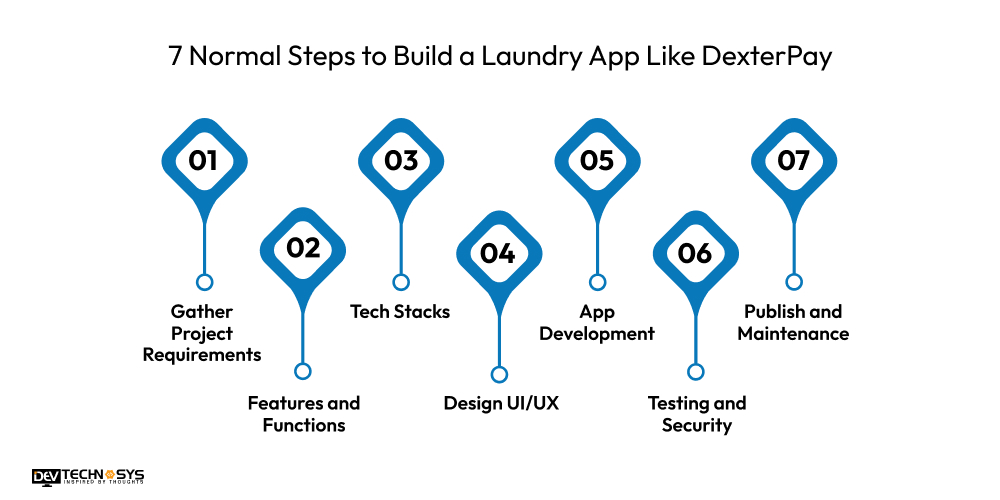
7 Normal Steps to Build a Laundry App Like DexterPay
To build a laundry app like DexterPay, you must follow the essential development steps to easily understand every process in detail. We start from the initial stage to the final post-launch maintenance stage. Let’s take a detailed explanation of the laundry mobile app development process:
1. Gather Project Requirements
Begin the first stage to create a laundry app like DexterPay, identify the project requirements and demands that must be added. Hire mobile app developers to make a structured list of project needs to reduce data redundancy and misunderstandings. Research in the market about which laundry applications are more trending and which type of applications can lead to higher success rates and popularity.
2. Features and Functions
Let’s move to the second step of DexterPay clone app development, create a proper list of features, such as basic and advanced. You can also observe the existing laundry app features to integrate into your application and find out some useful services. It includes various types of functionalities such as starting the machine remotely, machine availability check, secure payment options, cycle time notifications, and machine status updates.
3. Tech Stacks
In the third step to make a laundry delivery app like DexterPay, hire dedicated developers to select the required tech stacks for reliable app development. It involves a wide variety of tech stacks:
Frontend: Flutter, Swift, React Native, Kotlin
Backend: Django, Spring Boot, Ruby on Rails, Node.js
Cloud Storage: AWS, Microsoft Azure, GCP Storage
Designing: Zeplin, Figma, Sketch
Database: MYSQL, MongoDB, PostgreSQL
4. Design UI/UX
Coming to the fourth stage, to build an app like DexterPay, design a simple and intuitive UI that enables users to easily and quickly interact with all features and navigation. Using professional designing tools such as Adobe XD, Marvel, InVision, Sketch, Figma, Proto.io, and more. There are various elements that exist in design, such as navigation bars, colors, fonts, styles, templates, themes, built-in plugins, and more.
5. App Development
Move forward to the fifth step to create an app like DexterPay, hire experienced developers from a mobile app development company to start the real coding. There are various third-party tools and applications that must be integrated to increase the project’s accessibility and flexibility. It includes various third-party integrations such as social media logins, CRM, ERP, analytics, payment gateways, and more.
6. Testing and Security
Before releasing the app into the live phase, conduct the testing techniques to make sure all the specifications and services are working smoothly. It includes various types of testing such as unit testing, functional testing, integration testing, black-box testing, white-box testing, and user acceptance testing. Integrate the strong security measurements such as encryption techniques, two-factor authentication, biometrics, privacy techniques, SSL certification, and firewalls.
7. Publish and Maintenance
In the last stage to develop an app like DexterPay, publish the app on the selected platforms, such as iOS and Android. Developers make sure that all features and services are successfully deployed. Conduct the mobile app maintenance services such as fixing errors or glitches, updating the outdated features, performance optimization, regular backups, adding new enhancements, design changes, and more.
Important FAQs
1. What is the Best App For Laundry Delivery?
There are various top applications for laundry delivery:
- Tumbledry
- Laundryheap
- DhobiLite
- Rinse
2. What are the Core Features of a Laundry App Like DexterPay?
- Machine/Cycle Selection
- Transaction Summary
- Cycle Tracking
- Edge-Case Handling
- Cashless Payments
3. How to Reduce the Laundry App Development Cost?
Various ways help to reduce the cost to build a laundry app like DexterPay:
- Define Clear Requirements
- Use Open-Source Frameworks
- Hire freelancers
- Use Existing Templates
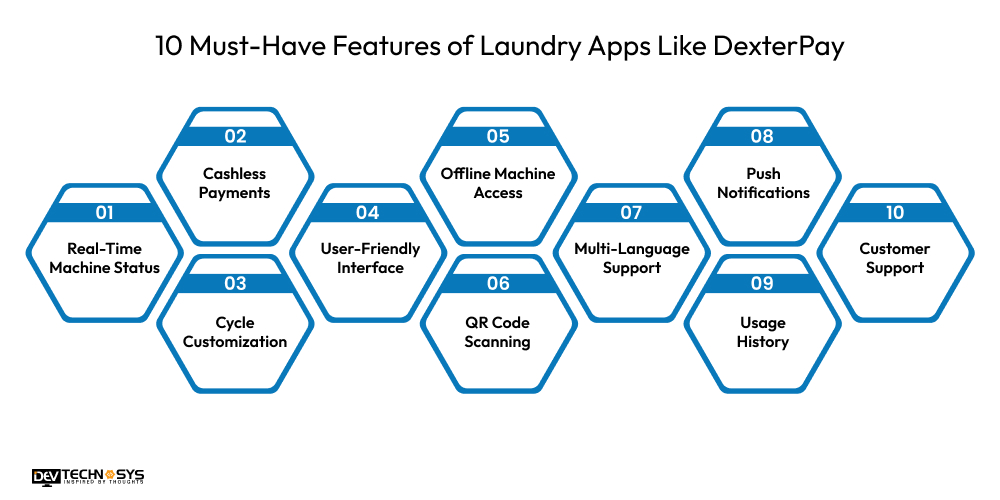
10 Must-Have Features of Laundry Apps Like DexterPay
Explore a wide range of features of laundry apps like DexterPay that must be integrated and choose the custom functionalities as per the business requirements. Let’s find out the best features of laundry apps:
1. Real-Time Machine Status
The DexterPay alternatives offer real-time availability of machine and cycle plans, allowing users to plan their visits to collect their orders and reduce waiting time.
2. Cashless Payments
A similar app like CSC GO offers digital or cashless payments via credit or debit cards, UPI, digital wallets, without the need for cash and coins.
3. Cycle Customization
DexterPay alternatives allow users to choose wash settings like temperature, rinse cycles, or drying time directly from the app before starting the machine.
4. User-Friendly Interface
The laundry delivery app has a clean, intuitive interface that new users can navigate easily without instructions or tutorials, minimizing frustration and errors.
5. Offline Machine Access
Laundry pick up and delivery app allows machine operation via offline tokens or Bluetooth if the internet is unavailable, ensuring uninterrupted service in low-connectivity areas.
6. QR Code Scanning
The DexterPay and CSC GO laundry app enable users to scan the QR code to start the machine instantly with ease of use.
7. Multi-Language Support
DexterPay clone app offers the interface in multiple local languages to accommodate diverse users and improve accessibility for non-English speakers.
8. Push Notifications
A similar app like DexterPay sends automatic alerts for cycle start, completion, errors, or promotions to keep users updated without constantly checking the app.
9. Usage History
Laundry delivery service app provides a complete log of past washes, payments, and machines used for easy reference, reimbursements, or dispute resolution.
10. Customer Support
The app for laundry pick up and delivery offers 24/7 support services to handle the customers’ raised concerns and solve them as soon as possible.
What is the Cost to Build a Laundry App Like DexterPay?
The cost to build a laundry app like DexterPay is around $8,000 to $25,000, or it can fluctuate. There are key factors that can highly impact the overall laundry app development cost, such as features, project complexity, size, functions, backend infrastructure, and security measures. It has additional factors that can also affect the cost, like maintenance services, development team, testing, designing, tech stacks, and third-party integrations. Let’s explore the detailed view of cost:
| Development Phase | Approx. Hours | Hourly Rate (USD) | Cost Estimate (USD) |
| UI/UX Design | 80 – 120 | $30 | $2,400 – $3,600 |
| Frontend Development | 200 – 300 | $35 | $7,000 – $10,500 |
| Backend Development | 250 – 350 | $40 | $10,000 – $14,000 |
| Admin Panel | 100 – 150 | $35 | $3,500 – $5,250 |
| QA & Testing | 80 – 120 | $25 | $2,000 – $3,000 |
| Project Management | 60 – 100 | $30 | $1,800 – $3,000 |
| Deployment & Launch | 20 – 40 | $30 | $600 – $1,200 |
Estimated Cost: $8,000 – $25,000+
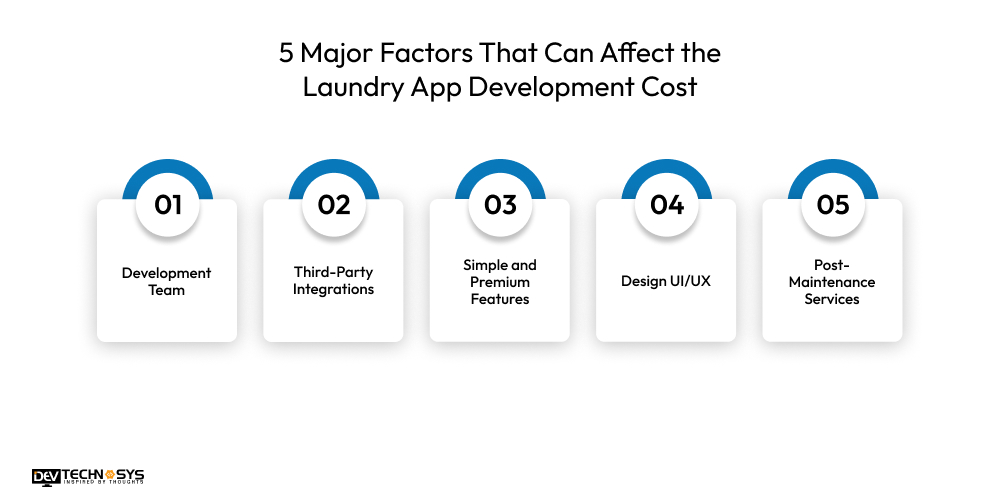
5 Major Factors That Can Affect the Laundry App Development Cost
Creating a laundry app like DexterPay within a fixed budget is a complex task for everyone, because there are major factors that can impact the cost. Before starting to develop, you must observe these factors and find ways to avoid them. So, let’s explore the key factors that can affect the cost to develop a laundry app like DexterPay:
1. Development Team
In the first cost-impacting factor, hiring developers from different regions can be one of the common factors. There are various regions that have higher living costs, which is why developers demand higher salary packages as compared to others. Developers who have more experience in creating laundry applications can also ask for a higher salary. At last, this can increase the overall cost to build a laundry app like DexterPay.
| Team Type | Description | Estimated Cost (USD) | % of Total Budget |
| Freelancers (Local/Remote) | Small team with limited scope, basic app | $3,000 – $6,000 | 35% – 45% |
| Small Dev Agency | Structured team: PM, 2 devs, 1 QA, agile delivery | $6,000 – $10,000 | 40% – 50% |
| Mid-size Firm | Full-stack team + UI/UX + QA + scalable support | $10,000 – $15,000 | 0% – 60% |
2. Third-Party Integrations
Moving to another factor, integration of third-party tools and applications is important to increase the app’s accessibility. But some of the third-party integrations require higher licensing fees and take time to implement, this directly impacts the higher mobile app development cost. It involves a wide variety of tools such as payment gateways, notification and messaging tools, locations and maps, cloud storage, analytics, customer support, and social media platforms.
| Integration Type | Examples | Estimated Cost (USD) | % of Total Budget |
| Payments Gateway | Stripe, Razorpay, UPI | $300 – $700 | 3% – 5% |
| Notifications | Firebase, OneSignal, Twilio | $0 – $300 | 1% – 2% |
| Maps & Location | Google Maps, Mapbox | $100 – $400 | 1% – 2% |
| Support Chat / Email | Zendesk, Freshchat, SendGrid | $200 – $600 | 2% – 3% |
| Total Estimate | $600 – $2,000 | 5% – 8% |
3. Simple and Premium Features
Simple and premium features are necessary for each app development, but their cost are different from each other. It includes a vast range of premium features such as remote monitoring, machine availability, custom wash settings, subscription plans, offline machine control, digital payments, and more. These premium features can raise the overall DexterPay app development cost; businesses select features as per their fixed budget and requirements.
| Feature Type | Inclusions | Estimated Cost (USD) | % of Total Budget |
| Simple Features | Login, payments, machine control, timers, notifications | $3,000 – $6,000 | 30% – 35% |
| Premium Features | Loyalty, coupons, referrals, subscriptions, analytics | $2,000 – $5,000 | 10% – 20% |
| Total Features | MVP + Extended | $5,000 – $10,000 | 40% – 50% |
4. Design UI/UX
In the fourth cost-affecting factor, designing a user interface includes various types of elements such as templates, fonts, themes, styles, colors, plugins, layouts, and navigation bars. These high-quality elements can increase the cost to build a laundry mobile app like Laundryheap. There are also paid designing tools such as Marvel, Sketch, Figma, Zeplin, Adobe XD, Proto.io, and more.
| Design Quality | Includes | Estimated Cost (USD) | % of Total Budget |
| Basic UI | Basic wireframes, standard layouts | $500 – $1,000 | 5% |
| Mid-level UI/UX | Clean UX, better visuals, custom icons | $1,000 – $2,000 | 8% – 10% |
| High-Fidelity Design | Brand styling, micro animations, seamless experience | $2,000 – $3,500 | ~10% – 15% |
5. Post-Maintenance Services
Connect to the last factor, maintain the actual performance of the app, and conduct the post-maintenance services to keep the app up-to-date. It contains various types of maintenance services such as upgrading the OS version, monitoring performance, regular data backups, adding new features, design enhancements, backend operations, and fixing security issues. These services can take more time, and this can directly affect the cost to develop a laundry app like DexterPay.
| Service Level | Includes | Estimated Annual Cost (USD) | % of Total Budget |
| Basic Maintenance | Bug fixes, uptime checks, minor patches | $500 – $1,000 | 2% – 5% |
| Moderate Maintenance | Minor updates, feature tweaks, and monitoring | $1,000 – $2,000 | 5% – 8% |
| Full Support Plan | Continuous updates, customer support assistance | $2,000 – $3,000 | 8% – 10% |
5 Monetization Models of Laundry Apps Like DexterPay
It’s good to create a mobile app, but how can you generate money from this? There are various types of monetization techniques that help businesses to easily generate higher revenue streams. So, let’s explore the best money-making strategies:
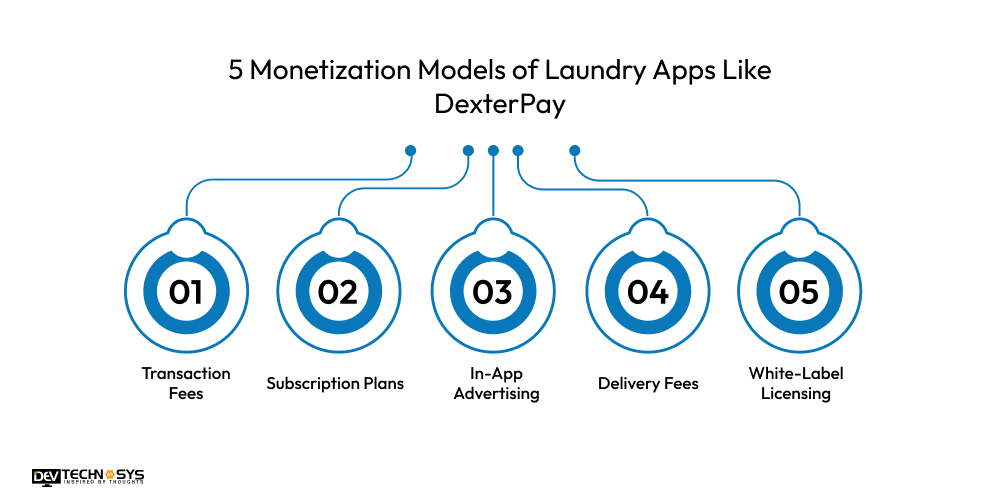
1. Transaction Fees
In the first money-making technique, businesses can charge a transaction fee on every payment made through the digital payment within the app. It is mainly known as a processing fee, and it can directly generate a new revenue stream and increase the business valuation.
2. Subscription Plans
Moving to the second monetization technique, laundry app like Cleanly and DexterPay offer paid subscription plans such as basic, premium, and enterprise. Users need to purchase these plans to access the unlimited or discounted washes on a monthly or yearly basis.
3. In-App Advertising
The DexterPay alternatives offer an ad space and enable third-party businesses or organizations to show their products or services within the app as advertisements. Charge an advertisement fee for every ad, based on the advertisement format type.
4. Delivery Fees
Laundry apps like DexterPay can charge users a fee for pickup and delivery services. This model adds convenience for users while generating consistent revenue, especially in urban areas where demand for door-to-door laundry services is high.
5. White-Label Licensing
Apps can license their platform to laundromat owners under a white-label model, allowing them to use customized branding. According to the iPhone app development company, this provides recurring income for the app provider while enabling laundromats to offer modern digital services without developing their own software.
Conclusion
In conclusion, building a laundry app like DexterPay requires careful planning, intuitive UI/UX design, secure payment integration, and robust backend infrastructure. To ensure seamless functionality and customer satisfaction, partnering with an experienced laundry app development company is essential. Such a company can provide custom features tailored to your business needs, from real-time machine tracking to user-friendly interfaces. By investing in the right development team, you can create a scalable, efficient, and competitive laundry app that drives long-term growth.
Frequently Asked Questions
Find answers to the most common questions related to this article.
The cost to develop a laundry app like DexterPay lies between $8,000 and $25,000. The price can go up and down due to various factors such as features, functions, complexity, size, infrastructure, and deployment platforms.
To make a laundry app like DexterPay, it normally takes around 5 to 12 weeks. The timeline is based on the crucial factors like developers' working hours, project complexity, a higher number of features, and many more.
Here is the list of technologies:
• Java
• C++
• Python
• PHP
• C#
• JavaScript
• Customer Support Integration
• Third-Party API Reliability
• Network Error Handling
• Scalable Server Architecture
• Time Slot Scheduling
It includes various monetization techniques:
• Subscription Plans
• Freemium Model
• Transaction Fees
• In-App Advertising
• Delivery Fees