











![Mobile App Development in France [2026]](https://devtechnosys.com/insights/wp-content/uploads/2025/12/Mobile-App-Development-in-France-1.jpg)
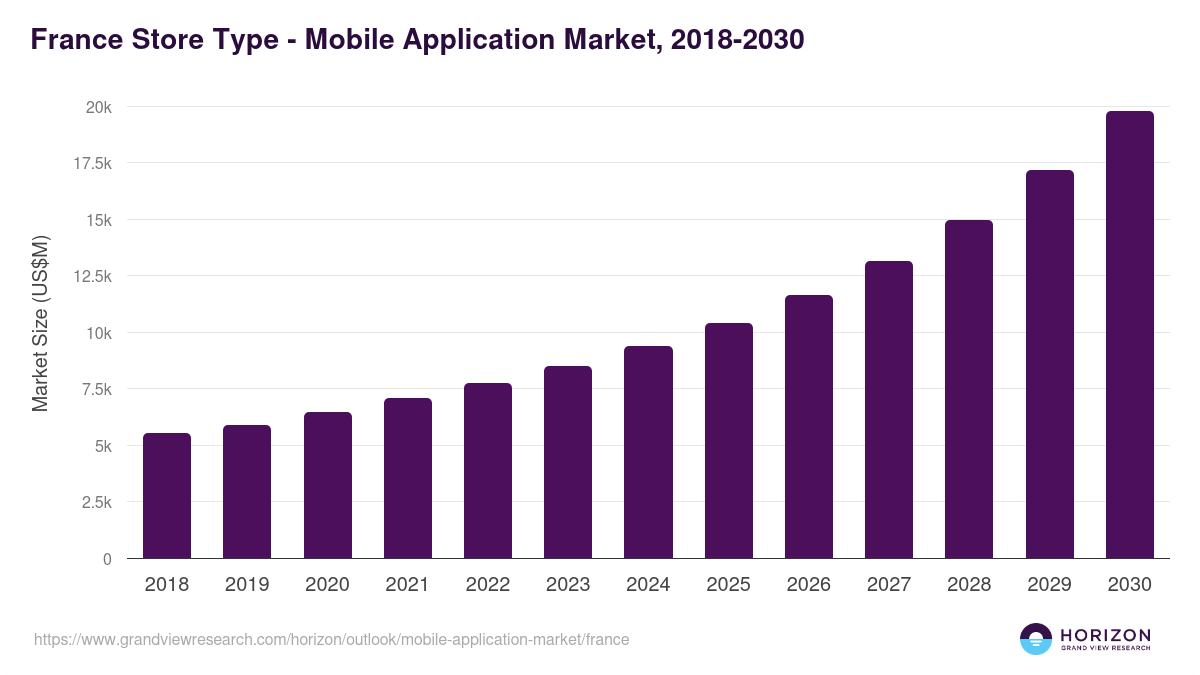
When it comes to mobile app development, most businesses focus on the USA, China, or Saudi Arabia. However, another region is quickly rising to the top in on-demand app development: France. Last year, the mobile aop market of France made USD 9.4 billion and is expected to reach USD 19.8 billion by 2030.
The French app development industry is releasing high-quality apps to boost customer engagement, simplify tasks, and stay competitive in a rapidly advancing digital economy. As mobile phone use has increased, France has stepped up and started offering exciting opportunities for startups and enterprises looking to build modern, user-friendly, and scalable apps.
In this blog, we will shed light on the market growth, business opportunities, and emerging mobile app trends in France. Let’s see how these trends are shaping the future of the French app development industry.
Let’s begin!
French Mobile App Market Analysis
- The French mobile application market generated a revenue of USD 9,373.4 million in 2024 and is expected to reach USD 19,775.7 million by 2030.
- The French market is expected to rise at a CAGR of 7% between 2025 and 2030.
- By segment, Apple Store was the most significant revenue-generating store type in 2024.
- Google Store is the most lucrative store type segment, registering the fastest growth between the financial year.
- In Europe, the UK mobile application market is expected to top the regional market in terms of revenue in 2030.
What are the Latest Mobile App Development Trends in France?
Mobile app development in France is growing rapidly thanks to the new emerging tech trends. Below are the top 10 iOS and Android app development trends that play a crucial role in shaping the French app development industry.
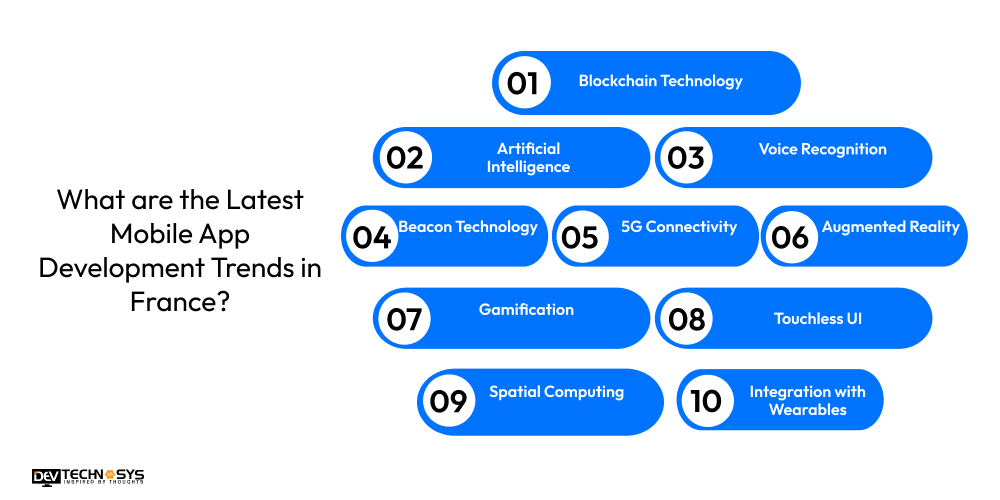
1. Blockchain Technology
One of the top app development trends in the French market is blockchain technology. Blockchain-based mobile ensures transaction security, data handling, and tamper-proof records. French fintech, healthcare, and supply chain businesses increasingly adopt blockchain to boost trust, reduce fraud, and improve user confidence.
The growing demand for transparency is pushing more companies to integrate decentralized systems. Its adoption also strengthens compliance with strict EU data regulations.
2. Artificial Intelligence
AI enhances mobile apps with smarter personalization, predictive analytics, automation, and real-time insights. In France, industries like retail, finance, and travel use AI-powered apps to deliver improved customer experiences and faster decision-making.
Businesses are leveraging AI chatbots and automation to reduce customer support costs. The trend is accelerating as more companies focus on hyper-personalized user journeys.
3. Voice Recognition
Voice-enabled hybrid app development is gaining popularity as French users prefer hands-free interactions. Businesses integrate voice commands for search, customer service, and accessibility features to improve convenience and engagement across multiple app categories.
Smart speakers like Google Home and Amazon Echo are boosting voice-based usage. This trend is opening new opportunities for multilingual and accessibility-focused apps.
4. Beacon Technology
Experts who build mobile app in France also create advanced Beacon-enabled apps that deliver hyper-personalized location-based alerts and offers. Retailers, transportation hubs, and museums in France use beacons to guide visitors, improving the in-store experience.
French tourism apps also use beacons to offer real-time navigation and historical insights. This technology is strengthening offline-to-online customer engagement for businesses.
5. 5G Connectivity
Whether it’s Android or iPhone app development, 5G brings ultra-fast speeds and lower latency for advanced mobile experiences. Experts in mobile app development in France leverage 5G to build high-performance apps supporting AR, HD streaming, cloud gaming, IoT, and real-time communications. Wider 5G rollout across France is enabling more resource-intensive applications. Developers can now deliver smoother, richer, and more interactive mobile user experiences.
6. Augmented Reality
AR creates immersive digital experiences for shopping, education, real estate, and entertainment. Thanks to smartphone usage growth in France, top brands are increasingly adopting AR apps to boost customer engagement, visualize products, and deliver more interactive content.
Retailers use AR to let users “try before they buy,” especially in fashion and furniture. The trend is expected to soar further with 5G-powered AR innovations.
7. Gamification
Gamification enhances app engagement using rewards, challenges, points, and interactive elements. French businesses integrate gamified features into fitness, learning, finance, and eCommerce, as well as progressive web app development, to increase user retention and motivation.
Companies are using gamification to drive habit-building and reward user loyalty. This approach is especially popular among French Gen Z and millennial audiences.
8. Touchless UI
Touchless interfaces use gestures, voice, and facial recognition to enable safer, more intuitive app interactions. Developers who create industry-specific mobile apps in France are increasingly adopting touchless UI to improve accessibility, enhance hygiene, and streamline digital experiences.
This trend surged post-pandemic as users preferred non-contact interactions. It is now shaping the future of apps in retail, healthcare, and smart home solutions.
9. Spatial Computing
The next trend in mobile app development in France is Spatial computing. It combines AR, VR, AI, and sensors to blend digital and physical environments. In France, it provides immersive training, retail, and industrial solutions, making applications more interactive and context-aware. Industries such as aviation, manufacturing, and education are adopting spatial apps for realistic simulations.
10. Integration with Wearables
Wearable-compatible mobile app adoption in France is rising at a rapid rate. These apps track health, fitness, productivity, and real-time notifications. French developers who are experts in wearable device app development integrate wearables to deliver seamless cross-device experiences, especially in healthcare, sports, and lifestyle applications. With smartwatches and fitness trackers becoming mainstream, demand for apps linked to wearables is skyrocketing.
What Opportunities Does it Bring for Startups & Enterprises?
With strong government support and rising tech adoption, businesses can unlock high-growth opportunities across multiple industries. Here are some of the lucrative mobile app investment opportunities France that businesses shouldn’t miss:
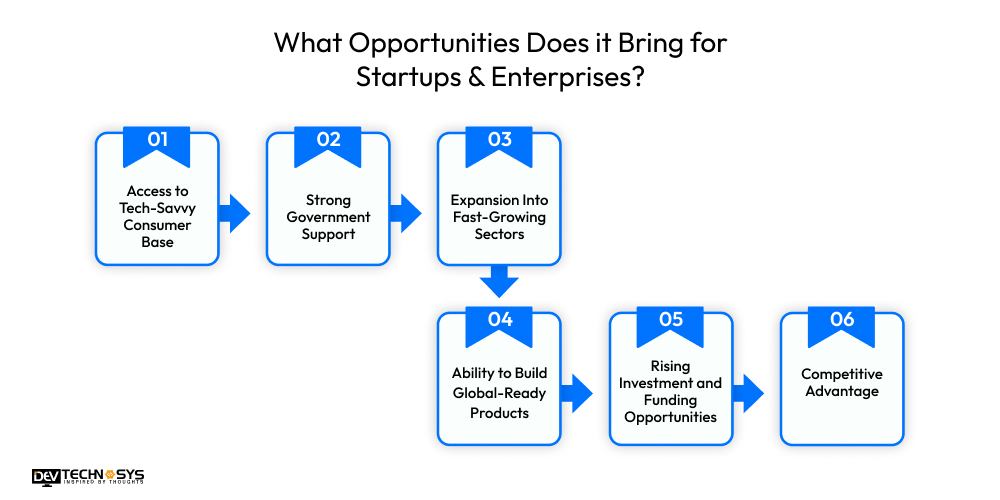
1. Access to Tech-Savvy Consumer Base
France’s digitally mature, high-spending population offers businesses a receptive market for innovative apps. High smartphone penetration ensures strong adoption, helping startups and enterprises quickly gain users, boost engagement, and scale faster.
2. Strong Government Support
Government initiatives like La French Tech, innovation grants, and attractive R&D tax credits make France a powerful ecosystem for Xamarin app development, supporting startups with funding, resources, and favorable policies that accelerate digital growth.
3. Expansion Into Fast-Growing Sectors
Rapid growth in sectors such as fintech, healthtech, edtech, and mobility creates fertile ground for impactful mobile apps. Mobile app development in France is beneficial because French developers build solutions that meet evolving market needs and tap into high-demand digital opportunities.
4. Ability to Build Global-Ready Products
France’s robust digital infrastructure, enterprise mobility solution, multilingual talent, and compliance with international standards like GDPR empower companies to develop scalable AI-powered mobile apps in France that can seamlessly expand across Europe and global markets with minimal friction.
5. Rising Investment and Funding Opportunities
As Europe’s second-largest VC hub, France offers strong investment potential. Startups can benefit from react native app development France due to abundant funding opportunities, increasing their chances of securing seed, early-stage, and growth-stage capital for expansion.
6. Competitive Advantage
Investing in mobile app development in France can benefit enterprises by automating workflows, enhancing customer experiences, and modernizing operations. This digital shift boosts efficiency, strengthens loyalty, increases revenue, and provides a significant competitive edge in France’s growing digital economy.
What are the Steps to Build a Mobile App in France?
Here are the smart steps for cross-platform app development France. From research to deployment, each step plays a crucial role in ensuring the app’s success in the competitive French market.
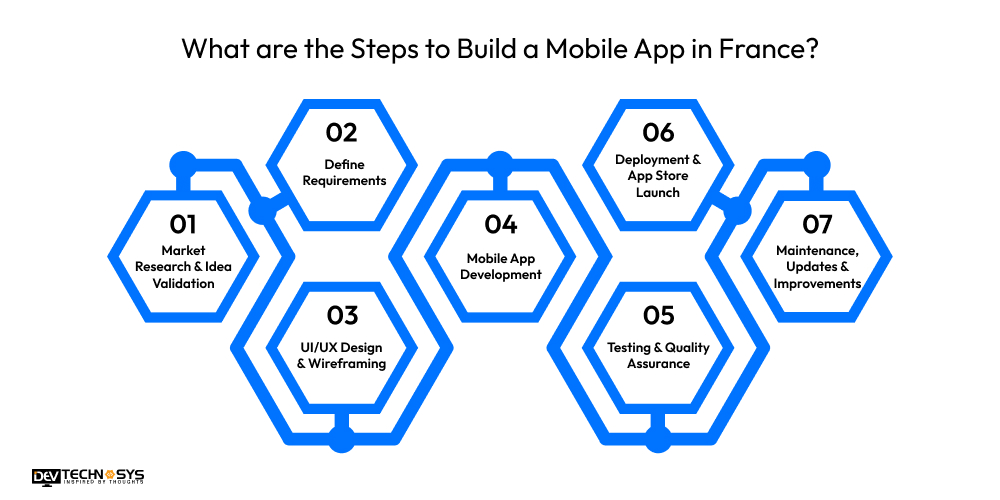
1. Market Research & Idea Validation
Whether your goal is blockchain app or IoT application development, start by analyzing the French market, target users, competitors, and industry trends. Then, validate your idea through surveys or prototypes to ensure demand. This step helps refine app goals, features, and unique value, reducing risks and guiding the entire development direction.
2. Define Requirements
Outline app features, user flows, technology stack, platform choice, and budget. Prepare a clear roadmap that includes timelines and milestones. This structured planning process helps teams stay aligned, manage expectations, and ensure efficient execution throughout the app development lifecycle.
3. UI/UX Design & Wireframing
Hire a skilled design team to get excellent mobile app design services. Your experts will design intuitive user interfaces and create wireframes that map the user journey.
French users expect clean, modern, and accessible designs. This step to build mobile app in France focuses on layout clarity, visual appeal, and easy navigation to ensure the final app delivers an engaging and seamless experience.
4. Mobile App Development
Hire a top mobile app development company in France to build the frontend, backend, APIs, and core functionalities using the chosen frameworks. This step to build mobile app in France turns your design into a working product.
Your low code development experts in France will ensure scalability, performance, and security while maintaining compliance with local regulations and high-quality development standards.
5. Testing & Quality Assurance
Conduct rigorous testing to identify bugs, performance issues, and compatibility problems across devices. French QA teams run functional, usability, security, and localization tests. This ensures the app performs flawlessly, delivers smooth experiences, and meets user expectations before launching publicly.
6. Deployment & App Store Launch
Publish the mobile app on the Apple App Store and Google Play Store following France-specific compliance guidelines. Optimize your listing with descriptions, keywords, and visuals. Deployment includes configuring servers, integrating analytics, and preparing the app for ongoing monitoring.
7. Maintenance, Updates & Improvements
After launch, application maintenance and support are crucial. Development experts will monitor performance, gather user feedback, and provide regular updates.
Continuous maintenance keeps the app secure, bug-free, and aligned with evolving French market needs. Enhancing features and improving UX ensures long-term user satisfaction and sustained business growth.
Planning a Mobile App?
Get a tailored development cost estimate in 3 simple steps — app basics, features, timeline, and your contact details.
- 3 quick steps
- 100% free
- Reply in 1 business day
2 Minutes Read
Tax, Compliance, and Legal Guidelines for Mobile App Development in France
Businesses must be aware of the legal regulations and legal framework in France when planning on creating a mobile application. Adhering to the tax requirements, data protection regulations, intellectual property rights, and consumer rights will have a considerable effect on the development process and cost of the project.
1. Compliance with GDPR and Data Privacy Legislation
France adheres to the regulation from the EU known as the General Data Protection Regulation (GDPR), which indicates that mobile Apps must be used for the collection, processing, and storing of personal data in a legal manner. In order to be compliant with the regulations and avoid penalties imposed by the government, developers need to establish the mechanisms.
2. Protection of Intellectual Property (IP)
Mobile app owners should make sure that they own the source code of the application, its UI/UX designs as well as trademarks and other digital assets through properly drafted contracts. Considering that intellectual property laws in France protect software innovations, IP terms should be present in all development agreements.
3. VAT and Tax Liabilities
If a business sells paid apps, subscriptions, or some in-app purchases in France, it might need to pay Value Added Tax (VAT). The company has to understand the VAT rules that apply and the way invoices are to be issued to be compliant with the law.
4. Consumer Protection Laws in Digital Services
According to consumer protection law in France, mobile apps need to be transparent about their prices, subscription terms, and refund policies when applicable, and they need to ensure that the payment processes are secure.
Companies providing mobile apps for digital services need to comply with the requirements of accessibility regulations, e-commerce regulations, and consumer rights protection laws.
What are the Most Profitable App Categories in France?
France’s rapidly growing digital economy has created several high-earning app categories that consistently attract strong user engagement and revenue. From gaming to fintech, these segments offer some of the most profitable opportunities for developers and businesses.
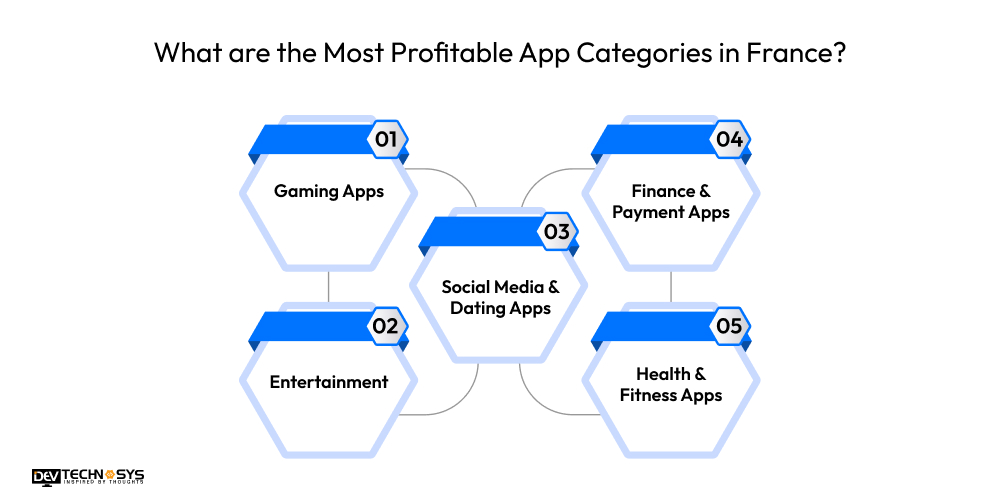
1. Gaming Apps
Gaming dominates France’s app revenue landscape, driven by in-app purchases, ads, and subscription models. Casual, strategy, and multiplayer games attract massive engagement, making gaming one of the strongest profit-generating categories in the French market.
2. Entertainment
Streaming mobile app adoption in France, like Deezer, Netflix, Spotify, and short-video platforms, has increased lately. Streaming apps generate substantial revenue through monthly subscriptions and premium tiers. High content consumption in France keeps entertainment apps among the top-earning categories.
3. Social Media & Dating Apps
Platforms such as TikTok, Instagram, and Tinder drive huge profits using ads, paid boosts, and premium memberships. With strong user engagement and continuous usage, these apps remain lucrative for both startups and large enterprises.
4. Finance & Payment Apps
Digital banking, e-wallets, budgeting apps, and investment platforms are booming in France. Contactless payments, fintech adoption, and secure mobile banking features make Fintech mobile apps France highly profitable through transaction fees and subscription-based services.
5. Health & Fitness Apps
Fitness trackers, meditation apps, and personalized wellness platforms thrive using freemium and subscription monetization. Growing awareness around health and lifestyle improvement makes this category a steady revenue generator in the French market.
What is the Cost to Develop a Mobile App in France?
The cost to develop a mobile app in France is around € 6,874 to € 21,483. This cost can differ depending on various factors like app features and complexity, design, tech-stack, security, and maintenance. Native mobile app development cost in France with simple features and functionalities is around € 6,874 to € 10,311.
However, the mobile app development cost in France, including advanced tools and technologies like AR/VR, AI, and wearable technology, may go beyond € 21,483. Here’s the table showcasing the mobile app development cost in France based on app complexity.
| App Type / Complexity | Estimated Cost (EUR) | Development Timeline |
| Basic App | €6,874 – €9,500 | 4–6 weeks |
| Simple App with Standard Features | €9,500 – €14,000 | 6–8 weeks |
| Moderately Complex App | €14,000 – €18,000 | 8–10 weeks |
| Advanced / MVP App | €18,000 – €21,483 | 10–12+ weeks |

What Challenges You Might Face In the French App Market?
Creating cloud-based app solutions in France is not always easy; there are several challenges and hurdles you need to overcome. Here we have listed some of the common challenges you might face during on-demand app development in France.
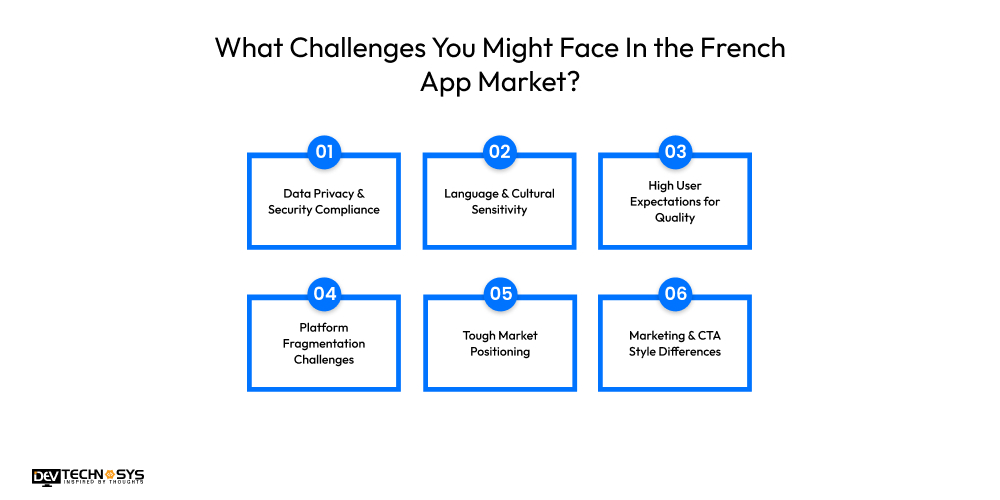
1. Data Privacy & Security Compliance
France has some of the strictest GDPR enforcement in Europe. Apps must follow privacy-by-design principles, ensure secure data handling, and provide transparent user consent. These requirements can complicate analytics, personalization, and AI-driven features.
2. Language & Cultural Sensitivity
Flawless, nuanced French is essential for custom mobile app development France. Even minor typos damage credibility. French users also dislike aggressive English-style CTAs like “Buy Now.” Softer alternatives such as “Commandez ici” feel more natural and trustworthy.
3. High User Expectations for Quality
French users expect visually refined, fast, and bug-free apps. Laggy performance, intrusive pop-ups, or design issues quickly lead to frustration—especially among millennials, who have low tolerance for poor digital experiences.
4. Platform Fragmentation Challenges
France’s device ecosystem is fragmented, especially for smart TVs and cross-platform digital experiences. Supporting multiple operating systems and device variations increases development time, testing needs, and long-term maintenance efforts.
5. Tough Market Positioning
Being the third or fourth competitor in a category is difficult. Experts at e-commerce mobile apps France note that the strongest position after the market leader is second place, and benefits from user trust without the burden of educating the market.
6. Marketing & CTA Style Differences
Direct, sales-heavy CTAs common in English-speaking markets often feel pushy to French users. Brands must use polite, softer messaging to build trust and improve conversion rates in France’s more subtle marketing landscape.
How Dev Technosys Will Help You?
We hope you find this blog helpful and informative. The future of mobile app development in France is shining bright with new mobile app trends. By embracing emerging technologies, understanding local regulations, and focusing on user-centric design, startups and enterprises can unlock massive potential in the French digital market.
If you are a business looking for top-tier mobile app development, then contact Dev Technosys. Their experts offer end-to-end mobile app development services tailored to the French market, from strategy and UI/UX design to development, testing, and deployment.
Frequently Asked Questions
Find answers to the most common questions related to this article.
Building a mobile app in France usually costs €6,874 to €21,483, depending on features, complexity, design quality, and required integrations. Advanced apps with AI, payments, or real-time features may require a higher budget.
A typical mobile app takes 2–6 months to develop. Simple apps launch faster, while complex on-demand, eCommerce, or enterprise platforms require extended design, development, testing, security checks, and deployment phases.
Retail, fintech, healthcare, education, travel, and entertainment see the most significant advantages. Growing digital adoption, mobile shopping, and remote services make apps a powerful tool for increasing revenue, customer engagement, and brand reach.
Yes, GDPR compliance is mandatory. Businesses must implement secure data handling, clear consent, transparent privacy policies, and safe payment processes to meet French legal standards and earn user trust.
Cross-platform suits faster development and lower costs, while native apps deliver better performance and tailored experiences. The right choice depends on your budget, launch timeline, and required long-term scalability.