
















Key takeaways:
-
- It takes around 4 to 18 weeks to build a mobile application in Germany. The overall timeline is influenced by multiple factors.
- Due to the need for algorithm training and complex data, the timeline for AI-powered apps is longer than the average app development cycle.
- Agile methodologies and automated testing shorten the timeframe for custom mobile app development.
The process of mobile app development is simpler and more seamless than before. Mobile applications improve customer engagement and streamline operations. But many organizations ask, “How long does it take to develop an app in Germany?” Here, we’ll address your biggest concern about the app development timeline.
The mobile app project timeline consists of several phases. Each phase requires different tools, expertise, and resources. Understanding the app development lifecycle becomes a top priority to obtain a stellar product without delay. In the case of time-to-market for mobile apps, “Timing drives success.”
Knowing the timeline upfront helps businesses plan budgets and launches more accurately. We’ll provide insights into the mobile app development timeline in Germany. And you will have an idea of the ideal time frame for completing a specific app project.
What Is The Mobile Application Development Timeline In Germany?
The mobile app development timeline for startups in Germany spans from 4 to 18 weeks. However, this timeline varies depending on factors like design, technology stack, complexity, platform, and development team. A simple mobile app development process is much shorter than a complex, cross-platform application.
People forget that the clarity of the actual app idea influences the speed more than expected. If the concept is unclear and vague, then the development timeline is extended to an extreme level. Proper planning prevents businesses from costly delays in building an app in Europe. Taking the time to map out all necessary requirements helps keep the project on the right schedule.
| App Complexity | Estimated Development Timeline | Typical Features | Best For |
| Basic App | 4 – 6 Weeks | Simple UI, login, push notifications, basic integrations. | MVPs, startups, small businesses |
| Moderate App | 7 – 12 Weeks | Custom UI, payments, APIs, user profiles, analytics. | eCommerce, booking, mid-sized apps |
| Complex App | 13 – 18 Weeks | AI features, real-time sync, advanced security, scalable backend. | Enterprises, fintech, large platforms |
What Are The Key Stages In The Mobile App Development Timeline In Germany?
Each stage in the cross-platform development process plays a crucial role in determining the overall time required. Every stage has its own objectives, validation checkpoints, and deliverables. So any delay or skipping a particular step will impact the app development timeline in Germany.
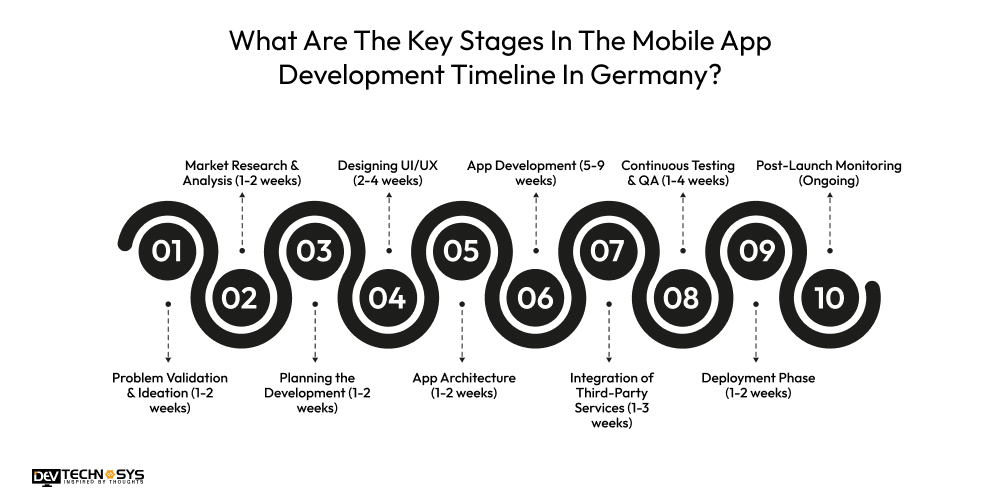
1. Problem Validation & Ideation (1-2 weeks)
This is the very first step in the enterprise app development timeline in Germany. During this phase, the initial idea is refined into a well-defined, valid problem statement. The objective is not to finalize the solution, but to confirm that a real, addressable problem exists. Skipping this step extends the timeline beyond the original estimate.
| Activity | Estimated Time |
| Brainstorm app ideas | 2–3 days |
| Define the core problem | 1–2 days |
| Identify target users | 1–2 days |
| Outline key features | 2 days |
2. Market Research & Analysis (1-2 weeks)
By doing market research, you can unlock potential opportunities for your app idea. Research competitors and identify gaps to confirm your app concept. This stage is a valuable opportunity to identify what’s missing in the market. The duration can extend longer depending on how in-depth you want your market research study to be.
| Activity | Estimated Time |
| Competitor analysis | 2–3 days |
| Study market trends | 2 days |
| Validate demand | 2–3 days |
| Identify monetization opportunities | 1–2 days |
3. Planning the Development (1-2 weeks)
This phase is also known as project requirements gathering. At this step, you need to define your target audience and align the app processes accordingly. Defining the project scope, number of features, the app type you want to build, platform decision, etc., is included under it. Proper planning minimizes resource waste.
| Activity | Estimated Time |
| Create product roadmap | 2–3 days |
| Finalize feature list | 2 days |
| Select tech stack | 2–3 days |
| Estimate budget & timeline | 1–2 days |
4. Designing UI/UX (2-4 weeks)
Before you begin the development process, it is important to map out the app’s design. The UI/UX design of your mobile app needs to stand out amidst the competitors’ apps. A complex interface will extend the UI/UX design timeline for mobile apps. A well-researched design approach prevents misalignments that could lead to delays.
| Activity | Estimated Time |
| Build wireframes | 3–4 days |
| Design user journeys | 2–3 days |
| Create interactive prototypes | 3–5 days |
| Conduct design reviews | 2 days |
5. App Architecture (1-2 weeks)
This is a crucial step in deciding the mobile app development timeline in Germany. It includes choosing the best tech stack and platform for Hybrid app development solutions. The architecture of your app defines its structure and layout. Setting up a well-planned development environment reduces the average time to develop an app.
| Activity | Estimated Time |
| Define system architecture | 2–3 days |
| Set up the database structure | 2 days |
| Plan APIs | 2–3 days |
| Establish a security framework | 1–2 days |
6. App Development (5-9 weeks)
The backend and frontend form the foundation for your app development. After the design and architecture, the actual coding and development take place in this phase. Using frameworks and programming languages, code is written. Backend and frontend development are done simultaneously to save time. The app’s complexity shapes the overall development lifecycle.
| Activity | Estimated Time |
| Develop frontend | 2–4 weeks |
| Build backend | 2–4 weeks |
| Implement core features | 3–5 weeks |
| Conduct internal code reviews | Ongoing |
7. Integration of Third-Party Services (1-3 weeks)
This stage involves integrating third-party services. APIs, payment portals, analytics tools, geolocation feature, and authentication providers are integrated. It is important to test how these third-party services integrate with your app. As it might introduce unexpected constraints or changes. Early integration planning helps to keep the timeframe under control.
| Activity | Estimated Time |
| Integrate payment gateways | 2–3 days |
| Connect external APIs | 3–4 days |
| Enable push notifications | 1–2 days |
| Configure analytics tools | 1–2 days |
8. Continuous Testing & QA (1-4 weeks)
After the core development process, it is crucial to test your mobile application. Without rigorous testing, you cannot launch the app. Delays are caused by critical bugs or issues that require additional debugging. Underestimating this testing phase can increase the mobile app project timeline in Germany.
| Activity | Estimated Time |
| Functional testing | 3–5 days |
| Performance testing | 2–3 days |
| Security testing | 2–4 days |
| Bug fixing & retesting | 3–5 days |
9. Deployment Phase (1-2 weeks)
This phase begins by preparing your app for launch. By addressing the policies, the team submits the application to the iOS App Store or Google Play Store. To avoid delays or rejection, ensure that your app complies with each app store’s guidelines. Coordinate your app marketing and social media efforts to build momentum and make an impact.
| Activity | Estimated Time |
| Prepare app store assets | 2–3 days |
| Conduct final testing | 2 days |
| Submit to app stores | 1 day |
| Review & approval process | 3–7 days |
10. Post-Launch Monitoring (Ongoing)
Releasing your app in the market is not the final step. It is an ongoing process. Through continuous monitoring, you can address bugs, optimize performance, and respond to user feedback. Regular updates will ensure the application remains stable, secure, and aligned with trends. A web app development company is essential for adding ongoing improvements.
| Activity | Estimated Time |
| Track performance metrics | First 1–2 weeks |
| Monitor crashes & bugs | Ongoing |
| Gather user feedback | 1–2 weeks |
| Release updates & patches | As needed |
Planning a Mobile App?
Get a tailored development cost estimate in 3 simple steps — app basics, features, timeline, and your contact details.
- 3 quick steps
- 100% free
- Reply in 1 business day
2 Minutes Read
Which Factors Influence The Mobile App Development Timeline In Germany?
The mobile application development timeline in Germany is affected by different factors. The platform, security, features, developers, integration, design, complexity, and regulatory compliance are core factors.
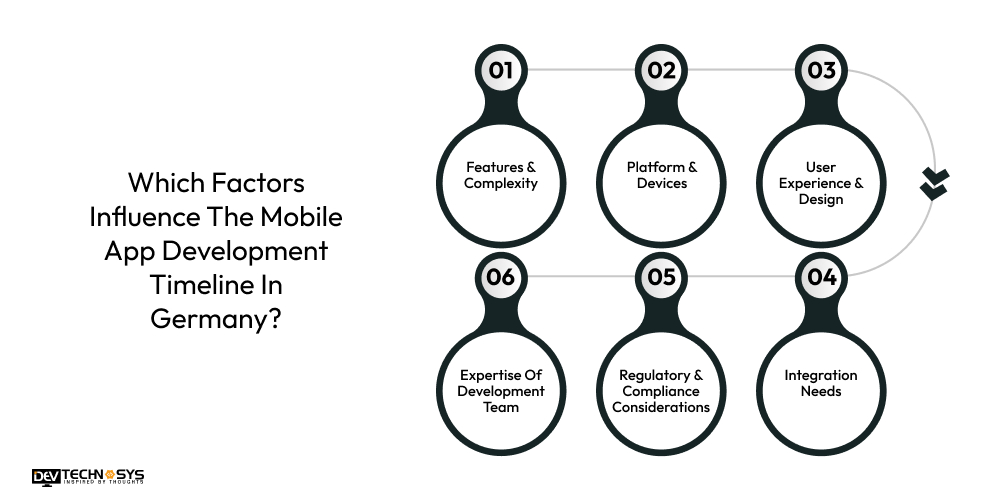
1. Features & Complexity
The complexity of the app directly impacts mobile app development time in Germany. Simple apps with basic features take much less time to develop. On the other hand, apps with interconnected functionalities require more time for design and development. Integrating additional features will increase the workload and duration.
| Factor | Key Points | Effect on Timeline |
| App Complexity | Basic apps with limited features vs. advanced apps with AI, automation, or real-time capabilities. | Simple apps require less development time, while complex apps extend timelines due to intensive coding and testing. |
2. Platform & Devices
iOS, Android, or both; choosing the platform affects the startup app development timeline in Germany. Usually, building an application for a single platform is much quicker than developing for both. Optimizing an app for various devices, screen sizes, and resolutions can extend backend development time.
| Factor | Key Points | Effect on Timeline |
| Platform Selection | iOS, Android, or cross-platform development; device compatibility requirements. | Single-platform apps launch faster. Multi-platform apps increase development and testing time. |
3. User Experience & Design
It is important to craft a visually appealing and user-friendly design to attract users. Usability testing, iterative design processes, and enhancements to user flows directly influence the development timeframe. Pre-designed templates help you launch the app faster. Custom design can extend the overall duration.
| Factor | Key Points | Effect on Timeline |
| UI/UX Complexity | Standard templates vs. custom animations, interactive elements, and branded design. | Simple designs speed up development, while custom UI/UX adds time for prototyping, revisions, and usability testing. |
4. Integration Needs
Incorporating third-party services can accelerate development. They provide a robust experience. However, leveraging pre-existing solutions introduces complexities that might extend the lifecycle. It involves understanding compatibility, documentation, and potential issues that might arise during the development process.
| Factor | Key Points | Effect on Timeline |
| Third-Party Integrations | Payment gateways, maps, chat services, analytics tools, or enterprise APIs. | Minimal integrations keep timelines short. Multiple or complex integrations require extra configuration and testing. |
5. Regulatory & Compliance Considerations
If your application handles sensitive data or operates in a regulated industry. Then, adhering to compliance standards and regulations becomes critical. Implementing security measures, data encryption, and documentation contributes to the mobile app development timeline in Germany. It is important to safeguard user information.
| Factor | Key Points | Effect on Timeline |
| Legal Compliance | GDPR adherence, data protection measures, consent management, and security protocols. | Compliance adds planning and testing phases, ensuring smoother approvals and reducing legal risks. |
6. Expertise Of Development Team
Android application development services require highly skilled developers. A less experienced development team will take longer due to a lack of domain expertise. More experienced developers work faster and solve complex challenges more efficiently. They ensure the timely delivery of high-quality mobile apps.
| Factor | Key Points | Effect on Timeline |
| Team Experience | Skilled teams with structured workflows vs. inexperienced teams with limited resources. | Experienced developers accelerate delivery, whereas less experienced teams may face delays and rework. |
What Are The Best Ways To Speed Up App Development Time In Germany?
When developing an app in Europe, quality and speed are the two most important components. A lengthy development cycle increases the cost. It becomes a major concern for both businesses and developers. But with some resourceful tips, you can accelerate the React Native app development timeline in Germany.
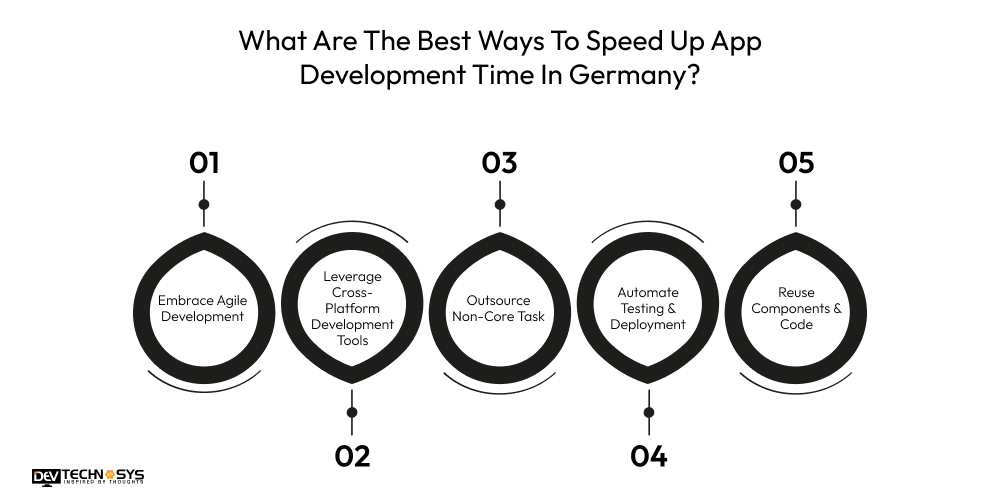
1. Embrace Agile Development
Agile methodology focuses on the most critical and valuable features. It is designed to prioritize adaptability, speed, and ongoing process. Agile methodology breaks the process into smaller parts. Which delivers working features quickly and keeps the project moving without any disruptions. For businesses seeking faster progress and better outcomes, Agile methodology is the foundation.
Industry Insight: According to the 17th State of Agile Report, three in five Agile practitioners report being satisfied because of better alignment with business needs.
2. Leverage Cross-Platform Development Tools
A good cross-platform framework cut down app development duration in Germany in half. It allows to create a mobile app that works seamlessly across both platforms with a single codebase. React Native, Flutter, and Xamarin are popular cross-platform development tools. It not only speeds up the development cycle but also reduces expenses.
3. Outsource Non-Core Task
You do not have to complete the entire development process in-house. Outsourcing non-core aspects is an effective way to quickly launch the application. It streamlines the development process and reduces delays that impact the timeframe. Handling everything internally slows down the process. But with outsourcing, you can bring specialized experts.
4. Automate Testing & Deployment
Automating app testing is one heck of a tip to reduce mobile app development time in Germany. Automation reduces human errors and helps you deliver a stable app more quickly. You can start automating with small, repetitive tasks to see if it works for you. For instance, to run automated functional and regression tests, you can use Selenium or Appium.
5. Reuse Components & Code
To shorten the ecommerce app development timeline, you can reuse some components and code. You don’t have to build an application from scratch, as there are resources available at your disposal. For common functionalities, you can leverage shared libraries. Reuse of UI components across screens is the smartest app development tip.

Government Regulations and Compliance Rules for Mobile App Development in Germany
Adherence to regulations and tax rules plays a major role when it comes to mobile application development timelines within Germany. Organizations need to be aware of issues related to the GDPR, VAT regulations, intellectual property protection, accessibility requirements, and consumer laws in the course of app development.
1. GDPR and Data Protection Compliance in Germany
Germany adheres to both the GDPR and the BDSG regulations, which make sure that companies respect the GDPR data law. Therefore, apps must follow the GDPR law by collecting consent from users and protecting their personal data while being transparent about privacy practices.
Fines under GDPR can reach up to €20 million and amount to 4% of worldwide earnings, which makes adherence to GDPR vital in development and implementation.
2. VAT Compliance for Apps
If a mobile app is earning money through subscriptions, downloads, or sales, it is important to be aware of VAT requirements in Germany. The VAT rate is 19% in Germany, while some services fall under the 7% VAT rate. Correct VAT setup and invoicing, as well as payment configuration, are necessary in order to comply with the VAT law and avoid problems.
3. Copyright Protection
The German copyright law protects software code as well. But companies should clarify ownership of the code by signing development agreements. Moreover, contracts should clearly define the ownership of source code, design, trademarks, and other digital assets to avoid troubles.
4. Compliance with Accessibility Standards
According to the European Accessibility Act (EAA), which starts on June 28th, 2025, it is necessary for certain digital products and services to comply with accessibility standards. In Germany, the BFSG has established rules governing accessibility. Mobile applications have to provide accounts, content that is readable, and the possibility to use assistive technology.
Comparing Development Timelines: Mobile Apps vs. Web Apps vs. Native Apps
The timeframes for mobile, web, and native apps are important for launching a digital product. Mobile and native apps require a longer development time. Due to simple deployment, web apps are quickly released into the market.
| Development Stage | Mobile App Timeline | Web App Timeline | Native App Timeline | Notes |
| Idea Validation | 1–2 weeks | 1–2 weeks | 1–2 weeks | Defines product vision and core functionality. |
| Market Research | 1–2 weeks | 1–2 weeks | 1–2 weeks | Evaluates competitors, demand, and target users. |
| Requirement Planning | 1–2 weeks | 1–2 weeks | 2–3 weeks | Native apps often require more detailed technical specifications. |
| UI/UX Design | 2–4 weeks | 1–3 weeks | 3–5 weeks | Native apps require platform-specific design (iOS/Android). |
| Technical Architecture | 1–2 weeks | 1–2 weeks | 2–3 weeks | Native projects involve more detailed infrastructure planning. |
| Development Phase | 8–16 weeks | 6–11 weeks | 10–20 weeks | Native apps take longer due to separate codebases and the need for optimization. |
| Integration Setup | 2–3 weeks | 1–2 weeks | 2–4 weeks | Mobile and native apps often integrate device features and APIs. |
| Testing & QA | 2–4 weeks | 1–3 weeks | 3–5 weeks | Native testing is extensive across devices and OS versions. |
| Deployment & Launch | 1–2 weeks | 1 week | 1–2 weeks | Mobile/native apps require app store approvals. |
| Total Estimated Timeline | 18–32 weeks | 12–24 weeks | 22–40 weeks | Timelines varies based on complexity and compliance requirements in Germany. |
Industry Insights: Business Of Apps 2025 confirms that Germany is one of Europe’s leading mobile markets, with users spending an average of over 3.5 hours per day on apps.
Mobile Application Development Timeline in Germany: Real-World Examples
Germany mobile app development timeline estimates vary by industry. Here are the real-world examples across different sectors to help you better understand the app development lifecycle.
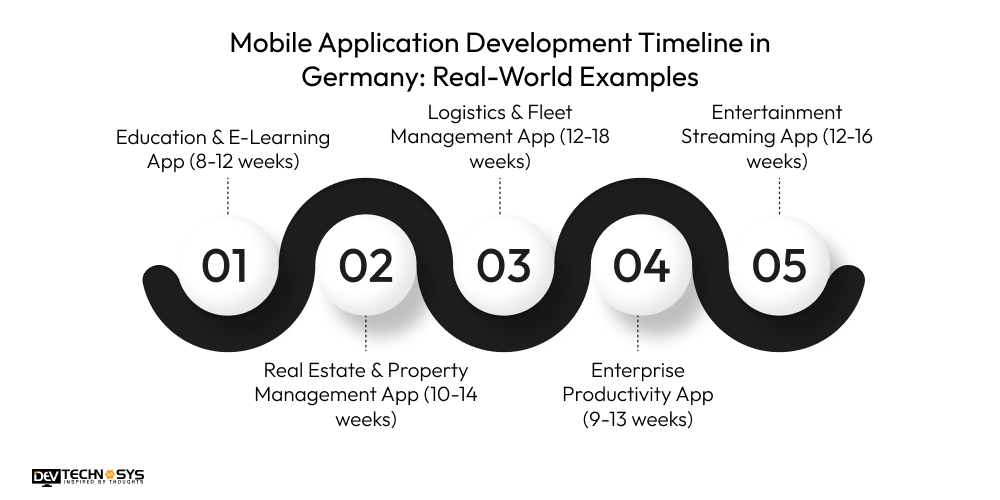
1. Education & E-Learning App (8-12 weeks)
The development timeframe for educational apps depends on the content-delivery infrastructure. Intuitive navigation and support for multimedia formats are the core components. Interactive learning tools require extra time and effort to build.
Example: Babbel, Duolingo, Coursera
2. Real Estate & Property Management App (10-14 weeks)
Real estate apps in Europe streamline tenant communication and building operations. Centralized dashboards, document sharing, and instant notifications improve the app’s efficiency. CRM or property databases integration can extend the development lifecycle.
Example: Immowelt, Redfin, Trulia
3. Logistics & Fleet Management App (12-18 weeks)
GPS tracking, route optimization, driver dashboards, and fuel monitoring are core features of fleet management apps. These apps take a longer timeline to develop due to real-time tracking and cloud infrastructure.
Example: DHL Fleet, Trucker Path, Onfleet
4. Enterprise Productivity App (9-13 weeks)
Enterprise productivity apps focus on workflow automation and team collaboration. The biggest factor that impacts the development timeframe is the integration with the existing enterprise system.
Example: Staffbase, Microsoft 365, Google Workspace
5. Entertainment Streaming App (12-16 weeks)
Video streaming apps require high-performance video delivery and content categorization. For smoother playback and scalability, these apps undergo extensive testing, which extends the timeline. You need a robust cloud architecture to build an entertainment app.
Example: Joyn, Netflix, HBO Max
What Is The AI-Powered App Development Timeline In Germany?
The development of AI-powered apps follows a longer and structured lifecycle. The reason behind this is the algorithm training and data handling complexity. It goes beyond the standard development process to ensure accurate outputs.
Germany’s strong emphasis on data protection and ethical AI use also influences development timelines.
| AI Component | Estimated Timeline |
| AI Virtual Assistant | 5–12 weeks |
| Predictive Analytics Engine | 8–16 weeks |
| Natural Language Processing (NLP) | 10–18 weeks |
| Speech Recognition | 12–20 weeks |
| Fraud / Anomaly Detection | 9–17 weeks |
| Data Engineering Pipeline | 4–10 weeks |
| AI Model Testing & Optimization | 6–12 weeks |

Final Thoughts
As seen from the blog, the mobile app development timeline in Germany depends on several factors: complexity, platform choice, feature set, and integration needs. To set up a realistic timeframe in 2026, it is important to understand every stage of the development process.
When you hire mobile app developers by offshore approach, you can significantly shorten the timeline. With this knowledge, your next step is to start the project with focus and intention. The goal is to match your timeline with the project’s real needs.
Frequently Asked Questions
Find answers to the most common questions related to this article.
The mobile app development timeline in Germany ranges from 4 to 18 weeks. Basic mobile apps can be launched much sooner, as the scope is limited. Apps that require advanced integration and enterprise-grade security will take longer to develop.
The app development and design phase generally consume a large portion of the mobile app project timeline in Germany. Technical complexity is the main reason. These phases involve implementing features, developing core logic, and connecting the system end-to-end. The more complex the architecture and features, the longer the phase tends to be.
The app development lifecycle in Germany is shaped by several factors. Understanding these factors helps startups to successfully launch the app in the market.
● Features and complexity
● Platform and devices
● User experience and design
● Integration needs
● Regulatory and compliance considerations
● Expertise of the development team
The testing phase typically takes 1 to 4 weeks of the development duration. It includes functional testing, regression testing, and performance validation. The use of automated testing tools accelerates the testing phase. It ensures quicker defect correction and reduces reliance on manual intervention.
The frontend and backend development stage takes most of the time in Canada, approximately 5 to 10 weeks. This step involves rigorous performance on servers, databases, APIs, authentication, business logic, and so on.