














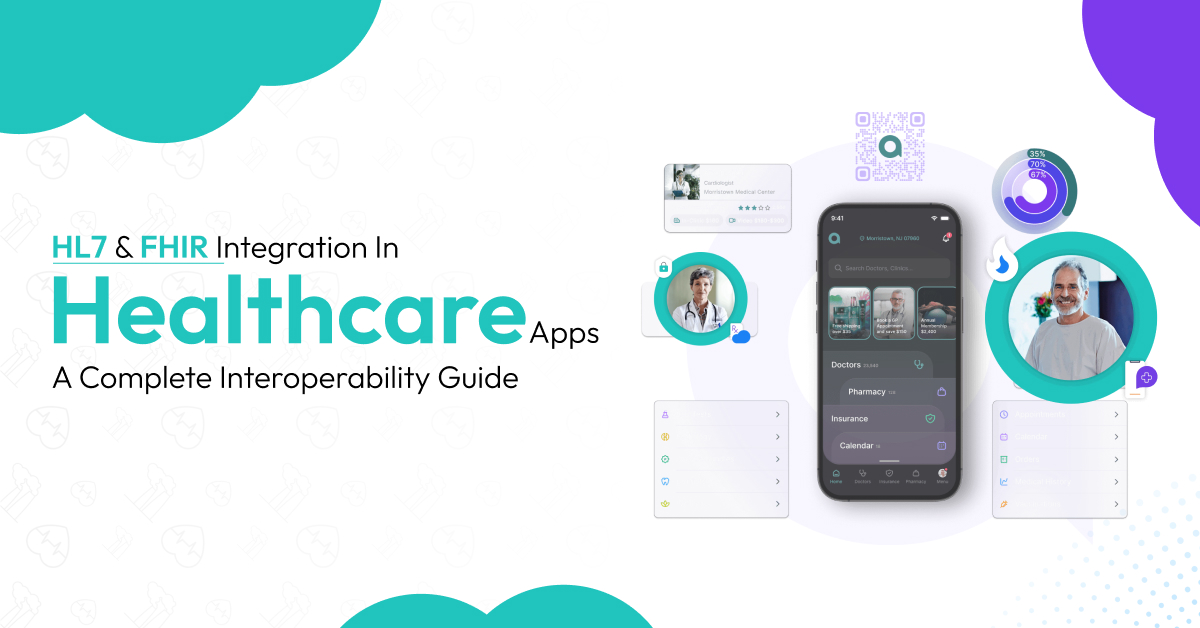
Picture yourself in a hospital on a busy Monday morning because you have an appointment. Here, the front desk has your basic details, doctors access past reports, labs handle current tests, and pharmacies maintain medication histories. But there is a lack of communication among these departments, making you repeat the same information again and again at different departments.
In this hectic situations, healthcare interoperability standards step in with HL7 and FHIR, tackling your problem like a hero. In this guide, we will understand everything related to Healthcare Interoperability standards with this HL7 FHIR integration guide.
Introduction to Healthcare Interoperability
Healthcare Interoperability is an enhanced way to have, exchange, integrate, and cooperatively use the patient’s data. Overall, it is a combination of multiple information systems, devices, and applications. Due to this, users’ data can be exchanged across organizational, regional, and national boundaries. It makes sure the data is circulated throughout the entire healthcare ecosystem accurately and seamlessly.
Interoperability in healthcare allows the patients’ medical history, lab results, prescriptions, and diagnoses to move securely across hospitals, labs, and pharmacies. The FHIR and HL7 integration in healthcare apps makes this possible with accuracy and consistency.
Using HL7 and FHIR integration in healthcare applications to access real-time data, reduce manual entry and errors. With this, patients can get a better experience while doctors can make quick and smart decisions in case of an emergency.
Overview of Healthcare Data Exchange Standards
Like every transformation, the healthcare data exchange standard has also evolved significantly. It has now become seamless, secure, and efficient to pass the patient’s information all around the disparate systems. It plays a vital role in the transformation of digitalized healthcare as it improves patient care, reduces costs, and streamlines administrative processes.
In short, it is the backbone of healthcare data interoperability that helps hospitals, labs, and FHIR & HL7 integration in healthcare apps to work together, while supporting HIPAA-compliant software development.
1. Evolution of Healthcare Interoperability Standards
The HL7 & FHIR integration in healthcare apps has removed the hassle of maintaining records manually, excessive paperwork, and manual data entry, making everything digitalized. Initially, HL7 standards allowed some basic data to be exchanged among the hospital systems.
Later on, FHIR came to support faster and app-friendly data sharing as mobile apps, cloud platforms, and APIs are emerging. Therefore, this evolution has made FHIR-based healthcare app development widely preferred.
Also Read: What is Healthcare App Development?
2. Role of Standards in Digital Health Transformation
The healthcare data exchange standards play a vital role in revolutionizing the healthcare and medical sector digitally. It enables hospitals and doctors to have secure and up-to-the-minute data on the patients. It also ensures regulatory compliance and empowers the right healthcare app development company to build smarter HL7 and FHIR integration architecture.
What Is HL7?
HL7 stands for Health Level 7, which is a global standard for exchanging health data digitally. This system is built by the Health Level Seven International, a non-profit ANSI-accredited standards development company. It allows several healthcare systems, such as billing, labels, EHRS, or EMR HL7 integration for better patient care. This standard defines how information is structured and communicated.
Advantages Of HL7
- Widely adopted across global healthcare systems
- Proven reliability for clinical data exchange
- Supports complex healthcare workflows and EMR software development efficiently
- Strong compatibility with legacy hospital systems
- Enables standardized messaging between disparate systems
Disadvantages Of HL7
- Complex implementation requiring specialized expertise
- Limited support for modern API-based integration
- Difficult customization due to rigid message structures
- Poor suitability for real-time mobile applications
- High maintenance costs for ongoing integrations

What Is FHIR?
FHIR, refers to Fast Healthcare Interoperability Resources, is also an electronic health record interoperability used worldwide to exchange patients’ health data online. It lets different healthcare systems, including EHRs, apps, and providers, talk and share patients’ information. It primarily supports security and efficiency while using the latest web technologies, including REST APIs.
Advantages Of FHIR
- Easy integration using RESTful APIs
- Supports real-time healthcare data exchange
- Developer-friendly with modern web standards
- Flexible resource-based data modeling approach
- Ideal for mobile and cloud applications
Disadvantages Of FHIR
- Still evolving with changing specifications
- Limited adoption in some legacy systems
- Requires strong API security management
- Inconsistent implementations across healthcare vendors
- Performance issues with large data volumes
Also Read: Healthcare App Development And Company Selection Guide
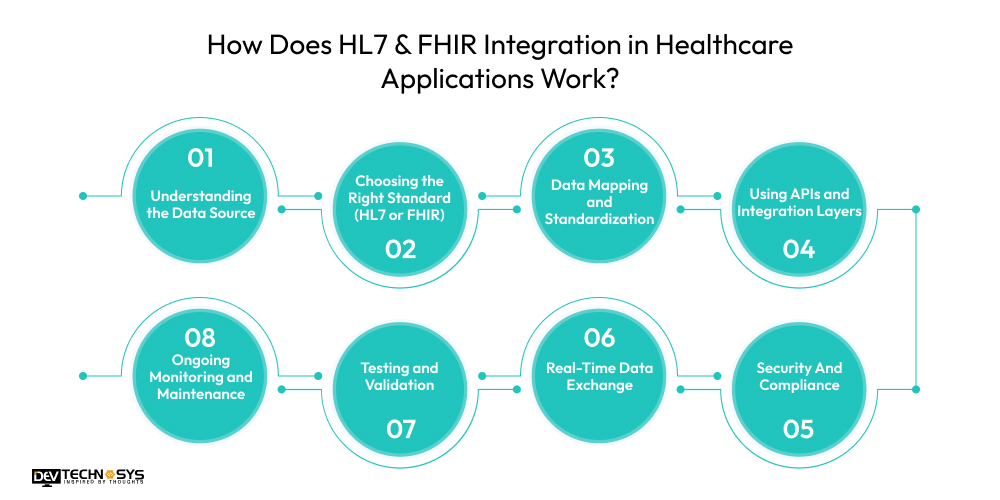
How Does HL7 & FHIR Integration in Healthcare Applications Work?
HL7 and FHIR integration allows healthcare applications to securely exchange patient data with hospitals, labs, pharmacies, and other clinical systems. Let’s understand thoroughly how these integrations actually work in a healthcare app.
1. Understanding the Data Source
The development of every healthcare app starts with discovering where to take data from. It includes EHR systems, labs, pharmacies, and other medical devices. Once you know the format of data and its update frequency, you can achieve smooth medical app interoperability. With this, there are fewer chances of data loss during integration.
2. Choosing the Right Standard (HL7 or FHIR)
Here comes an essential part where you have to select the right standards, either HL7 or FHIR. HL7 is a widely used traditional standard for messaging systems-to-systems. In contrast, the FHIR is ideal for the latest apps that incorporate APIs. Picking up the perfect standard highly relies on the app goals, existing systems, and the overall healthcare app development process.
3. Data Mapping and Standardization
Both systems have a unique or different way to store the patients’ data. When data is mapped, it gets converted into standard HL7 or FHIR formats while ensuring consistency. This is the stage where FHIR & HL7 integration in healthcare apps correctly understands patient details, diagnoses, and reports across systems. In this step, there are fewer chances of confusion and mistakes.
4. Using APIs and Integration Layers
FHIR healthcare API integration generally lets healthcare apps ask for and send data of patients securely. The job of integration layers or middleware is to translate older HL7 messages into FHIR-compatible formats when required. It fosters communication between modern applications and older healthcare systems without disrupting existing workflows.
5. Security And Compliance
The most essential thing about HL7 & FHIR integration in healthcare apps is to make the patient’s data private and protected. For this, secure authentication, encryption, and access control are used to meet security and regulatory needs. For this, you need secure HL7 integration in FHIR & HL7 integration in healthcare apps. This helps in building user trust in the healthcare app.
6. Real-Time Data Exchange
A software development company integrates HL7 messages and FHIR APIs that help in sharing real-time data. With this, doctors can see lab results, medication updates, and patient records immediately. This also helps in improving care coordination and decision-making within connected healthcare applications.
Also Read: Healthcare App Development Cost in 2026
7. Testing and Validation
Testing is the most important thing to do before launching the healthcare app. The HL7 & FHIR integrations are tested properly to ensure the accuracy of the data, workflows, and error handling. At the same time, validation helps in identifying problems earlier to make the app perform extremely well and more smoothly.
8. Ongoing Monitoring and Maintenance
As you have deployed the HL7 & FHIR integration in healthcare apps, you have to continuously monitor the app’s performance and errors. Regular updates keep integrations compatible with evolving standards, helping organizations build a scalable healthcare SaaS platform that remains reliable over time.
Want a chatbot demo or pricing? Fill the form and talk to our experts today.
Pick what you need below — you can select more than one — then tap Get detail to continue.
-
Chatbot demo dashboard
-
Cost to develop an app
-
Industry report
-
Case study
Explain HL7 vs FHIR: Key Differences and Comparisons
Healthcare interoperability solutions, HL7 and FHIR, are highly preferred for healthcare software development. However, they are different in terms of data formats, implementation complexity, flexibility, and more. So, here we will discuss the HL7 vs FHIR comparison and differences.
| Basis | HL7 | FHIR |
| Full Form | Health Level Seven is a set of standards for healthcare data exchange. | Fast Healthcare Interoperability Resources is a modern standard for healthcare data sharing. |
| Architecture | Message-based architecture relying on structured text messages for system-to-system communication. | Resource-based architecture using modular data components accessible through APIs. |
| Data Format | Primarily uses pipe-delimited or XML formats, depending on HL7 version. | Uses JSON or XML formats, designed for web and mobile compatibility. |
| Ease of Implementation | Complex to implement, requiring deep healthcare domain and interface expertise. | Easier to implement due to simplified structure and modern development practices. |
| Interoperability Approach | Focuses on point-to-point data exchange between specific healthcare systems. | Supports broad interoperability using standardized APIs across multiple platforms. |
| API Support | Limited native API support, often requiring custom integration layers. | Built with RESTful APIs for seamless and real-time data access. |
| Flexibility | Less flexible due to rigid message structures and customization challenges. | Highly flexible, allowing developers to extend resources without breaking compatibility. |
| Performance | Performs well for batch processing but is less suitable for real-time use cases. | Optimized for real-time interactions and scalable healthcare applications. |
| Use Cases | Commonly used for internal hospital integrations and legacy system communication. | Ideal for mobile apps, patient portals, and modern digital health platforms. |
| Security Model | Security varies by implementation, often handled outside the standard. | Includes standardized security protocols like OAuth 2.0 and OpenID Connect. |
| Developer Experience | Steeper learning curve due to complex specifications and older technologies. | Developer-friendly with clear documentation and widespread tooling support. |
What Are The Common Challenges Faced During HL7 & FHIR Integration?
Despite everything going well, there are some technical and organizational challenges that are faced during HL7 & FHIR integration in healthcare apps. Here, we will discuss them along with the measures to tackle these challenges during MVP development for healthcare.
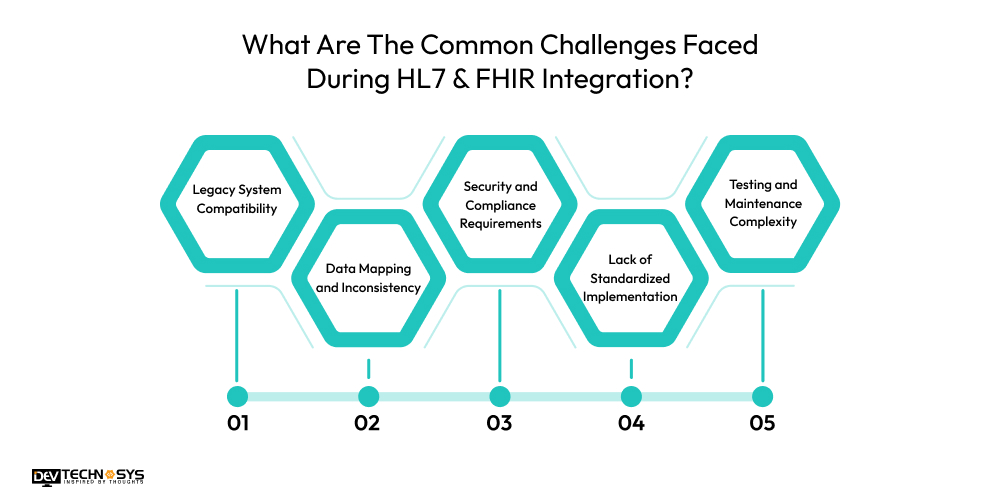
1. Legacy System Compatibility
Earlier, healthcare organizations used older systems that were far different from modern integrations. This is why connecting these legacy platforms with FHIR APIs generally requires extra efforts. It requires additional middleware and data conversion to ensure easy communication without confusing workflows that already exist.
2. Data Mapping and Inconsistency
When you build a scalable healthcare SaaS platform, you have to map the patient data to HL7 or FHIR standards. It can be complex and time-consuming because different systems store data in different formats. It may give rise to small errors like missing and duplication, and misunderstood information.
3. Security and Compliance Requirements
As healthcare data is highly sensitive, proper authentication, encryption, and access control are necessary. Maintaining all these security measures while meeting regulatory requirements like HIPAA can be challenging. It is because multiple systems and third-party APIs are used.
4. Lack of Standardized Implementation
Organizations ask healthcare software development company to integrate HL7 & FHIR integration in Healthcare Apps to use them differently. This causes variations that lead to integration issues. To adjust these differences, extra customizations and testing are required so that systems take in and exchange data accurately.
5. Testing and Maintenance Complexity
Integrating Medical app interoperability with HL7 and FHIR requires thorough testing and maintenance. It is necessary to avoid data errors, system failures, handle updates, new workflows, and evolving standards. However, this can increase long-term development effort.
What Are The Real-World Use Cases of HL7 & FHIR Integration?
Improved patient access to health records, enhanced care coordination among providers, and streamlined public health reporting and surveillance are some of the real-world use cases. Here, we will discuss some of these use cases of HL7 & FHIR integration in healthcare apps.
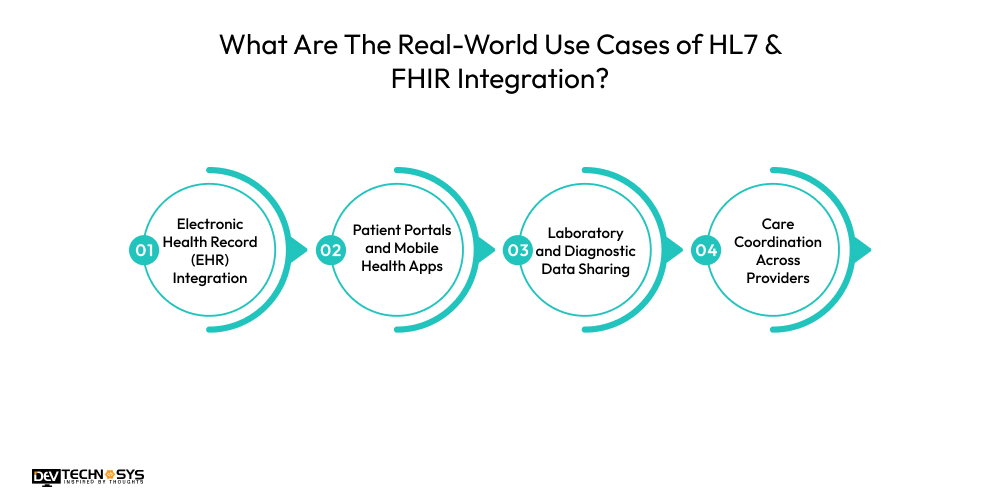
1. Electronic Health Record (EHR) Integration
HL7 and FHIR let healthcare apps get connected with EHR systems. With this, healthcare apps display patient history, diagnoses, and lab results all in one place. As doctors get complete patient details with EHR integration with FHIR and HL7, they can make better treatment decisions. This helps doctors make better treatment decisions.
2. Patient Portals and Mobile Health Apps
HL7 and FHIR incorporate AI in healthcare app development, which helps patients to view their medical records, prescriptions, and appointments through mobile apps. This can be marked as a measure to improve patient engagement and retention in the app. It reduces the need for hospital visits or paperwork. In contrast, offering ways for better self-care.
Also Read: Healthcare MVP to Enterprise SaaS Roadmap: A Complete Guide
3. Laboratory and Diagnostic Data Sharing
Previously, to send lab test orders and results from labs to hospitals, HL7 was used primarily. But now it is combined with FHI, so the test result can be shared immediately with doctors and patients. It speeds up the diagnosis and treatment with no unnecessary delays.
4. Care Coordination Across Providers
HL7 FHIR integration for healthcare app development allows doctors, specialists, and pharmacies to share patients’ treatment data securly. With this, all the healthcare providers stay coordinated and reduce the chances of duplicate tests. It also improves the communication between patients and doctors and ensures patients can get continuous care.
Conclusion
The purpose of HL7 & FHIR integration in healthcare apps is to build the foundation of a strong and secure healthcare system integration. These standards permit healthcare apps to connect easily with hospitals, labs, and clinical systems. It enables a secure, standardized, and real-time data exchange.
However, you must be searching for a mobile application development company that can build FHIR and HL7 integration services for a healthcare app. So, you are at the right place because Dev Technosys can answer all your questions. It also offers seamless FHIR and secure HL7 integration in medical apps.
As digital health continues to grow, adopting FHIR and HL7 integration services is essential for building interoperable, compliant, and future-ready healthcare applications. It helps deliver better results for healthcare providers and patients alike.
Frequently Asked Questions
Find answers to the most common questions related to this article.
HL7 is a traditional healthcare messaging standard used for system-to-system data exchange, mainly in legacy systems. FHIR is a modern HL7 standard that uses APIs, JSON, and web technologies, making healthcare data easier to access and integrate into modern apps.
The HL7 & FHIR integration in healthcare apps can be seamlessly done using APIs, healthcare middleware, and standard data models. This FHIR API integration can help the app securly access, send, and update patient data. These integrations also stay compatible with the already existing hospital system.
The benefits of incorporating HL7 and FHIR interoperability in a healthcare app include:
● Improved data sharing
● Reduces manual work
● Minimizes errors,
● Real-time access to patient information
● Deliver faster care
● Better patient experiences
● Clinical decision-making
Some of the common challenges of HL7 & FHIR Integration in Healthcare Apps are:
● Legacy system compatibility
● Data mapping issues
● Security concerns
● Regulatory compliance
The best practices of HL7 & FHIR integration in healthcare apps include using standardized FHIR APIs. They ensure data security and HIPAA compliance, validate data quality, maintain clear documentation, and thoroughly test integrations to support a reliable, scalable, and interoperable healthcare app.