

















The healthcare industry is rapidly adapting to digital transformation. Digital software solutions brought revolution to patient care, data management, and operational efficiency. Transitioning from a simple Minimum Viable Product (MVP) to fully scaled enterprise SaaS healthcare solutions, healthcare applications must maintain a balance between usability, compliance, and scalability.
In today’s Healthcare SaaS roadmap 2026, we will guide businesses through every stage of development, from validating ideas with an MVP to integrating advanced features, ensuring HIPAA or GDPR compliance, and ultimately delivering a robust, enterprise-grade SaaS solution.
By following a well-planned Healthcare MVP development approach, healthcare startups and established firms can reduce development risks, optimize budgets, and create impactful healthcare software.
The approach of scaling healthcare MVP to the enterprise level improves patient outcomes. It drives long-term growth in an increasingly competitive digital healthcare ecosystem. So, without further ado, let’s dive into the healthcare SaaS roadmap for 2026!
Understanding The Healthcare Market
The healthcare market is complex, involving multiple stakeholders and processes. Process to build a scalable healthcare SaaS platform with effective enterprise SaaS healthcare solutions requires understanding the needs of patients, providers, payers, and administrators, as well as the workflows that drive care and operations.
1. Key stakeholders
The primary participants in the healthcare market are patients, providers, payers, and administrators. Each of the stakeholders plays a distinct role:
i. Patients:
Central to healthcare delivery, patients expect easy access to care, telemedicine options, and secure management of their health records. Patient management SaaS tools ensure patient satisfaction, which directly influences the adoption of any telemedicine SaaS solutions.
ii. Providers (Doctors, Nurses, Clinics, Hospitals):
They need tools to manage patients, access EHRs, and coordinate care. Healthcare SaaS integration with EMR/EHR helps providers ensure efficiency, accuracy, and regulatory compliance.
iii. Payers (Insurance Companies, Health Plans):
Prioritize claims processing, billing, and cost management. They need healthcare SaaS solutions and tools that reduce administrative overhead, prevent fraud, and provide accurate reporting.
iv. Administrators & Managers:
Digital health solutions help manage the operational side of healthcare organizations. They manage staff scheduling, compliance reporting, and faculty performance. Smooth workflows ensure the system runs smoothly behind the scenes.
2. Clinical vs. Operational Workflows
The Healthcare app development process can be broadly divided into clinical and operational workflows, which, while distinct, are heavily intertwined. Healthcare SaaS development includes 2 interdependent workflow types:
i. Clinical Workflows:
It is directly related to patient care. SaaS for hospitals and clinics includes patient registration, diagnostics, treatment planning, and a telemedicine option. Streamlining these workflows improves patient outcomes and provider efficiency.
ii. Operational Workflows:
Healthcare app development with operational workflows reduces costs and improves the overall performance of organizations. It includes appointment scheduling, billing, insurance claims, inventory management, compliance tracking, and reporting.
Healthcare SaaS Roadmap 2026 Explained
Wondering how to build a healthcare MVP for SaaS? Well, building a successful healthcare SaaS platform in 2026 includes starting with an MVP, ideal validation, and gradually scaling into an enterprise-grade solution. This healthcare app development guide focuses on different goals, features, and levels of complexity.
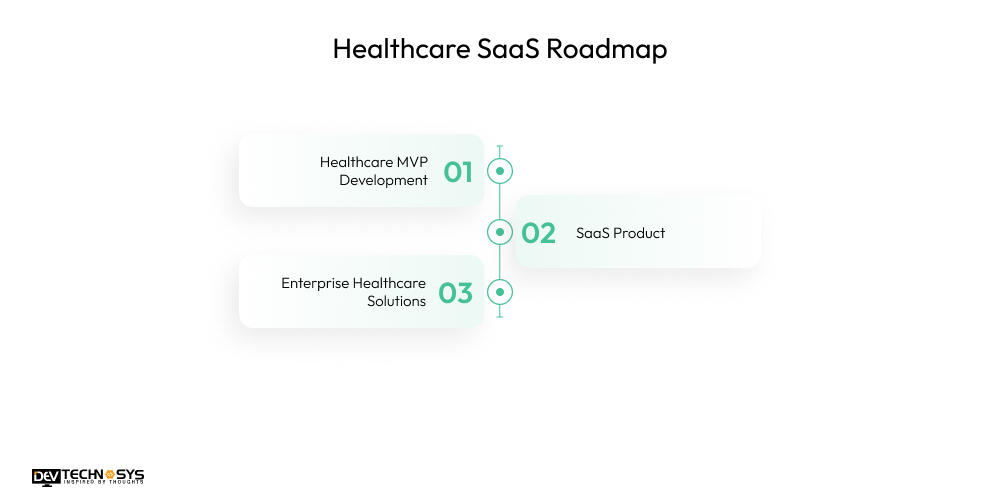
Stage 1: Healthcare MVP Development
This stage of healthcare MVP development focuses on validating the core idea with minimal risk and investment. The primary purpose of creating an AI-enabled healthcare SaaS platform is to prove the concept and achieve early adoption.
i. Purpose of Healthcare MVP Development
The purpose of a healthcare MVP development is to validate the core idea with minimal investment and risk. According to a top EMR software development company in NYC, starting with an MVP is beneficial because it focuses on solving a specific clinical or operational problem while gathering early user feedback to guide future development decisions.
ii. Healthcare MVP Features
The features of AI-enabled healthcare SaaS platforms are limited to essential functionality, such as user registration, basic patient or provider workflows, appointment scheduling, core dashboards, and simple reporting. The goal of investing in on demand app development solutions is usability and proof of value, not full-scale functionality.
iii. MVP Compliance and Security
During the MVP stage, healthcare products must adhere to compliance and security requirements. The security features include requirements that may include secure user authentication, role-based access control, and secure data storage.
Healthcare MVP development with HIPAA, GDPR, or local healthcare data protection laws compliance helps protect patient information and builds early trust.

Stage 2: SaaS Product
After MVP validation, the healthcare product can be turned into a SaaS platform. The end goal of a healthcare SaaS platform is to scale users, improve retention, and establish a sustainable SaaS business.
Also Read: What Is Healthcare App Development ?
Let’s see the steps to transform a healthcare MVP into enterprise software, its features, infrastructure, and security and compliance strategies:
i. Transitioning from MVP to SaaS
The best practices for healthcare SaaS development include focusing on evolving a validated healthcare MVP into a fully scalable SaaS platform. Insights from early users are used to refine features, optimize clinical and operational workflows, and implement standardized processes.
The goal of the MVP to SaaS transformation is to support multiple organizations while ensuring consistency, reliability, and a high-quality user experience across the platform.
ii. SaaS Features & Capabilities
According to experts who offer MVP app development services in California, the healthcare SaaS platforms expand functionality beyond the MVP to include multi-tenant architecture, advanced clinical and operational workflows, automated administrative processes, analytics dashboards, subscription and billing management, and seamless integrations with third-party systems such as EHRs, telehealth tools, labs, and payment gateways, ensuring scalability, flexibility, and efficiency for multiple users.
iii. SaaS Infrastructure & Scalability
A robust cloud-based infrastructure supports the SaaS platform, enabling high performance, reliability, and scalability. Key elements include load balancing, automated software development, secure data backups, monitoring tools, and elastic scaling to accommodate growing numbers of users, high volumes of healthcare data, and increased platform demand without disrupting service or user experience.
iv. SaaS Compliance & Security
At the SaaS stage, compliance and security requirements expand significantly. This includes robust data privacy measures, role-based access controls, audit logs, encryption, and regular security testing.
Also Read: Healthcare App Development Cost
The platform must comply with regional and global healthcare regulations, such as HIPAA and GDPR, ensuring secure handling of sensitive patient information while building trust with enterprise clients.
Stage 3: Enterprise Healthcare Solutions
i. Enterprise Customer Expectations
Clients looking for enterprise SaaS healthcare solutions expect high reliability, scalability, and customization. They require seamless workflows across departments, consistent user experience, and advanced reporting. Strong support, dedicated account management, and compliance with strict regulatory standards are essential.
Enterprise SaaS healthcare solutions must handle large volumes of patient and operational data while maintaining performance, security, and interoperability across the organization.
ii. Healthcare Enterprise Features
Cloud-based healthcare solutions for enterprises include advanced clinical and operational modules, configurable workflows, robust analytics dashboards. Use of cloud technology and AI in healthcare app development ensues better results, especially in enterprise platforms.
Incorporate AI-powered decision support, patient engagement tools, and automated administrative processes. These enterprise SaaS healthcare solutions and features enable organizations to optimize efficiency, track performance metrics, improve patient outcomes, and adapt to the complex needs of large healthcare networks or multi-location facilities.
iii. Enterprise Integrations
Enterprise solutions require seamless integration with existing hospital systems, EHRs, billing and insurance platforms, laboratory systems, and medical devices.
APIs and interoperability standards ensure smooth data exchange, minimize errors, and improve workflow efficiency. Integration capabilities allow healthcare organizations to unify data across multiple departments while maintaining accessibility, accuracy, and compliance.
iv. Enterprise Security & Compliance
Security and compliance are critical for enterprise healthcare systems. Solutions must include advanced encryption, identity management, audit trails, disaster recovery, and strict access controls. GDPR, ISO, HIPAA-compliant software development ensures the secure handling of sensitive patient data while protecting organizations against legal, operational, and reputational risks.
Want a chatbot demo or pricing? Fill the form and talk to our experts today.
Pick what you need below — you can select more than one — then tap Get detail to continue.
-
Chatbot demo dashboard
-
Cost to develop an app
-
Industry report
-
Case study
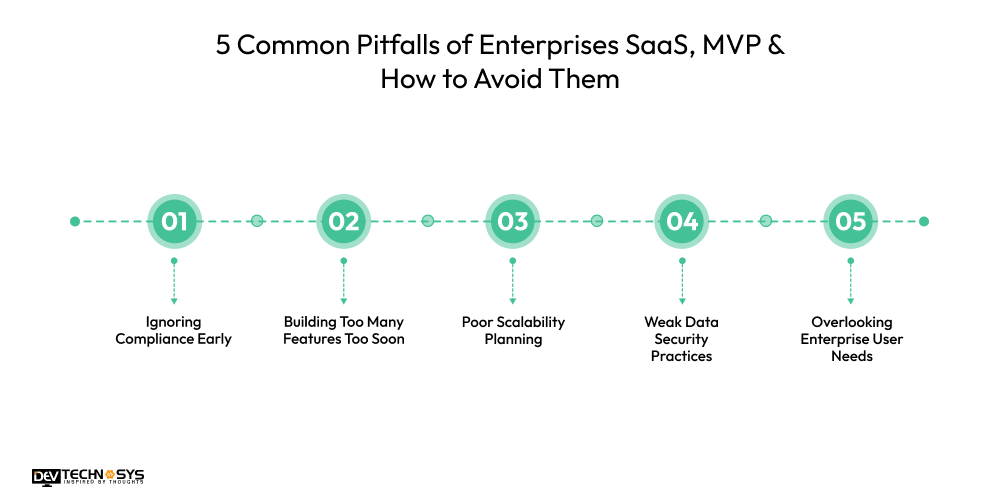
5 Common Pitfalls of Enterprises SaaS, MVP & How to Avoid Them
Here are some of the common pitfalls that you need to consider and avoid at all costs if you are developing enterprise SaaS healthcare solutions. Avoiding these common pitfalls early helps ensure a smooth transition from MVP to a scalable enterprise healthcare solution.
1. Ignoring Compliance Early
i. Pitfall:
Many development teams delay compliance planning, assuming regulatory requirements can be addressed after product validation. This approach often leads to expensive redevelopment, delayed launches, failed audits, and difficulties onboarding healthcare partners.
ii. How to Avoid:
HIPAA, GDPR, and local regulations in MVP architecture from day one. Use HIPAA-compliant healthcare software for even basic compliance foundations, such as audit logs and secure access, thus reducing future risks.
2. Building Too Many Features Too Soon
i. Pitfall:
Attempting to include too many features during the MVP phase undoubtedly will increase development cost, complexity, and maintenance burden while delaying market entry. It also makes user feedback less actionable.
ii. How to Avoid:
Focus on solving one clearly defined clinical or operational problem. Prioritize features that directly support that use case and refine the product using real user behavior and feedback.
3. Poor Scalability Planning
i. Pitfall:
MVP-centric system architectures often-times fail when user volume, data size, or workflows grow, leading to performance issues, downtime, and a poor user experience.
ii. How to Avoid:
Choose a cloud-based, modular architecture early. This approach allows the system to scale infrastructure, users, and data securely without major changes and redesigns as demand grows.
4. Weak Data Security Practices
i. Pitfall:
Inadequate encryption, weak authentication, or limited monitoring can expose sensitive healthcare data to breaches, damaging trust and regulatory standing.
ii. How to Avoid:
Implement strong authentication methods, role-based access control, data encryption, continuous monitoring, and routine security testing throughout all stages of development.
5. Overlooking Enterprise User Needs
i. Pitfall:
Products designed only for small teams or early adopters often fail to meet enterprise expectations such as advanced integrations, customization options, reporting, and long-term support.
ii. How to Avoid:
Ask your mobile app development company in USA to design workflows, APIs, and configuration capabilities with enterprise scalability in mind, even during early SaaS stages, to support future expansion and complex healthcare environments.
Conclusion
We hope this guide helped you gain a better understanding of healthcare MVP development and how to strategize the healthcare MVP to enterprise SaaS roadmap. In the above guide, we tried our best to explain the steps to transform a healthcare MVP into enterprise software, best practices for healthcare SaaS development, and pitfalls to avoid to make development easier for you.
Building a healthcare product from MVP to an enterprise-grade SaaS platform is a strategic journey that demands careful planning, continuous validation, and long-term vision. If you are looking for expert guidance to build an MVP for a healthcare app, contact Dev Technosys, a top healthcare app development company, and stay tuned for further updates.
Frequently Asked Questions
Find answers to the most common questions related to this article.
A healthcare MVP (Minimum Viable Product) is a basic version of a healthcare application built with essential features to validate a core idea, solve a specific problem, and gather early feedback while minimizing cost and development risk.
The transition from an MVP to enterprise SaaS typically takes around 6 to 12 months. The timeline can differ depending on product complexity, compliance requirements, user feedback, funding, and scalability needs
Early compliance ensures data security, builds trust with healthcare stakeholders, and prevents costly rework later. Even MVPs must comply with regulations such as HIPAA, GDPR, and local healthcare data protection laws.
Essential measures for enterprise healthcare SaaS include data encryption, role-based access control, secure authentication, audit logs, regular security testing, and compliance with healthcare regulations.
Enterprise features should be introduced in a healthcare platform after validating the MVP and stabilizing the SaaS product. It ensures the healthcare platform can support large numbers of users, complex workflows, and integration.