

















In this modernized world, every convenience is a few taps away, be it food delivery or home service. So how could a healthcare department lag behind? The healthcare mobile applications are not just a digital tool, but a necessity in this tech-oriented world.
Healthcare apps have become a highly preferred caregiver that maintains users’ health, wellness, and motivates them to live a quality life. This is the reason why entrepreneurs are investing in medical app development and searching for the right guide and company.
Being an entrepreneur, you must be wondering what the healthcare app development process is and how to choose a healthcare app development company. This guide helps you follow the correct healthcare app development guide and find the right healthcare mobile app development company.
What Are The Market Stats Of The Healthcare App?
Understanding the market stats gives you a brief on healthcare apps’ rapid global digital health adoption and demand for remote patient care. Here we will analyse the market predictions by Grand View Research:
- The market size of the healthcare mobile application was estimated globally at USD 114.17 billion in 2024 and USD 165.61 billion in 2025.
- This statistical data is expected to reach USD 1,070.58 billion by 2030, with a growing CAGR of 45.2% from 2025 to 2030.
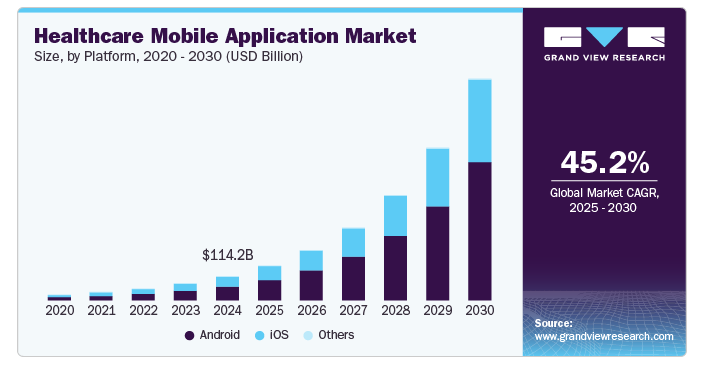
- In 2024, the healthcare mobile application market of North America led the global market with a 36.5% of the overall revenue share.
- According to the type, the fitness products and training segment held the global market by earning 34.3% of the total revenue share in 2024.
What Is A Healthcare App and What Is Its Purpose?
A healthcare app is a mobile software that processes health-related data to help patients, professionals, and caregivers. It also helps them manage, track, and improve health and health-related issues with seamlessness.
For patients, MVP App Development for Healthcare offers features like fitness trackers, appointment schedulers, etc. In contrast, for doctors, it offers telemedicine platforms and clinical tools features. The purpose of the healthcare app development with HL7 and FHIR integration is to empower users with health information and services.
Basically, a right healthcare app development company makes a healthcare app for both clinical and business goals. Clinically, its motive is to upgrade patients’ health, increase medication compliance, and reduce the chances of hospitalization.
While for business, the purpose to Build a Scalable Healthcare SaaS Platform is to engage users by improving operational efficiency. Also, increases patient retention, generates recurring revenue, or reduces development costs.
What Is The Healthcare App Development Process?
To take your Healthcare mobile app development from idea to deployment, you have to follow this healthcare app development guide. Following this process, regulatory compliance, data security, and scalability are guaranteed with every step of the medical app development process.
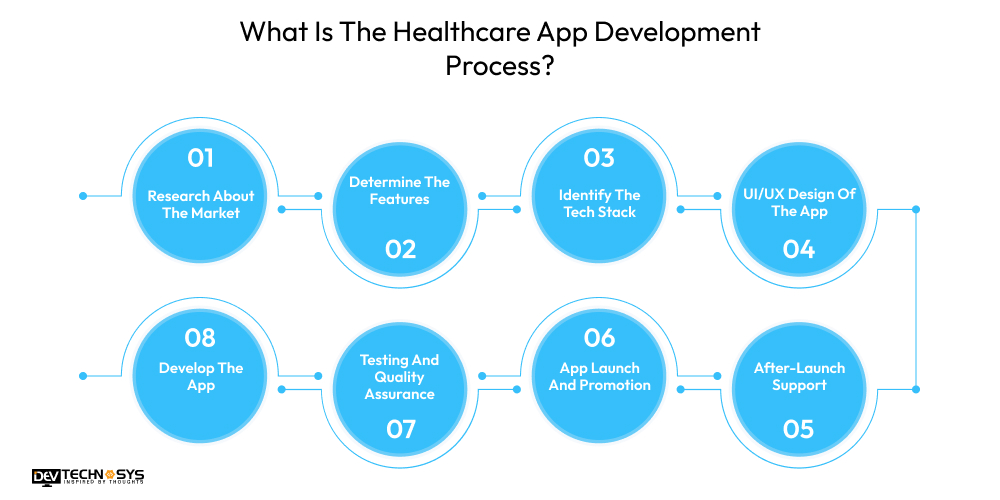
1. Research About The Market
The first step for a healthcare HIPAA-compliant software development is to research about the market requirements. This includes understanding the latest, ongoing, and upcoming trends that are and can be in demand for healthcare apps.
Also, you have to observe the strategies of your competitors and work to make and deliver something new. This is the step where you can identify your targeted audiences.
2. Determine The Features
The next big and crucial step is to identify the features you want in your app. Basically, it helps you decide what your healthcare app will do. Be it user registration, appointment booking, or payments, a clear planning of features is a necessary part of healthcare hybrid app development. With this, your app can easily meet the user needs, regulatory requirements, and business goals while eliminating useless complexities.
3. Identify The Tech Stack
Do you know that the tech stack is the backbone of the app? Yes, then it is time to choose the right tech stack for your healthcare mobile app development. This step involves selecting programming languages, frameworks, databases, APIs, and cloud deployment for healthcare apps.
These technologies highly rely on the scalability, performance, compliance, security, and budget of the app. A strong tech stack makes the app reliable in the long run.
4. UI/UX Design Of The App
The healthcare app UI UX design focuses on building an easy-to-use, accessible, and visually appealing interface. The most important thing in the healthcare app development process is to offer clarity and convenience for use.
Also Read: What is Healthcare App Development?
Normally, in this stage, designers create wireframes, prototypes, and user flows. Its purpose is to ensure patients and doctors can operate the app easily and safely.
5. Develop The App
This is the stage where your app’s blueprint gets converted into a fully-functional app. This step involves the healthcare app backend development, frontend development, database setup, security implementation, and healthcare app API integration.
This process involves the development of codebases and other workflows, following agile methods. It allows continuous improvement and timely feedback throughout development.
6. Testing And Quality Assurance
As the end-to-end healthcare app development is done and your app is now ready to launch, you have to thoroughly test the app. Testing makes sure the app works seamlessly, securely, and reliably on various devices.
Also Read: Healthcare App Development Cost in 2026
This step ensures the healthcare app data security by fixing bugs, usability, and compatibility issues, and receiving quality assurance. A healthcare app testing and QA are highly preferred to secure the app from potential threats to prevent data breaches, system failures, and errors.
7. App Launch And Promotion
Now, you can deploy your app on app stores by streamlining App Store Optimization. However, it is not sufficient; you have to implement some marketing strategies to promote your app so it can reach targeted audiences.
You have to work on marketing campaigns, onboarding guides, and user education as part of mobile app development services. This encourages the adoption of the app by patients, doctors, or healthcare organizations.
8. After-Launch Support
To maintain the user trust, satisfaction, and retention on the app, you have to work on its upgrades and maintenance regularly. This involves monitoring performance, fixing bugs, releasing updates, adding new features, and especially working on user feedback. It guarantees compliance with changing regulations, device updates, and evolving user expectations in the healthcare industry.
Want a chatbot demo or pricing? Fill the form and talk to our experts today.
Pick what you need below — you can select more than one — then tap Get detail to continue.
-
Chatbot demo dashboard
-
Cost to develop an app
-
Industry report
-
Case study
What Tech Stacks Does The Right Healthcare App Development Use?
Normally, a healthcare app development company incorporates modern, secure, and scalable technology stacks. This helps the app give seamless performance with regulatory compliance, data protection, and enhanced patient digital experience. Here, we will see what technology stack is used for secure medical app development.
App Layer |
Technologies / Tools |
Why It Is Used |
| Frontend | React Native, Flutter, Swift, Kotlin | Build intuitive, high-performance mobile applications |
| Frontend | React.js, Angular, Vue.js | Create responsive healthcare web interfaces |
| Backend Development | Node.js, Python, Java, .NET | Handle business logic and data processing |
| Database Management | MySQL, PostgreSQL, MongoDB | Secure storage of patient and clinical data |
| Cloud Infrastructure | AWS, Microsoft Azure, Google Cloud | Scalability, hosting, and data availability |
| APIs & Integration | HL7, FHIR, REST APIs | Enable interoperability with healthcare systems |
| Security & Compliance | HIPAA, GDPR, OAuth, SSL/TLS | Ensure data privacy and regulatory compliance |
| Analytics & Monitoring | Google Analytics, Firebase, Power BI | Track app performance and user behavior |
What Are The Important Features A Healthcare App Must Have?
The features in a healthcare app development are categorized into three panels: patient, doctor, and admin. These essential features of each panel ensure smooth operations, secure management, and efficient healthcare service. Now, we will have a look at these features of each panel necessary for a healthcare app.
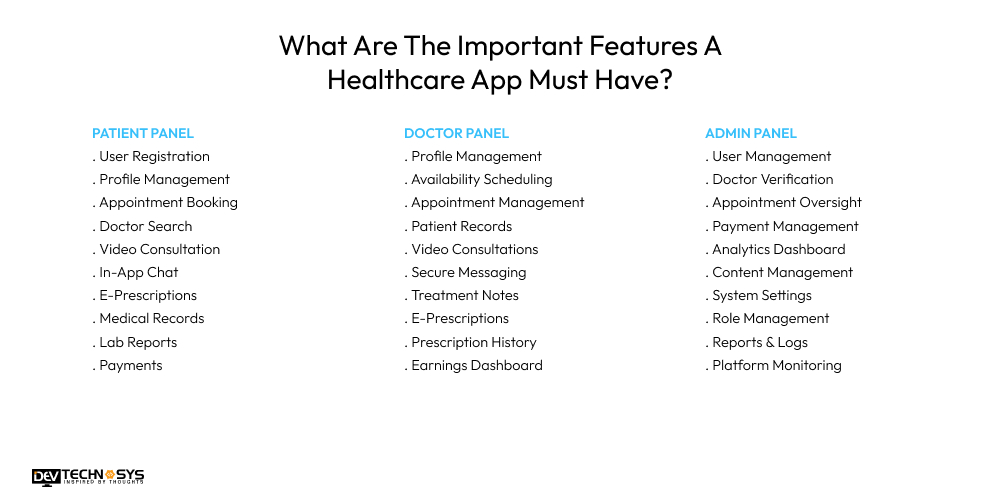
Patient Panel |
Doctor Panel |
Admin Panel |
| User Registration | Profile Management | User Management |
| Profile Management | Availability Scheduling | Doctor Verification |
| Appointment Booking | Appointment Management | Appointment Oversight |
| Doctor Search | Patient Records | Payment Management |
| Video Consultation | Video Consultations | Analytics Dashboard |
| In-App Chat | Secure Messaging | Content Management |
| E-Prescriptions | Treatment Notes | System Settings |
| Medical Records | E-Prescriptions | Role Management |
| Lab Reports | Prescription History | Reports & Logs |
| Payments | Earnings Dashboard | Platform Monitoring |
What Are The Top Healthcare Apps Available In The Market?
There are thousands of medical mobile app development in the US, Europe, and Australia. These apps can be a perfect healthcare partner, making your hospital visits and treatment seamless. Here we are mentioning some of the top GDPR compliant healthcare apps.
Also Read: AI in Healthcare App Development
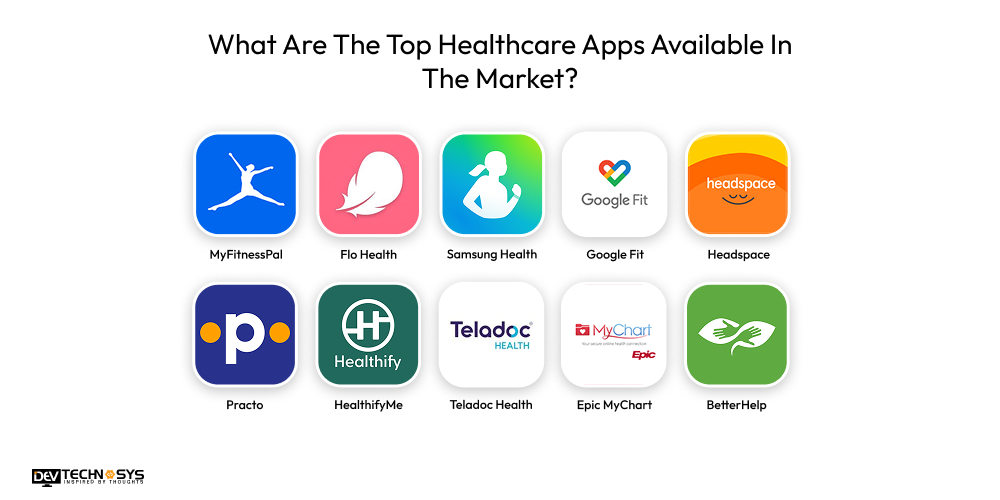
App Name |
Launch Year |
Rating |
Downloads |
Platform Availability |
| MyFitnessPal | 2005 | 4.5 | 100M+ | Android, iOS |
| Flo Health | 2015 | 4.6 | 100M+ | Android, iOS |
| Samsung Health | 2012 | 4.4 | 100M+ | Android, iOS |
| Google Fit | 2014 | 4.3 | 50M+ | Android, iOS |
| Headspace | 2010 | 4.7 | 70M+ | Android, iOS |
| Practo | 2014 | 4.4 | 10M+ | Android, iOS |
| HealthifyMe | 2012 | 4.3 | 10M+ | Android, iOS |
| Teladoc Health | 2002 | 4.5 | 10M+ | Android, iOS |
| Epic MyChart | 2010 | 4.2 | 10M+ | Android, iOS |
| BetterHelp | 2013 | 4.6 | 10M+ | Android, iOS |

How to Select the Right Healthcare App Development Company?
Selecting a mobile app development company for HIPAA compliant app development, you must focus on its proven expertise, deep understanding, security protocols, and more. In this section, we will understand what should be prioritized while selecting the right company for medical app development.
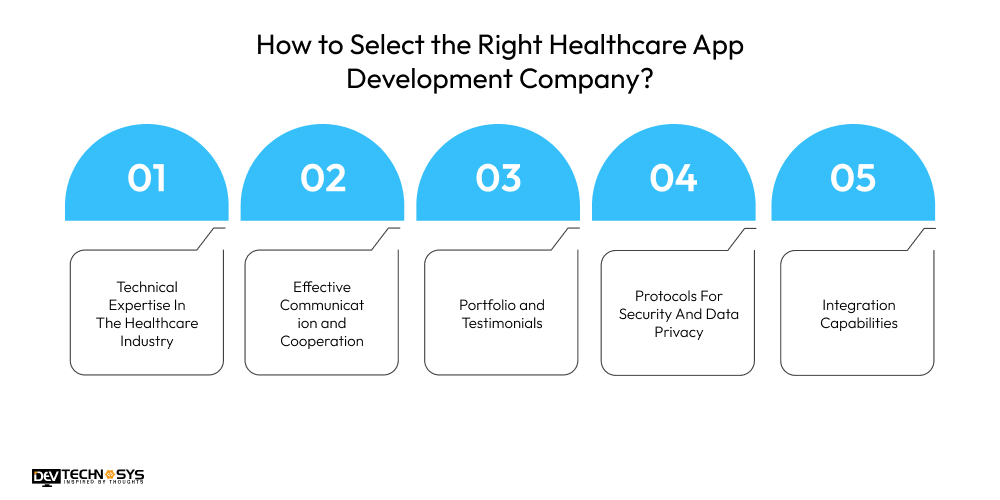
1. Technical Expertise In The Healthcare Industry
First, you have to select the right healthcare app development company that has a proven record in the healthcare industry. The company must have an understanding of medical apps, patient data, and healthcare rules. Their previous work in the healthcare sector should be safe, reliable apps that work well for doctors, patients, and healthcare organizations.
Read also: Top Medical Apps For Doctors
2. Effective Communication and Cooperation
For being the best, a healthcare EMR software development company should be extremely good at communication. They must listen to what you want, what your budget is, and explain things clearly while updating you regularly. This avoids any sort of confusion, saves time, and makes sure the final app is exactly what is demanded.
3. Portfolio and Testimonials
Apart from these, the portfolio, testimonials, client reviews, and ratings of the company are mandatory to check. This will give you a clear idea of what the web app development company presents to its clients.
It shows their skills and experience and helps you understand how reliable they are. It also shows how they work with clients and whether they deliver quality on time.
4. Protocols For Security And Data Privacy
A healthcare app that has to handle sensitive data of the patients. You have to check if your healthcare app development company uses strong measures for security and privacy.
Also Read: Healthcare MVP to Enterprise SaaS Roadmap
The company must follow strong security practices and data privacy laws. They must take secure steps to keep the patient’s data safe from hacking, leaks, or misuse.
5. Integration Capabilities
Make sure the right healthcare app development company can connect with the other systems. These systems include EHRs, payment gateways, wearables, or third-party tools. If the app is integrated with useful and helpful integrations, the healthcare providers can manage everything smoothly in one place.
Conclusion
As the blog ends, you must be clear on two major questions. First, what is the healthcare app development process, and second, how to choose the right healthcare software development partner? An ideal healthcare app development guide will let you understand the complete creation journey of an idea into a product.
In contrast, by analyzing technical expertise, healthcare domain knowledge, and long-term support capabilities, you can choose the right healthcare app development company. The guide and the company selection together can help you build a reliable, scalable, and impactful healthcare application. This leads to the healthcare app development that meets both patient needs and business goals.
Frequently Asked Questions
Find answers to the most common questions related to this article.
To build a healthcare app, you have to follow the steps written below properly and serially:
Research About The Market
Determine The Features
Identify The Tech Stack
UI/UX Design Of The App
Develop The App
Testing And Quality Assurance
App Launch And Promotion
After-Launch Support
The cost to build a healthcare app ranges somewhere between $8,000 and $30,000. The final development cost depends on complexity, features, backend infrastructure, security, third-party integrations, tech stack, and other factors.
To select a perfect healthcare app development company, you have to check its:
Technical Expertise In The Healthcare Industry
Effective Communication and Cooperation
Portfolio and Testimonials
Protocols For Security And Data Privacy
Integration Capabilities
Generally, a healthcare app with basic MVP and simple features can be developed within 2 to 4 months. On the other hand, a fully-featured, advanced app will take 3 to 6 months to get developed.
The most influential benefits of a healthcare app development are:
Enhanced patient engagement
Compliance and security
Better communication
Health tracking
Efficient access to medical reports
Enhance communication with the doctor
Prescription management
Accurate diagnosis