















MoodMission App Development at a Glance
- As people are becoming aware of the mental helath importance, the demand for wellness app development is at its peak.
- The global mental health app development market size is expected to reach USD 8.64 billion in 2026.
- The overall cost to develop an app like MoodMission in 2026-2027 can range from $30,000 to $1,50,000.
- The timeline to create an app like MoodMission can be from 4 to 7+ months, depending on complexity, integrations, and security implementations.
- Subscription, freemium model, and in-app purchase are some of the strategies that help mental health apps make recurring revenue.
How about opening an app after a hectic day and getting personalized activities that improve your mood within minutes? This is the only core behind the success of MoodMission, a mental wellness app. That’s why the demand for a similar MoodMission alternative app is rapidly growing in 2026-2027.
With the growing awareness of mental wellness, entrepreneurs are interested in CBT app development. Their main motive is to offer users emotional support with more accessibility and engagement. To build a mood-based recommendation app, businesses require a combination of:
- Behavioral science
- User-centered design
- AI-powered personalization
- Secure healthcare technology
From defining core features to ensuring compliance and scalability, every development stage plays a crucial role. This blog covers every single thing needed to build an app like MoodMission in 2026-2027.
What is MoodMission and How Does It Work?
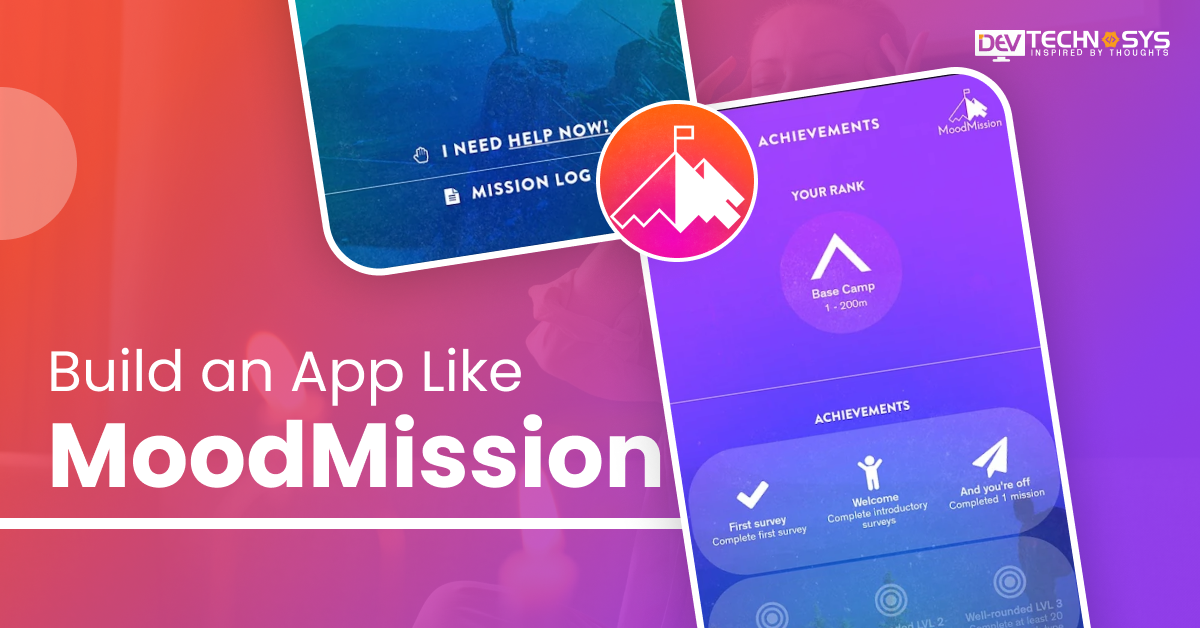
MoodMission is a mental health and wellness app built to help users manage stress, anxiety, and low moods. It allows users to manage these issues through evidence-based behavioral activities. This app is built and works on the principles of Behavioral Activation and Cognitive Behavioral Therapy (CBT). The app also suggests personalized “missions,” which motivate people to take positive actions and healthier coping strategies.
The workflow of MoodMission:
- First, users have to select their mood and emotional state
- The user selects their current mood or emotional state.
- The app analyzes responses and identifies relevant challenges.
- Personalized wellness missions are recommended instantly.
- Users complete activities designed to improve emotional well-being.
- Progress and mission outcomes are tracked over time.
- Recommendations are adapted based on user engagement and feedback.
Mental Health App Market Outlook and Future Growth Opportunities
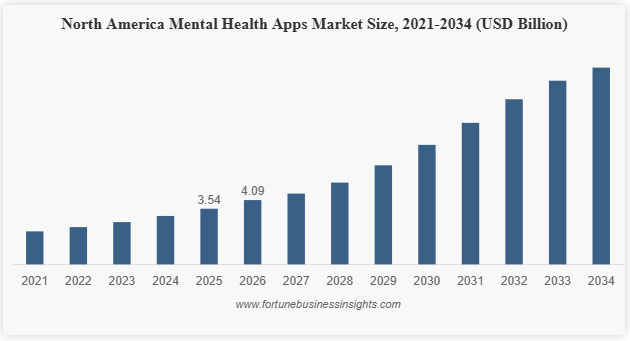
The demand for accessible, personalized, and technology-driven mental healthcare solutions is growing rapidly. It is because people are getting aware of mental concerns and need to resolve them. Here we are with the market outlook about mental health app development, analyzed by Fortune Business Insight.
- The mental health apps market reached a $7.48 billion valuation globally during the year 2025.
- Market revenue is projected to reach $35.29 billion by 2034, driven by adoption.
- The industry is expected to grow at a strong CAGR of 23% during the forecast.
- North America accounted for 26% market share, maintaining regional leadership during 2025.
- Home care settings are forecast to contribute 26% of the total market share by 2026.
Common User Pain Points in Traditional Mental Wellness Platforms
Even though the popularity of mental wellness apps is growing, many fail to offer long-term value. Users abandon these apps because they lack in providing a personalized, engaging, and meaningful experience and support. We are here to discuss the problems users face with traditional mental wellness apps.
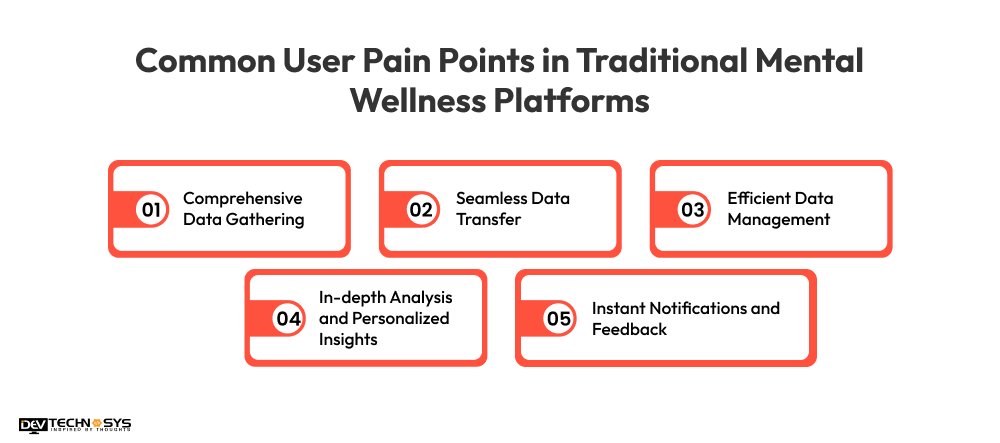
- Low Engagement: Users’ interest goes down over time with the same and repetitive content.
- Generic Suggestions: Similar recommendations are given to every user with different emotional needs.
- Limited Personalization: No adaptive content can make the user experience less relevant and effective.
- Poor Motivation: Insufficient rewards, reminders, or progress tracking can decrease user commitment and dedication.
- Privacy Concerns: Users may hesitate to share sensitive mental health information without strong security assurances.
These challenges become the reason and opportunity for entrepreneurs to develop more personalized, secure, and engaging mental health apps.
Why Are Entrepreneurs Launching MoodMission-Like Platforms?
In 2026-2027, the demand for accessible apps similar to MoodMission is rising. Combining these apps with advanced digital health technologies has created significant opportunities for businesses. An iOS or Android app development for mental health offers:
- Scalable solutions
- Recurring revenue potential
- Growing adoption
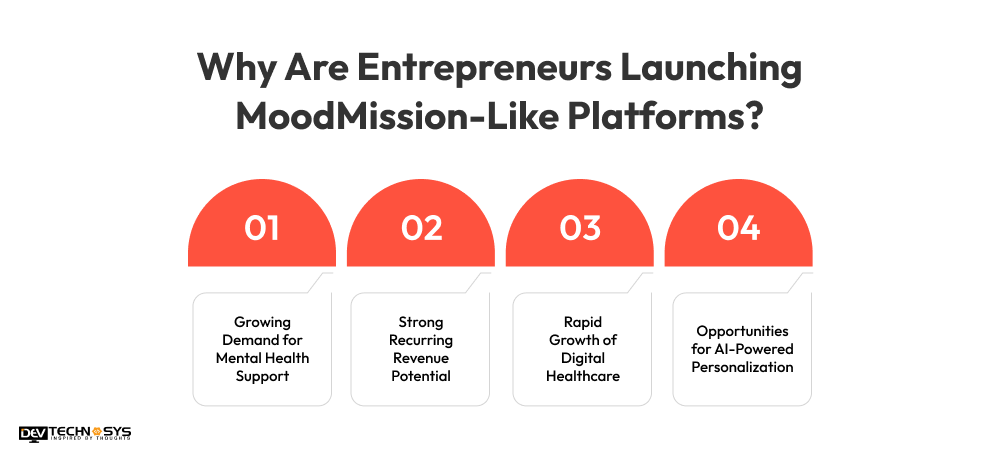
1. Growing Demand for Mental Health Support
People are getting concerned and aware of their stress, anxiety, burnout, and emotional well-being. This has driven the demand for digital mental health solutions. Teletherapy app development provides convenient, affordable, and accessible support for users worldwide.
2. Strong Recurring Revenue Potential
Businesses should add subscription-based models, premium wellness programs, and personalized coaching services to mental health apps. This way, they can have strong revenue potential while improving long-term customer retention and engagement.
3. Rapid Growth of Digital Healthcare
Everyone in this generation is struggling to make some time for themselves, but can’t succeed. This leads to the expansion of telehealth, AI-driven healthcare tools, and remote wellness services. It accelerates the adoption of digital mental health platforms globally.
4. Opportunities for AI-Powered Personalization
Modern businesses are leveraging AI-powered technologies like behavioral analytics and predictive insights. These technologies deliver personalized wellness experiences according to individual emotional or mental needs. It improves engagement, retention, and overall user outcomes.
What Startups Can Learn From MoodMission’s Success?
In today’s mental health and wellness market, MoodMission has developed a strong reputation. It skillfully combines behavioral science with simple, action-oriented wellness activities. The approaches Moodmission follows support emotional well-being effectively.
Although it is a successful app, startups can still improve personalization, engagement, and user support. So, here are some points every entrepreneur must consider and learn from MoodMission’s success.
- Personalized missions make mental health support practical and easy to follow.
- Recommendations depend heavily on user input and limited behavior analysis.
- Predictive insights and adaptive guidance can improve recommendation accuracy.
- For peer support and shared experiences, users have limited opportunities.
- User engagement and retention can be increased by streaks, awards, and achievements.
- Integrating the therapist and tracking outcomes can strengthen user trust.
Industry Insight: We have developed over 40 projects on mental health and have come across that startups like to differentiate their platform from MoodMission. They combine an evidence-based approach with AI personalization, community engagement, gamification, and stronger clinical support.
Essential Features Required to Build an App Like MoodMission
To make an app like MoodMission, a telehealth software development firm adds essential wellness functionalities. These features improve engagement, personalization, and long-term user retention. We have mentioned some MVP and advanced mood tracking app features that create opportunities for future growth.
-
MVP Features Required to Launch a MoodMission-Like App
The MVP mental wellness app features generally focus on solving the user’s core problem with a minimum set of features.
Feature |
Purpose |
User Benefit |
| Mood Assessment | Capture current emotional state | Enables personalized recommendations |
| Personalized Missions | Suggest evidence-based wellness activities | Provides actionable mental health support |
| User Profile Management | Store preferences and wellness goals | Creates a tailored user experience |
| Progress Tracking | Monitor completed activities and mood changes | Encourages consistency and motivation |
| Push notification (Firebase FCM) | Send reminders and wellness prompts | Improves engagement and retention |
| Mood History Dashboard | Visualize emotional patterns over time | Helps users identify trends |
| Daily Check-Ins | Collect regular mood updates | Supports habit formation |
| Feedback System | Gather mission effectiveness ratings | Improves recommendation quality |
-
Advanced Features That Differentiate Mental Health Apps in 2026
Advanced MoodMission app features can help businesses improve retention, personalization, and competitive positioning.
Advanced Feature |
Business Value |
User Benefit |
| AI-Powered Mood Analysis | Enhances recommendation accuracy | Delivers personalized wellness support |
| Predictive Mental Health Insights | Identifies behavioral trends | Enables proactive intervention |
| Voice Journaling | Improves user engagement | Simplifies emotional self-expression |
| Wearable API integration (HealthKit / Google Fit) | Expands health data collection | Provides real-time wellness insights |
| AI Wellness Assistant | Offers on-demand guidance | Creates interactive support experiences |
| Gamification SDK (rewards & badges) | Increases retention rates | Boosts motivation through rewards |
| Community Support Groups | Encourages peer engagement | Builds a sense of belonging |
| Teletherapy Integration | Expands service offerings | Provides access to professional help |
From Idea to Launch: Building a Mental Wellness App Successfully
To build an app like MoodMission, businesses require a structured approach. This approach includes strategic research, design, development, compliance, and continuous improvement. Each development stage guarantees the product is user-friendly, clinically responsible, and scalable in a competitive digital healthcare market.
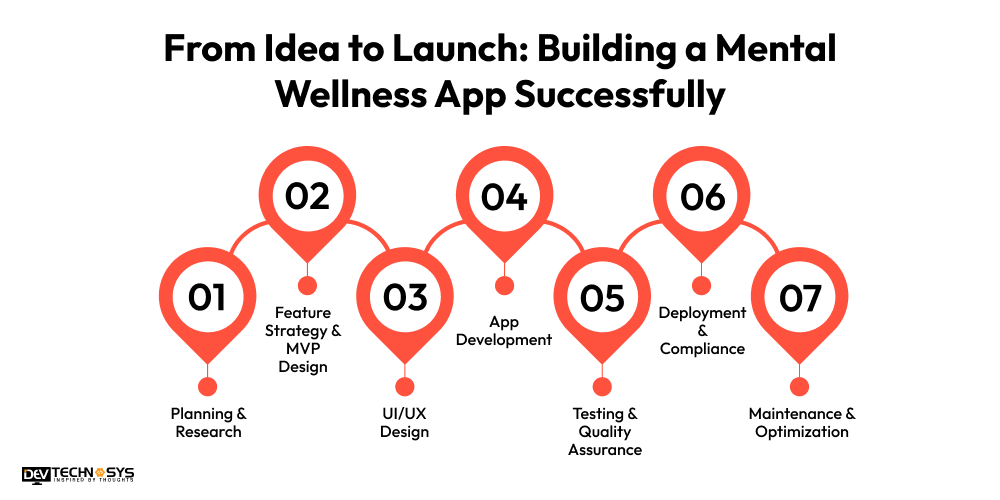
1. Planning & Research
At the first stage, it is important to define the app’s purpose, target audience, and pain points to solve. It also includes analyzing the market, competitors, and validation of user needs. If the planning is clear, it aligns with the real mental health challenges. Understanding sets a strong foundation for feature selection, monetization strategy, and long-term scalability.
2. Feature Strategy & MVP Design
Here, businesses should prioritize core functionalities to build an online therapy app. The most essential features, like mood tracking, personalized missions, and user onboarding, are primarily selected. As the goal is to launch a CBT-based mental health app quickly, MVP development is highly preferred. It also helps reduce complexity by allowing early user feedback and faster validation.
3. UI/UX Design
Now comes the important step to focus on creating a calm, simple, and emotionally supportive user experience. UI/UX design interfaces should decrease cognitive load and encourage daily engagement. It must integrate thoughtful design choices like soft visuals, intuitive navigation, and accessibility features. This makes users feel safe, improving retention and ensuring better mental wellness outcomes.
4. App Development
It’s time to create a mental health app with a frontend, backend, and AI-driven recommendation systems. In this stage, developers guarantee scalability, performance, and data security while integrating core features. It also involves choosing the right tech stack that supports real-time interactions, personalization, and future enhancements. It doesn’t compromise app stability or user experience.
5. Testing & Quality Assurance
Testing the app makes sure the app functions work correctly on multiple devices and in various user scenarios. It includes usability testing, performance checks, bug fixing, and security validation. QA also verifies that recommendations and features work as planned. Testing and QA also ensure a smooth, reliable, and emotionally safe experience for users before launch.
6. Deployment & Compliance
As the testing is done, the app is all set to get deployed on App Stores with proper ASO. Now, businesses can implement compliance with regulations like HIPAA and GDPR to protect user data. This step ensures the legal safety of the user information and builds trust with users. It also prepares the app for secure real-world usage.
7. Maintenance & Optimization
After the app launch, continuous monitoring and updates are essential to keep the app relevant and competitive. For this, developers analyze user behavior, fix bugs, and improve features based on feedback. If the app is updated regularly, it enhances personalization, engagement, and performance. It is also effective in delivering long-term mental wellness support.
Recommended Tech Stack for Building a Scalable Mental Health App
Healthcare businesses and startups require a combination of Flutter + Node.js + PostgreSQL + AWS + WebRTC + AI integration. This combination offers a balance of development speed, performance, security, and future scalability. In this section, we will learn about the tech stack required to build an app like MoodMission.
Development Layer |
Recommended Technology |
Why It’s Important for Mental Health Apps |
| Frontend (iOS & Android) | Flutter/React Native | Enables cross-platform development with a consistent user experience and faster deployment. |
| Backend Development | Node.js, Python (Django), NestJS | Supports secure APIs, real-time communication, and scalable application architecture. |
| Database | PostgreSQL, MongoDB | Handles patient records, therapy sessions, and user activity data efficiently. |
| Cloud Infrastructure | AWS, Google Cloud, Microsoft Azure | Provides scalability, high availability, disaster recovery, and healthcare-grade security. |
| Real-Time Chat | Socket.io, Firebase Realtime Database | Powers instant therapist-patient messaging and live communication features. |
| Video Consultation | WebRTC, Twilio Video, Agora | Enables secure virtual therapy sessions with high-quality audio and video. |
| AI & Chatbot Integration | OpenAI, Google Vertex AI, TensorFlow | Supports symptom analysis, personalized recommendations, and AI-driven mental wellness assistance. |
| Authentication & Security | OAuth 2.0, JWT, Firebase Auth | Protects sensitive user information through secure login and access control. |
| Data Encryption | AES-256, SSL/TLS | Ensures confidential mental health data remains protected during storage and transmission. |
| Notifications | Firebase Cloud Messaging (FCM), OneSignal | Delivers medication reminders, therapy schedules, and wellness alerts. |
| Analytics | Google Analytics 4, Mixpanel, Amplitude | Tracks user engagement, retention, and app performance metrics. |
| Payment Gateway | Stripe, PayPal, Razorpay | Supports subscription plans, therapy session payments, and premium services. |
| Compliance & Security Monitoring | HIPAA Tools, AWS CloudTrail, Azure Monitor | Helps maintain healthcare compliance and continuous security monitoring. |

How are AI Innovations Reshaping Mental Wellness App Development?
It is evident that AI is transforming almost every industry, and mental wellness app developemnt is no exception. Businesses that build an AI therapy app invest in personalization, proactiveness, and accessibility.
Rather than offering the same experience to every user, the AI/ML mood prediction model analyzes:
- Mood patterns
- Behavioral data
- Engagement history
AI personalization helps in delivering tailored recommendations according to each user’s mental health condition. It also improves user retention, satisfaction, and overall wellness outcomes. With the evolving mental health apps, AI is becoming a key differentiator for enterprises wanting effective solutions. It also provides users with Predictive analytics, sentiment analysis, and adaptive wellness. AI development powers chatbots that provide instant guidance and emotional support.
Clinical Validation Framework for Mental Health App Development
Nowadays, mental health apps are becoming an integral part of everyday healthcare. That’s why users are expecting more than just attractive designs and advanced features. Therefore, successful mental wellness apps follow a clinical validation framework.
The clinical validation framework is based on proven psychological principles, measurable outcomes, and expert oversight. It can be a great measure to gain trust and demonstrate effectiveness among users. In this section, we will understand the 6 pillars of a clinically validated mental health app.
Validation Component |
Why It Matters |
| Research-Backed Interventions | Ensures app activities are supported by established psychological studies and evidence. |
| CBT-Based Frameworks | Helps users recognize negative thought patterns and build healthier coping strategies. |
| Behavioral Activation Techniques | Encourages positive actions that improve mood and emotional well-being. |
| Clinical Expert Review | Validates content accuracy, safety, and alignment with mental health best practices. |
| Outcome Measurement | Tracks user progress, engagement, and wellness improvements over time. |
| User Testing & Feedback | Confirms the app is effective, accessible, and easy to use for target audiences. |
Mental Health App Risk Management and Crisis Response Planning
Yoga app development and mental health apps have the task of supporting users during times of stress, anxiety, or emotional distress. They take it as their responsibility to maintain user safety and trust in the app. For this, developers must implement structured risk management and crisis response protocols.
The protective measures help in detecting potential risks and immediately connect users with support resources. It also ensures the platform works responsibly within healthcare privacy regulations.
Work Process of a Mental Health Crisis Response System:
Step 1: Risk Detection
The user inputs, such as mood assessments, journal entries, and behavioral patterns, are continuously monitored. This helps in identifying emotional distress, self-harm, or crisis situations.
Step 2: Severity Level Assessment
Once the risk signal is detected, the first thing the platform does is to analyze its urgency. If the risk is low, wellness recommendations are triggered. Whereas the high-risk indications require instant escalation.
Step 3: Harm Detection Protocols Activation
AI-powered monitoring and predefined safety rules related to safety help identify:
- Keywords
- Behaviors
- Patterns
All of these associated with self-harm, suicidal thoughts, or severe emotional distress.
Step 4: Emergency Resources Connected
For users who need additional support, the platform offers instant access to:
- Crisis hotlines
- Emergency services
- Therapists
- Trusted contacts.
Step 5: Notify Emergency Contacts
During critical situations, designated family members, caregivers, or support persons are contacted immediately with the user’s consent.
Step 6: Moderation and Safety Controls
Content moderation systems help prevent harmful interactions, misinformation, or triggering content within community-based wellness platforms.
Step 7: Legal and Compliance Readiness
To meet legal responsibilities and industry standards, the platform maintains privacy and protects documentation and healthcare compliance.
MoodMission App Development Cost Breakdown for 2026
The average cost to build an app like MoodMission can be estimated at $30,000 to $1,50,000. The overall development budget is determined by the platform’s complexity. We will explain it like this:
- A simple app, following an MVP strategy, is less complex to build due to basic integrations.
- Estimated Cost Range: $30,000 – $70,000
- A mid-range app combining basic and advanced integrations has moderate development complexity.
- Estimated Cost Range: $70,000 – $1,10,000
- An advanced app with high-level integrations and modern technologies has higher development complexity.
- Estimated Cost Range: $1,10,000 – 1,50,000
Key Factors That Influence Mental Health App Development Costs
Despite complexity, there are multiple factors affecting the mental health app development cost. It includes factors like platform choice, AI integration, security & compliance, developers’ location, backend infrastructure, maintenance, and so on. We will now discuss some of these essential factors influencing the cost to develop an app like MoodMission.
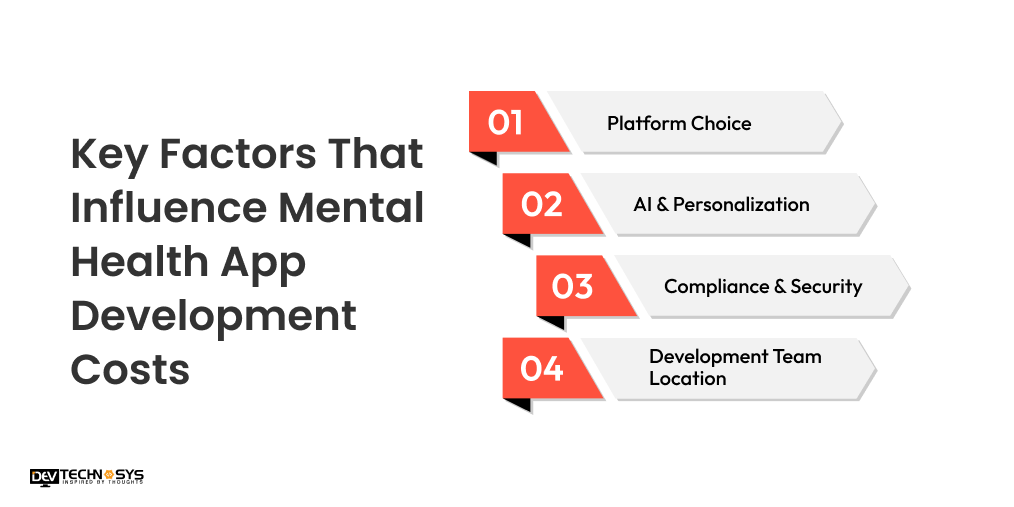
1. Platform Choice
The choice of platform, either Android, iOS, or cross-platform, affects the cost to build an app like MoodMission. Building platforms on separate platforms requires separate design, testing, and maintenance efforts. Native app development often delivers better performance and user experience.
Platform Type |
Estimated Cost (USD) |
Cost Impact |
| Single Platform (iOS or Android) | $30,000 – $60,000 | Lower development and testing costs |
| Cross-Platform App | $50,000 – $100,000 | Shared codebase reduces overall expenses |
| Native iOS + Native Android | $80,000 – $150,000 | Higher performance but increased development cost |
2. AI & Personalization
A modern cognitive behavioral therapy app includes features like mood tracking, symptom analysis, personalized recommendations, and virtual support. These features depend on AI model integration, data processing requirements, and personalization, raising mental health app development expenses.
AI Capability |
Estimated Cost (USD) |
Business Benefit |
| Basic Mood Recommendations | $10,000 – $15,000 | Personalized user experiences |
| Behavioral Analytics | $15,000 – $22,000 | Better engagement and retention |
| Predictive Mood Analysis | $20,000 – $25,000 | Proactive wellness support |
| Advanced AI Personalization | $25,000 – $30,000 | Highly customized user journeys |
3. Compliance & Security
Personalized mental health platforms have to handle highly sensitive information about users. This makes security and regulatory compliance extremely essential. Therefore, implementing data encryption, secure authentication, and consent management elevates the cost of the stress management app.
Security Requirement |
Estimated Cost (USD) |
Purpose |
| Basic Data Encryption | $3,000 – $5,000 | Protects sensitive user information |
| Secure Authentication | $5,000 – $8,000 | Prevents unauthorized access |
| HIPAA/GDPR Compliance Setup | $8,000 – $12,000 | Ensures regulatory compliance |
| Advanced Security & Auditing | $12,000 – $15,000 | Strengthens healthcare-grade protection |
4. Development Team Location
Corporate wellness app development prices vary significantly by region and expertise level. Teams in North America and Western Europe generally charge higher rates. Choosing the right team balances affordability, quality, and long-term project success.
Region |
Average Hourly Rate (USD) |
| India | $20 – $50/hour |
| Southeast Asia | $25 – $60/hour |
| Eastern Europe | $40 – $100/hour |
| Western Europe | $80 – $180/hour |
| United States & Canada | $100 – $250/hour |
Best MoodMission Alternatives and Competitors in 2026
As demand for digital mental wellness solutions continues to rise, several MoodMission clone apps have emerged. These platforms offer unique approaches ranging from AI-powered support and meditation to therapy access, mood tracking, and personalized behavioral interventions.
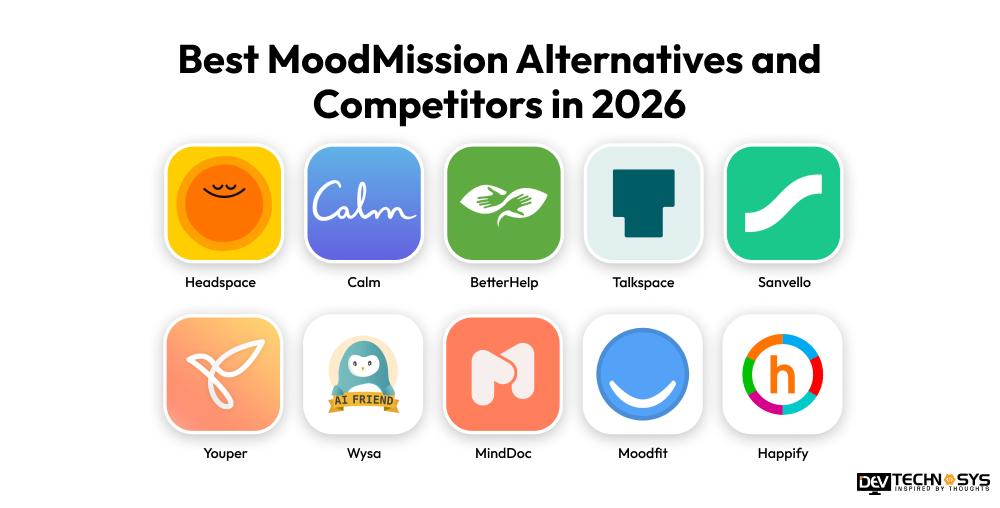
App Name |
Primary Focus |
Key Strength |
Ideal Users |
Business Model |
| Calm | Meditation & Sleep | Guided meditation programs | Stress management seekers | Subscription |
| Headspace | Mindfulness & Mental Wellness | Structured mental health courses | Beginners and professionals | Subscription |
| BetterHelp | Online Therapy | Licensed therapist access | Individuals seeking counseling | Subscription |
| Talkspace | Virtual Therapy | Text, audio, and video therapy | Ongoing therapy users | Subscription |
| Sanvello | CBT & Mood Tracking | Evidence-based self-care tools | Anxiety and stress management | Freemium |
| Wysa | AI Emotional Support | AI-powered conversational coaching | Users seeking anonymous support | Freemium |
| Youper | AI Therapy Support | Personalized emotional health insights | Mood improvement users | Subscription |
| MindDoc | Mood Tracking | Detailed mental health assessments | Long-term mental wellness monitoring | Freemium |
| Moodfit | Mood Improvement | Goal-based mental wellness tracking | Self-improvementfocused users | Freemium |
| Happify | Positive Psychology | Science-backed wellness activities | Daily mental fitness users | Freemium |
Security Standards Every Mental Wellness App Must Follow
A mobile application development company makes security and compliance non-negotiable for an emotional well-being tracking app. They handle highly sensitive personal data, and building user trust by protecting data and reducing legal risks is necessary. Here are some security standards every on-demand therapy app must follow.
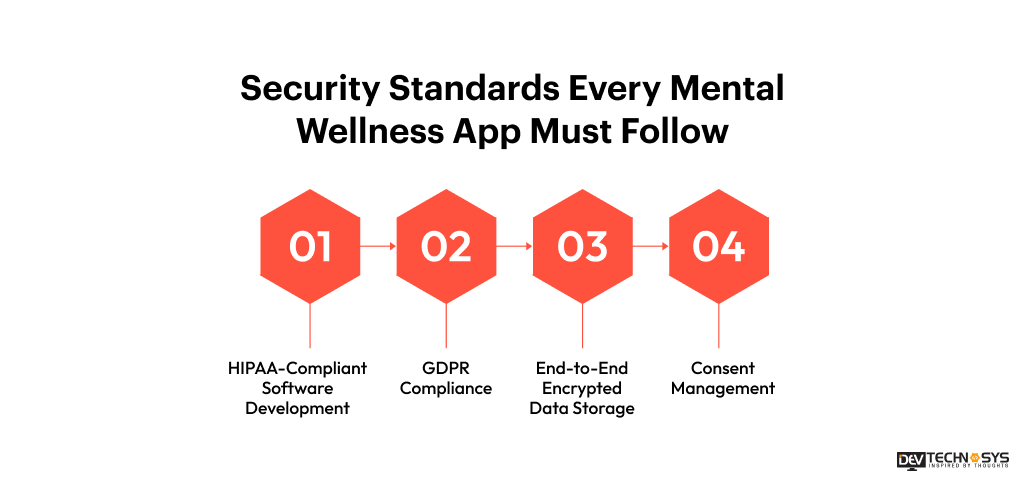
Security Standard |
What It Covers |
Business Benefit |
| HIPAA-Compliant Software Development | Secure handling of protected health information (PHI), access controls, audit logs, and privacy safeguards. | Reduces compliance risks and strengthens user trust in healthcare-focused applications. |
| GDPR Compliance | User consent, data transparency, privacy rights, and secure personal data processing. | Helps avoid regulatory penalties while improving data privacy and customer confidence. |
| End-to-End Encrypted Data Storage | Encrypts sensitive data during transmission and storage to prevent unauthorized access. | Enhances security, protects user information, and minimizes breach-related risks. |
| Consent Management | Allows users to grant, review, and withdraw permissions for data collection and processing. | Improves transparency, supports compliance requirements, and increases user trust. |
The focus of modern evidence-based wellness apps remains on:
- HIPAA compliance
- GDPR compliance
- End-to-end encrypted data storage
- Transparent consent management
Although it can improve app credibility, strengthen security, and support long-term user retention.
Industry Insight: According to IBM, for mental wellness apps handling sensitive emotional and behavioral data, proactive security is a competitive advantage that directly impacts user trust, retention, and brand reputation.
How Do Mental Wellness Apps Generate Sustainable Revenue?
With subscriptions, freemium, partnerships, coaching services, and in-app purchases, a mood tracking and logging app can generate continuous revenue. Here, we will discuss some of these mental health app monetization models.
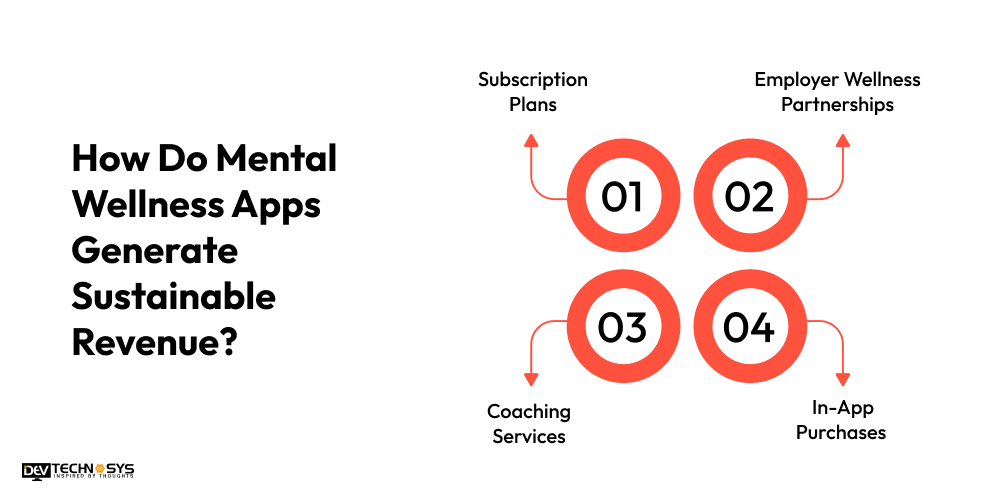
1. Subscription Plans
Mental apps offer basic services for free and ask for a monthly or yearly subscription for premium services. This approach supports long-term user engagement and business sustainability.
2. Employer Wellness Partnerships
Many organizations are increasingly investing in employees’ mental health programs. Partnering with businesses allows mental wellness apps to secure recurring contracts and earn continuous revenue.
3. Coaching Services
One-on-one coaching services connect users with certified wellness coaches, therapists, or mental health professionals. These services increase user value and potential to make continuous income.
4. In-App Purchases
In-app purchases enable users to buy specialized wellness programs, meditation packs, self-care resources, or premium content on demand. It generates revenue without requiring long-term subscription commitments.
You can reach out anytime; we are available 24/7. Our team provides a quick response.

Real-World Case Study: Gamified Mental Health App “SuperBetter”
At Dev Technosys, we have developed SuperBetter, a mental health and resilience-building platform. It is built for users to enhance emotional well-being. The app helps in mood tracking, guided self-care activities, therapist-led programs, and progress monitoring.
The initial budget to develop SuperBetter was estimated at $22,000. But the investment increased as the platform requires:
- HIPAA-aligned security architecture
- Real-time communication capabilities
- Therapist interaction modules
- Advanced analytics
- Scalable cloud infrastructure
Challenge Faced:
The main difficulty faced was creating a HIPAA-compliant platform capable of handling sensitive mental health data. Our focus was to make sure the platform offers personalized wellness recommendations through AI-driven behavioral analysis. Also, we have to maintain a balance of scalability, accessibility, and user experience.
Project Highlights
- Project Name: SuperBetter
- About Client: Jane McGonigal
- Industry: Mental Health & Healthcare
- Client Location: United States
- Development Timeline: 24 Weeks
- Team Size: 8 Developers
- Platform Type: Mental Health, Resilience Building & Wellness Tracking Platform
Conclusion
In 2026-2027, developing a MoodMission clone is something beyond just another wellness platform. It is like creating a meaningful moment of support when the user actually needs it the most. It is a simple mission to help someone take a positive step towards their mental well-being.
As mental health awareness continues to grow, businesses have an opportunity to deliver real value to users. They can combine behavioral science, AI innovation, and user-centered design to build an app like MoodMission.
By focusing on personalization, clinical credibility, safety, and engagement, a mental health app development company can build trusted digital wellness solutions. These solutions not only attract users but also make a lasting impact on their lives.
Frequently Asked Questions
Find answers to the most common questions related to this article.
The standard cost to make an app like MoodMission can be somewhere between $30,000 and $1,50,000. The overall mental helath app development budget is decided by its complexity. Some other factors include security, backend, platform choice, development team & their location, maintenance, and so on. Developing a simple digital mental health platform is less expensive than an advanced one.
Yes, you must involve psychologists and therapists to create an app like MoodMission. It is needed to make your app credible and distinguish it from harmful ones. Also, as per Google’s EEAT guidelines, the platform lacking expert involvement is penalized. Therefore, you should co-design the app with licensed therapists or clinical psychologists and clinically recommend all missions.
To make mood-based mission recommendations intelligent and personalized, you can build the app using:
● Rule-based logic for your MVP (if mood is anxious, show breathing missions)
● Collaborative filtering (recommend missions that worked for similar users)
● NLP sentiment analysis on user journal entries
● Reinforcement learning over time to improve recommendations based on what actually helped each individual user.
The widely used frameworks that the app’s contents should be based on include:
● CBT (Cognitive Behavioral Therapy): gold standard for anxiety and depression
● Behavioral Activation: core to MoodMission's mission structure
● ACT (Acceptance and Commitment Therapy): great for mindfulness features
● Positive Psychology: for gratitude, strengths-based missions
● DBT (Dialectical Behavior Therapy): for emotional regulation features
Each framework you use should be cited with clinical sources inside the app.
Generally, it takes 3 to 7+ months to build an app like Moodmission. However, the developemnt timeline is hugely affected by the platform’s complexity, integrations, and security levels. A simple app with basic integrations and less complexity can be developed within 3 to 5 months. Whereas a highly advanced application with the latest technologies and modern integrations takes 7+ months for development.