














Key Takeaways:
- As people are becoming more health-conscious, they demand accessible, convenient, and preventive healthcare tracking systems.
- The average cost to develop a heart rate monitor app can range between $30,000 and $1,50,000.
- According to Toward Healthcare, the heart rate monitor market is predicted to grow to $96 billion in 2026.
- Affiliate marketing, subscription, and in-app advertising are some of the common ways a heart rate monitor app makes recurring revenue.
Formerly, checking heart rate meant visiting clinics or hospitals, wearing multiple equipments, and long waiting to get the report. But today, monitoring heart rate is an instant process done through smartwatches or smartphones.
This shift has revolutionized heart rate monitoring from occasional to daily wellness habits. The adoption of wearable devices and AI-powered health insights has created a massive demand for heart rate monitoring apps.
This has ignited the trend among businesses, healthcare providers, and fitness startups to invest in developing smart applications. Do you know that heart rate monitor app development is more than just showing pulse data? It includes building a secure data infrastructure and implementing AI analytics.
Understanding everything about heart rate tracking app development is important to build a reliable solution. This guide covers all the essential information from the market stats to the challenges faced.
What Is a Heart Rate Monitoring App?
A digital tool that helps in tracking and recording pulse is a heart rate monitoring app. It measures users’ Beats Per Minute (BPM) to analyze heart rate variability (HRV). This can be done through a smartphone camera or any connected wearable device.
A heart rate monitoring platform is becoming popular among users as it helps track cardiovascular health over time. Top wearable apps provide real-time heart health insight by identifying irregular patterns, monitoring fitness progress, and making informed lifestyle decisions.
Medical Disclaimer: Although these apps are used for fitness purpose but can’t replace professional medical devices or care.
Heart Rate Monitoring Market Statistics: Size, Growth Rate, and Industry Forecast
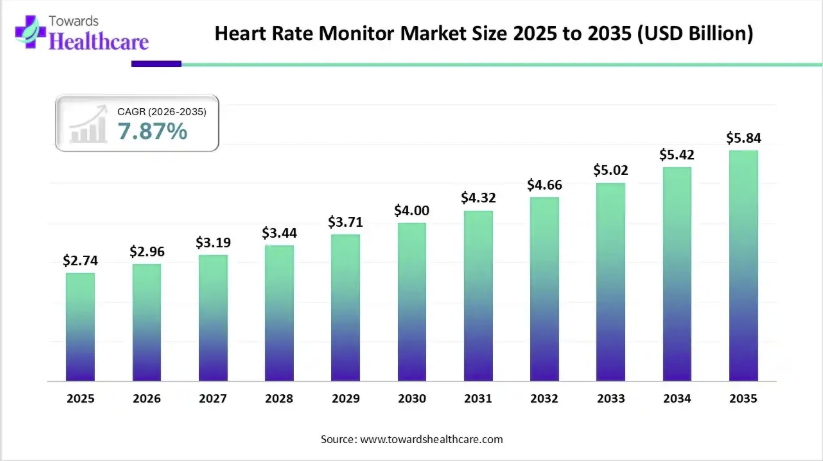
It is evident that the heart rate monitoring market is experiencing strong growth. It is especially due to the rising prevalence of cardiovascular diseases and the increasing adoption of wearable health technologies. We will now go through the market study analyzed by Towards Healthcare.
- Market expected to reach $2.96 billion by 2026, driven by wearable and digital health adoption.
- Industry projected to hit $5.84 billion by 2035, reflecting strong long-term expansion trends.
- Market growing at 7.87% CAGR from 2026 to 2035, fueled by remote monitoring demand.
- North America holds nearly 40% revenue share, leading global heart monitoring adoption in 2025.
- Wearable heart rate monitors dominated with 50% share due to high consumer preference.
Why Heart Rate Monitoring Apps Are Becoming Essential for Healthcare?
A wearable app development, like a heart rate monitor app, has transformed the healthcare industry. It allows users to track their cardiovascular health. These apps provide valuable health insight outside the traditional clinics. It helps patients and healthcare providers in making informed decisions.
With growing wearable technology and remote healthcare services, heart monitoring app development becomes a part of preventive and personalized healthcare. Such apps help in:
- Tracking heart activity 24*7
- Detecting cardiovascular risks through heart rhythms
- Monitoring patients without requiring frequent hospital visits
- Supporting more accurate medical assessments
- Managing users’ health and wellness goals
- Minimize emergency visits and long-term treatment expenses
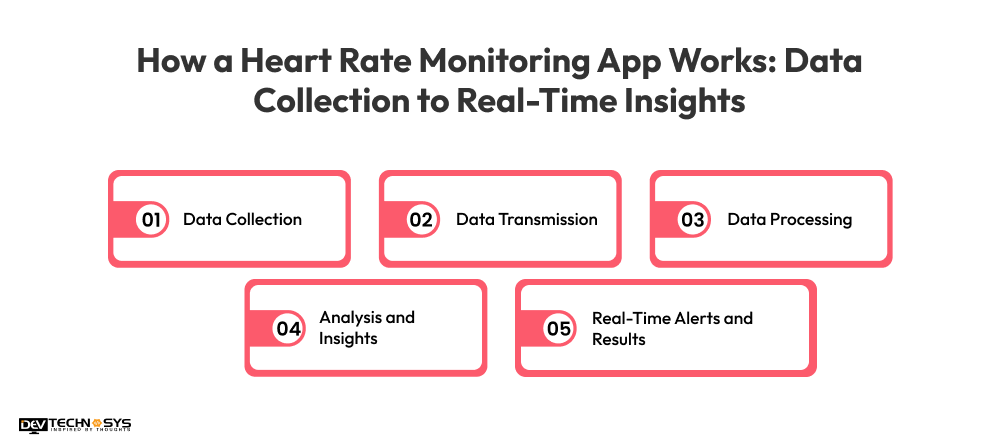
How a Heart Rate Monitoring App Works: Data Collection to Real-Time Insights
A heart rate monitor app acts like a digital health companion that tracks users’ heart rate. It simply collects body data, process ta analyze, and turn into simple insight. In this section, we will understand the workflow of a heart health app development.
1. Data Collection
At the beginning, the app collects heart rate through a smartphone camera or wearable devices. These sensors read your pulse continuously or at regular intervals.
2. Data Transmission
Once collected, the data is securely sent to the app through Bluetooth, Wi-Fi, or cloud systems. Then the data gets analyzed without delay or data loss.
3. Data Processing
The data gets processed after the removal of errors and inconsistencies. This ensures the heart rate readings are accurate and reliable for health tracking.
4. Analysis and Insights
Then, the heart pattern is studied, irregularities are checked, and heart rate variability (HRV) metrics are calculated. According to this, the app generates personalized health insights.
5. Real-Time Alerts and Results
Finally, the app shows live heart rate updates, visual reports, and sends instant alerts if it detects anything unusual. This will help users take quick action when needed.
Key Features Required in a Heart Rate Monitoring App
Every healthcare app development company integrates dedicated functionalities for patients, healthcare providers, and administrators in heart rate monitor apps. Together, these features create a comprehensive ecosystem that supports real-time health monitoring, remote patient care, and efficient platform management. Have a look at the heart rate tracking app features that should be available in the patient, doctors, and admin panels.
Patient Panel
A patient panel focuses on real-time tracking, personal health insights, and proactive heart care management.
Feature |
Purpose |
| Real-Time Heart Rate Tracking | Monitor BPM instantly using wearable or camera sensors. |
| Heart Rate History | View past heart rate trends for health analysis. |
| Wearable Device Sync | Connect smartwatches and fitness bands seamlessly. |
| HRV Monitoring | Track heart rate variability for stress and recovery insights. |
| Health Dashboard | Visualize heart performance through graphs and stats. |
| Abnormal Heart Alerts | Get instant warnings for irregular heart patterns. |
| Activity Tracking | Monitor steps, workouts, and calories burned. |
| Sleep Monitoring | Analyze sleep quality and heart behavior during rest. |
| Medication Reminders | Receive alerts for timely medicine intake. |
| Report Sharing | Share health reports with doctors for consultation. |
Doctor Panel
The doctor panel enables healthcare professionals to monitor patients remotely, analyze data, and provide timely medical support.
Feature |
Purpose |
| Patient Monitoring Dashboard | Track multiple patients in real time. |
| Live Heart Data Access | View continuous BPM and heart activity. |
| Health Risk Analysis | Detect early signs of cardiovascular issues. |
| AI-Based Insights | Get automated predictions and alerts. |
| Remote Consultation Tools | Conduct virtual patient consultations. |
| Digital Prescription System | Issue prescriptions electronically. |
| Medical History Access | Review complete patient health records. |
| Emergency Alerts System | Get notified about critical patient conditions. |
| Data Visualization Tools | Analyze charts and heart trends easily. |
| Report Generation | Create detailed medical reports for diagnosis. |
Admin Panel
The admin panel ensures smooth platform operation, security, compliance, and user management across the system.
Feature |
Purpose |
| User Management | Manage patients, doctors, and staff accounts. |
| Role-Based Access Control | Assign permissions and access levels. |
| Device Management | Monitor connected wearable devices. |
| Data Security Controls | Ensure encrypted and secure health data storage. |
| Compliance Management | Maintain HIPAA/GDPR healthcare standards. |
| System Analytics Dashboard | Track app usage and performance metrics. |
| Content Management System | Manage educational and health content. |
| Notification Management | Control alerts, updates, and system messages. |
| Payment & Subscription Management | Handle billing and premium services. |
| System Monitoring & Logs | Track app performance and detect issues. |
Step-by-Step Guide to Develop a Heart Rate Monitoring App from Scratch
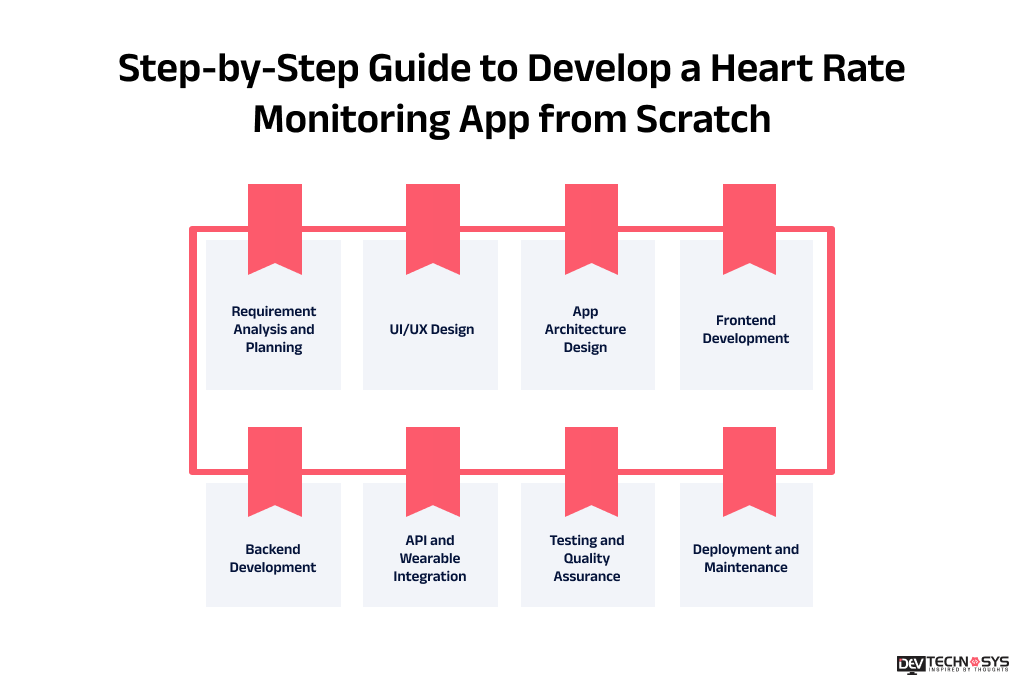
To develop a heart rate monitor app in 2026-2027, a strategic approach is required. From market analysis to after-launch support, every development stage requires proper planning and resource allocation. Here, we have explained the BPM monitoring app development process in eight essential steps.
1. Requirement Analysis and Planning
The development process of on-demand app development solutions, like heart rate monitor apps, begins with market research. It involves identifying the app’s goals, target audience, and business requirements. At this stage, competitor analysis, feature selection, regulatory considerations, and project scope definition are done. A well-planned strategy
2. UI/UX Design
A heart rate monitor app must have an intuitive and user-friendly interface. For that, designers create wireframes and interactive prototypes to make health tracking simplified. Its focus only remains on delivering easy navigation, real-time data visualization, and an engaging experience. This encourages users to monitor their health regularly.
3. App Architecture Design
A mobile app development firm uses scalable architecture to make a strong foundation for a heart rate monitoring platform. This makes developers clearly define the system structure, databases, cloud infrastructure, and security framework. If the architecture is well-structured, it ensures smooth performance and future scalability.
4. Frontend Development
Frontend development focuses on building the user-facing components of the application. Developers create dashboards, health reports, notifications, and wearable connectivity interfaces. The goal is to provide fast performance and a responsive design. Frontend development focuses on seamless access to real-time heart rate data across different devices and screen sizes.
5. Backend Development
The backend of a hybrid app development empowers data storage, user authentication, analytics, and application logic. In this step, developers build secure servers, databases, and APIs to process heart rate information efficiently. A robust backend guarantees reliable performance, real-time synchronization, and secure management of health records and user activities.
6. API and Wearable Integration
This stage involves connecting the application with smartwatches, fitness bands, health platforms, and third-party healthcare services. APIs enable secure data exchange, while wearable integrations provide real-time heart rate tracking. Proper integration ensures accurate data collection, synchronization, and a seamless monitoring experience.
7. Testing and Quality Assurance
Before launch, the app undergoes comprehensive testing to identify and resolve issues. Teams evaluate functionality, performance, security, compatibility, and usability across devices. Quality assurance ensures accurate heart rate readings, stable performance, regulatory compliance, and a reliable user experience in real-world conditions.
8. Deployment and Maintenance
After successful testing, the app is deployed to app stores and cloud environments. Ongoing maintenance includes performance monitoring, bug fixes, security updates, feature enhancements, and compatibility improvements. Regular updates help maintain user satisfaction, support business growth, and ensure long-term application reliability.
Heart Rate Monitoring App Development Timeline: From Planning to Deployment
To develop a heart rate monitor app, every development stage required a structured and timely engineering process. The average time taken to build a heart rate monitor app generally ranges from 4 to 7+ months. The timeline is highly influenced by the app’s complexity, features, integrations, and compliance.
Development Stage |
Estimated Duration |
Key Deliverables |
| Requirement Analysis and Planning | 2–3 weeks | Project scope, feature list, technical requirements, compliance planning |
| UI/UX Design | 3–5 weeks | Wireframes, user flows, interactive prototypes, and design system |
| App Architecture Design | 2–4 weeks | System architecture, database structure, scalability planning |
| Frontend Development | 4–6 weeks | Patient app UI, doctor dashboard interface, responsive design implementation |
| Backend Development | 5–8 weeks | APIs, database setup, authentication, data processing logic |
| API and Wearable Integration | 4–6 weeks | Wearable device connectivity, third-party API integration, and real-time data sync |
| Testing and Quality Assurance | 3–5 weeks | Functional testing, performance testing, security testing, bug fixing |
| Deployment and Maintenance | Ongoing (2–3 weeks initial setup) | App launch, server deployment, monitoring, updates, maintenance support |
Best Technology Stack for Heart Rate Monitoring App Development in 2026-2027
Picking up the right tech stack is very important to develop a heart rate monitor app. Correct technologies directly influence the platform’s performance, scalability, data accuracy, and real-time processing capabilities. In 2026-2027, modern heart rate monitoring apps are built using these technologies to deliver reliable and real-time cardiac insights.
Layer |
Technologies |
Purpose |
| Mobile Frontend | Flutter, React Native, Swift (iOS), Kotlin (Android) | Cross-platform and native app development |
| Backend Development | Node.js, Python (Django/FastAPI), Java (Spring Boot) | Server-side logic and data processing |
| Database | PostgreSQL, MongoDB, Firebase | Secure storage of patient and health data |
| Cloud Infrastructure | AWS, Microsoft Azure, Google Cloud | Scalable hosting and real-time data management |
| Wearable Device Integration | Apple HealthKit, Google Fit, Fitbit API, Garmin API | Syncing real-time heart rate data from devices |
| AI & Machine Learning | TensorFlow, PyTorch, Scikit-learn | Heart rhythm analysis and predictive insights |
| APIs & Communication | REST APIs, GraphQL, WebSockets | Real-time data exchange and connectivity |
| Security & Compliance | OAuth 2.0, JWT, SSL/TLS, HIPAA-compliant services | Data protection and secure authentication |
| DevOps & Monitoring | Docker, Kubernetes, Jenkins, Prometheus | Deployment automation and system monitoring |
Healthcare Compliance and Security Standards for Heart Rate Monitoring Apps
Following strict security and compliance standards is mandatory to develop a heart rate monitor app. It becomes more essential if these apps process Protected Health Information (PHI). End-to-end data encryption, HIPAA/GDPR compliance, and FDA/CE medical device certification are the key compliance and security requirements. If these are not fulfilled, it can be the reason for data breaches, regulatory fines, and dangerous medical inaccuracies.
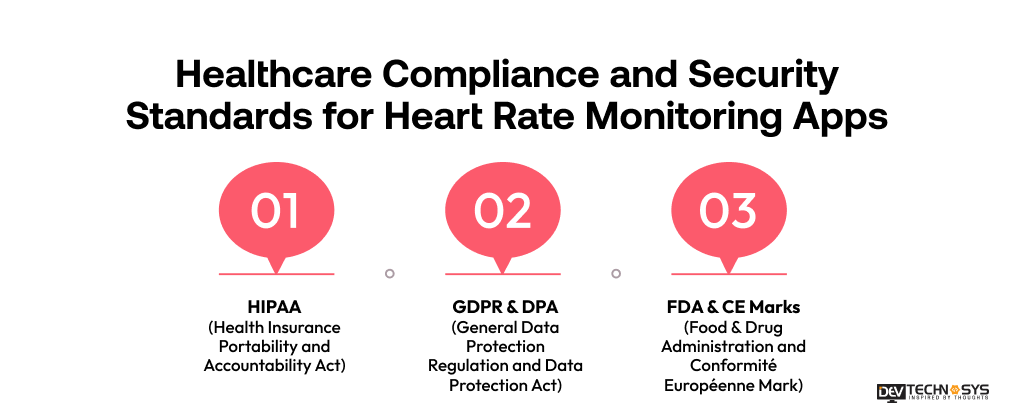
1. HIPAA (Health Insurance Portability and Accountability Act)
HIPAA-compliant software development is essential for heart rate monitoring platforms because they collect, store, and transmit patients’ health information. HIPAA requires data encryption, secure access controls, and audit trails to protect sensitive health records and maintain user trust.
2. GDPR & DPA (General Data Protection Regulation and Data Protection Act)
GDPR and DPA regulations manage the way healthcare data is collected, processed, and stored. That’s why heart rate monitoring apps must get user consent, ensure data transparency, enable data deletion requests, and implement privacy protection measures.
3. FDA & CE Marks (Food & Drug Administration and Conformité Européenne Mark)
FDA approval and CE marking show that a heart rate monitoring app meets established safety, quality, and performance standards. These certifications help ensure reliability, regulatory compliance, and greater confidence among healthcare providers and end users.

How to Integrate Wearable Devices with Heart Rate Monitoring Apps?
Connecting wearable devices with a heart rate monitoring app means:
- Establishing a secure connection
- Collecting health data
- Processing readings
- Ensuring accurate synchronization
Most developers follow the steps below to build a reliable wearable-enabled health monitoring solution.
Step |
Integration Process |
Why It Matters |
| 1 | Select Compatible Wearables | Identify devices such as Apple Watch, Fitbit, Garmin, or Samsung Galaxy Watch based on the target users. |
| 2 | Connect Using BLE | Use Bluetooth Low Energy (BLE) to establish secure, low-power communication between the wearable and mobile app. |
| 3 | Integrate Health APIs | Connect Apple HealthKit, Google Health Connect, or manufacturer SDKs to access heart rate and health metrics. |
| 4 | Process & Validate Data | Apply filtering algorithms to remove motion noise and improve heart rate accuracy. |
| 5 | Enable Cloud Synchronization | Store and synchronize health data across devices for real-time access and historical tracking. |
| 6 | Implement Security Controls | Encrypt health data and manage user permissions to comply with healthcare regulations. |
| 7 | Test Across Devices | Verify compatibility, synchronization speed, and data accuracy on different wearables and operating systems. |
Role of AI and Wearable Devices in Heart Rate Monitoring Apps
To make a heart rate monitor app more reliable and accurate, AI and wearable devices play a vital role. Smartwatches, fitness bands, and other wearables use PPG sensors and ECG-based tracking. It continuously collects heart rate data with higher precision and guarantees consistent monitoring during rest, activity, and sleep.
AI in healthcare app development helps in processing raw data to spot unnatural heart patterns and offer personalized health insights. It predicts potential risks by analyzing long-term trends in heart rate variability (HRV). With the help of AI, a heart monitoring app can send an SOS message or call to emergency services like 911.
AI and wearable devices together can improve reliability, user engagement, and make digital heart health tracking more clinically meaningful.
Want a chatbot demo or pricing? Fill the form and talk to our experts today.
Pick what you need below — you can select more than one — then tap Get detail to continue.
-
Chatbot demo dashboard
-
Cost to develop an app
-
Industry report
-
Case study
Top Heart Rate Monitoring Apps in 2026 and Their Key Features
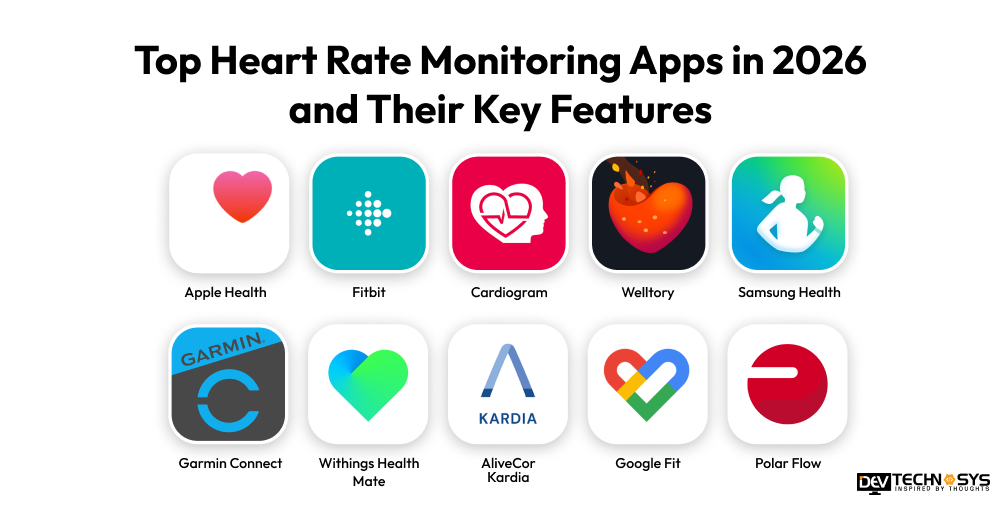
Apple Health, Fitbit, Cardiogram, and Google Fit are some of the most famous heart rate monitor apps. These apps are famous worldwide for wearable device adoption, remote patient monitoring (RPM), and AI-powered health monitoring. Have a look at the top heart rate monitoring apps along with their unique features.
App Name |
Core Focus |
Key Features |
Why It’s Popular in USA |
| Apple Health | Ecosystem health tracking | ECG, heart rate monitoring, activity tracking | Deep integration with iPhone & Apple Watch |
| Fitbit | Fitness + health monitoring | Continuous HR tracking, sleep analysis, stress management | Strong wearable adoption across USA |
| Cardiogram | AI-based heart insights | Arrhythmia detection, heart rhythm analytics | Advanced AI-driven cardiovascular insights |
| Welltory | Wellness & HRV tracking | Stress monitoring, energy tracking, HR variability | Popular for lifestyle health optimization |
| Samsung Health | Mobile health tracking | Heart rate, fitness tracking, wellness insights | Widely used Android ecosystem app |
| Garmin Connect | Sports & health monitoring | Advanced HR metrics, performance tracking | Preferred by athletes and fitness users |
| Withings Health Mate | Smart health ecosystem | Heart tracking, BP integration, health reports | Strong medical-grade device ecosystem |
| AliveCor Kardia | Medical-grade ECG monitoring | FDA-cleared ECG readings, arrhythmia detection | Trusted for clinical-level heart monitoring |
| Google Fit | Activity + heart tracking | Heart points, fitness tracking, wearable sync | Lightweight and Android-friendly solution |
| Polar Flow | Sports performance tracking | HR zones, training load analysis | Popular among professional athletes |
How Much Does It Cost to Develop a Heart Rate Monitoring App in 2026-2027?
The average cost to create a heart rate monitor app in 2026-2027 can range from $30,000 to $1,50,000. The final development expenses are determined by the app’s complexity and several other factors. We will explain it like this:
- A basic app with an MVP structure is less complex to build because of simple integrations. It can cost between $30,000 and $70,000.
- A mid-range app combines basic and advanced integrations, making it moderately complex to develop. It can be estimated from $70,000 to $1,10,000.
- An advanced app has modern and high-level integrations that make it more complex for development. It can range from $1,10,000 to $1,50,000.
Despite complexity, multiple factors exist that affect the cost to develop a heart rate monitor app. These include regulatory compliance, AI & ML, wearable integrations, backend infrastructure, and other factors. We will understand how these factors influence the cost to develop a fitness app like a heart rate monitor platform.
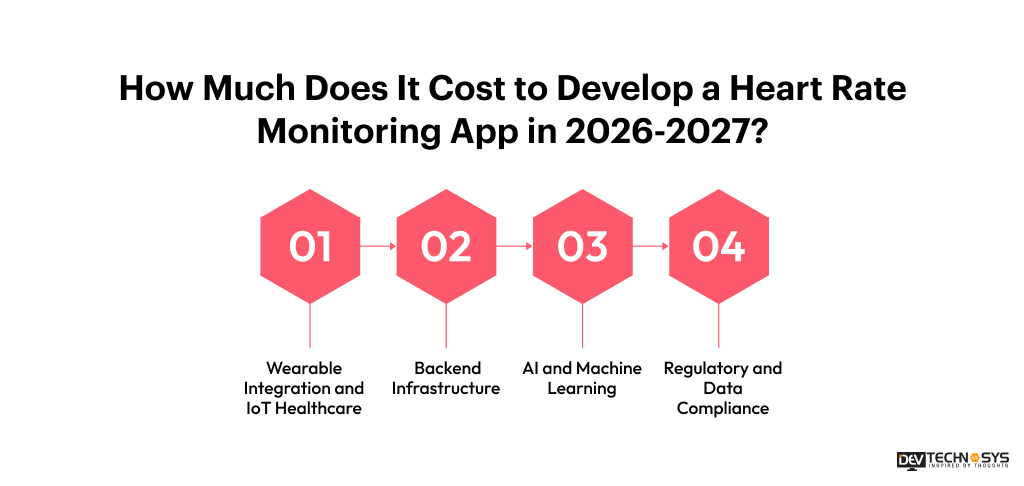
1. Wearable Integration and IoT Healthcare
Building a heart rate monitor application that integrates with wearable devices increases the development complexity. This ensures real-time data synchronization, device compatibility, Bluetooth connectivity, and secure data transmission. However, it adds to testing efforts and the overall heart rate monitor app development cost.
Integration Component |
Estimated Cost (USD) |
| Smartwatch Integration | $3,000 – $8,000 |
| Fitness Band Integration | $2,000 – $5,000 |
| Bluetooth & IoT Connectivity | $2,000 – $6,000 |
| Device Compatibility Testing | $3,000 – $6,000 |
| Total Cost | $10,000 – $25,000 |
2. Backend Infrastructure
A strong backend is important to store health records, process real-time heart rate data, and manage user accounts. It incorporates features like cloud storage, analytics dashboards, and API integrations, which require scalable backend infrastructure. This increases the operational cost to build a heart rate monitor app.
Infrastructure Element |
Estimated Cost (USD) |
| Cloud Server Setup | $4,000 – $10,000 |
| Database Development | $3,000 – $8,000 |
| API Development & Integration | $5,000 – $9,000 |
| Security & Data Management | $6,000 – $8,000 |
| Total Cost | $18,000 – $35,000 |
3. AI and Machine Learning
Advanced features like heart health predictions, anomaly detection, and personalized wellness recommendations are enabled by AI and ML. To develop and instruct these algorithms demands specialized expertise, large datasets, and additional testing. It can increase the expenses of heart rate monitor or telehealth software development.
AI Feature |
Estimated Cost (USD) |
| Predictive Health Analytics | $4,000 – $8,000 |
| Anomaly Detection Algorithms | $3,000 – $6,000 |
| Personalized Health Recommendations | $2,000 – $5,000 |
| AI Model Training & Testing | $3,000 – $5,000 |
| Total Cost | $12,000 – $24,000 |
4. Regulatory and Data Compliance
To develop a heart rate monitor app that handles sensitive health information. This makes compliance with healthcare regulations extremely important. To meet standards like HIPAA, GDPR, and other data protection laws, security audits, encryption, and legal review are required. All these can contribute to higher development expenses.
Compliance Requirement |
Estimated Cost (USD) |
| HIPAA/GDPR Compliance Setup | $2,000 – $6,000 |
| Data Encryption & Security | $2,000 – $5,000 |
| Compliance Documentation | $1,000 – $4,000 |
| Security Audits & Testing | $3,000 – $5,000 |
| Total Cost | $8,000 – $20,000 |
Common Challenges in Heart Rate Monitoring App Development and How to Solve Them
Heart rate monitor apps usually face technical challenges related to sensor accuracy, battery performance, and device compatibility. These issues can lead to poor real-time tracking and user experience. Therefore, optimizing these challenges properly during the development can solve many problems.
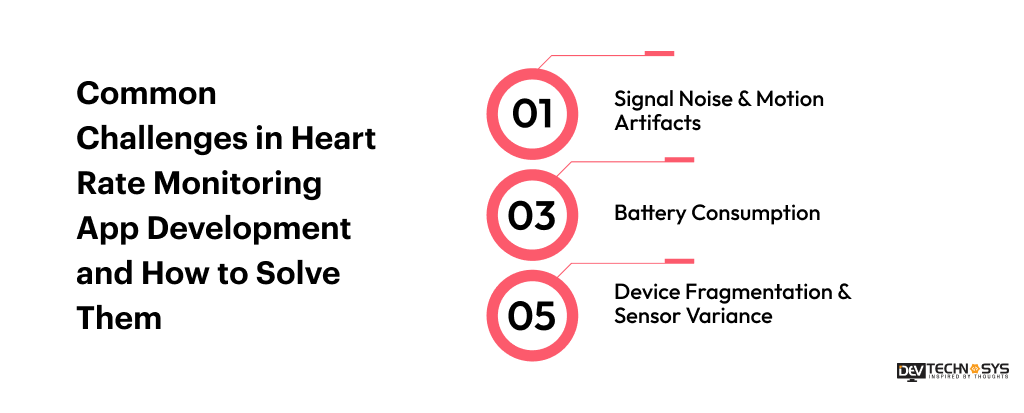
1. Signal Noise & Motion Artifacts
Due to hand movement, poor placement, or body motion, the PGP sensors could not read the data accurately. It can lead to false heart rate results and reduced tracking accuracy in real-time usage.
Solution:
- Apply adaptive filtering algorithms
- Use wavelet-based noise reduction
- Integrate edge AI for motion detection
- Train models on real-world datasets
2. Battery Consumption
If a person continuously tracks heart rate using sensors, flash, and background processing, it quickly drains the smartphone or wearable battery. This can significantly affect user experience and limit long-term monitoring.
Solution:
- Dynamic sampling rate adjustment
- Optimize background processing cycles
- Use low-power sensor modes
- Offload heavy processing to the cloud
3. Device Fragmentation & Sensor Variance
Different smartphones and wearables have varying sensor quality, camera systems, and hardware capabilities. This can be a great reason for inconsistent heart rate readings across devices.
Solution:
- Use standardized APIs (HealthKit, Health Connect)
- Implement Bluetooth Low Energy (BLE) support
- Calibrate for flagship devices first
- Set acceptable accuracy thresholds
How Accurate and Reliable Are Heart Rate Monitoring Apps: Expert Insights
Heart rate monitoring apps are usually trustworthy for daily fitness and wellness tracking. Although their accuracy and reliability depend on the technologies used. More accurate and consistent results can be expected from the apps connected to medical-grade wearables and optical sensors.
Smartphone camera-based measurements can be affected by lighting, movement, and skin tone. According to experts, these apps cannot replace clinical ECG devices. These apps are highly effective for monitoring & detecting unusual patterns.
The reliability of the heart rate monitor app improves when properly calibrated and used under stable conditions. So, basically, these apps are suitable for personal health tracking rather than medical diagnosis.
You can reach out anytime; we are available 24/7. Our team provides a quick response.

Case Study: Fynda Pro
Highly proficient developers at Dev Technosys have developed a scalable healthcare application, Fynda Pro. It is a platform developed for doctor discovery, appointment booking, and patient management. We built this platform for our clients whose motive is to connect patients with verified healthcare providers.
The initial cost to build this app was estimated at $20,000. However, advanced features increased the initial development cost due to secure integrations and enhanced functionality.
Challenge Faced: The problem is faced while ensuring data security, seamless third-party integrations, and high scalability while managing sensitive healthcare data.
Project Highlights:
- Project Name: Fynda Pro
- Client Name: Hesham Adel / Mazdiar Mehta
- Industry: Healthcare
- Team Size: 5 Developers
- Development Timeline: 4 Months
- Project Type: Healthcare Marketplace / Doctor Appointment Platform
What Monetization Models Work Best For Heart Rate Monitoring Apps?
Freemium, subscription, B2B licensing, and white-label solutions are the common monetization models used for heart rate monitoring apps. These models help the app generate revenue and ensure long-term business growth. Here, we will discuss how these models can offer continuous income streams for the app owners.
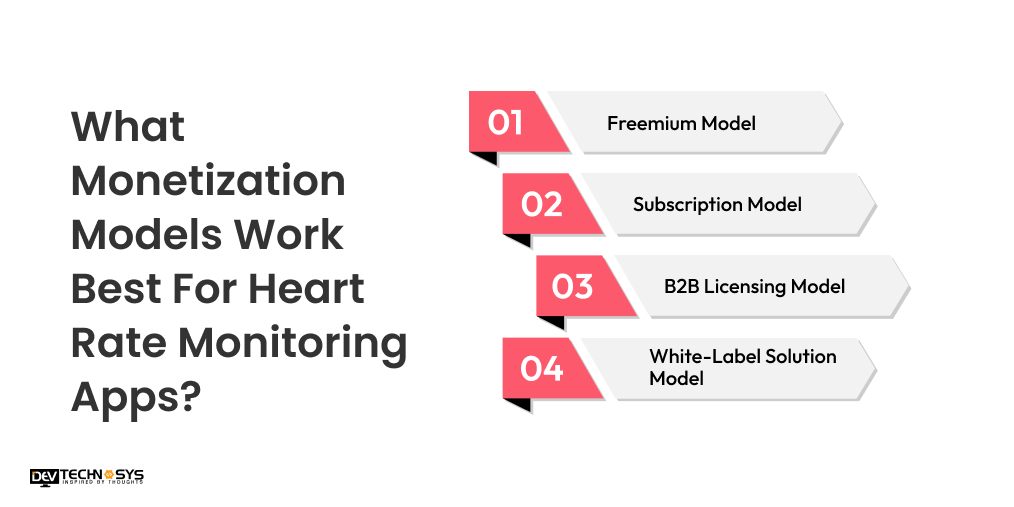
1. Freemium Model
In the freemium model, businesses offer basic heart rate tracking and BPM monitoring features for free. However, upgrades like advanced analytics, personalized health insights, detailed reports, and premium wellness tools are offered at a cost.
2. Subscription Model
The subscription model allows app owners to make revenue continuously by offering monthly or annual plans. Subscribers can access premium features like AI-driven health insights, continuous monitoring, cloud storage, personalized recommendations, and expert consultations.
3. B2B Licensing Model
By licensing the app to gyms, hospitals, clinics, wellness centers, and insurance providers, app owners can make continuous profits. Organizations use the platform for member engagement, patient monitoring, health programs, and preventive care initiatives.
4. White-Label Solution Model
Healthcare providers can purchase a customizable version of the app and launch it under their own brand. This way, they can create additional revenue opportunities while helping organizations accelerate digital healthcare adoption.
Conclusion
Heart rate monitoring apps have transformed the healthcare and fitness industries. These apps help users with real-time cardiovascular tracking, early risk detection, and personalized health insights. In this high-tech world, the adoption of wearable devices, AI-driven analytics, and remote patient monitoring is growing.
This has opened the doors for startups, healthcare providers, and enterprises to invest in heart rate monitoring apps. For development, businesses have to follow the strategy carefully and reach out to an experienced fitness app development company.
By understanding the development process, key features, cost factors, and technology requirements, businesses can build a reliable and scalable platform. These future-ready solutions meet evolving user and industry demands.
Frequently Asked Questions
Find answers to the most common questions related to this article.
The overall heart rate monitor or ECG monitoring app development cost can range between $30,000 and $1,50,000. The final cost is determined by the app’s complexity, features, backend, developer’s location, compliance, wearable integration, and more. A simple app with basic integrations is uncomplicated and inexpensive than an advanced one.
If your app is a wellness tool, not a diagnostic device, you need FDA clearance in the US or Europe. However, the moment your app claims to detect or diagnose conditions like arrhythmia or AFib, it enters regulated medical device territory. So it is always necessary to consult a regulatory expert before launch.
To create a heart rate monitor app, use the Apple HealthKit API for iOS. It is recommended to use the Google Fit/Health Connect API for Android. For wearables, integrate Bluetooth Low Energy (BLE) APIs and device SDKs. Cloud APIs like Firebase or AWS help store and sync real-time health data securely.
Yes, a heart rate monitor app can work without wearables using a smartphone camera and flash. It can detect pulse through blood flow changes in the fingertip. However, this method is less accurate compared to wearable devices like smartwatches. These can provide continuous and more reliable real-time heart rate tracking.
The average timeline required to make a heart rate monitor app is 4 to 7+ months. The development time is affected by the platform’s integrations, security level, and complexity. A basic MVP may take 3–4 months, while advanced apps with AI analytics, wearable integration, and compliance features can take longer.