


















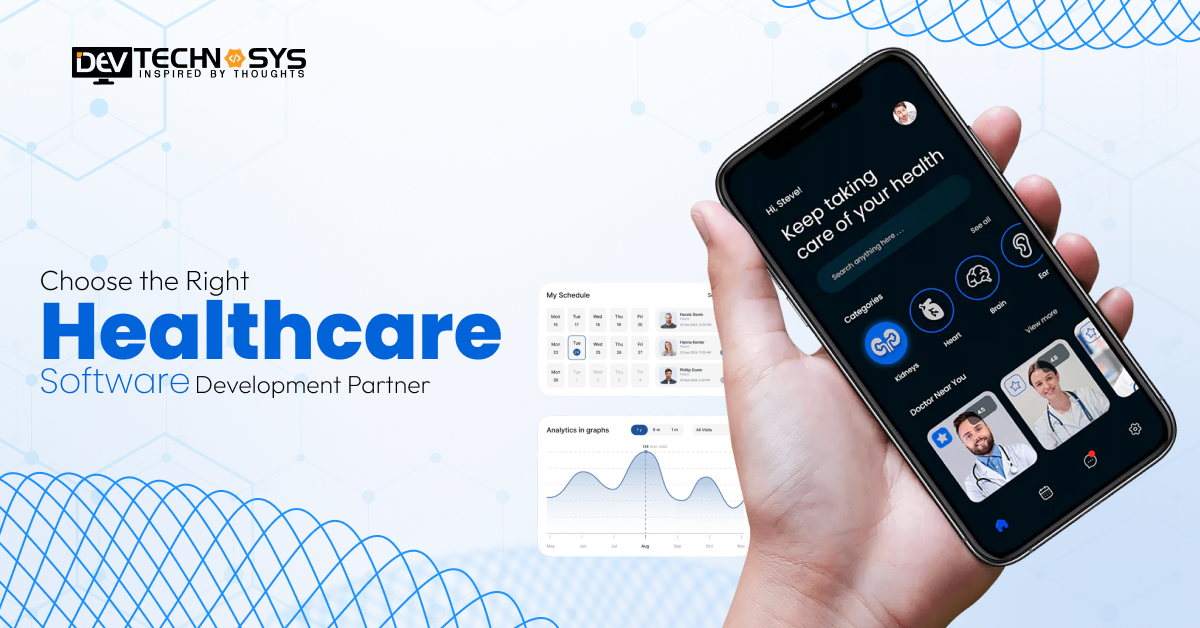
In the current rapidly shifting healthcare ecosystem, having the right technology partner can make or break the difference between innovation and inefficiency.
When choose the right healthcare software development partner, it is not simply a matter of coding; it is vital to find a partner that appreciates the importance of compliance, the security of patient data, and the complexities associated with the digital transformation of healthcare.
Strategic alignment is critical, whether it is an EHR system, a telemedicine tool, or an AI-based diagnostic solution, as your partner must share your vision, core values, and an understanding of the regulations.
This blog outlines the most important considerations to make, such as the balance of technical capabilities with industry experience and the importance of communication and scalability.
Let’s make a positive and informed choice that drives growth, minimizes risk, and creates value for patients and healthcare providers.
Understanding Your Healthcare Software Needs
Choose the right healthcare software development partner is crucial for delivering secure, compliant, and innovative digital solutions. The right partner helps healthcare organizations streamline operations, enhance patient care, and achieve long-term success through expertise, technology, and a deep understanding of healthcare regulations.
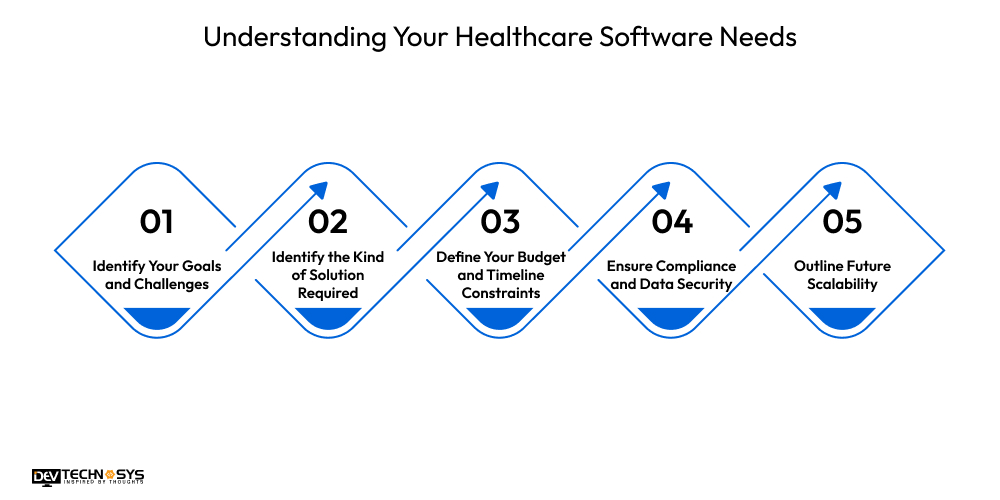
1. Identify Your Goals and Challenges
Begin by understanding what your organization is trying to accomplish or what problems it is trying to solve. Do you want to improve patient engagement, streamline workflows, or improve regulatory compliance?
Defining these goals early on helps to determine what features and architecture, and how scalable the software needs to be, while ensuring the project aligns with your overarching strategy in healthcare.
2. Identify the Kind of Solution Required
Identify the type of software you require, whether it is an EHR, telemedicine, patient portal, or analytics solution. Knowing what your solution type is will increase the chances that your enterprise product development partner will have the appropriate domain expertise. Which minimizes redundant, expensive changes and helps guarantee that the software will be of clinical and operational value when it is done.
3. Define Your Budget and Timeline Constraints
Budget and timeline expectations should be realistic and established before involving any partner. Given the complex integrations and compliance costs associated with most healthcare projects, understanding the constraints on project scope will enable better planning and reduce the likelihood of scope creep and associated delays. This will ensure the software delivers on the defined business and clinical goals.
4. Ensure Compliance and Data Security
The compliance of healthcare startup solutions with HIPAA, GDPR, and HL7 standards is crucial to protect patient data. State your compliance expectations when the project is initiated. A development partner experienced in healthcare security standards ensures legal adherence, data privacy, and trust across your digital health ecosystem.
5. Outline Future Scalability
Think beyond immediate requirements and plan for future expansion. Your healthcare software should easily integrate with existing hospital systems, IoT devices, or third-party APIs.
Prioritizing scalability ensures your platform evolves alongside technology trends, patient demands, and regulatory updates without requiring a complete redevelopment later.
10 Key Criteria for Selecting a Healthcare Software Development Partner
To choose the right healthcare software development partner, it is critical to build a medical app like K Health. From regulatory compliance and technical expertise to UX design and post-launch support, selecting a partner who aligns with your goals ensures innovation, efficiency, and long-term success.
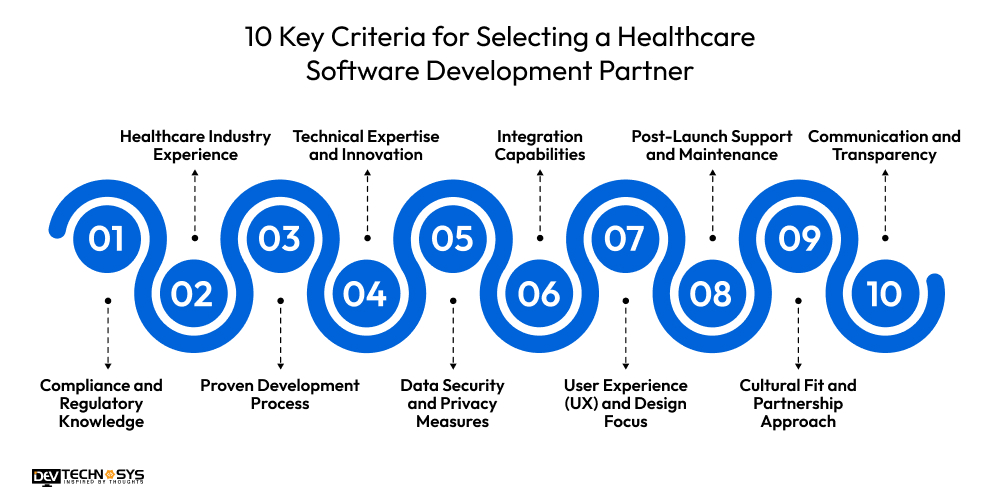
1. Compliance and Regulatory Knowledge
Your partner must demonstrate a deep understanding of healthcare regulations like HIPAA, HITECH, GDPR, and other data protection laws. Compliance ensures patient confidentiality and legal safety.
A skilled partner should implement robust data security measures, encryption standards, and privacy protocols, protecting sensitive medical information while aligning your software with national and international healthcare standards.
2. Healthcare Industry Experience
Hire software developers with proven experience in developing healthcare solutions such as EHR, telemedicine, and patient management systems. Industry expertise ensures they understand medical workflows, regulatory constraints, and patient data management.
Review their portfolio and case studies to confirm they’ve successfully delivered similar healthcare projects and can navigate industry-specific challenges efficiently.
3. Proven Development Process
Ensure the company follows structured methodologies like Agile, Scrum, or DevOps for efficient project management. A defined process ensures transparency, timely delivery, and continuous improvement.
Ask how they manage sprints, testing, and feedback loops. A disciplined process minimizes risks, maintains code quality, and ensures that evolving project requirements are handled smoothly throughout the development cycle.
4. Technical Expertise and Innovation
Evaluate their technical stack proficiency, from AI, ML, and cloud computing to interoperability standards like HL7 and FHIR. Hire dedicated developers to build scalable, future-proof healthcare applications.
They should also integrate innovative technologies such as IoT for remote monitoring or data analytics for predictive care, helping your organization stay competitive and digitally advanced.
5. Data Security and Privacy Measures
Data protection is crucial in healthcare software. Your development partner should employ strict security protocols, such as end-to-end encryption, role-based access control, and regular security audits.
They must also have a proactive approach to handling breaches and vulnerabilities. Ensuring that patient data remains secure builds trust and meets stringent healthcare data protection standards.
6. Integration Capabilities
A strong chatbot development partner must ensure the seamless integration of new software with existing healthcare systems, such as EMRs, hospital management tools, and billing platforms.
They should understand interoperability standards (FHIR, DICOM, HL7) to allow smooth data exchange between platforms. This reduces workflow disruption, enhances data accessibility, and improves overall healthcare delivery efficiency within your organization.
7. User Experience (UX) and Design Focus
Healthcare software should be intuitive and user-friendly for doctors, nurses, and patients alike. Choose a partner who prioritizes UX design, conducting user research, usability testing, and accessibility compliance.
A well-designed interface reduces errors, enhances engagement, and improves satisfaction. Human-centered design ensures that technology truly supports clinical workflows and patient interaction effectively.
8. Post-Launch Support and Maintenance
Software development doesn’t end at launch. A reliable partner for mobile app development in healthcare industry offers long-term maintenance, updates, and technical support.
They should monitor performance, fix bugs, and ensure compliance with evolving regulations. Continuous support guarantees system reliability and scalability, helping your organization adapt to new healthcare technologies and user demands without compromising service quality or security.
9. Cultural Fit and Partnership Approach
Beyond technical skills, cultural alignment ensures smoother collaboration. Look for a partner who values transparency, accountability, and innovation, and aligns with your organization’s mission.
A partnership approach, rather than a transactional one, encourages shared ownership of outcomes, open communication, and long-term strategic collaboration. This alignment results in better product quality and lasting business success.
10. Communication and Transparency
Clear and consistent communication is essential for project success. Hire healthcare app developers who offer open reporting, collaborative tools, and dedicated project managers.
Regular progress updates, milestone reviews, and accessible documentation foster mutual trust. Transparent communication helps resolve issues quickly, aligns expectations, and keeps your team informed about project timelines, risks, and deliverables.
Common Challenges Occur When Hiring a Healthcare Software Development Partner
When hiring the right custom healthcare software development company or partner, there are many common challenges that occur. You must know about these factors or errors to streamline your hiring process. So, let’s check out these challenges:
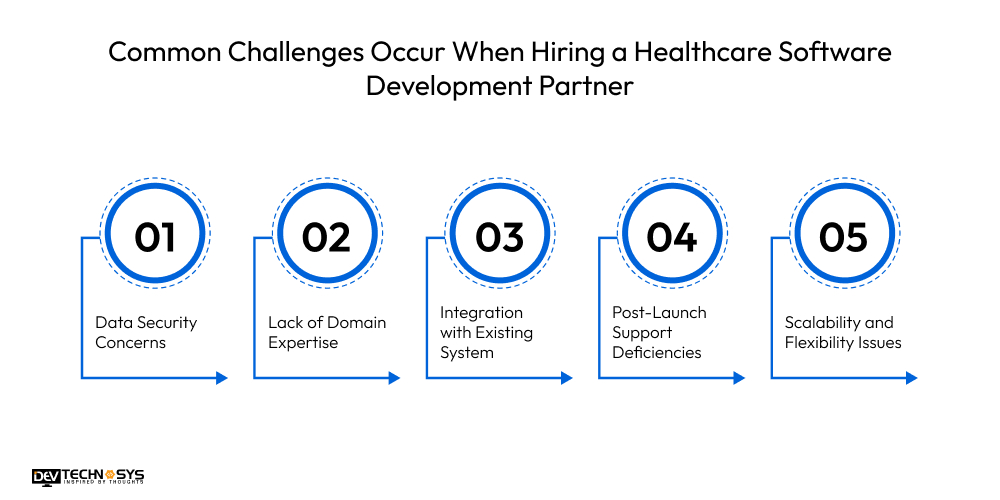
1. Data Security Concerns
The healthcare software data is highly sensitive, so it needs to integrate strong security and privacy concerns. But some software development partners do not implement the robust methods or approaches of security and privacy.
So, it is one of the most well-known challenges to choose the right healthcare software development partner that offers proven data protection strategies.
2. Lack of Domain Expertise
In healthcare software product development, there are various systems required, such as EHR/EMR integration, clinical workflows, patient portal, and many more.
Most of the digital healthcare solution providers have strong and enough technical expertise, but lack in the healthcare ecosystem or domain expertise. This can lead to misaligned healthcare solutions.
3. Integration with Existing System
We live in a world where multiple relevant services are accessed on one platform, which means integrations of tools and systems are necessary in every type of solution.
In healthcare software, there are multiple legacy systems that are integrated, but some hospital software development services provider has less experience in integrating existing systems like HL7 and FHIR.
4. Post-Launch Support Deficiencies
The healthcare software requires post-launch maintenance and support services to maintain the actual performance and ongoing troubleshooting. Some of the medical device software development partners offer limited post-launch maintenance and support services, this can delay clients’ projects and leave them vulnerable to conditions. So, choose the right healthcare software development partner that provides long-term maintenance and support services.
5. Scalability and Flexibility Issues
The healthcare software is growing and changing its features over time. Some of the telemedicine app development parents build a rigid healthcare software that can not handle a higher number of users and cannot adapt to changing needs.
This lack of scalability leads to a redevelopment of healthcare software. At last, choosing a healthcare software development services provider that offers a futuristic healthcare solution.
Some Critical Questions to Ask a Healthcare Software Development Partner Before Selecting
There are various types of questions to ask a healthcare software development company before hiring them. Let’s explore the questions that help to choose the right healthcare software development partner:
1. Can You Share Case Studies Relevant to My Organization’s Needs?
Correct Answer: Custom healthcare software development companies share detailed case studies with projects similar to your requirements and needs.
Provide a wide variety of healthcare software development solutions such as HIPAA-compliant telemedicine platforms, EHR integrations, patient management systems, and cloud-based solutions. These showcase measures the expected outcomes and their ability to meet your specific requirements.
2. How Do You Handle Data Security and Compliance?
Correct Answer: The healthcare technology partners implement strong data security measures such as two-factor authentication, encryption techniques, firewalls, biometrics, and secure access control. Implement compliance with industry standards such as GDPR and HIPAA. Continuously conduct the software testing services, such as automated, unit, functional, security, and user-acceptance testing.
3. What Experience Do You Have With Cloud Platforms and Modern Architecture?
Correct Answer: The cloud healthcare software development partners have experience in deploying healthcare solutions on the modern cloud platform, such as AWS, Azure, Google Cloud, and many more.
Their development team uses containerization, microservices, and API-first development to deliver secure, elastic, and modern applications. This can reduce the backend and frontend infrastructure cost and maximize scalability.
4. How is Your Project Management Methodology Aligned with Healthcare Projects?
The SaaS application development partner process is rooted in Agile and DevOps practices tailored for healthcare, ensuring continuous delivery, close stakeholder collaboration, and quick adaptation to regulatory changes.
They prioritize transparent communication, regular updates, and iterative releases, coupled with rigorous testing and compliance validation to deliver secure, reliable, and patient-centered healthcare solutions.

Choosing Between In-House and Outsourced Healthcare Software Development Partner
Are you confused about choosing between an in-house and outsourced development partner? Yes, it happens. Look at the comparison table below to clear all your doubts and confusions, select the right healthcare software development partner that meets your unique demands and needs.
| Factor | In-House Development | Outsourced Partner |
| Cost Control | Full control over budget, resource allocation, and long-term expenses | Can have hidden costs, variable pricing, or additional fees |
| Expertise Alignment | Team is fully aligned with the company vision, processes, and domain knowledge | May require time to understand your healthcare workflows and standards |
| Scalability & Prioritization | Projects prioritized internally; quick shifts in focus possible | Limited by the partner’s availability and competing projects |
| Time-to-Market | Faster decision-making and iterations since the team is internal | Delays are possible due to communication gaps or remote coordination |
| Security & Compliance | Direct oversight of patient data and adherence to HIPAA/GDPR standards | Dependence on the partner’s protocols and trustworthiness |
| Customization & Flexibility | Fully customizable solutions tailored to your exact needs | May be restricted to the partner’s frameworks, templates, or standard processes |
| Maintenance & Support | Immediate in-house support, bug fixes, and upgrades | Support may be slower or require separate contracts |
Conclusion
To choose the right healthcare software development partner, you will need to observe the key criteria such as technical expertise, healthcare domain expertise, proven track record, and more. We think that you have cleared all your doubts regarding selecting the best healthcare software development company.
Do you want to develop healthcare software? Then, you can directly reach a software development company that offers customized solutions at an affordable budget.
Frequently Asked Questions
Find answers to the most common questions related to this article.
To build a long-term partnership with a healthcare software company, focus on transparent communication, shared goals, and mutual trust. Establish clear expectations, maintain regular collaboration, prioritize quality and compliance, and invest in continuous improvement to ensure lasting success and innovation.
There are various steps to choose the right healthcare software development company:
● Define project requirements clearly
● Check industry expertise
● Evaluate technical competence
● Assess security and compliance standards
● Review client feedback
Alot of things to consider before hiring healthcare automation software developers:
● Healthcare domain knowledge
● Technical proficiency
● Experience in similar projects
● Testing and quality assurance
● Security practices
Yes, most of the healthcare development companies are experienced with interoperability standards like HL7, FHIR, and DICOM. They understand that these frameworks enable secure data exchange and make that compatible with various healthcare systems.
To build a healthcare software, it mainly takes around 3 to 6 months. The total development time is mainly based on the various factors, including resource planning, designing, feature integration, designing UI/UX, software development, testing, QA, and deployment.