
















Quick Summary:
Healthcare ERP software development cost in 2026–2027 typically ranges from $30,000 to $150,000+, depending on the modules, compliance requirements, integrations, deployment model, and customization level.
Cost Breakdown by Complexity:
-
- Basic Healthcare ERP (MVP): $30,000 – $50,000 (patient registration, appointment scheduling, billing, inventory management, finance, and reporting)
- Mid-Level Healthcare ERP: $50,000 – $100,000 (EHR/EMR integration, pharmacy management, laboratory management, HR, procurement, insurance claims, and third-party integrations)
- Enterprise Healthcare ERP: $100,000 – $150,000+ (AI-powered analytics, telemedicine, multi-hospital management, interoperability, predictive analytics, IoT-enabled medical devices, and advanced workflow automation)
Key Cost Factors:
-
- Healthcare ERP software costs are influenced by HIPAA/GDPR compliance, UI/UX design, cloud vs. on-premise deployment, API integrations, EHR/EMR interoperability, cybersecurity, AI capabilities, data migration, and the technology stack.
Development Timeline:
-
- Developing a custom healthcare ERP solution generally takes 3 to 7+ months, depending on project scope, customization requirements, regulatory compliance, testing, and implementation.
Regional Development Costs:
-
- Outsourcing healthcare ERP development to countries like India can reduce development costs by 15% compared to other countries while maintaining enterprise-grade quality and compliance standards.
Deployment Model Impact:
-
- Cloud Healthcare ERP: Lower upfront infrastructure costs, faster deployment, automatic updates, and easier scalability.
- On-Premise Healthcare ERP: Higher initial investment due to server infrastructure, licensing, security management, and ongoing maintenance.
High-Cost ERP Modules:
-
- Electronic Health Records (EHR/EMR), Hospital Information Systems (HIS), Customer Relationship Management, Laboratory Information Systems (LIS), Telehealth Software, and AI-powered Clinical Decision Support are among the most expensive modules to develop.
Hidden Cost Drivers:
-
- Data migration, legacy system modernization, HIPAA/GDPR compliance, interoperability standards (HL7/FHIR), cybersecurity implementation, employee training, third-party software licensing, cloud infrastructure, and post-launch support can significantly increase the total project budget.
Annual Maintenance Cost:
-
- Businesses should budget approximately 15–20% of the initial development cost annually for software maintenance, security updates, compliance upgrades, cloud infrastructure, performance optimization, and feature enhancements.
Business Value:
-
- Investing in a custom healthcare ERP enables hospitals, clinics, and healthcare organizations to streamline clinical and administrative workflows. Organizations can focus on patient care and drive higher long-term ROI.
A healthcare enterprise resource planning system streamlines regular workflow across departments to ensure smooth coordination among teams. Medical staff can check the patient’s data in real-time to provide the best treatment. From patients’ billing to scheduling an appointment, from checking electronic health records to managing laboratory workflows, a healthcare ERP system improves efficiency.
Organizations must estimate the healthcare ERP software development cost to predict the budget. The cost is usually affected by the latest technologies, modules, and security features.
This guide explains the pricing structure by project size, factors that affect the budget, development phases, and ways to reduce overall costs.
Healthcare ERP Market Trends and Cost Statistics 2026-2027
As per our understanding of the Healthcare ERP market from Grand View Research, we have analyzed that these systems are increasingly adopted by organizations. Mid-level to large healthcare organizations are finding this software to be easily accessible and secure.
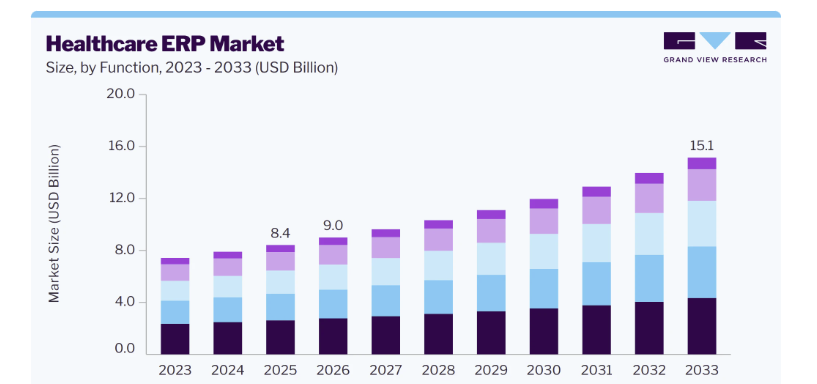
Some of our key findings include:
- The global healthcare ERP market is projected to grow to USD 15.1 billion by 2033 at a CAGR of 7.7%.
- North America is the leading market for building medical ERP software development.
- This growing demand is an opportunity for developers to enhance their skills to design ERP with the latest technologies.
- The increase in adoption of cloud computing in healthcare ERP is accelerating market expansion.
Healthcare ERP Software Development Cost at a Glance 2026-2027
The average healthcare ERP software development cost ranges from $30,000 to $150,000+ in 2026–2027. The cost depends on regulatory compliance, third-party APIs, and the size of the healthcare organization.
Below is a detailed breakdown of healthcare ERP pricing based on project complexity.
- A Basic Healthcare ERP typically costs $30,000 – $50,000 and is built with administrative modules. This is often used by clinics or diagnostic centers for appointment scheduling, billing, and patient & staff reporting.
- A Mid-Level Healthcare ERP supports more advanced workflows and ranges between $50,000 and $80,000. Such systems allow role-based access control, EHR/EMR integration, and pharmacy management.
- An Enterprise Healthcare ERP generally costs $80,000 to $120,000 and is designed for large hospitals and healthcare networks. Such organizations need to automate workflows to manage data across departments. This cost also includes costs for regulatory compliance.
- A Custom AI-Powered Healthcare ERP is an enterprise-grade platforms that support predictive analytics, personalized patient insights, and custom workflows. This is specifically built to manage complex healthcare operations. The cost is usually more than $150,000+ because of the advanced functionality used.
The following table provides a clear overview of healthcare ERP software development costs by solution type.
| Healthcare ERP Type | Ideal For | Included Features & Modules | Healthcare ERP Development Cost (USD) |
| Basic Healthcare ERP | Small clinics, diagnostic centers, and healthcare startups | Patient registration, appointment scheduling, billing, inventory management, finance, reporting, user management, and basic administrative workflows | $30,000 – $50,000 |
| Mid-Level Healthcare ERP | Multi-specialty clinics and mid-sized hospitals | EHR/EMR integration, pharmacy management, laboratory management, HR, procurement, insurance claims, role-based access, dashboards, and third-party integrations | $50,000 – $80,000 |
| Enterprise Healthcare ERP | Large hospitals and healthcare organizations | Multi-hospital management, interoperability (HL7/FHIR), revenue cycle management, compliance management, advanced reporting, healthcare analytics, cybersecurity, and workflow automation | $80,000 – $120,000 |
| Custom AI-Powered Healthcare ERP | Enterprise healthcare providers, hospital chains, and digital health platforms | AI-powered clinical decision support, predictive analytics, telemedicine, IoT-enabled medical devices, intelligent automation, custom workflows, NLP, advanced analytics, and enterprise integrations | $120,000 – $150,000+ |
7 Factors that Increase Healthcare ERP Development Costs
The basic factors are the healthcare modules and business size. Understanding these helps to create a strategic investment plan to increase ROI. A future-ready plan is much better than experiencing risks.
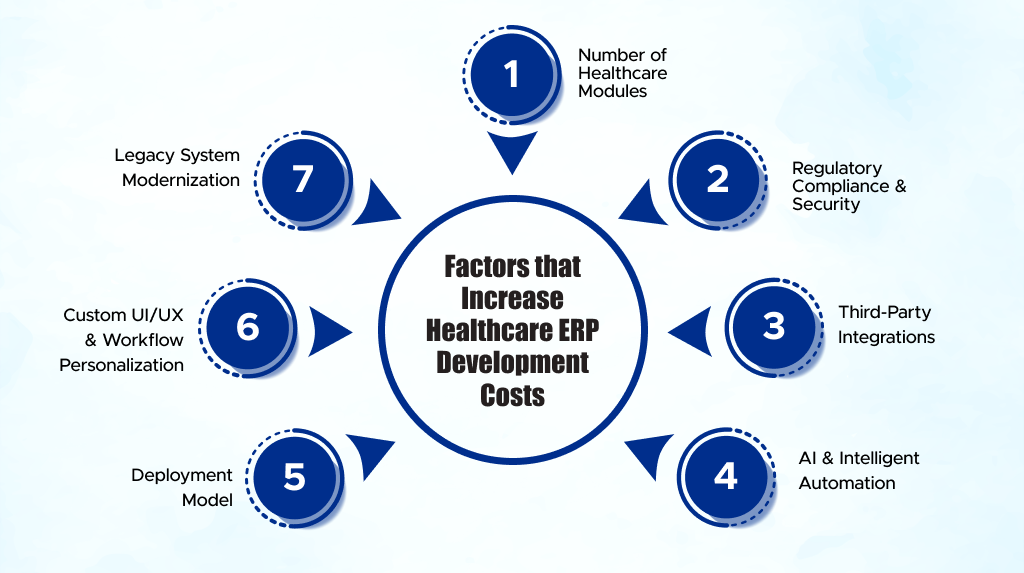
1. Number of Healthcare Modules
A basic ERP comprises at least 3 modules. Any addition to it directly affects the development cost. An example is shown in the table.
| Module Complexity | Healthcare ERP Cost Per Module (Estimated) |
| Basic (2–3 modules) | $25,000–$60,000 |
| Medium (4–7 modules) | $60,000+ |
| Enterprise (8+ modules) | $150,000+ |
2. Regulatory Compliance & Security
Organizations cannot compromise compliance standards because an ERP system transfers sensitive information. This is the main factor that increases cost.
| Compliance Requirement | Estimated Medical ERP Software Development Cost |
| HIPAA Compliance | $10,000–$30,000 |
| GDPR Compliance | $8,000–$20,000 |
| HL7/FHIR Integration | $15,000–$50,000 |
| Security Testing & Audits | $5,000–$20,000 |
3. Third-Party Integrations
The complexity of integrations is only solved by dedicated developers who have proven industry knowledge. This affects the cost to build a healthcare ERP.
| Integration Type | Estimated Clinic ERP Software Development Cost |
| Payment Gateway | $2,000–$8,000 |
| EHR/EMR Integration | $10,000–$40,000 |
| Laboratory & Pharmacy Systems | $8,000–$25,000 |
| Insurance & Billing APIs | $5,000–$20,000 |
4. AI & Intelligent Automation
Organizations that prefer AI implementation require expertise in ML, data engineering, and advanced algorithms, which directly affects the development cost.
| AI Feature | Estimated Healthcare ERP Software Pricing |
| AI Chatbot | $8,000–$20,000 |
| Predictive Analytics | $20,000–$50,000 |
| Clinical Decision Support | $30,000–$80,000 |
| Workflow Automation | $10,000–$35,000 |
5. Deployment Model
Organizations that choose cloud-based healthcare ERP solutions generally experience lower costs as compared to hybrid and on-premise solutions.
| Deployment Type | Estimated Healthcare ERP Project Cost |
| Cloud-Based ERP | $30,000–$150,000 |
| On-Premise ERP | $60,000–$250,000+ |
| Hybrid Deployment | $70,000–$300,000+ |
6. Custom UI/UX & Workflow Personalization
Customizations often add up to the average cost because it involves frontend development and user testing.
| Customization Level | Estimated Healthcare ERP Development Rates |
| Basic UI Customization | $5,000–$15,000 |
| Advanced Dashboards | $15,000–$40,000 |
| Mobile Applications | $20,000–$60,000 |
| Workflow Personalization | $10,000–$35,000 |
7. Legacy System Modernization
This factor affects cost because data is validated and transformed to a new ERP solution, which requires additional development effort.
| Migration Complexity | Estimated Healthcare ERP Development Services Cost |
| Basic Data Migration | $5,000–$15,000 |
| Medium Complexity | $15,000–$40,000 |
| Enterprise Legacy Migration | $40,000–$100,000+ |
Industry Insight: According to Precedence Research, AI is significantly impacting the healthcare ERP market. The market size is expected to be valued at USD 13.38 billion by 2035.
Healthcare ERP Development Cost Breakdown by Project Phase
Organizations partnering with a healthcare app development company must prioritize project management methodology such as agile to ensure consistent reporting. They must choose a company that is CMMI Level 3 certified and provides a non-disclosure agreement.
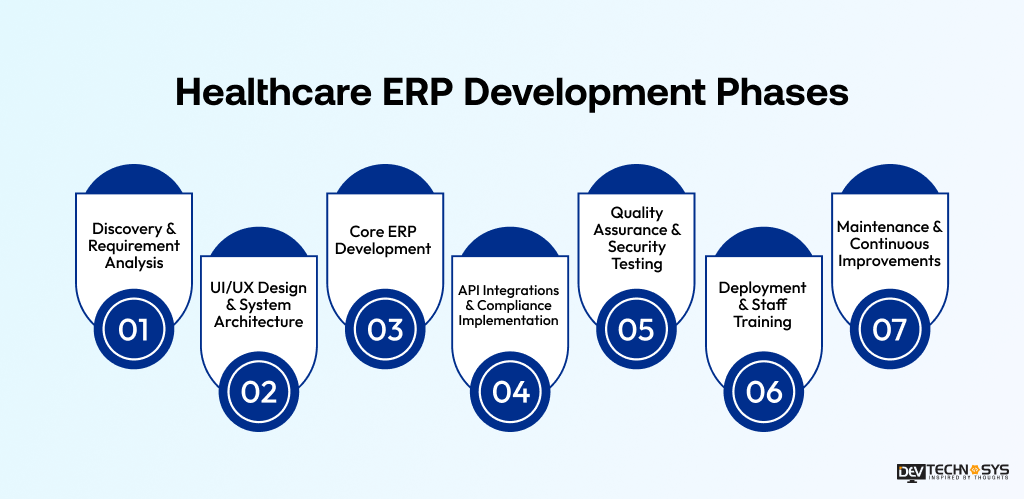
| Development Phase | Key Activities | Estimated Healthcare ERP Software Cost |
| 1. Discovery & Requirement Analysis | Business analysis, workflow mapping, feasibility study, healthcare compliance planning, project roadmap | 5% |
| 2. UI/UX Design & System Architecture | Wireframes, dashboard design, database architecture, user journey, technical planning | 10% |
| 3. Core ERP Development | Development of patient management, billing, finance, HR, inventory, procurement, pharmacy, and other core modules | 12% |
| 4. API Integrations & Compliance Implementation | EHR/EMR integration, HL7/FHIR interoperability, payment gateways, insurance systems, medical devices, HIPAA/GDPR security implementation | 15% |
| 5. Quality Assurance & Security Testing | Functional testing, penetration testing, compliance validation, performance optimization, bug fixing | 10% |
| 6. Deployment & Staff Training | Cloud/on-premise deployment, user onboarding, documentation, employee training, go-live support | 5% |
| 7. Maintenance & Continuous Improvements | Security patches, feature enhancements, cloud monitoring, technical support, compliance updates, performance optimization | 10% annually |
How Does Healthcare Compliance Impact ERP Development Costs?
Before beginning any project, businesses must know about the regulatory compliance associated with healthcare. Healthcare software development companies often charge for compliance to avoid legal issues.
1. HIPAA Compliance Cost
Health Insurance Portability and Accountability Act is mandatory for healthcare ERP systems operating in the United States. This compliance process takes more time for developers because the software product must be tested multiple times before deployment.
| Factor | Details |
| Estimated Implementation Cost | $8,000–$20,000 |
| Key Requirements | PHI encryption, RBAC, audit logs, MFA, secure backups, breach notifications |
2. FHIR Implementation Cost
Fast Healthcare Interoperability Resources enables healthcare ERP software with medical systems to generate patient reports and analyze overall medical expenditure.
| Factor | Details |
| Standard | FHIR (Fast Healthcare Interoperability Resources) |
| Estimated Implementation Cost | $8,000–$20,000 |
| Key Requirements | REST APIs, OAuth 2.0, SMART on FHIR, patient data exchange |
3. HL7 Integration Cost
HL7 (Health Level Seven) is a messaging standard for healthcare interoperability. It enables seamless communication between hospital systems, laboratories, pharmacies, radiology software, and electronic health records (EHRs).
| Factor | Details |
| Standard | HL7 |
| Estimated Integration Cost | $6,000–$18,000 |
| Key Requirements | Message parsing, interoperability, API integration, interface engine |
4. GDPR Compliance Cost
GDPR (General Data Protection Regulation) governs how organizations collect, process, and store personal data belonging to European Union residents.
| Factor | Details |
| Region | European Union |
| Estimated Implementation Cost | $5,000–$15,000 |
5. ISO 27001 Implementation Cost
This is an internationally recognized information security standard that helps healthcare ERP vendors establish secure information management. This compliance affects cost because it is mandatory to build consumer trust.
| Factor | Details |
| Standard | ISO/IEC 27001 |
| Estimated Implementation Cost | $6,000–$15,000 |
| Key Requirements | Risk assessment, ISMS, encryption, security monitoring, access management |
6. SOC 2 Compliance Cost
Software vendors use this compliance for cloud-based healthcare ERP solutions to ensure strong privacy controls and accessibility. Since multiple users access sensitive medical data, additional technical costs are required.
| Factor | Details |
| Standard | SOC 2 |
| Estimated Implementation Cost | $4,000–$10,000 |
| Key Requirements | Audit logging, infrastructure security, disaster recovery, identity management |
Industry Insight: According to Markets and Markets, healthcare organizations are preferring cloud-based deployments because of security and scalability.
Healthcare ERP Development Costs by Region Comparison
When choosing the ERP healthcare software development partner, businesses should evaluate price according to specific regions.
1. Healthcare ERP Development Cost in North America
This region is expensive because of advanced cybersecurity practices and high labor costs. Also, strict healthcare regulations require extensive knowledge.
| Factor | Details |
| Average Hourly Rate | US$120–US$250/hour |
| Estimated Project Cost | US$90,000+ |
| Advantages | Mature healthcare IT ecosystem, HIPAA expertise, enterprise-grade quality |
| Challenges | Highest development and operational costs |
| Best For | Enterprise hospitals and healthcare networks |
2. Healthcare ERP Software Pricing in Western Europe
Cost to develop ERP software is higher, but organizations can expect exceptional software quality and long-term reliability. Solutions are built using GDPR and technical expertise.
| Factor | Details |
| Average Hourly Rate | €90 – €170/hour |
| Estimated Project Cost | €75,000+ |
| Advantages | GDPR compliance, experienced healthcare developers, premium software quality |
| Challenges | Higher labor and maintenance expenses |
| Best For | European healthcare providers and enterprise projects |
3. Healthcare ERP Project Cost in Eastern Europe
Eastern Europe offers an excellent balance between affordability and technical expertise. Developers are highly skilled in enterprise software, cloud computing, and healthcare system integrations. Many healthcare organizations outsource projects to this region to reduce costs while maintaining strong development quality.
| Factor | Details |
| Average Hourly Rate | €40 – €80/hour |
| Estimated Project Cost | €45,000+ |
| Advantages | Competitive pricing, strong engineering talent, good communication |
| Challenges | Smaller healthcare ERP talent pool than Asia |
| Best For | Mid-sized healthcare organizations |
4. Custom Healthcare ERP Development Cost in India
Healthcare app development cost is budget-friendly in this region without compromising quality. Businesses gain access to a large pool of talent, developers with strong technical expertise and industry knowledge.
| Factor | Details |
| Average Hourly Rate | ₹1,800–₹4,500/hour |
| Estimated Project Cost | ₹8,00,000–₹30,00,000+ |
| Advantages | Cost-effective development, AI expertise, large developer community |
| Challenges | Time zone differences for Western clients |
| Best For | Startups, SMEs, hospitals, and enterprises seeking cost optimization |
5. Healthcare ERP Upgrade Cost in the Middle East
Organizations may experience higher costs due to increased demand for enterprise-grade systems with advanced security. Businesses should always carefully compare healthcare ERP software development quotes before choosing a development partner.
| Factor | Details |
| Average Hourly Rate | AED180–AED450/hour (UAE) |
| Estimated Project Cost | AED220,000–AED550,000+ |
| Advantages | Strong investment in healthcare digitalization, enterprise adoption |
| Challenges | Limited local ERP development talent |
| Best For | Government healthcare projects and private hospital groups |
Expert Insight: Organizations are demanding data-driven operations, which is possible with the integration of emerging technologies and choosing the right development partner. Healthcare organizations must prioritize investment at an initial development phase to avoid hidden expenditure after the ERP deployment.
3 Hidden Healthcare ERP Costs That Can Increase Your Project Budget
Many organizations skip considering healthcare ERP maintenance costs, its upgradation, migration, and integration, which count as hidden expenses. Identifying these costs will help to create realistic budgets.
1. Third-party API Integration Cost
Large healthcare organizations need to integrate their ERP systems with EHR, medical notes, patient monitoring systems, and perform scheduling, which requires a third-party integration. These often require sufficient development time and cost.
2. Cost for Data Migration
The cost to build a custom healthcare software for your hospital may be lower in comparison to upgrading a legacy system. Additional testing is necessary to clean, standardize, and validate the previous data without affecting its quality.
3. Role-based User Training
Doctors, nurses, administrative staff, finance teams, and IT personnel require training to access the ERP software. If users are not aware of accessibility, a hospital might lose productivity. Thus, this hidden cost should be taken into account.
How to Reduce Healthcare ERP Development Costs Without Compromising Security or Compliance?
Understanding the healthcare ERP software development cost breakdown is primary, but knowing how it is reduced is an important part. Implementing the best cost strategy can help businesses to control costs.
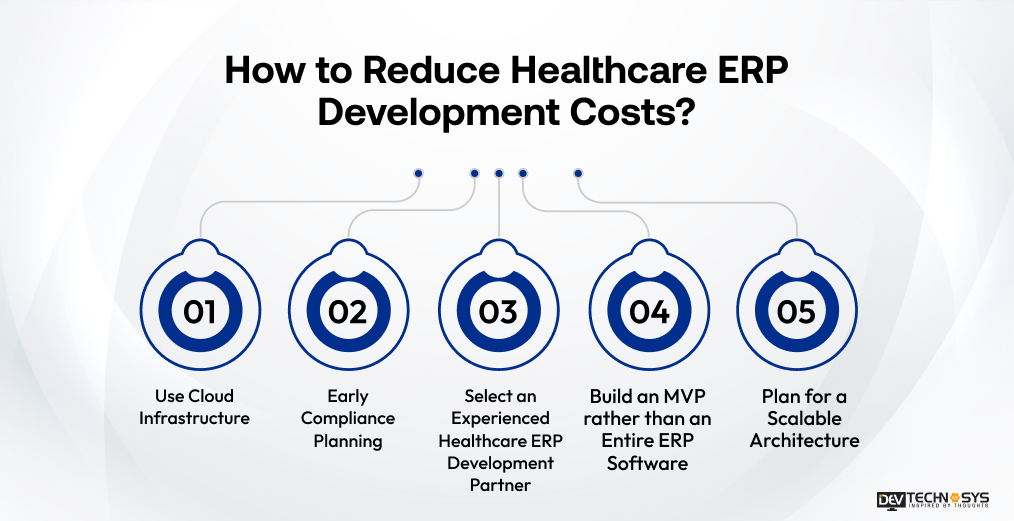
1. Use Cloud Infrastructure
Cloud solutions are one of the top trends in healthcare software development that organizations should use. Cloud infrastructure saves costs associated with hardware, data centers, and maintenance. These allow businesses to achieve faster deployment, automatic backup, and pay-as-you-grow pricing.
2. Early Compliance Planning
When selecting a partner, always understand healthcare ERP software pricing, including regulatory compliance. This reduces costs for failed audits and security breaches, as organizations already receive HIPAA/GDPR-ready architecture and role-based access control.
3. Select an Experienced Healthcare ERP Development Partner
Organizations should carefully analyze ERP case studies, domain expertise, FHIR/HL7 integration capability, and compliance implementation experience. Verifying a partner with these capabilities helps businesses to secure expenses.
4. Build an MVP rather than an Entire ERP Software
A Minimum Viable Product (MVP) reduces initial development costs and can be scaled gradually as per business needs. Develop only core modules such as patient monitoring, reporting, and billing to save healthcare ERP development pricing.
5. Plan for a Scalable Architecture
This step might be expensive initially, but it saves a huge amount when integrating AI features. Modular ERP design allows organizations to add new integrations or features without redesigning the entire platform.
Our Recommendation: Organizations should compare the costs associated with compliance standards, security practices, post-launch support, and deployment modules to ensure savings. A scalable ERP solution is a foundation of overall business success.
Healthcare ERP ROI Calculator: Estimate Your Return on Investment
Calculating ROI helps organizations to determine whether the investment aligns with their financial expectations. Businesses should use this formula to calculate ROI:
Healthcare ERP ROI (%) = [(Total Financial Benefits − Total ERP Investment Cost) ÷ Total ERP Investment Cost] × 100
(for seo: please put this formula in a quote)
Steps to estimate your return on investment:
Step 1: Calculate Total ERP Investment
All direct and indirect implementation costs have to be included as mentioned.
| Cost Component | Example Healthcare ERP Software Development Cost (USD) |
| ERP Development | $80,000 |
| Third-Party Integrations | $15,000 |
| Data Migration | $8,000 |
| Compliance & Security | $12,000 |
| Staff Training | $5,000 |
| First-Year Maintenance | $10,000 |
| Total Investment | $130,000 |
Step 2: Estimate Annual Financial Benefits
In this step, measure the value of ERP after its implementation.
| Benefit | Estimated Annual Savings (USD) |
| Reduced Administrative Work | $45,000 |
| Lower Billing Errors | $20,000 |
| Inventory Optimization | $18,000 |
| Reduced IT & Paperwork Costs | $12,000 |
| Improved Staff Productivity | $25,000 |
| Total Annual Benefits | $120,000 |
Step 3: Create an ROI Forecast Before Development
Estimating ERP implementation costs and expected annual savings helps prioritize high-impact features. This also resolves the budget allocation issue before the project begins.
Step 4: Measure ROI Over a Three-Year Period
The healthcare ERP software cost calculator supports a business’s long-term investment goals. Definitely, the initial cost will be higher, but the software will continue to improve overall return on investment in the coming years.
Planning a Healthcare App Project?
Get a tailored development cost estimate in a few simple steps.
- 3 quick steps
- 100% free
- Reply in 1 business day
2 Minutes Read
Understanding Buy vs Build vs Partner for Healthcare ERP Development
Some organizations prefer to build customized ERP solutions while others choose ready-made applications or partner with an ERP software development company. However, the best decision depends on the organization’s goals and future growth strategy.
| Factor | Build | Buy (Off-the-Shelf ERP) | Partner (Healthcare ERP Development Company) |
| Initial Investment | $30,000–$150,000+ depending on features and complexity | $10,000–$50,000 for licensing, setup, and customization | $30,000–$150,000+ with flexible pricing and dedicated development teams |
| Time to Deployment | 6–12+ months | 2–8 weeks | 4–8 months using Agile development methodology |
| Customization | Fully customized to your workflows and business requirements | Limited to vendor-supported configurations | Fully customized based on healthcare workflows and operational needs |
| Compliance (HIPAA/GDPR/HL7/FHIR) | Managed internally with dedicated compliance planning | Depends on the ERP vendor and available compliance features | Built with compliance requirements integrated throughout the development lifecycle |
| Integrations | Custom integrations with EHR, EMR, LIS, PACS, pharmacy, billing, and third-party systems | Limited to supported APIs and vendor ecosystem | Supports seamless integration with existing healthcare platforms and external APIs |
| Scalability | Highly scalable with the right architecture and infrastructure | May be limited by vendor capabilities and licensing models | Designed to scale with increasing users, locations, and healthcare services |
| Data Ownership | Complete ownership and control over application and patient data | Data ownership and portability depend on vendor policies | Full ownership of source code, infrastructure, and healthcare data |
| Maintenance Responsibility | Internal IT team manages updates, security, monitoring, and bug fixes | Vendor manages maintenance under a subscription or support agreement | Dedicated development partner provides ongoing maintenance, upgrades, and technical support |
| Technical Expertise Required | High—requires experienced developers, architects, DevOps engineers, and compliance specialists | Low—minimal technical expertise required for implementation and daily operations | Moderate—the development partner handles technical implementation while your team focuses on business operations |
| Long-Term Cost | Higher initial investment but lower licensing costs and greater flexibility over time | Lower upfront investment but recurring subscription, licensing, and customization costs can increase total ownership cost | Balanced long-term investment with predictable maintenance, scalability, and support costs |
| Best Fit | Large hospitals, healthcare enterprises, and organizations with in-house IT capabilities | Small clinics, healthcare practices, and organizations with standardized workflows | Healthcare startups, multi-specialty clinics, hospitals, and enterprises seeking a scalable, custom ERP solution without building an internal development team |
Real-World Healthcare ERP Development Use Cases
Key use cases include ERP modernization, cloud-based healthcare ERP, and custom healthcare ERP development. These examples demonstrate that such systems can centralize data for quick and easy accessibility.
Use Case 1: Multi-Specialty Hospital ERP Modernization
- Business Challenge: A multi-specialty hospital was managing operations with manual records. This created data duplication and inefficiency in delivering medical services.
- ERP Solution: Experienced developers were hired to build commercial service software for healthcare sector to manage multiple departments. The system was also integrated with EHR platforms to carefully treat patients and to manage their data.
- Estimated Development Cost: $85,000
- Business Outcome: Improved inventory and reduced administrative workload.
Use Case 2: Healthcare Network Managing Multiple Clinic Locations
- Business Challenge: A healthcare organization operated across multiple geographic locations and needed a centralized platform. The existing system did not support financial reporting, scheduling, or inventory.
- ERP Solution: A cloud-based healthcare ERP was implemented, providing access to HR, finance, and inventory, as well as analytics dashboards.
- Estimated Development Cost: $100,000
- Business Outcome: Operations were standardized across all locations, and users can easily access details through a centralized platform.
Use Case 3: Pharmaceutical Distribution Company ERP Implementation
- Business Challenge: A pharmaceutical distributor was using legacy software. He wanted to track inventory, the medical supply chain, and order fulfillment.
- ERP Solution: A custom ERP platform was designed using top ERP Trends to support demand forecasting, CRM, and other operations. AI-powered inventory analytics were integrated to optimize stock management.
- Estimated Development Cost: $150,000+
- Business Outcome: The distributor experienced 10% fewer stock shortages and used real-time reporting to improve business efficiency.
Industry Insight: At Dev Technosys, we have worked on multiple healthcare ERP software solutions for mid-level to large organizations. We have understood that organizations must follow trends while maintaining security to build efficient ERP systems.
Conclusion
The exact quote depends on the software quality, regulatory compliance, and project complexity. Clear ERP implementation investment planning helps businesses to save costs and build scalable systems. However, by carefully understanding the factors affecting cost, businesses avoid overspending.
If organizations are planning to partner with an ERP software development company, then they must assess client reviews, case studies, certifications, and compliance requirements to avoid legal issues. They must strategically plan the budget to ensure better ROI.
Trusted by U.S. Healthcare Providers for Custom Healthcare ERP Development
Real feedback from real clients who trust us to deliver results.
Dev Technosys developed a custom healthcare ERP solution that supported multiple functionalities. Data can be easily transferred from finance, HR, inventory, and administration. The project was delivered on schedule with the necessary features.
Frequently Asked Questions
Find answers to the most common questions related to this article.
Modules such as manufacturing, supply chain management, finance, and customer relationship management have the biggest impact on pricing. These require standardized programming and integration with emerging technologies that affect cost. Also, developers have to consider regulatory compliance, which is a major cause of increasing healthcare ERP software pricing.
Cloud-based healthcare ERP implementation pricing is usually lower because organizations pay through monthly or annual subscriptions. Initial cost can be up to $100,000, but a business can save expenses for infrastructure, updates, backups, and security. On-premises healthcare ERP costs more because servers and other hardware need to be purchased. Large organizations invest around $150,000+ in software licenses and dedicated IT resources.
Depending on complexity, AI functionality can increase the total development budget by 15%. But this is an initial cost. Once the technology is integrated, healthcare organizations can save up to $50,000 a year. AI allows deep analysis of patient reports, allowing doctors to provide an accurate treatment plan. Also, patient scheduling and billing are automated, saving time and operational costs.
Healthcare organizations choose India because of lower labor costs. They find experienced developers and partners to work on healthcare ERP development. Indian engineers have strong expertise in regulatory compliance, technology, and complex architectures. Choosing any other region is significantly more expensive due to higher demand and increased labor costs.
A custom healthcare ERP system is used by large organizations to manage sensitive data. Secure API authentication, multi-factor authentication, and role-based access control are some of the most common security features that need to be included. Besides this, end-to-end encryption, intrusion detection, automated backups, audit trails, and disaster recovery are also included. These security features ensure that the system is free from errors and threats.
The tech stack is used for the frontend, backend, hosting, and to ensure scalability. Most developers use React or Angular for the frontend to design interactive UI. .NET, Java, or Node.js are specifically for the backend, and PostgreSQL, MySQL, or Microsoft SQL Server are for the database. Large organizations that prefer the cloud use AWS, Google Cloud, or Microsoft Azure, which ensures easy accessibility and scalability. This technology stack can be chosen according to business size and goals.
The usual development time to build a healthcare ERP software is 12+ months. But modern businesses require AI capabilities and a mobile-first platform approach to improve user experience. This adds up to the overall development time because API integration, compliance, and security features require sufficient time. Multi-location support, AI-powered analytics, and upgrading the legacy system are the major factors.
Yes, a well-structured healthcare ERP software can be expanded without affecting the design of the entire platform. Businesses can choose a partner to build the custom software or hire dedicated developers to complete the project. But this requires careful planning and understanding of scalability before beginning the development. In most cases, healthcare organizations save up to 12% of the total cost using cloud-based architecture that supports scalability features.