















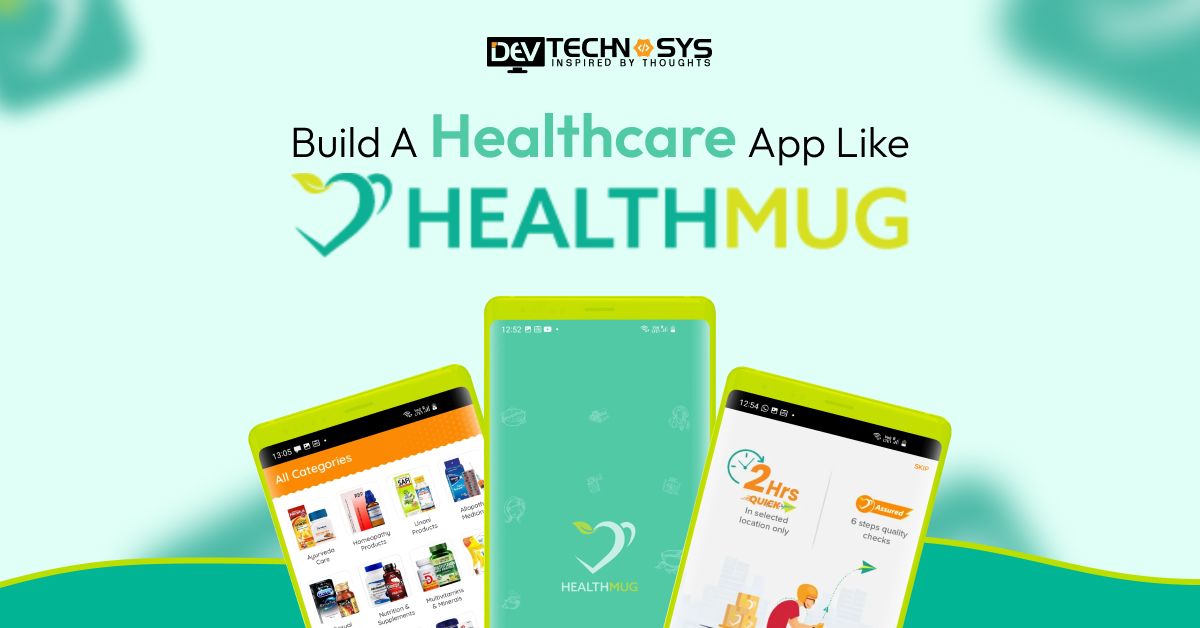
With a busy schedule, everyone needs apps to track appointments, manage wellness, and access healthcare services.
Healthmug is an app that enables users to track health metrics, schedule appointments, and retrieve expert advice, all in one app.
But how to create such an app, powerful and user-friendly, with an exceptional design?
From understanding essential functionalities to incorporating smart technology whilst maintaining data privacy and a holistic design, this blog covers all aspects.
This is an exciting journey to build a healthcare app like Healthmug, and is geared to provide all necessary information, whether you are a startup founder, developer, or healthcare professional.
Quick Answer: To build a healthcare app similar to Healthmug, begin by identifying your niche, selecting core offerings (e-commerce, prescriptions, consultations), assembling a proficient development team, and securing data (HIPAA/GDPR compliant). After a launch, rely on testing and user suggestions on which to base your improvements.
Current and Future Statistics of Healthcare Applications
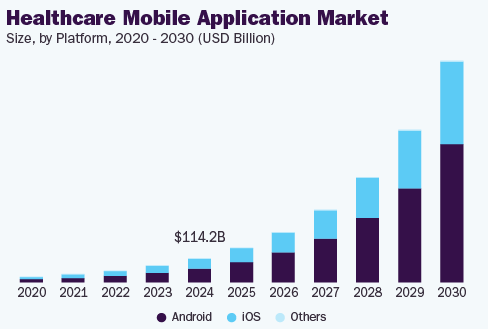
- The healthcare applications market was valued at around $114.17 billion in 2024; this is expected to increase to around $1,070.58 billion by the end of 2030.
- The North America region holds the highest market revenue share, around 36.5% in 2024.
- According to type, the fitness and training segment records the largest market share, 34.3% in 2024.
- As per the recent survey, the healthcare apps market is projected to increase with a CAGR of 45.2% from 2025 to 2030.
- Technology-wise, the non-AI-powered healthcare apps dominate the healthcare industry and record the largest share in 2024.
What is Healthmug?
The Healthmug is an online platform for healthcare operations, available on both Android and iOS platforms. This app basically works as an online pharmacy, and users can order medicines and have them delivered to their doorsteps. It has a wide variety of healthcare products such as Ayurveda, Homeopathy, and Unani products. Healthmug offers advanced features such as real-time order tracking, health information, health blogs, and booking consultations.
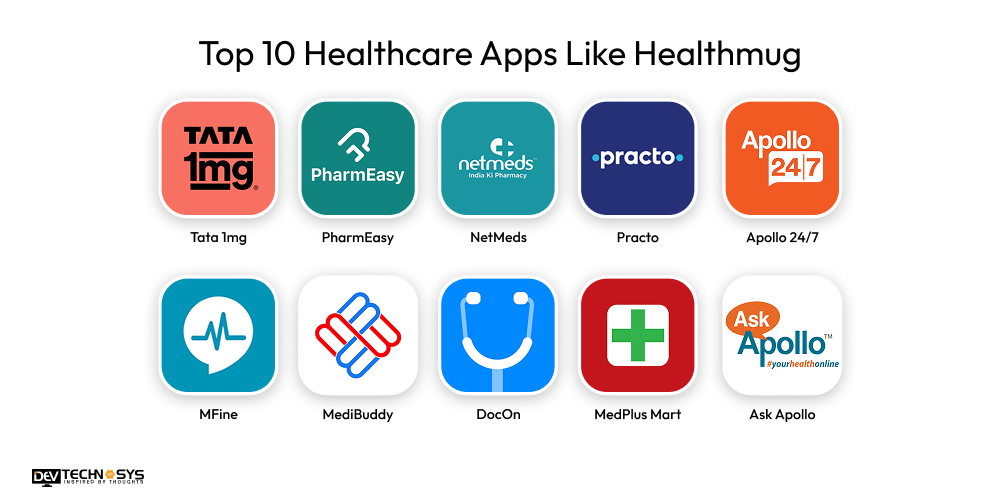
Top 10 Healthcare Apps Like Healthmug
Before starting to develop a healthcare app, you must consider or analyze the popular healthcare apps that record the highest success rates. So, let’s explore the best wellness and healthcare mobile apps:
App Name |
Downloads (approx) |
Rating (approx) |
Launched Year |
Platforms |
| Tata 1mg | 10M+ | 4.4 | 2015 | Android, iOS |
| PharmEasy | 10M+ | 4.3 | 2015 | Android, iOS |
| NetMeds | 10M+ | 4.2 | 2015 | Android, iOS |
| Practo | 10M+ | 4.4 | 2008 | Android, iOS |
| Apollo 24/7 | 10M+ | 4.4 | 2020 | Android, iOS |
| MFine | 5M+ | 4.3 | 2017 | Android, iOS |
| MediBuddy | 10M+ | 4.3 | 2015 | Android, iOS |
| DocOn | 1M+ | 4.2 | 2017 | Android, iOS |
| MedPlus Mart | 5M+ | 4.3 | 2016 | Android, iOS |
| Ask Apollo | 1M+ | 4.2 | 2016 | Android, iOS |
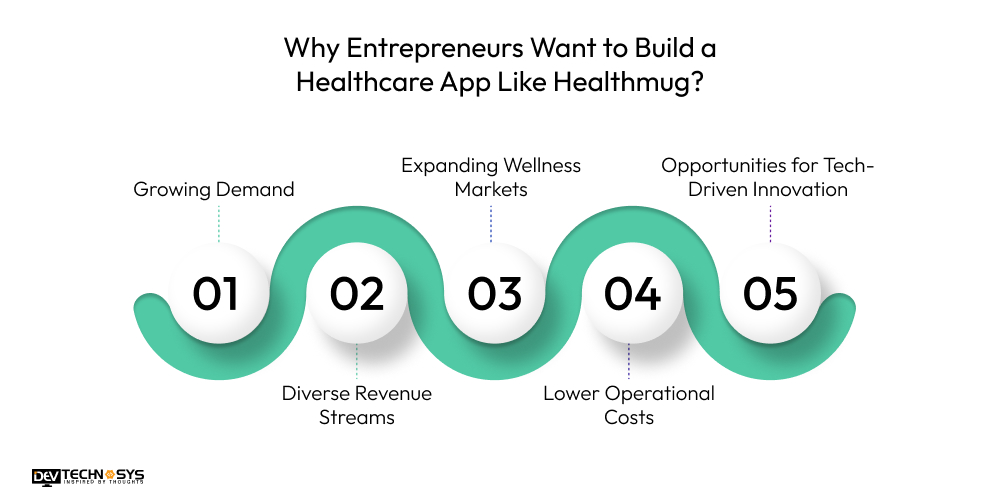
Why Entrepreneurs Want to Build a Healthcare App Like Healthmug?
With rising demand for digital health solutions, diverse revenue models, and growing interest in AYUSH products. The role of mobile app development in healthcare industry offers entrepreneurs a scalable, tech-driven opportunity to serve millions while reducing operational costs and boosting customer convenience.
1. Growing Demand
Consumers are increasingly turning to digital platforms for medicines, health products, and consultations. A healthcare app like Healthmug meets this demand by offering convenient access to a wide range of healthcare services, making it a lucrative opportunity for entrepreneurs in a fast-growing market.
2. Diverse Revenue Streams
ALLEVIA healthcare app development solutions generate income through product sales, online consultations, affiliate programs, and premium listings. This multi-channel monetization model attracts entrepreneurs looking for scalable, sustainable businesses in the digital healthcare space, especially as users are willing to pay for convenience, authenticity, and fast service.
3. Expanding Wellness Markets
With rising interest in Ayurveda, Homeopathy, and natural wellness, platforms that offer AYUSH products, like Healthmug, tap into a massive underserved segment. Entrepreneurs can leverage this trend by building apps that combine traditional medicine with modern convenience, attracting both urban and rural health-conscious users.
4. Lower Operational Costs
Running a healthcare app costs significantly less than maintaining physical retail outlets. With centralized inventory, digital customer service, and automated processes, entrepreneurs can scale quickly without high overheads, making the business model both capital-efficient and highly profitable when executed well.
5. Opportunities for Tech-Driven Innovation
Apps like Healthiago allow integration with telemedicine, AI-based recommendations, prescription uploads, and health tracking. Entrepreneurs see this as a chance to bring innovation to a traditionally slow-moving sector, improving patient outcomes while offering smart, data-driven healthcare solutions to a broader audience.
How AI Can Help Healthcare Applications?
- AI analyzes medical data to detect diseases like cancer or diabetes earlier, improving patient outcomes through timely intervention.
- AI enhances X-rays, MRIs, and CT scan interpretation, reducing diagnostic errors and helping radiologists make faster, accurate decisions.
- AI-powered chatbots offer 24/7 support, answering health queries, reminding medications, and reducing the burden on medical staff.
- AI accelerates drug research by identifying potential compounds and predicting their effects, significantly reducing time and research costs.
- AI automates repetitive tasks like billing, documentation, and appointment scheduling, freeing up time for healthcare professionals.
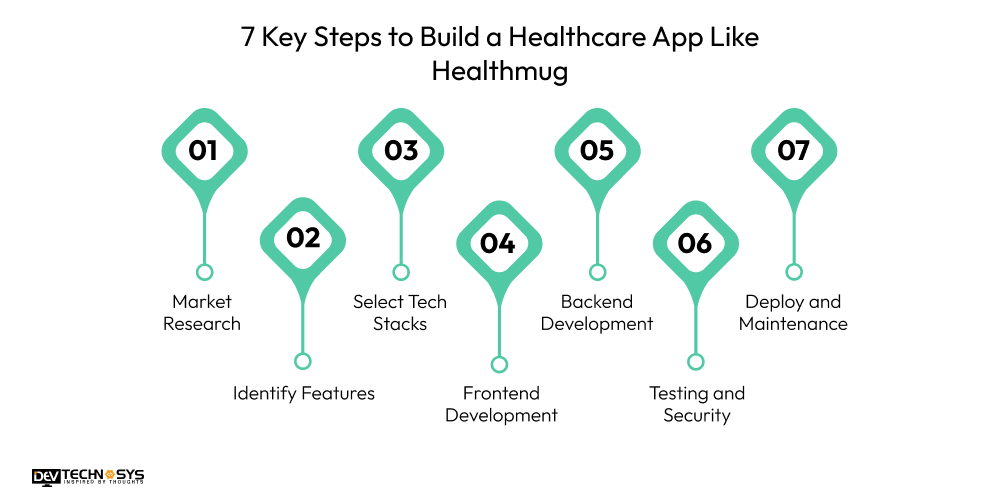
7 Key Steps to Build a Healthcare App Like Healthmug
Building a healthcare app like Healthmug consists of a few steps; businesses or developers must observe these steps that can lead the way to successful development. From market research to the final deployment phase, everything is explained in detail. So, let’s explore the healthcare mobile app development process:
1. Market Research
In the first stage, to create a healthcare app like Healthmug, observe the market trends to determine which type of healthcare app is gaining more popularity. Analyze the Healthmug alternatives and understand their working process and usability. Gather the project’s basic and advanced requirements.
2. Identify Features
Let’s enter another Healthmug clone app development process, hire healthcare app developers to identify the simple and premium features that must be integrated. There are various types of features such as product catalogue, delivery options, doctor consultations, digital health records, and symptom checker.
3. Select Tech Stacks
Moving to the third step to make a healthcare app like Healthmug, select the best technologies for a reliable and successful app development. It involves various types of tech stacks such as database, cloud storage, testing, designing, frontend and backend development, and many more.
4. Frontend Development
Coming to the fourth stage of healthcare app development, hire mobile app developers to design an attractive and user-friendly interface. There is a vast range of UI elements such as layouts, themes, templates, fonts, styles, colors, textures, and more. Designers use premium tools for designing, like Figma, Sketch, Farmer, and Zeplin.
5. Backend Development
Assemble the talented backend developers to begin the real coding and integrate the third-party tools and applications to increase the flexibility and accessibility. Developers create the server-side logics, handling data, infrastructure, processing user requests, and managing servers.
6. Testing and Security
In the sixth stage, to develop an app like Healthmug, now, test your application under various techniques to find out bugs or errors. It includes different types of techniques such as unit testing, functional testing, integration testing, and black-box testing. Hire a mobile app development company to set strong security methods such as authentication, encryption techniques, biometrics, and more.
7. Deploy and Maintenance
Finally, launch the healthcare app on the selected platforms, such as Android and iOS. Start the marketing techniques to promote the applications to a global audience. After that, conduct maintenance services such as fixing bugs or glitches, content updates, design enhancements, updating outdated features, and regular backups.
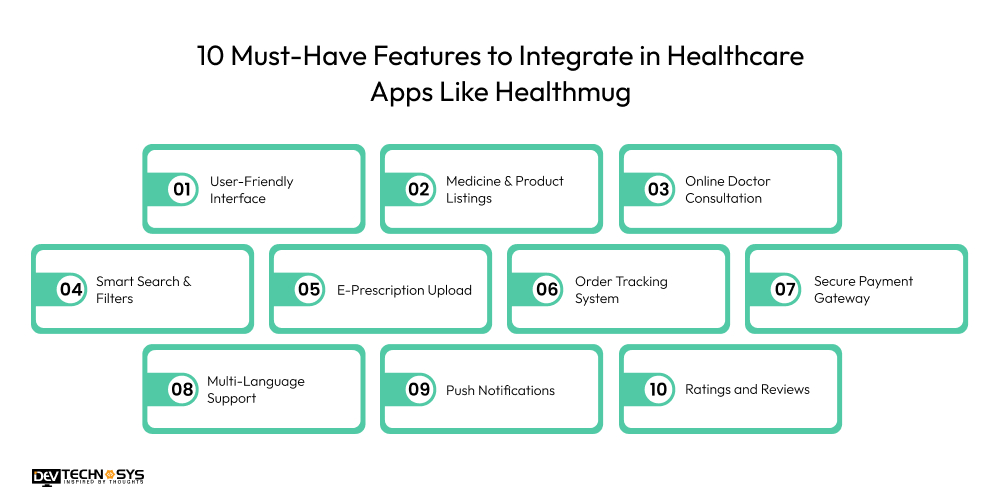
10 Must-Have Features to Integrate in Healthcare Apps Like Healthmug
1. User-Friendly Interface
Simple, intuitive navigation ensures users can easily browse products, book consultations, and manage orders without confusion.
2. Medicine & Product Listings
Comprehensive catalog with detailed descriptions, pricing, and availability for allopathy, Ayurveda, homeopathy, and wellness products.
3. Online Doctor Consultation
In-app booking and video calls with certified doctors for various medical systems, including prescriptions and health advice.
4. Smart Search & Filters
Advanced search with filters by brand, health concern, category, and price for a better user shopping experience.
5. E-Prescription Upload
HealthFlex enables users to upload prescriptions to order medicines directly, ensuring accuracy and compliance with medical regulations.
6. Order Tracking System
Real-time tracking of order status, estimated delivery time, and shipment notifications to enhance transparency and user trust.
7. Secure Payment Gateway
Multiple payment options with encryption ensure secure transactions and build user confidence in the platform.
8. Multi-Language Support
Localized content and app interface in regional languages to reach and serve a broader, diverse audience.
9. Push Notifications
Reminders for medicine refills, health tips, offers, and order updates keep users engaged and informed.
10. Ratings and Reviews
User-generated feedback on products and doctors builds credibility, helping others make informed healthcare decisions.
What is the Actual Cost to Build a Healthcare App Like Healthmug?
The cost to develop a healthcare app like Healthmug is around $8,000 to $25,000, depending on the custom features. The total healthcare app development cost can fluctuate due to crucial factors such as higher complexity, security measurements, testing, designing, tech stacks, third-party integrations, maintenance, and more. It also includes additional factors such as development team, backend infrastructure, deployment platforms, and more.
App Complexity |
Estimated Development Cost |
| Simple Healthcare App | $8,000 – $12,000 |
| Mid-Complex Healthcare App | $13,000 – $18,000 |
| High-Complex Healthcare App | $25,000+ |
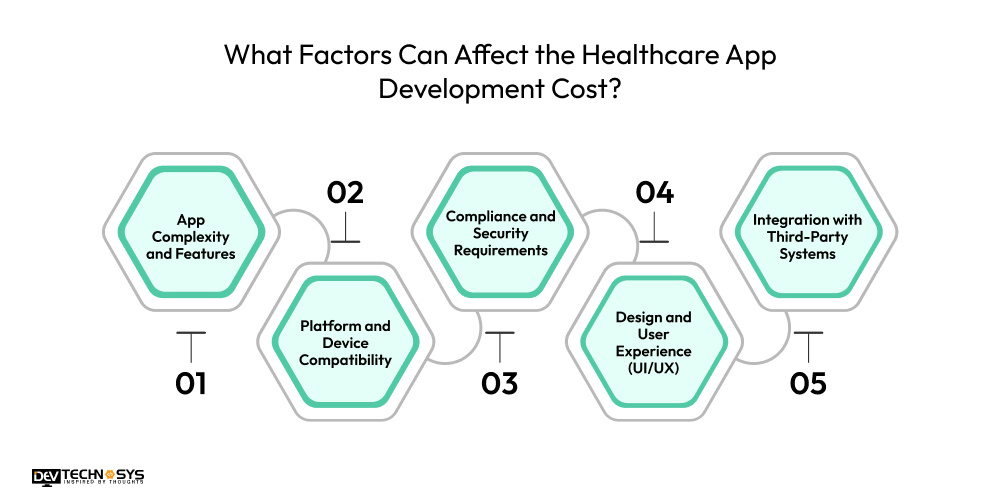
What Factors Can Affect the Healthcare App Development Cost?
Understanding the key factors affecting healthcare app development cost is crucial. Elements like app complexity, platform choice, compliance needs, design quality, and third-party integrations significantly influence the budget and timeline of building a successful healthcare application.
1. App Complexity and Features
The more advanced the features, like telemedicine, EHR integration, AI diagnostics, or real-time chat, the higher the cost. Simple apps cost less, while complex ones require more development time, testing, and expertise, increasing the overall Healthmug app development cost.
Level |
Description |
Estimated Cost Impact |
| Basic | Appointment booking, user profiles | $3,000 – $6,000 |
| Intermediate | Patient records, chat support | $6,000 – $10,000 |
| Advanced | EHR integration, video calls, notifications | $10,000 – $18,000 |
| Enterprise | AI diagnostics, multi-role dashboards, analytics | $18,000 – $25,000 |
2. Platform and Device Compatibility
Developing for multiple platforms (iOS, Android, web) increases mobile app development cost. Native apps (built separately for each platform) are more expensive than cross-platform solutions. Supporting various devices like smartphones, tablets, or wearables also adds to development and testing efforts.
Option |
Description |
Estimated Cost Impact |
| Single Platform (iOS) | iOS only | $2,000 – $4,000 |
| Single Platform (Android) | Android only | $2,000 – $4,000 |
| Cross-Platform (Flutter/React Native) | Single codebase, both platforms | $4,000 – $8,000 |
| Native for Both | Separate native apps for iOS and Android | $8,000 – $12,000 |
3. Compliance and Security Requirements
Healthcare apps must follow strict regulations like HIPAA (USA) or GDPR (Europe). Implementing robust data encryption, user authentication, and secure APIs increases both time and cost, as failure to comply can result in legal penalties and loss of user trust.
Level |
Description |
Estimated Cost Impact |
| Basic Security | Standard encryption, password protection | $1,000 – $2,000 |
| HIPAA Compliance | HIPAA policies, data encryption, audit logging | $3,000 – $6,000 |
| GDPR Compliance | Data consent management, data export features | $2,000 – $4,000 |
| Advanced Security | Multi-factor auth, role-based access, intrusion alerts | $5,000 – $8,000 |
4. Design and User Experience (UI/UX)
A user-friendly, accessible design tailored to diverse users (patients, doctors, admins) requires expert designers and usability testing. Investing in intuitive navigation, custom graphics, and responsive interfaces significantly increases design time and United Healthcare app development cost but improves adoption and retention rates.
Design Level |
Description |
Estimated Cost Impact |
| Basic UI | Minimal design, stock elements | $1,000 – $2,000 |
| Standard UI/UX | Custom UI, standard UX flows | $2,000 – $4,000 |
| Advanced UI/UX | Interactive elements, animations | $4,000 – $6,000 |
| Custom Branding | Unique visuals, logos, tailored UX for roles | $6,000 – $8,000 |
5. Integration with Third-Party Systems
Healthcare apps often need to integrate with EHR systems, insurance databases, payment gateways, or wearable devices. These integrations require custom APIs, backend development, and compatibility checks, all of which add complexity and increase the overall Healthmug app development cost.
Integration Type |
Description |
Estimated Cost Impact |
| Basic APIs | Maps, calendar APIs | $1,000 – $2,000 |
| Payment Gateway | Stripe, PayPal integration | $2,000 – $3,000 |
| EHR/EMR Integration | Connect with Epic, Cerner, etc. | $4,000 – $8,000 |
| Wearables & IoT Devices | Integrate with Fitbit, Apple Health, etc. | $3,000 – $6,000 |

How to Generate Money From Healthcare Apps Like Healthmug?
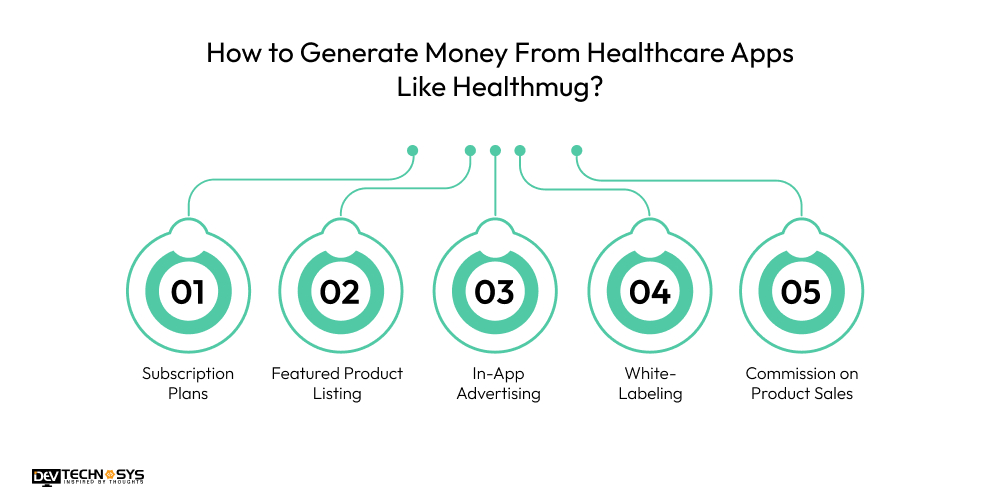
To generate new revenue streams from healthcare apps like Healthmug, observe the best money-making techniques. Let’s explore the monetization opportunities that help businesses to increase their valuation:
1. Subscription Plans
The Healthmug alternatives provide paid subscription plans, such as basic, premium, and enterprise, to enable users to access the full potential of the app. Users need to purchase the premium or enterprise plan on a monthly or yearly basis.
2. Featured Product Listing
The healthcare IT solutions charge fees from sellers to list their healthcare items as featured within the app. The featured product listing shows their product at the top of the search results and increases the chance of high sales. It is one of the most common revenue-generating techniques.
3. In-App Advertising
A similar app like Healthmug offers advertising options for third-party organizations or agencies, and they can show their product within the app. It includes various types of ad formats available, such as native ads, image ads, video ads, banner ads, display ads, and more. Charge an acceptable fee for each advertisement.
4. White-Labeling
The Healthmug clone apps license them to healthcare startups or small clinics that want a digital platform for online presence. You can serve them as a custom, support service, branding with their own name, and hosting. Charge licensing and maintenance fees on an annual basis.
5. Commission on Product Sales
If businesses create a healthcare app like Medscape, they can partner with a third-party healthcare startup or organization and allow them to sell their products within their app. You can charge a commission-based fee on each product sale around 8% to 12%. This is one of the simple monetization techniques.
Conclusion
To build a healthcare app like Healthmug, start by defining your core features, ensuring regulatory compliance (like HIPAA), and focusing on a user-friendly UI/UX. Integrate secure payment gateways, telemedicine capabilities, and reliable third-party systems. Collaborating with a trusted healthcare app development company ensures technical expertise, scalability, and on-time delivery. Prioritize data security and regular testing to maintain performance and trust. A clear roadmap, agile development, and post-launch support are essential for long-term success in the digital healthcare space.
Frequently Asked Questions
Q1. How Much Does it Cost to Build a Healthcare App Like Healthmug?
The cost to develop a healthcare app like Healthmug ranges from $8,000 to $25,000 or more. It can be changed because some key factors, such as tech stacks, security, testing, premium features, and backend infrastructure, are involved.
Q2. How Long Does it Take to Create a Healthcare App Like Healthmug?
To create a healthcare app like Healthmug takes around 5 to 16 weeks, or it takes longer. The project development time can be up and down due to project complexity, features, functions, size, integrations, and more.
Q3. How Do I Handle E-Prescriptions And Digital Health Records?
Use secure cloud storage with encryption to store e-prescriptions and health records. Follow standards like FHIR for data interoperability and ensure compliance with regional healthcare regulations like HIPAA, GDPR, or NDHM.
Q4. What Technologies are Used to Make a Healthcare App Like Healthmug?
Here we provide the list of technologies that are used to build an app like Healthmug:
- Java
- Python
- C++
- PHP
- Kotlin
- Swift
Q5. What are the Challenges Faced During the Healthcare App Development?
Explore the various types of challenges that are faced when make a healthcare app like Healthmug:
- High Operations Cost
- Privacy and Security Concerns
- Integration with Legacy Systems
- Real-time Data Synchronization
- Multi-platform Compatibility