













The adoption of e-learning has increased significantly with the explosive demand for online education over the past few years. Education is more than notes, lectures, and assignments; it’s about creativity and critical thinking.
With this new approach, the education sector has fully leveraged rapid technological advancements. In this guide, we’ll analyze market data and identify the latest education app development trends for 2026.
With the traditional classroom no longer being the only medium of learning, EdTech app development trends are opening new opportunities for learners and teachers. From students to corporate training, educational apps are reshaping the learning experience.
Making the learning process enjoyable, education app trends preserve the essence of knowledge exchange and training. So, if you’re looking for eLearning app development trends to upscale your educational institutions in 2026? Then stay with us till the end.
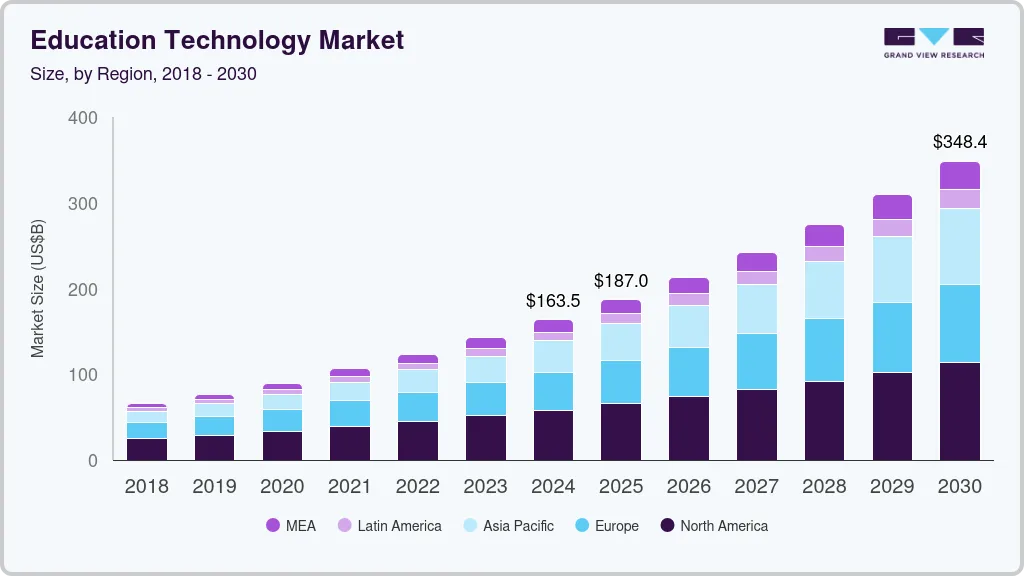
Global Edtech Market Analysis
The growth of the Edtech market is primarily driven by the adoption of e-learning to meet the demand for flexible and accessible learning worldwide. With a broad range of web app development solutions, Edtech has become a vital part of the global education landscape.
- By 2030, the global educational technology market is expected to reach USD 41 billion.
- In 2024, the market size was projected at USD 49 billion.
- From 2025 to 2030, it is expected to grow at a CAGR of 3%.
- With a 40% revenue share in 2024, the K-12 Edtech segment leads the market.
- The on-premises segment accounted for the largest revenue share in 2024, driven by deployment.
- North America dominated the educational technology market, accounting for 62% of revenue.
- The business segment adopted Edtech solutions for corporate training and professional development programs.
- The Edtech market in the Asia Pacific is growing faster over the forecast period.
- By type, the hardware segment accounted for 5% of market revenue in 2024.
Top Trending Edtech App – Duolingo
When it comes to e-learning apps, Duolingo is the most used, most recognizable, and most popular EdTech app. It is a language-learning app that offers courses in over 40 different languages.
The Duolingo mobile app drew on the gaming world to make the learning process more fun and playful. For a quick, accessible way to learn a new language, Duolingo has become the go-to choice worldwide. To understand the education app development cost for Duolingo, you must first know its market statistics.
- In Q4 2024, Duolingo reported revenue of USD 6 million.
- In the Asia-Pacific region, it recorded 5 million downloads.
- It spent USD49 million on sales in 2024.
- Its monthly active users touched 7 million.
- 103 million people access Duolingo once a month.
- It generated revenue of USD 54 million from the USA in 2024.
- 83% of Duolingo’s revenue is from Duolingo Plus subscriptions.
- By the end of 2024, the app’s downloads had climbed to 960
- In 2024, Duolingo’s valuation was USD 5 billion.
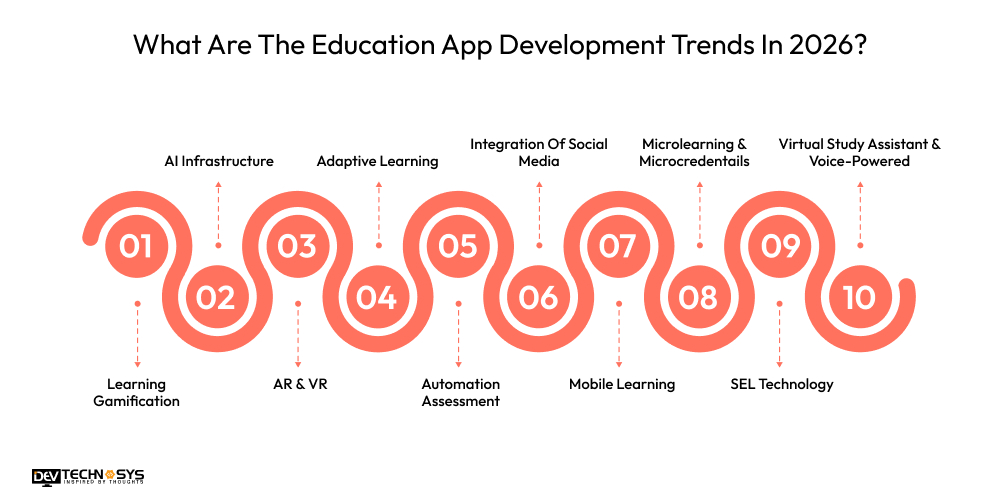
What Are The Education App Development Trends In 2026?
Powered by AI and real-time analytics, custom education app development is entering an era of intelligence. Emerging online learning app trends are redefining educational technology to deliver adaptive, personalized learning at scale.
An ethical, interoperable, and learner-centric system shapes the future of education apps. This section is the most interesting, where we’ll discuss the top significant trends in the education sector.
1. Learning Gamification
In 2026, having gamification in education apps is 100% must. The key to developing custom game-centred learning apps is to tie game mechanics to skills and outcomes.
One of the best examples of this trend is the Duolingo mobile learning app, which engages diverse users through its learning solutions. Some of the gamification solutions are a virtual leaderboard to compete with peers, earning virtual points and badges, missions, avatars, and simulations.
2. AI Infrastructure
AI in education apps is revolutionizing the education sector in ways never before seen. Adding AI in the education app development features enables adaptive, inclusive, and data-driven learning.
The AI analyzes attention spans, learning patterns, and performance in real time. With targeted interventions, it improves learning outcomes and supports diverse learning styles. Based on student needs, it customizes the learning by adjusting lessons and quizzes.
3. AR & VR
AR VR education apps create immersive, engaging learning experiences. This education app trends 2026 makes classes more interactive by encouraging learners to participate in digital learning activities.
Virtual Reality generates a constructed reality, while Augmented Reality provides an enhanced view of a real image. Students can explore virtual labs, historical events, etc., boosting motivation and long-term attention. VR and AR trends are more effective in remote classrooms.
4. Adaptive Learning
Adaptive learning technology and learning analytics are among the fastest-growing education app development trends. It evaluates and tracks students’ learning styles, strengths, and weaknesses.
This approach helps educators personalize the learning content to learners’ difficulty level, needs, and competencies. This trend holds great promise in digital education solutions. Real-time data insights driven by analytics learning help educational institutions make data-driven instructional decisions.
5. Automation Assessment
Automation assessment is one of the eLearning app development trends that is significantly impacting the sector. With AI in education app development, both educators and students gain access to actionable insights.
It eliminates manual grading, improves accuracy by minimizing human errors, and provides students with real-time feedback. Automated assessment in education enables scalability for a large student population.
6. Integration Of Social Media
With 90% of teens using social platforms, social media in learning is one of the most popular EdTech app development trends. Collaboration is the central aspect of these next-generation education apps.
Stream of live lectures and discussion, groups on social media, sharing of upcoming educational events, and use of X for group discussion are some of the ways to adapt this trend. It builds strong communities and promotes knowledge sharing among students.
7. Mobile Learning
In the modern pace of life, every Gen Z user uses smartphones for education. Mobile learning app trends meet students where they already are, offering personalized and bite-sized learning experiences.
Most educational institutions are adopting mobile-first models to deliver faster feedback, improve engagement, and make lessons easier to access. It enables learning anywhere, anytime. Education on-demand app development solutions increase student engagement and participation.
8. Microlearning & Microcredentials
Another eLearning app development trend that is revolutionizing the industry is microlearning. This trend makes the learning more efficient and flexible with nano degrees that align with real-world skills. Instead of complete degree courses, students can earn stackable badges and microcredentials.
Verifiable credentials enhance employability. The primary focus is on flexible and on-demand learning opportunities. This education app development trends allows skills acquisition in specific areas.
9. SEL Technology
Social-Emotional Learning is one of the key LMS app development trends. It provides AI-driven solutions to enhance students’ emotional intelligence and social skills. Challenges like emotional burnout and student disengagement are addressed by smart education apps that integrate SEL.
With an accessible credentials option, the SEL technology trend enhances retention by delivering short, relevant content. In the coming years, soft and social skills will be a focus.
10. Virtual Study Assistant & Voice-Powered
What is education app development without integrating speech recognition and virtual learning? Student engagement app features, such as voice search and a virtual assistant, enable hands-free operation while learners practice their speaking skills.
This trend helps evaluate the reading portion, such as pronunciation and oratory style. From definitions to explanations, a virtual study assistant provides a seamless and interactive experience that feels more personal.
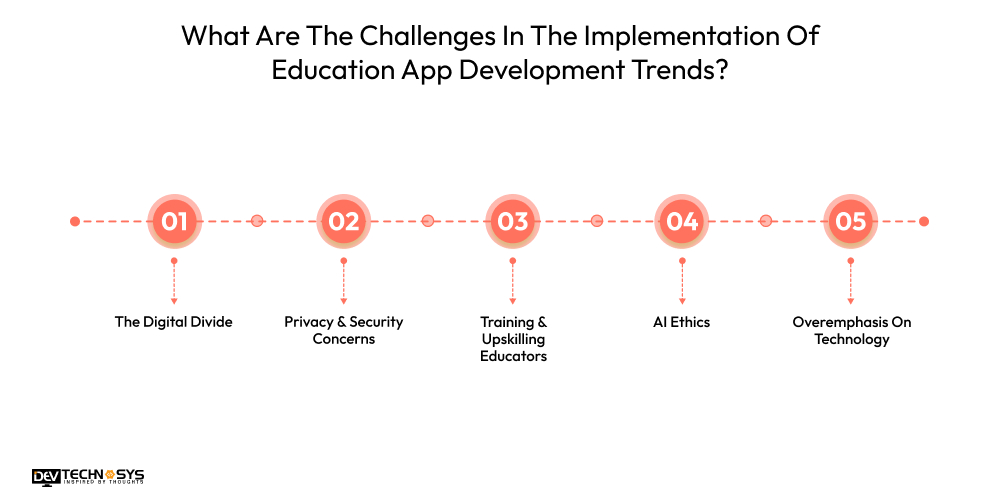
What Are The Challenges In The Implementation Of Education App Development Trends?
Adopting education app trends 2026 brings immense potential, but the transition isn’t seamless. The road to transforming the learning experience has a few roadblocks, and navigating these roadblocks is essential for a smooth transition. So let’s explore these challenges that are coming in the way of successfully implementing eLearning app development trends.
1. The Digital Divide
One of the biggest hurdles to adopting the latest EdTech app development trends is digital inequality. In developing regions, unequal access to the internet and smart devices limits students’ participation.
Before hiring an e-learning app development company, addressing this challenge is crucial. There are many government and corporate programs and initiatives to address this digital divide.
2. Privacy & Security Concerns
With the increased reliance on technology, data privacy and security concerns also rise. When implementing the virtual Classroom app trends, educational institutions must implement cybersecurity measures.
These policies and measures protect student data, ensuring that students’ rights are upheld. Also, fostering digital literacy and educating students about it is essential to address this challenge.
3. Training & Upskilling Educators
Adopting mobile learning app trends in classrooms will require professionally trained educators. But many educators and teachers lack the skills and abilities to work with modern EdTech trends.
Ongoing professional development is the key to addressing this challenge and helping teachers easily adapt to new technology and trends. It will enable teachers to use digital tools effectively in their daily teaching practice.
4. AI Ethics
Another challenge in implementing education app development trends is the ethical concerns they raise. The integration of AI into cloud-based education apps creates multiple touchpoints for unethical use and data vulnerabilities.
So educators and institutions must address this challenge and ensure AI is used responsibly. Being aware of transparency protocols and evolving data regulations is the key to overcoming this roadblock.
5. Overemphasis On Technology
Most lecturers and teachers who use traditional methods often reluctantly switch to digital education solutions. Also, greater reliance on technology in education might increase the risk of overreliance, leading to the neglect of traditional teaching and human connection.
Therefore, creating a perfect balance between these education app development trends and traditional approaches is essential for a well-rounded learning experience.
Wrapping Up!
Now, with these modern EdTech app development trends, you can seamlessly prepare for the future of education apps. Education has moved beyond traditional classrooms, and the above-mentioned trends will benefit educators, students, and EdTech companies.
They provide learners with an ideal learning experience. Some of these trends are set to become standard in classrooms, digital learning programs, and personalized learning. If you’re planning to build an education app from scratch, you must choose Dev Technosys.
Dev Technosys plugs mobile learning app trends into real platforms. Even if you want to modernize your LMS, improve student engagement, or adopt education app trends 2026, we’ll guide you at every step.
Frequently Asked Questions
Find answers to the most common questions related to this article.
Mobile-led learning, gamification, automated assessment, AI integration, microlearning, microcredentials, wearable tech, social learning platforms, and virtual study assistants are among the major EdTech app development trends in 2026.
In education, AI provides intelligent tutoring, personalized learning paths, automated grading, learning analytics for students' performance, enhanced accessibility, a virtual teaching assistant, and adaptive content delivery.
Microlearning is gaining popularity because it aligns with modern attention spans, delivering bite-sized lessons and quick quizzes. It improves knowledge retention by supporting mobile-first learning and on-the-go education for students and professionals.
The key challenges eLearning app development trends present are:
● AI Ethics
● The Digital Divide
● Training & Upskilling of Educators
● Privacy & Security Concerns.
The benefits of technology development in education are:
● Personalized Learning
● Global Accessibility
● Development of Digital Skills
● Enhances Learning Experience.