


















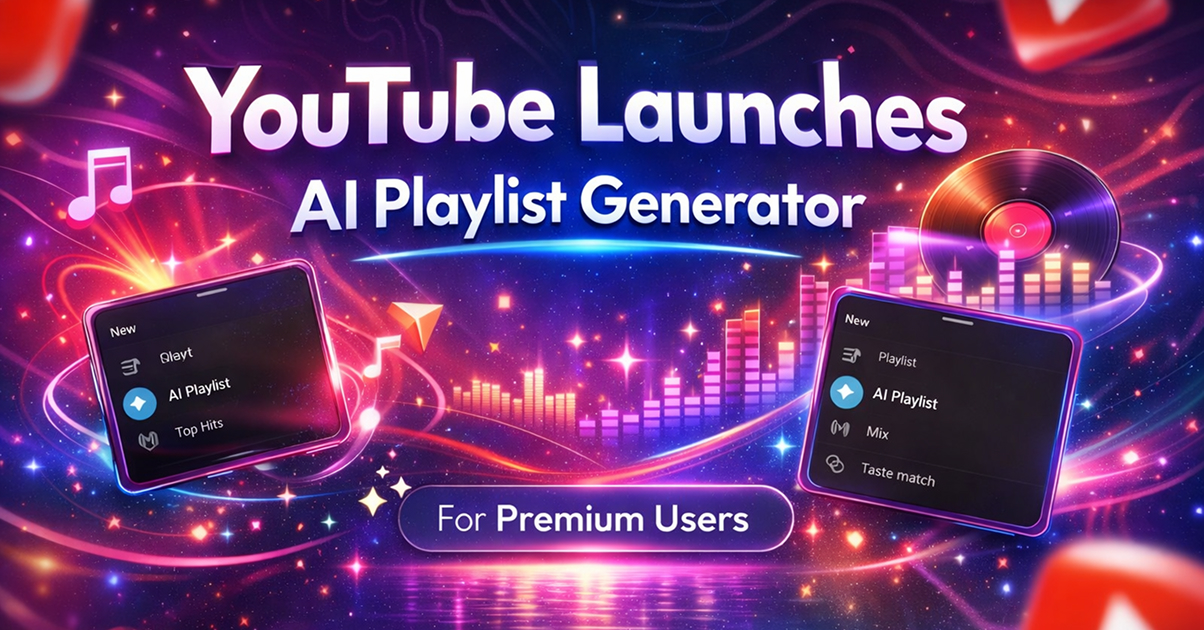
For all the music lovers out there, YouTube Music has just rolled out an AI-playlist generator feature. This new AI-powered generation feature is only for the premium users. It gives the 100+ million premium subscribers a new, exciting way to create music mixes. It marks Google’s push toward embedding generative AI.
The AI playlist generator for YouTube Premium is available on both iOS and Android platforms. Competitors like Apple Music, Spotify, and Amazon Music are also racing to deploy AI-powered playlist creation.
How To Use The YouTube AI Playlist Generator
- Go to the Library Tab
- Tap the New Button
- Select the AI Playlist option
- Now, enter the desired prompt in text or voice form
- And you have a personalized playlist based on your mood.
It’s pretty straightforward, not a revolutionary step. Back in July 2024, YouTube experimented with AI-powered listening. The platform rolled out prompt-based custom radio stations in the U.S. Now, AI-powered playlist creation seems the next logical step.
YouTube isn’t alone. Other music streaming platforms also have their own Smart playlist generator. Spotify has been testing its own custom AI playlist tool. It takes your listening history into account and generates a playlist that updates with time. Apple Music also rolled out its natural language search capabilities update in the last quarter.
YouTube Premium Lets AI Build Your Playlists
But what makes the YouTube Music Premium update so unique? Its massive catalog includes official releases, live performances, user-uploaded content, and remixes. What’s interesting about this new feature is that YouTube places it behind a premium paywall. Subtly reminding free users what they’re missing.
YouTube Music is trying to make its premium plan more attractive and exclusive to users. Earlier this week, the platform restricted free users from viewing song lyrics. In a recent interview with TechCrunch, YouTube described it as a “limited experiment with a small percentage of ad-supported users.”
Since late 2022, Google has been trying to prove its AI credentials at a global level. Google’s CEO, Sundar Pichai, said that “embedding AI into consumer products is a top priority for 2026” during the company’s Q4 earnings call. Which makes the timing of AI music recommendations on YouTube a calculated play in the crowded field of Generative AI.
YouTube Music’s approach to AI music discovery tools differs from its competitors. The competitors’ platforms are experimenting with freemium models. With the goal to hook non-subscribers to the AI-driven personalization feature. But YouTube sees this as a “premium differentiator” rather than acquisition hooks.

YouTube charges $13.99 per month for individuals and $22.99 per month for families. Google has seen growth in its subscription-based models. A recent report revealed that Google now has 325 million paying users across Google One and YouTube Premium. YouTube is the central aspect of this growth.
The technical execution of the YouTube Music AI playlist generator makes it more appealing to users. Early AI developer built AI playlist generators that stumbled on interpreting context and mood. For instance, when you asked for energetic workout music, you might get pop-funk when you wanted R&B & Soul.
YouTube Music have not disclosed which language model it is using for the text prompt playlist generator. But it is likely leveraging Google Gemini’s infrastructure. The model understands musical genres and moods, analyzes vague user requests, and maps them to the app’s sprawling catalog.
YouTube AI playlist generator creates a personalized, curated playlist that feels handpicked but operates at an algorithmic scale. It promises a middle path for how listeners discover new music and how artists break through.
Conclusion
For now, the YouTube AI playlist generator is limited to premium subscribers on the mobile app. It isn’t just a feature, but a retention tool. This could be a good change for YouTube Music subscribers in the long-run. Every other platform, like Tidal and Pandora, is racing to prove that its AI can understand what you want to hear. In the coming months, we’ll see how well this feature performs in the music industry.