












Quick Summary:
The MVP-based OTT app development cost is $8,000 to $15,000, and a mid-complex OTT platform ranges from $15,000 to $25,000. The fully-featured OTT streaming application costs around $25,000 or higher, depending on integrations and scalability.
Cost Impacted by Project or Development Complexity:
-
- Simple/MVP-Based Apps ($8,000 – $15,000): Include features like user registration & login, video streaming player, content categories, subscription plans, and basic admin panel.
- Mid-Complex Apps ($15,000 – $22,000): Features available such as multi-device compatibility, push notifications, watchlist & favorites, and advanced search filters.
- Complex/Enterprise Applications ($25,000+): Involve functionalities like an AI-based recommendation engine, live streaming support, DRM protection, and an advanced analytics dashboard.
Cost Based on OTT App Types:
-
- Subscription-Based OTT App: $10,000 to $20,000
- Ad-Supported OTT Platform: $12,000 to $22,000
- Live Streaming OTT App: $15,000 to $25,000
- Niche Content OTT Platform: $9,000 to $18,000
- Hybrid OTT Model (SVOD + AVOD): $18,000 to $28,000
Cost Based on Different Regions/Countries:
-
- The OTT app development cost in USA is around $15,000 to $30,000 or based on the app features and streaming infrastructure.
- The OTT app development cost in Australia ranges from $12,000 to $27,000, depending on integrations and tech stacks.
- The OTT app development cost in Canada lies between $10,000 to $26,000; it can fluctuate due to project scope and scalability requirements.
Additional Cost:
-
- Maintenance Services: The cost to maintain an OTT app is around 15% to 20% of the initial development cost.
- Security Measurements: Implementing DRM protection, encrypted streaming, and compliance standards is important, and the cost can increase due to legal and security requirements.
Have you ever thought about how your favorite streaming services like Amazon Prime, Disney+, or Netflix create their platforms?
OTT apps give you the ability to enjoy movies, live sports, and even music, offered to you without a regular cable subscription.
You might be one of the few to ask that question, how much does it cost to create an OTT app?
But have you ever thought why most entrepreneurs or startups want to start their own OTT platform?
As per Statista, the OTT apps market is valued at around $352.96 billion in 2026. This can grow at a faster rate to around $482.76 billion by the end of 2030.
This data shows that building your own OTT platform can expand your business worldwide and generate higher revenue streams.
In this blog, we will explore the OTT app development cost, factors affecting it, the cost of various types of OTT apps, and much more.
So buckle up, because we’re about to break it all down, simply and clearly!
OTT Platform Market Current & Future Statistics
- According to the Mordor Intelligence, for the 2025 OTT market share by device platform, smartphones and tablets are expected to account for 41.23%. Smart TVs are expected to grow at a 13.43% CAGR to 2031.
- As per ZEE News, the worldwide OTT video market is anticipated to reach 4.2 billion subscribers by 2027, with a remarkable 53% penetration rate.
- Statista shows that, with a projected market value of $236.72 billion in 2026, OTT Video Advertising is the largest market within this category.
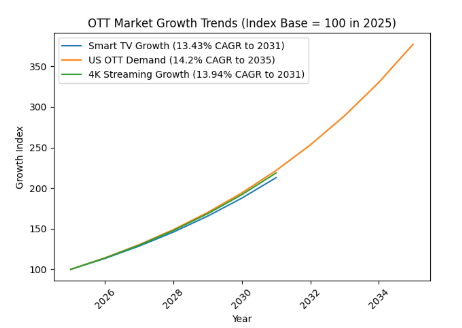
- According to Future Market Insights, through 2035, the demand for OTT content in the US is expected to grow at a 14.2% CAGR.
- Research of Modor Intelligence depicts that, for the 2025 streaming resolution share, high-definition 720p at 38.29%, 4K above projected, with a 13.94% CAGR to 2031.
Why OTT Apps are Beneficial to Create in 2026?
Over-the-top (OTT) services are basically beneficial for content creators, media businesses, entrepreneurs, and marketers. It offers different types of content in one place, and users can easily stream as per their preferences. OTT apps are one of the most demanding content platforms that most users use and subscribe to on a monthly or yearly basis.
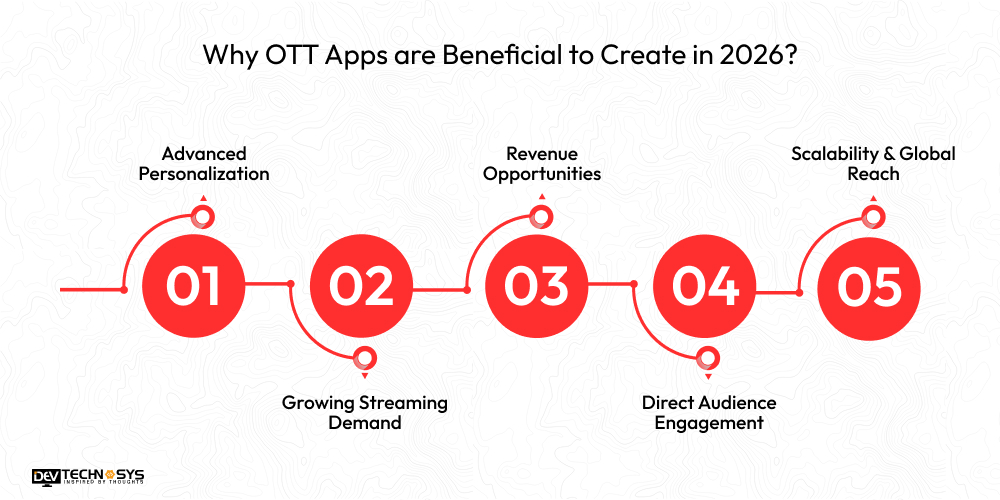
1. Advanced Personalization
The latest OTT app development solutions use artificial intelligence to deliver personalized content to users. This can enhance the viewing experience and increase the retention rates.
There are various famous OTT apps that use AI for hyper-personalization, such as Netflix, Amazon Prime Video, Sony LIV, and Hulu. Using the automation and analytics tools enables the internet TV apps to easily distribute and optimize content.
2. Growing Streaming Demand
As per Statista, the average revenue per user in the Over-the-top platforms is around $81.44 in 2026. This shows how quickly the OTT streaming market is growing worldwide and provides an on-demand service to users.
Businesses launching OTT apps in 2026 can tap into expanding global audiences, increasing viewership, subscriptions, and long-term digital growth opportunities.
3. Revenue Opportunities
Moving to another benefit, generating profit from OTT platforms, is one of the most important benefits. OTT applications offer various ways to create profit, such as subscription plans, pay-per-view, transaction fees, advertising, in-app purchases, and hybrid strategies. These revenue streams enable businesses to generate new income sources and increase overall business valuation.
4. Direct Audience Engagement
Over-the-top (OTT) services help businesses reach consumers directly, cutting out middlemen. OTT platforms improve user engagement through features like personalized content suggestions, targeted ads, watchlists, content interaction, and more. If businesses create a video streaming app, they can identify user engagement with direct OTT data and refine content as necessary.
5. Scalability & Global Reach
OTT services enable businesses to grow on a global level without large investments. Finite infrastructure can support OTT services on the cloud, compatible with diverse devices, and aids in the effortless integration of different markets. Using subtitles and region-based content, businesses can support a growing global audience, increasing operational efficiency.
Industry Insights:
According to The Times of India, the OTT audience quickly hit 600 million users in 2025, with a 10% year-over-year increase in overall viewership.
What is the Cost to Develop an OTT App in 2026?
The cost to build an OTT app is around $8,000 to $25,000 or depend on the application types and complexity. Developing a basic OTT app with simple features such as a content library, a video streaming player, and search functionality ranges from $8,000 to $15,000.
Building an AI-powered or complex OTT application costs $25,000+. There are various factors that impact the cost, such as features, functions, project size, complexity, backend infrastructure, platform compatibility, and many more.
Development Stage |
Estimated Cost (USD) |
| UI/UX Design | $1,000 – $3,000 |
| Frontend Development | $4,000 – $6,000 |
| Backend Development | $5,000 – $9,000 |
| Video Streaming Integration | $1,500 – $4,000 |
| Admin Panel | $1,000 – $3,000 |
| Testing & Deployment | $500 – $2,000 |
| Total Estimated Cost | $8,000 – $25,000 |
What is the Development Cost of Various OTT Applications?
The cost of OTT app development services varies depending on features, platform compatibility, content licensing, UI/UX design, backend infrastructure, and scalability requirements.
From basic on-demand streaming apps to advanced platforms with AI-driven recommendations and live streaming, budgets typically range widely based on complexity.
1. Subscription-Based OTT Development Cost
The development costs of subscription-based OTT apps can be moderate to high, depending on the size of the content library and the scalability needed for the application, such as the need for secure payment gateway integration and recurring billing systems. The overall cost to make an OTT app can increase even more due to advanced personalization and artificial-intelligence recommendations.
Feature / Complexity |
Description |
Estimated Cost |
| Basic Subscription Setup | Video library, user login, simple subscription plan | $10,000 |
| Advanced Subscription Features | Recurring billing, multi-device access, and payment gateway | $15,000 |
| Premium Streaming Platform | AI recommendations, multi-tier plans, smart TV support | $20,000 |
2. Ad-Supported OTT (AVOD) Development Cost
Ad-supported OTT platforms require ad network integration, video ad servers, tracking of user analytics, and monetization dashboards. There is a wide range of development costs depending on the complexity of the advertising and the targeting capabilities of that advertising.
The integration of third-party ad platforms increases the amount of back-end development costs, and thus overall development costs.
Feature / Complexity |
Description |
Estimated Cost |
| Basic Ad-Based Streaming | Video player with pre-roll ads integration | $8,000 |
| Advanced Ad Monetization | Mid-roll ads, ad dashboard, analytics tracking | $13,000 |
| Programmatic Ad Platform | Targeted ads, real-time bidding, reporting tools | $18,000 |
3. Transactional OTT (TVOD) Development Cost
Transactional OTT applications require a pay-per-view function, a secure one-time payment system, secure content access control, and digital rights management.
The development costs of transactional OTT applications will vary according to the level of transaction security, the licensing costs of the content, and the functionality of the purchase tracking systems. The on-demand app development costs of transactional OTT applications will be less complex in the back-end.
Feature / Complexity |
Description |
Estimated Cost |
| Basic Pay-Per-View Setup | One-time purchase, secure payment gateway | $9,000 |
| Advanced Purchase Controls | DRM protection, content unlock system | $14,000 |
| Premium TVOD Platform | Multi-event access, bundled purchases, and admin analytics | $19,000 |
4. Live Streaming OTT Development Cost
Live-streaming OTT applications require an infrastructure for real-time broadcasting, CDN integration for video delivery, low-latency optimization, and features for monetizing live-streaming events. The cost to make an OTT app will be higher than that of other types of OTT applications because the server architecture and streaming technology.
Feature / Complexity |
Description |
Estimated Cost |
| Basic Live Streaming | Live broadcast with basic streaming server | $15,000 |
| Interactive Live Platform | Live chat, event scheduling, subscription access | $20,000 |
| Large-Scale Streaming System | Low-latency streaming, CDN integration, monetization | $25,000 |
5. Niche OTT Platform Development Cost
Niche OTT Platforms provide content in different categories for niche audiences, engaging with their audience via community tools and UI/UX. So while development costs could be average to moderate, actual costs will vary depending on the level of personalization in your platform and the type of subscription plan you want to implement. Marketing integration/engagement tools will increase overall development costs.
Feature / Complexity |
Description |
Estimated Cost |
| Basic Niche Platform | Genre-specific content, simple streaming interface | $8,000 |
| Community-Based Platform | Ratings, watchlists, personalized recommendations | $12,000 |
| Premium Niche Ecosystem | Subscription model, advanced filtering, analytics | $16,000 |
6. Educational OTT App Development Cost
Educational OTT education platforms contain features such as a course management system, video hosting, certification modules & progress tracking features.
Development costs will vary depending on your type of LMS integration and functionality needs. Advanced analytics, live class features, and multiple instructor dashboards can greatly increase your total investment.
Feature / Complexity |
Description |
Estimated Cost |
| Basic Learning Platform | Video lessons, user login, course categories | $12,000 |
| Interactive Learning System | Quizzes, progress tracking, certificates | $17,000 |
| Advanced E-Learning OTT | Live classes, instructor panel, analytics dashboard | $22,000 |
7. Hybrid OTT Platform Development Cost
Hybrid OTT Platforms are a combination of subscription, advertisement, and Transaction-based monetization systems working together on one single platform.
Therefore, OTT Hybrid app development services cost will generally be higher as the complexity of the monetization system, multiple user access controls, Integrated Analytic Dashboards will increase overall development costs.
Feature / Complexity |
Description |
Estimated Cost |
| Dual Monetization Setup | Subscription + ads integration | $18,000 |
| Multi-Model Platform | Subscription, ads, and pay-per-view combined | $22,000 |
| Enterprise Hybrid OTT | AI personalization, analytics, scalable backend | $25,000 |
Planning a Video Streaming Project?
Get a tailored development cost estimate in a few simple steps.
- 3 quick steps
- 100% free
- Reply in 1 business day
2 Minutes Read
What Factors Impact the OTT Application Development Cost in 2026?
It is important to fix a budget for application development. But there are various types of factors that can influence the overall project budget. It involves premium features, technology stacks, third-party integrations, app complexity, application types, and many more.
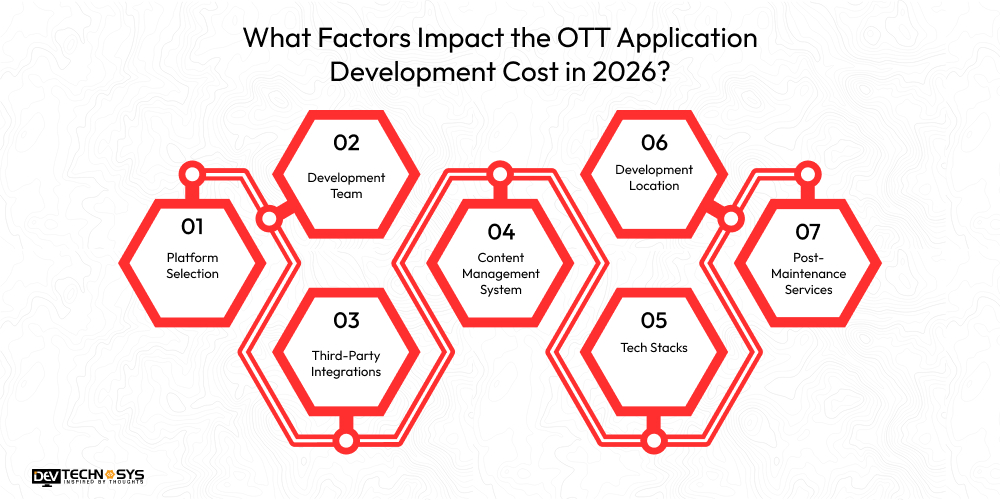
1. Platform Selection
The selection of platforms for developing an OTT app. Building apps on Android, iOS, web apps, smart TVs, every platform have different cost and separate optimization and UI designing.
Building an application on a single platform can be more cost-effective than developing an app for multiple platforms. It requires more development time and compatibility requirements, increase the overall cost to build an OTT app.
Platform Type |
Cost Impact |
| Single Platform (Android or iOS) | $2,000 – $5,000 |
| Cross-Platform (Flutter / React Native) | $4,000 – $8,000 |
| Multi-Platform (Mobile + Web + Smart TV) | $7,000 – $10,000 |
2. Development Team
The development team is one of the most common factors that impact the cost. Developers who have higher experience definitely demand a higher cost for developing OTT applications.
Mid-level experience developers charge less cost as compared to expert developers. So, hire developers as per the project demand and complexity; otherwise, it can impact the entertainment app development cost.
Team Type |
Cost Impact |
| Freelancers | $3,000 – $6,000 |
| Mid-Level Development Agency | $6,000 – $8,000 |
| Experienced OTT App Development Company | $10,000 – $12,000 |
Industry Insights:
According to The Guardian, at the TIME100 Summit, Sarandos said traditional cinema-going is becoming “outmoded” and suggested Netflix is “saving Hollywood” by meeting audience demand for home viewing through streaming.
3. Third-Party Integrations
OTT apps will need 3rd-party integrations of some type, like payment gateway, analytics tools, push notifications, DRM, cloud storage, etc. Each of these integrations will require setup of APIs, testing, and ongoing maintenance.
The number of external tools included in your OTT app will drive up the project cost due to increased back-end development, configuration for security, and optimization of performance.
Integration Type |
Cost Impact |
| Payment Gateway Integration | $800 – $1,000 |
| Video Streaming API (AWS / Vimeo) | $1,000 – $1,300 |
| Analytics & Ad Integration | $1,300 – $1,800 |
4. Content Management System
A basic CMS will provide uploading and organization of videos. However, developing an advanced dashboard with analytics, user management, scheduling, and revenue tracking will make the project much more complex to develop.
Custom-built CMS panels will require back-end logic, database management, and security control. The extent of the automation and reporting capabilities will have a direct impact on the cost to make an OTT app.
CMS Type |
Cost Impact |
| Basic Admin Panel | $1,500 – $3,000 |
| Custom CMS | $3,000 – $6,000 |
| Advanced AI-Based CMS | $5,000 – $7,000 |
5. Tech Stacks
Your selection of technology will directly impact OTT app development budget. Advanced technology stacks will provide greater scalability and faster streaming, but require very skilled developers to implement.
By implementing a modern framework, you will benefit from reduced development time. Whereas a highly customized architecture will drive up the cost due to the greater amount of specialized implementation and testing that is required.
Tech Stack Level |
Cost Impact |
| Basic (Firebase + Standard Player) | $2,000 – $5,000 |
| Scalable Cloud-Based (AWS / Azure) | $4,000 – $7,000 |
| High-End Streaming Architecture (CDN + DRM) | $6,000 – $8,000 |
Industry Insights:
According to The Times of India, the YouTube CEO says YouTube is different from all the other streaming platforms.
6. Development Location
The OTT platform development cost varies greatly relative to the geographical location where it is performed. Overall, development costs in North America or Western Europe will be more expensive than in Asia or Eastern Europe. Hourly rates, cost of doing business, and demand for skilled resources will determine the pricing.
Region |
Web ($) |
iOS ($) |
Android ($) |
| United States | $42 – $65/hr | $50 – $80/hr | $45 – $70/hr |
| Latin America | $40 – $55/hr | $45 – $70/hr | $43 – $65/hr |
| Central & Eastern Europe | $45 – $70/hr | $52 – $83/hr | $50 – $75/hr |
| Asia | $15 – $20/hr | $20 – $25/hr | $18 – $22/hr |
7. Post-Maintenance Services
Once the over-the-internet TV platform was launched, it required regular updates for maintenance, including fixing bugs, updating security protocols, monitoring servers, and adding new features.
Regular updates will also help ensure that the applications continue to be compatible with new operating systems and devices. Annual maintenance costs typically run between 10% and 20% of the initial OTT app development pricing.
Service Level |
Cost Impact (Annual) |
| Basic Support & Bug Fixing | $500 – $1,000 |
| Regular Updates & Security | $1,000 – $1,300 |
| Full Maintenance + Feature Enhancements | $1,300 – $2,000 |
Want a chatbot demo or pricing? Fill the form and talk to our experts today.
Pick what you need below — you can select more than one — then tap Get detail to continue.
-
Chatbot demo dashboard
-
Cost to develop an app
-
Industry report
-
Case study
What is the Hidden Cost of OTT Application Development in 2026?
OTT application development includes much more than just the cost of coding. Other hidden costs such as cloud storage and bandwidth, content licensing, third-party APIs, maintenance, security, and compliance with legal/regulatory compliance. All of these items will have significant implications on your long-term financial plan.
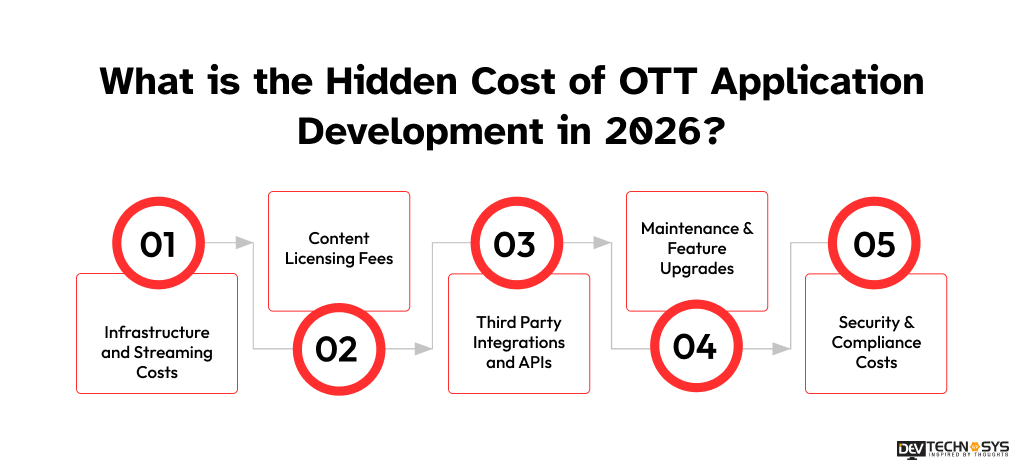
1. Infrastructure and Streaming Costs
OTT applications are costly to host in the cloud, utilize content delivery networks (CDN), and transcode video. As traffic increases from users, bandwidth and storage costs rise tremendously.
Therefore, when combined with all other long-term costs associated with building an OTT application in 2026, Infrastructure tops the list of major long-term hidden costs.
2. Content Licensing Fees
The cost of acquiring a movie, show, or exclusive content generally tends to be much higher than either the license fee charged by the company providing the content or the total production cost.
Licenses can vary greatly depending on area where used, popularity of the item being licensed, and exclusivity to the owner of the content; hence, acquiring quality content can be a very large hidden financial burden on OTT platforms.
3. Third Party Integrations and APIs
OTT applications are dependent on various 3rd-party products such as payment gateways, analytics tools, DRM systems, and recommendation engines.
These products typically have subscription fees or charges per use, which means they will continue to grow operational costs over time as they are used by an OTT application. This is a major hidden operational cost over what was originally estimated for development.
4. Maintenance & Feature Upgrades
Continuous updates, bug fixing, UI enhancements, and compatibility with new devices require constant ongoing development efforts. This ongoing development related to the lifecycle of the application maintenance cycle will have ongoing budgets and have already allocated funds for support teams, resulting in consistent ongoing unidentifiable or hidden long-term costs not incorporated into the initially quoted OTT app Development Costs.
5. Security & Compliance Costs
Security and compliance issues regarding user data protection, preventing piracy, and adhering to international government regulations such as GDPR all necessitate strong encryption, auditing for compliance, and a legal framework.
Therefore, the ongoing costs associated with these activities are all hidden, except for the understanding that they will incur ongoing expenses to properly protect OTT platforms during today’s highly regulated environment.
How Much Investment Is Required to Build Popular OTT Apps in 2026?
Building similar apps to popular OTT apps that already cover global audiences is one of the best ideas. But what’s their cost estimation? This section will provide detailed information about the cost of existing OTT applications. Take a closer look at the cost to develop clone apps of existing online video platforms:
1. Cost to Build an App Like Netflix
The typical cost to build an app similar to Netflix, in 2026, would be between $10,000 and $22,000+. The cost depends on the complexity of the features required, such as AI recommendations, offline viewing capabilities, multiple device compatibility, DRM security, cloud hosting, and scalable infrastructure.
Version |
Features Included |
Estimated Cost |
| Basic (MVP) | Video streaming, login, subscription, simple UI | $10,000 – $14,000 |
| Standard | Multi-device support, HD streaming, CMS, profiles | $14,000 – $18,000 |
| Advanced | AI recommendations, adaptive streaming, analytics | $18,000 – $22,000 |
2. Cost to Build an App Like Amazon Prime Video
The cost to develop an OTT app like Amazon Prime Video is around $12,000 to $24,000 or more. The costs are associated with subscription management, a secured payment system, personalized recommendation system.
The ability to stream the same content globally, secure content-licensing systems, and the ability to integrate content into multiple smart TV models.
Version |
Features Included |
Estimated Cost |
| Basic (MVP) | Core streaming, login, and payments | $12,000 – $13,000 |
| Standard | Smart TV support, content categories, offers | $13,000 – $19,000 |
| Advanced | Multi-region access, advanced analytics, DRM | $19,000 – $24,000 |
3. Cost to Build an App Like Disney+
The Disney+ like app development cost ranges from $9,000 to $20,000 or based on the features and integrations. The top expenses associated with building a video streaming application would be high definition and adaptive bitrate video streaming with parental controls, multilingual translations, and cross-platform accessibility.
Version |
Features Included |
Estimated Cost |
| Basic (MVP) | Streaming, subscriptions, simple UI | $9,000 – $12,000 |
| Standard | Parental control, multi-profile, HD support | $12,000 – $17,000 |
| Advanced | 4K streaming, DRM security, AI suggestions | $17,000 – $20,000 |
4. Cost to Build an App Like HBO Max
The cost to create an OTT app like HBO Max lies between $12,000 to $25,000, depending on the type of content added. The primary OTT application development cost estimate associated with building an application would include HD and 4K video streaming capabilities, a sophisticated and user-friendly user interface.
Version |
Features Included |
Estimated Cost |
| Basic (MVP) | On-demand streaming, login, billing | $12,000 – $16,000 |
| Standard | Multi-device sync, watchlist, CMS | $16,000 – $20,000 |
| Advanced | Personalized engine, premium UI, analytics | $20,000 – $25,000 |
5. Cost to Build an App Like Hulu
The Hulu clone app development cost starts from $10,000 to $18,000 or higher. The total cost can be based on the crucial factors such as content management system, CDN setup, live streaming integration, analytics dashboards, and more. It can fluctuate the cost and the development time.
Version |
Features Included |
Estimated Cost |
| Basic (MVP) | Streaming + subscription | $10,000 – $12,000 |
| Standard | Live TV integration, profiles, HD | $12,000 – $15,000 |
| Advanced | Ad management, AI recommendations, analytics | $15,000 – $18,000 |

How to Reduce the OTT App Development Cost in 2026?
To maintain the OTT application development cost, there are many techniques or approaches available that can eliminate the additional expense. It involves creating an MVP, cross-platform development frameworks, outsourcing development, adapting cloud-based infrastructure, and more.
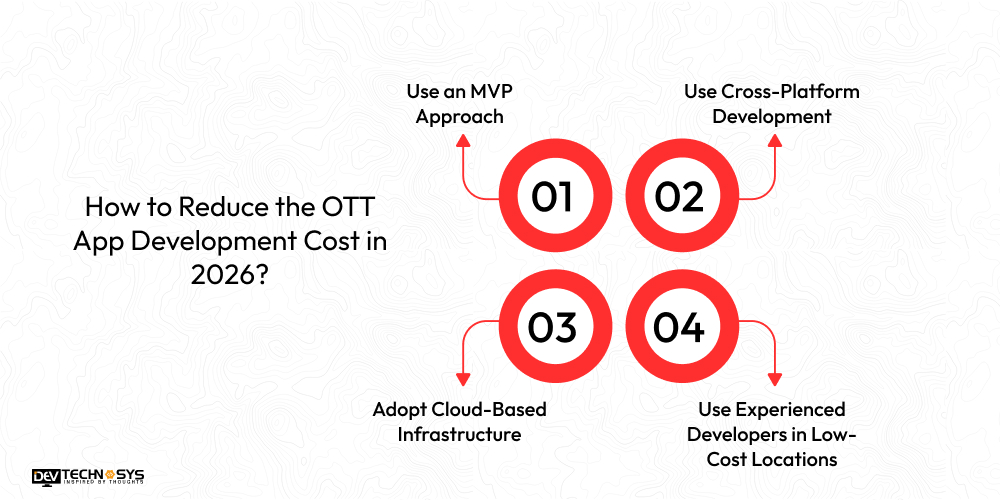
1. Use an MVP Approach
The smallest possible investment in developing a subscription streaming platform is a focus on essential features. Developing the Minimum Viable Product (MVP) gives you the least cost to create a minimum set of functionality, such as user registration, video streaming, and subscription management. This approach reduces your overall investment and provides quicker access to the marketplace.
2. Use Cross-Platform Development
By using cross-platform development frameworks such as Flutter or React Native, you can create one set of code for multiple platforms. The benefits of saving time, reducing recruitment costs, making maintenance easier, and achieving the same user experience are highly advantageous, greatly reducing the cost of developing online entertainment platforms.
3. Adopt Cloud-Based Infrastructure
Using cloud services to host an OTT app eliminates the need for a large capital investment in on-premise server hardware. By using cloud infrastructure, the online entertainment platforms will have a scalable content management system with built-in redundancy and disaster recovery options, plus they will be able to manage bandwidth, storage space, and distribution of video content.
4. Use Experienced Developers in Low-Cost Locations
Partnering with an experienced mobile app development company in low-cost areas reduces costs associated with recruiting and maintaining employees and provides an experienced OTT developer team that provides efficient coding practices, optimized architecture, and timely delivery of completed projects.
How Long Does it Take to Develop an OTT Application in 2026?
Typically, an OTT-developed app will take 3-6 months to complete in 2026 based on a variety of factors that include app complexity, functionality, & what platform you choose to create the application.
The development process consists of app planning, UI/UX design, back-end dev, streaming integration, app testing, app security implementation, and final deployment.
| Development Phase | Timeline | Key Work |
| Planning & Strategy | 1–2 Weeks | Requirement analysis, feature planning, tech stack selection |
| UI/UX Design | 2–3 Weeks | App design, user flow, prototypes |
| Backend Development | 3–5 Weeks | Database, APIs, server setup, user management |
| Streaming Integration | 2–4 Weeks | Video player, CDN, encoding, DRM setup |
| Frontend Development | 3–6 Weeks | Mobile/web app development, dashboards |
| Testing & QA | 2–3 Weeks | Bug fixing, performance, security testing |
| Deployment & Launch | 1–2 Weeks | App store release, production launch |
| Total Time | 3–6 Months |
Depends on features & complexity |
Why is the Project Budget Crucial for Businesses?
The business foundation has the most important tool to run smoothly: A Project Budget. Each business’s project budget helps an organization meet its financial responsibility, stay in line with its financial goals, and give the necessary resources to meet its individual project goals.
The project budget acts as a guide for prioritizing project tasks and managing risk; it also assists with accurate forecasting of anticipated project-related returns. Having a solidly developed project budget will result in making better decisions, operating more efficiently, and meeting project timelines
What are Monetization Models of OTT Applications in 2026?
Digital content streaming apps in 2026 will start earning revenue through various monetization models, including subscription-based, advertising-based, transactional, hybrid, and freemium models.
These models encourage digital streaming platforms to increase profitability and customer reach through flexible pricing and sustained revenue in the competitive digital entertainment market.
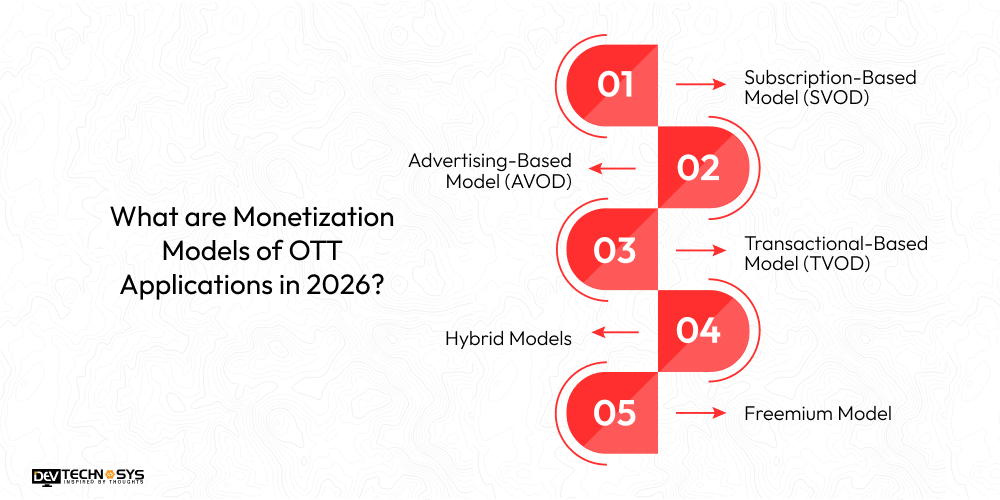
1. Subscription-Based Model (SVOD)
offers customers unlimited access to content for a monthly or yearly fee. This model works for Netflix, Disney+, etc. It offers steady revenue flow, no ads, early access to new content, and the subscription can be canceled or changed to a different plan to maximize revenue and retention.
2. Advertising-Based Model (AVOD)
provides content for free, but it’s backed by ads. YouTube, Hulu, etc, earn money via video ads, banners, and pay-per-click ads. This model captures a bigger audience, promotes engagement, and ultimately helps the platform earn money by not having to charge users a subscription fee.
3. Transactional-Based Model (TVOD)
allows users to pay per content piece. Users can rent or buy movies and shows; this is the case with Amazon Prime Video. This is suitable for new releases, live shows, and exclusive content and works with one-time payments instead of a subscription.
4. Hybrid Models
These models combine subscription and ad-based models. HBO Max, for example, has ad-based and premium (ad-free) models. This model helps increase revenue by catering to different user types and expanding the user base. According to the live streaming app development company, It provides users with different price options to maximize revenue.
5. Freemium Model
The freemium model provides customers with some free content, but users are required to pay in order to access premium services or exclusive shows. Increased streaming quality, the ability to download playlists for offline access, and the removal of advertisements are all included in the premium plan. These features result in higher conversion rates, as well as sustainable revenue growth over time.
Final Reflection!
In conclusion, the OTT app development cost in 2026 depends on various factors such as app complexity, platform selection, feature integration, tech stack, and post-launch maintenance. A basic MVP may require a lower budget, while a fully featured digital streaming platform demands a higher investment.
Partnering with a reliable OTT app development company ensures cost optimization, scalable architecture, advanced security, and seamless user experience. With proper planning and strategic execution, businesses can build a competitive OTT platform that delivers long-term growth and sustainable returns on investment.
Frequently Asked Questions
Find answers to the most common questions related to this article.
The OTT app development cost is around $8,000 to $25,000, based on unique features and services. The project budget can fluctuate due to various factors such as backend processes, platform choice, development team, design UI/UX, third-party integrations, tech stacks, and more.
Creating an MVP-based OTT app usually takes around 2 to 4 months. Developing a fully-featured or AI-powered OTT app mainly takes 3 to 6 months or longer. The total development time is based on various factors such as project complexity, a higher number of features, design UI/UX, and many more.
The maintenance cost of an OTT application is around 10% to 20% of the overall mobile app development cost. It includes various maintenance services such as solving bugs or errors, updating outdated features, designing enhancements, regular updates, performance optimizations, and many more.
The cost to hire OTT app developers starts from $15/hr for mid-experienced developers to $25+/hr as experienced developers. The cost of hiring developers can fluctuate due to crucial factors such as developers' living location, experience level, skill set, and project complexity.
Implement Subscription Plans
Run Targeted Advertisements
Provide Pay-Per-View Content
Hybrid Monetization Models
Partnerships & Content Licensing