












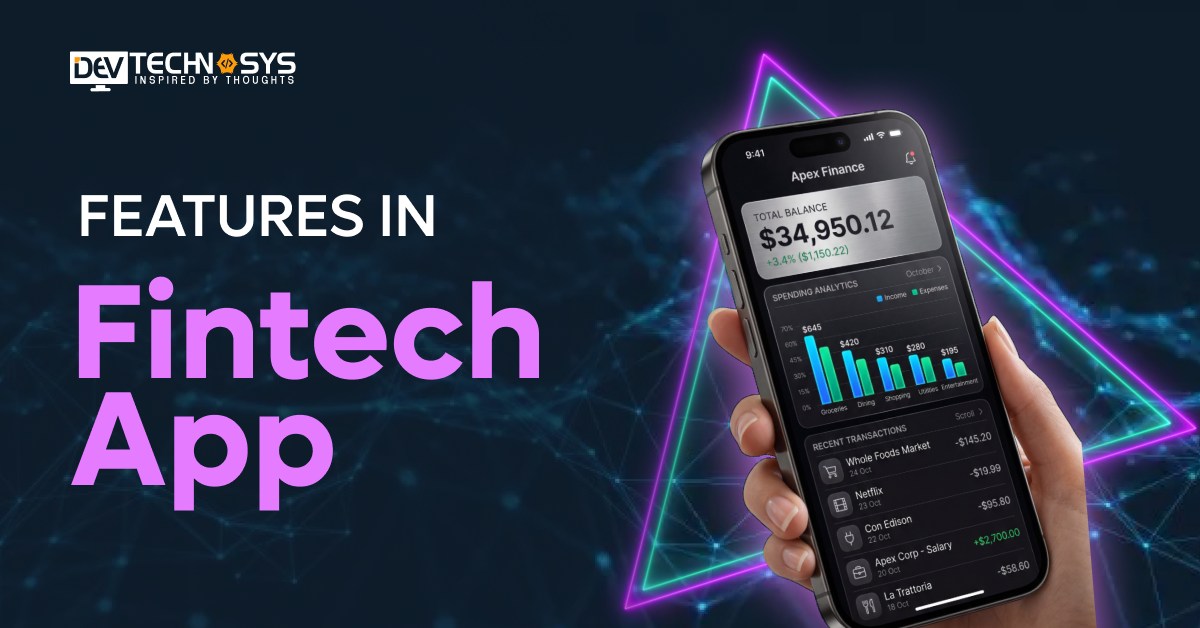
Key takeaways:
-
- Strong security features like encryption and biometric authentication are essential to protect user data and build long-term trust in fintech apps.
- Important devices are also compatible with applications that provide the ability for users to access financial services anytime through their smartphones and tablets.
- Fast and seamless transactions improve user experience by allowing instant payments, transfers, and bill settlements without delays or system errors.
Fintech applications are changing how people manage their assets; they’re providing a more efficient, easier, and intelligent way to use your money. With just a few screen taps, users can pay bills, invest, or save their money.
But what really separates an effective fintech application from one that’s not is more than just a sleek appearance. There are also many features in fintech app that are essential to consumers who rely on these tools as part of their regular financial activity.
These include being secure, fast, and easy to use, all in one place!
Users want to have access to tools that will help them understand and improve their finances with minimal effort on their part.
What do you need to create a powerful, effective, and necessary fintech application that meets daily requirements?
Let’s take a closer look at the must-have features in fintech apps.
What is a Fintech Application?
A fintech application is an online platforms that offer financial services such as payments, lending, investing, borrowing, banking, and more. Users no longer need to take cash when they are going out; they can easily manage their payments or bills through smartphones with just a few taps.
With the help of fintech app development solutions , make transactions faster, more secure, safer, and more efficient and convenient. It includes various advanced features such as real-time transactions, budgeting tools, instant transfers, and more.
What are the Core Features in Fintech Applications?
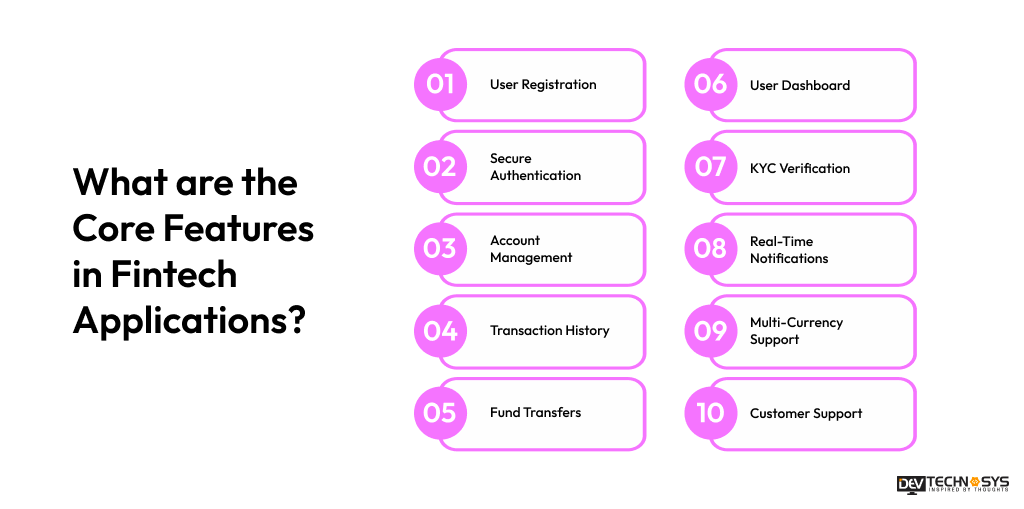
Before going into advanced fintech app features, know about the list of core features of a fintech application that must be integrated. It includes account management, check balance, transaction history, push notifications, and customer support.
1. User Registration
User can register their own account on the fintech app via phone numbers, email addresses, and social media platforms. Users need to upload documents, perform OTP verification, and ensure compliance. It offers a user-friendly interface that enables users to quickly access the signup or login process.
2. Secure Authentication
The ewallet app development solution provides secure authentication on users’ accounts, such as multi-factor authentication, facial recognition, fingerprint, passwords, and more. This core feature allows only authorized users to access the account and prevents third-party members and cyberattacks.
3. Account Management
Users can easily manage their multiple accounts, such as account information, link multiple bank accounts, and credit cards. This feature provides users with flexibility and convenience to easily switch between multiple accounts within a single application and get full control over the accounts.
4. Transaction History
These essential fintech features offer a detailed transaction history to view the past transactions, account activity, transfers, and receipts. Users can search their specific transaction history by applying filters and download the full statement for the month and year. It helps users to track their spending and manage their budget.
5. Fund Transfers
Users can send or receive money instantly between two different accounts, and users can also transfer funds to their own account. These fintech applications support domestic and international fund transfers with proper security measures. It ensures that transactions are processed without any delays or errors.
6. User Dashboard
The user dashboard provides clear financial insights such as account balance, recent transactions, account number, and many more. Dashboard is simple, intuitive, and customizable, which helps users to quickly access all the financial services. Users can track their daily financial activity without any confusion.
7. KYC Verification
KYC(Know Your Customer) verifies users’ identity via passports, residential ID, PAN, and other proof documents. It is necessary to verify the users to prevent fraud and offer financial services while legal requirements are met. It is one of the essential features for fintech platforms that build trust with fintech applications and maintain transparency.
8. Real-Time Notifications
The fintech app development solutions send users timely alert messages or notifications about transactions, account activity, security updates available, and other system updates. These notifications remind users about their upcoming bills or any financial insights. It can help to detect any unauthorized activity.
9. Multi-Currency Support
This features of digital banking and fintech apps allow users to make transactions in different currencies, making it easy for users to make international transactions. Users can easily send money in the form of cryptocurrencies and offer real-time exchange rates with seamless conversion.
10. Customer Support
Financial applications provide a customer support team to solve the users’ concerns and queries as soon as possible. Support team is available 24/7 to provide quick assistance, and users can connect via live chat, chatbots, call, and more.
Want a chatbot demo or pricing? Fill the form and talk to our experts today.
Pick what you need below — you can select more than one — then tap Get detail to continue.
-
Chatbot demo dashboard
-
Cost to develop an app
-
Industry report
-
Case study
Advanced Features in Fintech Applications
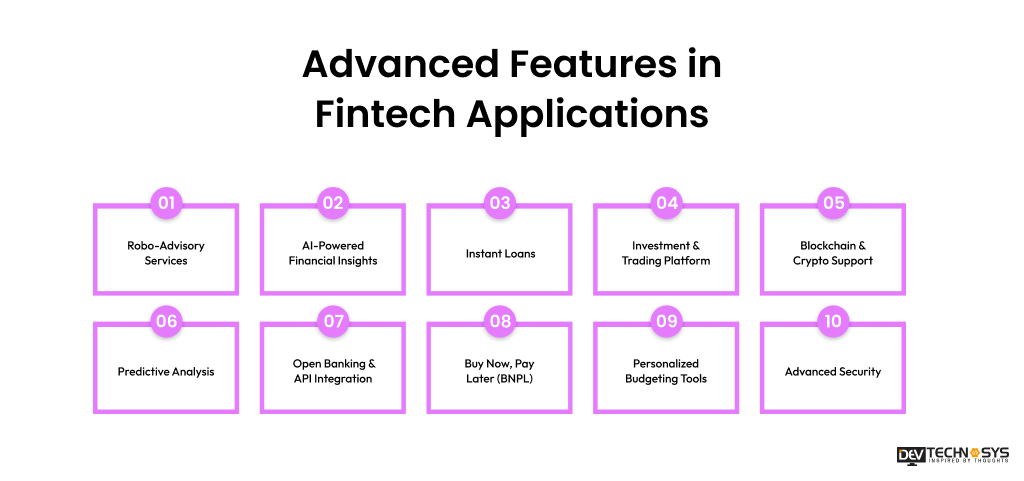
These advanced features in fintech platforms help users to stretch their flexibility further and get automated operations. It involves various advanced features that have totally changed the experience of users using fintech applications.
1. Robo-Advisory Services
Fintech application features offer robo-advisory services for automated advice to create a personalized portfolio based on market trends, goals, and risk appetite. It offers a cost-effective wealth management plan and eliminates traditional financial advisory services.
2. AI-Powered Financial Insights
Artificial intelligence analyzes the users’ spending habits, patterns, transactions, and income, and offers them personalized recommendations to spend money according to this. It helps users to save money more effectively without the need for any manual tracking.
3. Instant Loans
This feature in a fintech app allows users to apply for a loan, receive real-time approval, and get the funds instantly in their bank account. It includes credit scoring, easy repayment options, EMI calculators, and more. Offering convenience and flexibility as compared to a traditional platform.
4. Investment & Trading Platform
The fintech on-demand app development solutions integrate the investing and trading platform to allow users to execute trades, receive market insights, and monitor overall performance. It includes mutual funds, stock trading, portfolio management, and cryptocurrencies.
5. Blockchain & Crypto Support
It provides secure cryptocurrency transactions, wallet management, smart contract capabilities, and more. With the help of blockchain integration, it enhances transparency, security, and immutability for digital assets and international payments.
Read also: How to Start a FinTech Company in 2026: Complete Step-by-Step Guide
6. Predictive Analysis
Use the past or historical data and artificial intelligence to forecast spending, investment returns, and income trends. It helps users to make their budget plan and save money more effectively. Predictive analysis has the ability to detect anomalies.
7. Open Banking & API Integration
It enables users to share the data with third-party financial services, and users can access multiple platforms or payment gateway integrations within a single platform. It makes it easy for users to expand their financial services and increase their overall flexibility and accessibility.
8. Buy Now, Pay Later (BNPL)
The fintech application offers BNPL services as a short-term credit purchase, and users can split into installments with minimal interest. It can enhance user experience and convenience, promote responsible spending, and integrate with e-commerce platforms.
9. Personalized Budgeting Tools
The personalized budgeting tools help users to manage their spending and save a lot more. It includes various tools such as a budget tracker, suggesting adjustments, tracking daily spending, and expenses. It sends alert messages for money-saving opportunities based on user behavior.
10. Advanced Security
Fintech apps offer advanced security features such as facial recognition, fingerprints, passwords, and more to protect from data breaches and unauthorized access. Security features in fintech apps, coupled with AI, ensure that users’ data is secure from modern cyberattacks and third-party members.

Next-Generation Features in Fintech Applications
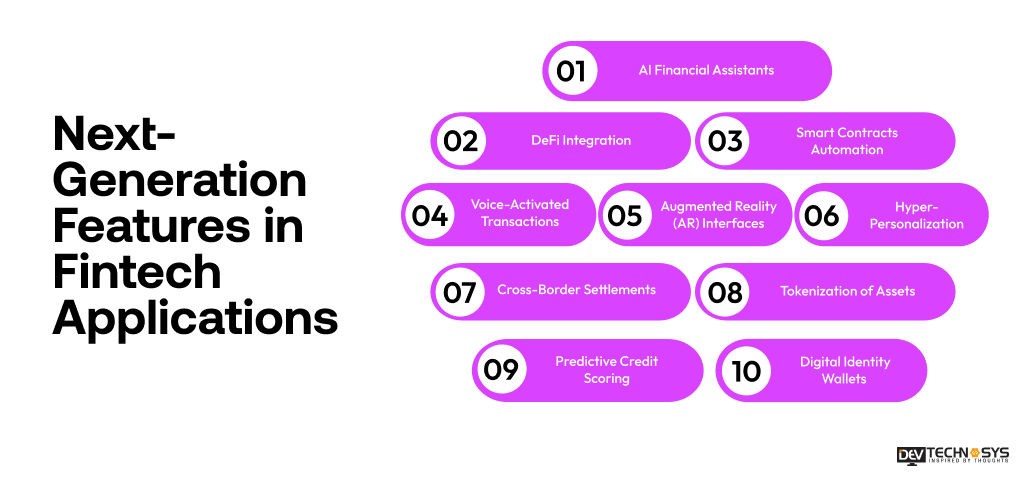
It’s the right time to uncover the unique or next-generation features in fintech applications. It includes futuristic features that help fintech apps gain a competitive advantage over other apps in the fintech industry.
1. AI Financial Assistants
AI in banking industry provides advice to users on their financial investments and solves their queries for bill payments and more. They learn users’ data insights, such as behaviour, habits, and patterns, over time. It offers personalized recommendations for improving financial decisions.
2. DeFi Integration
With the help of DeFi integration, users can access the blockchain-based services such as lending, borrowing, trading, investments, and more without any intermediaries. Mainly, it promotes transparency and global accessibility without dependencies.
3. Smart Contracts Automation
The fintech application offers smart contract automation to execute self-transactions when the conditions are met. It can reduce manual intervention, ensure transparency, and build trust in agreements. This mainly executes on insurance and cross-border transactions.
4. Voice-Activated Transactions
Users can perform some financial operations or tasks through voice command, such as balance check and making a transaction. It can enhance the user’s experience and offer convenience, flexibility, accessibility, and hands-free operation.
5. Augmented Reality (AR) Interfaces
With the help of Augmented Reality (AR), transform the visual appearance of financial data into an interactive format, which can increase the users’ engagement time. It mainly converts the complex information into an easy-to-understand visual interface.
6. Hyper-Personalization
In this, advanced data analytics offer highly customized user experiences, including proper budgeting plans, investment advice or suggestions, and personalized offers. Connect with a professional fintech app development company to integrate this type of feature in your fintech application.
7. Cross-Border Settlements
It allows users to make international transactions easily with minimal charges and delays. This feature generally improves global commerce by offering faster cross-border transactions or settlements, making it more cost-effective and transparent.
8. Tokenization of Assets
The tokenization of assets feature allows users to convert real assets like property and stocks into digital assets. This can increase the liquidity and enable access to the broader investment opportunities, and also provide fractional ownership.
9. Predictive Credit Scoring
With the help of AI and alternative data, such as users’ behaviour and spending habits, to assess the creditworthiness. The financial applications can also check the past loan data to know about the credit history.
10. Digital Identity Wallets
Mobile banking app development solutions store the users’ credentials data in a secure database that allows users to access other financial services. It mainly simplifies KYC processes, enhances privacy, and gives full control over data sharing.
Conclusion
Every features in fintech apps must provide a real benefit to the user on an everyday basis with the help of strong fintech app architecture. This makes it easier for people to manage their money effectively without causing undue anxiety about using the service.
Every features in fintech apps must provide a real benefit to the user on an everyday basis. Working with a reputable mobile application development company will enable entrepreneurs to design and build a robust, secure, and highly interactive mobile application that meets current consumer standards.
Frequently Asked Questions
Find answers to the most common questions related to this article.
Essential features include secure login, fast transactions, real-time notifications, budgeting tools, and easy navigation. These elements ensure users can manage their finances smoothly while feeling safe and confident using the app daily.
The primary concern for fintech applications is security regarding the protection of sensitive financial information from being compromised via either fraud or cybercrime. Features such as encryption of all data, two-factor authentication, and the use of Biometric Identification will help users build trust in the application and feel safe.
Having a simple, clean design will increase the likelihood that end-users will use an application. A straightforward design will help to eliminate frustration, enhance the user experience, and ultimately enable users to complete financial-related tasks without needing any technical skill or support.
Budgeting Tools assist with tracking all income and expenses, establishing financial goals, and managing personal finances. Budgeting tools offer insight to allow for better-informed financial decisions, as well as to help users remain within their budgeted amount.
Quick transactions allow users to save time and improve overall satisfaction with the use of the service. When sending money and/or paying bills, users expect either instant or quick processing of transactions in order to keep their finances organized and avoid having unwanted delays.