










Key takeaways:
-
- Web3 real estate app development consists of various steps such as idea validation, gathering requirements, blockchain platform selection, creating Ethereum real estate smart contracts, tokenization, developing the user interface, backend, testing, launching, and maintenance.
- Adding premium or unique features in a Web3 real estate app, such as blockchain-based transactions, digital wallet integration, real-time property listings, and verification.
- Using robust tech stacks for Web3 real estate app development, such as Flutter, JavaScript, Python, Go, Java, Node.js, Ethereum, Solana, Polygon, PostgreSQL, and AWS.
- The cost to build a Web3 real estate app ranges from $8,000 to $25,000, depending on essential factors or elements like blockchain platforms, features, third-party integrations, and more.
Web3 is revolutionising the internet as it relates to real estate!
By 2026, Web3 real estate applications will change how all property is bought, sold, and invested in, making these processes easier and more secure.
Web3 applications are built on blockchain technology, which makes them safe, fast, and transparent when it comes to transactions involving real estate. You can even purchase digital land or invest in real estate around the world with Web3 applications!
However, to build a successful Web3 real estate application, you need to have a robust plan, the right features, a good technology stack, and there is a variety of costs associated with design and complexity.
This blog will outline everything you need to know about building a successful real estate Web3 application, such as costs, what features are most important, and the technologies available to support successful applications.
How Large is the Web3 Applications Market Today In Monetary Terms?
- According to Grand View Research, the Web3 market is valued at around $2.25 billion in 2026, and it is expected to grow to around $33.53 billion by 2030.
- Blockchain type-wise, the public segment holds the highest revenue share, around 56.4% in 2025.
- The Web3 market valuation is expected to increase with a Compound Annual Growth Rate (CAGR) of 49.3% from 2025 to 2030.
- As per the report of Knowledge Sourcing Intelligence, the Asia-Pacific region holds the largest market share of around 30.54% in 2025.
- According to Technavio, as an end user, the BFSI segment is highly grown and generates a higher revenue of around USD 5.34 billion during the forecast period.
What is the Web3 Real Estate App?
Real-estate apps in the Web3 era mean these applications will help buyers, sellers, and real-estate investors through blockchain technology to track and trade properties digitally, securely, and without intermediaries. Users will also be able to own real estate digitally via tokenization and other methods.
Decentralized real-estate apps will improve the process of buying, selling, or investing in residential and commercial properties by creating efficient, effective, affordable, safe, and transparent transactions for all to use worldwide.
Why Today’s Entrepreneurs Want to Invest in Web3 Real Estate App Development?
The real estate market is increasingly being built with blockchain (web3) technology. The web3 space has seen an investment of over $1 billion into real estate app development by entrepreneurs looking to take advantage of this digital market and its rapid growth. blockchain-based real estate applications provide safe, transparent, and low-cost transactions to users.
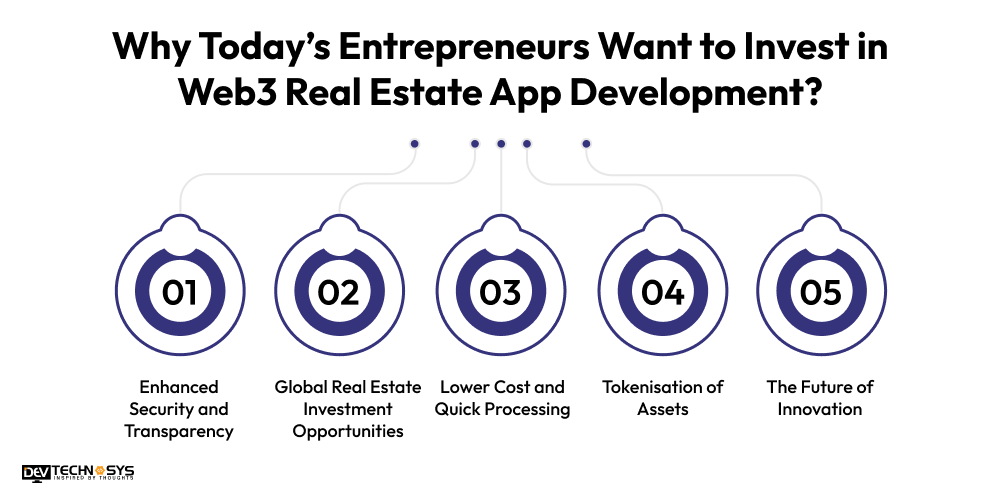
1. Enhanced Security and Transparency
NFT real estate marketplace apps entail strong security, as they utilise blockchain technology – having the added benefit of each transaction being documented and unalterable.
This helps foster trust between users and diminishes the potential for fraudulent activity, while also removing the requirement for middlemen. Thus, providing greater levels of transparency and reliability for both buyers and sellers within the market.
Real More: Types of Real Estate Apps
2. Global Real Estate Investment Opportunities
Web3 decentralized property marketplace app allow businesses to expand their market reach globally since individuals in other parts of the world can invest in real estate without having to be physically present for searching and visiting properties.
Consequently, businesses expand their market and create new opportunities for smaller real estate investors, providing individuals with more means to participate in the real estate market.
3. Lower Cost and Quick Processing
Real estate transactions often take some time to complete due to the number of transactions requiring documentation, as well as multiple transaction fees associated with using intermediaries.
Web3 applications reduce the amount of paperwork involved in real estate transactions and eliminate the use of intermediaries to complete transactions, creating more rapid processing of transactions.
4. Tokenisation of Assets
Web3 creates the opportunity for the tokenisation of real estate assets, which involves the division of real estate property into digital tokens. Consequently, businesses can sell fractional parts of their assets, allowing investors an affordable method of investing in real estate tokenization development. Tokenized real estate assets also increases the liquidity of real estate assets and allows for quicker purchases of real properties.
5. The Future of Innovation
By investing in web3 property marketplace development solutions, businesses can keep up with upcoming technological developments. As digital property and virtual real estate become more common, businesses can find new revenue sources.
Investing in Web3 will boost the company’s image as an innovative and current business, providing a long-term benefit by allowing it to be ready for the future economy.
Industry Insights:
According to Future Business Insights, the broader Web3 market (including DeFi, NFTs, AI‑integrated dApps) is forecast to scale from $6.9B in 2026 to $176B by 2034, reflecting strong adoption of decentralization technologies relevant to real estate apps.
What are the Key Steps to Develop a Web3 Real Estate App?
Develop a Web3 real estate app, which can consist of various development steps that enable businesses to easily understand each process in detail. From market research and blockchain platform selection to deployment and post-launch maintenance services. The following steps show how to develop a Web3 application:
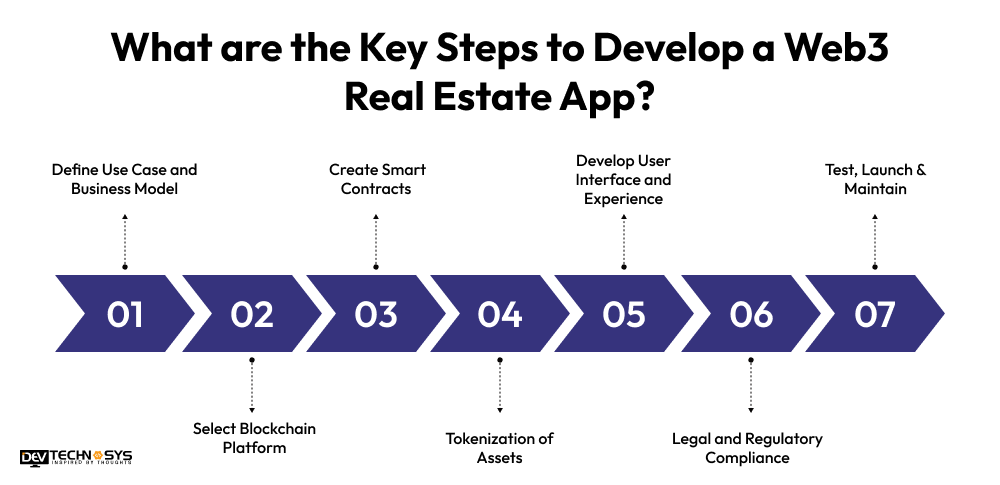
1. Define Use Case and Business Model
Begin by defining the overall goal of your Web3 real estate application, including property tokenization, fractional ownership, or decentralized property listings.
Identify who your targeted users are and how you will generate revenue, as well as what the value proposition of your fractional property ownership platform will be. The establishment of a clear business model will help to align technology with user needs and achieve long-term scalability.
2. Select Blockchain Platform
Choose from among well-established blockchain platforms like Ethereum, Polygon, and Solana based upon issues including scalability, transaction fees, and the associated ecosystem.
Hire dedicated developers to evaluate potential platforms for such items as smart contract functionality, security provisions, and the availability of developer-related tools. The selection of the appropriate blockchain platform for your app will not only allow for transactional efficiencies between users but also a transparent user experience.
3. Create Smart Contracts
Create secure smart contracts to manage ownership of the property and related transactions such as buying, selling, and transferring. Smart contract property transactions allows for the automation of processes related to buying, selling, or transferring ownership of real estate without the need for an intermediary. It is critical that the smart contracts be tested and audited regularly to identify any potential vulnerabilities.
4. Tokenization of Assets
The process of creating digital tokens from equity and/or real estate assets that allow for fractionalized ownership of that asset, which opens up real estate ownership to a larger pool of investors.
Hire professional developers from a Web3 development company to create a token standard (ERC-20 or ERC-721) and establish rules for compliance with applicable laws. Tokenization will help to increase liquidity and simplify the transaction process while ensuring transparency and traceability.
5. Develop User Interface and Experience
The creation of a user-friendly and responsive front-end will allow users to interact with the underlying technology of the blockchain with less complexity.
Users should also be able to secure login and transaction functions through the integration of a digital wallet into the user interface. Users should find the property listings, searching for properties, search filters, and dashboard functionalities to be user-friendly.
6. Legal and Regulatory Compliance
Both the real estate and blockchain industries have a high degree of regulatory compliance requirements. Therefore, it is imperative that you ensure compliance with applicable laws and regulations before proceeding with the development of your tokenization and/or blockchain-based project.
DeFi real estate applications development involves the use of legal counsel with expertise in real estate, KYC/AML requirements, and tokenization in your area.
7. Test, Launch & Maintain
Conduct rigorous testing, including smart contract audits, security checks, and performance testing. Hire a mobile app development company to deploy the app on the mainnet after successful validation.
Continuously monitor, update, and improve based on user feedback. Regular maintenance ensures security, scalability, and reliability, helping your Web3 real estate app stay competitive and trustworthy in a rapidly evolving market.
Want a chatbot demo or pricing? Fill the form and talk to our experts today.
Pick what you need below — you can select more than one — then tap Get detail to continue.
-
Chatbot demo dashboard
-
Cost to develop an app
-
Industry report
-
Case study
What are the Must-Have Features of Web3 Real Estate Applications?
Integrating features in Web3 real estate applications is the most important concern when beginning the real estate dapp development process. It includes various web3 real estate app features like smart contracts, decentralized storage, non-fungible tokens, real-time property listings, and more.
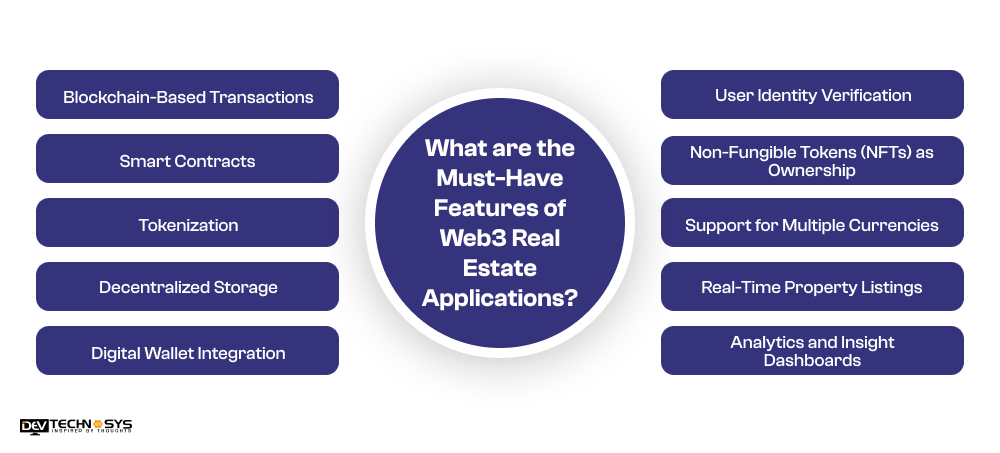
1. Blockchain-Based Transactions
Blockchain in real estate apps promotes secure, reliable, and public trust, along with anti-fraud measures for all transactions, while removing intermediaries from all transactions.
2. Smart Contracts
Smart contracts will automate both agreements and payments for the buyer and the seller, thereby reducing manual effort with more rapid increases in speed and certainty.
3. Tokenization
Real estate can be converted and represented as a digital token. Fractional ownership through digital tokens allows for more affordable real estate investments globally.
4. Decentralized Storage
Storing property data in a decentralized format eliminates the possibility of a single point of failure for the data, which provides reliability and continuity.
5. Digital Wallet Integration
A web3 property listing platform provides a seamless and secure method of storing, sending, and receiving cryptocurrency for property-related transactions.
6. User Identity Verification
The KYC verification system ensures that the onboarding of buyers, sellers, and investors is secure and provides built-in trust, while the identity verification process also serves to prevent fraudulent activity.
7. Non-fungible Tokens (NFTs) as Ownership
Property ownership can be represented through NFTs, which allow for easy transferability of ownership while creating a digital asset that contains proof of ownership.
8. Support for Multiple Currencies
Real estate transactions can be made in both cryptocurrencies and fiat currency. Crypto real estate investment platform creating options for users to choose their preferred payment method for transactions.
9. Real-Time Property Listings
A smart contract real estate app will provide accurate information about properties that are available for sale or lease. So that users can make more informed and timely decisions.
10. Analytics and Insight Dashboards
A decentralized property investment app providing data analytics and insights will provide investment decision-making tools for users and businesses looking to better understand their investments.
Industry Insights:
According to The World Property Journal, Digital currencies and stablecoins are quietly being built into real estate finance systems, not just for speculation but as operating rails for cross‑border property deals and financing.
What are the Challenges in Web3 Real Estate App Development?
Creating an application for real estate using web3 technology will face a lot of challenges, including regulatory uncertainty, security risks, scalability issues, and problems with users adapting to the new platform. Addressing these types of issues will take careful consideration of the financial future as well as the latest technologies available.
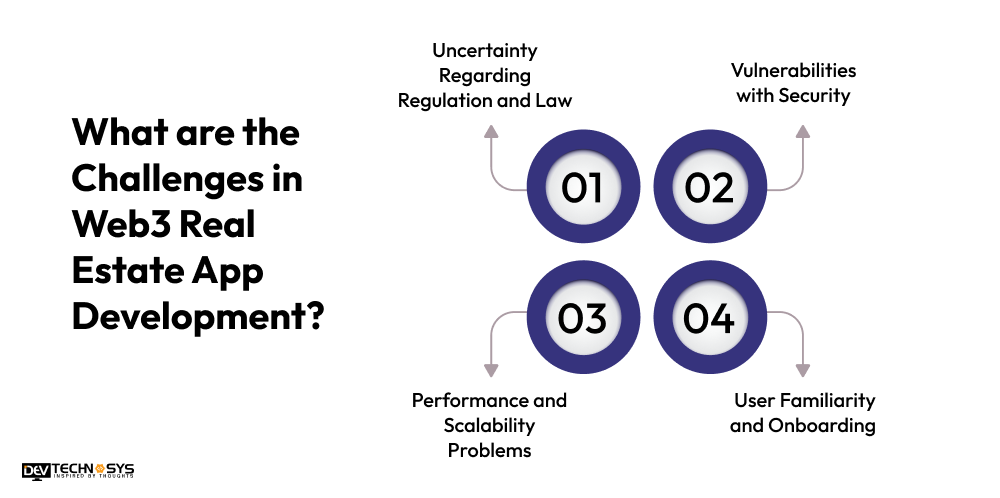
1. Uncertainty Regarding Regulation and Law
Web3 real estate exists within a very complicated and changing regulatory environment. Various property laws, rules regarding tokenization, and regulations covering cryptocurrencies differ from one jurisdiction to the next.
It’s very difficult to fulfil local legal requirements while continuing to operate in a decentralized manner, while also continuing to comply with the decentralized nature of their operations.
2. Vulnerabilities with Security
Smart contracts and blockchain integrations can have bugs or be exploited if they are not reviewed through an appropriate audit process. Bugs or exploits could result in monetary loss or damage to user confidence in the security of Web3 applications.
Because of the need for thorough audit processes, implementing encryption and ongoing monitoring of the blockchain will create additional complexity in the design.
3. Performance and Scalability Problems
High volumes of transaction data on the blockchain will create performance issues, such as transaction congestion, slow processing speeds, and higher-than-necessary transaction fees.
The end user will not have a pleasant experience conducting a real estate transaction, which requires both speed and reliability. The developer will need to develop a way to scale their application or select an efficient blockchain.
4. User Familiarity and Onboarding
A majority of users are still not familiar with many Web3 capabilities, including wallets and private keys. As a result, there will be significant onboarding and usability challenges for many users.
In order to overcome these onboarding and usability issues, a developer would need to create a user-friendly interface and educate the user about Web3 technologies. This will require a significant amount of design work and development of support systems.
How Much Does it Cost to Build a Web3 Real Estate App in 2026?
The cost to develop a Web3 real estate app starts from $8,000 for a basic app and ends at $25,000 for a highly complex or AI Agents For Real Estate App. The blockchain real estate platform cost can fluctuate or change due to various factors, such as features, functions, project complexity, backend infrastructure, blockchain platforms, and many more.
There are many additional factors that can also impact the real estate app development cost, such as security measures, testing, designing, tech stacks, and API integrations.
Component |
What’s Included |
Estimated Cost (USD) |
| UI/UX Design | Simple mobile/web interface, basic property listing screens | $1,000 – $3,000 |
| Frontend Development | Web or single-platform mobile app | $2,000 – $6,000 |
| Backend Development | Simple database, user auth, basic APIs | $1,500 – $5,000 |
| Blockchain Integration | Basic wallet login, minimal smart contract for property ownership | $2,000 – $5,000 |
| Admin Panel | Basic dashboard to manage listings/users | $500 – $2,000 |
| Testing & QA | Manual testing, functional verification | $500 – $1,500 |
| Deployment & Hosting | Cloud server + simple DevOps setup | $500 – $1,000 |
What are the Crucial Factors that Impact Web3 Real Estate App Development Cost?
There are many different factors that contribute to creating a Web3 application for real estate, and each of these factors adds cost to develop and maintain the application, including blockchain selection, smart contract complexity, and regulatory compliance. Each of these factors affects the scalability, performance, and trust of the user base.
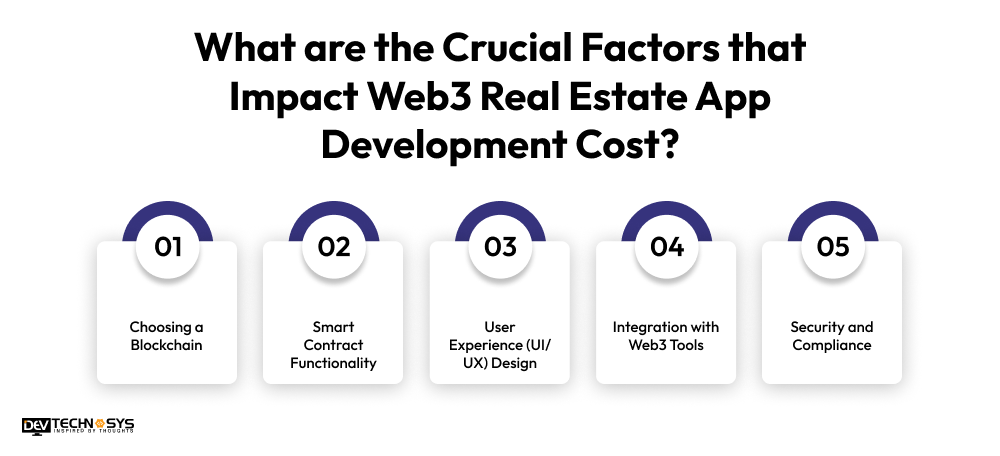
1. Choosing a Blockchain
Blockchain type impacts how much it will cost to develop. Some have higher fees (Ethereum – gas) and require more complex contracts to build. Blockchains differ from one another in terms of scalability, security, tooling, and developer availability, and, therefore, impact how long and at what cost it takes to develop a decentralized real estate platform.
Complexity |
Description |
Estimated Cost Impact ($) |
| Basic | Using a low-fee, scalable blockchain (e.g., Polygon) | 1,500 – 3,000 |
| Intermediate | Ethereum or Solana with moderate customization | 3,000 – 6,000 |
| Advanced | Multi-chain support for interoperability | 6,000 – 8,000 |
2. Smart Contract Functionality
Smart contracts automate performing transactions on property, i.e., transacting ownership of property and facilitating & automating many common property transactions.
Therefore, the more complex your smart contract is with logical conditions, the higher Web3 development cost. It’s vital to put in place a robust testing, auditing, and security regime throughout the entire process.
Complexity |
Description |
Estimated Cost Impact ($) |
| Basic | Standard property ownership transfer | 1,000 – 2,500 |
| Intermediate | Includes escrow, rental automation, and royalties | 2,500 – 5,000 |
| Advanced | Fractional ownership, DAO governance, complex logic | 5,000 – 7,000 |
3. User Experience (UI/UX) Design
Building a user-friendly application (for non-crypto users) is critically important to driving the adoption of your application. Custom dashboards, interactive property listings, integrated wallet functionalities, and seamless navigation will add more to the overall design and build effort.
More time, better quality designers, and iterative testing will be required to build high-quality UI/UX, all of which will increase the total Web3 real estate app development cost.
Complexity |
Description |
Estimated Cost Impact ($) |
| Basic | Simple responsive design with standard layouts | 1,000 – 2,000 |
| Intermediate | Custom dashboards, interactive property listings | 2,000 – 4,000 |
| Advanced | Highly polished UI, AR/VR integration, advanced workflows | 4,000 – 6,000 |
4. Integration with Web3 Tools
Integrating a wallet, payment gateway, NFT standard, and decentralised storage functionality into your application will complicate the development process. Tools such as MetaMask, IPFS, and Oracles need to work seamlessly within your application.
Each additional integration will add more work and costs associated with developing, testing, and maintaining it, depending on the number and complexity of the external services you are integrating.
Complexity |
Description |
Estimated Cost Impact ($) |
| Basic | Single wallet integration (MetaMask, WalletConnect) | 500 – 1,500 |
| Intermediate | Multiple wallets, crypto payment gateways, and NFT standards | 1,500 – 3,000 |
| Advanced | Full ecosystem integration with oracles and APIs | 3,000 – 5,000 |
5. Security and Compliance
Developers must ensure that their Web3 applications are safe and compliant with any applicable laws. Additionally, the web3 real estate app development cost includes: security audits, penetration testing, and adhering to regulatory compliance when dealing with real estate transactions that include ownership and financial data. Compliance with laws by jurisdiction and protection from hacks and vulnerabilities.
Complexity |
Description |
Estimated Cost Impact ($) |
| Basic | Standard security measures, minimal audits | 1,000 – 2,000 |
| Intermediate | Regular smart contract audits, GDPR/AML compliance | 2,000 – 4,000 |
| Advanced | Full-scale penetration testing, ongoing monitoring | 4,000 – 6,000 |
Which Tech Stacks are Used to Develop a Web3 Real Estate App?
Real estate applications for web3 utilize an advanced technology stack incorporating front-end frameworks, back-end technologies, blockchain networks, smart contracts, decentralized storage systems, and wallet integrations to facilitate safe, transparent, and efficient real estate transactions.
Layer |
Technologies / Tools |
Purpose |
| Frontend | React.js, Next.js, Vue.js, Angular | Builds responsive user interfaces and interactive property listing pages |
| Backend | Node.js, Express.js, NestJS, Python | Handles business logic, APIs, and server-side operations |
| Blockchain | Ethereum, Polygon, Solana, Binance Smart Chain | Enables decentralized transactions and property ownership records |
| Smart Contracts | Solidity, Rust | Defines automated agreements, ownership rules, and transaction logic |
| Wallet Integration | MetaMask, WalletConnect | Allows users to connect crypto wallets and manage digital assets |
| Storage | IPFS, Filecoin | Stores property data, images, and documents in a decentralized manner |
| Database | MongoDB, PostgreSQL | Manages off-chain data such as user profiles and listings |
| APIs & Oracles | Chainlink, The Graph | Fetches real-world data and enables blockchain indexing |
| Authentication | Web3Auth, OAuth | Secures login via wallets or traditional authentication methods |
| Dev Tools | Hardhat, Truffle, Ganache | Assists in smart contract development, testing, and deployment |
| Cloud/Hosting | AWS, Google Cloud, Vercel | Hosts frontend, backend, and ensures scalability |
| Testing & Security | OpenZeppelin, MythX, CertiK | Provides auditing, security testing, and vulnerability detection |

What are the Future Trends of Web3 Real Estate Apps?
Rapidly growing trends such as property tokenization, metaverse integration, and AI-driven automated processes are significantly transforming the web3 real estate industry.
These changes have already started to change traditional ways of owning and experiencing properties and will continue to do so as technology advances to reshape the entire global real estate market.
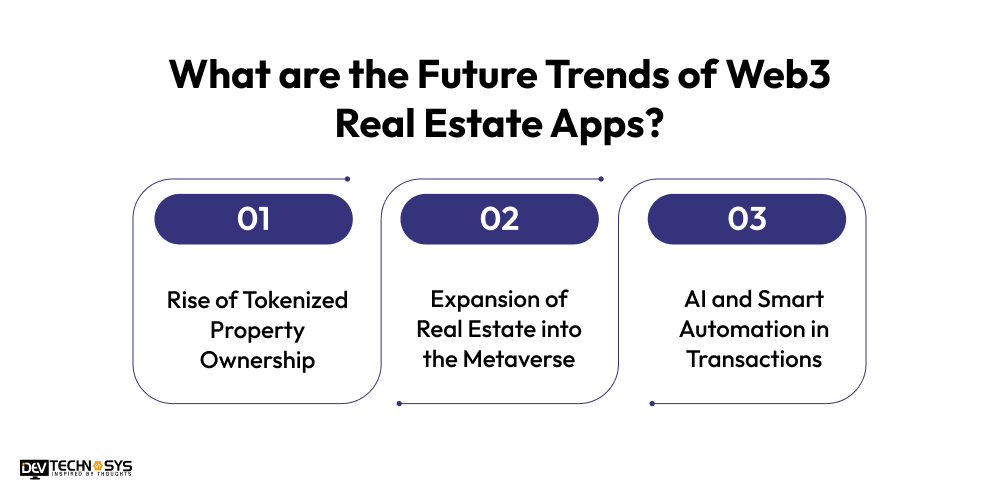
1. Rise of Tokenized Property Ownership
Digital property ownership using blockchain opens the opportunity for fractional ownership of real estate, leading to increasing accessibility for investors looking to purchase and invest in property globally.
Lowering the barrier to capital investments will result in improvements to liquidity in the real estate market, democratization of investment opportunities, and simple cross-border transactions via a transparent and secure digital record of ownership on the blockchain.
Real More: Build Real Estate Apps like Zoopla
2. Expansion of Real Estate into the Metaverse
Real estate within the context of Web3 will expand into a virtual environment where users can purchase, sell, or develop digital land. Businesses and individuals will purchase real estate in the metaverse for business branding.
Thus, facilitating the generation of new revenue streams while altering traditional views of what constitutes ownership and equating to new mixed physical and digital ecosystems within the real estate industry.
3. AI and Smart Automation in Transactions
Artificial intelligence will improve the ability to make property recommendations, conduct pricing analysis, and assess risk levels when it comes to all aspects of real estate transactions.
When used together with smart contracts, automating the real estate transaction process will remove the burden of administrative paperwork and eliminate the need for third-party intermediaries.
Conclusion
The future of real estate transactions has arrived. Blockchain technology, smart contracts, and decentralized ownership are revolutionizing the way that people buy, sell, and invest in property. To successfully build a comprehensive Web3 real estate application, developers need to concentrate on critical functions such as Property Listings, NFT ownership strategies, secure payments, and an exceptional end-user experience.
An organization that partners with an established blockchain real estate app development company will have access to superior technologies, including Ethereum blockchains, Solidity development, IPFS storage solutions, and React Native applications.