




















Key takeaways:
-
- To develop a DEX platform, follow several steps, such as creating a DEX business model, selecting a blockchain network, developing smart contracts, designing UI/UX, integrating features, developing, launching, and maintaining.
- The cost to build a DEX platform is around $10,000 to $30,000, based on several factors like project complexity, blockchain network selection, design, and maintenance services.
- Many ways to generate revenue from DEX platforms, such as trading fees, token listing fees, staking and yield farming, and liquidity pool incentives.
- Integrate advanced features in DEX platform to make it unique, like wallet integration, cross-platform compatibility, an advanced trading dashboard, fast transaction processing, and many more.
The emergence of Decentralized Exchanges (DEXs) has caused a tremendous amount of change within the world of cryptocurrency trading in just a few short years. By 2026, what was once viewed as an experimental and niche service used only by a limited number of crypto enthusiasts, will have become an essential part of the overall framework of digital finance today.
As DEX technology continues to evolve at an incredible rate, AI trading analytics and gas-efficient smart contracts. There is a race in the marketplace between companies, start-up entrepreneurs and blockchain developers to develop their own fully decentralized trading ecosystems that can provide secure & compliant solutions to compete with these centralized platforms.
However, in order to create a DEX platform requires much more than simply launching a token swap feature. In particular, a developer must have an intimate understanding of smart contract architecture, liquidity mechanics, security protocols, governance models, and user experience design before they can even begin designing their own DEX platform.
This comprehensive decentralized exchange development guide will take you step-by-step through the entire process, from AMM protocol selection and blockchain choice to developing smart contracts and performing security audits, to creating truly innovative DeFi solutions that are ready for the future.
Current and Future Market Statistics of Decentralized Exchange
Let’s consider the current and future market projections of decentralized exchange platforms via Grand View Research:
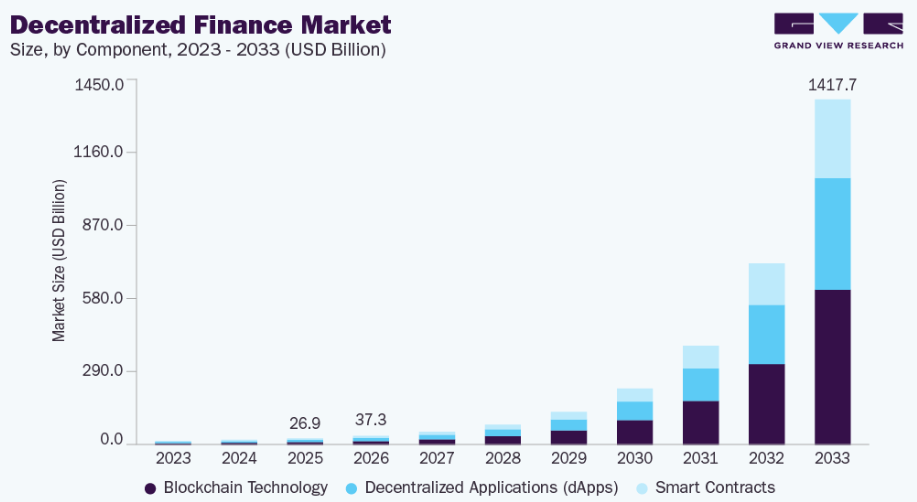
- The global decentralized finance market amounted in size to USD 26.94 billion in 2025 and is expected to grow to USD 1,417.65 billion by 2033 with a compound annual growth rate of approximately 68.2% from 2026 to 2033.
- The share of the North American decentralized finance marketplace is expected to represent 36.5% of the total marketplace by 2026.
- The Decentralized Finance (DeFi) Marketplace within the United States is expected to be the largest portion of Decentralized Finance by 2026.
- By Component, the Blockchain Technology Sector will represent the largest share of 42.5% of Decentralized Finance by 2026.
- By Application, the Data and Analytics Sector will represent the largest market share of Decentralized Finance in 2026.
What is DEX Platform?
The DEX (Decentralized Xchange) platform is a peer-based marketplace that operates on blockchain technology and enables the user to trade cryptocurrency directly through their wallets without the need for a central authority or third party to facilitate the trade.
In place of using traditional order book management systems, a number of DEXs use smart contracts and automated market makers (AMMs) to allow users to perform secure, transparent, and permissionless trades on their platform.
DEX offers users greater autonomy over their funds, increased privacy by not holding an individual’s funds, and reduced risks associated with storing individual funds.
How Does the DEX Platform Work?
Build a powerful decentralized exchange platform in 2026 with advanced AMM protocols, secure smart contracts, cross-chain liquidity, and seamless crypto trading features designed for scalable, transparent, and future-ready DeFi ecosystems.
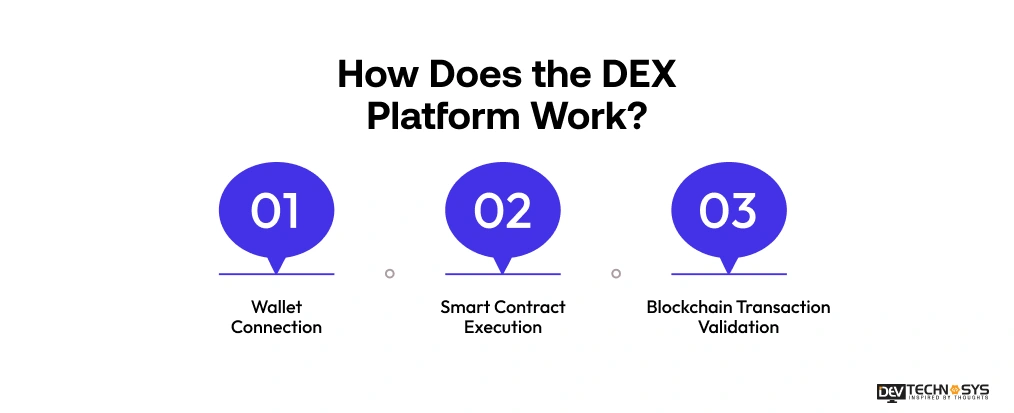
1. Wallet Connection
Users connect their cryptocurrency wallets with the DEX for secure and decentralized trading without having to sign up with a centralized account.
2. Smart Contract Execution
The DEX automatically executes token trades using smart contracts, liquidity pools, and automated market maker (AMM) algorithms, allowing them to process transactions transparently and trustlessly.
3. Blockchain Transaction Validation
The trade will be recorded as a transaction on the blockchain, which will validate the transaction, update both parties’ balances permanently, and send out trading fees to liquidity providers who are supporting the DEX.
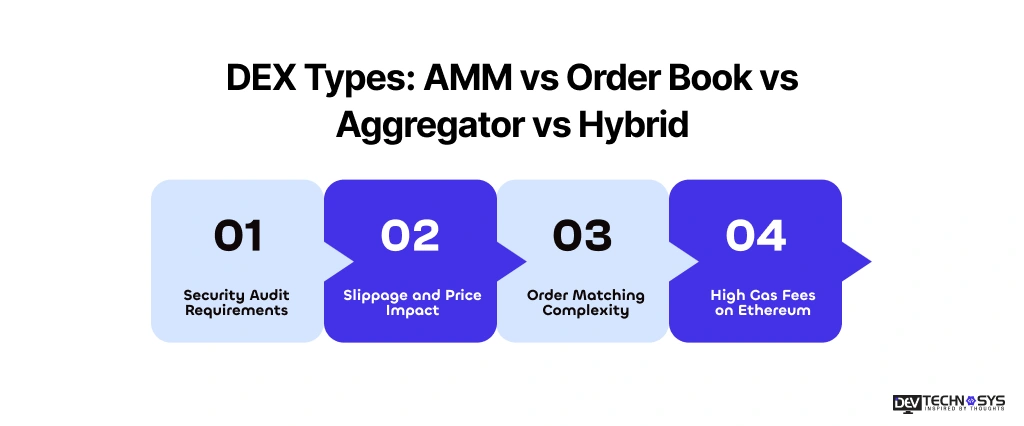
DEX Types: AMM vs Order Book vs Aggregator vs Hybrid
Different means of trading are utilized by decentralized exchanges. An automated market maker (AMM) decentralized exchange (DEX) utilizes liquidity pools to trade, while an order book DEX will match the buyer and seller together directly.
Aggregator DEXs find the best price for transactions among the different exchanges. Hybrid DEXs utilize multiple trading systems so they can improve efficiency, liquidity, and flexibility.
1. AMM DEX
AMM DEXs operate with liquidity pools and utilize mathematical formulas/pools for price discovery instead of matching buyers/sellers. Traders will swap tokens with each other via the assets in these liquidity pools. Some examples of AMM DEXs are Uniswap Labs and Balancer Labs.
2. Order Book DEX
Order Book DEXs function similarly to traditional exchanges that use order books to identify and match buyers with sellers based on what prices they want to enter/exit from.
They also provide a lot of precision in prices but typically have lower liquidity, so traders may not be able to find someone who wants to sell a token when they want to buy it.
3. Aggregator DEX
Aggregator DEXs are designed to scan all available DEXs and find the best price for any given token pairing while minimizing slippage at the same time. Aggregator DEXs will route trades across different DEXs automatically.
4. Hybrid DEX
Hybrid DEXs incorporate all attributes of both AMM and Order book DEXs as a means to provide liquidity, price efficiency, and traded flexibility. Hybrid DEXs are designed to balance principles of decentralization, throughput, and user experience. A great example of a Hybrid DEX is Injective Labs.
What is the Core Architecture of a DEX Platform?
DEX smart contract architecture consists of a combination of frontend, smart contract, blockchain, and liquidity layers. It collaborates to provide secure decentralized trading, automated transactions, seamless user experience, and more efficient liquidity management for users in the decentralized evolving DeFi ecosystem.
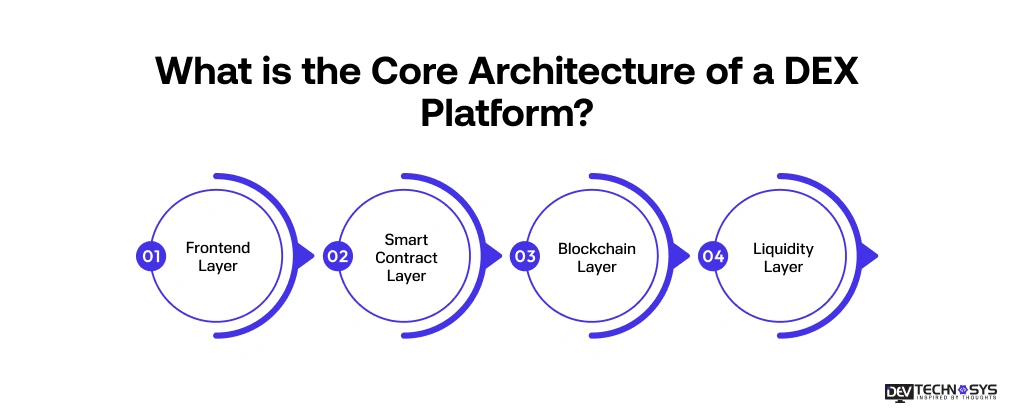
1. Frontend Layer
The frontend provides access to the user interface for trading, connecting to wallets, swapping tokens, and viewing analytics. It is responsible for providing a smooth experience for users when interacting with the backend blockchain operations of a decentralized exchange platform.
2. Smart Contract Layer
The smart contract layer is where automated execution of trades, liquidity management, staking, and governance functions take place. It provides security, transparency, and a trustless way to operate in a DEX ecosystem without intermediaries.
3. Blockchain Layer
The blockchain layer is the foundation of a DEX platform, where all transactions are recorded, data is validated, and decentralization occurs. It provides security and immutability to every activity on the DEX platform, as well as consensus to all DEX platforms.
4. Liquidity Layer
The liquidity layer consists of liquidity pools and AMM protocols, allowing for seamless swapping of tokens. The liquidity layer will ensure there are enough assets available for trading, minimize slippage, and allow for the efficient operation of decentralized trading.
Want a chatbot demo or pricing? Fill the form and talk to our experts today.
Pick what you need below — you can select more than one — then tap Get detail to continue.
-
Chatbot demo dashboard
-
Cost to develop an app
-
Industry report
-
Case study
Why Businesses Want to Invest in DEX Platform Development 2026?
Many businesses are currently rapidly investing in decentralized crypto exchange development to create new sources of revenue, improve transaction security, expand into new, global markets, and to get ready for the future of decentralized finance.
The demand for transparent and non-custodial trading solutions is growing, which makes DEX solutions imperative to organizations that want to get involved in the developing Web3 and blockchain ecosystem.
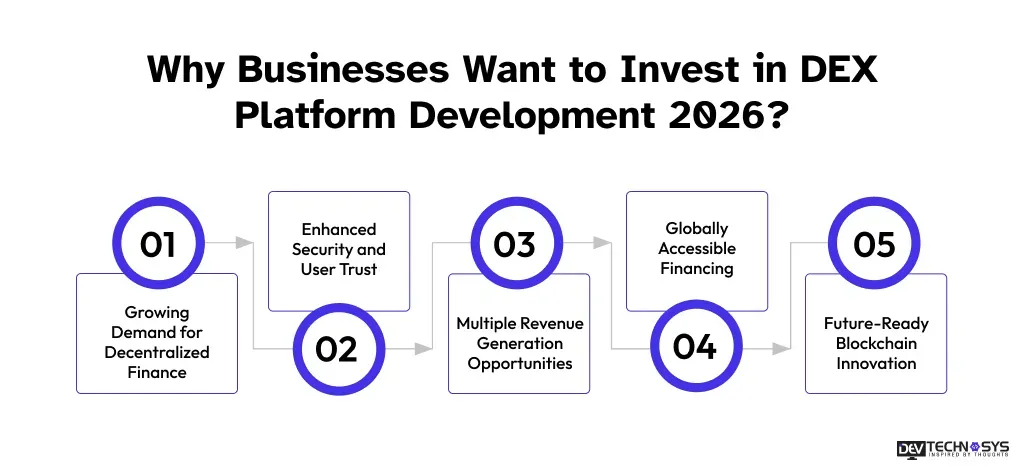
1. Growing Demand for Decentralized Finance
More and more companies are developing decentralized exchange (DEX) platforms in order to take advantage of the explosive growth of decentralized finance (DeFi).
Because many users prefer transparent, permissionless, and non-custodial financial systems, DEX platforms enable companies to generate revenue. While also providing access to the billions around the world who are looking for more control of their digital assets.
2. Enhanced Security and User Trust
Compared to centralized exchanges, P2P crypto exchange development solutions have much lower exposure to the risk of being hacked, having data stolen, and losing possession of customer assets.
Therefore, as companies offer secure smart contract-based trading environments, they will gain user confidence, enhance their brands, and reduce their operational risks associated with managing centralized customer assets.
3. Multiple Revenue Generation Opportunities
Companies can generate significant revenue from DEX platforms via transaction fees, incentives for providing liquidity, fee switch, staking services, governance token models, etc.
As a result, companies can create various sources of ongoing revenue, and at the same time continue to build their positions in the ever-changing blockchain and cryptocurrency space through a scalable decentralized trading infrastructure.
4. Globally Accessible Financing
Businesses can use DEXs to conduct business globally and offer users financial offerings without traditional means of having to go through a bank or a country-based banking system. By allowing users access to their cryptocurrencies from anywhere in the world.
CEX development services allow businesses to tap into growing crypto user markets and grow the adoption levels of their platform, and help create financial inclusion by having an unbiased peer-to-peer trading experience via cryptocurrencies.
5. Future-Ready Blockchain Innovation
Putting money into your company so you can build and grow your DEX will place your organization on the cutting edge of blockchain innovation and the Web3 revolution.
You will have opportunities to integrate advanced technologies, including cross-chain interoperability, AI-driven analytics, decentralized governance, and automated liquidity management, into your organization to help you be competitive in the future of digital finance.
7 Major Steps to Build a DEX Platform in 2026
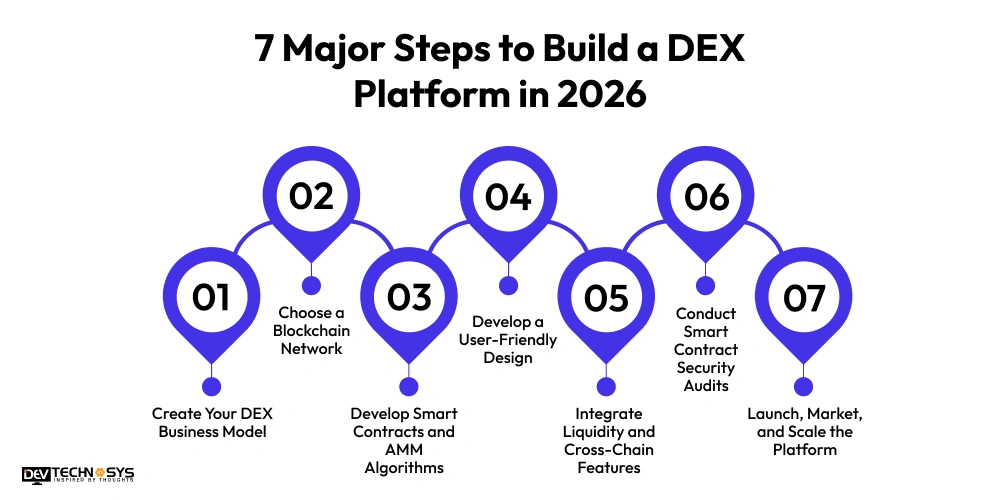
To build a DEX platform in 2026, you must take a plan-based approach to secure AMM smart contract development, scalable blockchain infrastructure, advanced AMM integration, liquidity management, and create a seamless user experience.
This includes everything from defining the concepts of your DEX to selecting a blockchain to testing the security of the smart contracts through an audit to determining how to scale your DEX platform.
1. Create Your DEX Business Model
Identify your DEX platform’s core goals, target user base, supported crypto assets, and revenue streams. Hire a decentralized crypto exchange development company if your platform will use an AMM, an order book, or a combination of the two for its trading architecture.
By developing your business model, you will allow for development, planning tokenomics, corporate governance structure, and long-term scalability of your decentralized exchange to support sustained growth.
2. Choose a Blockchain Network
In this stage, we choose to build DEX on Ethereum / Solana / BNB Chain. After you have established the architecture and design of your DEX, your next decision is which blockchain network to utilize for maximum scalability, security, and smart contract support, along with low transaction fees.
Your options for public blockchains are Ethereum, BNB Chain, Solana, Polygon, and Avalanche. The blockchain you choose will affect transaction speed, interoperability, user-to-user liquidity, and the general usability of your DEX ecosystem.
3. Develop Smart Contracts and AMM Algorithms
Once your DEX’s blockchain ecosystem has been established, hire a cryptocurrency exchange development company to create secure smart contracts for token swaps, liquidity pools, staking, and transaction processing. The smart contracts should also incorporate AMM algorithms that provide for real-time pricing of tokens and management of liquidity.
The design of your smart contracts should support a transparent, trustless, and automated trading experience for users while gas optimization and reducing security risks.
4. Develop a User-Friendly Design
An intuitive design will provide users with comfort in using their wallets; swapping tokens, managing liquidity, and obtaining trading statistics. Intuitive UI and UX support will assist in the retention of users on the DEX and the ease of increasing users.
Presenting dashboards and experiences that are specific to the device being used by the user will create a positive initial impression on new users and will accomplish the same on experienced users through real-time data, portfolio tracking, and compatibility with multiple devices.
5. Integrate Liquidity and Cross-Chain Features
In the fifth stage to make a DEX platform, having liquid assets means a user will be able to trade their tokens with little time delay and at stable prices. To provide liquidity, you can use liquidity pools, yield farming, or staking to bring in liquidity providers.
Hire a decentralized crypto exchange development services provider to add interoperability, or cross-chain trading capabilities, allowing users to trade their tokens on any blockchain network and adding liquidity to the DEX.
6. Conduct Smart Contract Security Audits
It is imperative that you conduct a security audit of all the smart contracts in your DEX before releasing it to the public. Security audits involve thorough testing of smart contracts, looking for vulnerabilities, performing penetration tests, and using bug bounty programs to find potential problems.
By ensuring that your platform is secure, you will be able to safeguard user funds, reduce the chance of someone exploiting the DEX, and improve the confidence that regulators have in your DEX.
7. Launch, Market, and Scale the Platform
Once your platform is deployed, you should start working on community building, token promotions, partnerships, and regular upgrades to the platform. Employ a professional DAO development company to use well-executed marketing campaigns to attract traders, investors, and liquidity providers.
You will continuously improve performance, add advanced DeFi features, and scale the infrastructure to support higher transaction volumes and the long-term success of a decentralized exchange into 2026.

10 Must-Have Features of Decentralized Exchange Platforms
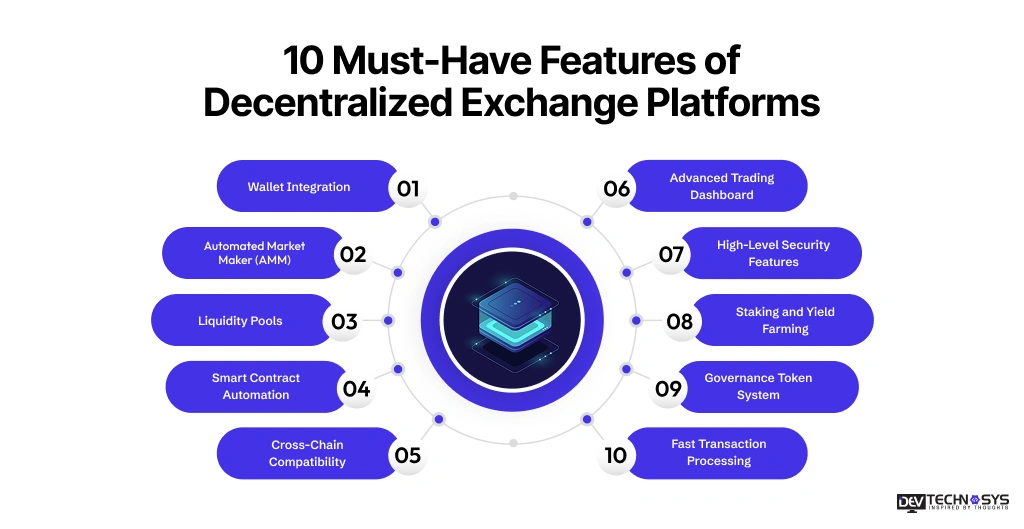
Essential features of a successful decentralized exchange platform in 2026 include wallet integration, automated market maker (AMM) protocols, liquidity pools, and cross-chain support, as well as the use of smart contracts and the latest in security standards to provide easy, scalable options for DeFi trading.
1. Wallet Integration
Wallet integration provides users with the ability to make direct trades on a decentralized exchange without needing to create a centralized account or be held in custody.
2. Automated Market Maker (AMM)
Automated Market Makers (AMM) use liquidity pools to automatically create token prices and swap them, instead of using a centralized order book exchange.
3. Liquidity Pools
Liquidity pools provide sufficient token supply so that users can trade quickly and at a fair price, and so slippage is minimized during a trade.
4. Smart Contract Automation
Smart contracts are used to automate the trading, staking, and execution of transactions while also ensuring that this process is transparent, accurate, and decentralized.
5. Cross-Chain Compatibility
Cross-chain interoperability allows digital asset trades to occur smoothly across multiple blockchains and decentralized networks.
6. Advanced Trading Dashboard
Users are more likely to optimize their decisions by utilizing an interactive dashboard that provides the user with detailed insights about the market, the price and volume of specific tokens, transactions made on the platform, as well as tools for managing portfolios.
7. High-Level Security Features
DEXs implement a variety of security measures to ensure that digital assets and users are kept safe from potential exploitation, including encryption, multiple layers of authentication, audits, and anti-exploitation methodologies.
8. Staking and Yield Farming
DEX users can earn passive income through staking and yield farming, while also providing liquidity to the DEX and helping to grow the overall DEX ecosystem.
9. Governance Token System
Community members utilize governance tokens to participate in decision-making processes affecting the DEX, including protocol modification, introduction of new features and the preservation of funds held within the DEX.
10. Fast Transaction Processing
By leveraging a blockchain infrastructure that is specifically designed and optimized for DEX transactions, DEX transactions are able to occur in a significantly shorter timeframe and decrease the likelihood of network congestion.
How Much Does it Cost to Build a DEX Platform in 2026?
The average DEX development cost 2026 will typically fall within the range of $10,000 to $30,000+, depending on the complexity of the platform, its features, and the type of blockchain being utilized. Generally speaking, building a simple DEX with standard AMM capabilities and wallet integration will cost less than creating a complex DEX with cross-chain capabilities, staking and governance tokens, or employing an extensive and secure audit of all smart contracts.
Additionally to the above, additional costs will be incurred for UI/UX design, adding the smart contracts and liquidity provision, as well as for supporting and maintaining the DEX through continual upgrades and marketing. All of these expenses should be anticipated for long-term scalability and adoption of the DEX within the DeFi ecosystem.
Complexity Level |
Description |
Features Included |
Estimated Cost (USD) |
| Basic DEX | Simple swap platform for MVP launch | Token swap, wallet integration, basic AMM, single-chain support | $10,000 – $15,000 |
| Intermediate DEX | Scalable platform with DeFi utilities | Concentrated liquidity AMM, staking, improved UI/UX, limited cross-chain support, and an analytics dashboard | $15,000 – $20,000 |
| Advanced DEX | Feature-rich commercial-grade exchange | Cross-chain trading, governance token, yield farming, high security audits, and advanced AMM logic | $20,000 – $25,000 |
| Enterprise DEX | Full-scale global trading ecosystem | Multi-chain interoperability, AI trading tools, institutional liquidity, advanced security, high-performance infrastructure | $25,000 – $30,000+ |
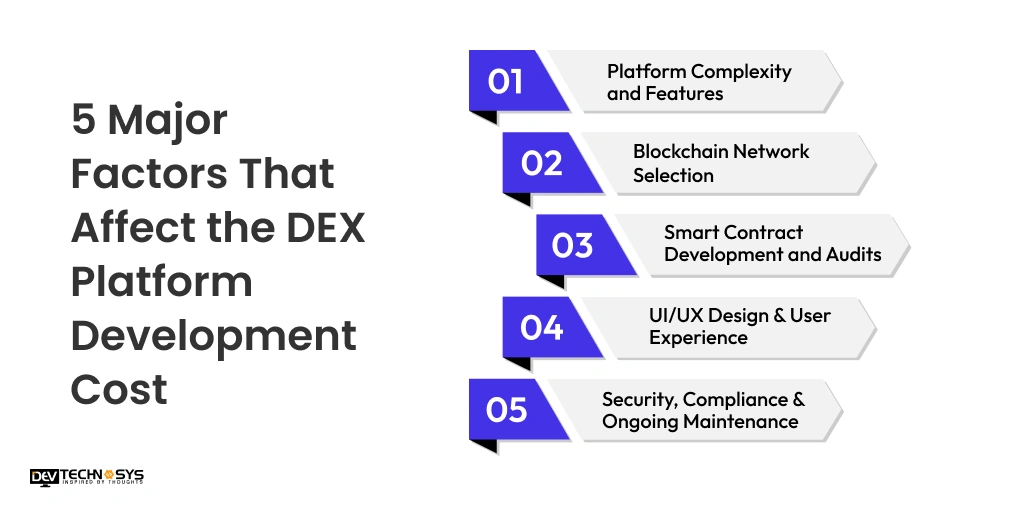
5 Major Factors That Affect the DEX Platform Development Cost
In building a Decentralized Exchange (DEX) platform within the next five years, many factors will be instrumental in determining the overall crypto arbitrage bot development cost.
Among these factors are the complexity of the platform, the blockchain used for the DEX, the technical foundation used to develop smart contracts, UI/UX design of the front-end user interface, and the regulatory considerations for security and compliance.
1. Platform Complexity and Features
The cost of building a DEX is reliant on complexity. A simple swap is less expensive, while more complicated functionalities (e.g., AMM algorithms, cross-chain support, staking, governance tokens, and yield farming) take longer to develop, require more expertise from developers, and need more extensive smart contract architecture, increasing the total cost to build a DEX platform.
2. Blockchain Network Selection
The blockchain network you select has an effect on cost depending on which tools are available for automated market maker development, how much a transaction will cost, the scalability of that network, and the complexity of integrating your application to that network.
When comparing Ethereum-based DEXs, most of the Ethereum DEXs will have a higher total cost. Whereas developing on a different blockchain network will cost less, but still require expertise in crypto trading bot development.
3. Smart Contract Development and Audits
Smart contract development is at the center of every DEX platform and requires highly experienced programmers to write and test. The more complex the AMM logic is, the longer it will take to build and test the logic, as there will be complex calculations required for the liquidity pool and every trade made.
The cost of security audits, vulnerability testing, and fixing bugs is also a cost that must be considered when building and maintaining a DEX.
4. UI/UX Design & User Experience
The creation and implementation of a user interface with high-quality UX greatly improves a trader’s experience; however, it also causes higher development expenses.
Creating intuitive dashboards, real-time trading charts, integration flows for wallets, and responsive layouts that work on multiple devices takes significant experience working in UI/UX. As the UI is designed to be more user-friendly and upgraded in features, the cost of developing that front-end portion of the exchange will increase.
5. Security, Compliance & Ongoing Maintenance
Security is paramount in a decentralized exchange, requiring continual audits of security systems, encryption protocols, and anti-hacking measures. Continual ongoing maintenance, updates, and improvements for blockchain compatibility also contribute to the cost to create a DEX platform.
Additionally, the continuing evolution and fluctuations of governmental regulatory compliance for cryptocurrencies will add to the cost of crypto trading bot development.
Cost-Affecting Factor |
Estimated Cost Range (USD) |
Why It Affects Cost |
| Platform Complexity | $15,000 – $20,000 | Advanced features like AMM, cross-chain swaps, staking, and governance increase development effort |
| Blockchain Selection | $5,000 – $10,000 | Integration varies by network (Ethereum, BNB Chain, Polygon) and affects scalability and fees |
| Smart Contract Development & Audits | $8,000 – $15,000 | Secure coding, testing, and professional audits are essential to prevent hacks and ensure reliability |
| UI/UX Design | $5,000 – $7,000 | High-quality trading dashboards, charts, and responsive interfaces require skilled designers |
| Security & Maintenance | $1,500 – $4,000+ per year | Continuous monitoring, updates, compliance, and bug fixes increase long-term operational expenses |
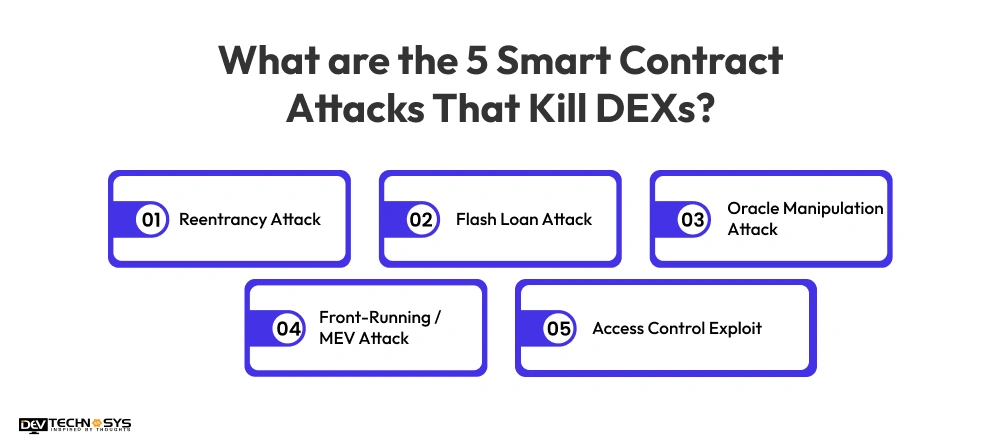
What are the 5 Smart Contract Attacks That Kill DEXs?
The major threat to security at decentralized exchanges comes from vulnerabilities within their Smart Contracts. There are several different attacks that can occur, including re-entrancy, flash loans, oracle manipulation, MEV (Miner Extractable Value) front-running, and access control exploits.
1. Reentrancy Attack
Attackers can use malicious contracts to continually try to call a function that is vulnerable to being called multiple times before the balances can be updated, which will ultimately drain the liquidity pool (or vault) of all funds. In particular, attackers can exploit the fact that, due to inadequate state management, an attacker can quickly execute multiple recursive calls to take away assets that are state-managed by the protocol.
2. Flash Loan Attack
An attacker can borrow a huge amount of money, usually instantly and without posting collateral. Then, flash loan attack prevention smart contracts and manipulate the price of the token or governance temporarily, exploit a vulnerability that is available, and then immediately repay the borrowed funds within the same transaction. While keeping the benefit of their criminal conduct.
3. Oracle Manipulation Attack
Attackers can manipulate external price feeds or low liquidity markets, resulting in a wrong valuation of an asset. Malfunctioning smart contracts utilize the price of the affected asset as the basis for executing trades and liquidations, ultimately resulting in significant financial impermanent loss.
4. Front-Running / MEV Attack
Attackers use bots to monitor pending transactions within the blockchain and place transactions with a higher fee than the victim’s transaction before it is mined, thereby profiting from the victim’s trade. Victims may receive a worse price than expected, suffer price slippage, or be subjected to sandwich attacks when the transaction is executed.
5. Access Control Exploit
Poor access control allows unauthorized individuals to gain administrative privileges and therefore mint tokens, pause contracts, or drain treasury funds. Furthermore, missing verification of roles creates a very high level of risk associated with the security of protocols.
White-Label vs Custom vs Clone Script: Which to Choose?
The DEX development model that you choose must take into account factors including budget, level of customization, scalability, and speed to launch. White-label solutions typically allow for quick deployment, while the custom development option provides full freedom and flexibility in cryptocurrency wallet development.
Clone script solutions, on the other hand, offer startup companies fast and inexpensive ways to enter the market by essentially copying an existing decentralized exchange business model.
Feature |
White-Label DEX |
Custom DEX |
Clone Script DEX |
| Development Time | Fast | Slow | Very Fast |
| Cost | Medium | High | Low |
| Customization | Moderate | Full | Limited |
| Security | Provider-based | Stronger | Riskier |
| Scalability | Medium | High | Low |
| Maintenance | Easier | Complex | Basic |
| Best For | Quick launch | Unique platforms | Budget startups |
What Tech Stacks are Used for Decentralized Exchange Development?
Layer |
Technology / Tools |
Purpose in DEX Development |
| Blockchain Networks | Ethereum, BNB Chain, Polygon, Solana, Avalanche | Core infrastructure for executing decentralized transactions |
| Smart Contract Languages | Solidity, Rust, Vyper | Writing AMM logic, swaps, liquidity pools, and governance |
| Smart Contract Frameworks | Hardhat, Truffle, Foundry | Development, testing, and deployment of smart contracts |
| Frontend Development | React.js, Next.js, Web3.js, Ethers.js | Building user interface and wallet connectivity |
| Backend Development | Node.js, Express.js, NestJS | API handling, data processing, and off-chain services |
| Database | MongoDB, PostgreSQL, Redis | Storing user data, analytics, and caching |
| Wallet Integration | MetaMask, WalletConnect, Coinbase Wallet SDK | Secure user authentication and transaction signing |
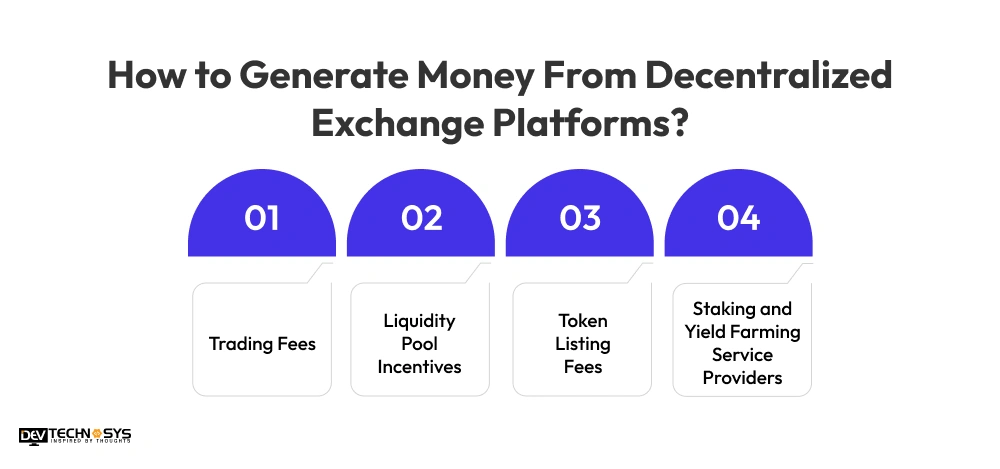
How to Generate Money From Decentralized Exchange Platforms?
Decentralized Exchange service providers generate income through several different methods, such as transaction fees, liquidity pool participation commissions, token listing fees, and staking/yield farming commissions. These revenue models will ultimately allow DEX service providers to achieve sustainable profitability while providing users with incentives to engage with them.
1. Trading Fees
DEX platforms have multiple revenue streams, but they earn the majority of their revenue by charging fees on each trade that is placed on their platform.
The transaction fees collected by the DEX are divided between the liquidity providers and the owner of the platform. As the trading volume increases, the total amount of income generated from trading fees will continue to grow.
2. Liquidity Pool Incentives
DEX platforms can monetize their service by offering liquidity pools that allow users to deposit tokens into a shared pool. The DEX will then take a small portion of the “swap fee” that is generated from the liquidity pools to generate revenue for its owners.
If the liquidity pool has sufficient liquidity, then the DEX will attract more traders which will, in turn, lead to an increase in overall volume and therefore, long-term profitability.
3. Token Listing Fees
When a new cryptocurrency project wants to list its token on a DEX, they agree to pay a fee to the DEX in exchange for being able to list its token. This allows investors to invest in trending or highly sought-after blockchain projects early in the project’s lifecycle, while at the same time providing the DEX with a significant source of income.
4. Staking and Yield Farming Service Providers
The majority of DEX service providers make revenue from the transaction fees from the staking and yield farming systems they operate for their users. As users lock up their tokens in order to earn passive income, DEX service providers benefit from increased liquidity in their pools and greater long-term user engagement with their services.
You can reach out anytime; we are available 24/7. Our team provides a quick response.

How Dev Technosys Helps to Build a DEX Platform?
Dev Technosys is dedicated to assisting businesses with the development of sophisticated DEX platforms by providing complete blockchain development capabilities, including smart contracts, AMM integration, user interface and user experience design, and security auditing.
Dev Technosys is a DEX development company with more than 15 years of experience and has successfully completed over 1,000 projects, employing over 200 skilled developers to design secure and scalable decentralized exchange solutions. With extensive experience in DeFi, cross-chain development, and blockchain consulting.
Conclusion
The key components of a successful decentralized exchange (DEX) are smart contract creation, automated market maker (AMM) protocols, liquidity management, and the underlying blockchain’s safety and security. Success depends upon the chosen DEX smart contract architecture, robust security audits, and a seamless user experience.
DeFi continues to evolve, so businesses must also consider issues such as scalability, cross-chain compatibility, and innovation if they wish to remain competitive. Working with a trusted blockchain development company will help greatly simplify development, mitigate risk, and ensure that the DEX you build today is ready for future growth.
Frequently Asked Questions
Find answers to the most common questions related to this article.
Develop a DEX platfrom takes around 2-4 months, while advanced platforms with cross-chain features, staking, and governance may take 3-6 months. Timeline depends on complexity, blockchain selection, smart contract development, security audits, and UI/UX design requirements.
Challenges include smart contract security risks, liquidity management, scalability issues, regulatory uncertainty, and high development costs. Proper planning, audits, and blockchain expertise are required to overcome these challenges effectively.
A DEX can technically use order books instead of liquidity pools, but most modern DEX platforms rely on liquidity pools and AMM models. Without liquidity pools, trading efficiency, speed, and continuous liquidity availability become limited and less scalable.
The cost to develop a DEX platform in 2026 typically ranges from $10,000 to $30,000+, depending on features, blockchain choice, and complexity. Advanced solutions with cross-chain support, staking, governance, and security audits require higher investment for scalable and secure decentralized exchange development.
DEX platforms earn revenue through trading fees, liquidity pool smart contracts commissions, token listing fees, staking services, and yield farming mechanisms. These models ensure sustainable income while incentivizing liquidity providers and active traders.