

















The real estate industry is not looking like the way it did five years ago, and it will not look the same in five years from today either. This is due to consumer behavior, which has changed fundamentally. Property buyers are no longer browsing passively; they expect apps to foresee their preferences and style, and guide them to their final decision with smart intelligence.
It’s not just because of the emergence of a new generation of apps. Consumers just want an entirely different category of experience where they can discover with predictive analysis, automated transactions, and explore sites virtually without physically visiting.
The timing matters in this. GenZ investors have entered the market with extensions shaped by hyper-personalized digital experiences. PropTech is maturing and transforming. Smart infrastructure is reshaping everything. And this has moved from novelty to necessity.
Real estate apps that are being built purely around simple listing have become obsolete. Intelligent ecosystems have taken over. Platforms that predict, personalize, and connect every dot of buying property are booming.
The opportunities ahead aren’t incremental. They’re structural. Here’s where they’re emerging.
Real Estate Industry Trends Shaping the Future of PropTech
The real estate market is not merely adopting new technologies; it is reacting to a fundamental change in how people think about property.
It’s those six factors that are transforming that.
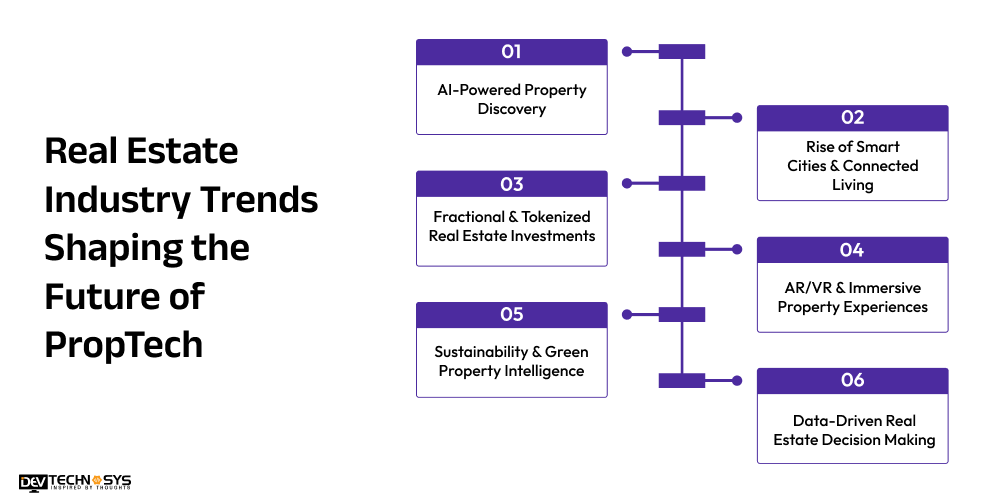
1. AI-Powered Property Discovery
Manual search filters are going away. Today’s buyers want platforms to know lifestyle preferences and uncover the ideal home even before they define what they desire. Discovery’s future might see fewer searches entirely as AI algorithms begin proposing houses based on behavioral trends, financial activity, and lifestyle purposes rather than keyword inputs.
2. Rise of Smart Cities & Connected Living
As the urban infrastructure gets smarter, property expectations are following suit. When making purchases, buyers now consider connected utilities, automated energy systems, and digitally integrated communities. More and more, the value of a home is related to the smartness of the surrounding ecosystem, not just the square footage.
3. Fractional & Tokenized Real Estate Investments
With property prices soaring, younger investors are turning to fractional ownership not as a last resort but as a plan. Tokenized models provide digital-first access, entry point flexibility, and passive rewards. This is not some odd habit. It’s a structural shift in the way a generation goes about being wealthy.
4. AR/VR & Immersive Property Experiences
Property buying is becoming ever more immersive, ever more remote. Buyers are becoming emotionally attached to homes they’ve never set foot in. Virtual walkthroughs and digital twins are their main tools for decision-making. The starting point is not the site visit anymore. For many, it is the ultimate proof.
5. Sustainability & Green Property Intelligence
Environmental performance is becoming a filter for purchasing. Carbon-conscious purchasers are actively considering energy ratings, sustainability certifications, and smart energy analytics before committing. Green intelligence is no longer a feature. It’s an expectation that’s built into the property decision itself.
6. Data-Driven Real Estate Decision Making
Real estate is quietly becoming a data intelligence business. Buyers, investors, and developers want neighborhood score, predictive pricing, and risk forecasts, not listing photographs. PropTech’s next generation will be data-rich platforms that will assist users in making quicker, more confident investment decisions, beating listing-heavy marketplaces.
These changes are not occurring in a vacuum. Together, they’re creating the conditions for a new generation of smart property ecosystems and unlocking big potential for entrepreneurs ready to build for where the industry is genuinely moving.
Why Investing in Real Estate Apps Is a Smart Opportunity in 2026
PropTech is no longer an emerging category; it’s an accelerating one. Property discovery, investment, and management are all trending towards digital-first behavior, and the platforms facilitating that movement are receiving substantial interest from both users and finance.
The stats tell the story. The global PropTech market is expected to cross $94 billion by 2032. 70% of house purchasers start their property search on mobile. Over the last two years, the use of AI across real estate platforms has more than doubled.
But the true opportunity is not in the numbers. That’s the gap between what traditional real estate sites give and what today’s buyers, investors, and tenants really want. The gap is large. And it’s growing.
As the new generation of investors gets accustomed to making high-value financial decisions within mobile ecosystems, real estate platforms are transforming into always-on digital investment environments.
The next wave of PropTech growth is probably not going to come from digitizing existing workflows. It will come from designing completely new property experiences, ones built from scratch on intelligence, automation, and accessibility.
The question is not if real estate applications are a viable possibility. It’s about the sort of ecosystems we want to establish.
Top Trending Real Estate App Ideas for 2026–2027
The real estate app landscape is moving from simple listing tools to smart ecosystems. Here’s what we see as the biggest opportunities for 2026 and beyond.
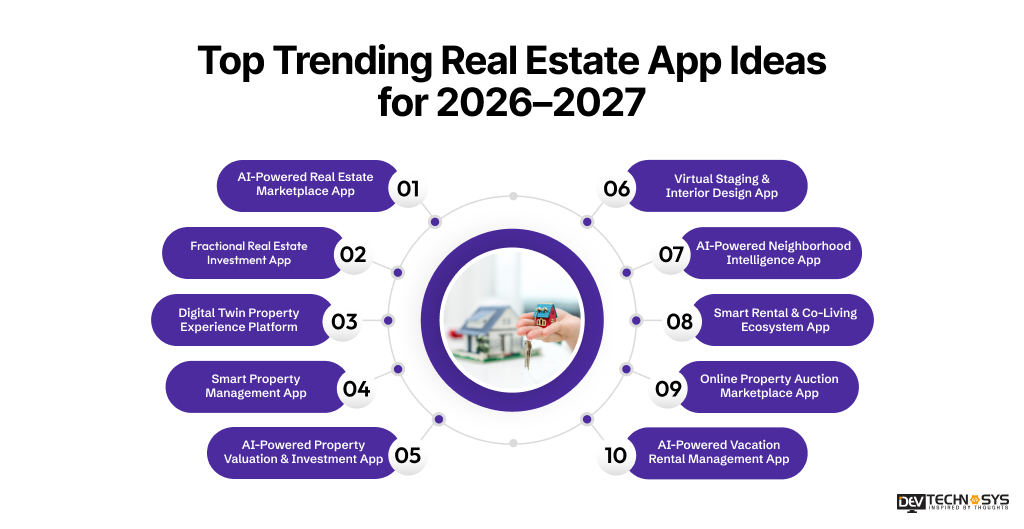
1. AI-Powered Real Estate Marketplace App
Property discovery is broken. Not technically, but experientially. Buyers spend hours scrolling through hundreds of listings that don’t reflect the way they genuinely want to live. The consequence is search fatigue, decision paralysis, and wasted chances at both ends of the transaction.
A real estate marketplace powered by AI that breaks free from the filter-based concept. Instead of waiting for what consumers desire to be defined, the platform learns it through behavioral patterns, lifestyle indications, geographical history, and financial context. Property suggestions become proactive rather than reactive. Search is becoming a discussion, not just a mechanical task.
This is more than just surface-level customization in the intelligence layer; These services connect buyers to residences according to commute tolerance, neighborhood character, proximity to green space, and spending behavior. Factors that standard listing platforms were never built to handle.
Buyer expectations are moving towards hyper-personalized experiences, and hence, marketplace models based on pure manual search are structurally outmoded. The AI marketplace is not a better listing site. It’s a completely different breed of platform. The same predictive logic that’s revolutionizing discovery is now changing the way that investors evaluate and buy homes altogether. These real estate app ideas can change the real estate process altogether.
2. Fractional Real Estate Investment App
A generation that invested through apps is starting to rewrite ownership expectations from scratch. GenZ and younger millennials are not waiting to save enough wealth to buy a typical property. They are coming in via fractional ownership schemes that provide actual asset exposure without the full financial commitment. Property listing app development helps in getting into the market and showing buyers what they want.
Fractional real estate platforms allow customers to buy percentages of residential, commercial, or rental properties and receive returns based on those percentages without having to personally manage the asset. Tokenized ownership structures allow for speedier, more transparent, and globally accessible transactions. The geographic and financial hurdles that have excluded most people from serious property investing for decades are systematically being taken down.
It’s not only about the money that’s changing behavior. This is part of a broader drive to flexible, digital-first asset management where property sits alongside equities and crypto in one mobile investment dashboard. Platforms that make fractional property investing as easy as buying an ETF are onto more than a niche. They are rewriting the rules for the next generation of wealth creation.
3. Digital Twin Property Experience Platform
Remote property buying isn’t an edge case anymore. Increasingly, international investors, moving professionals, and digitally native buyers want to view and emotionally engage with a home before they even visit it physically.
Digital twin platforms generate live, interactive copies of real properties. These settings are not static virtual tours but adapt to user involvement. Buyers can explore space dimensions in real scale, test natural lighting at different times of day, simulate restoration scenarios, and analyze structural features without even stepping inside. The technology uses spatial computing, IoT sensor integration, and AI-generated environmental simulation to create experiences that go far beyond photography or video.
Digital twins are becoming the must-have marketing infrastructure for developers. For purchasers, they are quickly becoming the major discovery moment of the first visit.
What looks like a premium product now will likely be a baseline demand in a few years. The question for developers and platforms isn’t whether they should build this functionality. It’s how soon they can make that standard.
4. Smart Property Management App
Property portfolio management has historically been about managing disparate systems. Maintenance inquiries, lease agreements, utility management, and tenant communication are all handled individually and inefficiently. The sheer operating overhead is enough to deter many landlords from growing beyond one property.
Fragmentation is eliminated by unified automation in smart property management platforms. Maintenance requests are automatically triaged and assigned. Lease renewals are notified before expiration based on prediction. IoT-connected building dashboards expose real-time operational data. Financial reporting aggregates across a complete portfolio in one place.
The main change here is not convenience, but scalability. As IoT infrastructure embeds itself more deeply into residential and commercial properties, property management solutions will become the operational layer that serious portfolio owners simply cannot function without. Landlords who jump on board early will manage more units with substantially less friction. That difference will only get bigger.
5. AI-Powered Property Valuation & Investment App
Historically, real estate has been one of the least transparent asset types available to individual investors. The price was not clear. It seemed like market timing was a shot in the dark. Institutional players had a lot of valuable data to themselves. These types of real estate apps are widely revenue-generating, helping businesses to grow more.
That dynamic is shifting quickly. AI-powered valuation platforms are not generating estimates, but rather real-time property intelligence by aggregating hyperlocal pricing trends, infrastructure development pipelines, rental yield histories, and macroeconomic signals. Risk rating, neighborhood trajectory projection, and automated portfolio analysis are fast becoming the expected rather than premium features.
Individual investors can now access the kind of predictive insight that previously required an entire research team. The boundary between PropTech and fintech is narrowing. Platforms sitting at that intersection are capturing a new generation of data-driven property investors. People who expect every significant financial decision to be backed by live, adaptive analytics rather than static market reports.
Now, individual investors have access to the same kind of predictive intelligence that was previously only available to a full research team. The line between PropTech and fintech is blurring. “Platforms at that intersection are capturing a new generation of data-driven property investors. For those who believe that every big financial choice should be backed by dynamic, real-time information, not historical market reports.

6. Virtual Staging & Interior Design App
Empty properties take longer to sell for less. Not that buyers can’t see the potential, but most people have a hard time emotionally connecting with vacant space.
Virtual staging platforms handle this problem without a single piece of real equipment. AI-powered tools are already creating bespoke presentations for buyer personas, including minimalist layouts for design-forward buyers, cozy family-friendly interiors for home buyers, and flexible office setups for remote-first professionals.
Buyers can use augmented reality layers to walk through spaces on mobile and view completely decorated rooms layered in real time.
The outcome is emotional resonance that static photography cannot match. With remote-first buying becoming the rule and not the exception, building authentic connections digitally is no longer a marketing nice-to-have. It is a prerequisite of conversion.
7. AI-Powered Neighborhood Intelligence App
Choosing a location is generally one of the most important factors in the property buying process. And one of the least data-informed historically. Beyond basic crime statistics and school ratings, most purchasers have depended on gut feeling and agent advice, rather than established behavioral cues.
Neighborhood intelligence platforms are flipping it on its head. By pooling hyperlocal data on transportation construction pipelines, company openings and closings, green space expansion, demographic shifts, and property value momentum, these platforms give buyers a forward-looking view of where they’re actually investing.
That makes a huge difference for investors. A neighborhood that is just beginning to show signs of economic momentum and infrastructural investment may appear completely different in five years. Platforms that surface those signals early not only inform decisions. They are paying great attention and creating a real competitive advantage for the purchasers.
8. Smart Rental & Co-Living Ecosystem App
Flexible living is no longer only a millennial trend. It is a structural change in the way an entire generation relates to housing. Remote work has unlinked work from place. Rising city fees are also making long-term leases less appealing. More and more renters are looking for community and flexibility, not square footage and permanence.
Co-living platforms designed for this reality are comprehensive lifestyle networks, not room-matching services. They manage flexible lease structures, lifestyle-compatible community matching, shared amenity booking, utility bundling, and digital move-in routines, all within a single experience layer.
In this context of change, subscription-based housing options are emerging, where rent is a managed monthly service rather than a fixed contractual obligation as it has been traditionally. Platforms that do successfully integrate access to housing with real community infrastructure are creating something closer to a living network than a rental marketplace.
9. Online Property Auction Marketplace App
Traditional property auctions were reliant on physical presence, limited access, and opaque bidding processes that systematically favored experienced players over first-time buyers. That exclusivity was not a feature. Design defect was the problem.
Digital auction platforms are fixing that. Online property auction apps enable competitive bidding across regions, real-time price visibility, speedier deal completion, and AI-driven reserve pricing, giving both sellers and purchasers confidence that valuations reflect live market realities.
It’s not just the technology you need to watch. Younger purchasers are more at ease with making large financial decisions using digital platforms. That comfort is increasing, and property auctions are shifting from narrow distressed-sale processes to a more genuinely trusted alternative for the masses. The trust change that is taking place here is bigger than the technology that is driving it.
10. AI-Powered Vacation Rental Management App
The short-term renting sector is very mature today. But the technologies that most independent hosts are using have not kept pace with the complexities of managing dynamic pricing, multi-platform listings, seasonal demand forecasts, and guest experience standards all at once. The tenant management app development will help businesses to manage their stay throughout their time.
AI-enabled vacation rental solutions offer predictive pricing intelligence, automated guest communication, occupancy forecasts, and reputation management in one adaptive environment. Dynamic pricing engines quietly recoup cash that manual pricing invariably leaves on the table by adjusting rates in real time depending on local events, competition availability, and demand signals.
But the story here is about access. Individual hosts have been denied sophisticated revenue management frameworks that institutional short-term rental firms have long had access to. AI-enabled platforms are definitely bridging the gap.
Independent hosts having access to institutional-grade decision-layer data will rapidly outpace those who are still managing reactively. That race to the bottom will determine the future of the short-term rental sector.
What Defines a Successful Real Estate App in 2026?
The number of features of real estate applications is not what sets future-ready platforms apart from obsolete ones. It’s about how smart the platform is in responding to the way people actually discover, assess, and transact property nowadays.
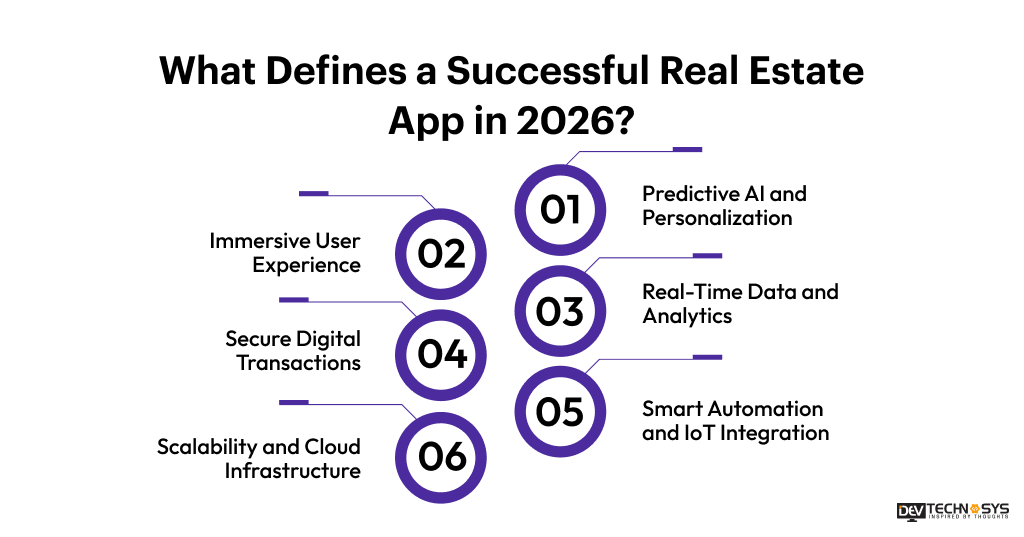
1. Predictive AI and Personalization
The winning platforms won’t wait for consumer input. The standard is systems that anticipate preferences before they’re communicated, not the differentiator when purchasers expect property platforms to comprehend lifestyle intent rather than work through human filters.
2. Immersive User Experience
Property exploring is becoming remote-native and emotion-driven. Platforms that can help purchasers create real connections with properties through digital twins, AR walkthroughs, and interactive visualization will always prevail over those still reliant on static photographs.
3. Real-Time Data and Analytics
Static market information quickly becomes obsolete. Live pricing information, neighborhood trajectory data, and investment grading provide the decision certainty that modern property platforms are increasingly expected to supply.
4. Secure Digital Transactions
Users want property transactions to be like a modern finance experience. Trust signals are turning into blockchain-verified paperwork, digital contracts, and frictionless payment infrastructure, not technological benefits. Build a real estate app with secure transaction to get trust and assurance between the buyers.
5. Smart Automation and IoT Integration
Buildings are becoming smart operation systems. Operational loyalty is being created by platforms that connect directly to connected infrastructure and automate operations, surfacing predictive maintenance data in ways that just transactional apps can’t imitate.
6. Scalability and Cloud Infrastructure
Future-ready PropTech ecosystems must deal with real-time data synchronization, multi-market expansion, and increasing user complexity without friction. Scalability is not a technological question. It is a strategic one.
With such capabilities becoming increasingly expected across the sector, the key difficulty for entrepreneurs is not whether to innovate, but which real estate ecosystem matches the correct market opportunity.
Which Real Estate App Idea Is Right for Your Startup?
There is no one-size-fits-all winning model inside PropTech. The correct ecosystem depends on the availability of finance, operational capability, the behavior of the target audience, and how fast a particular market segment is ready to embrace.
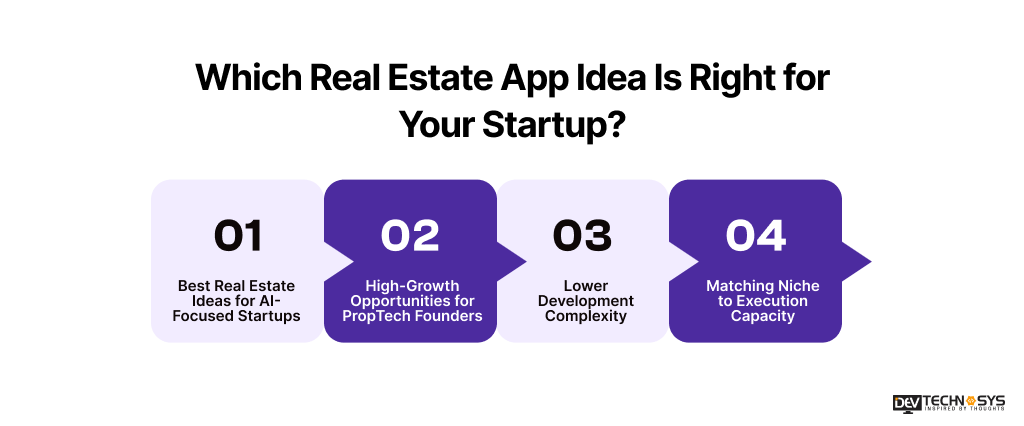
Best Real Estate Ideas for AI-Focused Startups
For data-driven founding teams, AI marketplaces, valuation platforms, and neighborhood intelligence apps are logical fits. The strategic advantage builds up over time with the accumulation of behavioral data, making the platform increasingly difficult to remove. The moat for startups with high AI competence should be data, as the moat.
High-Growth Opportunities for PropTech Founders
One thing all these fractional investing platforms, co-living ecosystems, and property management apps have in common: They’re not only downloaded, but they’re also relied on. These are some of the strongest categories for continued development due to recurring engagement, operational stickiness, and rising market demographics.
Lower Development Complexity
Neighborhood intelligence technologies, virtual staging applications, and auction marketplaces offer speedier paths to MVP validation with lower infrastructure requirements. These categories enable meaningful market entry for early-stage firms focused on speed and capital efficiency, without the hefty operational overhead.
Matching Niche to Execution Capacity
The best property app idea for any start-up is not always the most unique one out there. It’s the one where the market timing, audience demand, and execution capabilities are most aligned.
As these ecosystems evolve and technology becomes more deeply ingrained in urban infrastructure, the prospects ahead will be far beyond the capabilities of present platforms.
Future of Real Estate Apps Beyond 2027
The biggest changes in PropTech won’t be in better interfaces or speedier transactions. They will emerge from platforms that are becoming intelligent infrastructure layers integrated in people’s lives, investments, and interactions with urban settings at large. The proper real estate app development process will help to grow into the future and generate revenue.
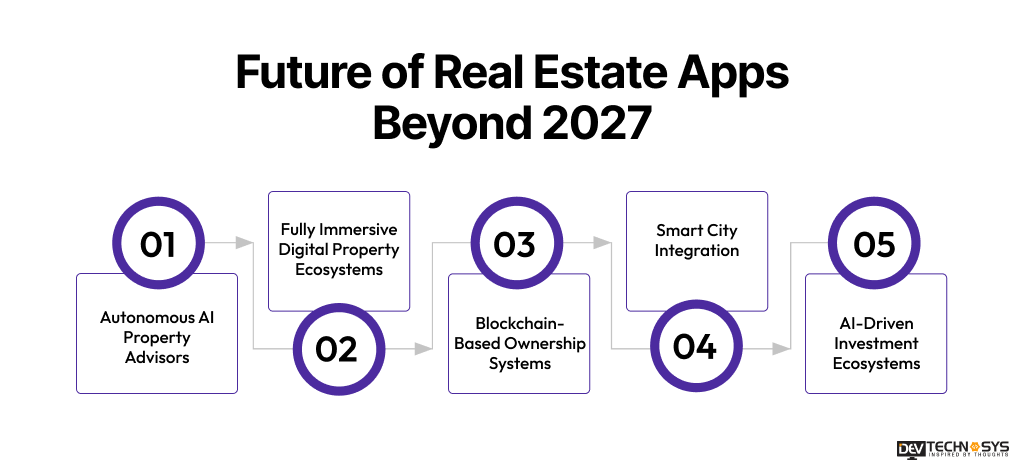
Autonomous AI Property Advisors
Property platforms may gradually evolve from being user-operated tools to systems that act on their behalf. AI advisers that can monitor market circumstances, indicate investment possibilities, and execute pre-defined portfolio plans could revolutionize the look of property ownership management at a consumer level.
Fully Immersive Digital Property Ecosystems
With the maturation of spatial computing, physical property exploration could be the last rather than the first phase. These persistent digital environments where purchasers may investigate, envision, and emotionally commit to houses in their entirety before a physical visit could become the default experience for a whole generation of remote-native buyers.
Blockchain-Based Ownership Systems
Trust infrastructure might be incorporated immediately in every property transaction. Tokenized ownership records, smart contract-powered closings, and immediate digital verification can reduce transaction times from weeks to hours, while dramatically lowering fraud exposure across global marketplaces.
Smart City Integration
Real estate platforms may one day tap into urban infrastructure networks, drawing real-time feeds from mobility systems, energy grids, and public development pipelines. Intelligence on property values could be inseparable from the intelligence of the city itself.
AI-Driven Investment Ecosystems
Algorithmic finance management could be more like property investing. Autonomous portfolio optimization, live risk modeling, and predictive asset reallocation could provide institutional-grade investment behavior for individual property owners operating solely through mobile platforms.
The future of real estate platforms could be less about standalone apps and more about sophisticated infrastructure layers woven into how cities, investments, and places to live operate in real time.
Conclusion
The future of real estate platforms could be less about standalone apps and more about sophisticated infrastructure layers woven into how cities, investments, and places to live operate in real time.
The opportunity in 2026 and beyond is not to digitize existing operations but to create intelligent ecosystems that predict behavior, automate complexity, and integrate property experiences into the larger digital infrastructure that today’s customers expect.
Timing is important here. The behavioral foundations are already changing. The technology is coming together. And the gap in the market between what traditional platforms can give and what users increasingly demand continues to increase.
The next generation of PropTech platforms might redefine not just how property is exchanged, but how modern urban living itself is experienced online. Hire a real estate app development company to get ahead of the competitors in 2026.