








Key takeaways:
-
- A successful AI copilot requires a modern technology stack, including scalable frontend and backend frameworks, AI models, vector databases, cloud infrastructure, APIs, and enterprise-grade security.
- According to the latest survey by McKinsey, a large share of respondents use AI in their regular business operations.
- Compliance with frameworks and regulations such as NIST AI RMF, CCPA/CPRA, HIPAA, PCI DSS, and SOC 2 helps businesses protect user data, reduce AI-related risks, and build secure mobile applications.
- Partnering with an experienced AI development company accelerates development, simplifies AI integration, ensures regulatory compliance, and enables businesses to launch future-ready AI copilot mobile apps with confidence.
Traditional mobile apps rely on manual user interactions, offering limited personalization. Users have to perform repetitive tasks or switch between multiple screens to shop online or book a ride.
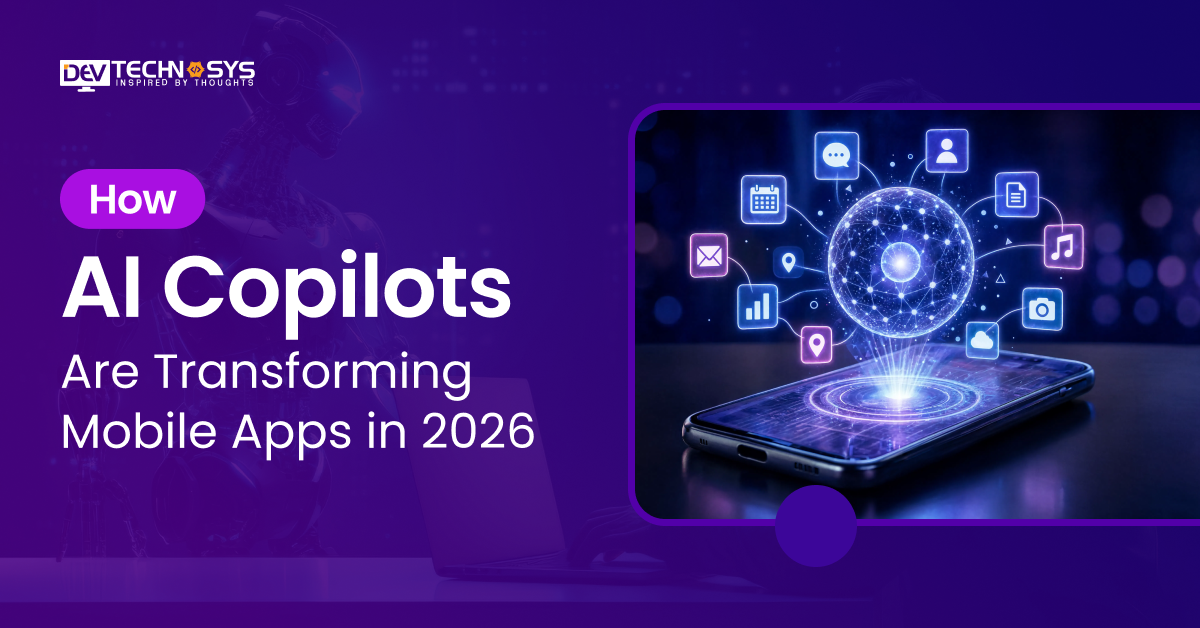
AI copilots are changing this experience by making mobile apps more intelligent and conversational. These can answer complex queries, generate content, automate repetitive tasks, and execute actions on behalf of users.
AI copilots are mostly used in industries such as healthcare, logistics, banking, retail, and finance where the data is transferred in large volumes. Due to the personalized experience, U.S. businesses are rapidly adopting AI copilots to automate workflows and improve efficiency.
However, developing an AI copilot-powered mobile app requires more than integrating an LLM. Businesses must select the right technology stack and comply with specific compliance requirements.
This guide explains how AI Copilots are transforming mobile apps in detail. It also includes AI features in mobile apps, the technology stack, and the challenges in building future-ready AI-powered mobile applications.
What is an AI Copilot in Mobile Apps?
AI copilots are an evolution of chatbots that help users with complex workflows. These assistants suggest actions, automate tasks, and understand user preferences to support their future actions. An AI copilot is an intelligent assistant that is built with technologies such as large language models, predictive analytics, natural language processing, and RAG.
How Do AI Copilots Work Inside Mobile Apps?
Multiple technologies are used to deliver accurate, contextual responses. These include machine learning, NLP, LLM, and predictive analytics. The workflow is explained in brief:
1. User Input
The user interacts through text, voice, or image. The system uses technologies such as NLP, speech recognition, and OCR to process the input before sharing an output.
2. Intent Understanding
In this stage, the AI copilot understands the request and determines what to accomplish. Technologies behind this are LLM and intent detection.
3. Context Retrieval
In this phase, the system gathers relevant information from APIs, databases, and cloud storage using RAG and vector databases. AI features in mobile apps allow users to gain proper insights as per their specific queries.
4. AI Processing
Generative AI and machine learning are used to provide recommendations, summaries, or answers based on specific user queries. These help users to understand complex queries in simple terms.
5. Action Execution
In this phase, AI copilot performs requested tasks such as scheduling an appointment, processing payments, or generating reports. Backend APIs and workflow automation are used.
6. Continuous Learning
The system improves future responses by analyzing user interactions while following privacy and security policies. For continuous learning, AI copilot mobile apps use machine learning, analytics, and user behavior models.
Industry Insight:
A survey by McKinsey reports that AI-powered mobile apps are helping businesses to generate better ROI. This is the foremost reason that businesses are choosing a digital transformation via AI automation in mobile apps.
Top 5 Ways AI Copilots are Transforming Mobile Apps in 2026
AI copilots have become an intelligent layer that helps businesses build smarter, more personalized apps. These are suitable for all industries and users. In 2026, these mobile apps are not limited to simply answering user queries but also support leaders in making crucial business decisions.
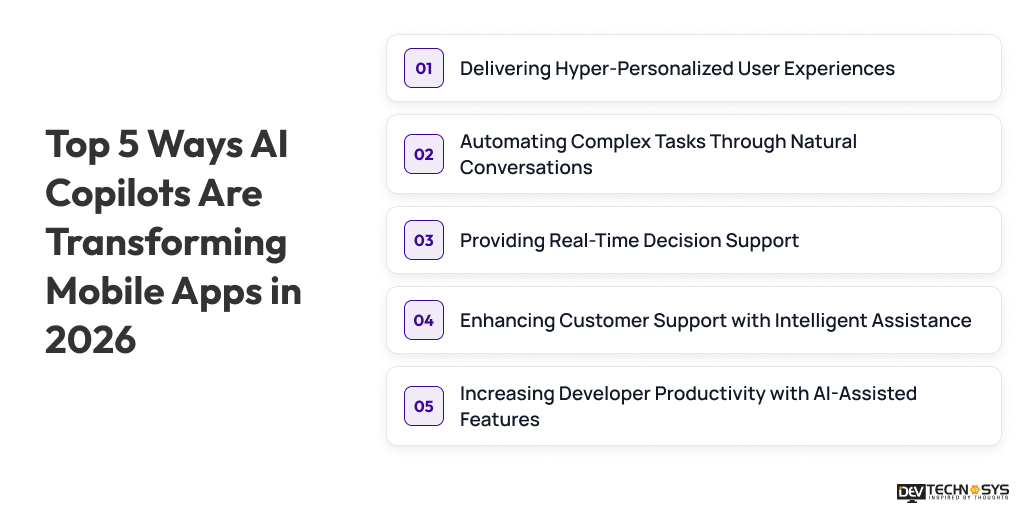
1. Delivering Hyper-Personalized User Experiences
What makes an AI copilot mobile app different from a traditional chatbot is that it provides a personalized experience for the user. It gathers data from previous user inputs, purchase history, and engagement patterns to recommend products, services, or tailored solutions.
Business Impact
- Higher customer engagement
- Improved retention rates
- Increased conversion and sales
- Better customer satisfaction
2. Automating Complex Tasks Through Natural Conversations
The major advantage of AI Copilots in mobile apps is that users can directly request an action without navigating to multiple screens. For example, they can easily book flights, pay bills, order food, or similar actions. The assistants can understand the user’s intent to provide conversational outputs. This transformation improves app usability.
Business Impact
- Reduced task completion time
- Higher productivity
- Lower customer effort
- Better user experience
3. Providing Real-Time Decision Support
Let’s understand this with an example of a finance app in which an AI copilot is integrated. It helps users make effective investment and savings plans. For healthcare, it provides summarized patient records for personalized treatment. Businesses are capable of making informed decisions.
Business Impact
- Faster decision-making
- Reduced operational errors
- Improved productivity
- Enhanced customer trust
4. Enhancing Customer Support with Intelligent Assistance
Traditional chatbots can answer only the inputs provided by the user. But AI assistants for mobile apps help users to escalate complex queries. It can serve a global audience with multilingual conversational support and provide the user with recommendations after a chat. Users do not have to wait for a long time to receive support from a business.
Business Impact
- 24/7 customer support
- Lower operational costs
- Faster issue resolution
- Higher customer satisfaction
5. Increasing Developer Productivity with AI-Assisted Features
AI copilots are transforming not only the end-user experience but also how mobile applications are developed and maintained. Development teams are utilizing the technology to understand deep deployment pipelines, test cases, to identify bugs, or to generate code. This results in faster, higher-quality mobile apps for businesses.
Business Impact
- Faster application development
- Reduced maintenance costs
- Improved software quality
- Shorter release cycles
Planning a Mobile App?
Get a tailored development cost estimate in 3 simple steps — app basics, features, timeline, and your contact details.
- 3 quick steps
- 100% free
- Reply in 1 business day
2 Minutes Read
Technology Stack Required to Build AI Copilot-Powered Mobile Apps in 2026
A robust technology stack that is combined with a modern mobile app development framework and scalable backend services. The right technology impacts responsiveness, data privacy, and overall user experience of mobile app AI solutions.
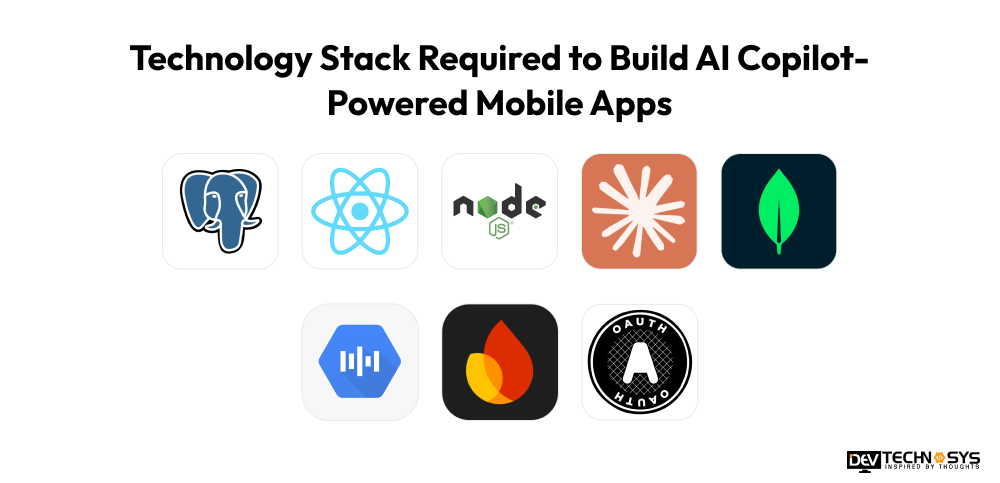
Layer |
Recommended Technologies |
| Frontend | Flutter, React Native, SwiftUI, Kotlin, Jetpack Compose |
| Backend | Node.js, Python (FastAPI/Django), Java Spring Boot, .NET |
| Database | PostgreSQL, MongoDB, Firebase, Redis |
| LLMs (AI Models) | GPT-5, Claude, Gemini, Llama 4, Mistral |
| AI Automation in Mobile Apps | LangChain, LlamaIndex, Semantic Kernel |
| Vector Database | Pinecone, Weaviate, Milvus, pgvector |
| Speech & Voice AI | Whisper, Google Speech-to-Text, ElevenLabs |
| Cloud & AI Infrastructure | AWS Bedrock, Azure AI Foundry, Google Vertex AI |
| Security | OAuth 2.0, JWT, AES-256 Encryption, TLS, MFA |
| Analytics & Monitoring | Firebase Analytics, Mixpanel, Langfuse, Datadog |
Top 7 Features of AI Copilots in Mobile Apps
AI-powered mobile apps can understand user intent, delivering the highest user satisfaction. Powered by technologies such as ML, RAG, and AI, these apps provide users with actionable insights. The following features determine what AI Copilots in mobile apps make them more proactive.
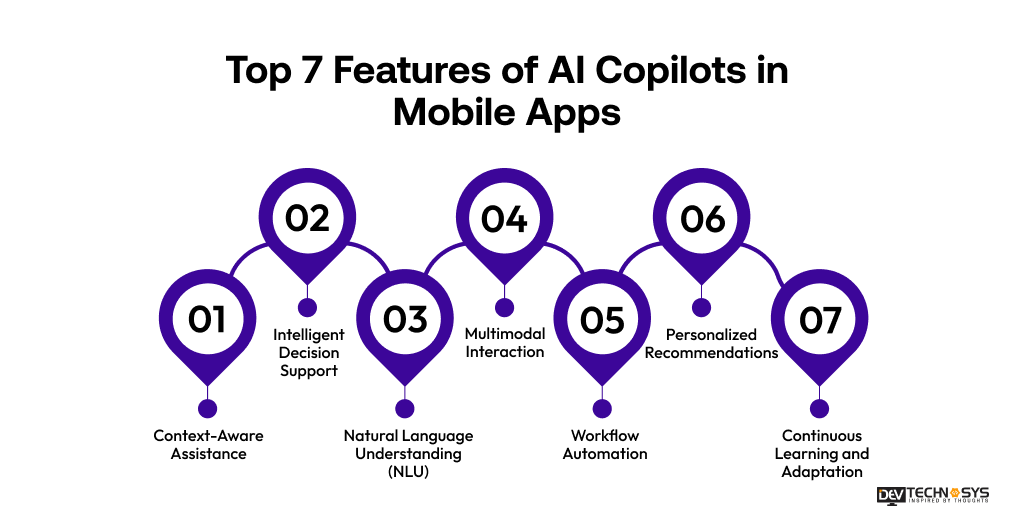
1. Context-Aware Assistance
Mobile apps go beyond generic responses, as AI copilots understand user behavior, business data, and previous conversations to provide personalized guidance. AI Integration in mobile apps answers follow-up questions accurately and shares next steps in subsequent conversations.
2. Intelligent Decision Support
Instead of simply displaying information, the mobile app AI solutions structure business data to provide actionable insights that enable intelligent decision-making. Businesses gain access to reports, trends, anomalies, financial performance data, employee workflows, and more.
3. Natural Language Understanding (NLU)
Users can easily search by voice or text instead of navigating menus or scrolling through multiple screens. This reduces human effort and creates a more personalized user experience. Natural Language Understanding allows AI copilot mobile apps to understand user queries without lengthy forms or surveys. This feature allows users to interact with the mobile app.
4. Multimodal Interaction
AI copilot mobile apps allow users to use a camera, access images, send text, and more with a single mobile app. With a combination of generative AI, speech recognition, and computer vision, mobile apps can easily read documents, understand images, or help users to easily interact with the app.
5. Workflow Automation
Approvals, data entry, stock management, and appointment scheduling are among the repetitive tasks that AI Copilots in mobile apps automate. Workflow automation can be done by following specific user instructions or predefined business rules. This saves operational costs and time, allowing employees to focus on higher-value activities.
6. Personalized Recommendations
AI copilots anticipate user needs and provide products/services according to the user preferences. Whether it is suggesting a product in an eCommerce app or an investment opportunity in a fintech app, personalized recommendations are delivered through the mobile app. This feature allows users to make informed decisions about purchasing a product/service.
7. Continuous Learning and Adaptation
AI copilots consistently improve their performance by analyzing user data, including feedback and behavioral patterns. With the proper integration of security, compliance, and data controls, these mobile apps adapt to changing business requirements. This continuous learning helps users gain efficient user experiences.
Industry-Wise Use Cases of AI Copilots
AI copilots are gradually becoming a workflow productivity tool by providing real-time insights and supporting faster decision-making within mobile applications. From improving patient care to delivering data-driven financial services, AI copilots help improve business efficiency.

Healthcare
AI-enhanced mobile apps help healthcare providers deliver better patient care by providing symptom & treatment guidance, patient monitoring, and appointment scheduling. Quick responses to patient queries and effective management of medical documentation are core features thats.
Banking and Financial Services
Mobile App AI Solutions support financial operations such as loans, fraud alerts, and other financial services. Banks or financial institutions gain insights into customers, while users can easily check their investments, income, and more financial information.
Retail and eCommerce
AI-powered retail apps now provide product recommendations based on customer preferences while answering specific queries. This has increased user engagement with the app while improving sales. Retailers can manage inventory, leading to higher conversion rates.
Logistics and Supply Chain
AI copilots support logistics companies beyond shipment tracking. They can easily optimize warehouse operations and find alternate transportation plans. By automating routine operations, businesses reduce transportation costs and delivery time.
Travel and Hospitality
AI integration in mobile apps provides recommendations for hotels and tourist attractions, simplifies booking, and provides multilingual support. Users simply have to share their queries regarding flight booking or related to a trip to receive personalized outputs.
Education and eLearning
The eLearning platforms are rapidly being adopted by educational institutions to provide in-depth learning. Quizzes and summarized learning materials help students to clear their doubts. Teachers can avoid teaching a lesson multiple times and can provide instant feedback-based learning.
Enterprise Productivity and Human Resources
Organizations experience reduced administrative workloads while using AI copilots. While employees can collaborate with different departments, generate business reports, and get access to payslips and other important information. HR department can easily manage attendance, payroll, and related human resource operations.
Common Challenges of Building AI Copilots for Mobile Apps
Though AI copilots are transforming the way in which mobile apps are created, businesses should be aware of the challenges associated with the development. There are several technical and operational issues that affect the performance of the mobile app.
Challenge – 1: AI Hallucinations
Most often, it happens that AI copilots generate inaccurate responses that are factually wrong. In industries such as healthcare, legal, or financial, data should be accurate to solve business and customer queries. Developers usually solve this issue by implementing Retrieval-Augmented Generation (RAG) that validates AI output while adding human insight.
Challenge – 2: Limited Context Understanding
AI copilots often struggle to maintain context during lengthy or complex multi-tasks. This results in incomplete responses or misunderstanding of user intent. Developers have to use contextual retrieval techniques or maintain session memory. This requires an expert to understand the limitations and accordingly work on them.
Challenge – 3: Security Risks
One of the crucial challenges is that AI holds sensitive information that is prone to security vulnerabilities. Organizations need to build mobile apps with industry-specific compliance and security protocols. They need to hire a dedicated team to manage security risks.
Challenge – 4: High Infrastructure Costs
Businesses that are planning to develop an entirely new mobile app or want to upgrade the existing one must know that these have high infrastructure costs. Cloud hosting, computing resources, and API requests need considerable budget. Businesses can manage this cost by partnering with a mobile app development company that will use scalable infrastructure.
Challenge – 5: Complex Integration with Existing Systems
Existing systems have to be modified with the latest technologies to improve user experience. The challenge is to integrate standardized protocols into the legacy formats. This requires strong technical capabilities and middleware solutions to connect the existing systems with newer capabilities.
Security and Compliance Best Practices for AI Copilots in Mobile Apps
Every USA business must consider compliance and standards before developing an AI copilot. This builds trust among users and ensures that the app is free from risks. The best practices also include that businesses.
1. Regulatory Compliance
Industry-specific compliance standards such as GDPR, HIPAA, PCI DSS, and SOC 2 should be implemented to ensure the app is built without legal risk. Businesses must partner with companies that provide a non-disclosure agreement to avoid any issues after the app development.
2. NIST AI Risk Management Framework
NIST AI RMF 1.0 helps organizations to assess and mitigate risks associated with artificial intelligence. This means that the mobile apps are consistently monitored for security updates and risk management.
3. U.S. State AI Laws
Several U.S. states have specific AI laws that businesses must follow. These are important to ensure transparency for high-risk AI systems. Also, it supports quick app launch as it meets the necessary regulatory requirements.
Industry Insight:
Precedence Research report reveals that the cloud-based segment is gradually dominating the mobile app market. This indicates that businesses should collaborate with the right partner to build scalable apps.
Why Choose an AI Development Company to Build Mobile Apps?
Building an AI copilot app means strong technical expertise, knowledge of AI, and relevant experience. Businesses require integration with security frameworks and scalable cloud infrastructure. Partnering with an AI development company accelerates the development process, too, with security and scalability.
1. Connect Existing Business Platforms
An experienced development partner can securely integrate the mobile app with the necessary software, such as ERP/CRM systems or payment gateways. They value time and maintain quality standards for a mobile app.
2. Strengthen Security Compliance
Professional AI development companies are usually CCMI Level 3-based firms that implement compliance practices while maintaining app responsiveness. Industry-specific and state regulations are followed to ensure mobile app security.
3. Optimize AI Performance After Launch
A trusted AI partner provides ongoing support for mobile app maintenance. It includes bug fixes, feature updates, and app enhancements. This helps businesses to maintain a competitive edge.
Industry Insight:
At Dev Technosys, we have worked on multiple AI Copilot projects and have understood that compliance and security are the most important to integrate into mobile apps. These help businesses to avoid legal risks and ensure a successful mobile app launch.
Conclusion
AI Copilots are redefining how users interact with mobile apps. From automating repetitive tasks to delivering contextual recommendations, these AI assistants are empowering the industry. According to Precedence Research, the AI software market size is expected to reach around $1600 by 2035.
This data indicates the dominance of artificial intelligence and the comprehensive use of AI copilots in mobile apps. This is the right opportunity for USA businesses to evaluate the right partner and build high-grade mobile apps. This will improve business efficiency and provide customer satisfaction.
Trusted by U.S. Businesses for AI Copilot Mobile App Development
Real feedback from real clients who trust us to deliver results.
Dev Technosys successfully developed an AI-powered mobile application with an intelligent copilot that brought a digital transformation to our healthcare business. AI assistant delivers personalized recommendations, automates routine tasks, and provides real-time support, resulting in higher user engagement and improved customer satisfaction. The dedicated team also provided ongoing support post-app launch.
Frequently Asked Questions
Find answers to the most common questions related to this article.
Businesses have to select a model according to their budget and deployment requirements. Popular AI models are Google Gemini, Anthropic Claude, OpenAI GPT, Meta Llama, and Mistral. These provide reasoning capabilities and allow developers to add multiple functionalities.
To avoid repetitive data or misunderstandings with user inputs, developers combine Retrieval-Augmented Generation with high-quality datasets, user feedback, and regular AI model updates. These ensure that even if a user shares complex queries, the mobile app responds with accurate information.
Traditional chatbots have a dependency on user interaction and input, whereas AI copilots automate complex tasks using advanced AI models. These provide faster responses while providing actionable steps for the users. Traditional chatbots follow scripted workflows, while AI copilots can be easily integrated with business systems to improve business efficiency.
Businesses can choose to build a basic AI copilot mobile app or an enterprise-grade one according to the business model or type. While an MVP can be developed within 5-7 months, an advanced app with security and compliance can take up to 12+ months.
While almost all industries benefit from AI copilot mobile apps, healthcare, banking and fintech, and eCommerce are the top sectors. AI integration helps to automate regular tasks while providing a personalized user experience. These industries transfer large volumes of data that must be secure and deliver customer satisfaction.
Depending on the required features and output, the AI copilot mobile app typically ranges from $30,000 to $150,000. However, enterprise-grade mobile apps with AI copilot can be expensive, ranging from $150,000+. Businesses that partner with a mobile app development company can manage this cost by implementing strategic decisions.
Most businesses are seeking companies that could integrate AI copilots into existing mobile apps. This is a challenging project for any firm because it requires experienced developers and a team to modify the system. AI copilots are connected through REST APIs, GraphQL, and webhooks, and common integrations include payment gateways, CRM & ERP software.
While developing AI copilot mobile apps, businesses should ask developers to implement specific security protocols to protect the user data. OAuth 2.0 authentication, role-based access control (RBAC), and end-to-end encryption are some of the most commonly used security measures. Also, the mobile app should be deployed after conducting testing and quality assurance.