















Key Takeaways:
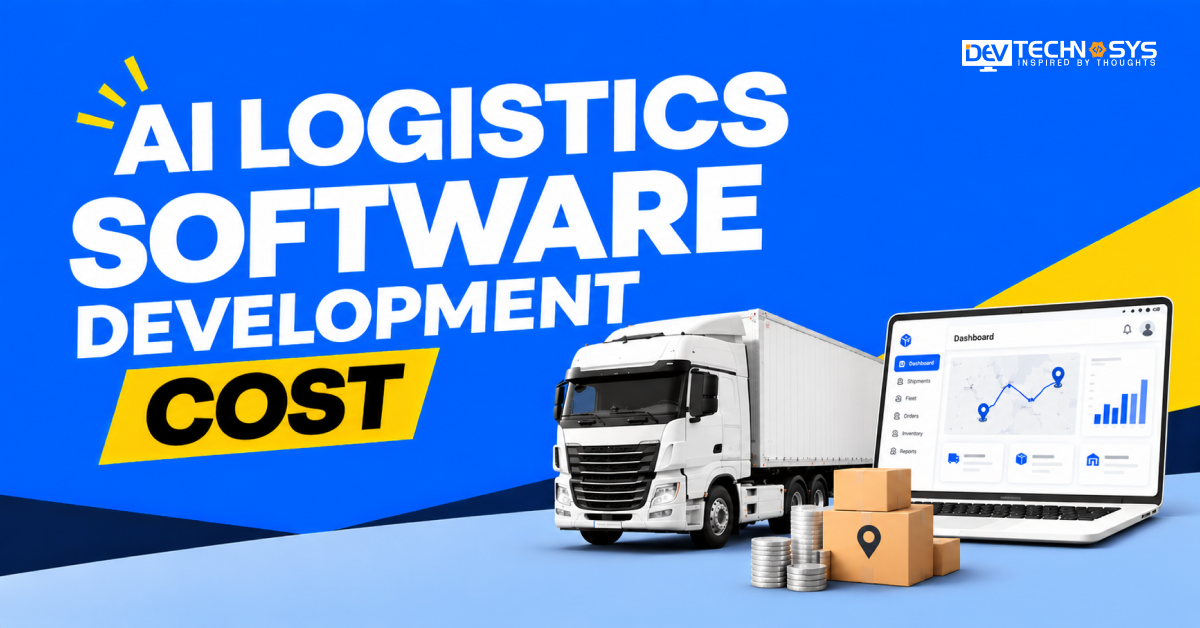
The AI logistics software development cost typically ranges from $4,999 to $90,000+, depending on features, software complexity, and AI capabilities required.
Cost Based on Software Types:
-
- Basic Logistics Management Software: $4,999–15,000+
- Transportation Management System (TMS): $15,000–35,000+
- AI-Powered Fleet Management Software: $25,000–55,000+
- AI-Powered Supply Chain Management Platform: $45,000–90,000+
Cost Based on Development Regions:
-
- USA: 45,000–90,000+
- Australia: 35,000–75,000+
- Canada: 30,000–70,000+
- India: 4,999–40,000+
Additional Costs:
-
- Maintenance & Updates: Typically 15% of the initial development cost annually.
- Hosting & Infrastructure: Cloud computing, database storage, GPS data processing, real-time tracking, and AI model hosting costs.
- Third-Party Integrations: GPS tracking systems, mapping APIs, telematics devices, ERP platforms, warehouse management systems, payment gateways.
- AI Model Development & Training: Data preparation, model training, testing, fine-tuning, and ongoing performance.
- Security & Compliance: Data encryption, ISO, SOC 1, PCI DSS, GDPR, role-based access controls, API security, audit logs, backups.
This is for a transition to work with AI. Stop working on spreadsheets that you cannot handle anymore. AI-powered software applications allow logistics managers to handle critical tasks. These include vehicle management, driver location, and product delivery. They can check data in real time to resolve concerns immediately.
Grand View Research reports that the global AI market in logistics is expected to grow at a CAGR of 38.9% by 2030. Key growth drivers are AI-powered solutions for demand forecasting, inventory management, and optimized logistics.
This AI logistics software development cost guide is for businesses that are willing to build a custom solution. They should be aware of the costs of integrations, security, and ongoing maintenance.
Top 3 Benefits of AI Logistics Software Development
AI in logistics is helpful in many ways. From forecasting, managing vehicles, and checking delivery information. Managers can easily manage these activities even when they are not physically present in the workspace.
1. High-Precision Demand Forecasting
Businesses are adopting smart inventory systems that automatically optimize storage placement, reducing understocking and overstocking. AI-powered predictive analytics helps to analyze seasonal trends so that sales can be planned effectively. This reduces product carrying costs and lowers warehousing holding costs.
2. Predictive Vehicle Maintenance
AI-powered predictive maintenance analyzes vehicle performance, engine data, mileage, temperature, and sensor readings to identify potential mechanical failures.
Instead of following fixed maintenance schedules, businesses can schedule servicing based on vehicle conditions, reducing unexpected breakdowns and maintenance expenses. Choosing the right predictive analytics services supports effective decision-making.
3. Reduced Operational Costs
With AI, businesses consistently receive updates on dispatch scheduling, shipment allocation, document processing, invoice verification, and inventory updates without needing an employee dedicated to these tasks. The solution also helps to reduce unnecessary operational spending.
Planning a Supply Chain Project?
Get a tailored development cost estimate in a few simple steps.
- 3 quick steps
- 100% free
- Reply in 1 business day
2 Minutes Read
What is AI-Powered Logistics App Development Cost?
The supply chain software development cost typically ranges from $4,999 to $90,000+, depending on the application’s complexity, AI capabilities, integration requirements, and security standards.
AI Logistics Software Development Cost Breakdown
AI Logistics Software Type |
Estimated Development Cost |
| Basic AI Logistics App (MVP) | 4,999–15,000 |
| AI Route Optimization Software | 10,000–25,000 |
| AI Fleet Management Software | 15,000–35,000 |
| AI-Powered Warehouse Management Software | 20,000–45,000 |
| Predictive Logistics Analytics Software | 25,000–55,000 |
| AI Logistics Automation Platform | 35,000–70,000 |
| Enterprise AI Logistics Software | 50,000–90,000+ |
Note: These are indicative development estimates, not fixed market quotations. Actual costs depend on project scope, technology choices, integrations, and development team rates.
Factors Affecting AI-Powered Logistics App Development Cost
The logistics management software development cost is influenced by several technical and operational factors. Understanding these factors helps businesses identify where their investment will go and which capabilities are necessary for their logistics operations.
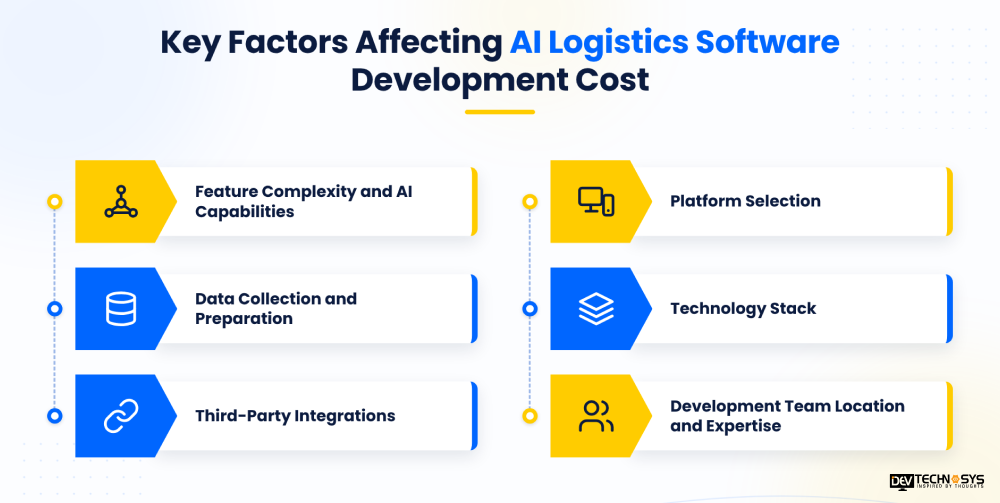
1. Feature Complexity and AI Capabilities
AI Logistics Feature |
Estimated Cost |
| AI Route Optimization | 5,000–12,000 |
| Predictive Maintenance | 5,000–10,000 |
| Demand Forecasting | 6,000–12,000 |
| Intelligent Fleet Management | 5,000–10,000 |
| AI Chatbots and Virtual Assistants | 3,000–8,000 |
| AI-Powered Dispatch Automation | 7,000–15,000 |
| AI Agents for Logistics Operations | 8,000–18,000 |
2. Data Collection and Preparation
For an AI solution, it is important for a business to maintain data quality. Data cleaning, creation of data pipelines, data labeling, and preparing datasets for AI model training affect overall development cost.
3. Third-Party Integrations
Common integrations such as payment gateways, APIs, ERP, GPS, telematics, or warehouse management systems impact cost. Most AI logistics development companies determine cost of third-party integrations prior to development to avoid any confusion.
4. Platform Selection
Choice of platform directly impacts cost. For example, cross-platform development might be feasible, or choosing separate development for iOS, Android, or a web application. Also, choose carefully between build vs buy AI logistics software that would also affect the cost.
5. Technology Stack
Besides regular frontend and backend technologies, businesses also have to pay for AI and Machine Learning, APIs, and Communication. These factors directly impact cost. However, experts at an artificial intelligence development company suggest the right tech stack after analyzing the existing technical architecture.
6. Development Team Location and Expertise
If you hire developers or partner with an AI logistics software development company, then select the Asia region. Here, you will find cost-effective experts with deep knowledge of AI integration and logistics industry experience.
Industry Insight:
The role of generative AI in logistics is expected to rise by USD 9.49 billion by 2034. This data highlights the growing importance of structured data for businesses.
How Security & Compliance Affect AI-Powered Logistics App Development Cost?
Such applications are process sensitive business information that could be hacked by attackers. Implementing RBAC, GDPR, encryption at rest, SOC 1, SOC 2, ISO, and more can be expensive.
Security Features That Influence Development Costs
Security Requirement |
Purpose |
Estimated Cost |
| Data Encryption | Protects sensitive information during storage and transmission | 500–1,500 |
| Role-Based Access Control (RBAC) | Restricts access according to user roles | 500–1,200 |
| Multi-Factor Authentication | Adds another layer of account protection | 300–800 |
| API Security | Protects communication between connected systems | 500–1,500 |
| Audit Logs | Records user activities and system changes | 400–1,000 |
| Data Backup and Recovery | Helps restore business information after failures | 500–1,500 |
| Penetration Testing | Identifies potential security vulnerabilities | 1,000–3,000 |
Note: These are indicative cost estimates for individual security components. Actual costs depend on application complexity, infrastructure, security requirements, and testing scope. They should not be treated as fixed vendor prices.

What are Hidden Costs of AI Logistics Software Development?
Hidden costs can include cloud hosting, software maintenance, AI Model Inference, security testing, and compliance. These can range from $100 to $5000 per month depending on the business size. However, AI integration services can also add to the hidden costs.
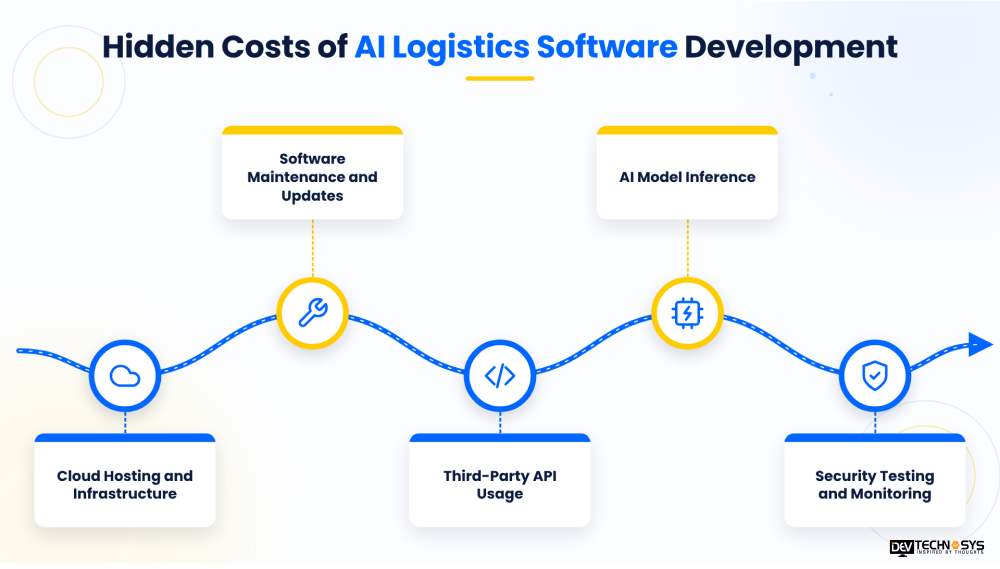
Hidden Cost |
Estimated Budget |
| Cloud Hosting and Infrastructure | $100–1,000+/month |
| Software Maintenance and Updates | 15–20% of initial development cost annually |
| Third-Party API Usage | $50–500+/month |
| AI Model Inference and API Usage | $100–1,000+/month |
| Security Testing and Monitoring | Depends on audit scope |
| Data Storage and Backup | $50–300+/month |
| Technical Support | Depends on support requirements |
| AI Model Retraining | Depends on data volume and model complexity |
Note: These are illustrative planning allowances, not fixed service-provider prices. Actual expenses depend on usage, cloud architecture, API pricing, and operational requirements.
How to Reduce AI Logistics Software Development Cost?
Considering the cost, you might be wondering how to plan the project with a limited budget. Here’s a quick solution to reduce supply chain software development cost.
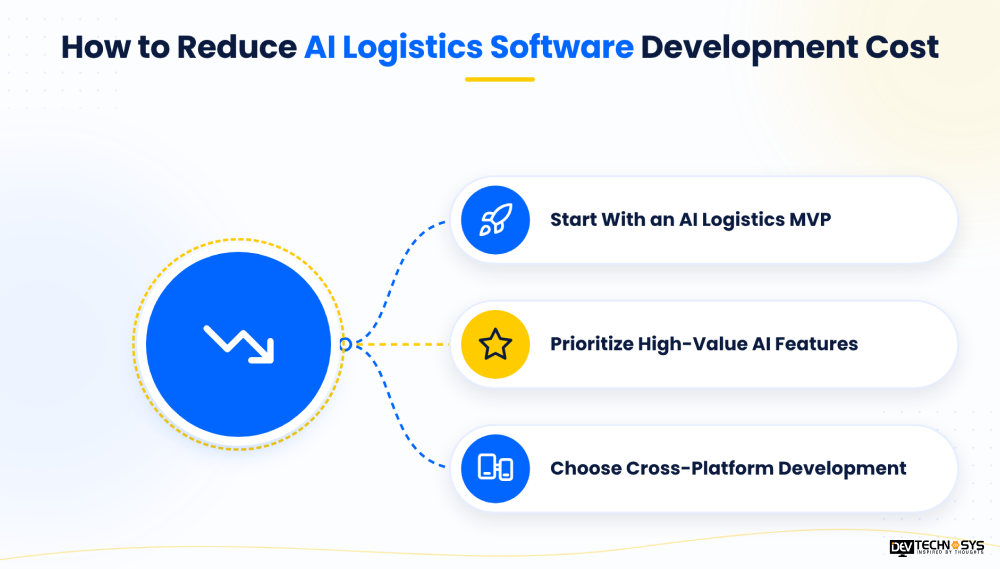
1. Start With an AI Logistics MVP
A basic version comprises the important features required to solve immediate operational problems. These include shipment tracking, delivery notifications, and a logistics analytics dashboard. Each user has access to the solution according to their role.
For example, a driver can access routes and check deliveries, while a logistics manager can track a driver’s location. An MVP can be upgraded with advanced capabilities such as predictive maintenance, AI agents, and automated dispatching once you decide on an expansion.
2. Prioritize High-Value AI Features
AI agent development cost can be reduced by investing in the features they actually want. For example, a company experiencing frequent delivery delays may prioritize AI route optimization, as it is not necessary to use all of the AI capabilities.
This strategy will prevent businesses from spending unnecessary development expenses. Even if you want to add the most important features later, take a suggestion from the experts to avoid performance issues.
3. Choose Cross-Platform Development
If your logistics application requires Android and iOS support, consider cross-platform technologies such as Flutter or React Native. These frameworks allow developers to share a significant portion of the application code, reducing development efforts. Many managers prefer to check demand forecasting data, which will be convenient with a mobile app solution.
Expert Insight: AI logistics software development cost in the USA can vary according to business size, AI capabilities, and software complexities. Thus, finding the right way to reduce costs is key to a better strategy. – Naveen Pareek, Supply Chain Expert, Dev Technosys
What is the Total Cost of Ownership (TCO) for AI Logistics Software?
The Total Cost of Ownership (TCO) of AI logistics software refers to the complete expense of developing, deploying, operating, maintaining, and upgrading the application throughout its lifecycle.
Businesses should measure AI cost instead of considering only the initial development cost because AI-powered logistics platforms require continuous infrastructure resources, API subscriptions, security updates, and AI model maintenance.
AI Logistics Software TCO Breakdown
Cost Component |
Estimated Expense |
| Initial Software Development | 4,999–90,000+ |
| Cloud Infrastructure | 1,200–12,000+/year |
| API and Third-Party Services | 600–6,000+/year |
| Software Maintenance | 15–20% of development cost/year |
| AI Model Monitoring and Updates | 1,000–5,000+/year |
| Security and Testing | Depends on requirements |
| Technical Support | Depends on support plan |
These figures are illustrative budgeting assumptions. Actual TCO varies according to application usage, infrastructure requirements, security needs, and support arrangements. Some costs may overlap with maintenance agreements.
How to Calculate AI Logistics Software TCO?
Businesses can calculate the estimated TCO using the following formula:
TCO=InitialDevelopmentCost+OperatingCosts+Maintenance+Upgrades
Example:
Suppose a logistics company invests $40,000 in developing AI-powered logistics software. Its estimated annual operating expenses are:
Expense |
Annual Cost |
| Cloud Infrastructure | $3,000 |
| Third-Party APIs | $1,500 |
| Software Maintenance | $6,000 |
| AI Model Monitoring | $2,000 |
| Technical Support | $1,500 |
| Total Annual Operating Cost | $14,000 |
For a three-year ownership period:
- Initial development cost: $40,000
- Three-year operating expenses: $42,000
Why Choose Dev Technosys for AI-Powered Logistics App Development?
Dev Technosys is a CMMI Level 3 development company that builds custom AI solutions with third-party integrations, ML, and more technologies. The team has accomplished more than 50 projects in logistics software solutions with a 79% client retention rate.
Choosing us means gaining access to technical professionals who provide post-launch support. Our AI capabilities include analyzing historical logistics data, identifying operational patterns, and predicting delivery delays to improve decision-making.
Conclusion
If the solution is complex, then the project will be expensive. Thus, partner with a logistics AI development company whose experts will guide you through the process. You will gain access to professionals who can analyze the business data to provide a feasible solution.
To reduce the cost, businesses can start with an MVP or prioritize high-value features. Experts will help you build a scalable solution that could meet existing and future operational requirements.
Frequently Asked Questions
Find answers to the most common questions related to this article.
The AI logistics software development cost typically ranges from $4,999 to $90,000+, depending on AI features required, third-party integrations, data infrastructure, and scalability. AI Demand Forecasting can cost $10,000, while AI agents can cost more than $40,000+.
The post-launch cost of AI logistics software is around 15% of the total development cost. Data storage might be expensive, while cloud hosting will be cost-effective. This choice depends on the decision-makers, such as which maintenance services they need for the solution.
A buy solution is cheaper than building AI logistics software, as businesses can use its existing features without funding for the entire software development process. Choose build solutions if you require proprietary route optimization, AI-powered demand forecasting, and automated dispatch.
Yes, you can add AI capabilities to an existing TMS or WMS. The cost range will be from $10,000 to $85,000+ depending on the features. AI-based inventory optimization costs about $32,000+, while AI-Powered Shipment Tracking can cost $14,000+.
AI logistics software can be built within 3 to 4 months, depending on factors such as data availability, security, compliance, and AI model complexity. If you require a report for each milestone, you can easily coordinate with the team to know the project’s progress.