


















Key takeaways:
-
- The cruise ship market industry is expected to grow from $85.24 billion in 2025
- Easy sign-up, cruise search & filters, real-time availability, secure payments, are some of the essential features to add in a cruise booking app.
- The average timeline to build a cruise booking app ranges from 3 to 6
- Ensure strong data encryption, secure payment gateways, and GDPR compliance for user trust.
A luxurious cruise trip with endless amenities sounds like the perfect idea of vacation! However, the traditional method of booking and comparing cruises by contacting multiple travel agents or visiting various websites spoils the fun, which is where cruise booking apps come in!
Whether searching for destinations or departure dates, comparing prices or cruise lines, cruise booking apps do it all. The rise in the cruise booking app market compels many businesses to invest in this booming cruise travel industry.
But what is the procedure for developing a successful cruise booking app for businesses? In this guide to build a cruise booking app, we will discuss every aspect of cruise booking app development.
This helpful guide will help businesses build a top cruise booking app that makes the cruise booking process easier for everyone, including travel agents and individual customers.
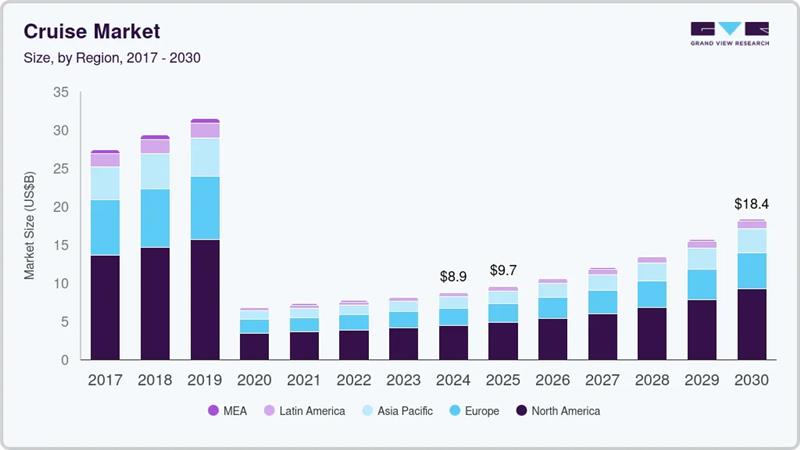
Global Cruise Market Insights
- The Cruise Ship Market Industry is expected to grow from $24 billion in 2025 to $159.54 billion by 2034, at a compound annual growth rate (CAGR) of approximately 7.21% during the forecast period (2025-2034).
- North America led the cruise ship market, accounting for a 45% share, followed by Europe at 30%. Asia Pacific contributed 15%, Latin America 5%, and the Middle East & Africa 5%
- According to the Cruise Lines International Association, 0% of the international vacationers are first-time cruisers, who are likely to cruise in the next few years.
- It is noteworthy that, by 2030, the cruise market is expected to generate 24% of its total revenue through online sales.
What is a Cruise Booking App?
A cruise booking app is a platform used to research, compare, and book cruise vacations from various cruise lines. These app platforms include detailed information about cruise ships, cabin options, destinations, and itineraries.
Cruise booking apps also include detailed cruise images, cabins, and ports, along with deck plans for easy exploration and booking. Besides the initial bookings, some cruise booking apps are also used as companion tools to manage voyages, offering features including reservation, ship navigation, and communication with other passengers onboard.
Why Should Businesses Invest in Cruise Booking App Development?
The cruise travel industry has enjoyed remarkable growth in recent few years. Businesses can gain an advantage from the increasing use of cruise booking apps.
By investing in cruise booking app development, companies can increase revenue, reduce costs, improve customer loyalty, and create long-term growth opportunities.
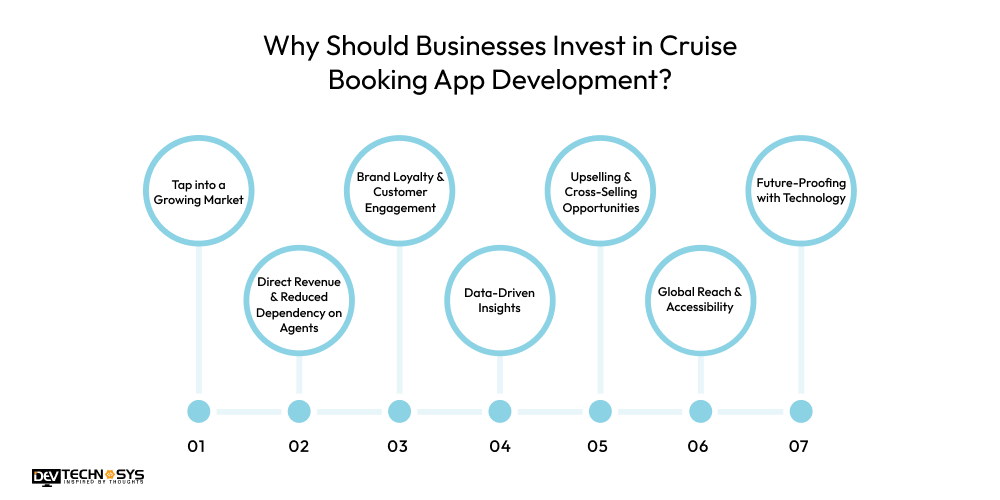
1. Tap into a Growing Market
Businesses should build a cruise booking app to tap into the growing market. The global cruise tourism market is projected to generate billions of dollars in revenue over the last 10 years. Investing early in business gives you a competitive benefit.
2. Direct Revenue & Reduced Dependency on Agents
According to a top Android app development company, traditional cruise bookings must involve travel agents who take high commissions. A booking app enables businesses to sell directly to customers, thereby maximizing their profits.
3. Brand Loyalty & Customer Engagement
Cruise booking apps keep people engaged and well-informed through push notifications, giving personalized offers, and incorporating loyalty programs. Repeat customers prefer apps instead of third-party platforms.
4. Data-Driven Insights
Apps for cruise bookings help users by providing them with detailed insights about customer data. It includes booking trends, seasonal demand, and preferred destinations. Businesses can use this information to come up with strong marketing campaigns and increase revenue.
5. Upselling & Cross-Selling Opportunities
Businesses can build an app like Booking.com that promotes onboard dining, entertainment, spa packages, excursions, and merchandise directly within the app. Adds extra revenue streams beyond ticket sales.
6. Global Reach & Accessibility
By investing to create a cruise booking app, businesses can expand their businesses and reach global markets. Multilingual and multi-currency features make it easier to target international travelers.
7. Future-Proofing with Technology
Cruise booking apps can make the cruise booking experience truly futuristic. The addition of AI chatbots, AR/VR ship tours, and IoT-based onboard services can make the experience truly futuristic. Investing now positions businesses as innovators in the cruise industry.
Top 10 Cruise Booking Apps to Explore in 2025
Before you jump into building a cruise booking app for your own business, let’s first view some of the best cruise booking apps to explore in 2025. All the cruise booking apps listed below offer a top-notch cruise booking experience, featuring advanced features and technology.
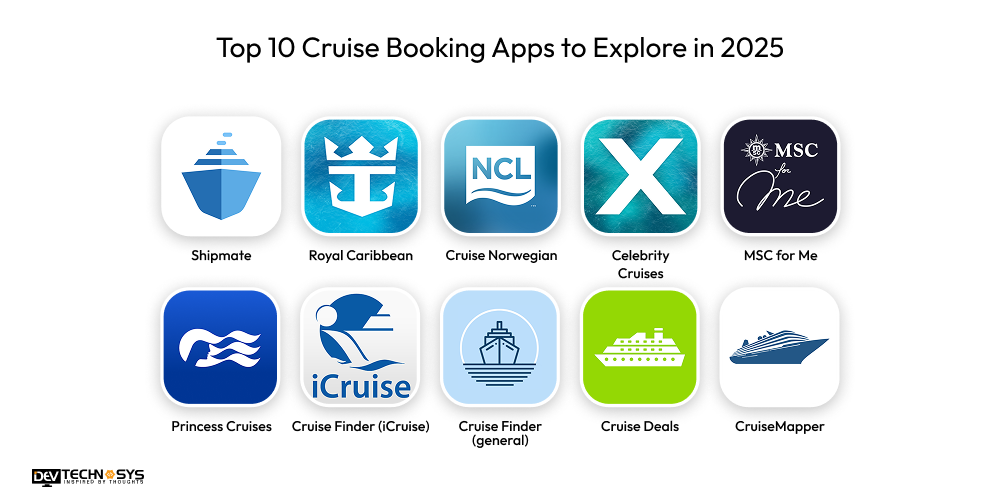
| App Name | Platforms | Launch / Timeline | Key Highlights / Features |
| Shipmate | iOS & Android | One of the first cruise apps (>10 years ago) | Search cruises, reviews, excursions |
| Royal Caribbean | iOS & Android | First iPhone app in 2010; revamped since 2020 | Check-in, onboard bookings, planner |
| Cruise Norwegian | iOS & Android | Redesigned version by 2024–25 | Excursions, dining, and activity planner |
| Celebrity Cruises | iOS & Android | Modern app with ongoing updates | Check-in, dining, entertainment |
| MSC for Me | iOS & Android | Available before sailing, continuously updated | Wristband access, ship navigation |
| Princess Cruises | iOS & Android | Rebranded in 2024 from MedallionClass | (MedallionClass)Medallion check-in, service requests |
| Cruise Finder (iCruise) | iOS | In market >10 years; updated July 2025 | Compare lines, itineraries, and deals |
| Cruise Finder (general) | iOS & Android | Popular among travelers | 50+ lines, filters, cabin options |
| Cruise Deals | iOS & Android | Available as a deals-focused app | Price comparison, last-minute deals, search by date/line |
| CruiseMapper | iOS & Android | Active, widely used tracking app | Live ship tracker, route maps, port details, vessel info |
Essential Features to Include in a Cruise Booking App
Features are the components that can make or break your cruise booking app. So, choosing the right set of features is exceptionally crucial.
| Category | Key Features |
| User-Side | Easy Sign-Up, Cruise Search & Filters, Real-Time Availability, Secure Payments, Itinerary Planner, Push Notifications, Loyalty Rewards, Multi-Currency, Reviews & Support |
| Admin-Side | Dashboard & Analytics, Cruise & Cabin Management, Dynamic Pricing, CRM, Payment Tracking, Inventory Management, Marketing Tools, API Integrations |
| Advanced | AI Recommendations, AR/VR Ship Tours, Wearable/IoT Access, Blockchain Payments, Voice Search, Social Sharing, Offline Mode, Real-Time Ship Tracking |
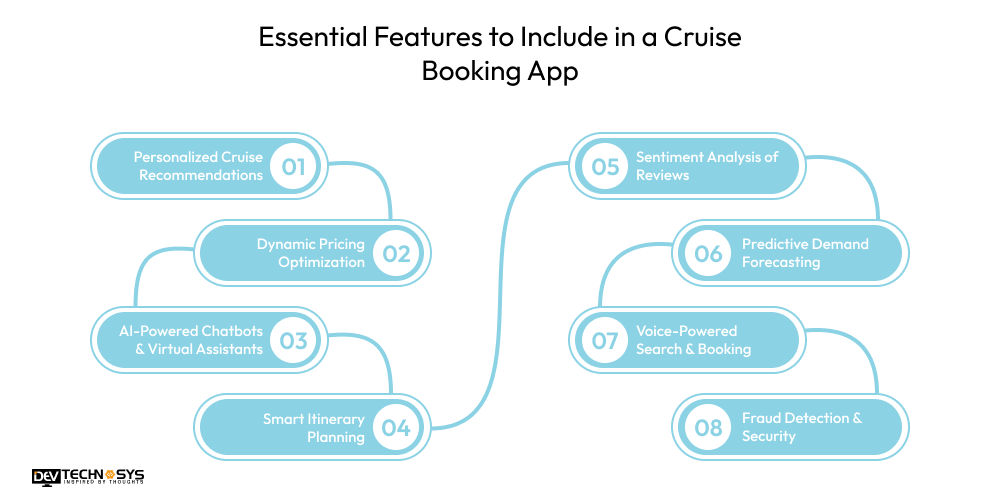
1. Personalized Cruise Recommendations
To build a cruise booking app, you need to incorporate features like personalized cruise recommendations. AI recommendations analyze a user’s preferences, budget, and travel history, then suggest relevant cruises, cabins, and packages tailored to each user’s specific preferences and needs.
2. Dynamic Pricing Optimization
Create a cruise booking app using machine learning models to adjust cruise fares in real time. You can adjust the prices on the basis of on demand, season, and competitor pricing, which increases revenue.
3. AI-Powered Chatbots & Virtual Assistants
If you want to make a cruise booking app, adding an AI chatbot feature will help you provide 24/7 customer support for bookings. It also helps with FAQs, cancellations, and onboard service requests through conversational AI.
4. Smart Itinerary Planning
To develop a cruise booking app, developers need to incorporate smart itinerary planning. AI can create personalized day-by-day itineraries, including shore excursions, dining options, and entertainment schedules.
Want a chatbot demo or pricing? Fill the form and talk to our experts today.
Pick what you need below — you can select more than one — then tap Get detail to continue.
-
Chatbot demo dashboard
-
Cost to develop an app
-
Industry report
-
Case study
5. Sentiment Analysis of Reviews
Sentiment analysis is a feature that analyzes users’ feedback and opinions. AI enables businesses to identify their strengths and weaknesses and take the initiative to improve services for the betterment of user convenience.
6. Predictive Demand Forecasting
AI is used for forecasting the latest booking trends, technologies, and optimizing inventory, among other applications. Through predictive demand forecasting, businesses can develop more effective promotional campaign strategies.
7. Voice-Powered Search & Booking
To make a cruise booking app, your developer needs to add a voice-powered search feature. It is an AI feature that allows users to search and book a cruise by using voice commands.
8. Fraud Detection & Security
According to companies that develop cruise booking apps, a robust fraud detection system is essential for a cruise booking app. AI systems can detect anomalies in payment behavior, which reduces the risk of fraud and ensures secure transactions.
What are the Steps to Develop a Cruise Booking App From Scratch?
Great! You finally made it here. This section discusses the crucial steps to build a cruise booking app. If you want to develop a cruise booking app successfully, then follow the steps mentioned below.
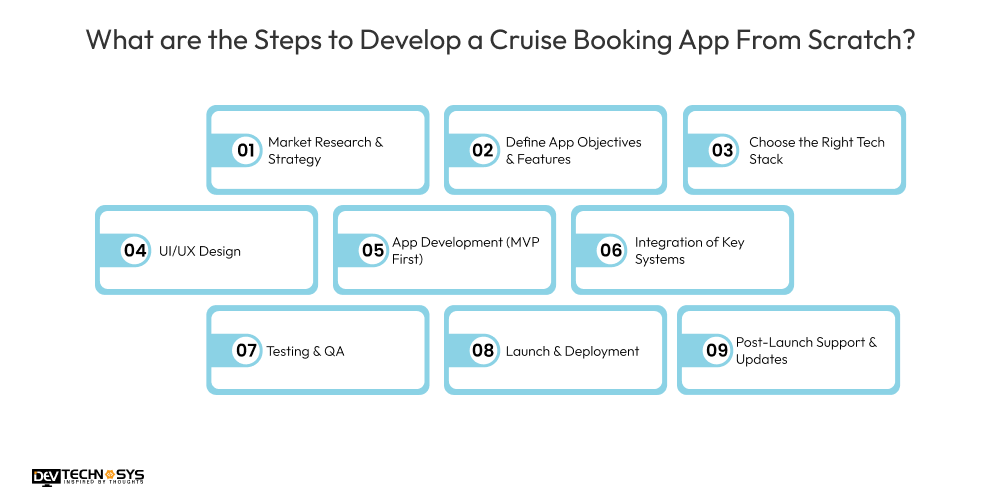
1. Market Research & Strategy
First, determine the purpose of developing a cruise booking app and identify your target audience. To build a cruise booking app, you need to do an in-depth analysis of your competitors, like Cruise Critic, VacationsToGo, and MSC’s app.
Next, you need to identify the strategies that are working well for your competitors and the areas where they are lacking. This analysis will help you devise a more effective approach than your competitors.
For example, if your competitors offer complex booking processes and limited payment options, consider providing convenient cruise booking services with multiple payment options to differentiate yourself from them.
You also need to determine your unique selling point ( it can be AI-driven recommendations, Voice Search features, VR cruise tours, or flexible payment options).
2. Define App Objectives & Features
To build a cruise booking app, your development team has to add essential features like search, booking, payment, and itinerary management. It’s crucial to choose the set of features that meet your business requirements.
You can also add advanced AI features, like AI personalization, AR tours, and real-time cruise tracking, to further enhance the user experience. You need to outline the user roles as well. It includes:
- User (Traveler/Customer): Users can search cruises, track itineraries, compare prices, book tickets, make payments, and take virtual cruise tours.
- Admin: This includes managing cruise listings, pricing, offers, user data, analytics, cancellations, and overall system monitoring.
- Travel Agent: Acts as an intermediary to recommend cruises, manage group bookings, offer personalized deals, and provide support.
3. Choose the Right Tech Stack
To develop a cruise booking app, selecting the right tech stack is crucial. The tech stack can be categorized into four main areas: frontend, backend, database, and Cloud & APIs. Your development team needs to select the most suitable technology for each category.
| Layer | Recommended Options | Purpose |
| Frontend (App UI) | Flutter, React Native | Build cross-platform apps with smooth UI/UX for iOS & Android |
| Backend (Server-Side) | Node.js, Django, Ruby on Rails | Handle business logic, bookings, payments, and user data |
| Database | PostgreSQL, MongoDB | Store user info, bookings, itineraries, and payment records |
| Cloud & APIs | AWS, Google Cloud, Stripe/PayPal, Map & Weather APIs | Enable hosting, secure payments, location/weather updates |
4. UI/UX Design
According to a top mobile app development company, design plays a role in cruise booking app development. Creating an attractive UI and ensuring smooth navigation are crucial to build a cruise booking app that engages users and keeps them engaged.
If you develop a cruise booking app with an engaging and intuitive UI, it will improve usability and increase customer retention rate. Key considerations for UI/UX design include
- User-Friendly Navigation:
- Visually Rich Interface:
- Personalized Experience:
- Responsive Design:
- Smooth Checkout:
5. App Development (MVP First)
We have now reached the core of development. The development process of cruise booking app development entails arranging all the features, design, functionalities, and tech-stack together to create an MVP.
Build a cruise booking app MVP with features, tech stack, user stories, minimal AI screens, testing checklist, deployment notes, and success metrics.
Launching an MVP first will help validate demand quickly and facilitate iteration. An MVP allows businesses to launch their cruise booking app into the real-world market quickly, with essential features including search, booking, payment, and itinerary management.
6. Integration of Key Systems
The next step to build a cruise booking app is integrating key systems. Hire dedicated developers who will integrate multiple payment gateways into your app.
There are various payment gateways that you can incorporate into your cruise booking app, like Stripe, PayPal, and Apple Pay. Include a CRM & booking management system, as well as AI/ML modules for recommendations. AR/VR tools for ship tours, though it is an advanced AI feature and is optional to add.
7. Testing & QA
Testing is an essential factor to consider in cruise booking app development. Once the development process of your cruise booking app is completed, you need to submit your app for testing.
The testing team will test your app on multiple platforms and devices, under heavy and normal load, to ensure smooth and seamless performance. Rigorous testing is necessary to ensure there are no bugs, errors, or technical mistakes left in the app that could affect the performance after launch. The app testing includes:
- Functional Testing: Checks search, booking, and payments.
- Performance Testing: Ensures fast loading and real-time availability.
- Security Testing: Ensure payment and data Encryption.
- User Acceptance Testing (UAT): Test the app with small groups first.
8. Launch & Deployment
Once your cruise booking app passes the testing phase, it is ready to be launched in the market through app stores. To publish the cruise app, select the App Store (iOS) and Google Play (Android) platforms.
Now comes the promotions. Focus on exceptional marketing and promotion with SEO, social media ads, and partnerships with cruise operators.
9. Post-Launch Support & Updates
Hire Mobile app developers from a reputable firm that would provide round-the-clock post-launch maintenance and support services. If you want to build a cruise booking app like Royal Caribbean or Cruise Critic, then you need to pay attention to constant post-launch services.
It may include bug fixes, performance monitoring, feature updates, system optimization, security enhancements, and acting on user reviews.

Why Should Customers Rely on Cruise Booking Apps?
Cruise booking apps can make your entire cruise journey worthwhile and convenient. Businesses are investing in the development of cruise booking apps to make planning and booking cruises faster, easier, and more reliable for users. Here are the key reasons why customers prefer using cruise booking platforms:
- Convenience & 24/7 Access: Customers are free to explore, compare, and book cruises of their choice without visiting numerous websites or travel agents.
- Personalized Recommendations: With AI-driven suggestions, users receive tailored cruise deals, itineraries, and excursions that match their preferences.
- Real-Time Updates: Booking apps send immediate alerts on itinerary changes, be it conditions or ship schedules. Real-time updates ensure a smooth travel experience.
- Secure Payments: Integrated payment gateways in booking apps enable secure transactions. They include flexible payment alternatives with instant confirmations.
- Cost Savings: Many applications include exclusive discounts, promotional offers, and last-minute deals that aren’t available offline.
What is the Cost to Develop a Cruise Booking App?
The cost to build a cruise booking app can vary depending on factors such as features and functionalities. On average, the cost to develop a cruise app ranges from $8,000 to $25,000.
The travel app development cost for a native platform with basic features may reach $15,000. However, the cost to build a cruise booking app for a cross-platform with advanced AI-supported features can range from $15,000 to $25,000 and higher. Take a look at the table below to determine the cost to create a cruise booking app by development phase.
| Development Phase | Timeline | Estimated Cost Range |
| Research & Planning | 1 – 2 weeks | $1,000 – $2,000 |
| UI/UX Design | 2 – 3 weeks | $1,500 – $3,000 |
| MVP Development | 4 – 6 weeks | $3,000 – $8,000 |
| Testing & QA | 2 – 3 weeks | $1,000 – $2,500 |
| Launch & Deployment | 1 week | $500 – $1,500 |
| Marketing & Promotion | Ongoing (post-launch) | $1,000 – $3,000 |
What Factors Can Affect the Cruise Booking App Development Cost?
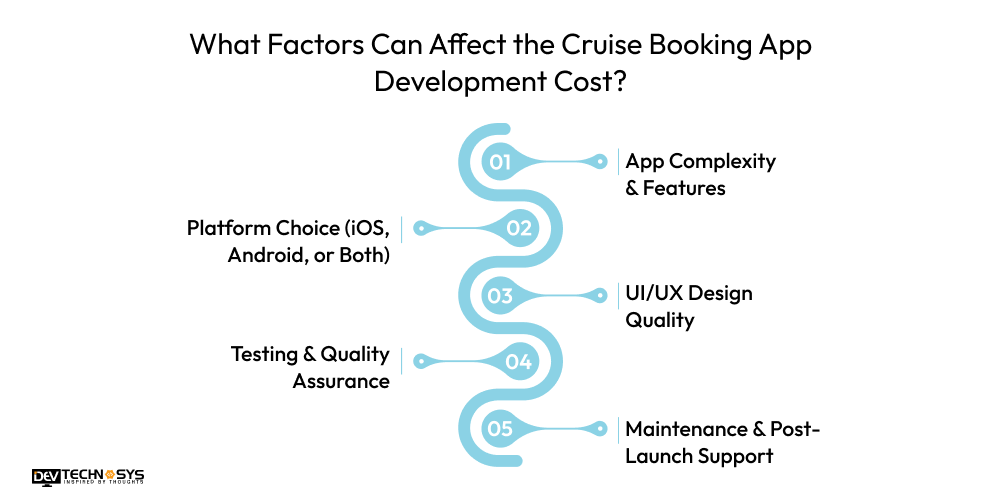
Here are the factors that can impact the cost of creating a cruise booking app. Consider these factors before beginning the development.
1. App Complexity & Features
According to a cruise booking app development company, factors such as app complexity and features can impact the cost to build a cruise booking app. The basic cruise booking app development cost is typically less and contains basic features like search, booking, and payment.
In comparison, advanced apps with AI personalization, real-time cruise tracking, and AR tours increase the cruise booking app development cost.
| Level | Features Included | Estimated Cost Range |
| Basic | Cruise search, booking, payments, and user login | $8,000 – $12,000 |
| Moderate | Advanced filters, reviews, loyalty programs, push notifications | $12,000 – $18,000 |
| Advanced | AI personalization, AR/VR cruise tours, real-time tracking, multilingual support | $18,000 – $25,000 |
2. Platform Choice (iOS, Android, or Both)
The cost to develop a cruise booking app also depends on the choice of platforms. Developing for one platform costs less. Developing a cruise booking app for cross-platform or a separate native app for iOS & Android increases the final budget. The table below outlines the cost to make a cruise booking app, depending on the chosen platform.
| Platform Type | Description | Estimated Cost Range |
| Single Platform | iOS or Android only | $8,000 – $12,000 |
| Cross-Platform | Built with Flutter / React Native (works on both) | $12,000 – $18,000 |
| Native for Both | Separate iOS & Android development | $18,000 – $25,000 |
3. UI/UX Design Quality
The cost to build a cruise booking app with a standard User interface design costs less. However, if you build a cruise booking app using custom designs, animations, and an interactive UI, then expect the development cost to be higher. Here’s the cruise booking mobile app development cost according to design type
| Design Level | Description | Estimated Cost Range |
| Standard | Simple layouts, basic navigation | $8,000 – $11,000 |
| Custom | Attractive UI, animations, smooth transitions | $11,000 – $16,000 |
| Premium | Highly interactive UI/UX, AR/VR design elements, luxury cruise branding | $16,000 – $22,000 |

4. Testing & Quality Assurance
Testing & Quality Assurance Testing complex apps needs advanced testing that includes both manual and automated methods. Testing can lead to more development time and cost.
However, normal testing does not require such expertise, so the cost to develop a cruise booking app is generally lower. The table below outlines the cost to make a cruise booking app based on quality assurance.
| Testing Level | Description | Estimated Cost Range |
| Basic | Manual testing, bug fixing | $8,000 – $10,000 |
| Intermediate | Manual + Automated testing, performance optimization | $10,000 – $15,000 |
| Advanced | Full-scale QA, stress/load testing, security audits | $15,000 – $20,000 |
5. Maintenance & Post-Launch Support
According to a cruise booking app development company, post-launch maintenance is an essential aspect of cruise booking app development. It takes up 10% to 15% of the total cruise booking app development cost.
There is an ongoing expense that includes bug fixes, new features, and server costs, which contribute to the total development cost. The table below showcases the cost to create a cruise booking app according to post launch services
| Maintenance Level | Description | Estimated Cost Range (Yearly) |
| Basic Support | Bug fixes, minor updates | $3,000 – $5,000 |
| Standard Support | Regular updates, feature enhancements | $5,000 – $8,000 |
| Premium Support | Continuous monitoring, upgrades, 24/7 support, scaling | $8,000 – $12,000 |
Monetization Strategies for Cruise Booking Apps
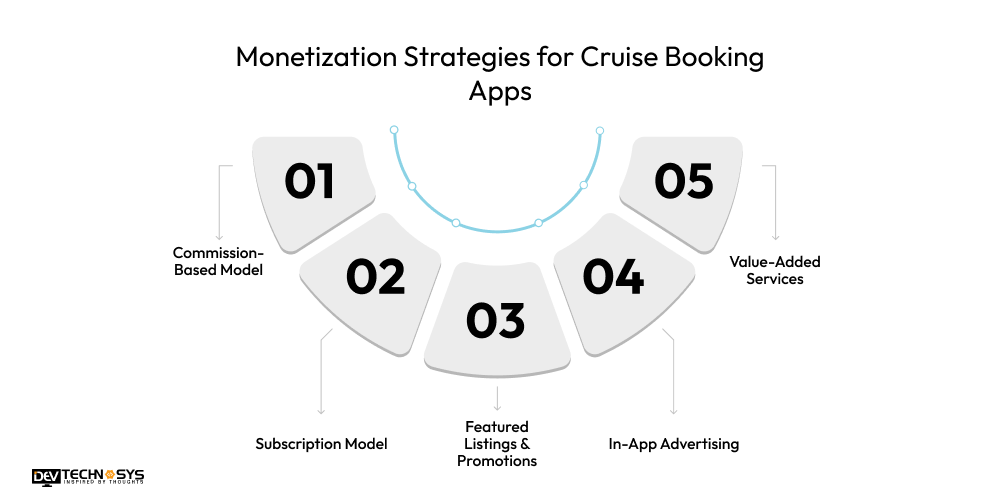
Here are some of the top monetization models that businesses can use to make their cruise booking app successful. Let’s see what these models are:
1. Commission-Based Model
A commission-based model is mutually beneficial, as the app drives new customers to the cruise operators, and the operators only pay for successful bookings.
In the model, the app acts as an agent, connecting with cruise lines, tour operators, and travel agencies. For every successful booking, they earn a fixed percentage of the total transaction value.
2. Subscription Model
This model is an ideal solution for frequent travelers seeking additional benefits and value. To enjoy the benefits of premium features, users have to pay a monthly or yearly fee. These features could include exclusive deals, early access to new promotions, and special loyalty perks.
3. Featured Listings & Promotions
This model utilizes in-app advertising to provide a more streamlined user experience. Cruise operators can pay to have their cruises appear in the best location, including the top of search results or on the homepage. It works similarly to “sponsored listings” on popular travel sites, such as Expedia or Booking.com.
4. In-App Advertising
In-app advertising is a supplementary revenue stream where the app displays ads from relevant third-party businesses. It includes travel-associated brands, airlines, stays, or insurance companies. Integrate the cruise booking app with networks like Google AdMob or establish a direct partnership with advertisers.
5. Value-Added Services
Value-added models focus on providing for existing customers. After booking a cruise, the cruise booking platform offers them additional services or add-ons that enhance their travel experience. A value-added model could include purchasing travel insurance, booking airport transfers, or upgrading onboard amenities such as dining or Wi-Fi.
Conclusion
The above provides details and information on how to build a cruise booking app. From ideation to launch, to post-launch. In the above blog, we explained the process of developing a cruise booking app to the best of our ability.
We hope it clears any doubts or queries you might have regarding cruise booking app development. If you are a business looking for an edge-cutting travel app development company, then contact Dev Technosys. Stay tuned for more informative updates.
FAQs
Q1. What are the Steps to Develop an MVP for a Cruise Booking App?
Here are the steps to build an MVP for a cruise booking app:
- Set Development Roadmap: Prioritize must-have features for the first release.
- Backend & Database Setup: Establish a robust foundation for user data, bookings, and payments.
- Frontend Development: Build a smooth, responsive interface for users.
- API & Payment Gateway Integration: Enable secure transactions, maps, and weather updates.
- Testing & QA: Ensure bug-free navigation, booking flow, and payment process.
- Soft Launch: Release to a limited audience for feedback before scaling up.
Q2. What Tech-Stack Can You Use in Cruise Booking App Development?
The tech stack that developers use for cruise booking app development includes:
- Frontend (mobile): Flutter (single codebase for iOS & Android)
- Backend:js + Express (or Django if team prefers Python)
- Database: PostgreSQL (relational bookings + ACID)
- Hosting / Cloud: AWS (EC2 / ECS / RDS) or Google Cloud
- Auth: JWT + OAuth for social logins
- Payments: Stripe (or region-appropriate processor)
- Notifications: Firebase Cloud Messaging (push) + SES/SendGrid (email)
Q3. How Long Does It Take To Build A Cruise Booking App?
On average, the time required to develop a cruise booking app is 3 to 6 months, depending on the app’s complexity, the number of features, and the chosen platforms (iOS, Android, or both).
Q4. How Much Does It Cost To Develop A Cruise Booking App In 2025?
The cost to make a cruise booking app typically ranges between $8,000 and $25,000+. The cost to create a cruise booking app varies depending on factors like app complexity, design level, platforms, and the need for third-party integrations.
Q5. How Do You Ensure Security In A Cruise Booking App?
Ensure security in a cruise booking app by integrating security measures, such as SSL encryption, for safe transactions. You can also add secure payment gateways, Two-factor authentication (2FA), and GDPR compliance for data privacy.