



















Do you remember those days when you needed to learn new things or solve questions, then you needed to purchase books? And you have to wait for a long time. But now everything has changed with the online tutoring application, which enables students to access every course and complete their homework easily.
There is an app like Chegg that gained more popularity with unique features such as personalized study experience, textbook rentals, math solver, and writing tools.
The global market for online learning applications was valued at approximately $60.25 billion in 2025, with projections indicating it will grow to around $75.52 billion by the end of 2029. This research reflects that investing in tutor app development is a lucrative opportunity for entrepreneurs to expand their businesses.
In this blog, we will offer detailed information about how to build a tutor app like Chegg and what functionalities must be added.
What is Chegg?
Chegg is an American online education platform that provides a variety of services to students. It offers textbook rental, sales, and digital textbook access. Chegg also provides study support, such as step-by-step solutions, tutoring, and homework assistance.
The platform also includes writing aid tools like grammar checks and plagiarism detection, as well as career services like internships and scholarships. App like Cambly and Chegg seek to improve student learning and make academic problems easier.
- Textbook Rentals & Sales
- Homework Help
- Math Solver
- Flashcards
Market Analysis of Online Learning Applications
- By 2029, revenue is anticipated to expand at a 81% annual rate (CAGR 2025–2029), reaching a predicted market volume of US$75.52 billion.
- As per the recent survey, by 2029, there will be 9 million users in the market for online learning platforms.
- According to a study, by 2029, user penetration is predicted to reach 7%, up from 14.3% in 2025.
- It is anticipated that the average revenue per user (ARPU) will reach US$71.90.
- In contrast, China will earn the majority of its revenue (US$43 billion in 2025).

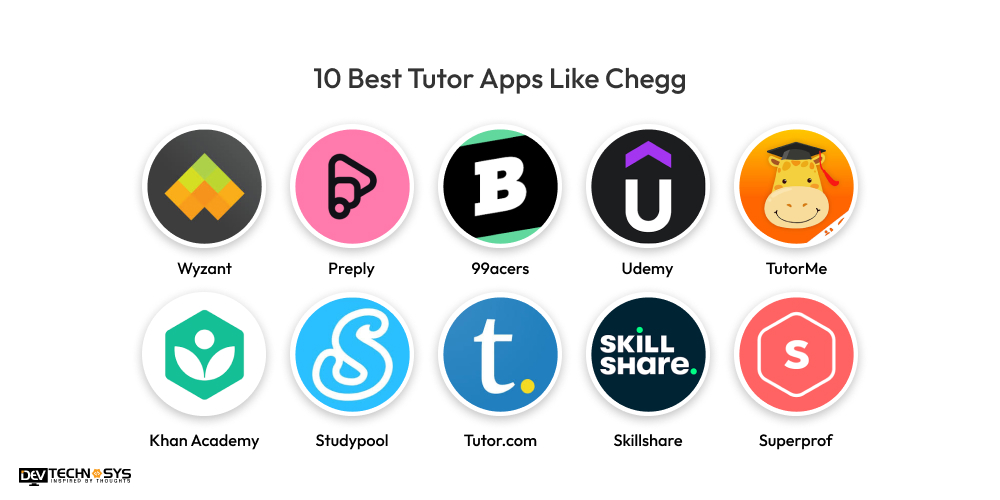
10 Best Tutor Apps Like Chegg
The top online tutoring apps similar to Chegg are listed in this table, along with information on downloads, ratings, year of release, and platform availability:
| Applications | Download Users | Stores Ratings | Apps Launched On | Platform Accessibility |
| Wyzant | 1M+ | 4.7 | 2005 | Android, iOS, Web |
| Preply | 10M+ | 4.7 | 2012 | Android, iOS, Web |
| Brainly | 100M+ | 4.6 | 2009 | Android, iOS, Web |
| Udemy | 100M+ | 4.7 | 2010 | Android, iOS, Web |
| TutorMe | 1M+ | 4.6 | 2014 | Android, iOS, Web |
| Khan Academy | 100M+ | 4.8 | 2008 | Android, iOS, Web |
| Studypool | 5M+ | 4.3 | 2014 | Android, iOS, Web |
| Tutor.com | 10M+ | 4.3 | 1998 | Android, iOS, Web |
| Skillshare | 10M+ | 4.6 | 2011 | Android, iOS, Web |
| Superprof | 10M+
|
4.5 | 2013 | Android, iOS, Web |
Why do Businesses Invest in Tutor App Development?
Businesses invest in tutor app development for a variety of strategic reasons, including meeting the increased demand for online education and individualized learning experiences. Here are five benefits of mobile apps in the education industry:
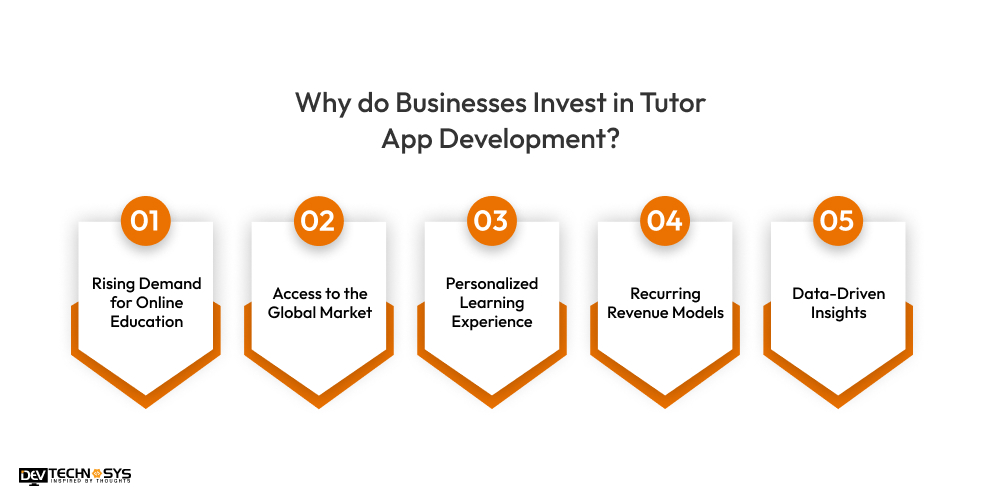
1. Rising Demand for Online Education
The global education sector is quickly adopting digital technologies. With an expanding number of students and professionals seeking flexible learning alternatives, e-learning apps provide a scalable platform to satisfy this need.
Investing in virtual classroom app development allows them to remain competitive in this growing market.
2. Personalized Learning Experience
The similar app like Chegg can give highly individualized education by utilizing one-on-one sessions, adaptive learning algorithms, and customized course materials. This is especially appealing to firms looking to set themselves apart from traditional, one-size-fits-all schooling methods.
Personalized learning improves engagement and outcomes, making it a crucial selling factor for firms focusing on excellent education.
3. Access to the Global Market
With an academic assistance app, businesses may contact students all over the world. Whether K-12 schooling, university-level courses, or professional skills training, online tutoring platforms reach a large global audience.
Investing in tutor finder app development services allows businesses to attract users from many areas, improving their market share and revenue possibilities.
4. Recurring Revenue Models
Similar app like Chegg frequently use subscription-based or pay-per-session structures, generating a consistent stream of recurring money for organizations. Businesses can also generate revenue by offering premium services such as advanced coaching sessions, certificate programs, or unique content. This consistent revenue structure makes investing in study app development a sound business decision.
5. Data-Driven Insights
If you create an app like online tutoring, it can generate valuable user data, such as learning patterns, performance indicators, and preferences. Businesses can utilize this data to continually improve their offers, tailor content, and increase consumer satisfaction.
Data-driven insights can also assist in making educated decisions about app updates, marketing strategies, and content development.
7 Key Steps to Build a Tutor App Like Chegg
To build a tutor app like Chegg in USA, focus on key features: user authentication, tutor profiles, search functionality, scheduling, real-time messaging, and payment integration.
Use a tech stack like React for the frontend, Node.js for the backend, and Firebase for authentication and database management. So, here we offer the tutor mobile app development process:
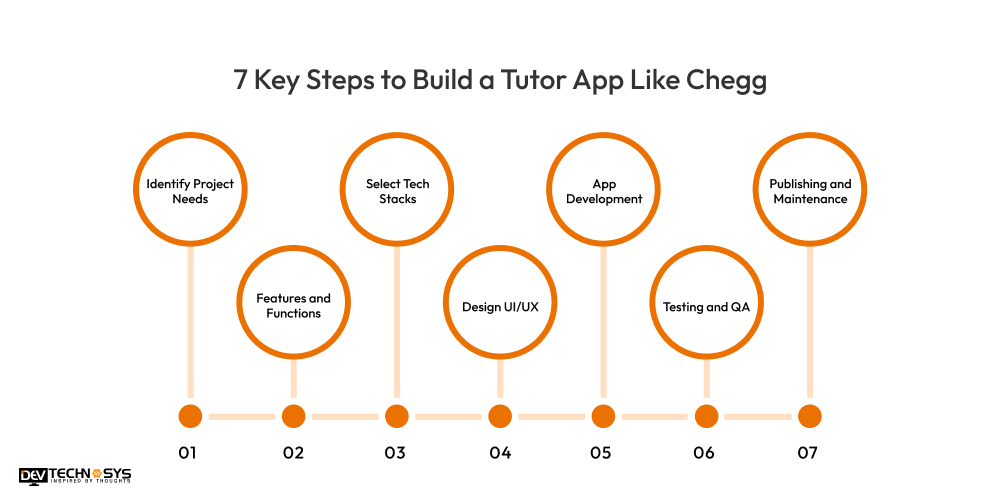
1. Identify Project Needs
Begin by assessing your target audience and defining the app’s core objectives. Understand the market demands, such as the need for real-time tutoring, scheduling features, or study materials. This will guide all subsequent development decisions.
| What are your app’s basic or core requirements? |
| Clear your app’s future goals. |
| Which learning apps are more successful and trending in this competitive market? |
2. Features and Functions
List essential features like live chat, video calls, payment integration, tutoring schedules, homework assistance, and progress tracking. Hire dedicated developers to ensure a balance of user-centric functionalities to enhance the learning experience, offering both tutor and student-side functionalities for smooth interaction.
| What are your app’s basic or premium features and functions? |
| Observe the existing online tutor platforms for the best features. |
| Make an organized sheet of features and functions to reduce data redundancy. |
3. Select Tech Stacks
Choose the right technology stack for both front-end and back-end development. Popular choices include React or Flutter for the front end, Node.js or Django for the back end, and MongoDB or PostgreSQL for the database. Ensure scalability, security, and performance.
| Which type of tech stacks are used in your Chegg clone app development? |
| Define your scalability requirements. |
| Choose advanced or basic tech stacks. |
4. Design UI/UX
In the fourth stage of development, hire mobile app developers to design an intuitive and user-friendly interface that’s easy for both tutors and students to navigate. Prioritize simplicity and accessibility, making sure the design is responsive across devices. Focus on interactive elements, smooth navigation, and engaging visuals for user retention.
| What are wireframes in UX design? |
| What tools do you use for prototyping? |
| How do you ensure a responsive design? |
5. App Development
Develop the app by dividing it into manageable modules like user profiles, chat functionality, scheduling systems, and payment gateways. Use Agile development practices to build iteratively, integrating features one by one. Prioritize performance and bug-free functionality.
| Do you want to create hybrid or native apps? |
| Choose highly talented mobile app developers. |
| Integrate a high number of features and functions. |
6. Testing and QA
Perform comprehensive testing to identify bugs, errors, and usability issues. This includes functional testing, security audits, performance checks, and user acceptance testing (UAT). Ensuring the app works smoothly across different devices and operating systems is critical for user satisfaction.
| Make sure that all features and functions are working properly |
| Use various testing methods, such as functional and usability testing. |
| Check the app’s security measurements. |
7. Publishing and Maintenance
Once thoroughly tested, hire mobile app development company to publish the app on platforms like Google Play and the App Store. Post-launch, continuously monitor app performance, fix bugs, release updates, and gather user feedback for future improvements. Regular updates are key to long-term success and engagement.
| Publish your app on selected platforms like Android and iOS. |
| Use the best marketing techniques. |
| Assign the post-maintenance phases to maintain the app’s performance. |

10 Basic and Premium Features of Tutor Apps like Chegg
Tutoring platforms like Chegg are intended to make learning more accessible and efficient. Here are ten features commonly found on such platforms:
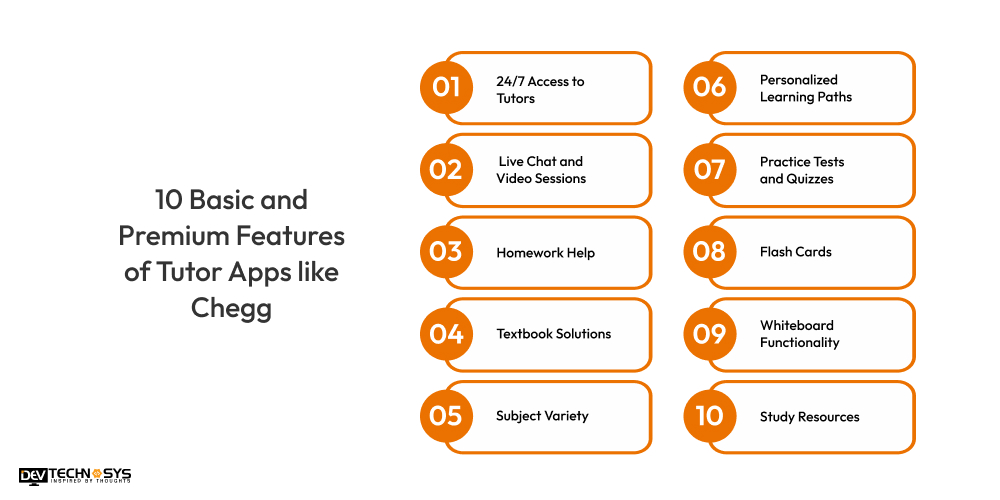
1. 24/7 Access to Tutors
These apps frequently provide round-the-clock access, guaranteeing that students may receive assistance whenever they need it, regardless of time zone.
2. Live Chat and Video Sessions
Chegg alternatives allow students to conduct real-time chats with tutors using interactive elements such as text chat or video conferencing for individualized instruction.
3. Homework Help
If you develop an online tutoring platform, students can submit homework questions or issues and receive step-by-step answers, making learning easier.
4. Textbook Solutions
Chegg clone apps in United States contain solutions to issues found in major textbooks, as well as thorough, solved examples for students to work on.
5. Subject Variety
Study assistance apps offer a wide range of disciplines, from mathematics and physics to humanities and computer programming, to meet diverse learning needs..
6. Personalized Learning Paths
Some apps provide individualized tutoring sessions based on a student’s progress, allowing them to focus on areas for growth.
7. Practice Tests and Quizzes
Top tutor apps to use practice exams to assist students in preparing for standardized assessments or evaluate their comprehension of the topic.
8. Flash Cards
To improve memory recall, applications provide personalized flashcards that can help students efficiently review subjects.
9. Whiteboard Functionality
Online tutoring services allow educators to visually illustrate concepts, making difficult ideas more understandable.
10. Study Resources
Chegg alternatives offer access to articles, notes, and study guides, giving users a vast collection of information to supplement their learning.
What is the Cost to Build a Tutor App Like Chegg in USA?
The cost to develop a tutor app like Chegg can cost anywhere from $8,000 to $25,000 or more, depending on criteria such as feature complexity, platform (iOS, Android, or both), and developer location. Key expenses include design, backend infrastructure, user interface, video chat integration, payment systems, and content management features.
Additional fees may apply for sophisticated features such as AI in the education industry, scalability, and ongoing maintenance. A customized system with high-end features and security can increase the Chegg app development cost.
| Tutor App Development | Estimated Cost | Time Frame |
| Basic App Development | $8000 – $12000 | 2 to 6 Months |
| Mid-Premium App Development | $14000 – $19000 | 6 to 8 Months |
| High-Premium App Development | $25000+ | 9+ Months |
5 Significant Factors That Affect Tutor App Development Cost
The cost to develop an Uber like app for tutors is influenced by factors such as platform (iOS/Android), features (live chat, video calls, payment integration), design complexity, developer expertise, location, and app maintenance.
Additional costs may arise from security measures, third-party integrations, and scalability for future updates or expansion.
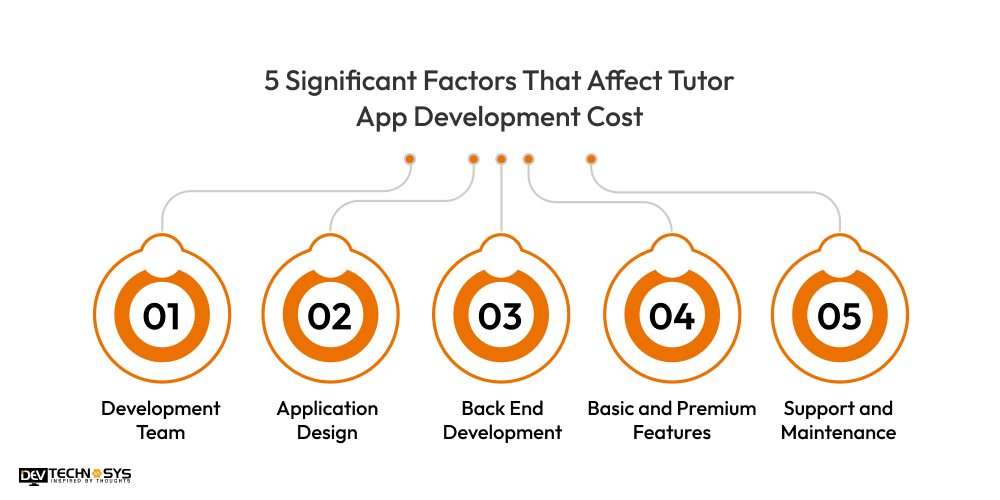
1. Development Team
The development team’s size, competence, and location can all have an impact on the cost. Experienced developers in locations such as the United States and Europe charge greater rates than developers in countries with cheaper labor expenses. Furthermore, having a full-stack team (designers, developers, and testers) vs. a smaller team will influence the cost to develop an app like Chegg.
| Developer’s Experience Level | Cost Estimation |
| Entry-Level Developer | $15 – $18/ Per Hour |
| Mid-Level Developer | $18 – $22/ Per Hour |
| Senior-Level Developer | $25+ / Per Hour |
2. Application Design
The complexity and quality of design have a substantial impact on development costs. Custom, user-friendly, and intuitive interfaces need more effort, which increases the cost of the design process. High-end features such as animations, UI/UX optimization, and responsive layouts raise prices, but simpler designs can reduce the overall development cost.
| Design Quality | Cost Estimation |
| Basic Design | $8,000 – $12,000 |
| Complex Design | $15,000 – $22,000 |
3. Back End Development
It is critical to have a solid backend capable of handling user data, payments, video calls, and real-time interactions. Scalability, security, and cloud infrastructure are examples of more complicated systems that take more time and resources to implement. A well-optimized back-end can provide smoother performance, but it costs more to build an app like Chegg due to technical skills and infrastructure requirements.
| Backend Development | Cost Estimation |
| Basic Backend Process | $10,000 – $18,000 |
| Premium Backend Process | $20,000 – $28,000 |
4. Basic and Premium Features
Basic features such as texting and homework help are less expensive to deploy. However, additional features such as live video tutoring, real-time whiteboards, AI-powered assessments, and tailored learning routes raise both development time and expenses. More complex features necessitate greater skill and resources, elevating the overall education app development cost.
| Features | Cost Estimation |
| Core Features(User Profiles and Real-Time Chat) | $8,000 – $10,000 |
| Advanced Features(Interactive Whiteboard and Practice Tests & Quizzes) | $13,000 – $19,000 |
5. Support and Maintenance
Post-launch support and monthly maintenance, such as bug fixes, software updates, and app scaling, incur continuous costs. Apps with heavy traffic require frequent updates, security patches, and performance improvements, which raises operational costs to create an app like Chegg. Long-term maintenance promotes smooth operation but necessitates consistent funding commitment.
| Maintenance Phase | Cost Estimation |
| Simple Maintenance Phase | $2,000 – $4,000/year |
| Complex Maintenance Phase | $7,000 – $9,000/year |

How do You Make Money From a Tutor App Like Chegg?
Making money with tutoring apps like Chegg requires a number of monetization tactics that may be customized to the platform’s capabilities, target audience, and market demand. Here are five excellent methods for generating revenue:
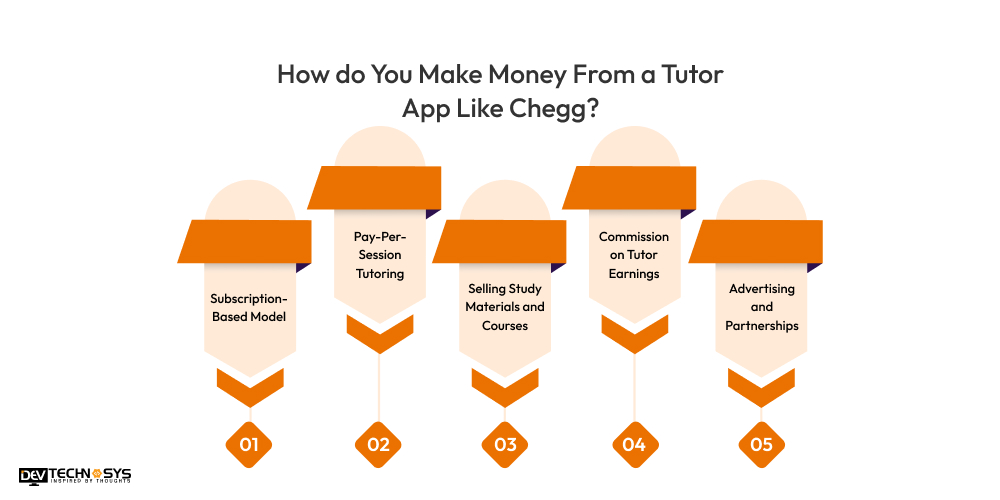
1. Subscription-Based Model
Chegg’s key services are delivered through a subscription model, with customers receiving access to study resources, textbook rentals, and online tutoring. This approach assures a consistent stream of revenue by charging consumers a recurring charge for ongoing access to educational content and tutoring sessions.
2. Pay-Per-Session Tutoring
Another revenue stream is pay-per-session tutoring, in which students pay for each tutoring session they schedule. This provides flexibility for consumers who may require one-time experiences rather than a full subscription. You may charge a price depending on session length, instructor expertise, or subject complexity.
3. Selling Study Materials and Courses
You can also offer access to premium study materials, courses, and practice tests through the app. According to the Android app development company, this strategy is incredibly profitable, especially if you create exclusive, high-quality information that appeals to people studying for specific examinations or certifications.
4. Commission on Tutor Earnings
As a platform, you can receive a percentage commission for each tutoring session or service provided. Tutors, for example, can set their own hourly rates, and the platform will receive a part of the cash. This strategy encourages the platform to attract talented tutors while ensuring a steady stream of cash from their services.
5. Advertising and Partnerships
Advertising and partnerships in an educational app involve collaborating with educational brands, textbook suppliers, or universities to display ads or promote services. You can earn revenue through ad placements, sponsored content, or referral programs while also boosting platform visibility and credibility through strategic partnerships.
Conclusion
Building a smart tutor app like Chegg requires a clear business model, a user-friendly interface, and robust features such as live tutoring, payment integration, and resource sharing. Focus on scalability, security, and engaging user experiences. With proper planning, development, and marketing, you can create a successful educational platform that meets students’ needs while generating sustainable revenue. If you want to create a tutor app like Chegg, connect with the best tutor app development company to offer futuristic development solutions.
Frequently Asked Questions
Q1. How Much Does It Cost To Build a Tutor App Like Chegg in Houston, USA?
The cost to create a tutor app like Chegg ranges from $8,000 to $25,000, depending on features, platform (iOS/Android), design complexity, development team location, and additional costs for maintenance and marketing.
Q2. How Much Time Does It Take To Make a Tutor App Like Chegg?
To make a tutor app like Chegg in San Francisco, it basically takes 3 to 6 months, depending on the complexity of features, platform (iOS/Android), design, development resources, and testing. Customization and scalability can extend the timeline.
Q3. Is There Any Other Platform Like Chegg?
Yes, platforms like Tutor.com, Wyzant, Preply, Skooli, and SuperProf offer similar services to Chegg, providing online tutoring, study resources, and academic support.
Q4. How Do I Monetize a Teaching App Like Chegg?
You can monetize a homework assistance app like Chegg through subscription plans, pay-per-session tutoring, commission on tutor earnings, in-app ads, selling study materials, and partnerships with educational institutions or textbook providers.
Q5. What Features Should Remote Learning Apps Like Chegg Have?
Essential features include user profiles, live video tutoring, chat capability, payment integration, ratings/reviews, tutor search filters, subscription administration, and study resources. Advanced features could include AI-powered tutoring or a question-and-answer forum.
Q6. How to Reduce the Tutor App Development Cost in United States?
To reduce tutor app development costs, focus on essential features, use open-source libraries, choose a cross-platform development framework, outsource to affordable regions, and prioritize a minimal viable product (MVP) approach.