













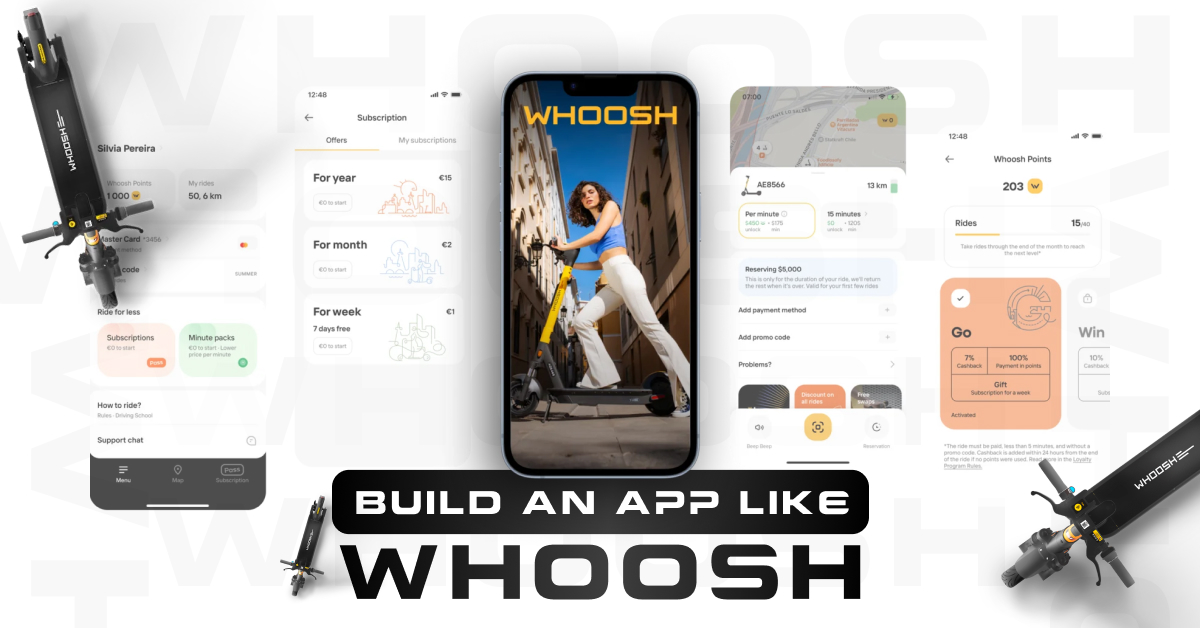
One way of travelling around the city differently and a lot faster, which also helps the environment, is by renting an electric scooter through a simple app such as Whoosh, which results in urban mobility changes.
The micro-mobility market, which is globally on the rise, has attracted the attention of entrepreneurs and businesses who are willing to build scooter-sharing platforms of their own. The key things for the app, like Whoosh, are the factors of a user-friendly interface, on-the-spot GPS locating, cashless transactions, IoT implementation, and a dependable organization of vehicle management.
It is quite essential to know the whole Whoosh development process if you know nothing about it and are a startup that wants to enter the mobility market, and apart from that, you are an enterprise that is looking to diversify.
In this blog, we intend to teach you the essential features, technology stack, cost, and step-by-step approach to build an app like Whoosh, which will be high-performing and in demand by users. Let’s go!
Why Do Entrepreneurs Want to Build an App Like Whoosh?
Those willing to invest in e-scooter app development that serves to reduce urban pollution, like the representative Whoosh, are asking themselves the question, as entrepreneurs, about whether to build an app like Whoosh.
Factors such as the need for clean transit in the city, low operational costs, and high scalability have contributed to the formation of this business model. Here is a list of the top reasons behind the choice of entrepreneurs’ behavior towards investing in the field of e-scooter rental apps like Whoosh.
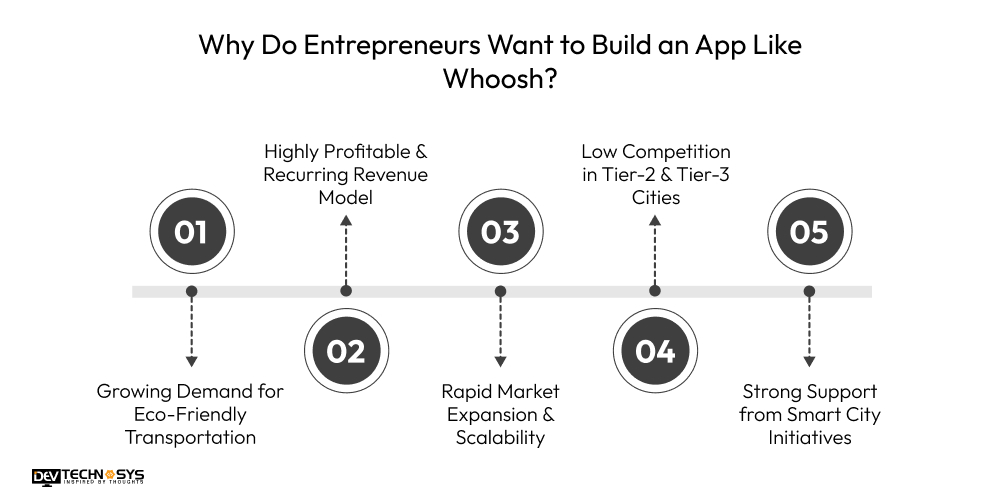
1. Growing Demand for Eco-Friendly Transportation
Worldwide, cities are advocating the use of sustainable and pollution-free modes of transport. Electric scooters are an ideal way for car and bike users to follow this trend because they offer a clean alternative to the already known vehicles.
Entrepreneurial minds perceive this trend as an endless source of business because governments and users will be their reliable fans of clean transportation solutions.
2. Highly Profitable & Recurring Revenue Model
EV charging station finder app development solutions generate revenues through user charges, subscription plans, price surging, and B2B partnerships.
After the fleet establishment, the operational expenses can be kept under control, and the income generated from each ride will be a steady, recurring one. The huge potential for a strong revenue stream is the main factor why this type of business is so attractive.
3. Rapid Market Expansion & Scalability
Their business model makes electric scooter rental platforms highly scalable. Entrepreneurs can start by working in one local community area and then extend their activities to twenty other neighborhoods, and start working in cities or even countries, where they can simply upgrade their fleet and software. The business model ensures that their expansion will be fast and without large infrastructure investment.
4. Low Competition in Tier-2 & Tier-3 Cities
While big cities have more competition, the smaller ones still lack sufficient service. Entrepreneurs are willing to start an e-scooter rental business in those areas because they know that the demand for fast and cheap means of transport is huge in places where public transport is limited. A local app similar to Whoosh can easily take over these markets.
5. Strong Support from Smart City Initiatives
Governments around the globe are backing up our future with smart mobility projects that are less of a hassle and more eco-friendly. Electric scooter rentals are a great idea in that regard.
On their part, entrepreneurs are attracted by the presence of regulations supporting them, the availability of government grants, and partnerships with shopping malls, business parks, and tourist locations, which all facilitate launching and scaling up ventures.
5 Stages to Build An App Like Whoosh
Hooray, the time has come to build an app like Whoosh with essential development stages. In this guide, we have covered a step-by-step process of building Whoosh development by experts only.
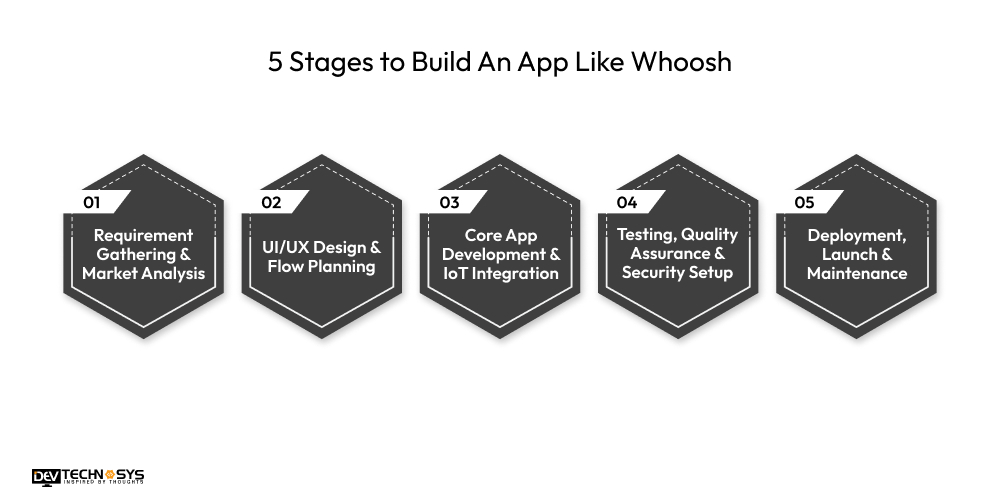
1. Requirement Gathering & Market Analysis
The journey to e-scooter or car rental app development starts with understanding the business model, including fleet size, operational zones, monetization strategies, and the target audience.
To get an idea of the mandatory features and the market segment that is not yet discovered, the scooter rental app development in Australia conducted customer research, including competitors such as Whoosh, Lime, and Bird.
They also clarify your technical requirements for IoT integration, GPS tracking, battery monitoring, and smart lock compatibility. This stage helps set the roadmap in perfect harmony with your business vision.
2. UI/UX Design & Flow Planning
Once the requirements are in place, the design team develops an intuitive interface that reflects the simplicity and speed of apps such as Whoosh. They prepare wireframes, user journey maps, and high-fidelity screens to visually represent the entire app flow.
The work is focused on easy navigation, untroubled booking, map visibility, and simple payment steps. They aim to provide a seamless rider experience that increases app usage, as this is lacking in the market.
3. Core App Development & IoT Integration
In the third step to build an app like Whoosh, backend and frontend development begin. Hire programmers from an Android app development company to write the code for the user and admin apps for the main features.
It includes scooter availability tracking, QR code-based unlocking, real-time GPS tracking, ride history, payment gateways, push notifications, and user authentication.
At the same time, IoT devices are installed on each scooter to enable location sharing, battery monitoring, locking/unlocking, and anti-theft functionality. A dependable tech stack and scalable architecture are key to good performance under heavy load.
4. Testing, Quality Assurance & Security Setup
A Whoosh-like platform should not only be dependable but also demand top-notch security measures. QA professionals test the app through a gauntlet of tests that cover functional, performance, usability, and security.
They also mimic real-life scenarios with weak GPS, heavy traffic, and fluctuating battery levels to test whether the app behaves stably. Every aspect of payment security, including encryption, OTP verification, and fraud prevention, is carried out with the utmost care to ensure the safety of transactions and data handling.
5. Deployment, Launch & Maintenance
In the last scooter rental app development process, when an application is finally given a green light after all testing phases, it is then released on Android, iOS, and backend servers.
The automotive software development team not only helps with app store approvals, launch plans, and user onboarding but also post-launch support, which includes maintenance, fleet analytics, bug fixes, feature upgrades, and performance optimization, etc., to maintain the smooth functioning of a platform like Whoosh. The regular updates pave the way for improved stability, user satisfaction, and scalability aligned with your business growth.
Top 7 Alternatives of Whoosh
Here is the list of amazing alternatives to Whoosh, which you must know about if you want to build an app like Whoosh. Having a list of incredible alternatives to Whoosh, which you must get your hands on.
1. Bird:
Starting its activity in 2017, Bird is an international leader of micromobility with a presence in 350+ cities worldwide. Users speak highly of the availability of scooters and the green transport model; however, they also indicate that the quality of service varies depending on the local regulations and the city’s support.
2. Lime:
Lime, which was established in January 2017, provides dockless electric scooters, e‑bikes, and mopeds in 200+ cities across 30 countries. Apps like Lime are very popular apps on both Google Play and App Stores in terms of the number of downloads and positive user feedback, which is attributed to their extensive reach and ease of use.
3. Spin:
Spin, initially launched around 2016, offers the ease of access to shared electric scooters and bikes through a smartphone app, which is usable in numerous urban areas.
It is a good performer in terms of reliability and accessibility; thus, a strong option if you are looking for a well-known, globally operating alternative, is the feedback it receives.
4. Bolt
Bolt, a multi-modal platform for ride-hailing and scooter-sharing operations in over 600 cities worldwide, is gradually extending its line of services with e-scooter rentals alongside taxis, cars, and delivery.
The app is very popular among users, as evidenced by the number of its downloads, and is highly convenient and appreciated for its multipurpose mobility offerings.
5. Martı
Established in 2018 (service started 2019), Martı is a provider of scooter, moped, and mobile rental services mainly across Turkish cities. It is rated reasonably on the application markets and is regarded as a solution that offers cheap and convenient rides in cities.
6. Helbiz
Helbiz was founded in 2015 and started launching its scooter-sharing services around 2018. It offers dockless scooter sharing in several cities across Europe and North America. Its flexibility and coverage are liked by the users, even though the availability depends on the local regulations of each city.
7. Voi
Voi is a European micromobility app and is often referred to as one of the best e-scooter platforms. It’s an excellent alternative for cities where it operates. The company is known for providing a smooth urban ride experience and strictly adhering to regulations. Users in regions supported by Voi give it high ratings for customer experience.
Want a chatbot demo or pricing? Fill the form and talk to our experts today.
Pick what you need below — you can select more than one — then tap Get detail to continue.
-
Chatbot demo dashboard
-
Cost to develop an app
-
Industry report
-
Case study
Case Study
At Dev Technosys, our squad has recently completed the project of a Whoosh-inspired e-scooter rental app. We emphasized real-time ride tracking, secure payments, user-friendly navigation, and robust fleet management for operators while creating a similar solution.
We also included IoT-based scooter connectivity, geofencing, and smart lock/unlock features to make the journey comfortable. Some of the challenges were maintaining accurate GPS, optimizing battery usage, and ensuring app scalability during high traffic.
Though the obstacles were there, our team has been able to bring out a high-quality, high-performance, and scalable mobility solution.
Narayan Das (Delivery Manager)
Essential Features of Electric Scooter Rental App Like Whoosh
Now that you know the process to build an app like Whoosh, having a list of essential features is a must. In this table below, we have covered the electric scooter rental app, Whoosh, with three different panels.
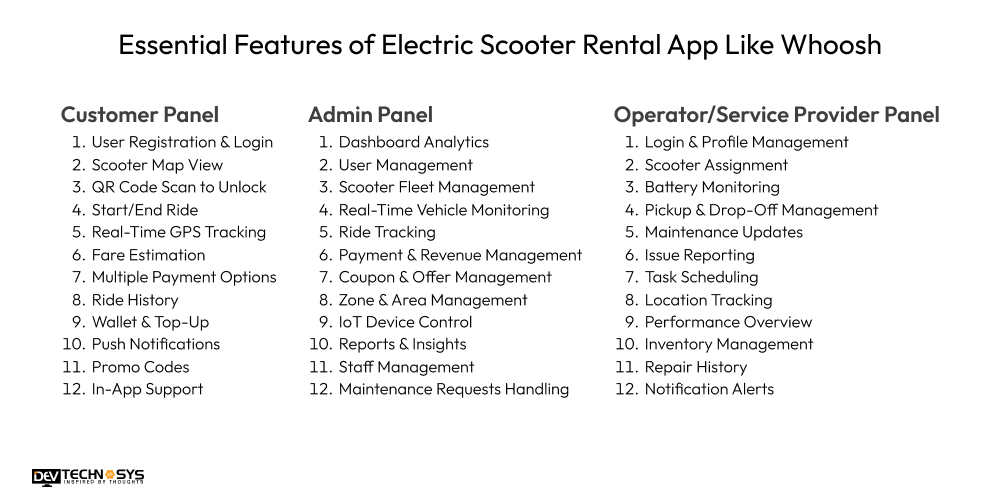
Customer Panel |
Admin Panel |
Operator/Service Provider Panel |
| User Registration & Login | Dashboard Analytics | Login & Profile Management |
| Scooter Map View | User Management | Scooter Assignment |
| QR Code Scan to Unlock | Scooter Fleet Management | Battery Monitoring |
| Start/End Ride | Real-Time Vehicle Monitoring | Pickup & Drop-Off Management |
| Real-Time GPS Tracking | Ride Tracking | Maintenance Updates |
| Fare Estimation | Payment & Revenue Management | Issue Reporting |
| Multiple Payment Options | Coupon & Offer Management | Task Scheduling |
| Ride History | Zone & Area Management | Location Tracking |
| Wallet & Top-Up | IoT Device Control | Performance Overview |
| Push Notifications | Reports & Insights | Inventory Management |
| Promo Codes | Staff Management | Repair History |
| In-App Support | Maintenance Requests Handling | Notification Alerts |
Advanced Functions Of the Escooter App Like Whoosh
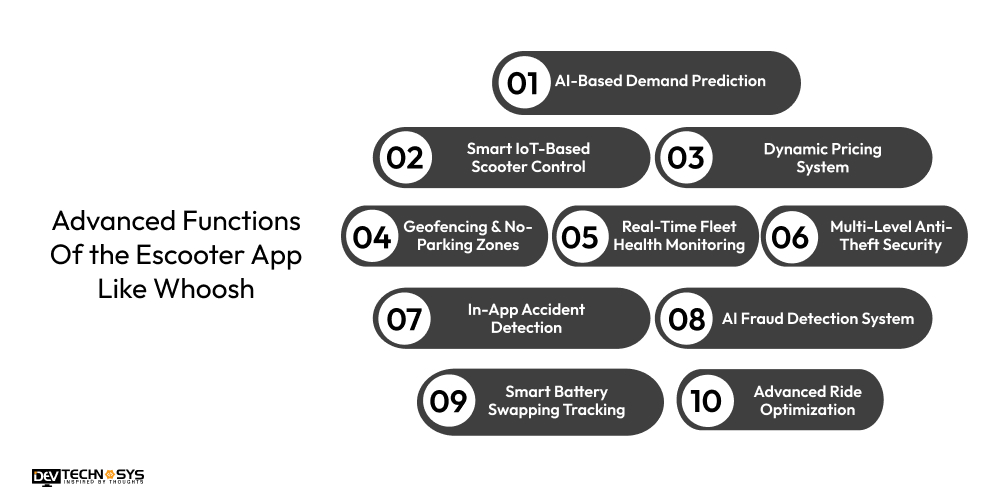
i. AI-Based Demand Prediction
Artificial intelligence algorithms are used to predict locations and hours of high demand. This helps in optimizing fleet distribution, reducing shortages, and increasing daily rental revenue without much effort.
ii. Smart IoT-Based Scooter Control
It allows remote operations such as locking, unlocking, battery checking, and turning on anti-theft alerts through real-time IoT. The technology is seamlessly integrated into the scooter’s system.
iii. Dynamic Pricing System
The company sets ride prices through a fully automated system that considers various factors. Such factors include demand, time, location, special events, and the availability of the fleet. The goal is to maximize profits and increase user satisfaction.
iv. Geofencing & No-Parking Zones
Whoosh alternatives are used to locate areas that are off-limits and areas that are slow-speed zones. It also determines the boundaries of parking to help riders park at the right spot, prevent the misuse of e-scooters, and ensure compliance with city regulations.

v. Real-Time Fleet Health Monitoring
Top e-scooter apps monitor battery levels on scooters, the hardware, the performance of the ride, and any faults that might be present. This information can be used by operators to set up the appropriate time for the maintenance of their scooters and also to help in reducing breakdowns.
vi. Multi-Level Anti-Theft Security
GPS-based tracking is made available to a scooter owner with this technology. Along with automatic alarms, the scooter immobilization feature, and tamper detection are some of the other features that help in preventing the theft of the scooter as well as unauthorized movements of the scooter.
vii. In-App Accident Detection
Uses sensors and ride behavior analytics to recognize incidents, automatically send emergency alerts, and provide riders with instant help if the situation is unexpected.
viii. AI Fraud Detection System
Detects fraudulent activities in the app, account misuse, fictitious payments, and unusual ride paths to keep the business safe and avoid losses of income.
ix. Smart Battery Swapping Tracking
Whoosh clone apps enable battery swapping and charging of scooters to be done efficiently by the operators, who can also assign tasks and check if the scooters are in good working condition for the riders during the rush hours of the day.
x. Advanced Ride Optimization
The system collects data such as rider habits, speed, weather, and traffic information to offer more comfortable navigation and safer riding routes with the help of the most recent guidance available in real-time.
You can reach out anytime; we are available 24/7. Our team provides a quick response.

How Much Does It Cost to Build an App Like Whoosh: An Electric Scooter Rental App
The cost to develop an app like Whoosh ranges from $8,000 to $30,000 or more. The electric scooter rental app development cost widely depends on various factors in the electric scooter app development in UK.
These types of applications entail installing sophisticated features such as real-time GPS tracking, mobile payments, an admin interface, and scooter locking technology, among others. Below are the key factors that influence the final cost to create e-scooter sharing app.
Factor |
Approx. Cost Range |
| Basic App Features (login, QR unlock, tracking, payments) | $3,000 – $7,000 |
| Advanced Features (IoT, geofencing, subscriptions, multi-city) | $5,000 – $12,000 |
| Platform Choice (Android / iOS / Both) | $2,000 – $6,000 |
| Backend & IoT Integration | $4,000 – $10,000 |
| UI/UX & Map Interface | $1,500 – $4,000 |
| Development Team Cost (Region & expertise) | $1,500 – $6,000 |
1. App Features & Complexity
Feature quantity and complexity have the greatest influence on expenditure. A basic version may include user registration, QR-based scooter unlock, trip tracking, payments, and ride history.
Advanced features of an app, such as geofencing, dynamic pricing, subscription plans, IoT communication, and multi-city operations, add up to the total cost to build an app like Whoosh.
2. Platform Selection (Android, iOS, or Both)
The decision regarding the platform has a direct impact on the cost to develop a mobile app. Developing an app for a single platform is less expensive, whereas the creation of native apps for both Android and iOS will double the work.
The utilization of cross-platform frameworks may help in reducing electric scooter rental app development costs; however, these frameworks may not support heavy GPS or IoT features as efficiently as native apps.
3. Backend Infrastructure & IoT System
The necessity of a solid backend to help with managing scooter availability, user activity, payments, battery levels, and real-time ride data cannot be overemphasized.
Adding to the Whoosh app development cost of IoT is the architectural design, since the scooter’s hardware module has to communicate continuously with the server.
To provide users with stable connectivity, live map tracking, and admin control, the company has to make a significant investment in the backend of scooter rental app development in the USA.
4. UI/UX Design & Mapping Interface
A clean, intuitive, and user-friendly design not only improves the user experience but also lengthens the development time considerably. The skilled designers needed to create interactive maps, smooth navigation flows, visually appealing screens, animations, and branding components, which adds to the overall cost to create a mobile app for e-scooter rental.
5. Development Team Location & Expertise
The place of your Escooter app development company and their level of experience also have a very significant impact on the electric scooter rental app development cost.
A team with a proven record of requirements such as IoT integration, the GPS-heavy app, and real-time systems will, in general, charge more. If you hire a high-cost region, you increase your budget, while an offshore e-scooter app development company can provide you with the same quality at a lower cost to build an app like Whoosh.
How Does an App Like Whoosh Make Money?
If you’re an entrepreneur, then you must be wondering how to get returns on your cost to develop an app like Whoosh. Here, we have covered how you can monetize from e-scooter rental app development like Whoosh.
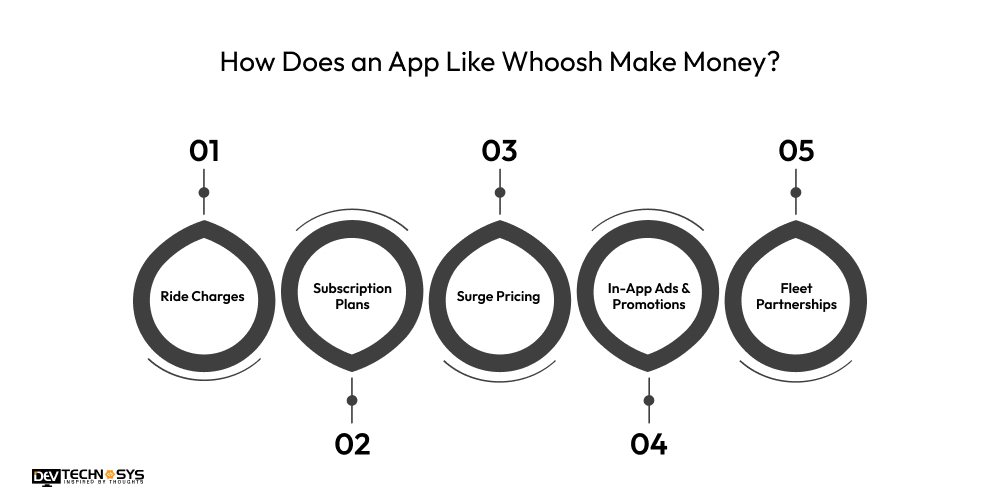
1. Ride Charges
E-scooter on-demand app development solutions mainly make money by charging users per-minute costs and per-ride fees. Travel duration, distance, and unlock fees are the three types of charges that the users will be subject to. These charges turn into steady revenue when more riders choose to use e-scooters for short commutes, daily travel, and quick local errands.
2. Subscription Plans
The regular mode of payment is a good platform to grow your e-scooter app business, such as those offered by Whoosh clone apps, which offer (weekly or monthly) subscriptions that reduce per-ride costs for frequent users.
These memberships bring in predictable recurring income while at the same time they encourage users to go on the scooters more, hence increasing the overall engagement and the long-term customer loyalty, getting strengthened.
3. Surge Pricing
During peak periods, on festive days, or in high-demand areas, Whoosh alternatives impose dynamic surge pricing. By doing so, the fare can be increased to the maximum when demand is at its highest, thereby increasing the revenue generation potential.
The surge pricing does a lot more than that; it ensures availability, balances fleet usage, and gives the company the opportunity to take more without the customer having to pay more upfront.
4. In-App Ads & Promotions
Some e-scooter app developers, on the one hand, might choose to advertise; on the other hand, they could collaborate with brands to display targeted ads, offer deals, or promote nearby businesses.
As a result, this generated advertising money is an income stream that does not require any price increment for the rides. According to the mobile app development company, partner campaigns also support the advancement of apps through strategic, mutually beneficial collaborations.
5. Fleet Partnerships
By collaborating with various facilities such as malls, resorts, corporate parks, and tourism spots, companies can deploy exclusive scooter fleets. These B2B deals through leasing, maintenance contracts, and shared profits are a source of stable revenue for the company.
On one hand, these partnerships lead to the expansion of the app user base; on the other hand, they reduce the dependence on individual rides for income.
How Dev Technosys Can Help You Build an App Like Whoosh?
Dev Technosys is a box of Innovation, strategy, and future mobility solutions that enable your e-Scooter rental business idea to achieve the goal of turning it into a business venture. We support you in designing a smooth ecosystem where travelers take advantage of easy trips, companies open up new sources of income, and urban areas progress towards eco-friendly means of transport.
At Dev Technosys, we are with you in every step of your journey, from the user flow to business operations, branding, and smart mobility experiences, to make sure your idea turns into a leading product in the intelligent-transport world.
So, with the e-scooter rental app development company, you do not only get a simple app but a successful mobility business that is sustainable over time.
Frequently Asked Questions
Find answers to the most common questions related to this article.
The cost to develop an app like Whoosh is generally in the range of $8,000 to $30,000. Various factors, such as features, the complexity of the design, platforms, and real-time GPS or IoT requirements, can influence the cost to develop an app like Whoosh.
To create an app like Whoosh, it requires anywhere from 3 to 9 months. The time mainly hinges on the feature list, mapping system, IoT functions, branding, and overall app complexity.
To make an app like Whoosh, opens up possibilities for urban mobility issues with a clean transport solution of the future, bringing in a steady income, and having the potential to scale rapidly, which makes it a profitable business venture ready for the future.
Indeed, these applications are very scalable. There is an option for you to expand from local to several cities by escalating your scooter fleet, changing geo-zones, and setting up access rules in the admin system.
They make money by ride charges, subscriptions, surge pricing, in-app ads, and partnerships with corporate parks, malls, and tourist zones, thus providing various sources of income and ensuring business sustainability and continued growth.