



















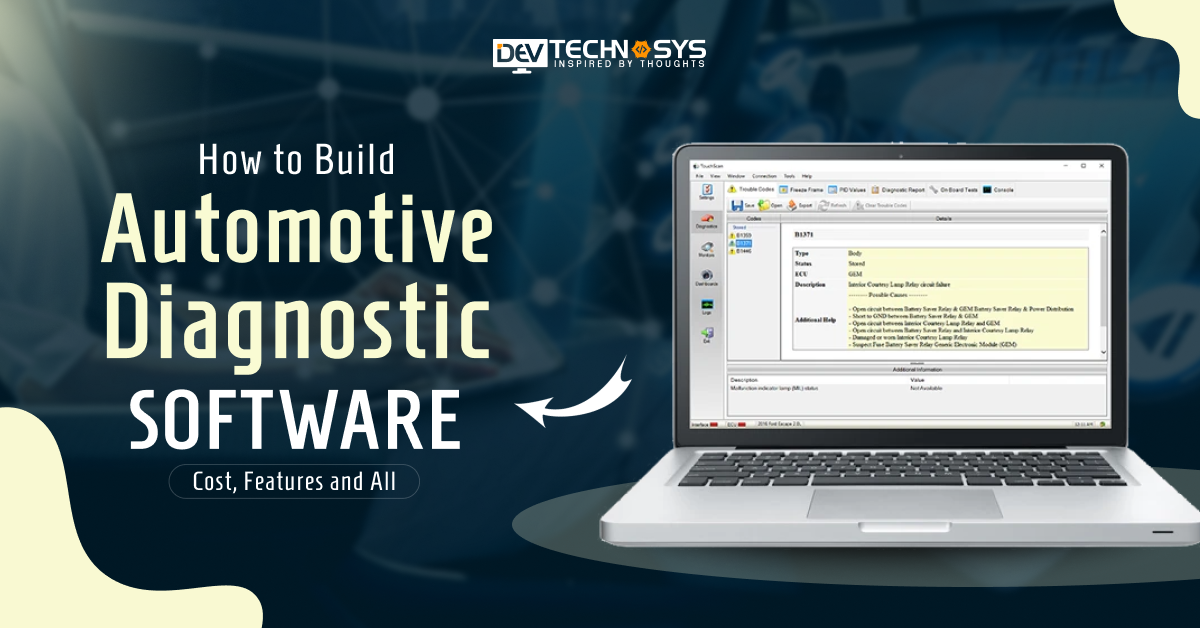
Nowadays, all vehicles are fully electronic-based, from acceleration sensors to gear shifting; all these are electronic. If any problem occurs in the vehicle, then automotive diagnostic equipment is plugged into the vehicle’s OBD socket to read out errors and solve them.
For every mechanic that runs a larger workshop, the automotive diagnostic software provides advantages such as finding accurate diagnoses, focusing on root errors, and increasing repair efficiency.
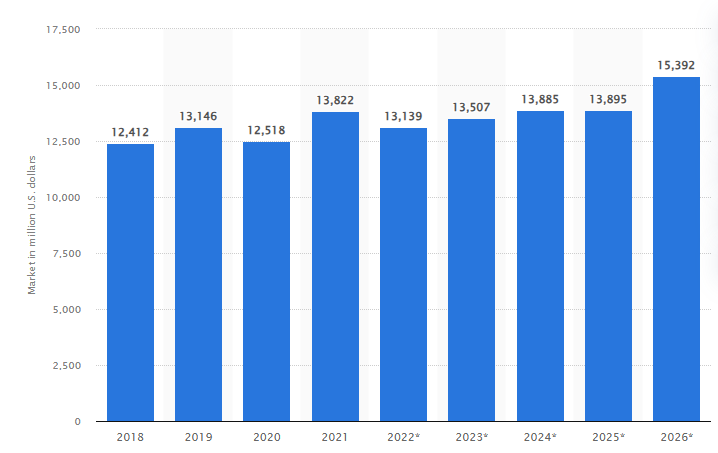
According to the global market, the automotive diagnostic software market size was valued at around $33.1 billion in 2022. It is projected to grow around $41.4 billion by the end of 2026 with a CAGR of 4.5%.
This data shows that investing in automotive diagnostic software is the most profitable opportunity for entrepreneurs to drive higher success in this competitive market.
In this blog, we will explore how to build automotive diagnostic software, overall development cost, features, and money-making opportunities.
Let’s go ahead!
What is Automotive Diagnostic Software?
Automotive diagnostic software interfaces with a vehicle’s onboard diagnostic system (OBD) to diagnose and troubleshoot issues. It reads and analyzes error codes, monitors real-time data from car sensors, and assists in detecting issues in various systems such as the engine, brakes, and transmission. It is critical for mechanics and automotive specialists to repair and maintain automobiles efficiently, enhancing performance and lowering maintenance costs. If you build an auto repair shop management software, it is the most profit-generating opportunity for entrepreneurs to grow their businesses.
- Error Code Reading and Clearing
- Real-Time Data Monitoring
- Reporting and Documentation
- Fault Diagnosis
Market Analysis of Automotive Diagnostic Software
- By 2026, the global market for automotive diagnostic scan equipment is projected to have grown from its 2022 valuation of USD 1 billion to USD 41.4 billion.
- As per the recent survey, the automotive diagnostic software market is grow with a compound annual growth of 6% during the forecast period from 2023 to 2026.
- One of the main factors propelling the market’s expansion is the swift electrification of automotive components, especially in passenger cars.
- Population growth, rising needs, and fast urbanization combined with newly developed technologies, enhanced electrical systems, and electronic components.
- According to a study, China holds the largest share of automotive diagnostic software, and it is expected to increase in 2030.
Top 10 Automotive Diagnostic Software
These automobile diagnostic software solutions are vital for efficient and precise troubleshooting since they provide critical insights into vehicle health, allowing for faster repairs and maintenance.
| Software | Special Features | Launched Year |
| Autel MaxiSys | – ECU coding
– Online programming – Comprehensive diagnostics for over 80 brands – Wireless connectivity |
2010 |
| Launch X431 | – Supports 150+ vehicle brands
– Active tests and bi-directional control – Live data streaming – OBD-II protocols support |
2009 |
| Bosch KTS | – Full system diagnostics
– Real-time data logging – Vehicle health reports – Extensive ECU coverage |
2008 |
| Snap-on SOLUS Edge | – Fast vehicle identification
– Detailed DTCs and live data – Intuitive interface – Reliable customer support |
2015 |
| OBD Auto Doctor | – OBD-II code reading
– Real-time data monitoring – Emissions status monitoring – Supports multiple platforms |
2010 |
| Torque Pro | – Customizable dashboard
– Real-time monitoring – Wide OBD-II adapter support – Advanced features |
2013 |
| CarScanner | – Real-time engine data
– Read/clear DTCs – Multiple OBD-II protocol support – Affordable pricing |
2015 |
| BlueDriver | – Wireless OBD-II scanning
– Extensive vehicle coverage – Real-time data monitoring – Advanced diagnostics |
2012 |
| Alldata | – Repair guides and manuals
– Diagnostic codes – Service bulletins – Wiring diagrams |
1986 |
| iCarsoft | – Multi-brand support
– Fast code reading – Vehicle-specific protocols – User-friendly interface |
2003 |
Why Do Businesses Invest in Automotive Diagnostic Software Development?
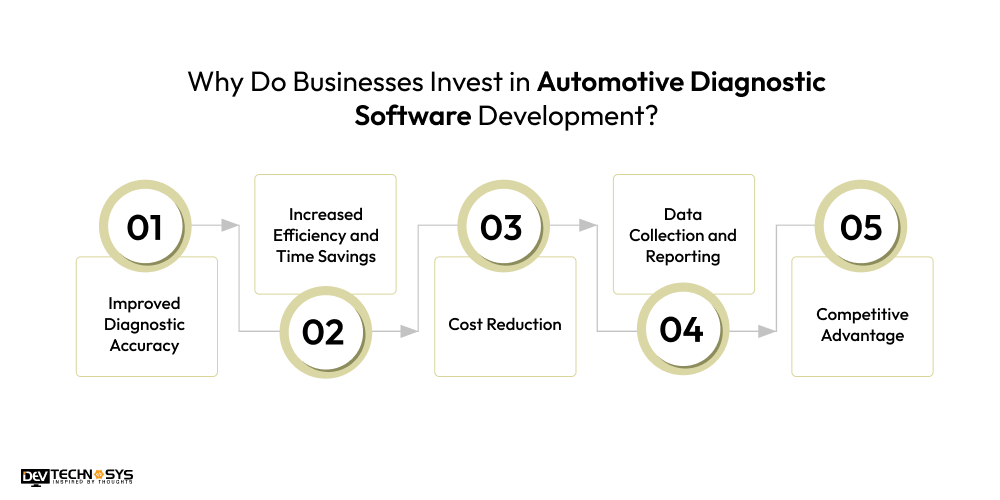
Businesses invest in vehicle diagnostic software development for a variety of reasons, all geared toward enhancing operational efficiency, customer satisfaction, and long-term profitability. Here are five key variables driving this investment:
- Improved Diagnostic Accuracy
- Increased Efficiency and Time Savings
- Cost Reduction
- Data Collection and Reporting
- Competitive Advantage
1. Improved Diagnostic Accuracy
Cloud-based automotive diagnostic software enables firms to accurately identify and diagnose vehicle issues. By interacting with a vehicle’s onboard diagnostic (OBD) system, the software may instantly detect defects, read error codes, and offer real-time information.
This lowers human error and guarantees that mechanics do the correct repairs, thereby enhancing service quality and avoiding misdiagnosis, which can result in costly blunders and customer unhappiness.
2. Increased Efficiency and Time Savings
Diagnostic software automates problem detection, saving mechanics time compared to traditional diagnostic procedures. It helps them identify problems faster by displaying data in an orderly format, allowing for faster repairs. This efficiency enables firms to serve more customers while reducing vehicle downtime, resulting in greater throughput and income.
3. Cost Reduction
Businesses that invest in automotive software development can decrease labor expenses and wasteful part replacements. The software detects specific problems, saving mechanics from doing superfluous repairs and eliminating the costs involved with trial-and-error troubleshooting. Furthermore, organizations can streamline inventory management, ensuring that only the necessary parts are ordered, reducing operating costs.
4. Data Collection and Reporting
Automotive diagnostic software delivers essential information on the vehicle’s health, performance history, and servicing requirements. Businesses can utilize this data to improve maintenance schedules, anticipate probable breakdowns, and provide more tailored services.
The ability to compile complete reports increases customer trust and happiness because clients receive transparent and detailed information about their automobiles.
5. Competitive Advantage
In an increasingly technologically driven automobile industry, providing high-tech services like diagnostics powered by innovative software gives enterprises a competitive advantage. As we discussed earlier with door to door car service app development company, It positions them as industry leaders in terms of service quality and innovation and attracting new clients.
7 Key Steps To Develop Automotive Diagnostic Software
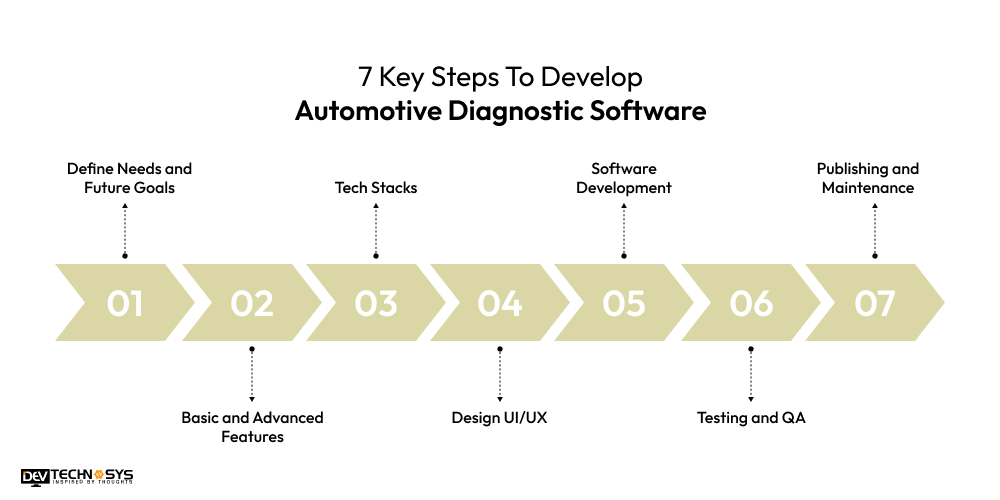
Automotive OBD2 software development with extensive functions follows the advanced development steps that help businesses understand each step and clear their doubts. The below steps include every phase of development, such as designing, integrations, and more. So, here we provide the software product development process:
- Define Needs and Future Goals
- Basic and Advanced Features
- Tech Stacks
- Design UI/UX
- Software Development
- Testing and QA
- Publishing and Maintenance
1. Define Needs and Future Goals
Let’s start the first stage of development, identify the basic requirements and needs, and write in an organized sheet to reduce the confusion. Also, identify the future goals and observe the existing automotive software that helps to understand the working process and what functionalities they offer.
| What are your project’s basic or core requirements? |
| Define your future goals. |
| Which automotive diagnostic software is more successful in this competitive market? |
2. Basic and Advanced Features
Moving to the second stage of development, hire software developers to choose the basic and advanced features that must be integrated into your project. It includes various features such as live data monitoring, ECU programming, wireless connectivity, cloud integration, and bi-directional control.
| What are your project’s basic features and functions? |
| Analyze the popular automotive diagnostic softwares. |
| Make an organized sheet of features and functions to reduce confusion. |
3. Tech Stacks
Tech stacks are one of the most crucial development processes. You need to choose the right technologies for your software development. Various tech stacks are used in different sectors, such as design tools, security, testing, quality assurance, and front-end and back-end languages.
| Which type of tech stacks are used in your app development? |
| Define your scalability requirements. |
| Choose advanced or core tech stacks. |
4. Design UI/UX
Let’s come to the fourth custom software development stage, which includes various types of designing tools, such as Adobe XD and Sketch, to integrate premium themes and templates. Design a user-friendly interface that enables users to easily access all the services and functionalities of software.
| What are wireframes in UX design? |
| What tools do you use for prototyping? |
| How do you ensure a responsive design? |
5. Software Development
In this development stage, assemble a highly skilled development team with expertise in integrating various resources such as third-party integrations, built-in features, models, and modules. This stage mainly focused on the backed processes and creating the server-side functionality.
| How to process backend services? |
| Choose the experienced developers. |
| Implement a high number of features and functions. |
6. Testing and QA
Connecting to the sixth stage of development, there are various software testing services such as functional testing, unit testing, integration testing, and security testing. After that, check the software’s quality and make sure that quality remains the same.
| Make sure that all features and functions are working properly |
| Use various testing methods such as unit and functional testing. |
| Check the software quality. |
7. Publishing and Maintenance
In the last stage of development, hire experienced developers to publish the software to the live phase and ensure that all integrated resources are successfully uploaded. After that, start maintenance services to monitor the overall performance, fix bugs or glitches, and update outdated features.
| Launch your software on the live phase. |
| Use the best marketing techniques to promote the software. |
| Assign the post-maintenance phases to maintain the software performance. |
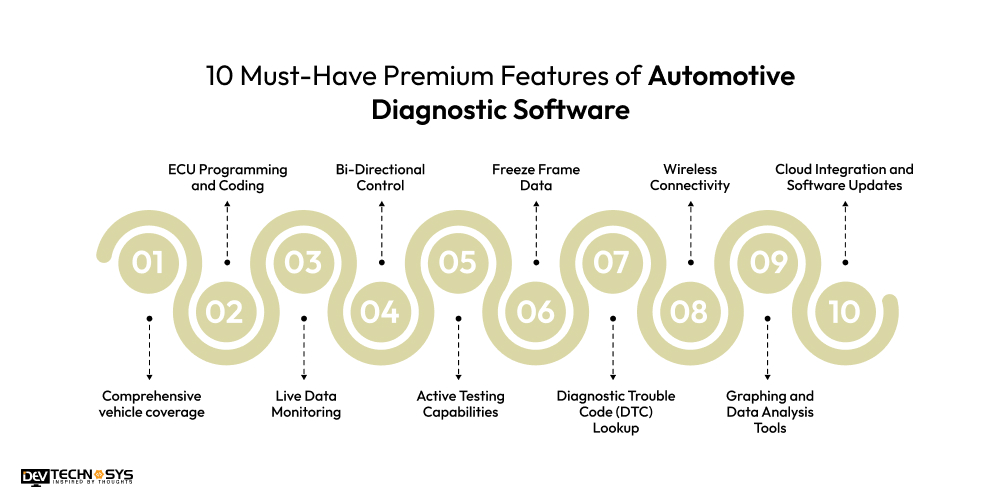
10 Must-Have Premium Features of Automotive Diagnostic Software
Premium automobile diagnostic software has a variety of advanced features that improve functionality, performance, and user experience. Here are ten essential premium features that make this software indispensable:
1. Comprehensive vehicle coverage
Supports diagnostics for a wide range of vehicle makes and models, both local and international, ensuring versatility for any workshop.
2. ECU Programming and Coding
Users can conduct difficult operations such as ECU programming, module coding, and adaption, which enables complex repairs and adaptations.
3. Live Data Monitoring
Real-time data from vehicle sensors, such as engine temperature, fuel level, and tire pressure, enables dynamic monitoring and precise defect diagnosis.
4. Bi-Directional Control
Users can transmit commands to car systems, such as operating the fuel pump or testing ABS brakes, for thorough diagnostics and testing.
5. Active Testing Capabilities
Allows mechanics to run active testing on car components and systems to imitate real-world situations and validate performance.
6. Freeze Frame Data
Captures and shows data from when a failure occurred, allowing personnel to examine vehicle performance in specific settings.
7. Diagnostic Trouble Code (DTC) Lookup
Develop an automotive website that provides extensive descriptions and probable solutions for issue codes, simplifying the troubleshooting procedure.
8. Wireless Connectivity
Provides Bluetooth or Wi-Fi connectivity for remote diagnostics, enabling personnel to work in a comfortable and flexible environment.
9. Graphing and Data Analysis Tools
Real-time data is graphed for simple comparison and extensive analysis, allowing specialists to detect patterns and pinpoint faults more effectively.
10. Cloud Integration and Software Updates
In-vehicle infotainment app offer cloud-based services for recording car histories and automatically updating the software to reflect new vehicle models and diagnostic processes.
The Cost To Build Automotive Diagnostic Software
The automotive software development cost is $8,000 to $25,000 depending on numerous aspects, including the complexity of the features, the number of supported car models, and the platform (mobile, desktop, or cloud). Software development, integration with OBD-II systems, user interface design, and regular upgrades for new vehicle models are all significant expenses.
Additional costs may result from licensing, testing, and security measures. Advanced features, such as ECU programming or live data monitoring, might raise the overall cost because they require specialist knowledge.
Cost to Develop Automotive Diagnostic Software
| Automotive Diagnostic Software Development
|
Estimated Cost | Time Frame |
| Simple Software Development
|
$8000 – $12000 | 2 to 5 Months |
| Mid-Premium Software Development
|
$12000 – $19000 | 5 to 9 Months |
| High-Premium Software Development
|
$25000+ | 9+ Months |
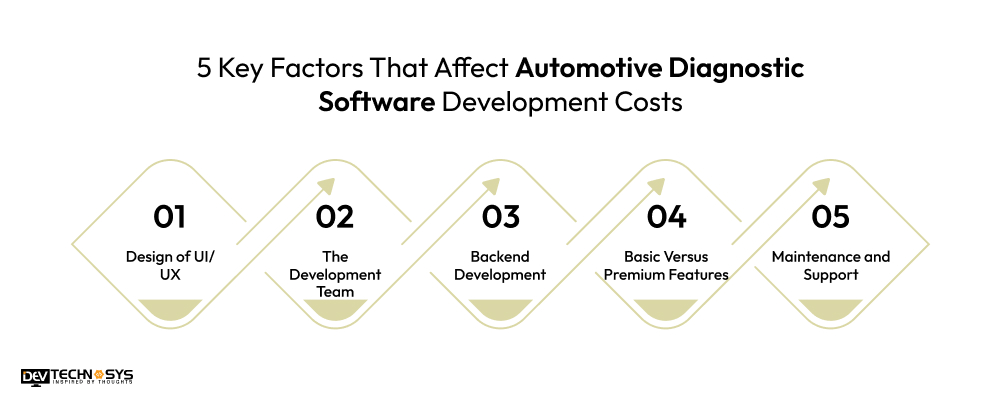
5 Key Factors That Affect Automotive Diagnostic Software Development Costs
To make automotive diagnostic software, a variety of factors might influence the total cost. These include technical knowledge, design choices, backend infrastructure, ongoing maintenance, and feature complexity. Here’s how each element affects development costs:
1. Design of UI/UX
The user interface (UI) and user experience (UX) design are critical to the success of automotive diagnostic software. A clean, intuitive design guarantees that mechanics and technicians can use the software effectively.
Creating a high-quality UI/UX requires lengthy study, testing, and iteration, which might raise automotive diagnostic software development costs.
An intuitive design that is simple to navigate is especially crucial for professionals who require quick and dependable results.
| Design Quality | Cost Estimation |
| Basic Design | $8,000 – $12,000 |
| Complex Design | $15,000 – $22,000 |
2. The Development Team
The cost of the development team contributes significantly to the entire software cost to build automotive diagnostic software. Hiring a team of competent specialists, including developers, testers, and project managers, will inevitably raise the software development cost.
The software’s complexity necessitates professional developers with specific knowledge of vehicle systems and diagnostics. Furthermore, while outsourcing to lower-cost countries may save money, it may compromise project quality and timeline.
| Developer’s Location | Cost Estimation |
| Asia Pacific | $8,000 – $15,000 |
| North America | $15,000 – $20,000 |
| Eastern Europe | $13,000 – $18,000 |
| Western Europe | $16,000 – $25,000 |
3. Backend Development
The backend of automobile diagnostic software consists of a database, cloud infrastructure, and interface with OBD-II or other car communication protocols. A strong backend enables the program to analyze enormous volumes of data from car sensors and diagnostic codes efficiently.
Data encryption, cloud integration, and server management are examples of additional resources required to develop a safe, scalable backend.
| Backend Development | Cost Estimation |
| Basic Backend Process | $10,000 – $18,000 |
| Premium Backend Process | $20,000 – $28,000 |
4. Basic Versus Premium Features
The features incorporated in the program have a significant impact on its pricing. Basic capabilities, such reading fault codes and providing vehicle health reports, are typically less expensive to make automotive diagnostic software. Premium features, such as ECU programming, live data monitoring, bidirectional control, and advanced analytics, necessitate specialist knowledge, longer development times, and more resources.
| Features | Cost Estimation |
| Core Features(Live Data Monitoring and OBD-II Code Reading) | $8,000 – $12,000 |
| Advanced Features(ECU Programming and Coding and Live Data Graphing) | $15,000 – $20,000 |
5. Maintenance and Support
Ongoing maintenance and support are essential to ensure that the software remains compatible with new vehicle models and diagnostic protocols. This includes regular updates, bug fixes, and troubleshooting, which require a dedicated team. Over time, software development and testing for newer vehicle systems will increase maintenance costs.
| Maintenance Phase | Cost Estimation |
| Simple Maintenance Phase | $2,000 – $4,000/year |
| Complex Maintenance Phase | $8,000 – $10,000/year |
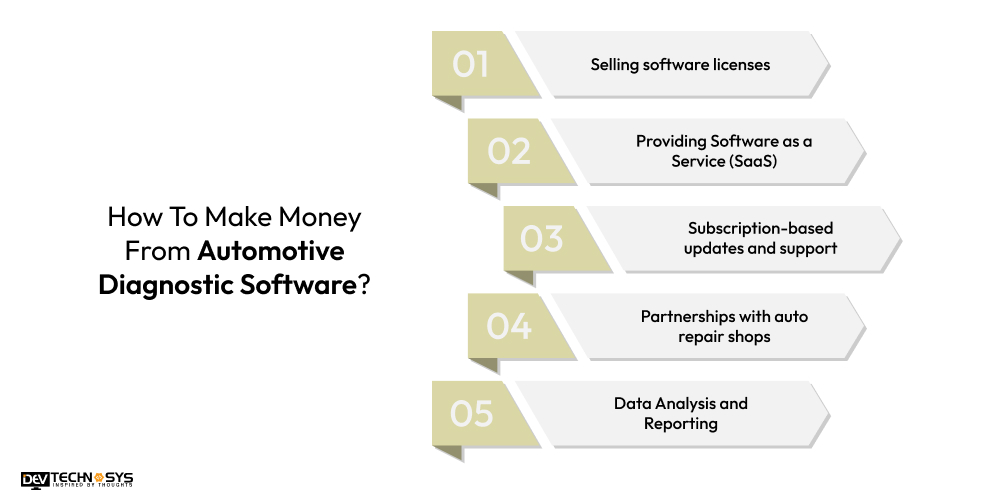
How To Make Money From Automotive Diagnostic Software?
There are various ways to profit from vehicle diagnostic software, whether you’re a developer, service provider, or business owner. Incorporating these methods helps automotive diagnostic software developers and service providers diversify their revenue streams and maximize profits over time. Here are five important strategies for monetizing this software:
- Selling software licenses
- Providing Software as a Service (SaaS)
- Subscription-based updates and support
- Partnerships with auto repair shops
- Data Analysis and Reporting
1. Selling software licenses
One of the most prevalent ways to earn money is by selling software licenses. To gain access to the software, users must pay a one-time price or subscribe to it. You can create several pricing tiers based on features, vehicle coverage, and usage limits.
For example, a basic license may allow limited access to critical functionalities, whereas a premium license may provide complete functionality, such as ECU programming or bi-directional control.
2. Providing Software as a Service (SaaS)
A SaaS approach allows you to provide diagnostic software hosted in the cloud. Customers pay a monthly fee to maintain access to the platform, which includes frequent upgrades and support for new vehicle models.
SaaS provides recurring revenue, which is beneficial to businesses because it ensures consistent cash flow and customer retention. This variant is ideal for vehicle repair shops and mobile mechanics that require regular updates.
3. Subscription-based updates and support
As car technology advances, ongoing updates and support are critical. Businesses can provide their consumers with the most recent vehicle diagnostics by charging for regular software upgrades or offering a subscription-based technical assistance service.
According to the software development company, premium support services, such as priority customer service or technical assistance, can potentially generate significant money.
4. Partnerships with auto repair shops
Collaborate with automotive repair shops, mechanics, and car service providers. You can create revenue through partnership agreements by supplying diagnostic software in conjunction with tools, equipment, or training. You could be compensated for offering access to your software with a commission on service packages, equipment purchases, or monthly software costs.
5. Data Analysis and Reporting
Automotive diagnostic software generates useful information, such as vehicle performance history and failure trends. You can make money by selling anonymized data to manufacturers, insurance companies, or automobile maintenance services. Offering customized reporting or analytics services to automobile businesses generates additional money.
Conclusion
We are standing at the last phase of this blog. We provide detailed information about how to build automotive diagnostic software and why it is a profit opportunity for businesses. We also offer advanced features that help businesses or developers to integrate the features and also provide cost and the factors that affect the overall development.
In today’s era, building automotive diagnostic software is a lucrative opportunity for businesses to grow their business.
To create automotive diagnostic software, reach out to leading automotive software development company to receive cost-effective software development solutions.
Frequently Asked Questions
1. How Much Does It Cost To Build Automotive Diagnostic Software?
The cost to build automotive diagnostic software typically ranges from $8,000 to $25,000, depending on complexity, features, vehicle compatibility, and development team expertise. Advanced features can increase the overall cost.
2. How Much Time Does It Take To Develop Automotive Diagnostic Software?
To create automotive diagnostic software, it can take anywhere from 3 months to 9 months, depending on complexity, features, integration with vehicle systems, and the development team’s experience and resources.
3. What Types of Businesses Benefit from Automotive Diagnostic Software?
Auto repair companies, vehicle service centers, mobile mechanics, and dealerships can all benefit from custom vehicle diagnostic software development. It enables them to easily detect and resolve issues, manage workflows, and increase customer satisfaction.
4. How Do I Monetize Automotive Diagnostic Software?
You can monetize the software through subscription-based models, selling licenses, charging for updates and support, offering SaaS (Software-as-a-Service), or partnering with auto repair shops and vehicle service providers.