














Key Takeways:
The MVP-based DApp development cost is $30,000 to $60,000, while a mid-complexity DApp typically ranges from $60,000 to $80,000. A fully-featured, enterprise-grade DApp can cost $150,000 or higher, depending on blockchain selection, smart contract complexity, integrations, security, and scalability requirements.
Cost Impacted by Project or Development Complexity:
-
- Simple/MVP-Based DApps ($30,000 – $60,000): Include features such as wallet connectivity, basic smart contracts, user profiles, blockchain transactions, token integration, and a simple admin dashboard..
- Mid-Complex DApps ($60,000 – $80,000): Features may include multi-chain support, advanced smart contracts, token swaps, staking mechanisms, decentralized governance, notifications, transaction history, and enhanced user dashboards.
- Complex/Enterprise Applications ($150,000+): Involve functionalities such as complex DeFi protocols, NFT marketplaces, cross-chain interoperability, DAO governance, advanced analytics, automated transactions, oracle integrations, and enterprise-level security infrastructure.
Cost Based on DApp Types:
-
- DeFi DApp: $40,000 to $150,000
- NFT Marketplace: $25,000 to $80,000
- DAO Platform: $18,000 to $45,000
- Blockchain Gaming DApp: $30,000 to $100,000
- Enterprise DApp: $40,000 to $150,000+
Cost Based on Different Regions/Countries:
-
- The DApp development cost in the USA is around $40,000 to $100,000, depending on blockchain architecture, development expertise, security requirements, and project complexity.
- The DApp development cost in Australia ranges from $35,000 to $85,000, depending on smart contract requirements, integrations, and technical infrastructure.
- The DApp development cost in Canada lies between $30,000 to $80,000; the final investment can fluctuate based on functionality, blockchain selection, scalability, and compliance requirements.
Additional Cost:
-
- Maintenance Services: The cost to maintain a DApp is typically around 10% to 20% of the initial development cost annually, covering upgrades, monitoring, bug fixes, and blockchain updates.
- Security & Compliance: Smart contract audits, penetration testing, wallet security, KYC/AML requirements, ISO 27001, SOC 1, SOC 2, GDPR, or CCPA-related controls can increase the overall cost.
According to Business Research Insights, the decentralized application market is valued at around $42.13 billion in 2026. This is projected to hit around $199.7 billion by the end of 2035.
When discussing blockchain, it is impossible not to mention decentralized applications. These are applications built using blockchain technology. They are not managed by a single server but operate on a peer-to-peer basis.
They are highly secure and quick to develop, serving purposes such as trading, purchasing digital assets, and voting, all without the need for a central authority.
But now, many people want to know what DApp development costs are and which factors affect that cost.
So, this blog will answer all your questions, such as which features can be implemented and at what cost, and what you can implement to reduce your dApp’s cost.
What is a DApp?
As for DApps, they are applications that run on blockchain technology rather than being controlled by a single person or organization. They are not ordinary applications; instead, they function like computer programs that share information and data across multiple devices or computers.
DApps are primarily used for shopping, voting, trading, and gaming. They are very popular in the market because they give users greater control, allowing them to use the DApp according to their own preferences.
Planning a Blockchain Project?
Get a tailored development cost estimate in a few simple steps.
- 3 quick steps
- 100% free
- Reply in 1 business day
2 Minutes Read
How Much Does DApp Development Cost in 2026?
To put it simply, the cost of dApp development can range from $30,000 to $150,000. Ultimately, it depends on the client, specifically, the type of dApp they want to build and the services or features they wish to include.
The number of factors can also determine the total cost of DApp development, involving features, blockchain choice, security, backend infrastructure, smart contracts, design, and so on. There are many features, such as AI-powered capabilities, that come at a very high cost, yet they boost the dApp’s popularity and attract users.
Complexity Level |
Estimated Cost (USD) |
Typical Features |
| Basic | $30,000 – $60,000 | Wallet connection, basic smart contract, simple UI, token transactions |
| Medium | $60,000 – $80,000 | Multiple smart contracts, dashboards, NFT/token features, APIs, admin panel |
| Complex | $80,000 – $120,000 | DeFi logic, staking, swapping, advanced contracts, multiple integrations |
| Highly Complex / Enterprise | $120,000 – $150,000+ | Multi-chain, sophisticated DeFi, high-volume transactions, advanced security, enterprise integrations |
Expert Advice: As per our CTO, Parmod Jangid, we have already developed 10+ DApp solutions, and based on those projects, the cost of development is $30,000 to $150,000.
DApp Development Cost by Type
In this section, you will gain a better understanding of the potential costs involved in dApp development. We will explain the costs for various types of dApps, such as gaming dApps, NFTs, DeFi, and many others, giving you a clear idea of the pricing for each.
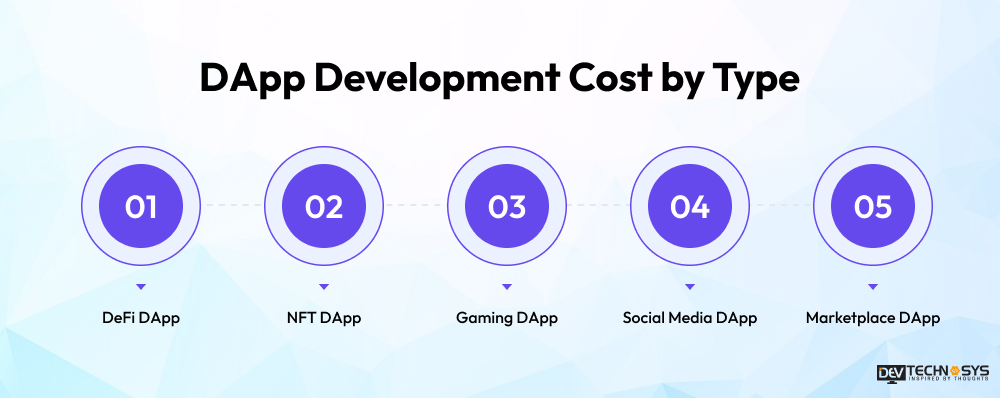
1. DeFi DApp
The term “decentralized finance” indicates that this dApp is designed for financial services such as lending, borrowing, staking, and trading. According to the DeFi development company, security and smart contracts play a crucial role, which could potentially lead to higher costs, as robust security measures are required to handle digital assets and transactions. The total cost to build a DeFi dApp is around $40,000 to $150,000, based on the features and requirements.
2. NFT DApp
NFT apps are primarily used for creating, buying, and selling digital assets, and they are very popular applications for marketplaces. They include wallets, NFT minting, smart contracts, and marketplaces.
The NFT DApp development cost lies between $25,000 and $80,000; it mainly depends on the security, features, functions, backend infrastructure, testing, blockchain platforms, and third-party integrations.
3. Gaming DApp
Gaming dApps must be integrated into online games using blockchain technology to enable users to trade, earn, and own digital assets such as NFTs or tokens.
Developing such gaming dApps requires blockchain integration, game design, high-quality graphics, and smart contracts. Basic gaming dApp development costs around $30,000 to $1,00,000, and it can go to higher costs for advanced gaming dApp development.
4. Social Media DApp
Social media dApps are similar to standard social media platforms, but they do not rely on a central company. In other words, no single authority controls them. Users can message, share posts, and interact through these dApps.
They also offer features like blockchain-based ownership, user profiles, posts, rewards, and much more. It requires advanced security measures; the cost is around $30,000 to $1,00,000, depending on customization.
5. Marketplace DApp
The marketplace dApp clearly indicates that buying and selling services are provided here. Users can buy or sell NFTs and other digital assets through this dApp by leveraging blockchain technology.
It includes various common features such as product listings, wallets, smart contracts, user accounts, and payment systems. The cost to build a marketplace DApp ranges from $25,000 to $90,000 or higher.
DApp Type |
Short Description |
Estimated Development Cost |
| DeFi DApp | Supports lending, trading, staking, and other financial services. | 40,000–150,000+ |
| NFT DApp | Used to create, buy, sell, and trade NFTs. | 25,000–80,000+ |
| Gaming DApp | Combines blockchain with games, NFTs, and digital assets. | 30,000–100,000+ |
| Social Media DApp | Enables users to share, connect, and earn through blockchain. | 30,000–100,000+ |
| Marketplace DApp | Allows users to buy and sell digital or physical assets. | 25,000–90,000+ |
Market Fact:
According to Coinbase, 85% of surveyed institutions are using or interested in using stablecoins for internal cash management and money movement.
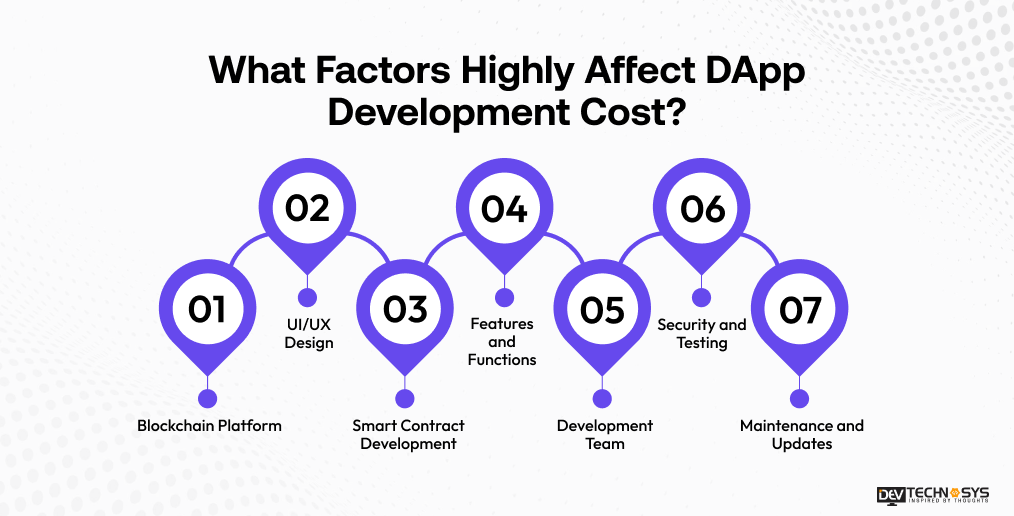
What Factors Highly Affect DApp Development Cost?
You now know the cost involved in building the DApp. However, are you aware that there are several factors that can influence this cost, causing it to fluctuate?
Understanding these factors is crucial for managing your dApp development budget effectively. Let’s check out the factors one by one and identify which factors can highly impact decentralized application development cost.
1. Blockchain Platform
Blockchain platforms play a crucial role in building dApps. There are many such platforms, such as Solana, Polygon, Ethereum, and Binance, but they differ in terms of transaction fees, speed, and development requirements, all of which directly impact costs. Additionally, developers require specific skills to work on each of these platforms.
Cost Factor |
Description |
Estimated Cost Impact |
| Blockchain selection & setup | Choosing and setting up the right blockchain network for the DApp. | 3–5% |
| Network integration | Connecting the DApp with the selected blockchain and its tools. | 3–5% |
| Transaction/gas optimization | Improving transactions to reduce fees and improve performance. | 2–4% |
| Blockchain infrastructure | Setting up nodes, APIs, wallets, and other required services. | 1–3% |
| Total Estimated Impact | Overall impact of blockchain-related work on the project cost. | 9–17% |
2. UI/UX Design
When it comes to dApp designs, there is a wide variety available these days. Simple designs are very cost-effective but lack visual appeal. On the other hand, complex designs incorporate elements like animations, dashboards, specific fonts, colors, textures, and custom layouts. Naturally, complex designs have a direct impact on the overall dApp development cost.
Cost Factor |
Description |
Estimated Cost Impact |
| User research & planning | Understanding what users need and planning the app experience. | 2–3% |
| Wireframes & prototypes | Creating basic screens and layouts before development begins. | 2–4% |
| Visual design | Designing colors, buttons, icons, screens, and the overall look. | 3–5% |
| Usability testing | Checking whether users can easily understand and use the DApp. | 2–4% |
| Total Estimated Impact | Overall impact of design and user-experience work. | 9–16% |
3. Smart Contract Development
Smart contract development is integral to every aspect of blockchain technology and is particularly essential for dApps. They execute automatically when specific conditions are met.
Developing a secure and accurate smart contract requires experienced developers, as the process is time-consuming. Including the testing phase. Consequently, this can drive up costs, especially since poor smart contracts can lead to serious problems.
Cost Factor |
Description |
Estimated Cost Impact |
| Smart contract planning | Deciding how the contract will work and what rules it will follow. | 2–4% |
| Contract development | Writing the blockchain code that controls important DApp activities. | 5–8% |
| Testing & optimization | Testing contracts and improving their speed, reliability, and efficiency. | 3–5% |
| Mainnet deploymentt & integration | Deploying contracts and connecting them with the DApp. | 2–3% |
| Total Estimated Impact | Overall impact of smart-contract-related development. | 12–20% |
4. Features and Functions
It is a simple fact that the more advanced or feature-rich the integration, the higher the cost. Basic features, such as registration, wallets, and transactions, do not significantly impact the cost.
In contrast, advanced features like staking, voting, token systems, push notifications, and payment options inevitably drive up expenses. Furthermore, integrating each of these advanced features requires more extensive testing and planning.
Cost Factor |
Description |
Estimated Cost Impact |
| Basic features | Includes simple functions such as registration, profiles, and dashboards. | 5–8% |
| Advanced features | Includes complex functions such as NFTs, staking, voting, or token systems. | 5–10% |
| Wallet/payment integration | Connecting crypto wallets and payment systems with the DApp. | 3–5% |
| Custom functionality | Building special features according to the project’s unique requirements. | 3–7% |
| Total Estimated Impact | Overall impact of the number and complexity of DApp features. | 16–30% |
5. Development Team
Who develops the dApps also affects the cost. For instance, a less experienced blockchain development company will charge less. Whereas an experienced team with deep knowledge of blockchain networks and smart contracts will certainly charge a higher fee.
The location of the development team is also another factor, because several regions have higher living expenses, and that directly affects the total dApp development cost.
Cost Factor |
Description |
Estimated Cost Impact |
| Developer expertise | Experienced blockchain developers usually charge more for their skills. | 5–8% |
| Team size | Larger projects may require more developers, designers, and testers. | 4–7% |
| Development location | Developer rates can vary based on their country or region. | 3–6% |
| Project management | Planning, communication, and managing the development process add costs. | 2–4% |
| Total Estimated Impact | Overall impact of the people involved in building the DApp. | 14–25% |
6. Security and Testing
Looking at the security measures of DApps can also affect the dApp development pricing. There are many security methods available that charge high licensing fees to secure the DApp activities and financial transactions.
Security audits also require more smart contracts; this can impact the cost to build a DApp. Testing is also necessary to find bugs, errors, and glitches to make sure all processes perform well.
Cost Factor |
Description |
Estimated Cost Impact |
| Functional testing | Checking whether all DApp features work correctly. | 2–4% |
| Security testing | Finding possible security weaknesses and protecting user data and assets. | 3–5% |
| Smart contract audit | Expert review of smart contracts to identify possible vulnerabilities. | 3–6% |
| Bug fixing & optimization | Fixing problems found during testing and improving performance. | 2–4% |
| Total Estimated Impact | Overall impact of security checks, testing, and quality improvements. | 10–19% |
7. Maintenance and Updates
After successful DApp development, maintaining a DApp is crucial and ensures that every step works correctly as the user wants. There are many services performed during maintenance, such as feature upgrades, adding new enhancements, fixing bugs or errors, new versions, fixing security patches, and so on.
Some of the maintenance processes are time-consuming, so developers can charge a higher cost, and it can impact the total decentralized application development cost.
Cost Factor |
Description |
Estimated Cost Impact |
| Bug fixes | Fixing errors or problems that appear after the DApp launches. | 2–4% |
| Security updates | Updating the DApp to protect it against new security risks. | 2–4% |
| Performance improvements | Making the DApp faster, smoother, and more reliable. | 1–3% |
| New features & upgrades | Adding new functions and updating the DApp as user needs change. | 2–5% |
| Total Estimated Impact | Overall impact of keeping the DApp updated and working properly. | 7–16% |
The 4 Hidden Costs of DApp Development
You might have estimated the Web3 development cost and settled on a figure, but you could be taken aback later by additional expenses, specifically, hidden costs. It is best to be aware of these beforehand, as they might require you to revise your overall budget. Let’s check what the hidden costs can be for your project.
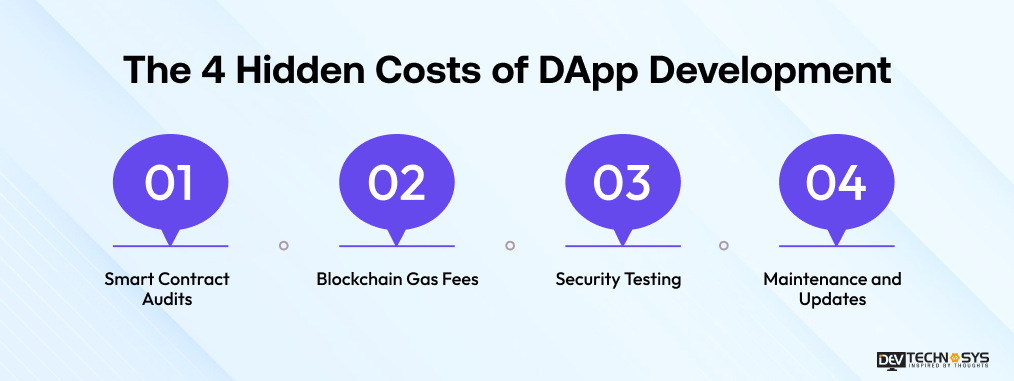
1. Smart Contract Audits
Smart contract audits represent a very common hidden cost for blockchains and dApps. This process involves developers checking the code for security vulnerabilities, such as bugs, prior to launch. This requires a significant investment of both time and money. While skipping this step might save you money, it can lead to serious problems.
2. Blockchain Gas Fees
Blockchain gas fees represent another hidden cost faced by both developers and users. This is because processing any blockchain transaction requires network fees, the amount of which depends on the network’s activity.
These fees directly impact testnet deployment, testing, and dApp usage. You can manage the hidden dApp development costs by choosing a reliable and best blockchain platform for cost optimization transactions.
3. Security Testing
Security testing is somewhat of an unexpected hidden cost, yet it becomes necessary when there are security risks prior to launch. It covers various components such as multi-signature wallets, APIs, smart contracts, user accounts, and other parts of the application.
If you wish to avoid this specific testing cost, you can invest in security measures early on, thereby eliminating the need for such testing at the final stage.
4. Maintenance and Updates
This is a very common and well-known cost, one that could even be described as a “hidden” cost. Do you think the work ends once Web3 development is complete? No, that is certainly not the case.
It requires periodic maintenance to ensure all operations and functions run flawlessly, and to replace any outdated features with the latest ones. Naturally, this entails costs.
Regional Regulatory Compliance: The Overlooked Cost Driver
Many organizations and experts will quote you the cost for the DApp’s code and design, not for the legal aspects. Every region has its own distinct rules, regulations, laws, and licensing requirements. You cannot launch your DApp without addressing these. So, understand the regional regulatory compliance and its cost:
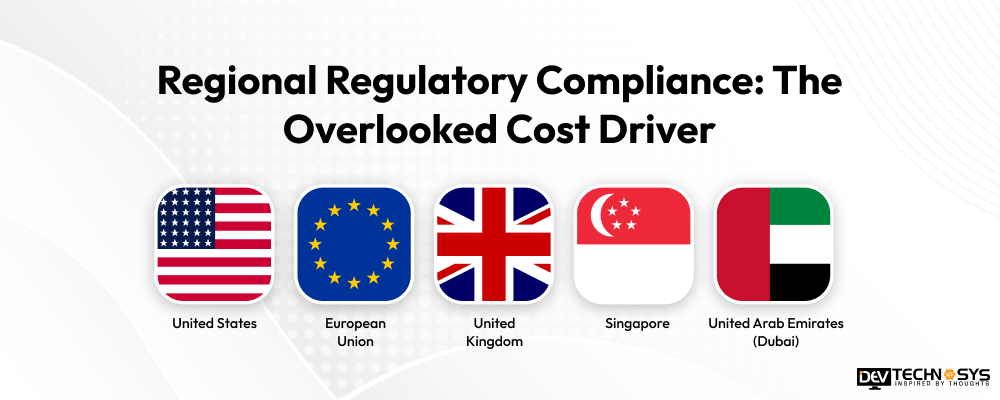
1. United States
When discussing things on a regional basis, each region has its own distinct rules and regulations. In the USA, for instance, rules and regulations vary from state to state because each state’s local government formulates its own rules.
If you are running an application in multiple states of the USA, then your cost is going to increase. So it can directly affect the overall development cost.
2. European Union
There is a regulation in Europe known as MiCA that applies across the board, but it covers a wide range of aspects, such as user data, safety plans, and tokens. Assessing all these elements takes a significant amount of time, and there are clear indications that this leads to increased costs.
3. United Kingdom
UK regulations are somewhat stricter compared to other regions. You need permission to launch the app, and subsequently, a separate approval is required regarding how the app is displayed on your platform and in advertisements.
Essentially, instead of paying in just one place, you have to make payments in two. It can directly affect the total decentralized application development cost.
4. Singapore
Now, let’s talk about Singapore’s rules and regulations. If your platform includes features like money transfers or remittances, you will need to obtain separate permissions for each one; essentially, you need distinct approval for every specific functionality. This means that more features entail more approvals, and higher costs associated with obtaining those approvals.
5. United Arab Emirates (Dubai)
Now, let’s talk about the rules in Dubai. You need a license to carry out any type of work there, and that license must be renewed annually. Furthermore, if you introduce any new features along the way, you will need to obtain a license for them as well and pay the associated fees.
Region |
Compliance Cost |
Main Reason |
| United States | 4,000–15,000 | Separate rules per state |
| European Union | 3,000–10,000 | One big rule (MiCA) checks many things |
| United Kingdom | 2,500–8,000 | Separate checks for app + ads |
| Singapore | 2,000–7,000 | Separate approval for each app feature |
| United Arab Emirates (Dubai) | 3,000–9,000 | License needed per feature, renewed yearly |
Note: The regulatory and compliance cost is included in the total development cost and is not any type of additional cost.
How to Reduce the DApp Development Cost?
Do you think developing a DApp is extremely expensive? That is not necessarily the case; with smart planning and the right strategies, you can build a product that meets your preferences even within a limited budget.
It involves various ways that help to eliminate additional expenses, such as creating an MVP, using pre-built templates, and hiring the right development team.
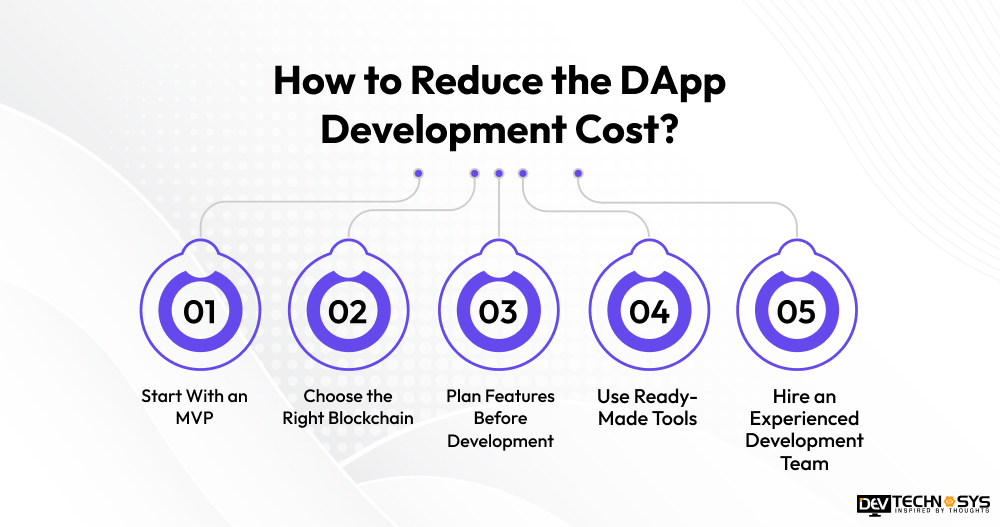
1. Start With an MVP
Adopting the MVP approach for development is highly beneficial for any organization. By including only essential features, you save on both development time and costs. You can then wait for user feedback before adding further features. This approach helps you avoid excessive spending and minimizes risk.
2. Choose the Right Blockchain
Before starting the development process, evaluate which blockchain platform best suits your project and fits within your budget. Compare factors such as security, scalability, speed, transaction fees, and developer support.
Select a platform that meets your project’s requirements while remaining within your budget. As we discussed, a DEX development company can help businesses avoid additional technical expenses.
3. Plan Features Before Development
This approach of narrowing down the scope is beneficial for everyone. You should prepare a list of the features, user needs, and technical requirements to be integrated into the project.
This clarifies the scope for the development team, enabling them to work efficiently, and avoids the need for subsequent changes that would otherwise increase costs.
4. Use Ready-Made Tools
Developers can use pre-existing tools, libraries, frameworks, and APIs for development. So they don’t have to build tools from scratch and waste time doing so. Basically, this can also increase development time and cost. Many ready-made tools are available, such as wallets, authentication, blockchain connections, and payments.
5. Hire an Experienced Development Team
Hire an experienced Ethereum development company to save money. They will identify errors before the launch and write clean, high-quality code that is easy to understand for future modifications. Experienced developers can charge more than the average developer, but their expertise helps eliminate delays and security risks.

In-House vs. Agency vs. Freelance: Cost Comparison
Are you extremely confused about which RWA tokenization development source to choose? Don’t worry, we have clarified this. The table below compares the options, explaining what each is best suited for and helping you determine the ideal source for your project.
Factor |
In-House |
Agency |
Freelancer |
| Hourly Rate | 60–150/hr | 80–250/hr | 25–150/hr |
| Mid-Complexity DApp Cost | 150K–400K+ | 60K–180K | 15K–70K |
| Setup Time | 2–4 months | 1–2 weeks | Days |
| Team Coverage | Full (if hired right) | Full team included | Usually solo |
| Security Audits | Extra cost | Often included | Rarely included |
| Best For | Long-term products | Full-service, faster delivery | Small MVPs, tight budgets |
| Biggest Risk | High fixed costs | Subcontractor markups | Single point of failure |
Security & Compliance: Essential Costs to Consider
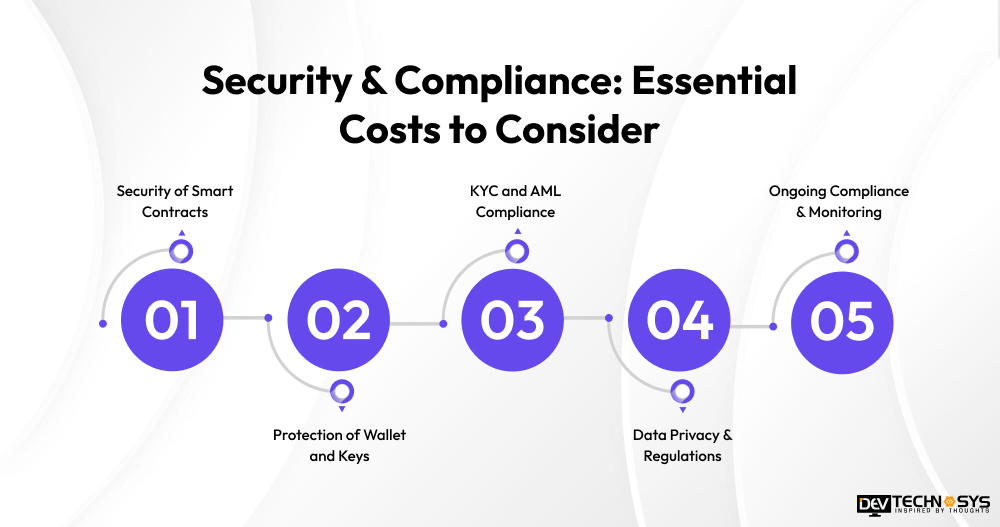
Security and compliance are important parts of developing DApps that have a huge impact on the overall cost of DAO development. Smart contract audits, penetration testing, KYC/AML implementations, and protection of data throughout, along with continuous monitoring of blockchain compliance, are thus carried out to reduce risks and secure users before and after launching DApps.
1. Security of Smart Contracts
It is very important to conduct audits, penetration testing, vulnerability assessments, and code checking before the launch of a smart contract. These steps are aimed at highlighting vulnerabilities, logical faults, and weaknesses in access control, which can lead to financial losses. These steps can be complicated and take a considerable amount of time, leading to the rise of the DApp development budget.
2. Protection of Wallet and Keys
The development of DApps that deal with cryptocurrencies must include secure integration of wallets, management of private keys, multisignature, control of roles, and approvals of transactions.
These measures will protect the financial resources and administrative activities against unauthorized access. Implementing these controls may also require security frameworks and processes aligned with ISO 27001, increasing infrastructure and development costs.
3. KYC and AML Compliance
Depending on the business model and the jurisdictions of operation of the financial DApp, it may require KYC and AML services. The integration of KYC compliance needs confirmation of identity, checking against sanctions, monitoring of transactions, and reporting, which includes cooperation with third-party services and cryptocurrency wallet development of the backend. Resources related to expenses of the firm can be easily neglected when estimating the costs.
4. Data Privacy & Regulations
DApps that collect personal information may need to comply with privacy regulations such as GDPR and CCPA. The requirements may include consent management, encryption, data storage security, access control, document retention policy, etc. Thus, meeting the above standards can lead to changes in architecture and development timelines as well as increased legal and technical costs.
5. Ongoing Compliance & Monitoring
Enterprise-focused DApps may need ongoing assurance through frameworks such as SOC 1 and SOC 2, alongside continuous security and privacy monitoring.
Requirements include periodic audits, vulnerability detection, compliance verification, software updates, audit of transactions, incident response, and policy changes. Therefore, budgeting only for initial development may significantly underestimate long-term costs.
Note: Our DApp development company follows all the compliance and security measures like GDPR, CCPA, ISO27001, and more. We are successfully certified and doing work under these standards.
Conclusion
We hope this blog has successfully explained and clarified app development costs for you. Through this blog, you have certainly learned about the actual costs involved in building a dApp and the factors to consider during its development. If you wish to create such dApps, you can certainly do so, as there is currently a huge demand for them.
To proceed, you should consult a CMMI Level 3 dApp development company to build the dApp for you within your budget and in compliance with region-specific rules and regulations. So, are you ready to invest in the blockchain era?
Frequently Asked Questions
Find answers to the most common questions related to this article.
The cost to develop a DApp in 2026 lies between $30,000 and $150,000; basically, it can fluctuate due to the needs of businesses and the level of feature complexity There are many major factors, such as features, functions, blockchain platforms, smart contracts, UI/UX design, backend processes, wallet integrations, and dApp security measures.