



















Enterprise blockchain private key security has experienced a fair amount of evolution over the last ten years. In the earlier days, businesses were primarily concerned with the protection of smart contracts from attacks like coding mistakes and flaws in logic or protocols.
Although having secure code is still important, the largest enterprise risk today has shifted to things such as stolen private keys, hacked credentials, and poor identity management. Cybercriminals are now more focused on targeting the employee and the cloud infrastructure instead of directly attacking the blockchain protocol, as it only takes one compromised credential for the attacker to get access to valuable assets.
With the increased adoption of enterprise blockchain, security budgets must be adjusted to cover these new threats.
In this blog, we will talk about how credential protection is more worthy of investment, how attack strategies have evolved, and what measures businesses must take to make their blockchain ecosystem more secure.
The Enterprise Blockchain Threat Landscape Has Changed
The realm of enterprise blockchain has progressed beyond the issues related to smart contract vulnerabilities. Although the importance of secure code still stands, attacks are now being increasingly aimed at private keys, privileged credentials, cloud infrastructure, and software supply chains. Being aware of the latest ways of making attacks enables companies to make the right decision about where to invest in security measures.
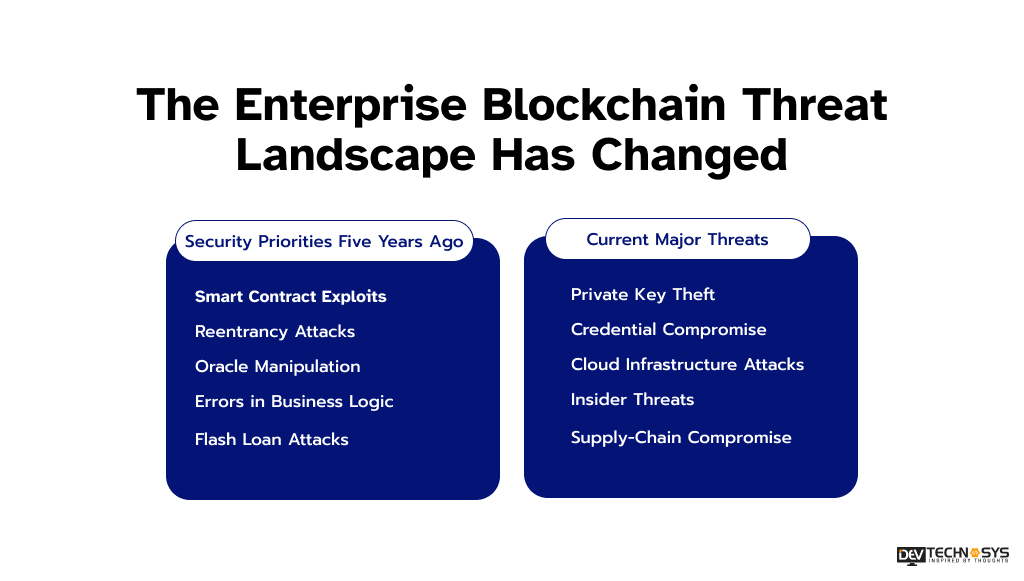
1. Security Priorities Five Years Ago
i. Smart Contract Exploits
Enterprise blockchain private key security has previously focused on smart contract development exploits, which are weaknesses within Solidity or Rust code resulting in illegal transfers, privilege escalations, bypasses of business logic, and alterations of protocols. The only means of prevention against such occurrences has been proper auditing of code.
ii. Reentrancy Attacks
Reentrancy attacks have involved the use of unprotected contract functions and execution flaws during which the attackers have been able to call an external contract multiple times before the state change has been introduced. That has enabled them to steal funds and inflate their balance with no means of validating the transaction.
iii. Oracle Manipulation
Blockchain applications using external price feeds have suffered from oracle manipulation attacks where attackers have been using compromised or low-liquidity data sources. This has enabled them to misrepresent the prices and make unauthorized liquidations, flash loans, and financial transactions across blockchains.
iv. Errors in Business Logic
Smart contract bugs led to business logic weaknesses that caused unauthorized token issuance, improper permission assignment, inefficient governance processes, and failed transaction authentication. Most security investigations concentrated on discovering coding mistakes prior to deployment.
v. Flash Loan Attacks
Through its combination of immediate uncollateralized lending, price manipulation, and protocol flaws, a flash loan attack allowed for the appropriation of a huge amount of funds in one transaction. In response, security specialists improved economic models, liquidity protection, and oracle verification procedures.
2. Current Major Threats
i. Private Key Theft
Today, blockchain private key security theft is among the most dangerous threats for corporate blockchains, allowing thieves to take over wallets. Carry out payment transactions, hack validator systems, and move money illegally, without using smart contracts or blockchain consensus.
ii. Credential Compromise
When administrator credentials, API tokens, SSH keys, or privileged identities become compromised, attackers will have direct access to the blockchain infrastructure, as identity-based attacks bypass application security controls. Thus making the need for Identity and Access Management (IAM) to be fulfilled by enterprises.
iii. Cloud Infrastructure Attacks
The secure and trustworthy cloud environments that businesses rely on need to be safeguarded, as misconfigured cloud environments. Unsecured storage buckets, insecure Kubernetes clusters, or compromised virtual machines can create threats to blockchain platforms.
iv. Insider Threats
Malicious or careless insiders with administrative access can exploit their powers to leak cryptographic data, manipulate functions, or bypass security measures. To minimize the risks associated with this type of threat, enterprises must rely on proper blockchain private key security policies.
v. Supply-Chain Compromise
Current blockchain ecosystems rely upon various third-party libraries, CI/CD pipelines, software dependencies, and cloud services. Breaches in supply chains might bring about malicious software code, illegally acquired digital signature certificates, or backdoors, all of which threaten the safe software delivery and functioning of enterprise blockchains.
Why Do Stolen Keys Cause Bigger Financial Losses Than Broken Code?
Although vulnerabilities in smart contracts can usually be discovered, fixed, or reduced, compromised private keys give hackers an instant and valid means to gain access to enterprise blockchain resources.
Credential-related attacks circumvent conventional security measures, hasten illegal transactions, and generate significant financial threats throughout interconnected ecosystems.
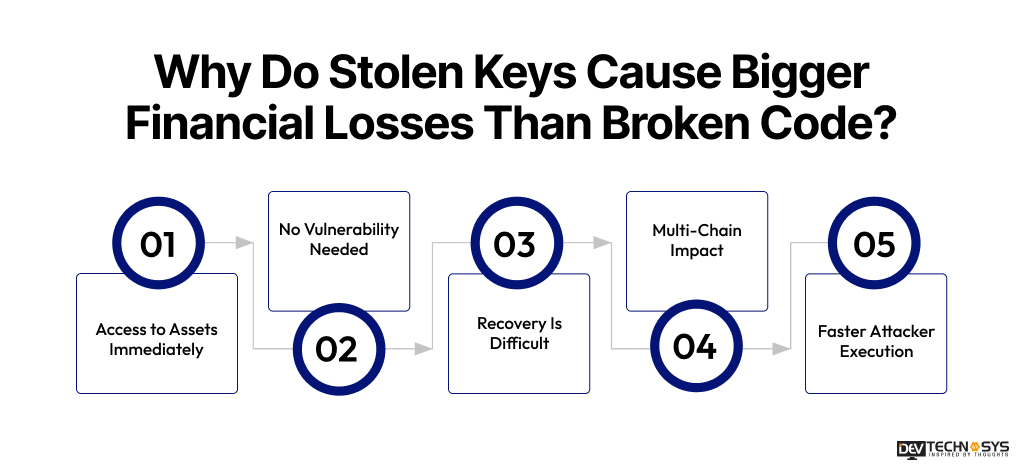
1. Access to Assets Immediately
If a private key is compromised, criminals are able to sign transactions, move assets, and perform operations on the blockchain without waiting to discover vulnerabilities. As opposed to malware-based attacks, which require exploits to be used, blockchain procedures enable fast and easy transfer of funds through the blockchain.
2. No Vulnerability Needed
In attacks based on hacking credentials, the security inherent in blockchain technology is completely bypassed. Criminals use their privilege, so while the regular operation of networks and smart contracts would be successful, the fraudulent operation still succeeds even when protocol rules are not breached, as the private key was valid.
3. Recovery Is Difficult
In case of private key loss, companies face severe difficulties in restoring the private key. Once any transaction is confirmed by the network, it becomes irrevocable even for the owner of the funds. Organizations will need to migrate their HD wallets or change their credentials in order to resume working with blockchain.
4. Multi-Chain Impact
Multiple blockchain networks, wallets, validators, and decentralized applications are controlled by companies using the same identity infrastructure. Just one compromised private key or privileged account can leak all assets across Ethereum, BNB Chain, Polygon, Solana, and other chains, resulting in high financial and operational risk for the company.
5. Faster Attacker Execution
Modern attackers use malware, phishing kits, and infrastructure automation to facilitate wallet discovery, credential theft, transaction signing, and asset transfers. Attackers can immediately benefit from their stolen credentials and transfer funds in a matter of seconds, giving little chance for security teams to tackle the problem.
Understanding Enterprise Blockchain Attack Surfaces
Business blockchain systems possess many attack opportunities, which can be found not only within smart contracts but in demographic wallets, development pipelines, cloud infrastructure, APIs, and developers’ systems.
By pinpointing challenges in these aspects, companies can enhance security, minimize vulnerabilities, and form a stronger blockchain network that can withstand cybercrime’s impact.
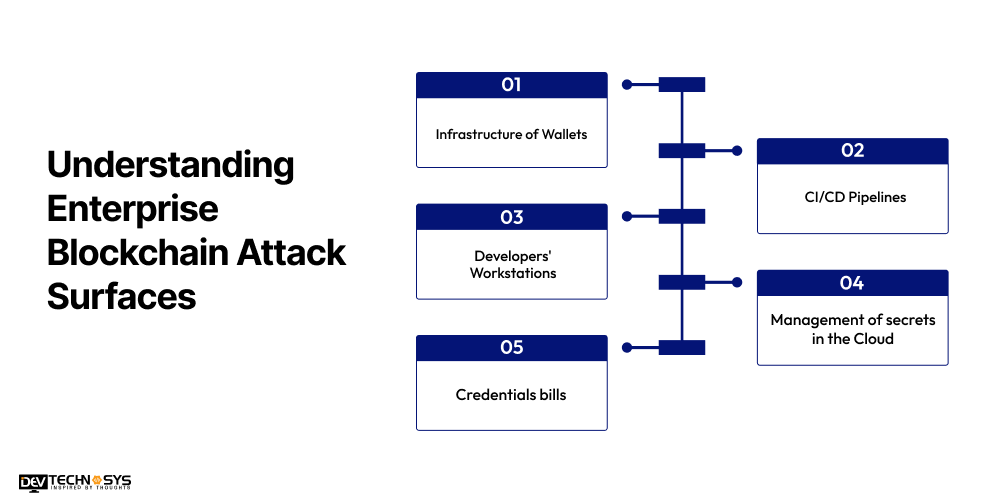
1. Infrastructure of Wallets
The infrastructure of wallets keeps and manages private keys, thereby making it the primary target for attackers. Insufficient authentication, unsecured storage, and bad access controls can lead to unauthorized transactions. Crypto wallet apps like MetaMask, using encryption, HSMs, and continuous monitoring, can lead to a reduction of security threats.
2. CI/CD Pipelines
CI/CD pipelines make the development and deployment of blockchain applications easier; however, they might present some security threats if attacked. An attacker may inject malicious code as well as steal credentials. Ensuring the correct configuration of the pipelines, code signing, access control, and performing regular security checks could ensure the integrity of software.
3. Developers’ Workstations
The workstations of the developers may potentially contain source code, credentials, and deployment tools. The breakdown of such devices can lead to leakage of valuable resources or the proliferation of virus code. Possessing endpoint protection, implementing multi-authentication, monitoring devices, and keeping devices regularly updated allows one to enhance the process of crypto wallet development services.
4. Management of secrets in the Cloud
Management of secrets in the cloud must be ensured to keep all API keys, private keys, passwords, and authentication tokens in a safe place. The use of crypto custody solutions meant specifically for management of secrets prevents credentials’ exposure and ensures appropriate access controls, allows for their timely key rotation, and helps to avoid issues related to security breaches.
5. Credentials bills
Credentials in API systems allow applications to connect to blockchain consulting services and third-party platforms. The presence of exposed or misconfigured credentials can lead to unauthorized access and hacking incidents. Safeguarding credentials involves their reliable cold storage, minimum privilege settings, credential rotations, and constant monitoring.
Planning a Blockchain Project?
Get a tailored development cost estimate in a few simple steps.
- 3 quick steps
- 100% free
- Reply in 1 business day
2 Minutes Read
Recommended Enterprise Blockchain Security Budget Allocation
When developing a balanced blockchain private key security budget, preemptive action should be favored over reactive action. Funds should be allocated across various expenditures, including infrastructure security, private key protection, smart contract audit cost, runtime monitoring, compliance, incident response, threat intelligence, staff training, and ongoing risk assessments. This strategy delivers improved resilience and reduced cybersecurity risks.
Security Area |
Recommended Budget Share |
| Identity & Access Management | 20% |
| Key Management Infrastructure | 20% |
| Smart Contract Audits | 15% |
| Security Monitoring (SIEM/SOC) | 15% |
| Cloud Security | 10% |
| Employee Security Training | 8% |
| Incident Response Planning | 7% |
| Compliance & Governance | 5% |
Private Key Protection Strategies Every Enterprise Should Adopt
Blockchain private key security, enabling enterprises to effectively discover and implement a high level of protection for themselves. To do this, they need to deploy sophisticated security measures including the use of hardware security modules, as well as multi-party computation, multi-signature wallets, role-based access control, and zero trust architecture.
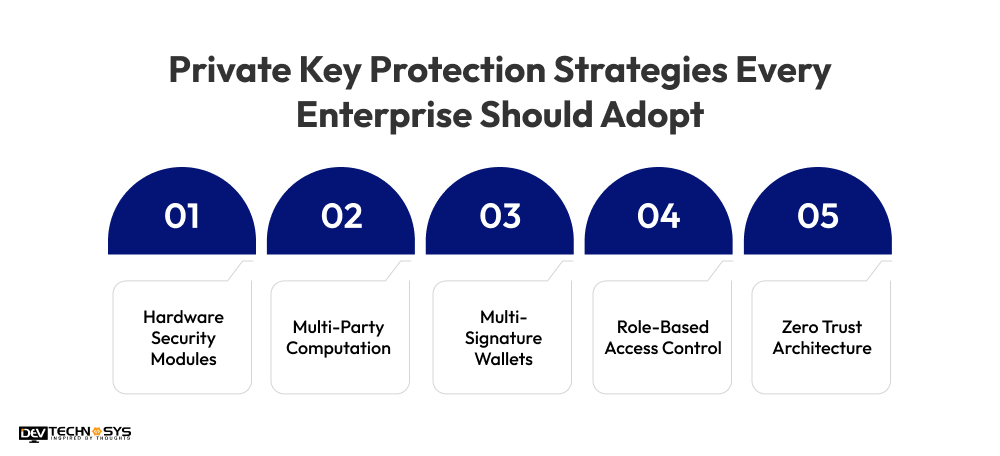
1. Hardware Security Modules
Hardware Security Modules (HSMs) are devices that ensure secure generation, storage, and management of private keys in secure hardware. This solution helps to guarantee that keys remain confidential, allows performing cryptographic operations securely, and ensures business requirements regarding security of private key usage are satisfied.
2. Multi-Party Computation
The concept of Multi-Party Computation (MPC) entails splitting the key-making process between various trusted parties without exposing the complete key. This means that there are no single points of failure and that the transaction security is strengthened because it becomes impossible for an insider to compromise any part of the operation process.
3. Multi-Signature Wallets
With Multi-signature wallets, multiple authorizations from authorized persons are required before conducting any transactions. The blockchain private key security model minimizes unauthorized transactions because there is no single person who can have full control over the approval process.
4. Role-Based Access Control
RBAC or Role-Based Access Control is a mechanism for controlling access to blockchain systems based on previously defined user roles and responsibilities.
Employees can only access the necessary permissions for the work they are tasked to do, thus minimizing the possibility of insider actions, denying the possibility of unauthorized deeds, and enhancing MPC wallet security in the blockchain settings.
5. Zero Trust Architecture
Zero Trust Architecture instills the idea that no person, device, or application can be trusted automatically. All requests for access are subjected to constant verification, authentication, and authorization.
This blockchain private key security model increases the chances of minimizing the attack surface, as well as preventing unauthorized access and ensuring better protection against cybersecurity threats faced by enterprises.
Beyond Smart Contract Audits: Building a Layered Security Strategy
It is important to utilize multiple layers of defense when it comes to enterprise blockchain security. An effective plan utilizes a combination of techniques, including secure infrastructure, constant monitoring, transaction analysis, air-gapped wallet behavior tracking for security threats, cloud security practices, and ongoing risk evaluation.
1. Infrastructure Security
Infrastructure security prevents cyberattacks on blockchain ecosystems, including nodes, servers, APIs, databases, and cloud technologies. This approach involves measures such as network segmentation, firewalls, endpoint protection, secure configurations, and constant patching. Referral in infrastructure security leads to improved reliability and reduction of unauthorized access.
2. Runtime Monitoring
Runtime monitoring is the technique of tracking blockchain applications, smart contracts, and supporting infrastructure all the time. This allows monitoring of suspicious behavior, deviations in the process, and performance failures in real-time since the procedure is taking place live. Such continuous comprehension allows security specialists to take prompt actions, thus making operations with blockchain effective.
3. Transaction Anomaly Detection
Transaction anomaly detection is the process of identifying cases of unusual blockchain activities such as unusual transfer amounts, unexpected wallet interaction, or too-fast transactions using analytics and AI. Early detection can help to avoid possibilities of fraud, insider threats, and economic losses.
4. Wallet Behavior Analytics
Wallet behavior analytics is the process in which one studies the history of transactions, patterns of access, and various activities of the users in order to get to the bottom of suspicious behavior related to wallets. It helps one identify compromised accounts, unauthorized access, and unexpected transfers of funds.
5. Threat Intelligence
Threat intelligence collects and studies information concerning newly emerging threats in the sphere of blockchain, ways of attacking, and vulnerabilities. Such intelligence is needed for businesses to enhance their security in the sphere and be ready for new attacks.
6. Cloud Posture Management
Cloud posture management continuously monitors issues related to misconfigurations, security issues, excessive permissions, and compliance issues. It helps ensure that the environment of blockchain is secure and that the possibility of data theft, unauthorized access, and disturbance of the work of the applications based in the cloud is minimized.

Enterprise Blockchain Security Framework
An effective enterprise blockchain private key security system merges the methods of governance, monitoring of identity, protection of keys, defense of smart contracts, safeguarding of the infrastructure, and constant checks of compliance with the laws. All of these make for a highly reliable system, which is low-risk, adaptable, and unbreakable in the use of blockchain systems.
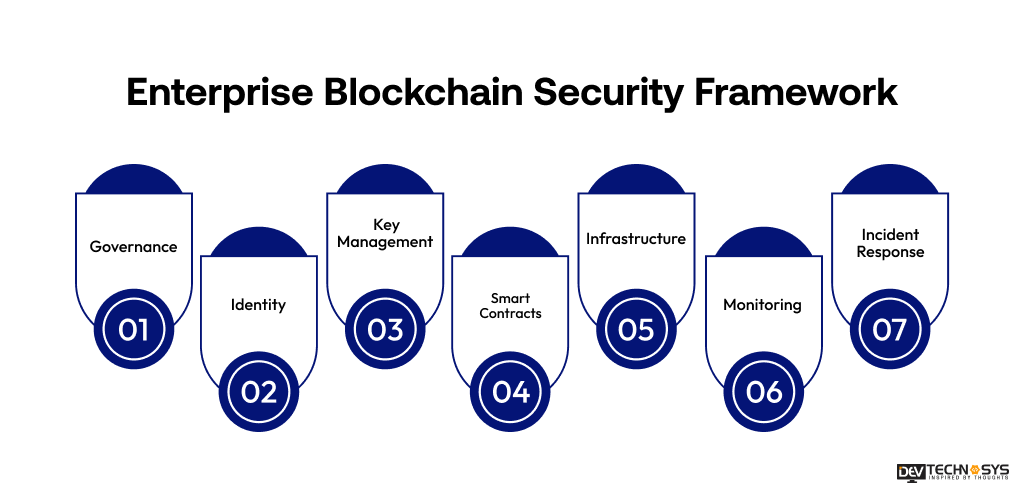
1. Governance
Governance involves the creation of security policies and processes, defining responsibilities, decision-making processes, and standards for operating within blockchain settings.
It also ensures that all stakeholders use consistent security practices, minimize risk, provide reasons for their actions, and comply with the organizational objectives, legal obligations, and industry regulations.
2. Identity
Identity management involves the verification of users, devices, and applications to enable access to the blockchain. Through the use of security methods, such as strong authentication, role-based access control, and access control practices, the identity management function helps prevent unauthorized activities.
3. Key Management
Key management is responsible for generating, storing, distributing, rotating, and recovering crypto private key security. The adoption of such technologies as hardware security modules, multi-party computation, and secure backup practices can minimize the risks of the biggest crypto thefts of private keys, transactions without substitutes, and loss of assets within the context of enterprise blockchain environments.
4. Smart Contracts
Smart contract safety is concerned with not only safe programming but also safety testing, auditing, and overseeing all stages after smart contract deployment.
This allows identifying weaknesses, preventing someone from exploiting them, and enhancing the reliability of smart contracts. Regular upgrades and safety reviews mitigate failures and enable conducting business safely and effectively with the help of the blockchain.
5. Infrastructure
Infrastructure security is responsible for the safety of blockchain networks, clouds, servers, APIs, databases, and channels of communication. Strong configuration, encryption, network monitoring, and system hardening allow reducing attack surfaces and improving availability.
6. Monitoring
Continuous monitoring enables real-time insights into blockchain transactions, network performance, user actions, and security incidents. According to the blockchain development firm, automated notifications and analyses allow detecting suspicious behavior immediately, thus making it easier for security teams to react to incidents.
7. Incident Response
Incident response is the term that refers to the use of systematic protocols aimed at detecting, evaluating, containing, and recovering from some sort of security breach in blockchain technology.
A good incident response plan allows for minimizing losses, restoration time, recovering vital information, and implementing secure operations in the future.
Why Compliance Has Become a Core Security Investment?
The modern system of blockchain security is much more than technical mechanisms. Effective adherence to regulatory requirements or industry standards can help companies enhance their risk management, increase transparency, safeguard sensitive information, and increase client trust.
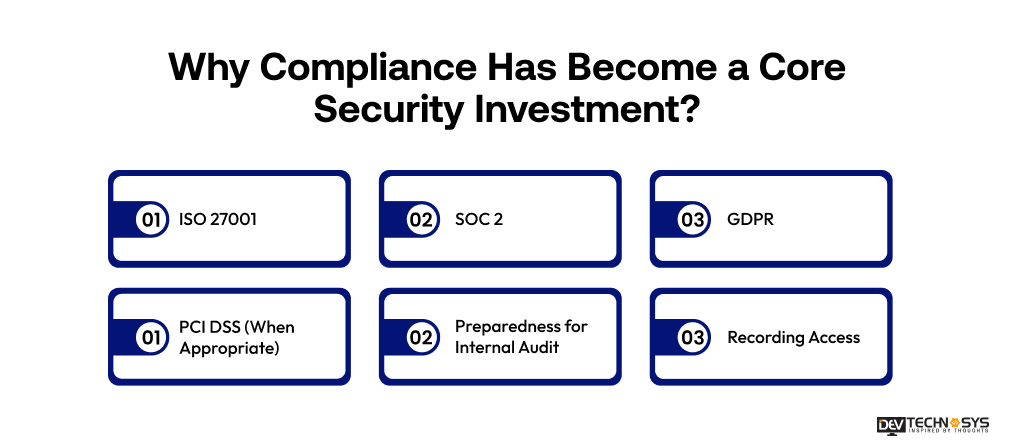
1. ISO 27001
ISO 27001 is globally acknowledged as an important framework in the area of information security risk management. It serves as a guideline for businesses to create their security policies, safeguard the critical blockchain data, enhance the resilience of their operations, influence trust in customers, and actually embody commitment to the principles of secure operations.
2. SOC 2
SOC 2 is mainly focused on assessing the manner in which the companies protect their clients from data breaches using technical means of protection, data availability, processes ensuring data confidentiality, as well as privacy.
Getting the SOC 2 certificate means having a decent internal state of security, which leads to an increase in clients’ confidence in the organization and makes partnerships with enterprises easier.
3. GDPR
GDPR implies the obligation for a company to take good care of the personal data of its clients by guaranteeing transparency in the process of data processing while also respecting the privacy rights of the users.
Blockchain companies must be ready for the implementation of reliable security measures, responsible data management, and meeting the relevant criteria of compliance in order to avoid legal troubles as well as to enhance the
4. PCI DSS (When Appropriate)
The PCI DSS program applies to businesses that handle credit card details. Compliance necessitates robust encryption, proper authentication methods, effective access control, proper handling of vulnerabilities, and ongoing monitoring for safe transmission of payments.
5. Preparedness for Internal Audit
Internal audit preparedness ensures that company policies, operational procedures, and compliance documents are updated and available for inspection.
Frequent reviews help spot deficiencies before any external evaluations are made, enhance accountability, decrease compliance loopholes, and help companies use more reliable security measures for their corporate blockchain operations.
6. Recording Access
Access logging makes it possible to track every login, completed activities, and administrative operations in blockchain-based systems. By maintaining comprehensive logs, it is possible to improve visibility, facilitate forensic investigation, detect illicit operations, ease compliance reporting procedures, and strengthen the organization’s security overall.
Future Enterprise Blockchain Security Trends (2026-2030)
Blockchain security is changing quickly due to the increasing sophistication of cyber threats. New technologies such as AI-based threat detection, autonomous cybersecurity operations, quantum-proof private key cryptography, and decentralized identities will enhance business resilience and secure their digital assets.
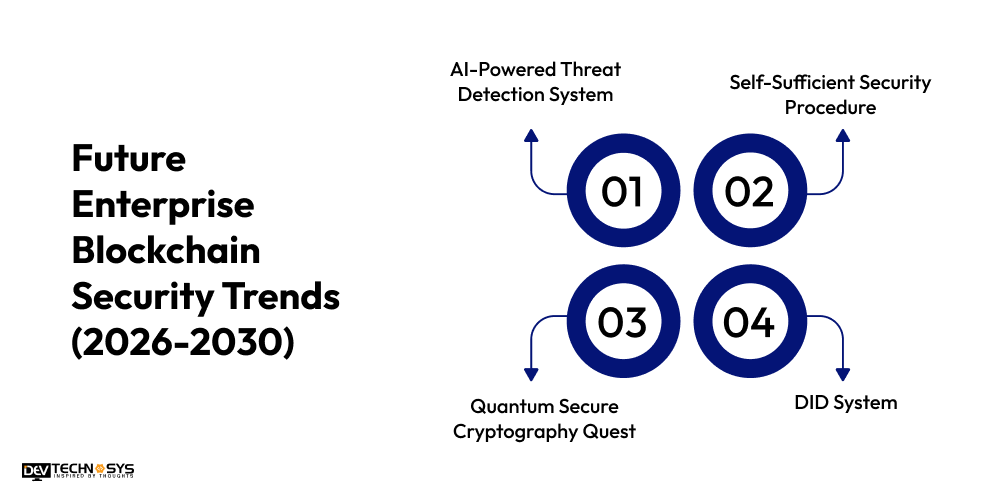
1. AI-Powered Threat Detection System
The process of an AI-powered threat detection system evaluates blockchain transactions, user dynamics, and operational activities in real time to provide details on suspicious activities or actions. Quick identification, automated notifications, and predictive modeling of possible data breaches help organizations lower risks and take timely measures before attacks happen.
2. Self-Sufficient Security Procedure
A self-sufficient security process uses machine learning and automation to keep track of blockchain systems, evaluate incidents, classify risks, and make the required responses happen. The mentioned approach minimizes manual work, increases reaction times, enhances robustness, and allows for efficient management of processes.
3. Quantum Secure Cryptography Quest
Quantum secure cryptography involves the development of public-key cryptography technologies capable of resisting quantum computers. Companies are actively searching for new post-quantum approaches that would allow them to secure blockchain transactions, digital identities, and private key encryption from imminent computer system capabilities.
4. DID System
DID system allows people to control and verify their digital identities without centralized providers. The advantages of the presented type of identification are increased security, decreased risk of identity fraud, better verification processes, and trustworthiness of transactions.
Final Words!
The scope of enterprise blockchain protection has evolved. It does not focus on fixing smart contract problems only. Now it is equally important to protect private keys, user identities, cloud infrastructure, and other important credentials. A lost key might cause a lot more harm than many coding problems.
With the help of a blockchain development company, businesses can invest in security across code audits, enterprise blockchain key management, access controls, continuous monitoring, and risk awareness. This helps to manage risks and strengthen the blockchain environment of companies.
Frequently Asked Questions
Find answers to the most common questions related to this article.
Having stolen private keys means that an attacker can easily carry out a transaction on the blockchain without having to hack coding vulnerabilities. Whereas bugs in smart contracts are harder to find and exploit, stolen keys can easily permit access to someone's wallet, thus giving way to unapproved transactions through the account faster and in a more damaging way when compared to damage caused by bugs in smart contracts.
Money for security should be allocated for many different aspects of blockchain security, such as ensuring the protection of coding that is involved in smart contract development and management, and making investments in other parameters like having sound Private Key Management strategies, Identity and Access Management (IAM), and Cloud Security together with regular monitoring of the system
The most secure method involves the use of Hardware Security Modules (HSM), multi-party computation (MPC), multi-signature wallets, threshold signatures, encrypted key storage, stringent access controls, and routine credential turnover. This combination ensures minimum unauthorized access while maximizing security and compliance in enterprise blockchains
Multi-Party Computation (MPC) protects private keys by splitting the cryptographic operation among a number of players so that there is no key available in one place. This enables the elimination of single points of failure, increased security of the wallets, and decreased chances of credential theft in blockchain systems
It is necessary for any organization dealing with blockchain technology to use reliable systems for crypto key management, audit smart contracts, put infrastructure security measures in place, and deploy multi-factor authentication. Monitor the blockchain environment; have access rights; conduct vulnerability assessments; have incident response planning in place; and comply with regulations