










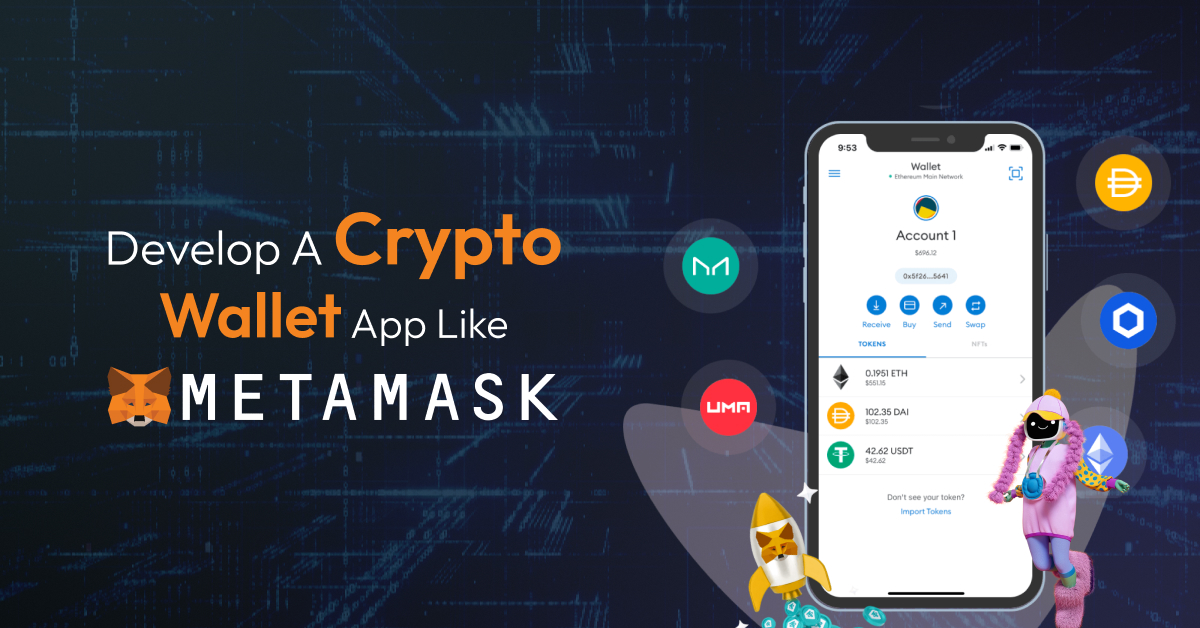
Have you ever wondered how apps like MetaMask let people store and use their crypto coins so easily?
In today’s world, cryptocurrency is becoming super popular, and people need safe ways to manage their digital money.
That’s where crypto wallets come in!
Key takeaways:
-
- The market for cryptocurrency wallets was valued at USD 59 billion in 2024 and is projected to grow to USD 100.77 billion by 2033.
- MetaMask’s success shows the importance of simple design, strong security, and blockchain integration.
- Core features include wallet creation, private key encryption, token swaps, and blockchain integration for smooth operation.
- Apps like MetaMask, Trust Wallet, and Coinbase Wallet offer secure, seamless crypto storage and transactions.
MetaMask is one of the most famous crypto wallet apps, and millions of people use it every day. But have you ever thought about how such an app is made?
In this guide, I’ll take you through the simple process to develop a crypto wallet app like MetaMask.
Although it may sound complicated, we’ll break it down into simple steps so that anyone can understand.
Get ready to explore the world of blockchain, security, and app development in an easy way. Let’s get started!
Global Market Statistics of Crypto Wallet Applications
- The market for crypto wallets was worth USD 59 billion in 2024, and it’s projected to be worth USD 100.77 billion by 2033.
- In 2025, 9% of all income from crypto wallets came from North America, making it the biggest market.
- In 2025, the hot wallets section led the market by type and made up 56.0% of all income.
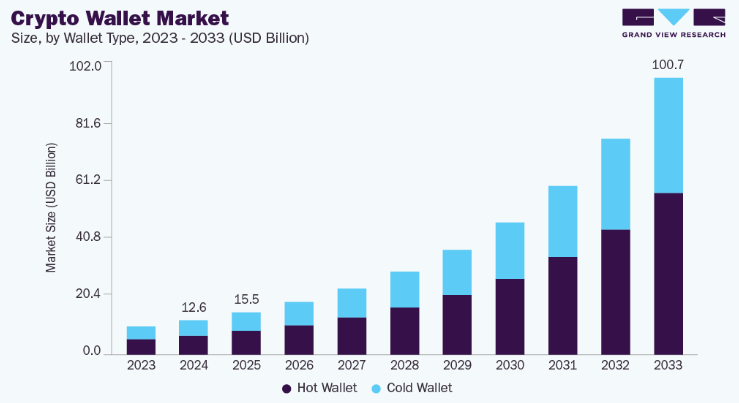
- Over the next few years, the Asia-Pacific area is projected to have the fastest growth in the market.
- According to the global crypto wallet apps market, it is expected to increase with a compound annual growth rate of3% from 2025 to 2030.
What is Metamask?
MetaMask is a mobile and browser-based cryptocurrency wallet app that allows users to manage Ethereum holdings. It supports the safe storing, sending, and receiving of cryptocurrencies, particularly ETH and ERC-20 token support. The software also allows users to connect to decentralized wallet apps (dApps) and explore the Web3 ecosystem.
Crypto wallet apps like Trust Wallet and MetaMask offer a secure and user-friendly gateway to blockchain and DeFi systems, featuring functionalities such as token swapping and private key management.
User Case Study: Metacade
Metacade is a decentralized gaming and ICO ecosystem developed by Dev Technosys. It is built for UK-based client Alex Thompson. During the development, a team of 12-members delivered the project in 32 weeks. It includes building the MCADE token, ICO platform, staking system, and P2E gaming hub. All these are developed with secure multi-chain smart contract integration, driving community engagement and scalable Web3 gaming innovation.
Narayan Das (Delivery Manager)
Types of Crypto Wallet Apps
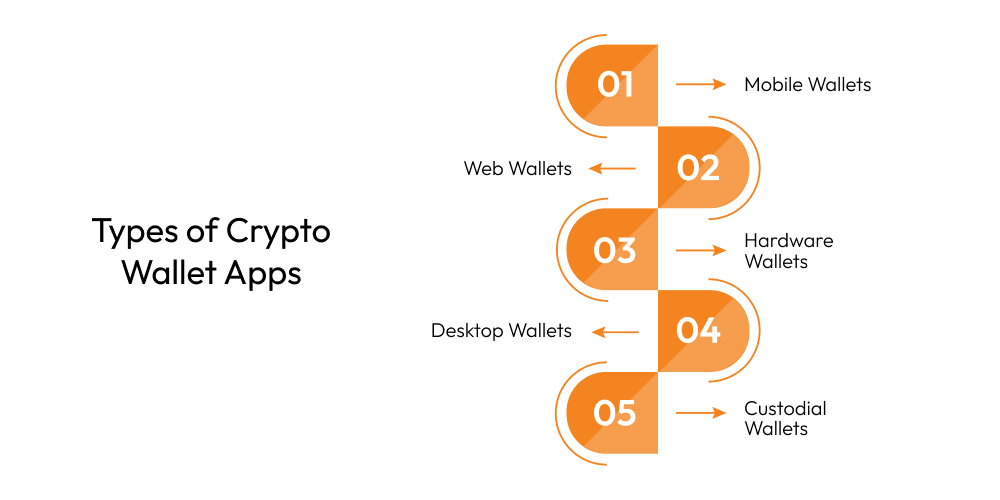
Crypto wallet apps come in various forms: mobile, desktop, web, hardware, and custodial, each offering unique features, security levels, and convenience for managing and storing digital assets.
1. Mobile Wallets
Mobile wallets are smartphone apps that enable you to store, transmit, and receive cryptocurrency. They are handy for daily usage and support dApps, apps like Coinbase, MetaMask, and Trust Wallet.
2. Web Wallets
Web wallets are accessible through browsers and hosted online. They are simple to use, but less secure owing to internet exposure. Popular solutions include Blockchain.com and exchange wallets such as Binance and Coinbase.
3. Hardware Wallets
Hardware wallets are physical devices that hold private keys offline, offering excellent security against hacking. Top options for long-term storage include the Ledger Nano X and Trezor.
4. Desktop Wallets
Desktop wallets, which are installed on desktops, provide you with complete control over your cryptocurrency. They are more secure than online wallets and accept a variety of coins. Examples include apps like Exodus, Electrum, and Atomic Wallet.
5. Custodial Wallets
Custodial wallets are controlled by third-party businesses such as exchanges, and they store your private keys. They are user-friendly, but less secure because consumers do not have complete control over their assets. Coinbase and Binance wallets are good examples of custodial and non-custodial crypto wallets.
Top 10 Crypto Wallet Apps
Discover the best blockchain wallet apps offering secure, user-friendly features for managing digital assets, enabling easy blockchain access, and supporting multi-platform use for seamless cryptocurrency transactions.
Wallet Name |
Downloads (Approx.) |
Rating (out of 5) |
Launched Year |
Platforms |
| MetaMask | 10M+ | 4.5 | 2016 | iOS, Android, Browser |
| Trust Wallet | 100M+ | 4.6 | 2017 | iOS, Android, Web |
| Coinbase Wallet | 5M+ | 4.4 | 2012 | iOS, Android, Browser |
| Exodus | 1M+ | 4.5 | 2015 | iOS, Android, Desktop |
| Crypto.com Wallet | 10M+ | 4.3 | 2016 | iOS, Android |
| ZenGo | 500K+ | 4.2 | 2018 | iOS, Android |
| Guarda Wallet | 1M+ | 4.1 | 2017 | iOS, Android, Desktop, Web |
| MathWallet | 1M+ | 4.0 | 2018 | iOS, Android, Desktop, Web |
| Atomic Wallet | 1M+ | 4.3 | 2017 | iOS, Android, Desktop |
| BRD Wallet | 2M+ | 4.2 | 2014 | iOS, Android |
Why Businesses Want to Invest in Crypto Wallet App Development?
Cryptocurrency is rapidly changing how people handle money and digital assets. Many businesses now want to invest in their own MetaMask wallet app development to tap into this growing market. Here are five key reasons why investing in cryptocurrency wallet development makes smart business sense:
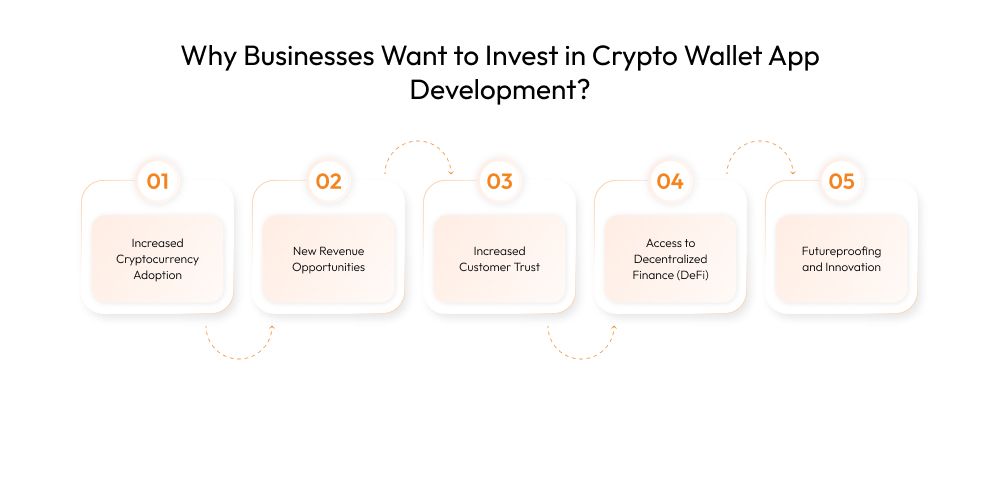
- Increased Cryptocurrency Adoption
- New Revenue Opportunities
- Increased Customer Trust
- Access to Decentralized Finance (DeFi)
- Futureproofing and Innovation
1. Increased Cryptocurrency Adoption
Cryptocurrencies are increasingly being used by individuals and businesses. As digital currencies gain popularity, companies want to provide consumers with simple and secure wallets for storing, sending, and receiving cryptocurrency. Creating a wallet software enables businesses to participate in the rapidly increasing cryptocurrency ecosystem.
2. New Revenue Opportunities
BRC-20 wallet development solutions provide new business models and revenue sources. Companies may profit from transaction fees, token exchanges, premium features, and integration with DeFi services. The advent of NFTs and blockchain games also opens up new business opportunities within wallet apps.
3. Increased Customer Trust
Providing a safe and user-friendly wallet fosters client confidence. Wallet applications provide consumers complete control over their private keys and assets, increasing transparency and loyalty. Businesses that provide dependable cryptocurrency solutions stand out in the competitive digital landscape.
4. Access to Decentralized Finance (DeFi)
Crypto wallets serve as entry points to DeFi platforms, allowing users to lend, borrow, stake, and trade without middlemen. Businesses that invest in NFT marketplace development solutions position themselves to gain from the burgeoning DeFi market while also attracting customers interested in sophisticated blockchain services.
5. Futureproofing and Innovation
Investing in crypto wallet development allows businesses to stay competitive in the rapidly expanding tech sector. It fosters innovation, attracts tech-savvy clients, and positions firms for the future of digital banking and Web3 technology.
How AI Can Help Crypto Wallet Apps?
- AI detects suspicious activity and unusual transactions in real-time, helping prevent fraud and enhancing wallet security significantly.
- AI customizes wallet interfaces, features, and alerts based on user behavior, improving usability and engagement.
- AI analyzes user spending and provides insights or warnings about fees, gas prices, and better trading opportunities.
- AI suggests asset diversification and investment strategies based on market trends and user risk preferences.
- AI helps maintain regulatory compliance by flagging KYC/AML violations or suspicious patterns requiring manual review.
7 Basic Steps to Develop A Crypto Wallet App Like Metamask
Develop a crypto wallet app like MetaMask, enabling seamless blockchain transactions, multi-asset management, and decentralized wallet app integration. Empower users with advanced security features, real-time updates, and an intuitive interface for managing digital assets effortlessly. So, let’s explore the secure crypto wallet app development process:
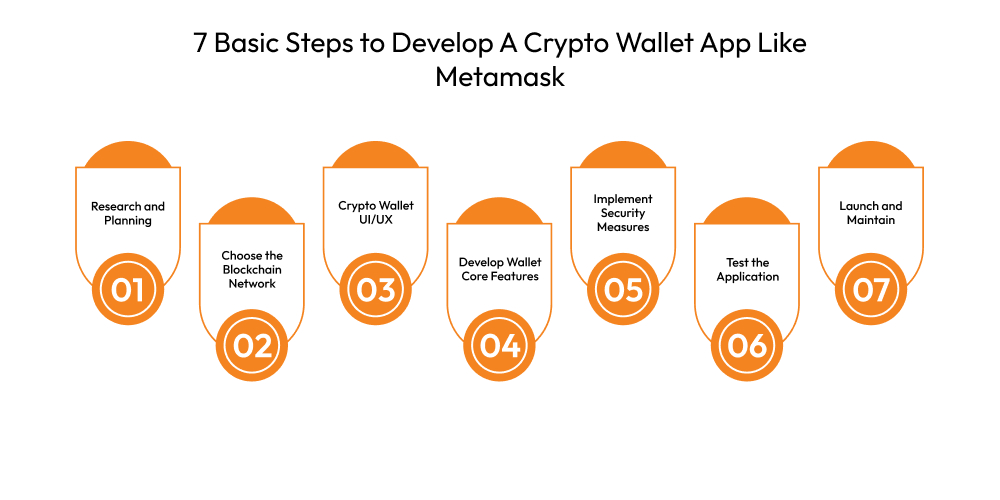
- Research and Planning
- Choose the Blockchain Network
- Crypto Wallet UI/UX
- Develop Wallet Core Features
- Implement Security Measures
- Test the Application
- Launch and Maintain
1. Research and Planning
Let’s begin the metamask clone app development process. Understand the cryptocurrency wallet market, user needs, and competitors, such as MetaMask. Define your app’s core features, supported blockchains, security standards, and target audience.
Hire developers from a blockchain development company to create a detailed project roadmap including design, development, testing, and launch phases to ensure a smooth workflow.
2. Choose the Blockchain Network
Select which blockchain(s) your wallet will support, such as Ethereum, Binance Smart Chain, or multi-chain options. This decision impacts smart contract integration, transaction handling, and wallet features. Multi-chain support offers broader usability but requires more complex development.
3. Crypto Wallet UI/UX
Create intuitive, simple, and secure designs for your wallet app. Assemble professional designers from a cryptocurrency development company to focus on easy wallet creation, transaction flow, and seamless dApp integration. Prioritize security prompts and backup options for private keys to help users feel safe while using the app.
Pick what you need below — you can select more than one — then tap Get detail to continue.Want a chatbot demo or pricing? Fill the form and talk to our experts today.
Chatbot demo dashboard
Cost to develop an app
Industry report
Case study
4. Develop Wallet Core Features
Build essential features including wallet creation, private key encryption, transaction signing, sending/receiving crypto, and balance display. Integrate crypto wallet APIs to connect with blockchain nodes for real-time data. Include token swap and transaction history features for enhanced functionality.
5. Implement Security Measures
Let’s move to the non-fungible token development stage, incorporate strong encryption for private keys, multi-factor authentication, biometric login, and secure storage. Conduct penetration testing and audits to identify vulnerabilities. User data and assets must remain protected to build trust and comply with regulations.
6. Test the Application
Perform extensive testing: functional, security, usability, and performance testing across devices. Fix bugs and optimize speed. Use beta testers to gather feedback and improve user experience before the official launch.
7. Launch and Maintain
Hire professional developers from an Ethereum development company to deploy your wallet app on platforms like iOS, Android, and browsers. Monitor performance, fix bugs, and release regular updates. Stay updated with blockchain wallet app changes and enhance features to keep users engaged and secure.
Why Users Choose Metamask Over Other Crypto Wallet Apps?
Users choose MetaMask for its intuitive interface, broad compatibility with Ethereum and Layer 2 networks, and strong security features, making it the trusted, versatile wallet for seamless Web3 and DeFi access.
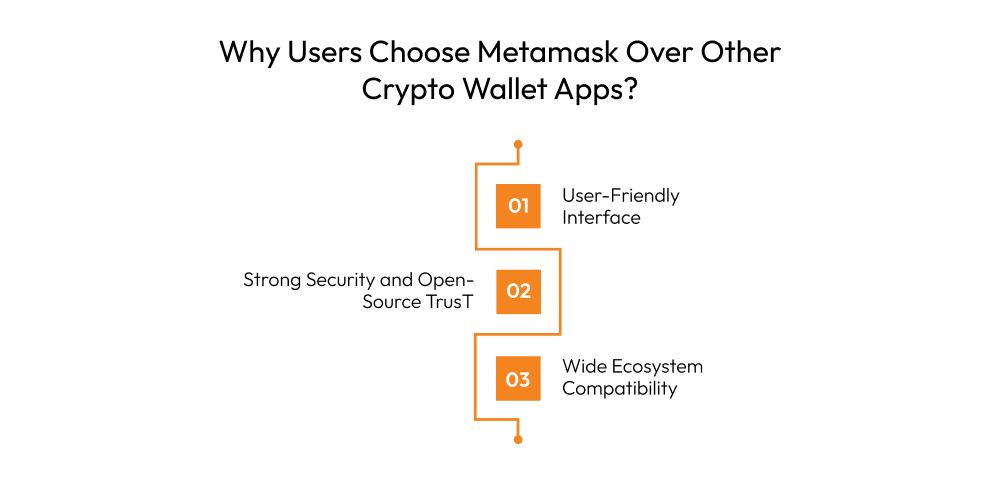
1. User-Friendly Interface
MetaMask is a basic, clear UI that works both as a browser extension and a mobile app. This simplicity of use appeals to both new and experienced users, allowing for speedy setup and maintenance of Ethereum wallets and decentralized app interactions with little technical complexity.
2. Strong Security and Open-Source Trust
MetaMask focuses on minimum viable product security features, such as private key encryption, hardware wallet integration, and phishing detection. Because it is open-source, it benefits from community audits and constant enhancements, which encourage transparency and trust that few rivals can match.
3. Wide Ecosystem Compatibility
Cross-platform crypto wallets support Ethereum and numerous Layer 2 networks, giving users access to a wide range of DeFi platforms, NFT markets, and dApps. Its extensive interoperability makes it an appealing option for customers who want a single wallet to manage several blockchain activities easily.
10 Must-Have Features of Crypto Wallet Apps Like Metamask
These crypto wallet features collectively make wallets like MetaMask reliable, versatile, and secure, driving their popularity in the growing Web3 ecosystem.
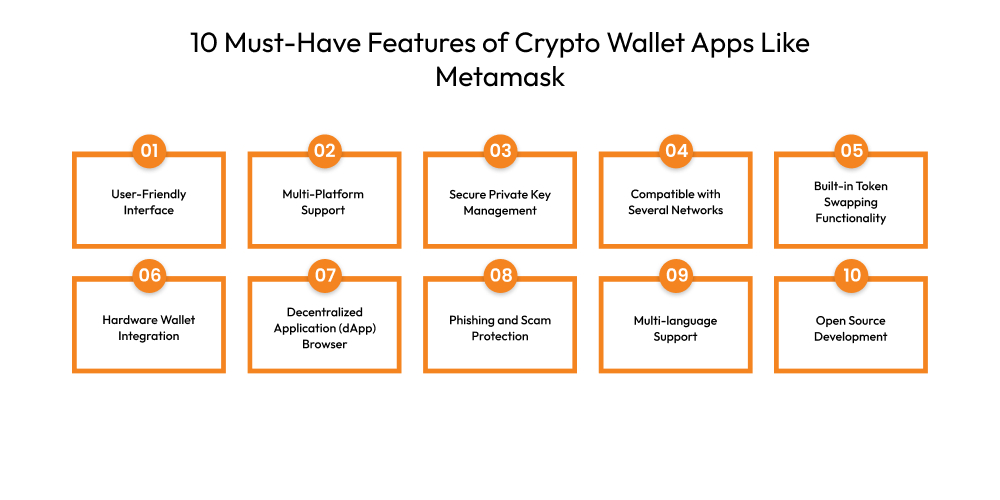
1. User-Friendly Interface
A clear and straightforward design is required for both novice and expert users to easily handle wallets and transactions.
2. Multi-Platform Support
Metamask wallet app support for browser extensions and mobile applications allows users to access their wallets at any time and from any location, increasing ease.
3. Secure Private Key Management
To protect user assets, the wallet must securely store private keys locally using strong encryption and provide backup and recovery alternatives.
4. Compatible with Several Networks
A MetaMask wallet alternative that supports Ethereum, Layer 2 solutions, and other blockchains enhances flexibility and access to a diverse set of decentralized applications (dApps).
5. Built-in Token Swapping Functionality
If you create a mobile app like Metamask, it enables users to exchange cryptocurrencies directly within their wallet, bypassing external exchanges and shortening transaction times.
6. Hardware Wallet Integration
Metamask wallet app compatibility with hardware wallets such as Ledger and Trezor provides an added degree of protection by storing private keys offline.
7. Decentralized Application (dApp) Browser
A built-in dApp browser allows for easy interaction with DeFi platforms, NFT markets, and blockchain games from the wallet UI.
8. Phishing and Scam Protection
Crypto app security features alert users to phishing attempts and harmful websites, preventing fraud.
9. Multi-language Support
The Metamask wallet app, supporting many languages, increases worldwide adoption and makes the wallet available to a wider range of user populations.
10. Open Source Development
An open-source codebase fosters community contributions and audits, resulting in continual progress and transparency.

What is the Cost to Develop a Crypto Wallet App Like Metamask?
The cost to build a crypto wallet app like MetaMask is around $8,000 to $25,000, depending on complexity, features, and development time. Key cost drivers include secure private key management, multi-platform support, blockchain network integration, token swap functionality, and robust security measures.
Additional expenses arise from UI/UX design, testing, and ongoing maintenance. Hiring experienced blockchain developers and ensuring compliance with regulations can also increase the Metamask app development cost.
The final blockchain app development cost varies based on team location, project scope, and desired functionalities, but investing in security and user experience is crucial for success.
Feature |
Estimated Cost (USD) |
| Basic Wallet Setup & Private Key Management | $10,000 – $16,000 |
| Multi-Platform Support (Web & Mobile) | $15,000 – $20,000 |
| Blockchain & Network Integration | $10,000 – $12,000 |
| Token Swap Functionality | $5,000 – $7,000 |
| Security Features (Encryption, Phishing Protection) | $6,000 – $10,000 |
| UI/UX Design | $5,000 – $12,000 |
| Testing & QA | $5,000 – $8,000 |
| Maintenance & Updates (Annual) | $3,000 – $7,000 |
Total Estimated Cost: $8,000 – $25,000
What Are the Major Factors That Impact the Crypto Wallet App Development Cost?
Several key factors impact the cost to develop a crypto wallet app like Metamask, including app complexity, security requirements, supported platforms, UI/UX design quality, and development team location. Each element influences the time, resources, and expertise needed, ultimately determining the total investment required to build a secure and user-friendly wallet solution.
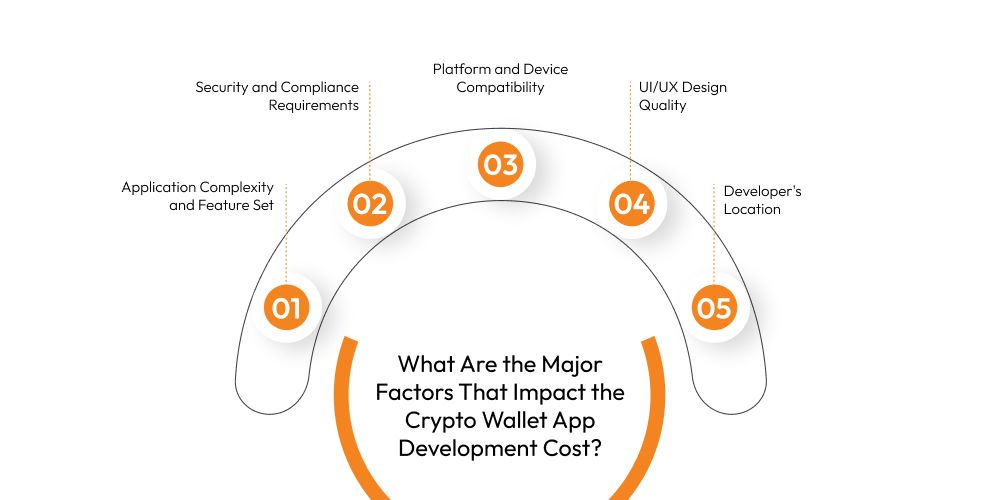
1. Application Complexity and Feature Set
The more features you add, such as token swaps, NFT support, and multi-chain connectivity, the greater the development cost. Basic wallets are less expensive, but adding additional features, bespoke dashboards, and dApp interfaces greatly increases complexity, necessitating more development time and experience.
Feature |
Estimated Cost (USD) |
| Basic wallet functionality | $10,000 – $15,000 |
| Multi-network support | $8,000 – $20,000 |
| Token swap integration | $5,000 – $15,000 |
| dApp browser & NFT access | $10,000 – $25,000 |
| Advanced analytics/dashboard | $5,000 – $10,000 |
| Custom smart contract support | $8,000 – $15,000 |
2. Security and Compliance Requirements
High security standards are vital for safeguarding user assets. Implementing encryption, two-factor authentication, phishing prevention, and regulatory compliance (such as KYC/AML) necessitates the use of expert developers as well as frequent security assessments.
These security layers not only increase the initial expenditures, but also need continual maintenance and upgrades to assure safe operations.
Security Feature |
Estimated Cost (USD) |
| Data encryption & secure storage | $5,000 – $12,000 |
| Biometric authentication | $3,000 – $7,000 |
| Phishing & scam detection | $4,000 – $10,000 |
| Hardware wallet integration | $6,000 – $12,000 |
| KYC/AML compliance modules | $5,000 – $15,000 |
| Regular security audits | $3,000 – $8,000 |
3. Platform and Device Compatibility
Supporting various platforms, such as iOS, Android, and browser extensions, incurs additional cryptocurrency wallet app development cost. Cross-platform programming tools can save money but may sacrifice performance or functionality. Providing smooth, responsive experiences across all devices increases development time and total financial needs.
Platform Element |
Estimated Cost (USD) |
| iOS app development | $10,000 – $20,000 |
| Android app development | $10,000 – $20,000 |
| Browser extension (Chrome, Firefox) | $8,000 – $15,000 |
| Cross-platform development (e.g., React Native) | $15,000 – $25,000 |
| Device-specific optimizations | $5,000 – $10,000 |
4. UI/UX Design Quality
A user-friendly interface increases user engagement and trust. Investing in a clean, intuitive design with seamless navigation, theming choices, and animations boosts usefulness while increasing the Metamask app development cost. High-quality UI/UX needs expert designers and user testing to provide a competitive and entertaining experience.
Design Element |
Estimated Cost (USD) |
| Wireframes and prototyping | $2,000 – $5,000 |
| Custom UI design | $4,000 – $10,000 |
| UX flow optimization | $3,000 – $7,000 |
| Theming & branding integration | $2,000 – $5,000 |
| Usability and A/B testing | $3,000 – $6,000 |
5. Developer’s Location
Hiring developers in North America or Europe is often more expensive than in Asia or Eastern Europe. Pricing depends on whether you hire freelancers, in-house teams, or a mobile app development agency. A full-stack team with blockchain knowledge often produces superior quality, but at a higher cost.
Hiring Option |
Estimated Cost |
| Freelance developers | $15 – $25/hour |
| Offshore dev agency | $8,000 – $20,000 (total) |
| Local dev agency (US/UK/EU) | $10,000 – $30,000 (total) |
| In-house development team | $25,000+ annually |
| Blockchain specialist | $20 – $50/hour |
Advanced Tech Stacks to Build a Crypto Wallet App Like Metamask
Category |
Technology/Tool |
Purpose |
| Frontend | React.js / React Native | Web and mobile UI development |
| Backend | Node.js / Express.js | Server-side logic and API handling |
| Blockchain | Web3.js / Ethers.js | Interact with blockchain networks |
| Ethereum / BSC / Polygon | Supported blockchains | |
| Smart Contracts | Solidity | Build and deploy smart contracts |
| Wallet Integration | MetaMask SDK / WalletConnect | Connect your wallet to dApps |
| Security | AES / SHA256 / Biometric APIs | Data and user authentication |
| Database | MongoDB / PostgreSQL | Store non-sensitive user data |
| DevOps | Docker / GitHub Actions | Deployment and CI/CD automation |
| Testing | Jest / Cypress | Application testing |
5 Money-Making Techniques of Crypto Wallet Apps Like Metamask
These techniques allow Metamask alternatives to monetize their platforms while delivering value to users through security, convenience, and Web3 access.
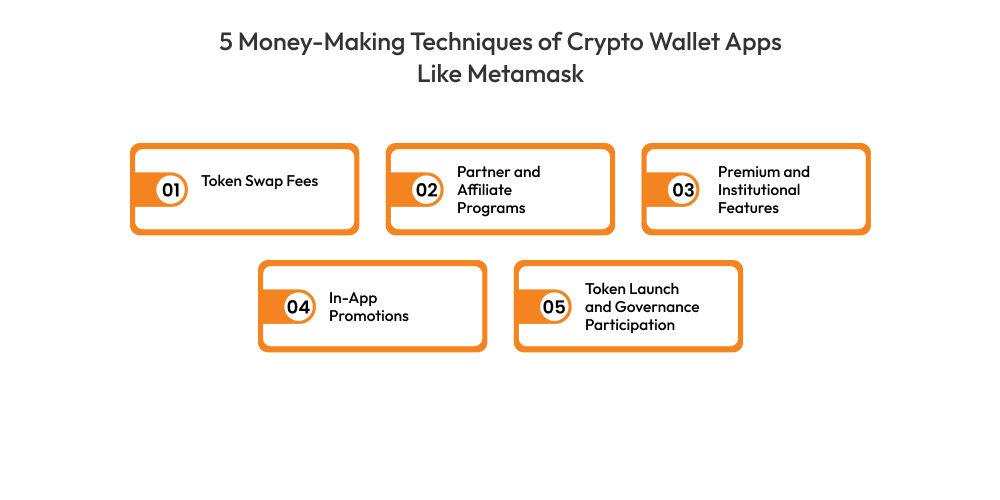
- Token Swap Fees
- Partner and Affiliate Programs
- Premium and Institutional Features
- In-App Promotions
- Token Launch and Governance Participation
1. Token Swap Fees
Built-in token exchange functionality is one of the key income streams for Metamask clone apps. When users swap cryptocurrencies directly within the wallet, a modest service fee (usually between 0.3% and 0.875%) is charged for each transaction. With large daily volume, these micro-fees add up to considerable revenue for the platform.
2. Partner and Affiliate Programs
Metamask clone apps frequently work with third-party services such as decentralized exchanges (DEXs), staking systems, and hardware wallets. When customers connect with these services via the wallet interface, the wallet app receives a commission or referral fee.
According to the crypto wallet development services provider, these collaborations aid in the monetization of traffic while maintaining a positive user experience.
3. Premium and Institutional Features
MetaMask, for example, has begun to offer institution-specific services, such as MetaMask Institutional. These features include sophisticated trading tools, custodial wallet connectivity, and compliance monitoring. Businesses and high-net-worth clients pay a premium to have access to these exclusive services, resulting in a constant income stream.
4. In-App Promotions
MetaMask clone apps can charge blockchain projects or dApps to boost their exposure within the app, such as sponsored listings or promoted integrations. Being highlighted can increase user engagement for the partner and provide additional income for the wallet provider.
5. Token Launch and Governance Participation
Some wallet programs either create their own coins or use governance tokens. They gain from ecosystem growth by staking, holding, or participating in incentive schemes. When the wallet keeps treasury cash or produces a dividend on token holdings, it might provide passive revenue for development and operations.
How Dev Technosys Will Help You to Develop a Crypto Wallet App Like Metamask?
Dev Technosys, a leading cryptocurrency wallet development company, can help you develop a crypto wallet app like MetaMask with expert blockchain developers, modern tech stacks, and end-to-end support. From UI/UX design to smart contract integration and multi-platform deployment, they ensure seamless performance, top-notch security, and regulatory compliance.
With deep industry experience and agile development methods, Dev Technosys delivers scalable wallet solutions tailored to your business goals.
Frequently Asked Questions
Find answers to the most common questions related to this article.
The cost to build a crypto wallet app like MetaMask typically ranges from $8,000 to $25,000, depending on features, security, platform support, design complexity, and the development team’s location and expertise.
To create a crypto wallet app like MetaMask, it typically takes 3 to 6 months, depending on feature complexity, security implementation, platform support, and the development team’s experience and resources.
Technologies to make a crypto wallet app like MetaMask include React.js for the frontend, Node.js for the backend, Web3.js or Ethers.js for blockchain interaction, Solidity for smart contracts, and tools like MetaMask SDK for Web3 wallet integration.
A crypto wallet app should support popular blockchain networks like Ethereum, Binance Smart Chain, Polygon, Avalanche, and Layer 2 solutions to ensure broad compatibility, fast transactions, and access to a diverse range of decentralized applications.
Integrate token swap functionality by connecting your wallet to decentralized exchanges (DEXs) via APIs or crypto wallet SDKs, or develop custom smart contracts to enable seamless, secure, and instant cryptocurrency swaps within the app.
Integrate Ethereum blockchain by using libraries like Web3.js or Ethers.js to connect the wallet with Ethereum nodes, enabling transactions, smart contract interactions, and real-time blockchain data retrieval securely within the app.
To create a MetaMask-style wallet for dApps, build a secure UI, integrate Web3.js or Ethers.js, support Ethereum-based networks, manage private keys locally, and enable dApp connections using WalletConnect or similar protocols.