
















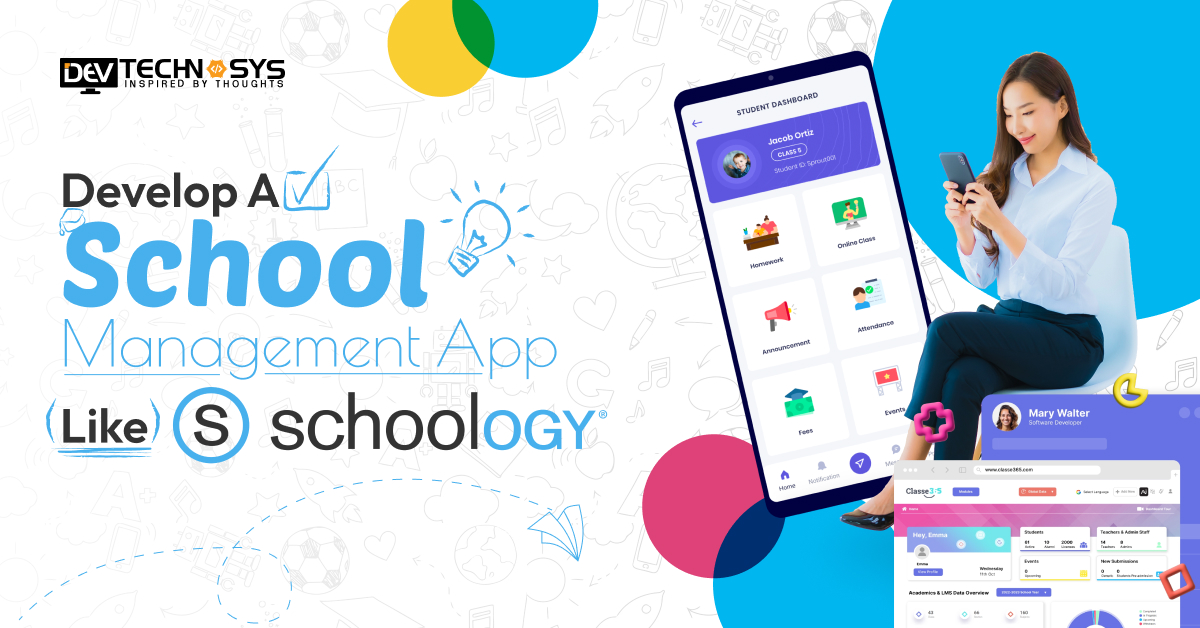
“All-in-one LMS”
Have you ever thought about how cool it would be to have a special app that helps your school work better?
Well, apps like Schoology are made just for that!
They help teachers, students, and parents stay connected, share homework, take tests, and learn new things all in one place.
It’s like having your whole classroom on your phone or tablet!
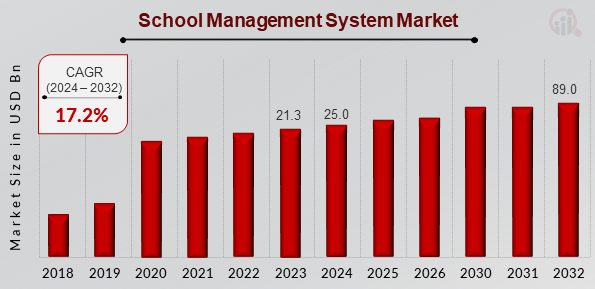
The market for school task management apps, worth $25 billion in 2024, is forecasted to grow to approximately $89 billion by 2032, reflecting a strong shift toward educational digitization and automation.
The above data shows that investing in the school management app development is a huge profit-making opportunity for startups and entrepreneurs.
Let’s dive into this blog to explore how to develop a school management app like Schoology and other related terms or information.
What is Schoology?
The Schoology app is a mobile version of the Schoology learning management system. It’s meant to make it easier for students, teachers, and parents to talk to each other and work together. It can be used on both iOS and Android devices and lets users access course materials, turn in tasks, join conversations, and keep track of their academic progress while they’re on the go. The app can be used both online and offline, so you can keep learning even when you’re not online.
- Course Management
- Assignment Submission
- Communication Tools
- Parent Access
Present and Future Statistics of School Management Applications
- It is expected that the market for the best management app for after school will grow from $25 billion in 2024 to about $89 billion by 2032.
- The world market is expected to grow at a compound annual growth rate (CAGR) of 2% from 2024 to 2032.
- North America had the biggest market share for school control apps around the world.
- In 2023, the market was led by the previous School Management System group.
- The big names in the business are Abbott Laboratories (US), Stryker Corporation (US), DePuy Synthes (US), and B. Braun Melsungen AG (Germany).
5 Best School Management Apps Like Schoology
Find out about the five best school management systems, like Schoology, that make it easier for kids, teachers, and parents to communicate, get more done, and improve learning in today’s schools.
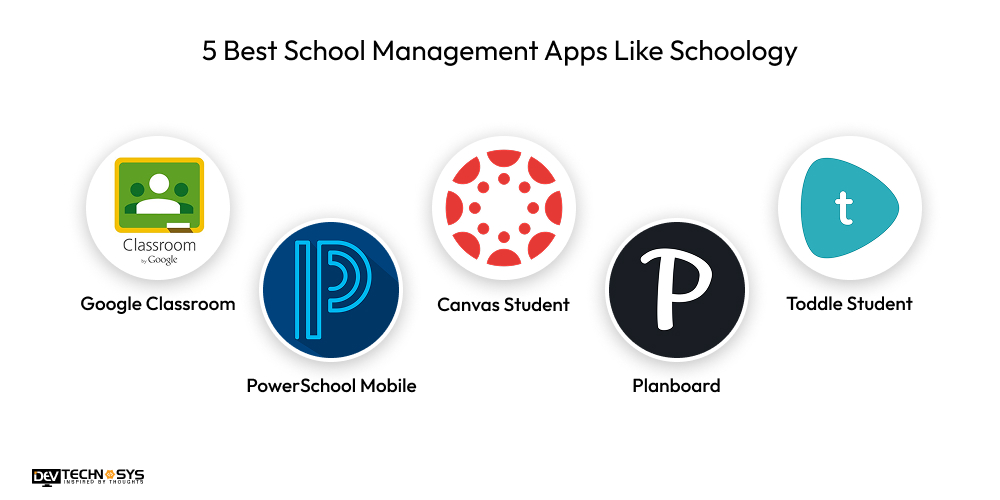
| App Name | Launch Year | Downloads | User Rating | Platform Availability |
| Google Classroom | 2014 | 100M+ | 4.1 | Android/iOS |
| PowerSchool Mobile | 2015 | 5M+ | 4.2 | Android/iOS |
| Canvas Student | 2011 | 10M+ | 4.7 | Android/iOS |
| Planboard | 2011 | 100K+ | 3.8 | Android/iOS |
| Toddle Student | 2019 | 100K+ | 4.4 | Android/iOS |
Why Startups and Businesses Want to Invest in School Management App Development?
The education sector is rapidly evolving, and technology plays a pivotal role in this transformation. Startups and businesses recognize immense potential in student information system app development for several compelling reasons.
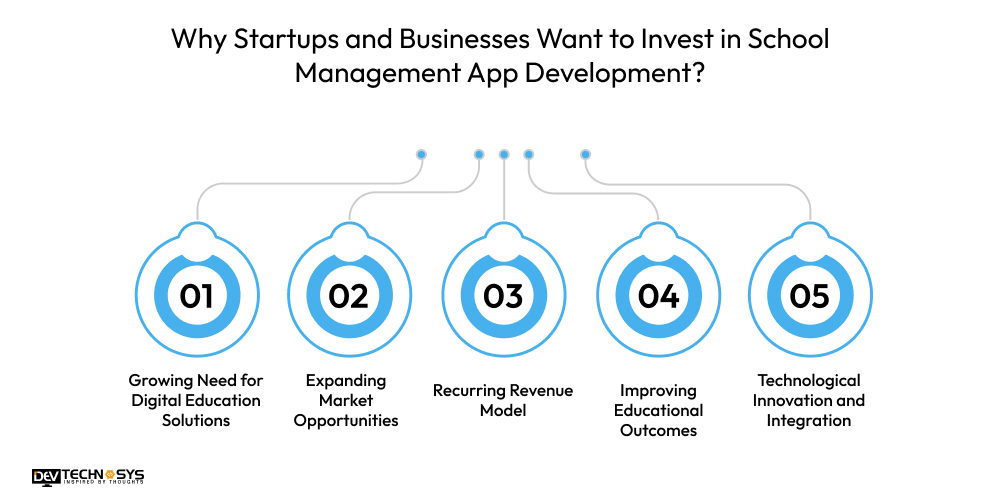
1. Growing Need for Digital Education Solutions
As e-learning and blended learning models gain popularity, schools are looking for effective technologies to streamline administrative operations, communication, and academic administration. School administration applications address this requirement by providing centralized platforms for managing attendance, grading, scheduling, and communication, making them extremely popular.
2. Expanding Market Opportunities
Over the next ten years, the global market for school management software solutions is likely to grow very quickly. As schools throughout the world transition to digital infrastructure, there is a large market to grab, encouraging entrepreneurs and enterprises to invest early and build a solid footing.
3. Recurring Revenue Model
Many school administration applications rely on subscription or license models to generate continuous and predictable revenue streams. This recurring income model appeals to investors because it provides stability and scalability, allowing organizations to develop steadily.
4. Improving Educational Outcomes
These school management software development solutions improve educational results by enhancing communication among instructors, students, and parents, as well as streamlining administrative tasks. Businesses see value in offering solutions that not only benefit schools but also improve learning outcomes.
5. Technological Innovation and Integration
The industry has several chances to combine cutting-edge technologies such as artificial intelligence, analytics, cloud computing, and mobile accessibility. Startups are keen to innovate, offering sophisticated features such as individualized learning routes, real-time statistics, and seamless interfaces to differentiate their offerings in a competitive market.
How Can AI Make School Management Apps Work Better?
- AI can recognize student faces or behavior patterns to mark attendance automatically, saving time and reducing manual errors.
- AI analyzes student performance data to create tailored learning plans that match individual strengths, weaknesses, and learning speeds.
- AI can grade quizzes, assignments, and essays automatically, providing instant feedback and reducing teacher workload significantly.
- AI analyzes class availability and teacher schedules to automatically generate conflict-free, efficient school timetables.
- AI enables real-time language translation in communication tools, breaking barriers for multilingual school communities.
7 Robust Steps to Develop a School Management App Like Schoology
Now the wait comes to an end. We provide a step-by-step guide to build a school management app like Schoology; these steps clear all doubts and confusions to create a successful mobile app. So, let’s take a closer look at the school management mobile app development process:
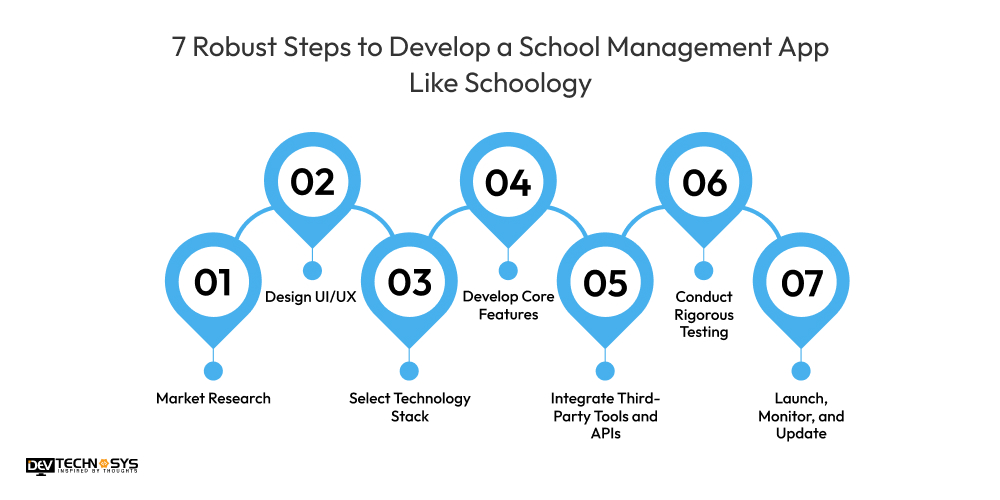
1. Market Research
In the first stage to develop an app like Schoology, understand the needs of schools, teachers, students, and parents. Look at rivals like Schoology to find out what features and gaps they need to fill. Hire software developers to define your app’s unique value proposition, target audience, and key functionalities to create a focused development plan.
| What are customer needs and preferences? |
| Who are the main competitors? |
| What challenges do users face with existing solutions? |
2. Design UI/UX
Move to the second stage to build an app like Schoology, creating user-friendly wireframes and prototypes that emphasize simplicity and ease of navigation. Ensure the design caters to different users—students, teachers, and administrators—with clear workflows. Mobile responsiveness and accessibility should be priorities to guarantee smooth experiences across devices.
| How can the interface be simplified for easy navigation? |
| How can user feedback be incorporated into the design? |
| What visual hierarchy will guide user attention effectively? |
3. Select Technology Stack
Choose suitable technologies for front-end (React Native, Flutter), back-end (Node.js, Django), database (MySQL, MongoDB), and cloud services (AWS, Google Cloud). Hire ServiceNow developers to prioritize scalability, security, and performance to support multiple users and data-intensive operations typical in educational apps.
| Which back-end technologies offer scalability and security? |
| What cloud services provide reliable hosting and backups? |
| What front-end frameworks best support cross-platform development? |
4. Develop Core Features
Coming to the fourth stage to create an app like Schoology, build essential modules like course management, assignment submission, grading system, communication tools, calendars, and notifications. Ensure real-time updates and smooth collaboration between users. Implement role-based access controls to manage permissions for students, teachers, and administrators.
| What key modules must the app include (e.g., courses, assignments)? |
| How will users submit and track assignments? |
| What calendar and scheduling features are essential? |

5. Integrate Third-Party Tools and APIs
Hire experienced developers from a software product development company to integrate services such as Google Drive, Microsoft Office, plagiarism checkers, and video conferencing tools. These integrations enable richer content sharing, live classes, and streamline administrative workflows, improving overall user engagement and efficiency.
| Which third-party services enhance learning experiences? |
| Are video conferencing tools like Zoom or Teams needed? |
| What payment gateways are required for subscriptions? |
6. Conduct Rigorous Testing
Perform thorough software testing services, including functional, usability, performance, security, and compatibility tests. Find bugs early and fix them to make sure the launch goes smoothly. Beta testing with actual users, like teachers and students, can provide valuable feedback for improvements.
| What types of testing are essential (functional, usability, security)? |
| How will performance be measured under heavy user load? |
| When and how will beta testing with real users occur? |
7. Launch, Monitor, and Update
In the last stage, assemble a highly skilled development team from an education app development company to deploy the app on relevant platforms (iOS, Android, Web). Always keep an eye on speed, user comments, and analytics to find ways to make things better. Regularly update the app with new features, security patches, and performance improvements to keep users engaged and satisfied.
| Which platforms will the app launch on first? |
| How will user onboarding be handled after launch? |
| How will communication with users about updates be maintained? |
10 Simple and Premium Features for a School Management App Like Schoology
All of these features work together to make a complete and easy-to-use school management system that helps teachers and students do their best.
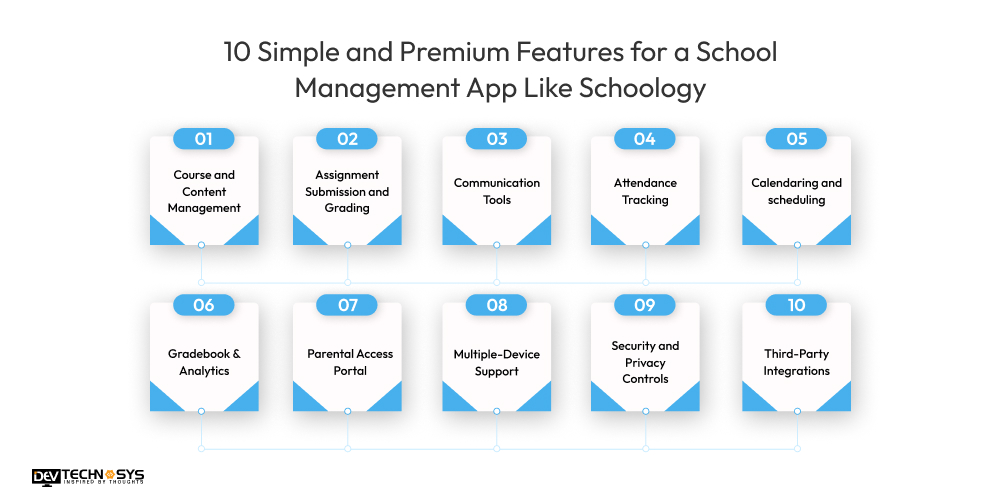
1. Course and Content Management
The Schoology clone app enables instructors to develop, organize, and distribute courses, lessons, and multimedia materials.
2. Assignment Submission and Grading
A similar app like Schoology allows students to submit tasks online, and teachers can evaluate, grade, and offer timely feedback using the app’s integrated grading system.
3. Communication Tools
Include messages, announcements, and discussion forums to allow for seamless interaction between students, instructors, and parents, boosting cooperation and involvement.
4. Attendance Tracking
Schoology clone app provides an easy-to-use attendance system that allows instructors to track student attendance and provide reports for administrators and parents.
5. Calendaring and scheduling
Integrate a dynamic calendar to handle class schedules, examinations, assignment deadlines, and school activities, and utilize reminder alerts to keep users informed.
6. Gradebook & Analytics
Schoology alternatives provide a complete gradebook that monitors student progress over time, coupled with analytics dashboards to assist instructors and parents in monitoring academic achievement.
7. Parental Access Portal
Create separate parent accounts to track their children’s attendance, grades, assignments, and get crucial notifications, therefore increasing parental participation.
8. Multiple-Device Support
The school dismissal manager app ensures that it operates seamlessly on smartphones, tablets, and PCs, with offline access options to accommodate various learning situations.
9. Security and Privacy Controls
Implement robust authentication, data encryption, and role-based access to protect sensitive information and ensure compliance with privacy requirements.
10. Third-Party Integrations
Schoology alternatives enable connectivity with popular technologies, including Google Drive, Microsoft Office, plagiarism checkers, and video conferencing platforms.
How Much Does it Cost to Develop a School Management App Like Schoology?
The cost to build a school management app like Schoology can range from $8,000 to $25,000, depending on its complexity, features, and platform (iOS, Android, or web). The most basic versions have basic features like managing courses, assigning work, and communicating.
More complicated apps with data, third-party integrations, and custom security can make prices go up. Designing the UI and UX, testing, and ongoing support are all extra costs. The location of the tech stack and development team also has a big effect on the total cost of custom software development.
| School Management App Development | Estimated Cost | Time Frame |
| Basic Mobile App Development | $8000 – $12000 | 2 to 4 Months |
| Mid-Premium Mobile App Development | $13000 – $21000 | 4 to 8 Months |
| High-Premium Mobile App Development | $25000+ | 9+ Months |
What Are the Key Factors That Can Affect the School Management App Development Cost?
The budget and timeline to develop school management system software are affected by many things, such as the number of features, the complexity of the app, the platform chosen, the quality of the design, the location of the development team, the need for integration, the need for security, and the need for ongoing maintenance.
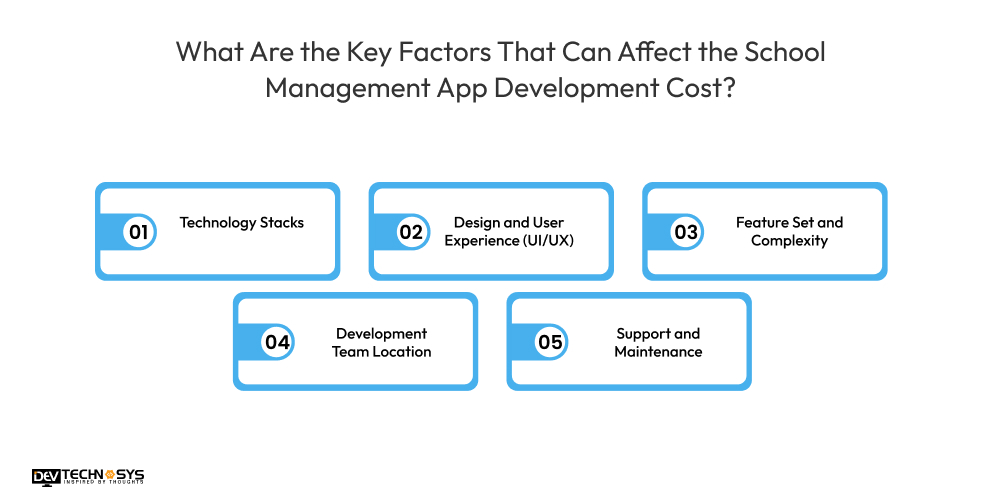
1. Technology Stacks
The choice of technology stack has a significant influence on development costs. Using complex frameworks or custom-built solutions may incur additional costs, whereas established, well-supported technologies might save time and money.
The necessity for scalability, security, and integration capabilities has an impact on technology selections and total enterprise product development budget.
| Component | Technology Stack | Estimated Development Cost (USD) |
| Frontend (Mobile) | React Native / Flutter | $8,000 – $15,000 |
| Swift (iOS) + Kotlin (Android) | $12,000 – $22,000 | |
| Backend | Node.js + Express | $5,000 – $10,000 |
| Django (Python) | $6,000 – $11,000 | |
| Laravel (PHP) | $4,000 – $8,000 | |
| Database | PostgreSQL / MySQL | $1,000 – $3,000 |
| MongoDB | $1,500 – $3,500 | |
| Admin Panel | React + Node.js / Vue.js | $3,000 – $6,000 |
| Cloud Hosting | AWS / Google Cloud / Azure | $2,000 – $5,000 |
| Payment Integration | Stripe / Razorpay / PayPal | $1,500 – $3,000 |
| Mapping & Location | Google Maps API / Mapbox | $1,000 – $2,500 |
| Notifications | Firebase / OneSignal | $500 – $1,500 |
2. Design and User Experience (UI/UX)
High-quality UI/UX design makes the software more intuitive and entertaining, but it comes at a higher school management app development cost. Custom visuals, animations, and responsive designs for many devices require expert designers and longer production times.
A well-designed software increases user pleasure while requiring a larger initial cost to develop a school management app like Schoology.
| Design Quality | Cost Estimation |
| Basic Design | $8,000 – $10,000 |
| Complex Design | $12,000 – $18,000 |
3. Feature Set and Complexity
The price goes up or down straight with the number of traits and how complicated they are. Basic apps with essential features are less expensive, but adding additional modules like as real-time collaboration, analytics, and third-party interfaces dramatically increases development time and costs.
Complex workflows and adaptations demand additional resources, increasing the Schoology app development cost.
| Basic Features | Estimated Cost | Advanced Features | Estimated Cost |
| Course Management | $3,000 – $5,000 | Video Conferencing Integration | $5,000 – $7,000 |
| Assignment Submission | $2,000 – $3,000 | AI-Powered Personalized Learning | $7,000 – $10,000 |
| Attendance Tracking | $1,500 – $2,000 | Offline Access | $4,000 – $7,000 |
| Gradebook | $3,000 – $4,000 | Third-Party Integrations | $3,000 – $6,000 |
| Communication Tools | $2,500 – $4,000 | Security Enhancements | $2,000 – $4,000 |
4. Development Team Location
Because labor prices vary throughout the world, where the development team is situated has an impact on pricing. Hire teams in North America or Europe from a custom software development company typically charge more than those in Asia or Eastern Europe.
However, communication, quality, and time zone alignment are all critical issues in addition to the Schoology app development cost.
| Developers Experience level | United States | United Kingdom | Southeast Asia | Eastern Europe |
| Junior-level | $15 – $25 | £14 – £24 | $12 – $22 | $10 – $20 |
| Mid-level | $30 – $50 | £27 – £44 | $25 – $35 | $25 – $33 |
| Senior-level | $60 – $80 | £50 – £65 | $40 – $55 | $40 – $50 |
5. Support and Maintenance
Post-launch support and maintenance are required to correct issues, update functionality, and ensure security. Ongoing costs are determined by the app’s complexity and the frequency of updates. Budgeting for frequent maintenance allows the program to function smoothly and adapt to users’ changing demands over time.
| Services | Estimated Annual Cost (USD) |
| Bug Fixes | $1,000 – $3,000 |
| OS & Device Updates | $2,000 – $4,000 |
| Performance Optimization | $1,000 – $2,500 |
| Server Maintenance | $1,500 – $3,500 |
| Security Updates | $1,000 – $2,000 |
| Third-Party API Updates | $1,000 – $2,500 |
| Feature Enhancements | $2,000 – $5,000 |

5 Monetization Techniques of School Management Apps Like Schoology
By using all of these ways to make money, top school management apps can make the most money possible while still giving people useful services. This will ensure their long-term growth and success.
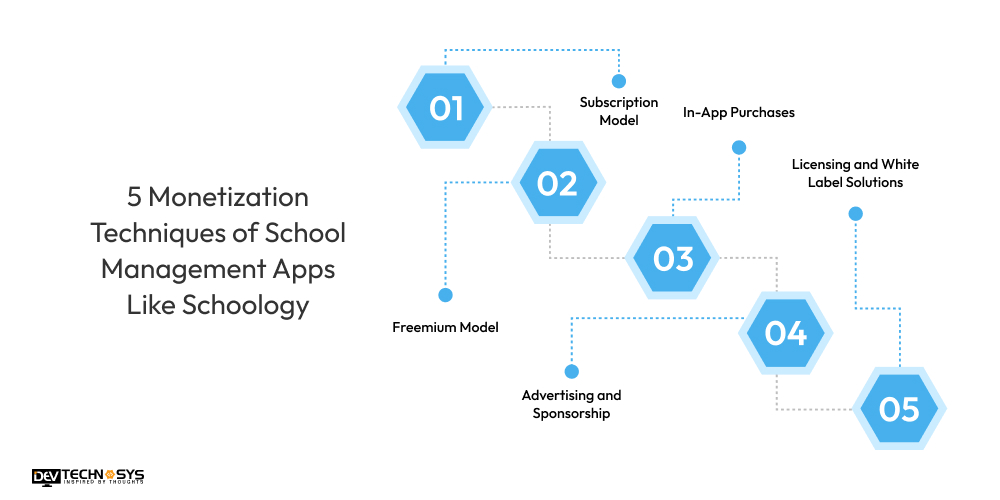
1. Subscription Model
One of the most frequent monetization strategies is to provide the software through subscription plans. Schools, instructors, and districts pay monthly or yearly fees to have access to premium services including sophisticated analytics, extra storage, and improved communication capabilities. Tiered subscriptions enable consumers to select plans depending on their demands and budgets, resulting in a consistent, predictable income stream.
2. Freemium Model
A similar app like Schoology provides a free basic version with key features to attract a wide user base. Users may then upgrade to paid plans or buy add-ons such as more storage, personalized branding, or premium support. This method helps to establish trust and provide value before clients commit financially, resulting in improved conversion rates over time.
3. In-App Purchases
Users may personalize their experience by making extra in-app payments for additional course materials, specialty tests, or unique content. According to the ServiceNow development company, schools or instructors can pay for these extras to improve learning results without committing to a full subscription, which generates incremental income.
4. Advertising and Sponsorship
Incorporating strategically placed advertising or sponsored content might create cash without charging consumers directly. To prevent interfering with the user experience, advertisements should be non-intrusive and relevant to the educational sector. Partnerships with educational publishers or technology companies may create sponsorship opportunities.
5. Licensing and White Label Solutions
Selling licenses or white-label versions of the program allows schools, educational institutions, and resellers to personalize and brand the platform as their own. This business-to-business approach may command higher costs and longer-term contracts, making it desirable to enterprises looking for customized solutions.
Conclusion
To develop a school management app like Schoology, you need to plan carefully. First, understand what students, teachers, and parents need. Then, design easy-to-use screens and choose the right technology. Build important features like courses, attendance, and messaging. Evaluate the application to ensure its functionality is optimal. Finally, launch and keep improving it. If you want a great app, working with a good school management software development company can help make everything easier and better. They know how to create apps that schools love!
Frequently Asked Questions
Q1. How Much Does it Cost to Develop a School Management App Like Schoology?
The cost to build a school management app like Schoology typically ranges between $8,000 and $25,000, depending on the features, design, platforms, and location of the development team. Advanced features and ongoing maintenance can increase the overall budget.
Q2. How Long Does It Take to Create a School Management App Like Schoology?
It usually takes between 3 and 6 months to create a school management app like Schoology. This depends on how complicated the app is, what features it needs, how it needs to look, and the size and skill level of the development team working on it.
Q3. Which Technologies Are Used to Make a School Management App Like Schoology?
Technologies used to make a school management app like Schoology include React Native or Flutter for front-end, Node.js or Django for back-end, MySQL or MongoDB for databases, and AWS or Google Cloud for hosting.
Q4. Why Should I Invest in Building a School Management App Like Schoology?
Investing in a school management app like Schoology offers long-term growth potential, meets rising demand for digital education tools, enables recurring revenue through subscriptions, and helps schools streamline operations, improve communication, and enhance learning outcomes.
Q5. Can I Integrate the App With Existing School Systems?
Yes, you can integrate the app with existing school systems using APIs. This allows seamless data exchange with student information systems (SIS), learning management systems (LMS), and ERP platforms, enhancing functionality and reducing data duplication.