


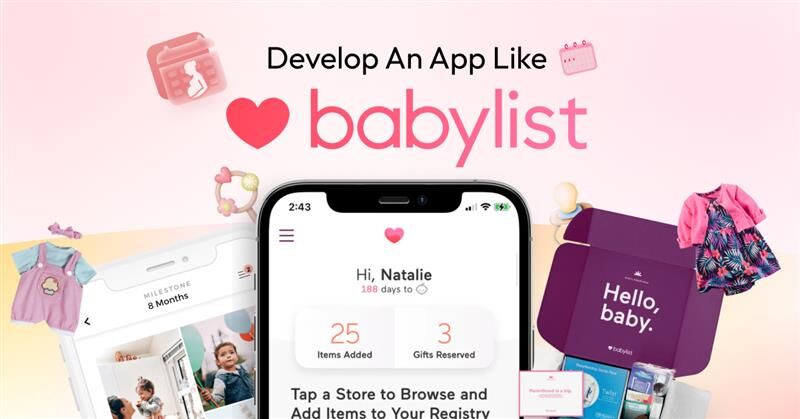
Becoming a parent is a wonderful experience, but the seemingly endless choices in baby gear can be daunting.
What if there were an app that turned this chaos into calm, a universal baby registry that allows you to add every item you dream about, from any store?
Babylist has changed this experience for millions of people, making it easy and enjoyable. This demand creates excitement for anyone who wants to start their business in this space.
Key takeaways:
-
- The baby registry app market is expanding rapidly, offering great opportunities for startups to tap into personalized parenting and gift-giving experiences.
- BabyList’s success highlights the need for user-friendly design, multi-platform access, and integration with e-commerce stores for a seamless gifting experience.
- Core features include registry creation, product search, price comparisons, group gifting, user profiles, and integration with online retailers and baby product brands.
- Apps like BabyList, MyRegistry, and Amazon Baby Registry offer inspiration for UX, diverse features, and smart ways to combine commerce with user needs.
Are you excited to build your own solution that people want, like Babylist?
This blog post is going to show you how to build an app as fun and intuitive as Babylist.
We will cover what to include in your app, an overview of the tech stack to build it, and a real breakdown of how much it will cost to develop an app like BabyList.
Let’s get ready to take your ideas and turn them into a meaningful application!
What is a Babylist?
Babylist is a universal baby registry that was launched in 2011 by Natalie Gordon. It lets expecting parents add items from any store, including Amazon, Target, or local boutiques, all in one spot. Babylist also allows for cash funds, doula services, group gifting, etc.
The baby tracking app, like Nara and Babylist, has also become one of the leading pregnancy tracker apps with features such as checklists. And expert guides, and even the Hello Baby Box. Their mobile app has around one million downloads on Android products and is rated very highly on both platforms, which makes it user-friendly.
Look What Market Stats Say about BabyList
- It is the number 1 in the U.S. under Childcare for Similarweb, and on average, users spend a time of 4-10 minutes with a bounce rate of about 54% to 61%.
- Babylist gets around 9-11 million web visits a month.
- Their global pregnancy tracker app space is around $301 million in 2024, is expected to grow to $357 million in 2025, and reach $1.38 billion after 2033, with a CAGR of ~18.4% from 2025-2033.
- Some other forecasts even estimated the space to be $2 billion in 2023, which is expected to double again in about USD 4.1-4.5 billion from 2031-2033, with a CAGR of around 9-9.5%.
- In the U.S., the combined market is projected to have generated $269 million in 2023, which should grow to $731 million by 2030, at approximately 15.3% CAGR.
- Over 96% of Baby Lists traffic comes from the U.S., with traffic that comes from Canada and Australia.

- Baby List has about $6-8 million monthly eCommerce revenue, with an average order value of $225-$250.
- According to Grandview Research, a related segment—pregnancy tracking and postpartum care apps — was valued at $217 million in 2022, growing to USD 257 million in 2023, with a high CAGR of ~19.1% expected through 2030.
- The overall platform (beyond pregnancy and maternity) exceeded $500 million in annual revenue as of 2025.
- Babylist’s growth was 10–15% YoY in eCommerce revenue from 2024 to 2025. The conversion rate is approximately 2.0% – 2.5%. Approximately 65% of purchases are made from desktop devices, while 35% are made from mobile devices.
- 70% direct, 12% organic search, 9% paid search traffic gained. Babylist’s breast pump Medicaid program on its own generated $50 million.
Why Businesses Invest to Develop an App Like BabyList?
You’re not the only one who thought about investing in a universal baby registry platform. But you can be the #1 person in 2025 who seriously considered it.

1. Strong Demand + Niche Marketplace:
The “preparing for baby” market is evergreen and consistently showing growth. Expectant parents are inundated with choices and actively looking for tools to ease this overwhelming process. A universal registry app would be a direct response to this pain point, providing substantial value.
2. Universal Appeal:
The baby tracking app development solutions enable parents to add items from any retailer on Babylist, whereas a single-store registry provides a dedicated solution for a single store. We all know there are limitations and restrictions on what is sold and available by any one retailer.
Parents greatly favor the flexibility of being able to choose exactly what they want and need from all available items, regardless of which store they may be available from. This allows for maximum utility of the registry for the gift giver.
3. Monetization Potential:
There are many more forms of revenue derivation than just direct app purchases. This includes partners paying for affiliate commissions when a consumer makes a purchase from their linked retailers, sponsored content, premium app features (such as higher-quality tracking or a paid personalized consultation), in-app sales of curated products, and many other options. The “Hello Baby Box” model is another successful approach to partnerships and revenue generation.
4. Community & Content Hub:
If businesses build an app like Flo Period, it can serve as a content hub for all new parents, not just a registry app. An app can offer pregnancy trackers, week-to-week early development and growth tips, product and service reviews, and community forums.
Having this additional content and information can foster loyalty and engagement among users, which can require your app to be most useful to them throughout their parenting journey.
5. Data & Insights:
The personalized baby gift app collects data on consumers, including the products they like, what they have purchased, and how they made their purchases.
The app can provide valuable insights predisposed to targeted marketing opportunities around product development, buying habits, and trending products in the baby market, which could have upside benefits as a competitive element.
Top BabyList Alternatives in 2026
Look, we understand you’re excited to learn about the process of developing an app like BabyList. But do you know what’s more important than that? Learning about top babylist alternatives. Here, we have compiled a list of Babylist clone applications for 2025.
Platform | Launch Date | Estimated Downloads/Reach (R) |
| MyRegistry.com | 2005 | 1M+ app downloads / 2M+ users |
| Poppylist | 2020 | Niche audience (10K–50K+ users) |
| Zola Registry | 2013 | 500K+ users (part of Zola platform) |
| Amazon Baby Registry | 2010 | 10M+ users (Amazon app-wide) |
| Target Baby Registry | 2013 | 1M+ app downloads / high in-store use |
1. MyRegistry.com
A true universal registry for all life’s occasions – not just babies. Add items from any retailer – online or brick-and-mortar – make it easy to even link and sync an existing store registry from a known store.
Add in-store purchases using a barcode scanner and cash gifts that can be limited to experiences or large purchases.
2. Poppylist
A more modern take on a baby registry, where parents don’t have to worry about gift exchanges. They can exchange gifts for cash before shipping takes place, or they can hold off on deliveries until they’re truly ready to deal with the clutter.
The platform features a curated shop and even allows you to contribute to services. A new way to prepare for baby essentials.
3. Zola Registry
Generally known for wedding registries, Zola offers a solid baby registry. You can take advantage of a curated shop, universal adding items, and no fees for cash funds. You can also receive a completion discount, and you have the option to exchange gifts before they are shipped, which makes returns easier.
4. Amazon Baby Registry
Takes advantage of the large variety from Amazon and Prime, along with a universal list. Welcome box and completion discount. Includes diaper fund, group gifting for larger items, as well as an extended return period, making it a great option for some.
5. Target Baby Registry
A favorite for in-store convenience and selection. The welcome kit includes samples and coupons, along with the completion discount. Easy returns and the ability to complete your list on your app make it a favorite for many parents!
Want a chatbot demo or pricing? Fill the form and talk to our experts today.
Pick what you need below — you can select more than one — then tap Get detail to continue.
-
Chatbot demo dashboard
-
Cost to develop an app
-
Industry report
-
Case study
Stages To Develop an App Like BabyList
The time has come for you to undergo this remarkable process to develop an app like BabyList. In this section, we have compiled a step-by-step guide to help you create your universal baby registry application.
1. Discovery & Planning:
Let’s begin the first stage of childcare management app development, where you should conduct full market research to understand the needs of your users and what others are offering. Clearly articulate your core features, such as a universal registry (allowing additions from any store), cash funds, group gifting, and a personalized checklist.
Outline the app’s one “unique value proposition” and user flow – a technical specification and project road map will be created.
2. UI/UX Design:
In the second stage to make an app like BabyList, we will look to create a user-friendly, highly usable, and visually aesthetic interface during this phase of the project.
Pregnancy is a delicate time for expectant parents and their gift-givers, so it will be important for us to ensure that the design is not only reassuring but straightforward to navigate.
The UI/UX design will involve process steps to include wireframes, prototypes, and user testing to guarantee ease of use for expectant parents and gift-givers.
3. Development & Integrations:
This is where the code becomes a reality. Hire experienced developers from a mobile application development company to work on the front-end and back-end development to implement all the painstakingly defined features.
Significant integrations will be made with primarily e-commerce platforms for universal registry linking, payment gateways for cash fund payments, and for information sharing, as well as potentially shipping, with other third-party APIs. It will be critical to prioritize data security and data privacy measures.
4. Testing & Quality Assurance:
Move to the second-to-last stage to create an app like BabyList. Testing is essential to finding and addressing bugs, checking performance, and ensuring the app functions properly across devices and operating environments.
We will approach testing from user testing, functional testing, usability testing, performance testing, and security audit perspectives to ensure the app is stable and reliable.
5. Deployment & Post-Launch Support:
Consult with a professional childcare management app development company for a tested and launched app on app stores for iOS and Android.
After the launch of the app, continuous monitoring, bug fixing, updates, and feature enhancements are essential to grow and satisfy users, among other benchmarks of success for their strategy in staying relevant in the market. User-driven feedback and trend adaptation must also take place.
Some Features of an App Like BabyList
Having a list of essential features of BabyList alternatives is crucial to becoming your new universal baby registry empire in 2025. An application like BabyList offers a comprehensive and highly user-friendly experience for parents. Here are the top features to include in a BabyList-like app:
-
Universal Baby Registry
This serves as the fundamental feature, allowing users to add items from any online store or request non-traditional gifts, such as home-cooked meals, cleaning services, and even hand-me-downs.
-
Cash Funds/Group Gifting
Friends and family can donate cash toward big-ticket items (e.g., a stroller or crib), college funds, or even parental leave.
-
Custom Registry Checklist
A step-by-step checklist, personalized to the user’s due date, lifestyle, and preferences, would assist them in identifying essential items from a wide range of categories (nursery, feeding, diapering, etc.).
-
Price Comparison Tool
A pregnancy monitoring app like Ovia allows users to view where registered products are purchased and at what price retailers offer them to gift-givers.
-
Product Guides & Reviews
This holds a vast library of expert-vetted articles, product reviews, and comparisons for various baby gear, thereby assisting parents in making informed comparisons and decisions. This includes “best of” lists and safety information.
-
Pregnancy Tracker
Varied weekly pregnancy updates, baby size comparisons, and additional articles to help with the user’s due date, making the app a continuous engagement experience.
-
Hello Baby Box”/Welcome Kit Offer
A bonus for completing the registry, which may include free samples, coupons, and more from partner brands.
-
Direct-to-Consumer Shop Integration
An e-commerce store in the app, enabling users to purchase products that are curated by the company within the app, often with extras (like BabyList’s 15% registry discount)!
-
Registry Management & Sharing
BabyList clone apps offer simple-to-use features for organizing the registry, tracking gifts purchased, and sharing a registry link with friends and family across various platforms.
-
Community Features/Q&A
BabyList alternatives offer real-time Q&A from other parents or experts, as well as the ability to share experiences in real-time with other parents.

Advanced Features of an App like BabyList
Hey! The essential feature won’t take you to the success board. If you want to build a baby wishlist app, you must have some advanced features that will make your application stand out.
-
AI-Powered Product Recommendations
Recommend products using AI based on the user’s data, preferences, and lifestyle, and ease the decision-making process for parents.
-
Virtual Nursery Planner (AR/VR)
BabyList clone apps enable the creation of usable space in the nursery with features like bookshelves and changing tables, as well as the authenticity of decisions made through augmented reality.
-
Smart Baby Tech Integration
BabyList alternatives connect with IoT baby devices (i.e., monitors, trackers) for centralized management and real-time awareness of the baby’s health & well-being.
-
Post-Partum Support & Resources
Educational materials, local service directories, & product recommendations specifically geared towards maternal recovery and newborn care.
-
Interactive Milestones & Tracking
A childcare app like OWNA allows parents to record & visualize their baby’s growth, development, feeding, and sleep episodes, thus creating a digital memory book.
-
“Hand-Me-Down” Marketplace
A custom baby registry app utilizes a community to locate or list lightly used or unwanted baby items, promoting sustainability and cost savings.
-
Expert Consultations (Telehealth)
A baby product wishlist app schedules in-app, virtual, personalized, and direct time with pediatricians, lactation specialists, or experts in baby sleep.
-
Automated Thank You Note Tracker
Easily acknowledge gifts by tracking & providing user templates for customizable thank-you notes with the help of Registry app development for newborns.
-
Gifting Analytics
A baby shopping list app helps parents understand registry usage, and gift givers can share registry activity to streamline purchases and avoid duplicates.
-
Environmental Product Filtering
Baby planning app provides users with the ability to filter for organic, eco-friendly, non-toxic, or ethically sourced baby products.
A Story About Babylist
Babylist has come full circle, from personal annoyance to a successful team of software engineers and users, to an industry leader and advocate. BabyList was founded in 2011 by Natalie Gordon, a new mom, because she saw a need for a universal baby registry where parents can add items from all stores.
Once purely self-funded, Babylist secured seed funding in 2013, enabling growth and expansion. Success stemmed from the ability to evolve constantly. As a registry in its first iteration, it evolved into a content platform with guides and advice, and ultimately grew into an e-commerce retailer.
In 2024, Babylist reported $240 million in revenue, with projections of $400 million by 2025. This growth has been achieved through strategic partnerships, a deep understanding of its audience, and positioning Babylist as the go-to resource for millions of expectant parents.
Why Do Users Love BabyList This Much?
As an entrepreneur, you are wondering why this app is the most chosen one. Registry app development for newborns like BabyList is the best investment made by the founder. Here we have covered important benefits you need to know about.
1. Universal Registry
This is arguably Babylist’s biggest differentiator. Unlike traditional registries that only represent a single store, Babylist allows you to add items from any online retailer, small boutique, and register even for non-material gifts like meals or babysitting.
Because the registry has no restrictions, parents have the ability to register for exactly what they need and want.
2. Comprehensive Guides & Resources
Babylist is more than just a registry; there is a wealth of expert-vetted guides, product reviews, and informational articles on anything that could include pregnancy week-by-week, newborn care content, product comparisons, and so much more. This is invaluable to new parents who are trying to make decisions out of sheer choice overload.
3. Price Comparison
In addition to the ability to add items to the registry, when adding an item to the registry, Babylist frequently has a high likelihood of price comparison showing from all retailers; as per our example with the stroller above, the new parent can see the best deal available from various retailers.
This benefit for gift-givers is huge, as it allows them to find the best deals and maximize for parents.
4. Community & Support
Babylist create a community. With shared registries, real parent reviews, and helpful recommendations, we intentionally connect pregnant parents to assist networks, reduce feelings of isolation, and offer relatable experiences.
5. User-Friendly Experience & Progression
There is a simple, user-friendly website and mobile app to create, manage, and share registries. Additions and progressions to Babylist occur constantly, like their own curated shop + incorporating health services like ordering a breast pump. All showing that Babylist continues to work towards meeting the changing needs of growing families.
Cost To Build An App Like BabyList
The cost to build an app like BabyList can not simply be estimated as it requires a lot of functionalities, not only does it have a universal registry and extensive content, but also an e-commerce offering.
The cost to develop an app like BabyList generally ranges from $8,000 to $25,000+, and these costs vary widely based on many different factors. Below are seven components that will affect the baby tracking app development cost:
1. Platform (iOS, Android, Web)
If your app is developed for both iOS and Android (native apps), it will invariably cost more than a single-platform app or a cross-platform solution (which have their limitations, but can reduce your initial cost to develop a custom baby registry app).
If you use Babylist as an example, they have a large, robust web platform that also adds significant cost to build an app like Babylist.
Platform Type | Estimated Cost |
| Single platform (iOS or Android) | $2,000 – $3,500 |
| Cross-platform (Flutter, React Native) | $3,000 – $5,000 |
| All platforms (iOS, Android & Web) | $5,000 – $6,000+ |
2. Complexity & Features
A simple registry app will be significantly less expensive than an app that includes advanced features such as AI-driven recommendations, integrated e-commerce (the Babylist shop), interactive pregnancy tracking, community forums and/or video content. “Every complex feature contributes substantial time and cost to create a pregnancy tracking app.
| Feature Level | Estimated Cost |
| Basic registry features only | $3,000 – $4,000 |
| Registry + eCommerce + Pregnancy tracking | $4,500 – $6,000 |
| All advanced features (AI, forums, video) | $6,000 – $8,000+ |
3. UI/UX Design Complexity
A polished, seamless, easy-to-use, and visually attractive user interface and user experience (UI/UX) design will take considerable investment on design, wireframing, prototypes and user testing. This is one of the reasons that affects the BabyList app development cost.
Design Scope | Estimated Cost |
| Basic wireframes & layout | $1,500 – $2,000 |
| Custom UI & animations | $2,500 – $3,500 |
| Premium UX with testing | $3,500 – $4,000+ |
4. Third-Party Integrations
When building an app, if the app will need to integrate with many external services like universal registry linking (pulling their product from somewhere like, Amazon, Target, etc), secure payment gateway integrations, shipping an API, and possibly advertising, the complexity and increased BabyList app development cost.
Integration Type | Estimated Cost |
| Basic (Payment gateway only) | $1,000 – $1,800 |
| Registry APIs + Social Logins | $2,000 – $2,800 |
| Full stack integration (Shipping, Ads, etc.) | $3,000 – $3,500+ |
5. Backend Infrastructure
Each app should include a solid, scalable backend to manage large doses of user data, product information, the volume of transactions, etc. A solid, scalable backend will include server set-up, database design, and API development, all of which increase the cost to make an app like BabyList.
Backend Level | Estimated Cost |
| Basic API & DB setup | $2,000 – $2,800 |
| Scalable backend with admin panel | $3,000 – $4,000 |
| High-load optimized architecture | $4,000 – $5,000+ |
6. Development Team Location and Size
Baby registry app development cost will vary considerably based on locality (e.g., best baby registry app developers in North America or Western Europe will cost more than a team of developers and designers in India or Eastern Europe). The size and expertise of the baby app also directly impact the overall cost of eCommerce app development services.
Team Type | Estimated Cost |
| Small team (India/Eastern Europe) | $1,500 – $3,000 |
| Medium team (Remote global mix) | $3,000 – $4,000 |
| Large in-house team (US/UK) | $4,000 – $5,000+ |
7. Ongoing Maintenance & Updates
Baby registry app development cost affected by this last ongoing maintenance and update too. Post-launch, ongoing expenses include bug fixes, security updates, feature enhancements, server maintenance, and app store fees. These can account for 15-20% of the annual BabyList app development cost.
Maintenance Plan | Estimated Cost |
| Basic (Security patches, bug fixes) | $1,000 – $1,500/year |
| Moderate (Updates + Support) | $1,500 – $2,200/year |
| Full service + Feature upgrades | $2,500 – $3,000+/year |
Tech Stack To Develop An App Like Babylist
Having a list of the best Tech stack required to develop a BabyList clone is essential. In this section, we have compiled a list of some important technology stacks that you need to know.
Component | Technology/Tool | Purpose |
| Frontend (Mobile) | Flutter / React Native / Swift (iOS) / Kotlin (Android) | Cross-platform or native mobile app development |
| Frontend (Web) | React.js / Angular / Vue.js | Building responsive and interactive web interfaces |
| Backend | Node.js / Ruby on Rails / Django / Laravel | Managing server-side logic, APIs, and data processing |
| Database | PostgreSQL / MongoDB / MySQL | Storing user data, registry items, gift lists, etc. |
| Cloud Hosting | AWS / Google Cloud / Microsoft Azure | Hosting backend services, databases, and media assets |
| Authentication | Firebase Auth / Auth0 / OAuth 2.0 | Secure user login, account management |
| Push Notifications | Firebase Cloud Messaging / OneSignal | Sending real-time updates and reminders |
| Payment Integration | Stripe / PayPal / Razorpay | Enabling gift purchases and transaction handling |
| Third-Party APIs | Amazon API / Target API / Shopify API | Fetching product listings and prices from partner stores |
| Analytics | Google Analytics / Mixpanel / Firebase Analytics | Tracking user behavior, app usage, and performance |
| Admin Panel | React + Node.js / Laravel + Vue.js | Internal tool to manage users, orders, and content |
| DevOps & CI/CD | Docker / Jenkins / GitHub Actions / Kubernetes | Automated deployment, version control, and container management |
| Security Measures | HTTPS, JWT, SSL Encryption, Data Masking | Ensuring secure data transmission and storage |
How to Monetize Apps Like BabyList?
Now that you know how to develop a baby registry app, you must be wondering about its ROI. Achieving revenue from an application like BabyList is a complex yet possible process, involving the utilization of its large, engaged user base and the unique data it collects. Additionally, there are five ways to make money for the BabyList registry mobile application:
1. Affiliate Marketing & Commissions
This is BabyList’s first revenue opportunity. They partner with multiple retailers (Amazon, Target, etc.), and when you add items to your registry and purchase products in the app, BabyList earns a commission. Their unique proposition of a universal registry significantly increases commission revenue opportunities.
2. Direct Product Sales (e-commerce)
BabyList is a true direct-to-consumer retailer. BabyList is selling baby products, carefully curated, directly within the app. This allows them to control the entire process, from sales to shipping and customer experience, with a better profit margin.
3. Advertising & Sponsored Posts
Brands connected to the new parent community want to reach Babylist’s unique targeted audience. The app can prove itself by offering advertising placements, sponsoring product placements, agreeing to collaborate on a product review, or providing dedicated content (e.g., sponsored guides) that meets the needs of users while offering companies a way to pay.
4. Premium Features/Subscription Model
GPS tracking app development solutions typically provide a free registry (as it’s a direct-to-consumer retail store), but may offer premium registrations.
Something like an ad free registry, or pages with metrics based on registry behavior, exclusive discounts when they go through the store, early access to new features or rewards (the highest tiers), or offer a specialized virtual call with a baby expert (chefs, experts, educators etc. ) who will teach users what their worth as new parents.
5. Data Monetization (Ethical & Anonymized):
With all the data we have regarding user preferences, shopping behavior, and trends, BabyList can provide anonymized and aggregated market data to brands and manufacturers.
This data can be important for product development and formulating marketing strategies, as long as it is handled in accordance with rigorous privacy policies.

How Does AI Affect the BabyList App?
AI is providing even more value and enhancement to the Babylist app experience, to make it easier and smarter for expecting parents to use. Here are five benefits:
1. Personalized Recommendations
AI will analyze the users’ preferences, browsing history, and when looking for similar registries as a reference, and can recommend products, guides, as well as relevant services, in an explorable but overwhelming universe of baby gear.
2. Content Curation
AI algorithms allow BabyList to regularly pull the most relevant articles, checklists, expert advice, and other content, so the users get “just in time” content around their pregnancy.
3. More Advanced Search
Users can also take advantage of AI search functions, which can understand natural language searches better and help users to find very specific products or information, even if the terms they are using are not exactly aligned.
4. Better Customer Service
AI chatbots can deal with simple questions, provide instant answers, and guide users through some features in the app. By doing this, human customer service can focus on more complicated matters.
5. A Better Group Gifting Experience
AI can help facilitate the group gifting process and provide gifting individuals with complementary items, which simplifies the process and prevents parents from receiving duplicate gifts.
How Dev Technosys Can Help You Build An App Like BabyList?
Hopefully you liked this blog, and now you know. The efficacy of an app, such as BabyList, is rooted in a model that empowers and enables expectant parents in a big life transition. To be able to develop such a comprehensive and user-beloved platform, one must have significant industry knowledge and engineering/software development capacity.
This is where Dev Technosys can help you. Dev Technosys is a leading mobile app development agency that has created healthcare and tracking applications long before them to understand the considerations needed to create secure, scalable, and friendly destination experiences for highly sensitive users.
Our strategic ecosystem and technical expertise give you the confidence to take your position as the leading pregnancy and baby app from vision to reality.
FAQ
Q1. What Are The Must-Have Features For A Babylist-Like App?
- Universal registry (add from any store).
- Cash funds and group gifting.
- Personalized checklists and guides.
- Price comparison across retailers.
- User reviews and community features.
Q2. What Tech Stack Is Typically Used To Create An App Like Babylist?
- Frontend: React Native/Flutter (cross-platform) or Swift/Kotlin (native).
- Backend: Node.js, Python (Django/Flask), Ruby on Rails.
- Database: PostgreSQL, MongoDB.
- Cloud: AWS, Azure, Google Cloud.
Q3. How Long Does It Take To Develop An App Like Babylist?
- A complex app like BabyList with extensive features can take 9-12+ months for initial development.
- This includes discovery, design, development, testing, and deployment phases.
- Simple MVP versions can be built faster, usually 4-6 months.
Q4. What Factors Significantly Impact The Cost To Develop An App Like Babylist?
The cost to develop an app like babylist is $8,000 to $25,000 but it can affect depending on these factors.
- Feature Complexity: More features mean higher costs.
- Platform (iOS, Android, Web): Developing for multiple platforms increases expense.
- UI/UX Design: Custom, intuitive design adds to BabyList app development cost.
- Integrations: Third-party APIs (e-commerce, payments) impact budget.
- Team Size & Location: Developer rates vary geographically.
Q5. How Can An App Like Babylist Generate Revenue?
- Affiliate Commissions: From purchases made through universal registry links.
- Direct Sales: Selling curated products directly through their own shop.
- Sponsored Content/Ads: Partnering with baby brands for promotions.
- Premium Features: Offering subscription for advanced tools or services.


