




















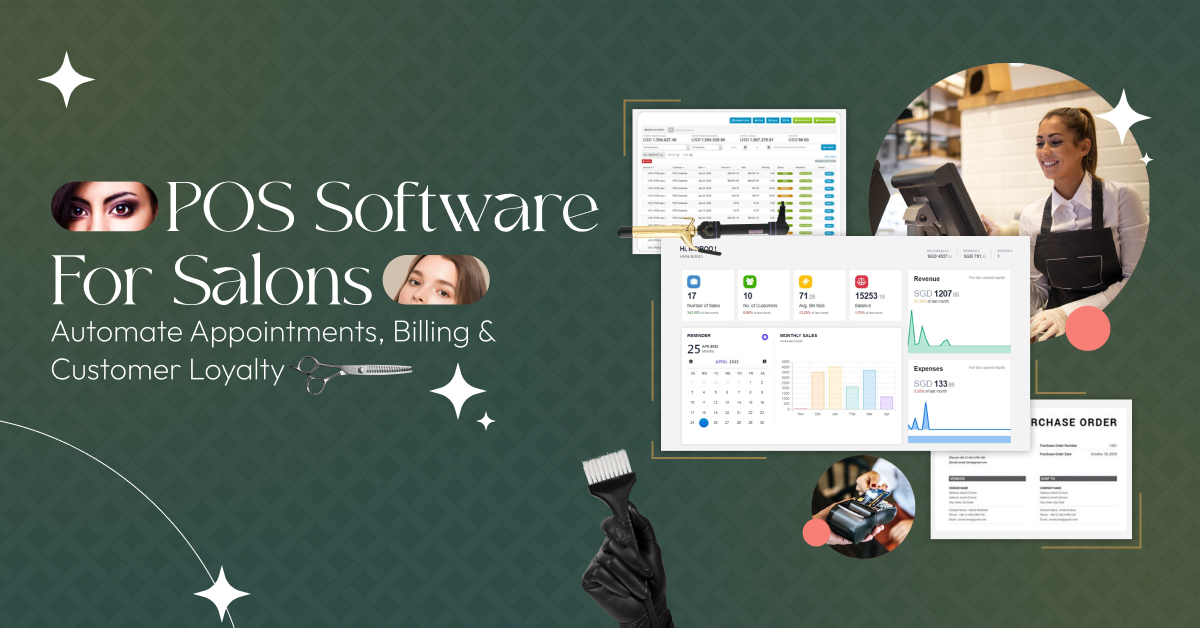
“Renovate your business looks with a salon POS system.”
Do you feel pressure in handling salon customers, billing, and cosmetic products manually? If yes, then you need to build a POS software for salons that can automate all tasks and increase efficiency for small and medium spa owners. There are various salon CRM systems that are used by beauty professionals to manage user concerns and business requirements.
Key takeaways:
-
- The worldwide salon business is valued at $1.2 billion in 2026 which is growing at rate of 8.9% CAGR resulting in a profitable domain.
- Idea of the development approach starting from software consultation to maintenance and market launch.
- Industrial factors that influence the average development cost that is between $8,000 to $25,000 in all regions.
- Access to multiple fashion and luxury units involving users as major contributors along with increase in salon chains.
The idea to create a POS software for salons is unique in the present situation as the industry is growing rapidly. This will help businesses to know answers of questions like how to manage appointments with salon POS.
So, here we will understand the POS software development for salons with detailed information of all topics like features, process, and cost.
Worldwide Salon and Wellness Market
Growing consumer emphasis on self-care and technology integration are driving the robust expansion of the worldwide salon and wellness industry. Projected market size and revenue show substantial growth in beauty salon management software designed specifically for this industry:
- Global salon services market: It was accounted as $122 Billion in 2026 and projected to reach $230.5 Billion by 2034, growing at a 6.7% CAGR rate.
- Alternative estimate: The overall wellness market projected $247 Billion in 2026 and expected to grow to $447.8 Billion by 2032 at a 7.8% CAGR rate.
- Global spa services segment: The revenue is $96.5 Billion in 2026 which will increase to $147.1 Billion by 2030 with a 7.5% CAGR rate.
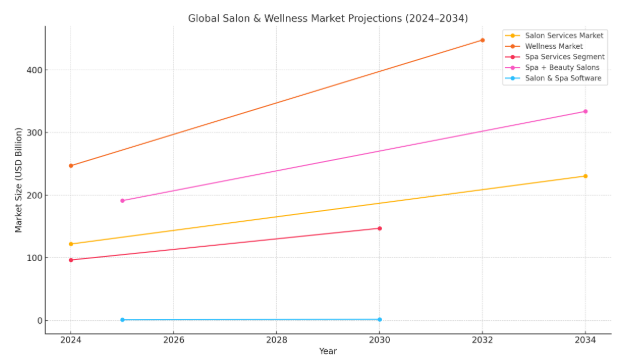
- Spa + beauty salons combined: This segment will make $191.3 Billion by 2026 and will shoot up to $333.8 Billion by 2034 with a 6.38% CAGR rate.
- Salon and spa software sub-market: The market category will account for $1.01 Billion in 2026 that will expand to $1.69 Billion by 2030 with a 10.9% CAGR rate.
What is POS Software?
Businesses utilize a POS system with
Appointment Scheduling System
to maintain inventory, handle payments, manage sales transactions, and optimize operations.
Salon management software is also a POS system that facilitates client administration, reporting, and appointment scheduling in the salon and wellness sector. So, businesses must avail software development services for developing similar portals to increase efficiency and improve customer service.
- Modern spa POS systems support both online and offline transactions.
- Cloud-based salon software that provides role-based access control (RBAC) and real-time data syncing.
- Integrated POS solutions can include CRM, marketing, and payroll tools.
Why Invest in POS Software Development for Salon Business?
Businesses may develop a POS software for salons to improve customer engagement. It centralizes important business operations like scheduling, payments, inventories, and analytics:
1. Streamlined Operations
Basic functions including staff management, billing, and appointment scheduling are automated by salon billing software. This saves staff time and lowers manual errors. Operations become quicker, more effective, and less reliant on paperwork as a result.
2. Enhanced Customer Experience
Using linked technologies, clients can easily make payments, schedule services online, and receive reminders. Employees can provide individualized experiences because of personalized profiles and service histories. So you must create a POS software for salons to enhance customer satisfaction.
3. Data-Driven Decisions
Businesses can manage salon staff and payments with POS systems. Salon managers are able to monitor performance, spot patterns, and modify services as necessary. You must avail POS software development services to get better revenue and operational efficiency.
4. Improved Inventory Control
Real-time stock levels of items like shampoos, dyes, and equipment are tracked by the cloud-based POS system for beauty salons. It stops overordering and notifies employees when items are running low. This minimizes waste and guarantees prompt restocking.
5. Business Scalability
Expanding to more locations or introducing more services is supported by a well-designed point-of-sale system. It provides centralized management, reliable data transfer, and adaptable functionalities. As a business investor, you must get POS software development services for salons to expand.
How AI can Improve POS Systems in the Wellness Industry?
AI is revolutionizing point-of-sale systems in the wellness sector by improving personalization, optimizing workflows, and promoting more intelligent decision-making. It helps businesses to easily reduce the cost to develop a POS software for salons.
A POS software development company uses AI to provide specialized services, allocate resources, and enhance client interaction. AI-powered POS systems improve the general wellness experience for both customers and providers through automation and real-time insights.
- Automates appointment scheduling based on customer preferences and staff availability.
- Recommends personalized services and products using customer behavior data.
- Predicts inventory needs through usage trends and seasonal demand.
- Enables dynamic pricing and promotional offers using real-time analytics.
- Supports chatbot-based customer service for faster query resolution.
Types of POS Software
Point of Sale (POS) software is available in various types to accommodate different operational models. You can make a POS software for salons based on budget, mobility, scalability, and internet access:
1. Cloud-Based POS
Cloud-based salon POS systems save information online and make it accessible from any internet-connected device. They provide automatic backups, real-time updates, and smooth tool integration.
2. On-Premise POS
On-premise point-of-sale software is set up locally on servers or PCs in salons. It gives more control over data and system settings, it usually necessitates IT assistance and manual updates. The salon booking software to automate salon billing and scheduling helps users to find best services.
3. Mobile POS (mPOS)
For tiny or mobile salons, mobile POS systems that run on smartphones or tablets are perfect. The use of palm payment in POS systems makes bookings, transactions, and inventory checks possible. A mPOS like barber shop POS software is very convenient and reasonably priced.
4. Self-Service Kiosk POS
Customers can check in, schedule services, or pay for themselves at these touchscreen stations. Self-service kiosks improve client satisfaction while cutting down on staff workload and wait times. The best POS software for small salon businesses offers automation and quick response.
How to Develop POS Software for Salon?
In this section, we will study the process to build a POS software for salons helping businesses to easily manage cost and resources. So, let’s move forward and understand more:
1. Market Research & Analysis
Start by examining the salon sector, determining problems, and comprehending user demands. Examine rivals’ features, costs, and performance disparities. To identify essential features, get feedback from salon owners, employees, and patrons.
Bonus Read: Build A Restaurant POS System
You may launch a product that delivers a competitive advantage and satisfies market demand. But, it is necessary to know the cost to develop a POS software for salons at first.
2. Hiring Software Developers
Businesses may hire a POS software development company or create a team internally. It is mandatory to seek developers who have worked on payment integrations, mobile and online app development, and point-of-sale systems.
Make sure your team consists of a project manager and experts in front-end, back-end, and quality assurance. You must consider technical proficiency to create a POS software for salons.
3. UI/UX Design
Create a user-friendly interface for your salon billing software that makes managing inventory, scheduling appointments, and billing easier. Businesses can make a POS software for salons with user friendly layouts, accessible dashboards, and easily navigational designs.
To make the design responsive across devices, take into account the needs of both salon employees and patrons. Test usability early on with prototypes and wireframes.
4. Backend Development & Integration
For salon appointment scheduling software, create the essential features, such as product tracking, appointment modules, database administration, user roles, and billing systems. Include third-party services such as accounting tools, SMS/email alerts, and payment gateways.
Make sure the backend is built with secure frameworks and is scalable. Connect with a POS software development company to implement CRM or loyalty programs through APIs.
5. Testing & QA
You must test the Salon software with CRM by ensuring security, performance and usability. To find errors and inconsistencies, test both manually and automatically. To avoid real-world problems, including edge case testing such as concurrent reservations or payment mistakes.
To get feedback from actual users, use SAAS application development services for beta testing. QA reduces future interruptions and guarantees better functioning of POS systems.
6. Deployment & Security
Depending on the architecture selected, install the software on local computers or cloud servers. Make sure that payment processing complies with data protection laws such as GDPR or PCI-DSS. Put encryption, role-based access limits, frequent backups, and monitoring systems into place.
Teach salon employees how to use the system effectively and safely. Other small spa owners may buy salon POS software from you resulting in profit generation.
Interesting Features of Salon POS Software
A Point of sale for salons is made to improve staff productivity and customer experience. Its features facilitates data-driven decision-making, streamlines reservations, and manages resources:
Feature |
Description |
| Appointment Scheduling | Easily manage bookings, reschedule slots, and reduce no-shows with calendar views. |
| Customer Profiles & History | Store detailed customer data, visit history, preferences, and past purchases. |
| Commission Tracking | Track staff schedules, performance, and calculate commissions automatically. |
| Inventory & Product Management | Monitor stock levels, manage supplies, and receive low-stock alerts in real-time. |
| Loyalty Program & Gift Cards | Offer rewards, discounts, and digital gift cards to boost client retention. |
| Multi-location Support | Manage multiple branches with centralized control and synced data access. |
| Real-time Reporting & Dashboards | Access performance insights, sales reports, and KPIs from interactive dashboards. |
| Online Booking Portal | Allow clients to book appointments anytime through a branded web or mobile portal. |
| SMS/Email Notifications | Send automated reminders, promotions, and booking confirmations to clients. |
| Integrated Payment Processing | Accept multiple payment methods securely with built-in billing and checkout tools. |
Want a chatbot demo or pricing? Fill the form and talk to our experts today.
Pick what you need below — you can select more than one — then tap Get detail to continue.
-
Chatbot demo dashboard
-
Cost to develop an app
-
Industry report
-
Case study
Advanced POS Features of Salon Software
Top-rated POS for beauty professionals helps to increase sales and improve security with advanced features. These include data protection, automation, and personalization because of smart technology:
-
Upselling Recommendations
You can build a POS software for salons with AI to look at past purchases and preferences of users. Client satisfaction is raised and average order value is raised with this individualized strategy.
-
Facial Recognition
Quick client check-ins and a smooth, frictionless experience are made possible by facial recognition. To provide individualized service, a salon POS solution can be utilized to obtain customer profiles.
-
Voice-enabled Assistant
An appointment scheduler for salons helps to create reports, check calendars, and handle appointments with voice commands. You can build POS software like Clover to improve and increase productivity.
-
Data Encryption
Sensitive information, including customer and payment details, is protected by end-to-end encryption. POS software with SMS reminders guarantees privacy laws and defends the salon from online attacks.
-
Marketing Automation
Personalized emails or app notifications for promotions and follow-ups are sent to track salon analytics and reporting. Without requiring actual labor, this encourages repeat business and keeps clients interested.
Top POS Software for Salon
There are various POS software for salon chains that improve salon operations and customer satisfaction. Below are the most popular salon POS, each with special features for scheduling, paying, and other tasks:
1. Square Appointments
This is the best salon POS software used for scheduling, payments, and client administration. Its free plan option and easy-to-use interface make it perfect for small to mid-sized salons.
- Free online booking page for clients.
- Integrated payments with Square hardware and services.
2. Fresha
Fresha beauty salon POS system offers online booking, payment processing, and inventory tracking. It is mobile-friendly, cloud-based, and well-liked because there are no monthly costs.
Bonus Read: Develop a Coffee Shop POS System
- Commission-free bookings and payment processing.
- Automated reminders via SMS and email.
3. Vagaro
Vagaro is the best POS for salons in USA that offers features like email marketing, payroll, reports, and appointment scheduling. This POS System provides fitness services and works with salons of all sizes.
- Customizable scheduling calendar for salons and stylists.
- Built-in marketing tools including email campaigns and deals.
4. Zenoti
Zenoti is a salon appointment software with robust enterprise-grade system made for franchises and big salon chains. It provides features like marketing automation, inventory, and AI-driven insights.
- Enterprise-grade analytics for multi-location chains.
- AI-powered customer engagement and smart upselling.
5. Mindbody
Mindbody provides tools for booking, POS, and CRM, to serve wellness and beauty enterprises. It is the top salon POS software with appointment booking that also provides fitness courses or wellness services.
- Virtual wellness class support alongside salon services.
- Client retention tools like loyalty programs and auto messages.
6. Salon Iris
Salon Iris is a salon client management software that provides payroll, marketing, and personnel scheduling. Both single stylists and salon teams can use it because of its PC and mobile apps.
- Comprehensive employee management with time tracking.
- Built-in payroll and commission handling.
7. Rosy Salon Software
Rosy is a cloud-based POS system that offers inventory management, communication, and appointment booking. You may develop a POS software for salons with a user-friendly interface like Rosy.
- Automated email marketing with templates.
- Inventory control with reorder alerts.
8. Phorest
Phorest is a POS system with integrated marketing, reviews, and loyalty plans. It is a spa appointment scheduling software providing options for salons that attract and retain loyal customers.
- Client feedback system linked to Google Reviews.
- Integrated loyalty program with points and rewards.
9. Salonist
Salonist is a cloud-based salon invoice software that offers mobile access, billing, and reports. This POS software can improve business processes for growing salon operations and supports numerous branches.
- Multi-branch support for growing businesses.
- Advanced reporting dashboard for performance tracking.
10. Booker
Booker is a spa and salon POS system that offers online booking, POS, and CRM. It is intended for spas and salons seeking a simplified solution with marketing benefits.
Bonus Read: cloud based POS Software
- Custom-branded online booking page.
- Membership and package management for repeat clients.
Case Study: Point of Sale (POS) System
At Dev Technosys, we’ve developed several high-performing cloud-based POS systems for retail and service businesses that streamlined transactions. Our 10-member team has built this in 24 weeks. We have integrated advanced features, including multi-payment support, loyalty programs, and cloud-based access. Cutting through challenges, our team still delivered scalable, future-ready point of sale solutions. As digital assets continue to rise, businesses are eagerly investing, so why not start your POS journey today?
How Users Benefit From Salon-Based POS Software?
Businesses may create a POS software for salons that can improve the customer experience and streamline processes. It speeds up, increases transparency, and customizes interactions for each client:
1. Faster Billing
POS systems expedite the checkout process by applying discounts and automating computations. You can build a POS software for salons to offer less waiting time for clients that results in a more seamless and polished experience.
2. Easy Appointment Booking
Appointments can be scheduled on a salon POS system at any moment using internet portals or mobile apps. Real-time availability is displayed by the system, enabling clients to select convenient times with their favorite stylist.
3. Seamless Payment Options
Numerous payment methods like cards, contactless alternatives, and mobile wallets, are supported via integrated POS systems. These payment software solutions guarantee a simple, safe checkout with high security and transparency.

4. Transparency in Services & Pricing
Before making a reservation, customers can examine service menus with transparent prices. This clears up misunderstandings, fosters trust, and assists users in making well-informed decisions. A POS for salons with integrated CRM and loyalty tools offers all these services.
5. Customized Offers & Rewards
All-in-one salon software can leverage user history to provide birthday offers, loyalty points, and customized discounts. Through focused incentives, this gives customers a sense of value and promotes return business.
Important Tools & Technologies for Developing POS Software
A strong technology stack is necessary to develop a POS software for salons that guarantee speed, scalability, security, and an intuitive user interface. You can consult with a custom software development company to implement backend databases and payment systems. The main tools and frequently used technologies are listed in the table below:
Component |
Tools & Technologies |
| Frontend Development | React.js, Vue.js, Angular |
| Backend Development | Node.js, Django, Ruby on Rails |
| Database Management | PostgreSQL, MySQL, MongoDB |
| Mobile App Development | Flutter, React Native, Swift (iOS), Kotlin (Android) |
| UI/UX Design | Figma, Adobe XD, Sketch |
| Payment Gateway Integration | Stripe, PayPal, Square, Razorpay |
| Appointment Scheduling API | Calendly API, Acuity Scheduling API, Custom Scheduler Logic |
| Cloud Hosting & Deployment | AWS, Google Cloud, Microsoft Azure |
| Security & Encryption | SSL/TLS, OAuth 2.0, AES Encryption |
| Analytics & Reporting | Google Analytics, Mixpanel, Tableau |
What is the Cost to Build POS Software for Salons?
The cost to build a POS software for salons varies due to several factors. It can often range from $8,000 to $30,000, depending on the platform, location, and features. Businesses may choose the best development strategy and create successful budgets by having a thorough understanding of the cost drivers:
1. Software Complexity
The cost to develop a POS software for salons increases with the complexity of the POS system. This includes adding AI functions, multi-location support, or interactive dashboards. It is less expensive to use basic solutions with conventional booking and billing functionality.
Software Complexity |
Development Time |
Estimated Cost |
| Simple | 2-5 months | $5000-$10000 |
| Moderate | 5-8 months | $10000-$15000 |
| Complex | 8-12 months | $15000-$20000 |
| Premium | More than 12 months | $20000-$25000 |
2. Platform Choice
The cost of salon POS system is less for a single platform, such as web or mobile, than to create cross-platform solutions. Their codebases are different, so native apps for iOS and Android increase the POS software development cost. Cross-platform frameworks have the potential to save money.
Platform |
Estimated Cost |
| Web-Based POS | $8,000 – $15,000 |
| Native Mobile Apps (iOS or Android) | $15,000 – $20,000 |
| Cross-Platform Mobile Apps (React Native, Flutter) | $20,000 – $25,000 |
3. Third-Party Integration
The POS Software development cost is increased when payment gateways, SMS/email services, accounting tools, or CRM platforms are integrated. While some APIs are free, some need recurring memberships. The cost of implementation increases with the number of integrations required.
Integration Type |
Estimated Cost Range |
| Payment Gateway | $3,000 – $7,000 |
| SMS/Email Notification Services | $2,000 – $5,000 |
| Accounting & CRM Software | $5,000 – $10,000 |
4. Team Experience
Hiring a skilled development team may increase the cost of custom software development, but it guarantees quality services. Inexperienced teams may save money, but because of errors and inefficiency, they will cost more in the long run. Your budget can be efficiently optimized by qualified experts.
Team Experience |
Cost Estimation (USD) |
| Junior/Entry-Level | $8000-$12000 |
| Mid-Level/Experienced | $12000-$16000 |
| Senior/Expert | $16000-$20000 |
| Professional | $20000-$24000 |
5. Development Location
Regional differences in POS Software development cost are significant like North America and Western Europe have the highest expenditures. Without sacrificing quality, hiring engineers from Southeast Asia, India, or Eastern Europe can drastically save expenses.
Demographics |
Estimated Cost |
| USA | $25000-$30000 |
| Australia | $20000-$25000 |
| India | $5000-$12000 |
| UK | $15000-$20000 |
| UAE | $8000-$15000 |
| Brazil | $12000-$16000 |
How Long Does it Take to Develop a POS Software for Salons?
In general, a salon POS system can take 1 to 6+ months, depending on whether it is a simple MVP or a fully advanced business solution. The timeline also varies depending on the complexity of features, integrations, and scalability requirements. A basic system can be delivered quickly, while advanced enterprise-level solutions take longer due to CRM, analytics, and multi-branch support.
Key Factors Affecting Timeline are:
- Feature complexity (booking, billing, CRM, inventory)
- UI/UX design customization
- RESTful APIs & Third-party integrations (payments, SMS, APIs)
- Cloud infrastructure and scalability setup
- Testing, debugging, and deployment cycles.
|
POS Type |
Development Timeline |
Key Features Included |
|
Basic Salon POS (MVP) |
1 to 2 months |
Appointment booking, billing, and customer management |
|
Standard Salon POS |
2 to 4 months | Staff management, real-time data synchronization, inventory tracking, and payment gateway |
|
Advanced Salon POS System |
4 to 6+ months |
Multi-branch support, AI scheduling, offline mode synchronization, loyalty programs, |
How to Monetize Salon POS Software?
You can make a POS software for salons and use a variety of revenue models to produce consistent income. You can mix and match these tactics to fit your target market, clientele, and long-term objectives:
1. Subscription Plans
Depending on the features, user count, or number of branches, charge salons a monthly or yearly cost. It is beneficial to develop a POS software for salons with priced tiers to accommodate businesses of varying sizes. This guarantees your software company steady, regular revenue.
2. Transaction Fees
Receive a tiny commission for each transaction that is handled by the POS to generate income. It is important to integrate payment gateway with POS for generating revenue. It ties your profits to the success of your customers and the amount of usage.
3. Premium Features
Provide free or inexpensive basic functions and charge more for more sophisticated features like analytics, loyalty programs, and marketing automation. As companies expand, this freemium model promotes upgrades. Make subscription-based salon POS software to improve client retention.
4. White-Labeling
Grant licenses to other businesses so they can rebrand and sell your point-of-sale software under their own names. Upfront license fees and recurring revenue helps to balance the cost to build a POS software for salons. It’s perfect for growing without acquiring new clients directly.
5. Ads/Sponsored Products
Permit advertising for related salon or beauty product brands on your booking site or point-of-sale interface. In addition to this, you must avail software product development services to implement value through suggested tools and items. This generates an additional money source.
6. Data Monetization
Combine usage data to learn more about customer behavior, market trends, or well-liked services. A POS system for salons and spas offer these data to market researchers, product manufacturers, or industry advisors. Verify that all data exchange conforms with privacy laws.
Let’s Summarize!!
A salon inventory management system offers advanced POS services that helps businesses to track sales, manage users, and supply products efficiently. It is important to approach a mobile app development firm like Dev Technosys that offers:
- Business models on the best value salon POS 2025 and latest versions.
- Pricing estimate listing the cost to build a POS software for salons.
- Affordable services that include security and launch of the product.
- Dedicated team of developers to make a POS Software for salons.
So, if you also aim to avail all these benefits then it is mandatory to make proper plans and execute them successfully. This will increase revenue and gather target audiences for your business.
FAQs
Q1. How does POS Software Work for Salons?
- Manages appointments, billing, and customer profiles.
- Allows staff to schedule services.
- Integrates features like loyalty programs.
Q2. How Long Does it Take to Develop POS Software for Salons?
- A basic version takes 3 to 4 months.
- Medium solutions with CRM take around 6 to 8 months.
- Advanced systems with AI may require 9 to 12 months or more.
Q3. Can a POS System Automate Appointments for Salon Clients?
- Yes, it can offer online self-booking portals.
- Sends automated reminders via SMS.
- Reschedules or assigns appointments based on staff availability.
Q4. How to Integrate Payment Gateways With Salon POS Software?
- Choose a payment provider based on your region.
- Use their API documentation to connect with the POS backend.
- Ensure compliance with PCI-DSS standards.
Q5. Is it Possible to Access the POS System on Mobile Devices?
- Yes, modern POS systems offer mobile apps.
- Staff can manage appointments and client data.
- Mobile access increases flexibility for salons.
Q6. How to Maintain POS Software?
- Perform regular updates for security patches.
- Monitor system performance to prevent loss.
- Offer user training and collect feedback.