




















Today, everyone is crazy about trading, and nowadays, such apps and websites have made trading very easy. If we talk about Forex trading or Forex exchange, then users can do global trading, which means trading in different currencies. There are many foreign exchange sites that enable users to trade currency and access real-time global market data.
According to global market analysis, the United Kindom has the largest forex exchange market with an average daily turnover of around 3.8 Trillion US dollars.
The above data reflects that building the currency trading platform is the most profitable opportunity for entrepreneurs to increase their business growth.
In this blog, we will explore Forex trading website development, cost of development, premium features, a list of famous Forex trading websites, and more.
What is Forex Trading?
A forex trading website is an online platform that allows users to purchase and sell currencies on the foreign exchange market. These platforms provide real-time price charts, technical analysis, and economic calendars to assist traders in making informed decisions.
Users can access a variety of currency pairs, manage their accounts, and make transactions. MetaTrader 4, eToro, and IG are among the most popular FX trading websites.
- Real-time Market Data
- Economic Calendar
- Technical Analysis Tools
- Order Types
Market Analysis of Forex Trading Website
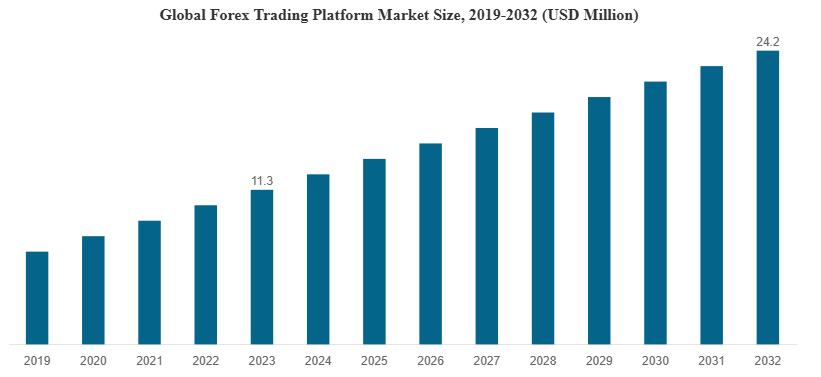
- The Forex trading portals was valued at around $11.3 billion in 2023, and it is expected to increase to around $24.2 billion by the end of 2032.
- According to the global market, Forex trading or exchange websites are projected to reach a compound annual growth rate of 86% from 2024 to 2032.
- This rise is especially noticeable in places like the UK, where the yearly net average daily turnover is an astounding $3.576
- Electronic trading platforms are a significant player with $425 billion in daily FX deals in 2023—roughly 5% of the whole market
- The Japanese Yen is third at 7%, followed by the Euro at 30.5%. Emerging market currencies, excluding the yuan, account for 17.8% of daily FX trades.
10 Best Forex Trading Websites
Here’s a table showing the best online trading platforms with their debut years, platform availability, and a unique feature:
Websites |
Special Feature |
Platform Availability |
Websites Launched On |
| MetaTrader 4 (MT4) | Extensive technical analysis | Desktop, Web, Mobile | 2005 |
| MetaTrader 5 (MT5) | Multi-asset trading capabilities | Desktop, Web, Mobile
|
2010 |
| eToro | Social trading network | Web, Mobile | 2007 |
| Forex.com | Proprietary trading tools | Desktop, Web, Mobile | 2001 |
| Pepperstone | Low spreads, fast execution | Desktop, Web, Mobile
|
2010 |
| Saxo Bank | High-quality research | Desktop, Web, Mobile | 1992 |
| FXTM | Fast withdrawals | Desktop, Web, Mobile
|
2011 |
| XM | Bonus promotions & Education | Desktop, Web, Mobile | 2009 |
| Alpari | Wide range of account types | Desktop, Web, Mobile | 1998 |
| AvaTrade | Automated trading features | Desktop, Web, Mobile | 2006 |

Why Do Businesses Invest in Forex Trading Website Development?
Businesses invest in custom Forex trading software development for a variety of strategic reasons, including the desire to get into the enormous and profitable worldwide forex industry. Here are five main reasons why:
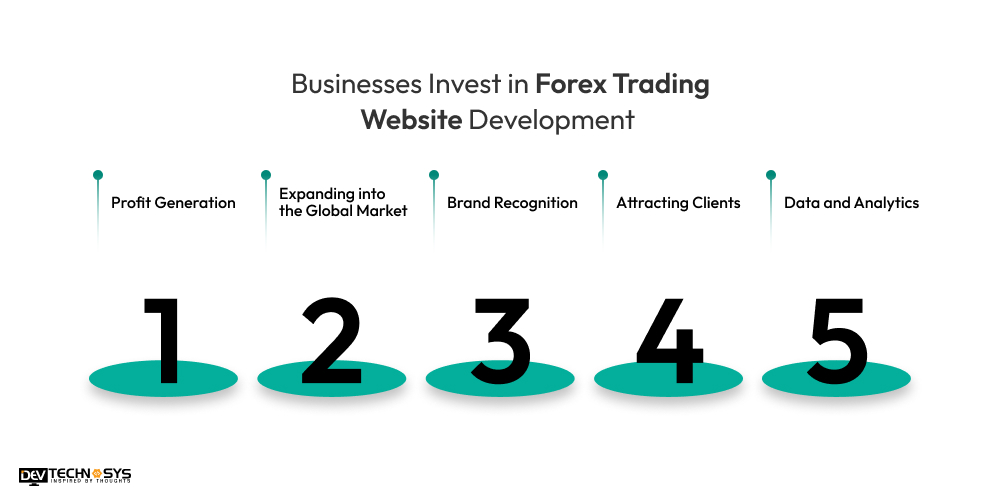
- Profit Generation through Brokerage Services
- Expanding into the Global Market
- Brand Recognition
- Attracting Institutional Clients
- Data and Analytics
1. Profit Generation through Brokerage Services
Businesses in the financial services sector, such as brokerage firms, can benefit from providing forex trading platforms to individual and institutional investors. As we discussed earlier with a stock trading platform development company, a well-designed foreign exchange site enables firms to act as mediators between the forex market and their customers.
2. Expanding into the Global Market
Forex trading is one of the world’s largest and most liquid financial markets, with daily turnover exceeding $6 trillion. Businesses that invest in the creation of a Forex online platform gain access to a global customer base. The platform allows traders from all over the world to engage, offering it an ideal option for worldwide market expansion.
3. Brand Recognition and Competitive Advantage
The forex market is extremely competitive, with multiple platforms fighting for traders’ attention. A well-designed, user-friendly, and feature-rich Forex market website helps businesses differentiate themselves from the competition.
Businesses can strengthen their brand reputation by providing distinctive features such as enhanced charting tools, instructional resources, social trading networks, and mobile trading apps.
4. Attracting Institutional Clients
If you develop a trading app like Zerodha, it will also serve institutional investors, hedge funds, and asset managers. These customers need high-performance systems with advanced capabilities like algorithmic trading, direct market access (DMA), and custom APIs for trade execution.
Businesses that establish a sophisticated trading website can attract institutional clients, who frequently trade in larger volumes, resulting in increased income prospects.
5. Data and Analytics for Market Intelligence
A currency exchange platform collects large volumes of user data, which can provide significant insights into trading activity, market trends, and client preferences.
Businesses can use this data to make more educated decisions about product offerings, pricing tactics, and client acquisition. This helps to refine marketing efforts and improve overall service performance.
How to Create a Forex Trading Website?
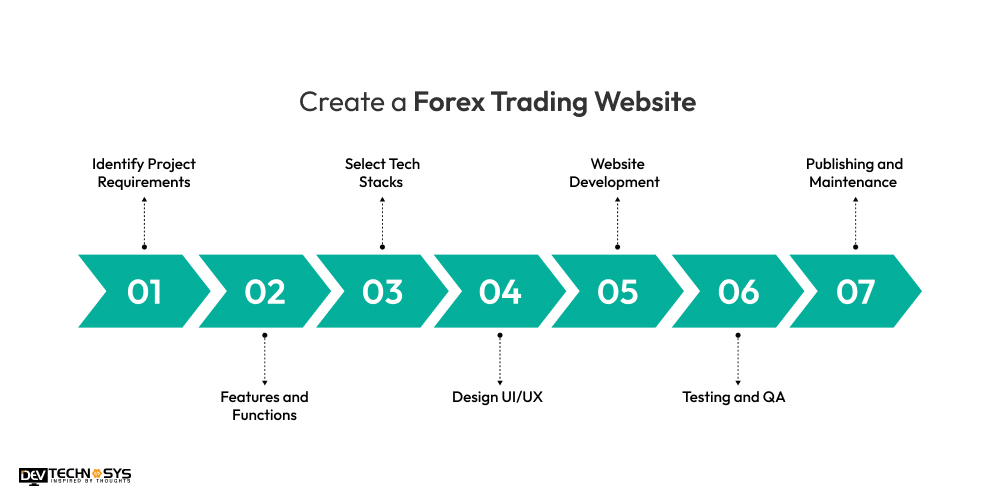
To create a Forex trading website with extensive features, such as real-time market data, order types, and multiple account types. The below development steps enable businesses or developers to develop a successful website. So, here we provide the stock trading app development process:
- Identify Project Requirements
- Features and Functions
- Select Tech Stacks
- Design UI/UX
- Website Development
- Testing and QA
- Publishing and Maintenance
1. Identify Project Requirements
Let’s begin the first development step, and gather detailed project requirements, including target audience, features, and business goals. This includes understanding the types of currency pairs to offer, user experience preferences, trading tools needed, and compliance with local regulations to define the development scope.
2. Features and Functions
In the second stage of development. Hire dedicated developers to decide on key features such as real-time market data, advanced charting tools, risk management options, multi-currency support, mobile trading, and secure login methods. The platform should also include order types, account management, and customer support functionalities tailored to different user levels.
3. Select Tech Stacks
Moving to the third stage, hire Forex trading software developers to choose the appropriate technologies for both front-end and back-end development. Popular stacks include HTML5, CSS3, JavaScript for front-end, and Python, Java, PHP for back-end. For real-time trading features, implement WebSocket and MetaTrader APIsdatabases for data storage and management.
4. Design UI/UX
Create an intuitive, user-friendly interface (UI) with a focus on easy navigation, fast execution, and clear chart displays. Hire website developers to ensure responsive design for mobile and desktop users, integrating smooth transitions and personalized dashboards. A good UX design simplifies complex trading tools and enhances the overall user experience.

5. Website Development
Develop the front-end and back-end, ensuring proper integration of features like live charts, trading execution, payment systems, and user accounts. Implement security measures like SSL encryption and two-factor authentication. Ensure the platform can handle real-time data and high-frequency transactions securely and efficiently.
6. Testing and QA
In the sixth web app development process, conduct extensive quality assurance (QA) testing to ensure all features function as expected. Test for performance, security vulnerabilities, usability, and compatibility across different devices and browsers. Simulate real trading conditions to ensure accurate pricing and smooth execution of trades without downtime.
7. Publishing and Maintenance
Once testing is complete, deploy the website for public access. Monitor the platform regularly for security updates, bug fixes, and server performance. Provide ongoing maintenance, ensuring compliance with new regulations and user feedback, and introduce new features as needed to remain competitive.
10 Must-Have Features of Forex Trading Websites
A well-designed FX trading website must include several crucial features to attract and keep traders. Here are ten must-have features for functionality, usefulness, and profitability:
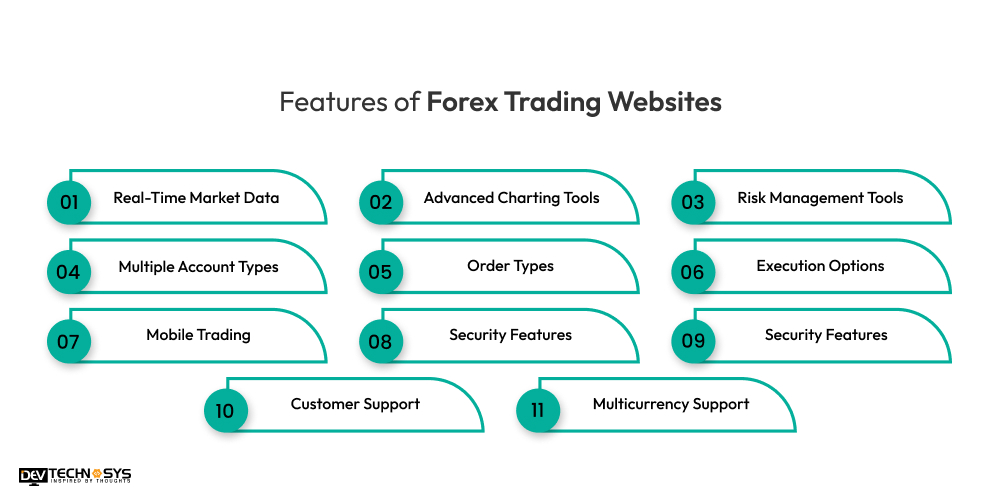
1. Real-Time Market Data
Live, reliable currency price quotes and real-time charts are critical for traders to make sound judgments.
2. Advanced Charting Tools
Interactive charts with numerous timeframes, technical indicators, and sketching tools assist traders in analyzing market patterns and executing plans effectively.
3. Risk Management Tools
Stop-loss, take-profit, and margin controls allow traders to manage their risks and avoid large losses.
4. Multiple Account Types
Offering a choice of account kinds (e.g., demo, standard, VIP) caters to both new and experienced traders.
5. Order Types & Execution Options
Allowing traders to place limit, market, stop, and tail orders with fast execution times is critical for forex market performance.
6. Mobile Trading
If you develop an online trading platform like the eToro app, it allows traders to manage their positions and stay updated while on the go.
7. Security Features
Strong encryption, two-factor authentication, and secure payment channels protect customer data and payments.
8. Educational Resources
Tutorials, seminars, and trading guidelines assist new and experienced traders improve their skills.
9. Customer Support
Website trading Forex offer 24/7 customer service via live chat, email, or phone guarantees that traders receive timely assistance.
10. Multicurrency Support
Supporting a diverse range of currencies and payment methods facilitates worldwide business and flexibility.
The Cost to Develop a Forex Trading Website
The cost to build a Forex trading website can vary widely, typically ranging from $8,000 to $25,000 or more. Factors influencing the cost include the complexity of the platform, the number of features, and the technology stack used.
Basic websites with essential functionalities may be on the lower end, while advanced platforms with custom features like mobile apps, real-time data, and sophisticated security measures could push costs higher. Ongoing costs for server maintenance, licensing fees, and customer support should also be factored in.
Forex Trading Website Development |
Approximate Cost |
Time Frame |
Normal Website Development |
$8000 – $12000 | 2 to 5 Months |
Mid-Premium Website Development |
$14000 – $19000 | 6 to 8 Months |
High-Premium Website Development |
$25000+ | 9+ Months |

What Are The Factors That Affect Forex Trading Website Development Cost?
Factors affecting trading app development solutions include the development team’s expertise, the complexity of back-end systems for trade execution, user-friendly website design, integration of simple or advanced features like algorithmic trading, and ongoing support and maintenance to ensure security, updates, and platform reliability over time.
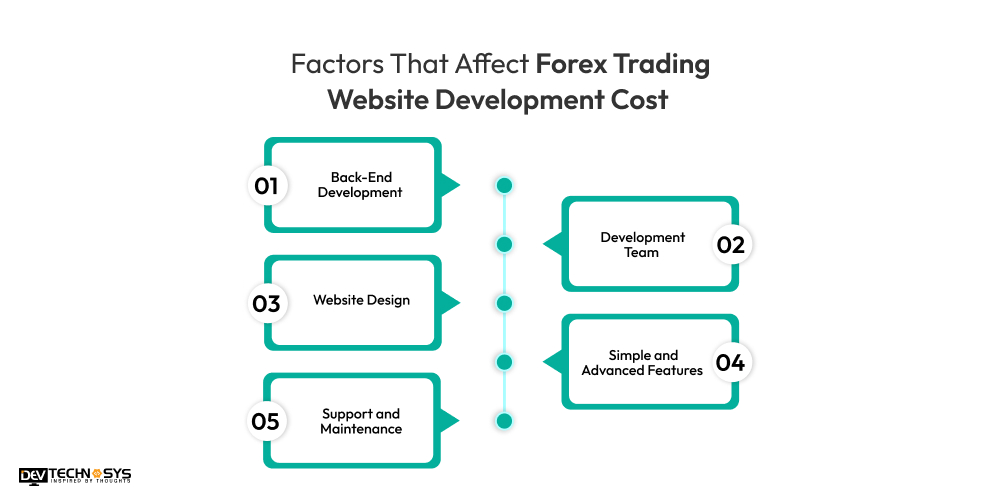
1. Back-End Development
Back-end development include building a strong infrastructure to manage user accounts, transactions, real-time data, and market feed connections. A strong back-end enables quick and secure trade execution, effective data processing, and scalability.
The backend’s complexity, such as algorithmic trading support or API integration, has a direct impact on development time, cost, and overall platform performance.
Backend Development |
Cost Estimation |
| Basic Backend Process | $10,000 – $18,000 |
| Premium Backend Process | $20,000 – $28,000 |
2. Development Team
The development team’s ability and experience have a considerable impact on both the cost and quality of the website. A talented team of engineers, designers, and project managers provides smooth integration of complicated features, fast coding, and on-time delivery. Whether in-house or outsourced, assembling the correct team is critical to creating a successful and dependable Forex brokerage site.
Developer’s Experience Level |
Cost Estimation |
| Entry-Level Developer | $15 – $18/ Per Hour |
| Mid-Level Developer | $18 – $22/ Per Hour |
| Senior-Level Developer | $25+ / Per Hour |
3. Website Design
The Forex trading official websites should be intuitive and user-friendly, providing a positive user experience. A visually appealing interface with simple navigation, clear call-to-actions, and responsive design allows traders to easily access services.
A clean, efficient interface geared for desktop and mobile use improves usability and keeps traders interested in the platform. The complex website design has the ability to increase the cost to build a trading app like RobinHood.
Design Quality |
Cost Estimation |
| Basic Design | $8,000 – $12,000 |
| Complex Design | $15,000 – $22,000 |
4. Simple and Advanced Features
Simple features like as real-time charting, trading orders, and account management are required on any Forex website. However, adding additional features such as algorithmic trading, social trading, or multi-currency support complicates the development process.
The more advanced the features, the greater the cost and time necessary for development. Businesses must strike a balance between feature richness, user needs, and budget limits.
Features |
Cost Estimation |
| Core Features(Real-Time Market Data and Advanced Charting Tools) | $8,000 – $10,000 |
| Advanced Features(Mobile Trading and Educational Resources) | $13,000 – $19,000 |
5. Support and Maintenance
Ongoing support and maintenance are critical to keeping the platform secure, bug-free, and up to current with regulatory changes. Regular updates, security patches, and performance monitoring are required to ensure that the platform runs smoothly.
The cost of long-term maintenance and customer support must be included in the total cost to develop a crypto trading app to ensure efficiency throughout time.
Maintenance Phase |
Cost Estimation |
| Simple Maintenance Phase | $2,000 – $4,000/year |
| Complex Maintenance Phase | $7,000 – $9,000/year |
5 Profit-Making Techniques of Forex Trading Websites
Currency exchange platforms can utilize a variety of profit-making strategies to generate income from its consumers while delivering relevant services. Here are five main methods:
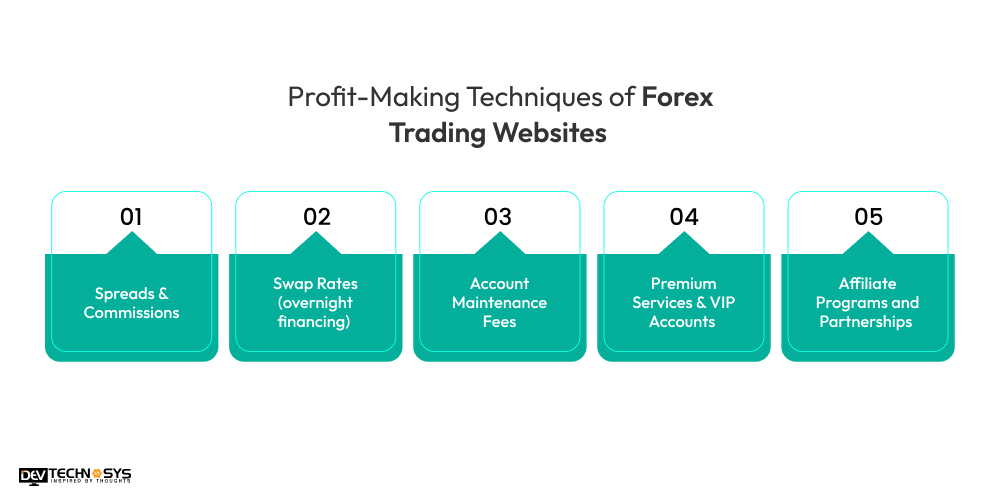
- Spreads & Commissions
- Swap Rates (overnight financing)
- Account Maintenance Fees
- Premium Services & VIP Accounts
- Affiliate Programs and Partnerships
1. Spreads & Commissions
Spreads—the difference between the purchasing and selling prices of a currency pair—are one of the most prevalent ways for Forex trading platforms to make money. When a trader enters a trade, the broker earns from the spread. Some platforms charge a commission each trade in addition to the spread, particularly for professional or institutional clients.
2. Swap Rates (overnight financing)
Forex brokers frequently charge or pay swap rates (also known as overnight financing) for positions held overnight. These rates are based on the difference in interest rates between the two currencies in a pair.
Brokers may profit by charging traders a swap charge if the position is kept overnight, particularly for longer-term trades, which can generate significant revenue for the platform.
3. Account Maintenance Fees
Some websites for Forex trading charge account maintenance fees to users who leave their accounts open for an extended period of time. These fees are sometimes charged to inactive accounts or accounts that do not satisfy specified trading volume limits.
According to the trading website development company, this is an extra revenue stream, particularly for those who are less engaged but still have an account.

4. Premium Services & VIP Accounts
Premium services such as advanced trading tools, research reports, exclusive seminars, and access to personal account managers can generate substantial revenue.
VIP accounts, which cater to expert traders, are often charged additional fees by forex platforms. These accounts include additional benefits such as narrower spreads, priority customer assistance, and cheaper commissions.
5. Affiliate Programs and Partnerships
Forex brokers sometimes conduct affiliate programs in which they pay commissions to third-party websites, influencers, or marketers who send new traders to the platform.
This affiliate marketing method broadens the platform’s reach, encouraging new users to sign up and trade. Brokers generally offer a share of the profits gained from referred consumers, resulting in a consistent income stream.
Conclusion
In conclusion, Forex trading mobile app development requires careful planning, robust technology, and user-focused design. Key aspects include secure infrastructure, advanced trading tools, real-time data, and responsive customer support.
By offering essential features like multiple account types and mobile access, businesses can create a competitive, profitable platform that attracts traders and ensures long-term success in the global forex market. Looking to develop a Forex trading website? Let our professional trading app development company create a seamless experience for you.
Frequently Asked Questions
1. How Much Does Forex Trading Website Development Cost?
The cost to build a Forex trading website ranges from $8,000 to $25,000, depending on factors like complexity, features, design, platform functionality, and the development team’s expertise.
2. How Much Time Does It Take To Make a Forex Trading Website?
To make a Forex trading website, it typically takes 3 to 6 months, depending on complexity, features, design, and development team resources. Advanced platforms with custom features may take longer to complete.
3. What Features Should a Forex Online Platform Have?
The top forex trading websites should have real-time market data, advanced charting tools, secure payment options, risk management features, mobile trading, multi-currency support, customer support, and a user-friendly interface.
4. What Technologies Are Used to Build a Forex Trading Website?
Forex market websites are built using technologies like HTML5, CSS3, JavaScript for the front end, PHP, Python, and Java for the back end, along with platforms like MetaTrader for trade execution and WebSocket for real-time data.
5. How Can I Ensure My Fx Trading Website Is Secure?
Ensure your foreign exchange site is secure by using SSL encryption, two-factor authentication, regular security audits, firewalls, secure payment gateways, and data encryption to protect user information and prevent cyber threats.
6. What is the Best Website for Forex Trading?
The best website to learn forex trading depends on your needs, but popular options include IG, OANDA, and Forex.com for their robust platforms, low spreads, educational resources, and regulatory standards.