









“Deliver fuel online by regularly maintaining your platform for improved productivity.”
The need for renewable or non-renewable and natural or man-made fuel is getting bigger with time. Especially in Gulf countries like the UAE, Kuwait, Qatar, and Oman, fuel delivery business is the major contributor in the economy. So, businesses having ready-made applications must know the fuel delivery app maintenance cost.
The rate of maintaining fuel delivery applications is influenced by a lot of factors that we will discuss in this blog. Additionally, there are some challenges that businesses may face during the fuel delivery app maintenance process.
Here, we are going to study all the cost affecting factors with suitable reducing methods. Alongside, it is important to discuss the future of fuel delivery app maintenance.
What is Fuel Delivery App Maintenance?
Businesses use mobile app development services that also ensure maintenance after the app is launched. The process to continuously update, monitore, and optimize is known as fuel delivery app maintenance. It guarantees seamless operation, security, user contentment, and technological compatibility. Fixing issues, enhancing features, and adhering to industry standards all depend on routine maintenance.
- Fixes bugs and performance issues to ensure smooth user experience.
- Updates the app to stay compatible with new OS versions and devices.
- Enhances features based on user feedback and market trends.
- Implements security patches to protect user and transaction data.
- Ensures server uptime and optimizes backend performance.
Why is it Important to Maintain Fuel Delivery Apps?
To guarantee smooth operations, safe transactions, and user happiness, fuel delivery apps must be maintained. Frequent updates maintain the app’s alignment with industry standards and user needs:
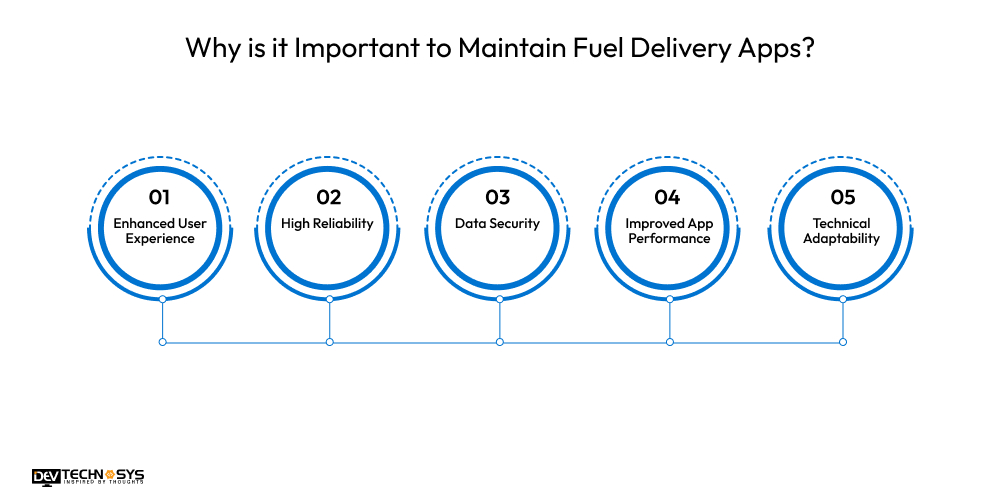
1. Enhanced User Experience
Regular maintenance aids in bug fixes, UI updates, and usability-enhancing feature additions. A seamless, user-friendly interface promotes client happiness and retention. Satisfied customers are more inclined to use the service again and recommend it.
2. High Reliability
Reliable performance and continuous service are ensured by routine app checks and upgrades. Real-time tracking and timely fuel supply depend on this. Reliability enhances the reputation of the brand and fosters trust.
3. Data Security
Sensitive user and payment information is shielded from breaches by routine maintenance. It entails using the most recent security fixes and adhering to PCI-DSS and other rules. You can develop an app like GasBuddy that is secure and meets regulatory requirements to win over users.
4. Improved App Performance
Backend stability, load time, and speed are all improved by maintenance. Performance adjustments also lessen lags, crashes, and downtime. This guarantees seamless user interactions even when traffic is heavy.
5. Technical Adaptability
The software needs to remain compatible when hardware, operating systems, and user preferences change. Maintenance facilitates the integration of industry upgrades, third-party tools, and new technologies. It guarantees the app’s operation and relevancy throughout time.
How AI Enhances Fuel Delivery App Maintenance Process?
By facilitating predictive analytics, automatic problem identification, and intelligent user engagement, AI greatly enhances the fuel delivery app maintenance process. It also reduces the Fuel app support and maintenance pricing by facilitating downtime reduction, app performance optimization, and data-driven insights. A custom fuel delivery app development company uses AI to make maintenance more economical, effective, and proactive.
- Predicts potential failures using real-time performance data.
- Automatically detects and reports bugs or anomalies.
- Analyzes user behavior to recommend feature improvements.
- Enhances security by identifying unusual activity patterns.
- Optimizes backend operations for faster load and response times.
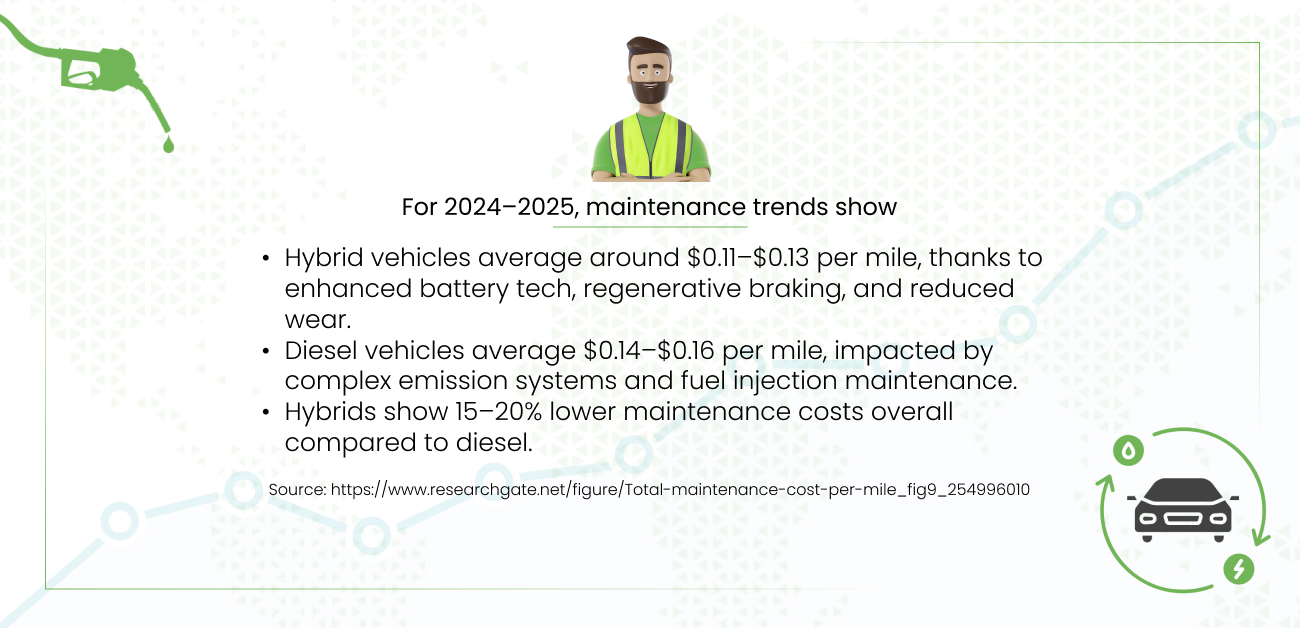
Fuel Delivery App Maintenance Cost Breakdown
In order to maintain security, performance, user pleasure, and regulatory compliance, the fuel delivery app maintenance cost ranges between various figures. The complexity, features, and service scale of the app all affect these prices.
The Android app maintenance cost breakdown of the necessary parts usually needed to sustain a gasoline delivery application may be found below:
| Component | Estimated Monthly Cost (USD) |
| Bug Fixes & Updates | $300 – $500 |
| Server & Hosting | $500 – $1,500 |
| Database Management | $300 – $800 |
| API & Third-Party Services | $200 – $700 |
| Security & Compliance | $400 – $1,000 |
| UI/UX Enhancements | $250 – $600 |
| Real-Time GPS & Tracking | $300 – $700 |
| Customer Support Maintenance | $200 – $500 |
| Performance Monitoring Tools | $150 – $400 |
| Compatibility & Testing | $300 – $600 |
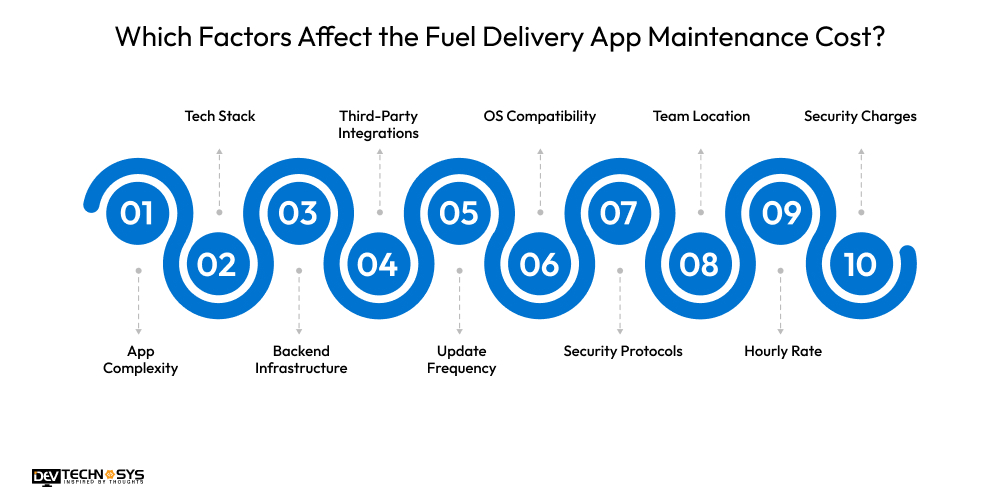
Which Factors Affect the Fuel Delivery App Maintenance Cost?
Numerous operational and technical aspects affect the fuel delivery app maintenance cost. Every component affects the amount of time, money, and equipment needed to maintain the app’s functionality, security, and updates:
1. App Complexity
More maintenance is needed for apps with advanced features like analytics, dynamic pricing, route optimization, and real-time tracking. More testing, debugging, and updates are required for complex architectures. Over time, this increases the monthly maintenance cost of fuel delivery applications.
| Component | Estimated Monthly Cost (USD) |
| Basic (Order + Delivery) | $300 – $600 |
| Moderate (Real-time Tracking, Payments) | $700 – $1,200 |
| Advanced (AI, Analytics, Driver Routing) | $1,500 – $2,500 |
2. Tech Stack
Maintenance efforts are directly impacted by the selection of programming languages, frameworks, and libraries. Because of the lack of support or specialized needs, using antiquated or unusual technologies may result in higher expenses. Long-term costs are frequently reduced with a contemporary, scalable stack.
| Component | Estimated Monthly Cost (USD) |
| React Native | $200 – $400 |
| Flutter | $250 – $450 |
| Node.js | $300 – $500 |
| Django | $350 – $600 |
| MongoDB | $100 – $300 |
| PostgreSQL | $150 – $350 |
Want a chatbot demo or pricing? Fill the form and talk to our experts today.
Pick what you need below — you can select more than one — then tap Get detail to continue.
-
Chatbot demo dashboard
-
Cost to develop an app
-
Industry report
-
Case study
3. Backend Infrastructure
Smooth app performance is ensured by a robust and scalable backend, but it also requires frequent database upkeep, changes, and monitoring. More resources are needed for real-time data processing or high server loads. Microservices could lower the fuel app bug fixing and software update cost.
| Component | Estimated Monthly Cost (USD) |
| Cloud Hosting (AWS, GCP) | $500 – $1,500 |
| Database Management | $300 – $800 |
| API Management & Scaling | $400 – $1,000 |
4. Third-Party Integrations
Continuous compatibility tests are required for APIs used for analytics, fuel inventory, payment gateways, and maps. The application needs to swiftly adjust if suppliers change their APIs. The maintenance cost of mobile apps is increased by testing and maintaining these integrations.
| Component | Estimated Monthly Cost (USD) |
| Payment Gateways (e.g., Stripe) | $100 – $300 |
| Mapping & GPS (Google Maps API) | $200 – $600 |
| Fuel Inventory Software | $250 – $700 |
5. Update Frequency
Maintenance expenses rise with frequent upgrades to address bugs, add new features, or enhance user experience. Regular upgrades, however, also lessen the possibility of serious problems. Both budgetary management and performance depend on a balanced update cycle.
| Component | Estimated Monthly Cost (USD) |
| Monthly Bug Fixes | $300 – $500 |
| Quarterly Feature Updates | $600 – $1,000 |
| Emergency Patches & Hotfixes | $400 – $800 |
6. OS Compatibility
Although it raises testing and development efforts, supporting the most recent versions of iOS and Android guarantees widespread user access. Compatibility checks and potential code modifications are necessary for every system update. Support for several platforms raises maintenance expenses.
| Component | Estimated Monthly Cost (USD) |
| iOS Support | $300 – $600 |
| Android Support | $300 – $600 |
| Cross-Platform Testing | $200 – $500 |
7. Security Protocols
Vulnerability scans, data encryption, SSL updates, and adherence to data privacy regulations are all examples of security maintenance. In order to prevent breaches, continuous monitoring is necessary. Strong security is crucial but it increases the on-demand fuel app maintenance cost.
| Component | Estimated Monthly Cost (USD) |
| SSL & Encryption Updates | $100 – $250 |
| Data Compliance (GDPR, PCI-DSS) | $200 – $500 |
| Vulnerability Scanning | $300 – $600 |
8. Team Location
The location of your development team affects maintenance costs. It may cost more to hire teams in Western Europe or North America than in Asia or Eastern Europe. Productivity may also be impacted by communication styles and time zone variations.
| Location | Estimated Hourly Rate (USD) |
| USA | $100 – $150 |
| UK | $80 – $130 |
| Australia | $70 – $120 |
| Eastern Europe | $40 – $70 |
| India | $25 – $50 |
| Southeast Asia | $20 – $40 |
9. Hourly Rate
Depending on area and skill level, freelancers, agencies, and in-house developers charge varying hourly prices. Although they increase your budget, higher prices can result in faster solutions and greater quality. Matching rate to value delivered is crucial.
| Component | Hourly Rate (USD) |
| Freelancers | $25 – $70 |
| In-House Developers | $50 – $120 |
| Outsourced Development Teams | $30 – $80 |
10. Security Charges
The cost to maintain fuel delivery app is increased by premium security services, firewalls, fraud detection, and data breach insurance. These services lessen possible damages from cyberthreats and safeguard user trust. Putting money into strong security is a long-term precaution.
| Component | Estimated Monthly Cost (USD) |
| Web Application Firewall | $150 – $300 |
| DDoS Protection | $200 – $500 |
| Authentication Systems (2FA) | $100 – $250 |
| Security Audits & Insurance | $400 – $1,000 |
Methods to Reduce the Cost of Maintaining Fuel Delivery Apps
Strategic planning is necessary to lower app maintenance costs without sacrificing performance. The following techniques support long-term sustainability, reduce overhead, and streamline operations:
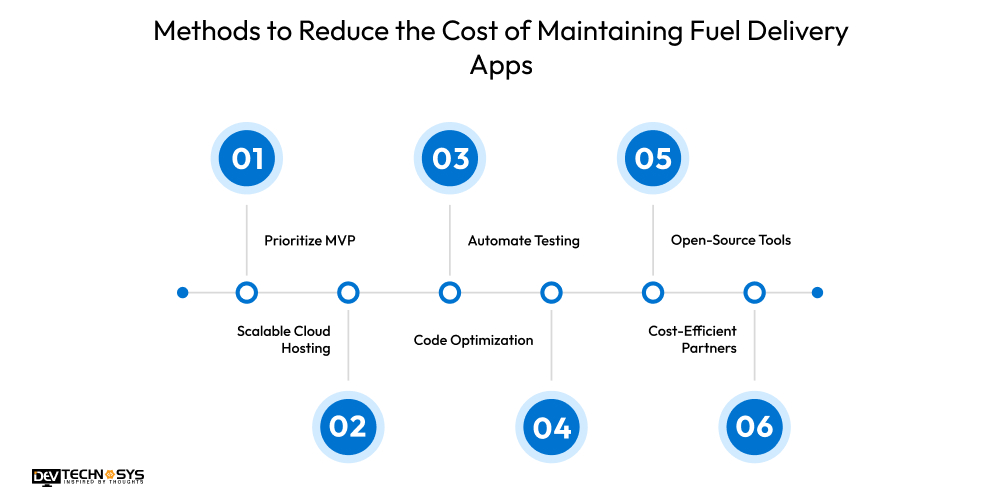
1. Prioritize MVP
In the beginning, concentrate on creating and maintaining just the essential features required for the app to run. This removes pointless updates and reduces the mobile fuel app upkeep cost. Later, improvements may be made in response to user input. With regulated spending, it also guarantees a faster time to market.
2. Scalable Cloud Hosting
You can only pay for what you use when you use scalable cloud solutions like AWS or Google Cloud. It lowers the price of keeping up big, unused infrastructure.
Without continual human supervision, auto-scaling makes sure the program runs well during busy periods. This adaptability is perfect for demands on fuel distribution.
3. Automate Testing
You must Hire dedicated developers to use automated testing methods for finding flaws and performance problems on a regular basis. When compared to manual QA efforts, this saves money and time.
Additionally, it guarantees early problem discovery and quicker deployments. Frequent automated testing lessens developer workload while maintaining quality.
4. Code Optimization
Long-term maintenance efforts are reduced by code that is clear, modular, and effective. Code that has been optimized is simpler to scale, update, and debug.
Additionally, it improves performance by lowering resource use and user complaints. Finding opportunities for improvement is aided by routine code audits.

5. Open-Source Tools
Using open-source frameworks and libraries speeds up development and reduces the fuel delivery app maintenance cost. Many of these tools are updated frequently and are maintained by the community.
They offer flexible, safe, and scalable substitutes for proprietary software. However, in order to prevent security threats, appropriate screening is required.
6. Cost-Efficient Partners
Collaborating with cost-effective yet seasoned development teams or organizations aids in maintaining cost management. Significant savings can be obtained by outsourcing to areas with cheaper rates. Select partners with domain knowledge to increase efficiency and reduce trial-and-error.
Key Considerations for Fuel Delivery App Maintenance
Various industry standards must be followed and important systems must be updated on a regular basis. Long-term client happiness, security, and efficiency are all ensured by covering fundamental areas:
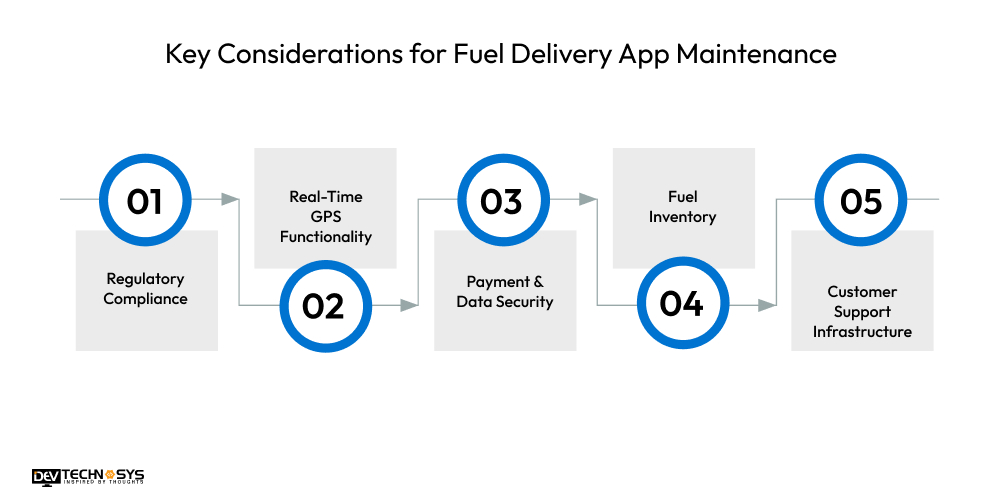
1. Regulatory Compliance
Regulations pertaining to digital transactions, safety, and fuel transportation must be followed by the app. Updates must be made frequently to comply with changing environmental, local, and federal regulations. Service suspension, fines, and legal problems may result from noncompliance.
2. Real-Time GPS Functionality
For real-time delivery updates, GPS tracking must remain precise and responsive. It guarantees improved customer satisfaction, ETA accuracy, and route optimization. Errors or location lags are avoided by routine calibration and upgrades.
3. Payment & Data Security
Regular security upkeep guards against intrusions involving user data and payment information. This entails using secure gateways, SSL encryption, and frequent vulnerability assessments. These strategies for mobile app maintenance like PCI-DSS are also essential.
4. Fuel Inventory
Real-time tracking of fuel availability and storage conditions is ensured by proper maintenance. It aids operational planning, guarantees delivery preparedness, and lessens the likelihood of stockouts. It is necessary to continuously check integration with supply chain systems.
5. Customer Support Infrastructure
Regular testing and AI or chatbot improvements are necessary for responsive and effective support systems. This guarantees lower churn, improved user happiness, and quicker query resolution. As the user base expands, a scalable support system becomes essential.
In-House vs. Outsourced Maintenance: A Comparison
Cost, control, experience, and scalability are some of the elements that influence the decision between in-house and outsourced gasoline delivery app maintenance.
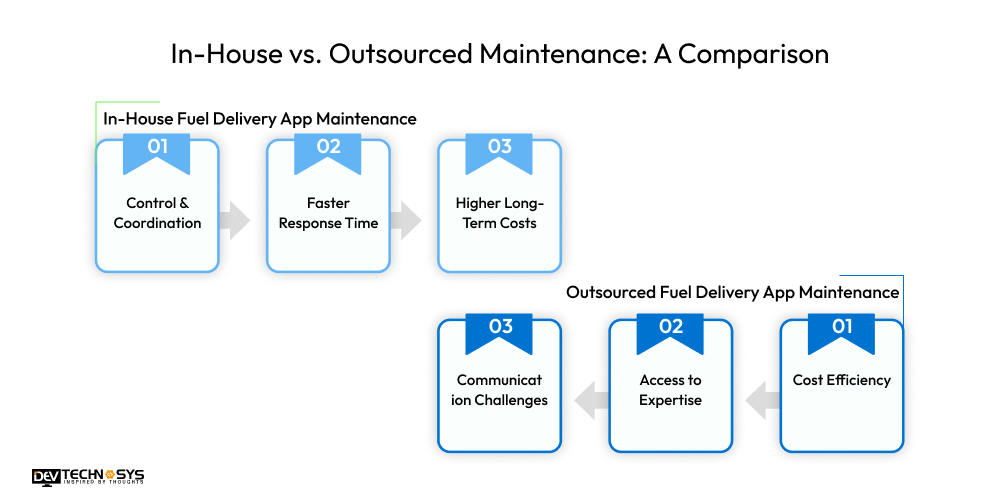
While outsourcing offers flexibility and possible cost savings, in-house teams give direct oversight and quicker communication. To assist you choose the one that best suits your company’s requirements, here is a comparison:
| Element | In-House Maintenance | Outsourced Maintenance |
| Cost | Higher due to salaries, benefits, and infrastructure expenses. | More cost-effective, especially when outsourced to regions with lower labor rates. |
| Control & Communication | Direct oversight and faster internal communication. | May face delays or communication gaps due to time zones and external management. |
| Expertise & Scalability | Limited to in-house team’s skills; scaling requires hiring new talent. | Access to a broader talent pool with specialized skills; easily scalable on demand. |
| Response Time | Quick response to urgent issues due to on-site availability. | May have delayed responses, depending on service level agreements (SLAs). |
| Long-Term Flexibility | Ideal for companies with long-term, stable needs and continuous feature development. | Suitable for startups or businesses looking for flexibility and reduced long-term costs. |
In-House Fuel Delivery App Maintenance
1. Control & Coordination
Workflows, priorities, and changes are entirely under the authority of internal teams. Faster departmental decision-making and easier cooperation are made possible by direct communication.
2. Faster Response Time
When there are in-house developers on hand, problems may be addressed and fixed fast. This enhances the user experience overall and decreases downtime.
3. Higher Long-Term Costs
Ongoing costs for infrastructure, training, benefits, and salary are necessary to keep an internal staff. Over time, these fixed expenses can add up, particularly for smaller companies.

Outsourced Fuel Delivery App Maintenance
1. Cost Efficiency
The cost to develop an app like Filld gets affected by full-time staff and is eliminated through outsourcing. It is frequently more affordable and offers flexible pricing structures, particularly when utilizing offshore resources.
2. Access to Expertise
Specialized talents and experience are frequently brought by outside agencies or freelance teams. This facilitates the effective implementation of scalable architecture, security upgrades, and sophisticated features.
3. Communication Challenges
Collaboration can be slowed down by cultural differences, time zone difficulties, and indirect communication. To get beyond these obstacles, organized workflows and clear documentation are crucial.
Future Trends in Fuel Delivery App Maintenance
Fuel delivery app maintenance is moving toward more intelligent and responsive models. The goals of emerging trends are to increase productivity and reduce downtime:
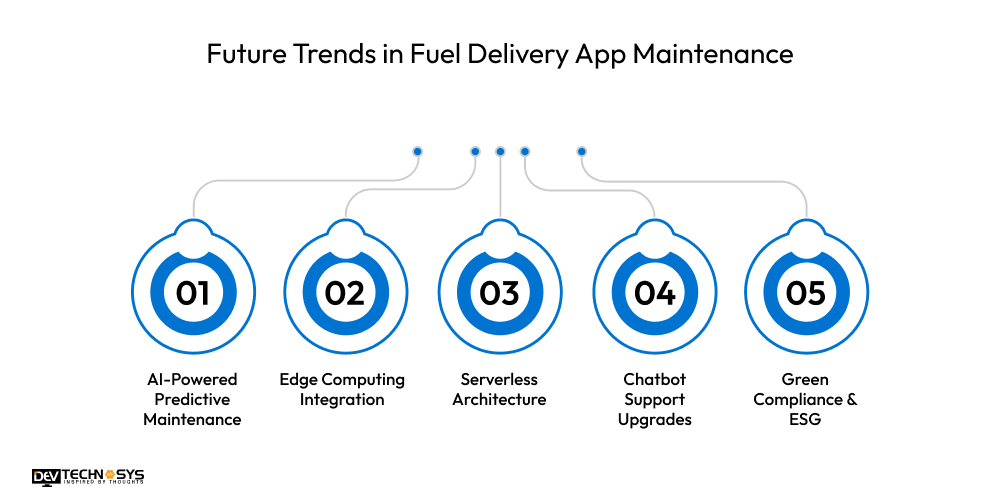
1. AI-Powered Predictive Maintenance
To anticipate faults before they occur, AI algorithms examine system logs, usage trends, and performance indicators. This lowers repair costs and avoids downtime. In order to guarantee smooth service delivery, maintenance shifts from reactive to proactive.
2. Edge Computing Integration
Instead of processing data on centralized servers, edge computing does so closer to the user’s device. This increases real-time decision-making, lowers latency, and boosts app performance in faraway locations. It’s particularly helpful for fuel supply operations that have a tight deadline.
3. Serverless Architecture
Serverless systems eliminate the need for human server management by scaling automatically in response to demand. This lowers the cost and overhead of fuel delivery apps. The functionality of the app can take precedence over server maintenance for developers.
4. Chatbot Support Upgrades
Advanced AI-driven chatbots answer common questions, resolve problems, and assist users with the app. These bots speed up response times and lessen the workload for human help. Additionally, they gather input for upcoming revisions.
5. Green Compliance & ESG
Carbon tracking, eco-friendly methods, and energy-efficient programming are being prioritized in the maintenance of apps. Brand trust is increased by making sure that ESG (Environmental, Social, Governance) criteria are followed. Additionally, it gets the software ready for future legal compliance.
Final Thought!!
Now, you must be knowing that there are several elements that influence the fuel delivery app maintenance cost and process. So, it is your authority to ensure best practises for maintaining all kinds of fuel delivery applications:
- Approach a reliable IT consulting firm for exchanging plans.
- Ensure mobile app maintenance and support services at affordable rates.
- Follow a generally used maintenance process for better results.
- Target certified solutions can be handled without any extra investment.
As a business investor, you must implement the above points to deliver desired feature updates and generate revenue streams for industrial growth.
FAQs
1. What is the Annual Fuel Delivery App Maintenance Cost?
A fuel delivery app’s yearly maintenance expenses normally fall between $5,000 and $25,000. Features, server utilization, backend complexity, and third-party integrations all affect the final price. High user traffic and real-time tracking apps frequently need more expensive and frequent updates.
2. What are the Main Factors That Affect App Maintenance Cost?
- Advanced features like real-time tracking.
- Apps with complex tech stacks.
- A growing number of users demands.
3. Is App Maintenance Mandatory After Launch?
Yes, maintenance is necessary to keep your app current, safe, and functional. It assists with bug fixes, third-party tool updates, and OS or regulatory adaptation. User unhappiness, data breaches, and app crashes can result from neglecting maintenance.
4. How Often Should I Update my Fuel Delivery App?
Depending on usage and user input, fuel delivery apps should preferably be updated every month or every three months. As soon as problems are found, critical upgrades like security patches or bug fixes should be implemented.
5. Can I Reduce Maintenance Costs Without Affecting Quality?
Yes, by concentrating solely on essential upgrades, utilizing scalable cloud services, and automating testing. To cut operating costs, you can also contract out maintenance to knowledgeable but economical teams. Preventive maintenance and an effective code structure greatly lower long-term expenses.
6. What Happens if I Skip Regular Maintenance?
- Outdated apps are vulnerable to data breaches.
- Bugs, crashes, and lagging features reduce app ratings.
- Ignoring maintenance leads to technical debt.