






Key takeaways:
-
- The cost of developing a grocery delivery app in 2026 typically ranges from $30,000 to $150,000+, depending on app complexity, features, platforms, integrations, and technology requirements.
- Businesses can plan for better monetization options with a grocery delivery app. These include in-app purchases, advertising, subscription plans, and delivery charges.
- A recent study shows that the U.S. online grocery market is growing at a 17% CAGR, highlighting demand for a personalized shopping experience.
- Partnering with a professional app development company like Dev Technosys helps businesses build a secure, scalable, and user-focused grocery delivery platform.
With the e-commerce sector advancing at a rapid rate across all industries, online grocery retail has turned into a primary choice for buying foodstuffs for a growing number of households across the United States.
Grocery delivery e-commerce revenue in the country is expected to surpass the $455 billion mark by 2029. The online grocery customer base comprises approximately 138 million shoppers and is expected to continue growing in the next few years.
It is a perfect opportunity for businesses that want to open an online grocery store or develop an app like Instacart, which delivers groceries when people need them. However, one question that keeps arising when discussing the development of a grocery app is: “How much does grocery delivery app development cost?” For the second question, we have you covered.
So, before deciding to build a grocery delivery app, read the entire blog to understand the cost of grocery delivery app development and the features that affect that cost. You can make money from your shopping app, too. Let’s start!
Future Predictions & Projection of Grocery Delivery Service
- The estimated value of the global online grocery market is USD 67.64 billion in 2024 and is projected to reach USD 992.35 billion by 2033, growing at a CAGR of 36.8% from the year 2025 to 2033.
- The Asia Pacific online grocery dominated the global market with the largest revenue share of 61.5% in 2024.
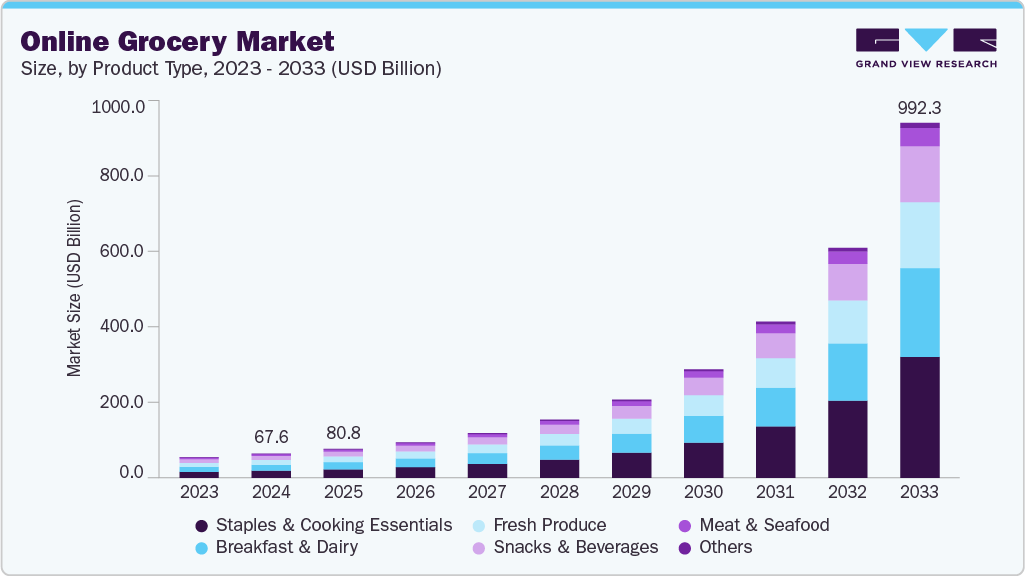
- The online grocery industry in the U.S. is expected to experience significant growth from 2025 to 2033.
- By product type, the staples & cooking essentials segment held the largest share of revenue in 2024 with 29.1% and is predicted to grow significantly over the forecast period.
What Is An On-Demand Grocery Delivery App?
Online grocery apps let consumers select grocery stores to deliver to their doorstep. The system is nothing fresh; the transformation to mobile applications has made it inexpensive and thus widespread.
With a smartphone app like Coles, users no longer need to assign a domestic worker to pick up food; they can simply order it with a few clicks. Some of the top examples of grocery delivery apps include Instacart, BigBasket, and Amazon Fresh.
How Does an On-Demand Grocery App Work?
This is how a typical online grocery store works:
- Location Access: Users must give access to the location or insert their full address manually. The app will automatically list grocery shops close by.
- Product Selection and Placement: Users can simply choose from a wide range of products, make payments, and select the time and date of shipping.
- Pick-up Option: Consumers can also arrange for pick-ups straight from the supermarket. All you need to do is place an order for the necessities of the grocery that you need and choose a pick-up time at your ease.
Case Study of Instacard
Instacart was launched in 2012 by Apoorva Mehta in San Francisco. Facing the classic issue of building simultaneous supply and demand, he resorted to “ninja shopping,” personally buying groceries and delivering them himself.
He also cataloged store inventory by physically photographing each product, an early $50K investment that doubled demand overnight. In September 2023, Instacart went public on the Nasdaq under the ticker CART, raising $660 million and achieving a $10 billion valuation.
How To Develop An On-Demand Grocery Delivery App?
Right now, there is huge competition in the online grocery delivery market, and to find new opportunities, you should have a specific selling point for grocery app development. To that end, some businesses offer appealing rates, others confuse with a lot of choices, and yet others depend on the tech facet.
Whether you’d like to develop a grocery delivery app or a website, the features of a grocery app would be more or less identical. So, here is a step-by-step process signifying ‘How to develop an on-demand grocery delivery app?
1. Choose A Business Model
If you are looking to build an on-demand grocery delivery app for your grocery store, there is a wide range of options available. So, the first step should be to validate an app idea with an IT consulting firm. Now choose the most suitable business model for your on-demand grocery delivery app. To help you with it, here are some of the popular business models of grocery delivery applications.
i. Aggregators
Aggregators list all retailers and their products in the vicinity. This type of app allows the user to purchase these stores. They use associate drivers to deliver the goods, but the shipment of the product differs in the store. One such example is Instacart, a popular US-based Flipkart food app that joins the market that is steadily growing in India.
ii. Marketplace Model
Marketplace applications get their options, and delivery men take orders and deliver the groceries to the porch. If you don’t have a previous grocery-related business but want to run a grocery app, then contact an online marketplace app development company; this is the most appropriate type of app for you. Bigbasket and Grofers are some such illustrations that are popular in India.
iii. Recognized Grocery Chains
Big app stores like WalMart and the Kroger mobile app have their very own applications for their clients. Through these apps, customers can conveniently order from grocery stores and deliver them to their homes.
iv. Single-Store Marketplace
Developed by individual stores, these apps are specifically built for daily store customers. The app designing and maintenance, taking orders, and distributing them are all controlled by a single retail outlet. They can get more biz their way this way.
2. Focus on the Three Different Panels
You can’t just make a single grocery application and earn success. When it comes to on-demand app development, there are three parts to the application and every business owner should consider it during grocery delivery app development.
i. The Consumer App
This would be the user app. The model will be hosted in the app store for download and installation. The consumer app needs to be full of attractive attributes and needs a beautiful UI/UX layout and design.
ii. The Owner App
It is the aspect that needs to be designed with the utmost priority because if anything goes wrong on the admin side of the operation, users won’t get their supplies.
iii. Distribution Agent App
This is for the person who is going to make the delivery. The deity of grocery delivery apps is completed with this app. It will bind the customer with the dealer and the delivery person, allowing them to get excellent services.
So, we can say that three panels need to be developed when we are looking for grocery app development. To find out the actual grocery app development cost, you have to add all of these costs to it.
3. Think of App Layout And UI/UX
An attractive UI/UX architecture goes a long way when it comes to designing on-demand grocery apps. When you’ve started designing your grocery store app, ensure that your app has a strong UI/UX design and design. The more appealing it is, the more fun it will be for the user to use it.
And the more they like using the application, the more people will begin using the app. A visually appealing interface is completely important to keep users retain. It is advisable to hire dedicated developers who can create an amazing UI/UX design to communicate your concept of a grocery app to your target audience.
4. Finalize Tech Stacks for Grocery App Development
The fact is that the tech stack is also one of the significant factors that influence the grocery app development costs. For developing these kinds of app, you are require a specific tools and technology required, which are the following –
Category |
Tools & Technologies |
| Database | MongoDB, HBase, MailChimp Integration, Cassandra, PostgreSQL |
| Front-end Development | JavaScript, React, Angular, Vue.js |
| Back-end Development | Node.js, .NET, Java, PHP |
| Android Development | Java, Kotlin |
| iOS Development | Objective-C, Swift |
| Push Notifications | OneSignal, Twilio |
| Real-time Analytics | Apache Flink, Cisco, IBM, Hadoop, Spark, Big Data |
| Cloud Environment | AWS, Google Cloud, Microsoft Azure |
5. Begin Grocery Delivery App Development
Finally, when you gather all the essential information about developing a grocery app, you can finally start the grocery delivery app development process.
It is the major steps of all as you will require a dedicated team for grocery app development. So, either hire one or connect with a well-known grocery delivery app development company.
6. Test & Launch Your Grocery Delivery App
Next, when you are done creating a grocery delivery app, carefully test and launch an on-demand grocery delivery app on the desired development platform, i.e., Google Play Store and App Store. This process will require additional grocery delivery app development cost, but the decision will be worth it.
7. Grocery Delivery App Maintenance
At last, avail grocery delivery mobile app support and maintenance services to keep your grocery app alive for years to come. Although it is not a mandatory grocery delivery mobile app development process, but should be considered if you are planning for log-term basis.
Key Features Of Grocery Delivery App Development
The reason to describe the App panel separately in this guide to evaluate the grocery app is the app panel always has a profound impact on the grocery app development cost.
The app panel contains almost all features of the app that decides the cost of an app. So, as per the grocery app development company, below are the different panels features of grocery delivery app development-
1. Customer Panel
It is for end-users to sign up and log in for ordering their required grocery app items. Following are the features of the customer panel.
-
Signup/login
First, users have to sign up with their respective e-mail id or phone number, or social media id; once signed up for the app, they can use the app any time.
-
Profile Management
Under this tab, they can add or modify their profile details, such as adding an alternate e-mail id, phone number or permanent delivery address.
-
Browsing Product Listing
It is one of the essential features of any grocery app. It allows users to view all the products in the categorized format so they can choose and order.
-
Search Option Including Filters
If users cannot find the products, then they can easily search them via applying various filters.
-
Add to Cart
It works as a physical cart but is digital. The user can add single or multiple items to it. The best part is the cost calculator inbuilt with this option whereupon adding or deleting the items, the total cost changes that a user has to pay after check out.
-
Multiple Payment Option
It allows users to pay for their purchases via their debit or credit card or net banking. Most of the advanced apps have mobile wallet features also including the basic payment facility.
-
Applying Discount Vouchers
This feature allows the users to apply the discount vouchers and coupon codes.
-
My Offers
Under this tab, the users can see the offers they have got on their account.
-
Choosing Time Slot For Delivery
It is one of the exciting features that facilitate the users to choose the delivery time at their convenience.
-
Order Tracking
A user can track the actual time location of their order.
-
Push Notifications
This is one of the most important grocery delivery app features that gives real-time notifications about ongoing deals, offers, and other information to users.
-
Help & Customer Support
It directly connects the app customers or users to customer support for any help.
-
Ratings & Reviews
Customers can rate and review the grocery brands or food brands with ease.
2. Delivery Partner Panel
The delivery partner panel contains the features of grocery app development that help the delivery service personals to manage their task.
-
Registration
The delivery boy can easily register themselves with ease to put their social id number, phone number, e-mail address, and other information. Once registration is done, they can quickly start taking orders for delivery.
-
Delivery Request
The delivery personals can accept or reject the delivery request as per their availability and queue status.
-
Push Notifications
In case of updating the real-time status, a delivery boy can send push notifications.
-
Live Map Feature
The delivery uses this feature to deliver the package to the provided address. In addition, this feature is equipped with a Google Map API that showcases the real-time statistics of traffic and roads.
-
Route Optimization
This feature facilitates the delivery personals to optimize the route for fast delivery.
-
Availability
The drivers or delivery boys can display or hide their availability. However, sometimes it happens that it is impossible to take the delivery orders due to heavy workload so they can manage it perfectly.
-
Delivery Time Slots
The delivery staff gets the information about the customer’s desired delivery time slot.
-
Earnings & Delivery Reports
If delivery men want to see their earnings, then they can easily see this. Via this option, they can observe their daily, weekly, and monthly earnings. They generate delivery reports like in a particular month how many customers they have served.
-
Ratings & Reviews
The delivery boy writes reviews about the customers and rates them on the five-star rating system.
-
Help and Customers Support
In the event of any help, the staff can contact the support with ease.
3. Admin Panel Features
-
Single-Click Dashboard
The centralized system facilitates the admin to manage all the tasks. It also includes the overall information handling of the user panel as well as the customer panel.
-
User Management
The admin has control over all users’ activities that includes delivery boy and end-user. An admin can add or remove the users, modify their details, reset their account and do many other activities.
-
Driver Management
This features to include in grocery app development allows the admins to have full access to driver’s information such as contact information, trip details, social id details, no. of days served, handled total customers in a day, current status, and availability.
-
Product Management
Admin can add multiple products as much as can. He also has control to modify the product details, including price, quantity, product details, remove products, and many other details.
-
Order Management
The grocery app-admin/manager manages the orders with ease. Once the order is confirmed, then they send it to the delivery person. The admin can track the order status, delivery status, live location of delivery vehicle, total earning, etc.
-
Reset Passwords
In the event of password misplacing, the manager can reset the password for the delivery account, user account, or both.
-
Payment Management
When you create a delivery service app, allows management to track all payments done by customers. The admin can generate the report of monthly or quarterly received payments.
-
Campaign Management for Email, SMS, Social Media
For brand promotion, campaign management is a highly required activity, and you will be amazed to know that it is one of the most delicate features of the grocery app. An admin can run multiple marketing campaigns for multiple products at multiple locations.
-
Promotions & Discount Coupons
As per need, promotional offers and discount coupons can be generated.
Challenges & Solutions of Grocery Delivery App Development
The rise of e-commerce has revolutionized the way we shop, and grocery delivery apps have become an integral part of modern life. However, developing such apps comes with its own set of challenges. Here are some of the key challenges and potential solutions:
Challenge #1: Designing a brochure with hundreds or even thousands of items that is easy for customers to find their way around.
- Solution: You can use smart search, groups, filters, and suggestions.
Challenge #2: Getting people to buy things they can’t see, touch, or smell.
- Solution: Users should be able to rate products and leave reviews. Each place in the catalog should have information about materials and nutritional value of business app development. Each product card should also have a lot of photos.
Challenge #3: Retaining customers.
- Solution: Use a system that makes suggestions based on AI, give special deals, make it easy to reorder, add personal tags, and add any other customization grocery delivery app features you think are important.
Challenge #4: letting the customer know enough about the state of their order.
- Solution: Add a GPS tracking service to the app, like Google Maps.
Challenge #5: Dealing with the huge amounts of data that your app will always produce.
- Solution: Make sure that Grocery Delivery App Development Companies are made up of skilled professionals who can build a solid system for keeping, sharing, and getting large amounts of data.
Challenge #6: Giving three types of users (buyers, admins, and shoppers/couriers) enough features at the same time.
- Solution: Make two apps: one for buyers and one for shopping or delivery people. An admin page is also there to handle both types of people.
Benefits of Grocery Delivery App Development
There are several benefits of the grocery app development not in terms of services but also in business generation. More than 43% of users prefer to order grocery items from the mobile app, and it is just an example. So as per the grocery delivery app development services provider, below are the key benefits that you would like to read-
1. Time-Saving Approach
From the customer’s point of view, it is such a time-saving option where a user has to add the items in the cart and pay directly via multiple options.
2. Order Tracking Facility
It is directly related to the comfort of the users. For example, there is no need to go to the store; a user can order from their respective locations. Once the order has been done, then a user can track their order with comfort.
3. A Tool For Increasing Sales
Suppose if you are running a physical grocery store, still not generating the revenue as per expectations, then a grocery app can promise you what you are looking from a long time. It works as an excellent tool for increasing sales. The reason is you can provide various options to your customers that they can enjoy while shopping the grocery products.
4. Targeting Large Customer Base
The grocery app empowers you to target a large customer base. For example, suppose you are already focusing on an area and want to increase your service area. Then, via a fine grocery app, you can target that particular location and increase sales.
5. Best Tool To Study The Customer Behavior
Via the grocery app, you can efficiently study consumer behavior. For example, you can track the pattern that on which items customers are focusing and ordering. Once you get the data, you can increase the frequency of that item on your app.
6. Better Customer Relationship Management
You can make better relations with the customers by offering personalized deals & offers. It will also generate trust among the customers.
7. Payment Comfortability
Multiple payment gateway provide comfort to the users as they can smoothly pay from their favored method.
8. User Engagement Via Customer Loyalty Program
The customer will find it more interesting to get the extra rewards or specialized offers for being loyal to the app. It can also motivate the other users to increase the activity on the app.
Why Is It Important to Fix a Budget for Your Grocery App Development Project?
The value of setting a budget in the process will be explained before we get into the specifics of grocery delivery app development cost. Setting a budget helps you understand how everything fits together and helps you take the right steps to build your grocery delivery app. That’s why you should remember these things before you start working on the growth of your business:
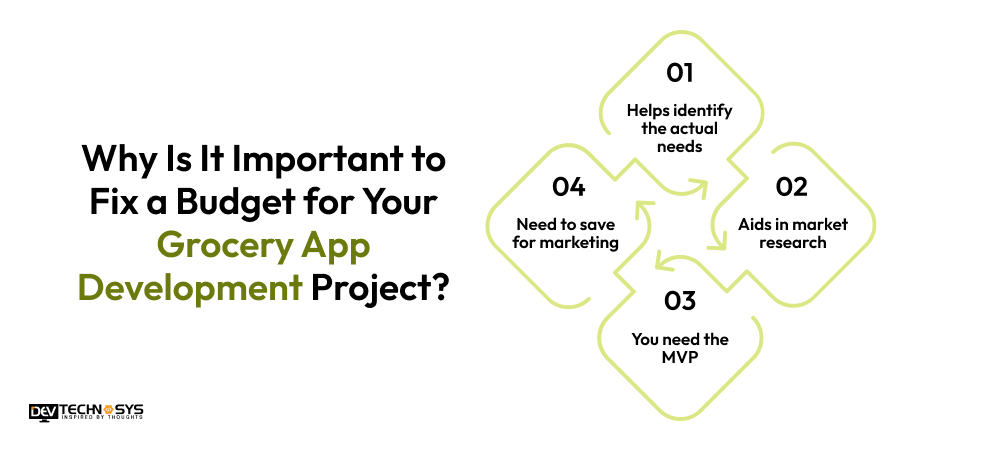
1. Helps Identify the Actual Needs
For many reasons, it’s important to set a budget for your grocery app development project. First, it helps you figure out what your job really needs.
By figuring out On-demand grocery app development cost, you can decide which features and functions are most important to the success of your app. This keeps you from spending money you don’t need to and makes sure your resources are used well.
2. Aids in Market Research
Second, having a budget helps you study the market. Recognizing your financial limits lets you look into possible ways to make money and make money online. This knowledge can help you a lot as you decide what features to add to your app, who to target, and grocery delivery mobile app development cost.
3. You Need the MVP
Third, you need a budget to make an MVP. An MVP is a simple version of your app that lets you try your idea and get feedback from people who might use it. You can figure out the scope of your MVP and make sure it fits with your financial goals by making a budget.
4. Need to Save for Marketing
Finally, you need a budget to save money for marketing. Getting people to download your grocery delivery app development costs a lot of money. You can make sure that your app gets to the right people and gets the amount of attention you want by setting aside money for marketing.
Industry Insight
According to Market Data Forecast, the rising adoption of digital platforms is encouraging businesses to expand their services for same-day delivery, AI recommendations, and personalized customer experiences.
How Much Does It Cost to Build a Grocery Delivery App?
The cost will go up as the project gets bigger and more people work on it. So, if you want to develop a grocery app, you’ll want to know the required budget. Determining the exact cost of developing a grocery delivery app is a challenging task. We can only give you a rough estimation of the grocery delivery app development cost for a grocery delivery service, though.
The cost to build a mobile app usually ranges between $30,000 to $150,000+. It can go higher depending on the level of app complexity, features, platform, and other factors. It’s essential that your project needs are taken into account before determining the cost of grocery delivery app development. It changes the cost to make a grocery delivery app generally. Take a look at the table below:
| App Complexity | Cost Estimation |
| Essential Grocery Delivery App | $30,000–$50,000 |
| Feature-Rich Grocery Delivery App | $50,000–$100,000 |
| Enterprise Grocery Delivery App | $100,000–$150,000+ |
These are just the basic estimates of mobile app development cost. You can calculate the cost by using the below formula:
Total Grocery Delivery App Development Cost = hourly rate of developers * development time
Now that you know the grocery delivery app development cost, it is time to hire a grocery delivery app development company.
Factors That Can Affect the Grocery Delivery App Development Cost
The users’ expectations with grocery apps are rising day by day, and definitely, the future of these apps is bright, where we will experience lots of updates.
On the other hand, the process to develop a grocery delivery app like Flink requires lots of effort, where the price also includes if you are planning to launch for your own business. The grocery app development costs depend on various factors, which are as follows-
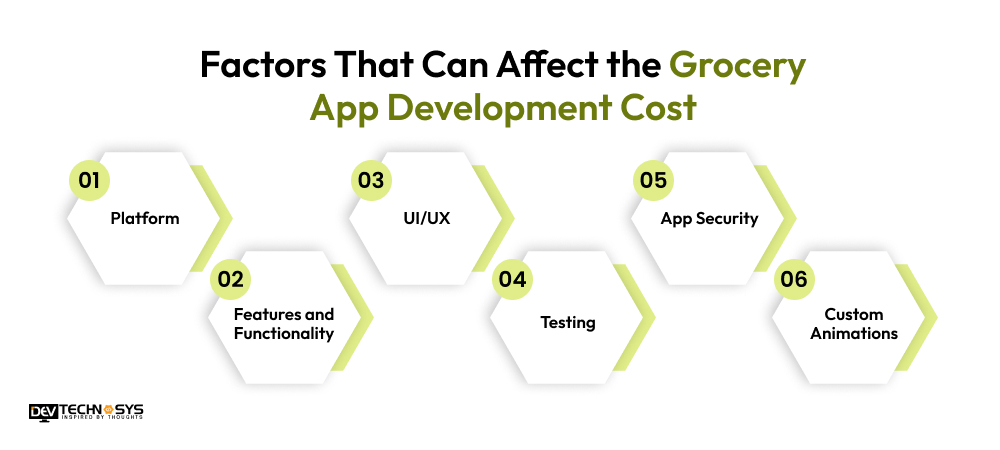
1. Platform
It is okay that you have decided to launch your grocery app. But have you thought about the platform? There are two major platforms for mobile apps: Android and iOS. Most users worldwide use Android smartphones, but iPhone users are more, so you have to decide on it in the US.
For your information, an enterprise grocery delivery platform cost is more than an Android-only platform. If you want to target users on both platforms, cross-platform grocery app development will be cost-effective.
Platform Choice |
Development Timeline |
Estimated Cost |
| Android or iOS (Single) | 2–3 months | $8,000 – $12,000 |
| Cross-Platform | 3–4 months | $12,000 – $18,000 |
| Both Android & iOS (Native) | 4–5 months | $18,000 – $25,000 |
2. Features and Functionality
Features & Functionalities are other crucial factors that affect the grocery app development cost. In simple terms, you can understand it as more features, more cost. Although the basic features will be included in the essential grocery app development cost, if you need additional features such as geolocation, in-app video call, etc., they will be added to the additional grocery app development cost.
Feature Set |
Development Timeline |
Estimated Cost |
| Basic | 2–3 months | $8,000 – $12,000 |
| Advanced | 3–4 months | $12,000 – $20,000 |
| Enterprise-level | 4–6 months | $18,000 – $25,000 |
3. UI/UX
Usually, the users are attracted by the UI/UX of the app, and if an app lagging it, then there will be a high chance of uninstallation. Therefore, to have an impressive app, you need to spend the money.
A basic grocery app with standard frameworks and design costs less compared to a custom UI/UX design with advanced graphics, layout, and wireframes. Take a look at the table below to see the UI/UX development cost for a grocery app.
UI/UX Level |
Development Timeline |
Estimated Cost |
| Basic & Simple | 1–2 months | $8,000 – $10,000 |
| Customized & Modern | 2–3 months | $10,000 – $15,000 |
| Highly Interactive | 3–4 months | $15,000 – $20,000 |
4. Testing
Although the grocery app development company will build the backend for you, flawless, bug-free app testing is still required. Your grocery app needs to go through functionality, usability, security, and performance testing. Thorough testing of the app ensures smooth, error-free operation after launch. If the case it requires an extra tool, then it will increase the grocery delivery app development cost.
Testing Type |
Development Timeline |
Estimated Cost |
| Standard QA | 2–3 weeks | $8,000 – $10,000 |
| Advanced | 1–2 months | $10,000 – $15,000 |
| End-to-End | 2–3 months | $15,000 – $20,000 |
5. App Security
An on demand app development company always focuses on security solutions, so to integrate it, they add some more elements that require a little cost added to the app. User security and privacy are the main concerns due to the increasing fraud and cyber attacks on applications. User security and privacy assurance increase the cost to create an app like instacart. Check out the table below to know the cost to create a grocery app according to the app security factor.
Security Level |
Development Timeline |
Estimated Cost |
| Basic Encryption & Secure Login | 1 month | $8,000 – $10,000 |
| Advanced | 1–2 months | $10,000 – $15,000 |
| Enterprise-grade | 2–3 months | $15,000 – $22,000 |
6. Custom Animations
It is a fact that animations have a significant effect on a person’s mind. Suppose for handling an enterprise app, if any training is required, then custom animations can work great. The more sophisticated and high-quality animations you add to your app, the higher the cost of development will be. However, adding animations is a smart move, as these visual elements can make your grocery app truly great.
Animation Level |
Development Timeline |
Estimated Cost |
| Basic Transitions | 2–3 weeks | $8,000 – $10,000 |
| Moderate | 1–2 months | $10,000 – $15,000 |
| Advanced | 2–3 months | $15,000 – $25,000 |

How to Monetize Your Grocery Delivery App?
What should you do now that you’ve made an app for grocery delivery? Is this the end? Not at all. To make a lot of money, you need to find ways to make money off of your grocery delivery app. So, we’ve made a list of the most common ways for big app like Wolt to make money.
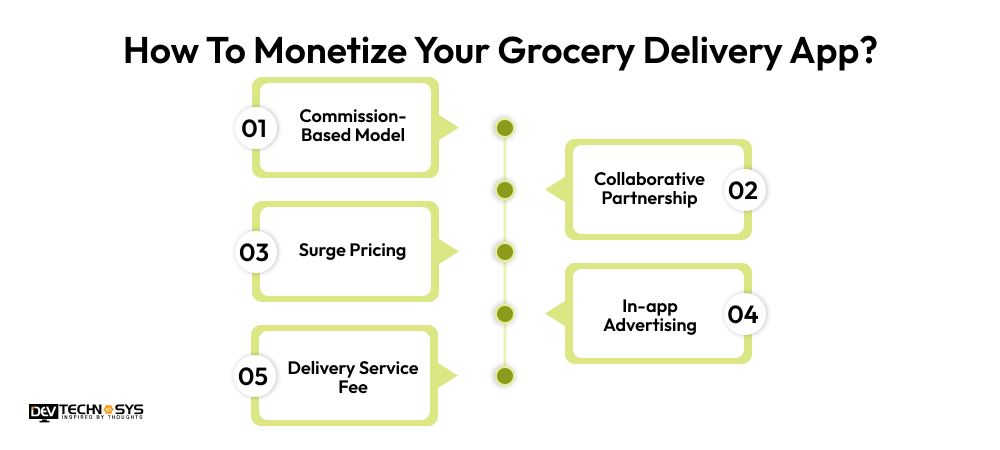
1. Commission-Based Model
The commission-based strategy is one of the most common ways for grocery delivery apps to make money. Businesses can make money from it because it takes a cut of every order made through the app. In this way of making money, the grocery delivery app works with nearby businesses like stores, shops, or restaurants in exchange for a cut of every sale the app makes possible. For every sale that comes through the app, a fee of a certain amount is taken.
2. Collaborative Partnership
Many on-demand grocery delivery apps use smart relationships with other businesses or platforms as a way to make money. This helps them get more users, keep those users longer, and get more money. In this plan, the grocery delivery app works with other platforms or services that support it to create a link that is good for everyone.
These shopping apps can also reach new markets by working together, raise knowledge of their brands, and increase the number of transactions. If the app uses the skills and customers of linked companies or platforms, it can make more money and give customers a better, more complete experience.
3. Surge Pricing
During times of high demand or low supply, on-demand grocery delivery apps often use surge prices as a way to make more money. It means briefly raising the prices of goods or services in order to make money off of the higher demand and get more drivers or delivery partners to sign up.
With surge pricing, the shopping app can change prices on the fly based on the market, like during busy times, special events, or times when demand is higher than supply. In surge pricing, algorithms and real-time data analysis are often used to pick the best surge increase to add to the base price.
4. In-app Advertising
In-app ads are a common way for on-demand grocery delivery apps to make money. With this method, ads are shown in the app’s interface to grocery delivery app development cost. Banner ads, pop-up ads, or paid material that has been placed on purpose may be in the delivery app.
The cost to develop a grocery delivery app Like Blinkit shows relevant and customized ads by using user tastes or demographic data, among other targeting methods. This increases conversion rates and makes money.
5. Delivery Service Fee
The delivery service fee is often how on-demand buying and delivery apps make money. In this type of business, the app charges users for each delivery that is made through its website. The money from this fee is used to keep the app running. It’s part of the total price of the order.
With the delivery service fee, you can cover the grocery delivery app development cost of running the business that delivers packages with the help of an android app development company. It takes care of things like paying drivers, handling shipping, customer service, and keeping the app’s infrastructure in good shape.
Hidden Costs of Grocery Delivery App Development
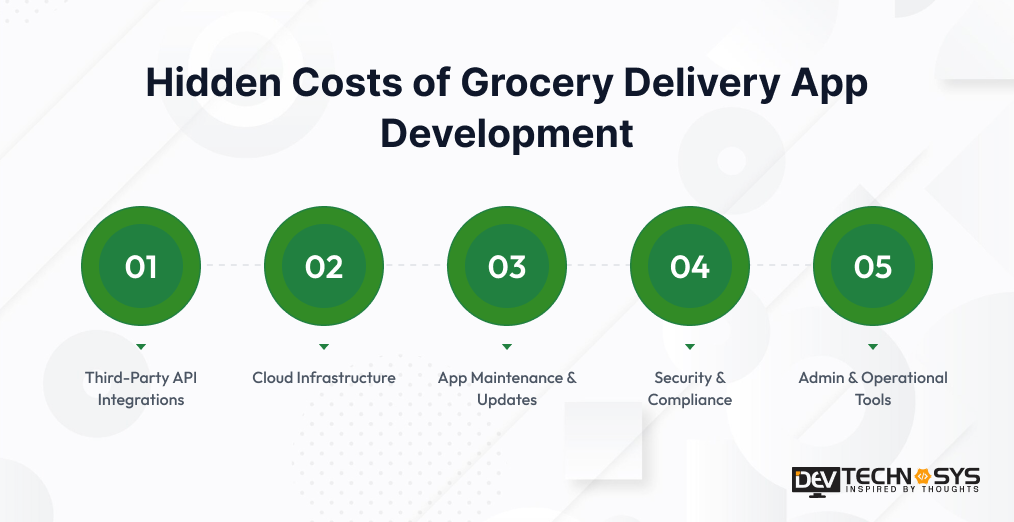
Most businesses prefer to follow grocery delivery app development market trends but miss out on hidden expenses that can actually impact their investment strategy. The initial development estimate does not always represent the complete investment required to launch and operate a grocery delivery app.
Businesses should also account for ongoing expenses related to infrastructure, integrations, maintenance, security, and operations. Planning for these costs early helps prevent unexpected budget increases as the platform grows.
Hidden Cost |
Particulars |
Estimated Cost |
| Third-Party API Integrations | For a grocery app, maps, payment gateways, push notifications, and other external APIs are required | $3,000–$10,000+ |
| Cloud Infrastructure | To manage the services with easy accessCloud hosting, databases, storage, backups, and CDN are included | $2,000–$8,000+ |
| App Maintenance & Updates | Bug fixes, OS updates, performance optimization, security patches, and ongoing improvements | 15% of the total development cost |
| Security & Compliance | Security audits, penetration testing, encryption, vulnerability assessments, monitoring, and compliance implementation | $5,000–$25,000+ |
| Admin & Operational Tools | Admin needs to manage customers and businesses, for which analytics and reporting tools are important | $3,000–$15,000+ |
How to Reduce Grocery Delivery App Development Cost?
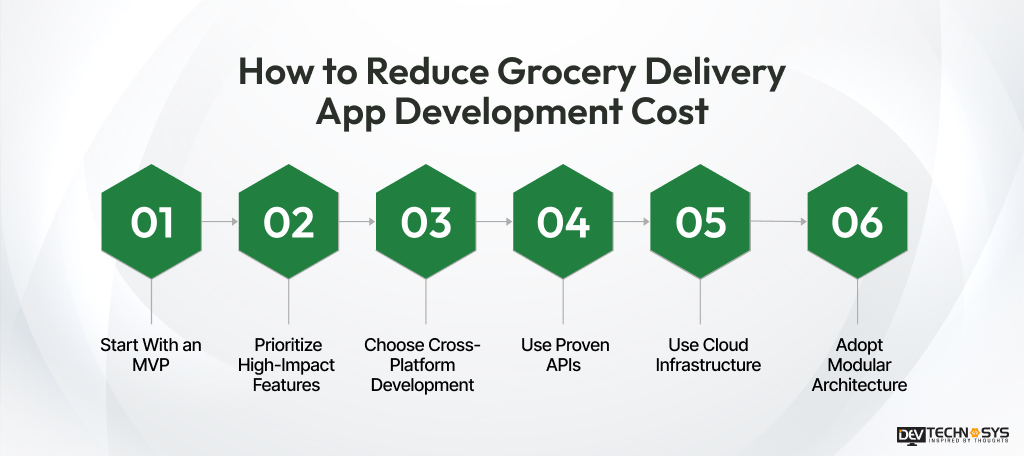
Businesses can control the grocery delivery app development cost without compromising the core user experience by prioritizing features and adopting a scalable development strategy.
1. Start With an MVP
The best strategy to reduce grocery delivery app development cost is to build an MVP. This comprises the fewest features that can be completed within a few weeks with a manageable budget. Businesses can later scale the solution according to business expansion.
2. Prioritize High-Impact Features
Discussions with the project managers should take sufficient time to include features that could improve workflow rather than non-essential ones.
3. Choose Cross-Platform Development
Choosing cross-platform app development is beneficial because developers can make changes to both apps with minimal effort.
4. Use Proven APIs
Integrate reliable third-party solutions for payments, maps, notifications, authentication, analytics, and communication instead of developing these services from scratch.
5. Use Cloud Infrastructure
Cloud platforms allow businesses to scale computing, storage, and database resources based on actual demand, reducing the need for expensive upfront infrastructure.
6. Adopt Modular Architecture
Build the application using reusable, independent modules so that new features, integrations, and services can be added without significantly rebuilding the existing platform.
Security and Compliance Impact on Grocery Delivery App Development Cost
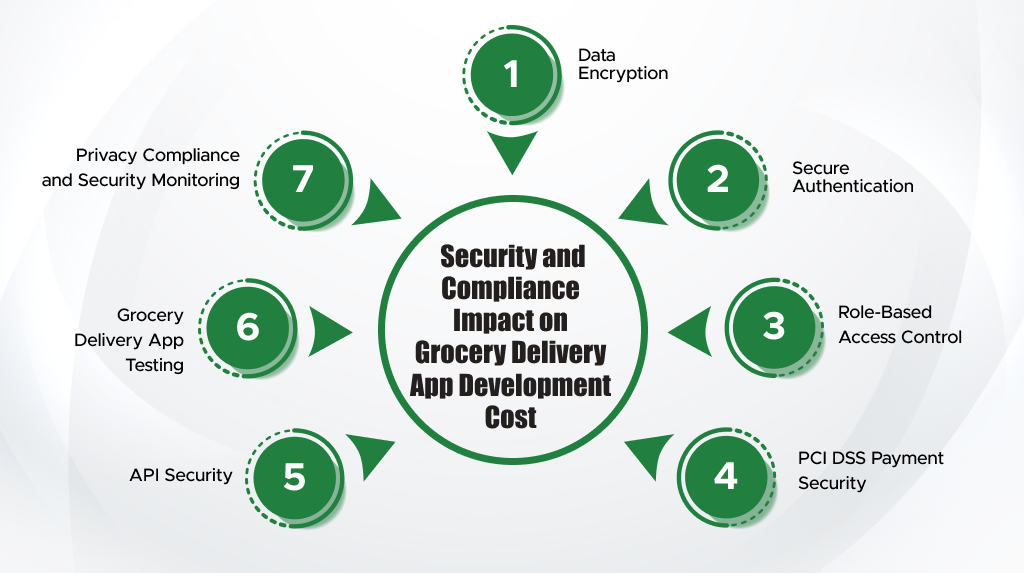
USA businesses must not avoid the costs associated with security and compliance practices. These capabilities are built into the architecture, including data encryption, SOC 2, RBAC, and secure authentication.
1. Data Encryption
Most businesses prefer to build Same-day delivery infrastructure, for which developers use HTTPS/TLS for secure data exchange. The data is transferred through the backend to the user interaction that needs protection. However, the final cost depends on the encryption architecture and the total amount of sensitive data in the grocery delivery app.
Estimated Cost: $3,000–$8,000
2. Secure Authentication
The cost of quick commerce app development is affected by the choice of a secure authentication architecture for device verification or biometric login. Other than this, OTP verification, multi-factor authentication, session controls, and token-based authentication are implemented to secure the user identity. This prevents unauthorized access to the app while protecting sensitive information.
Estimated Cost: $4,000 – $12,000
3. Role-Based Access Control
The grocery marketplace app’s cost is mainly affected by these security practices, which create separate permissions for customers, delivery partner panel users, and other users. In mid-level to enterprise apps, this complexity increases, and costs become higher. Developers need to put in additional effort to create secure programming to use RBAC.
Estimated Cost: $3,000–$10,000
4. PCI DSS Payment Security
Modern customers prefer to pay by card to save time, so a PCI DSS-compliant payment gateway is implemented. Appropriate security controls reduce fraud and data exposure. This compliance affects cost because experts with strong knowledge and proven experience are required to handle the project.
Estimated Cost: $8,000 – $25,000+
5. API Security
The main purpose of a grocery delivery app is to experience smooth supply chain operations; API security is a must. This protects data transferred through customer apps, delivery applications, vendor dashboards, payment services, maps, and administrative systems. Businesses might incur higher costs depending on app complexity.
Estimated Cost: $5,000 – $15,000
6. Grocery Delivery App Testing
Testing adds to the grocery delivery app maintenance cost because developers perform dependency checks, secure code reviews, penetration testing, and API testing. This phase is crucial to keep the app up to date while providing a personalized user experience. The customer, delivery, and admin panel are checked for threats or inefficiencies. A dedicated team handles bug fixes or similar concerns in the application.
Estimated Cost: $8,000 – $20,000
7. Privacy Compliance and Security Monitoring
An enterprise grocery delivery platform cost is affected by continuous monitoring for security and compliance. Software engineers perform regular testing to ensure the application complies with U.S. privacy laws. In accordance with the requirements, compliance documentation and third-party security assessments are conducted to ensure privacy-aware data handling.
Estimated Cost: $10,000 – $30,000+
Let’s Create A Top-Notch Grocery Delivery App!
It takes more than just writing code for a cool app to make a successful grocery delivery service. You need to make a solid business plan for your company to do well.
The best way to do this is to work with the best mobile application development company who can do both the technical work and the business planning.
We at Dev Technosys have the newest tech stacks and years of experience that will help you make a great grocery delivery app.
Set up a free meeting to talk about how we can make your grocery delivery dreams come true.
Planning a Grocery Project?
Get a tailored development cost estimate in a few simple steps.
- 3 quick steps
- 100% free
- Reply in 1 business day
2 Minutes Read
Frequently Asked Questions
Find answers to the most common questions related to this article.
The time to build a grocery app will be between 2-8 months or can go above. Basically, it depends on the factors like app complexity, features and tech stack.
The cost to develop a grocery mobile delivery application can be around $10000-$25000. Depending on your project requirement, the cost can fluctuate.
You can make money from a grocery delivery app by leveraging the below methods:
In-app purchase
Subscription model
Collaboration model
Freemium model
The benefits of developing online grocery delivery app are mentioned below:
Loyalty programs
Tracking
Multiple payment options
Inventory management
Manage orders
Following are the best examples of top grocery apps
Instacart
Amazon Fresh
Walmart
Kroger
Shipt
Thrive Market
Whole Foods
Peapod
FreshDirect