







Key Takeaways:
-
- To build a food delivery app consists of various steps, such as market research, collecting project requirements, tech stacks, design, development, testing, publishing, and maintenance.
- Popular meal delivery platforms such as Zomato, Deliveroo, DoorDash, Uber Eats, Swiggy, Grubhub, Seamless, and many more.
- Food delivery apps generate higher revenue streams by using legal monetization models such as subscription plans, freemium models, delivery fees, transaction fees, and advertising.
- Implement the advanced features such as order customization, real-time order tracking, multiple payment options, user-friendly interface, secure authentication, and more.
- Experts follow PCI-DSS standards throughout the entire development process ensuring security to the sensitive information.
In accordance with McKinsey & Company, food delivery exceeded $150B globally; growth driven by convenience, apps, and changing consumer habits. As of 2026, it’s now easier than ever to build a food delivery app that will live up to how quickly things change in today’s fast-paced world. Not only do people order food via apps, but they also demand speed and personalization, along with an easy and seamless user experience from the moment they open your app until they actually receive their order.
One can only imagine how busy we all are. Also, people tend to eat later, and let’s be honest. So convenience is often explored after, and this is what is influencing this modern trend.
Your application may be able to resolve actual issues by offering faster or more personalized delivery, better recommendations, and a greater variety of options that support healthier living. In this blog, we will provide a clear business direction, creativity, and desire to research things, which are all that’s needed to start bringing your food delivery app idea to fruition!
Current & Future Market Projections of Food Delivery Apps
- According to Statista, the food delivery apps market is valued at around $1.51 trillion in 2026. This is projected to increase to around $2.05 trillion by the end of 2031.
- As claimed by Fortune Business Insights, looking at the payment method-wise, the online payments hold around 68% market share of food ordering applications.
- In keeping with Statista, the user penetration in the food delivery apps market is around 29.2% in 2026.
- The worldwide meal delivery service platforms’ revenue shows a rapid growth with a CAGR of 6.24% during the forecast period from 2026 to 2031.
- In agreement with Businessofapps, China is the fastest-growing country or region in the takeout delivery service market, with around $40.02 billion in 2026.
What is a Food Delivery App?
A food delivery application is a mobile or web-based platform where customers can connect with local restaurants, grocery stores, and cafes to order food and deliver it to their doorsteps. Customers can also pick up their order and book a dine-in via the app.
Top food delivery apps offer a wide range of restaurants or cafes for users to order food items from their favorite restaurant. They provide real-time order tracking features that make it easy for users to get the real-time order status.
How Does a Food Delivery App Work?
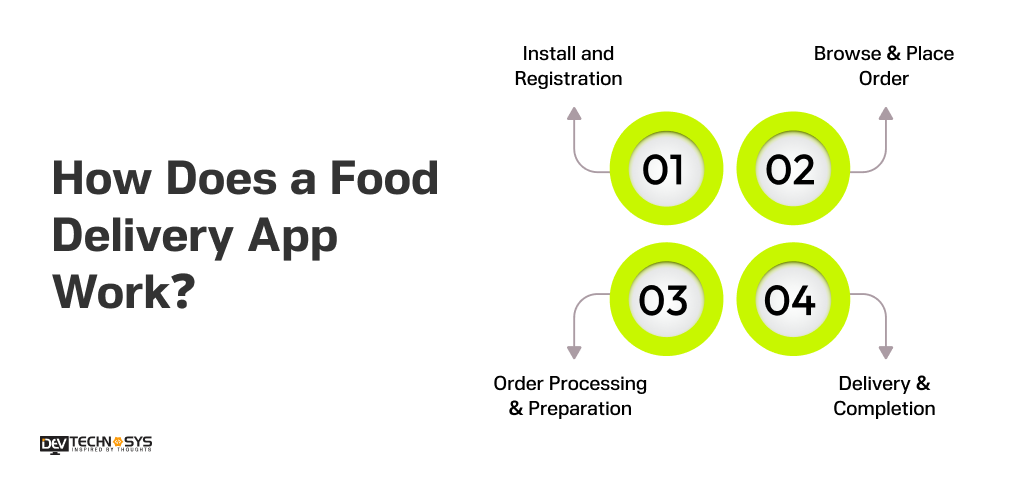
To use the full potential of a food delivery app, you must know how the application works and what services they actually offer. Let’s take a view at the following steps to know the working criteria:
1. Install and Registration
First of all, install the food delivery app as you want and register your account via phone numbers, email address, social media platforms, and more.
2. Browse & Place Order
Users browse the wide range of restaurants and select their favorite restaurant. Choose the food item that users want to order, move to the cart, apply offers or coupons, and complete the payment.
3. Order Processing & Preparation
The food ordering platform sends the order to the restaurant, and they confirm the order and start to prepare the food. The app assigns a delivery partner to deliver the order on time.
4. Delivery & Completion
The delivery partner picks up the order from the restaurant and delivers it to a specific location. Users can track the delivery in real-time and send feedback and ratings.
Industry Insights:
According to PW Consulting, around 70% of digital ordering users now prefer mobile apps over phone or website ordering for food delivery, indicating that mobile is the dominant user interface.
5 Different Types of Food Delivery Applications
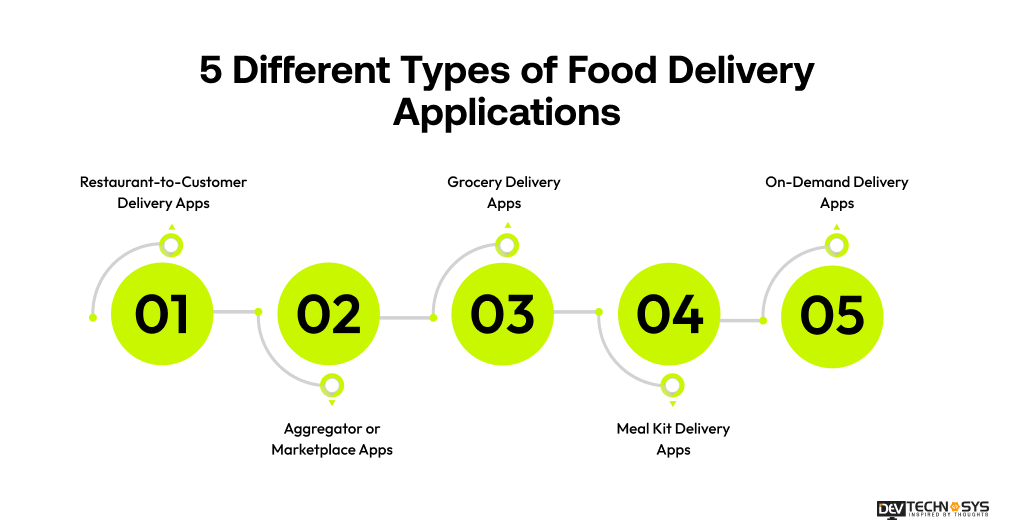
The five major categories of food delivery apps are: restaurant, aggregator-wide delivery, grocery, meal kit, and hyperlocal. These creative applications are changing the way we order, cook, and enjoy food at home conveniently in many ways.
1. Restaurant-to-Customer Delivery Apps
Apps that operate restaurant chains and provide customers with the ability to order from restaurants that are closest to them. Users can browse through the menu, place their orders, and track deliveries, all of which create convenience and give restaurants the ability to control the quality of their food from the time it leaves the restaurant until it arrives at the customer’s door.
2. Aggregator or Marketplace Apps
These apps provide customers with a single point of entry to multiple restaurants from across all types of cuisines by allowing them to place orders and track the delivery of their food through various restaurants. They also provide customers with ratings, reviews, promotions, and order tracking.
3. Grocery Delivery Apps
Grocery delivery app development solutions that allow users to shop for groceries and other basic food products at home without having to visit a physical store. These apps also allow users to view in-store inventory, schedule a delivery, or have their groceries delivered the same day.
4. Meal Kit Delivery Apps
These apps provide users with easy-to-prepare recipes and pre-measured ingredients to use when preparing a meal. Customers can prepare fresh meals with no prior cooking experience required, which decreases food waste and encourages cooking at home while also offering convenience to those who want variety in their cooking.
5. On-Demand Delivery Apps
An app that delivers food, beverages, or snacks to customers quickly within a relatively short distance of the restaurant. The on-demand app development solutions promise quick delivery, often within a matter of minutes, and operate with gig workers or couriers to meet customers’ immediate cravings and/or needs; examples include Uber Eats and DoorDash.
How to Build a Food Delivery App in 2026?
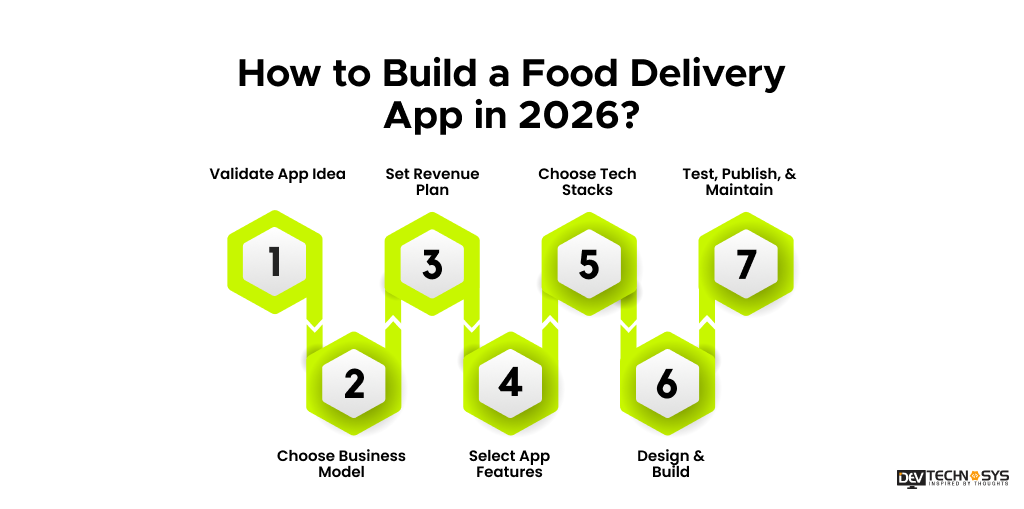
Build a food delivery app in 2026 means verifying that there is an audience for your product. Defining a business model that allows it to scale, planning how you will generate revenue, and defining the core features of the application. Using the most current technology stacks, designing it to look great from all angles, testing it on multiple platforms, and supporting the application through ongoing maintenance.
1. Validate App Idea
The first step in developing a successful app or business is validating your idea through research on the target market, competitors, and users’ needs. Hire a food delivery app development firm to conduct research to identify gaps in the market by reviewing apps such as Uber Eats and DoorDash to determine what they are missing.
You can do this by conducting surveys, gathering user feedback, and defining your unique value proposition. Additionally, you can validate your app idea by conducting a pilot test or creating an MVP to ensure that you have developed a solution to a real problem.
2. Choose Business Model
There are many different types of delivery app business models, including aggregator, order-only, and full-stack delivery. For example, Zomato uses an aggregator business model, while several other food delivery companies manage all aspects of logistics.
Decide whether you want to partner with restaurants or provide delivery services in-house, as these options will affect your delivery app’s operations, costs, and growth potential. Choose a business model that will allow you to manage your resources and target market.
3. Set Revenue Plan
Hire professional consultants from a mobile app development agency to identify how your delivery app will generate revenue and what the revenue streams will be. Many delivery apps generate revenue through delivery fees, commission from restaurants, subscription services, surge pricing, and advertisements.
For example, Swiggy uses multiple methods to generate revenue for the business. You will need to ensure that your pricing structure allows you to remain competitive while generating enough revenue after expenses to be viable.
4. Select App Features
Determine the basic app functionalities such as user sign-up and account creation, restaurant information and menu options, ability to shop using a shopping cart, ability to pay for purchase via secure payment processor, and ability to track the order delivery in real-time.
Optional advanced features can include providing AI-Recommended products, chat features available for contacting customer service, and a contactless delivery option. Perform competitive research on similar apps to identify users’ expectations for these features of an application.
5. Choose Tech Stacks
Find the right technology stack to support the front-end/ back-end of the application and the database. Popular choices of technologies for the front-end for developing cross-platform applications would be either React Native or Flutter.
Employ one of the best food delivery app development companies for developing the back-end, using Node.js or Django, using a cloud service API where applicable for your application. And to ensure secure payment processing through a payment gateway. You want your app to support scalability, safety, and excellent performance.
6. Design & Build
Ensure the UI and UX of the application are user-friendly so users are able to find products easily and can purchase them quickly. You need to include the following three panels: user, restaurants, and delivery partners in the application.
Employ the agile method for developing the app by breaking the project down into smaller iterations while continuing to enhance features. Ensure that every component works together for a seamless experience, such as payment processing and real-time GPS tracking.
7. Test, Publish, & Maintain
In the last stage of food delivery app development services, before launching your app, make sure you have tested it to find bugs, test its performance, and verify its security. After publishing to the app store, gather initial user feedback and keep track of this in order to identify areas that need to be improved within your app.
You will need to regularly add new features and correct problems based on feedback from users. To maintain the competitive status of your app in the extremely competitive field of food delivery service, you need to continue to provide maintenance to your app after launching it.
Dev Technosys provides ongoing mobile development for a food delivery service company. A scalable solution is developed for iOS and Android platform.
Top 10 Food Delivery Applications
There are thousands of food delivery apps available in the market, but choosing the best one for food ordering services. Offering 10 popular apps for food delivery with their user downloads, launch year, platform availability, and ratings:
App Name |
Approx. Downloads |
Launched Year |
Rating |
Platform Availability |
| Uber Eats | 100M+ | 2014 | 4.8/5 | iOS, Android, Web |
| DoorDash | 50M+ | 2013 | 4.7/5 | iOS, Android, Web |
| Zomato | 100M+ | 2008 | 4.6/5 | iOS, Android |
| Swiggy | 100M+ | 2013 | 4.7/5 | iOS, Android |
| Grubhub | 10M+ | 2004 | 4.6/5 | iOS, Android, Web |
| Deliveroo | 10M+ | 2013 | 4.7/5 | iOS, Android |
| Just Eat | 10M+ | 2001 | 4.5/5 | iOS, Android |
| Postmates | 10M+ | 2011 | 4.6/5 | iOS, Android |
| Instacart | 10M+ | 2012 | 4.6/5 | iOS, Android |
| foodpanda | 100M+ | 2012 | 4.4/5 | iOS, Android |
1. Uber Eats
Uber Eats is one of the leading and most popular food delivery platforms across the world, and it was launched in 2014 by Travis Kalanick and Garrett Camp. Uber Eats connects users with local restaurants and grocery stores to order food items or meals and delivers them to their preferred location. It includes features like real-time order tracking, delivery options, diverse selection, and more.
2. DoorDash
DoorDash is the biggest American food delivery platform and was founded in 2013. This platform holds 56% share of the USA market, and it serves its services to various countries such as the US, Canada, and Australia. It delivers various types of items such as groceries, alcohol, retail items, and many more. An app like DoorDash provides several features like secure payment options, personalized recommendations, restaurant selection, and more.
3. Zomato
Zomato is one of the most well-known food tech platforms that enable users to discover their favorite restaurants, order meals, and receive them at their specific location.
It involves several functionalities such as tracking orders in real-time, restaurant discovery, Zomato Gold, dining out, and more. Zomato was founded in 2013 and provides delivery services to 3 lakh restaurants across different cities.
4. Swiggy
Swiggy is India’s leading and most popular food ordering and delivery platform, where users can order meals and also set the pickup option. Users can also order food from the train and receive their seat number, and provide a local and chain restaurants with no minimum order requirements. An app like Swiggy is available in over 600 cities and also offers grocery delivery services.
5. Grubhub
Grubhub is a US-based food delivery app and has gained higher popularity because of its faster delivery options and connection with local restaurants. It offers a variety of restaurants such as KFC, McDonald’s, Taco Bell, and other cafes. Grubhub supports secure payment options like PayPal, Apple Pay, Venmo, Gift cards, debit, or credit cards. Partnership with 300,000 restaurants in 4,000+ cities.
Free App Idea Reality Check: Let's Stress-Test Your Concept
Share your app idea with us. Within 3 business days, we'll uncover UX gaps, feature opportunities, and potential development challenges, so you can build with confidence. No strings attached.
Why Businesses Want to Build a Food Delivery App in 2026?
Food delivery apps have become more than just a luxury but also essential to a business in 2026, with rising customer demand, the convenience of digital services, and intense competition driving online food delivery services through food delivery apps. By building a professional food delivery app, businesses will benefit from increased revenue potential and establish stronger connections with customers.
1. Rising Need for Convenience
The year 2026 predictions show that consumers across the globe have moved toward using their smartphones for ordering food rather than cooking or dining out. This trend is being driven primarily by the current fast-paced lifestyles of consumers looking for immediate gratification. Many businesses are taking advantage of this opportunity to connect with more potential customers in a quick and easy manner.
2. Increased Revenue Opportunities
With the ability to generate multiple streams of revenue, including delivery fees, subscription plans, and advertising or promotional campaigns. Through the use of a food delivery website development solution, businesses can accelerate growth beyond the confines of their physical location, while also maintaining all hours of operations (24/7).
3. Enhanced Customer Relations
Using mobile app development for food delivery, businesses can engage with customers in ways such as sending them notifications, promotions, personalized recommendations, and more.
This ultimately builds customer loyalty, forming a strong relationship between the business and the customer, thus providing a reason to reorder frequently. Through analyzing user data and patterns, businesses can create a more customized experience for the consumer.
4. Data-Driven Decision Making
If businesses build a food waste management app, it provides businesses with data about consumer preferences, including which menu items are most popular, ordering patterns, and busy times of day. Businesses can use the data obtained from food delivery apps to improve their menus and pricing strategies, as well as targeted marketing strategies.
5. Gaining a Competitive Edge
As more restaurants go digital these days, having a food delivery app for your business is no longer an option. If a business has invested in a food delivery app, they are distinctly positioned differently from competing restaurants that do not have meal delivery apps and will continue to remain relevant in today’s economy. In addition, having a food ordering app creates a strong brand presence while providing great service.
5 Common Challenges When Building a Food Delivery App
Food delivery app development process goes beyond having a great user experience; it is about building the product itself. There are a number of hurdles that a business has to get over when launching a food delivery app: recruiting restaurants and customers at the same time, providing real-time tracking of the delivery, handling failed payments, managing peak period traffic, and retaining delivery drivers.
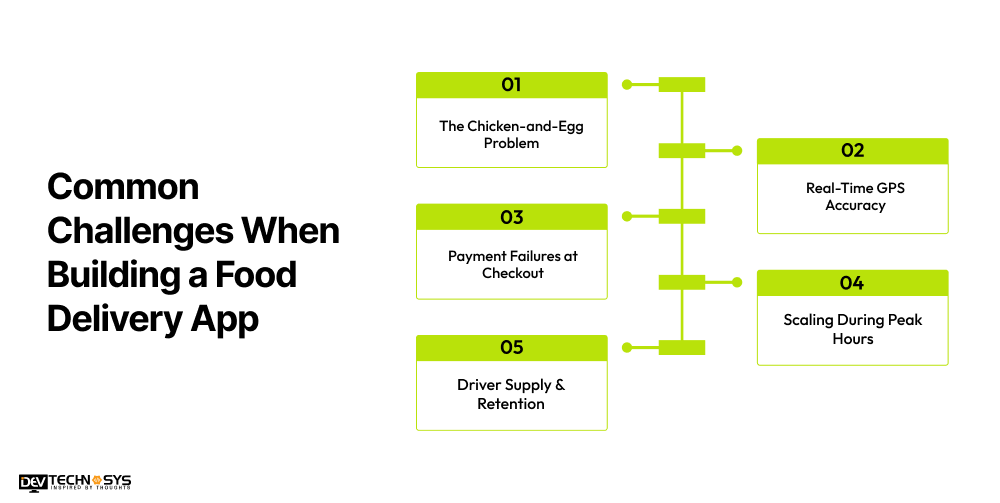
Challenge 1: The Chicken-and-Egg Problem
A restaurant delivery business has no way to feed customers because there aren’t enough customers or enough restaurants. If customers don’t have a lot of restaurants to choose from, they leave. If there are no orders coming into a restaurant, the restaurant closes.
Solution: Issue is to expand the delivery service in a small geographical area, sign up for 20+ restaurants to deliver prior to opening for business, and promote and subsidize (or partially pay) for first-time deliveries.
Challenge 2: Real-Time GPS Accuracy
Real-time GPS for deliveries is important because having an accurate location would increase customer satisfaction; however, using GPS to track a delivery continually will kill a phone’s battery very quickly.
Solution: Use background location services combined with geofenced triggers. By using geofenced triggers, a restaurant could provide a delivery person’s location with very little battery drain on the delivery person or the customer’s phone.
Challenge 3: Payment Failures at Checkout
One of the major food delivery app development challenges is when payment at the checkout fail. The majority of customers abandon their carts. When the payment is declined for any reason, there is a very good possibility that the order will not be completed.
Solution: Use multi-gateway payment processing to automatically try to rerun the transaction with another payment gateway (for example: Stripe, Razorpay, etc.) to maximize the success rate of payment processing.
Industry Insights:
In accordance with Reuters, Uber plans to launch or expand food delivery services into several new European markets aimed at adding about USD 1 billion in gross bookings over the next 3 years.
Challenge 4: Scaling During Peak Hours
During the lunch rush or dinner rush (on Fridays), there is the potential for up to a tenfold increase in traffic, which can easily overwhelm the servers and cause performance slowdowns.
Solution: Use AWS or GCP cloud auto-scaling, use Redis caching for frequently searched items, and process all orders through queues to maintain performance and reliability during peak times.
Challenge 5: Driver Supply & Retention
In order to maintain an active driver network to provide timely deliveries and meet customer needs, there needs to be a solid base of drivers; when driver turnover rates are high, operational disruption and increased costs may occur.
Solution: Create gamified driver earnings dashboards, provide instant payout options, and provide drivers with bonus payments during periods of peak activity to retain drivers and increase driver engagement.
Must-Have Features to Build a Food Delivery App in 2026
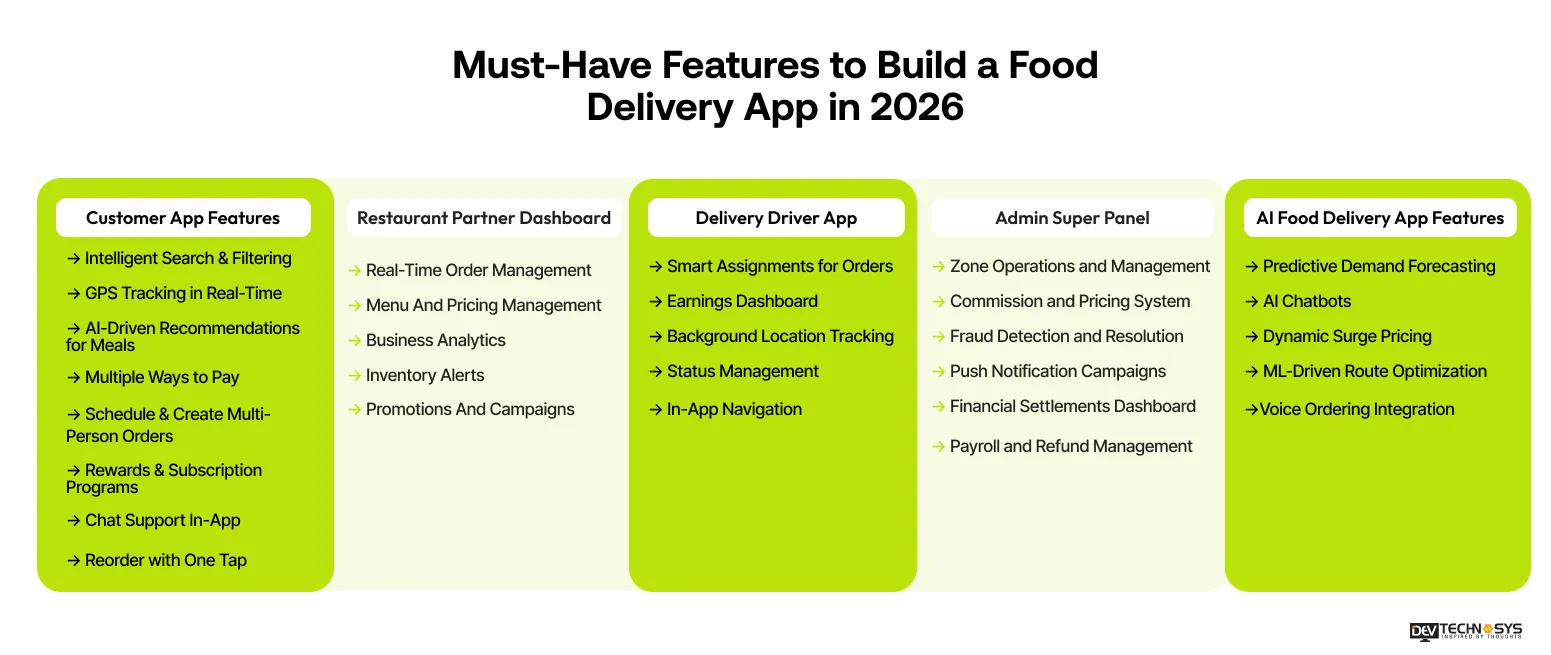
1. Customer App Features:
- Intelligent Search & Filtering: Allow customers to discover meals by cuisine, rating, delivery time, dietary preference, cost, and location.
- GPS Tracking in Real-Time: Track orders in real-time with location updates on drivers, accurate ETAs, and real-time complete delivery status updates.
- AI-Driven Recommendations for Meals: Use AI to provide recommendations for meals based on customers’ interests, ordering history, seasonal trends, and time of day activity.
- Multiple Ways to Pay: Offer customers many ways to pay, such as UPI, credit cards, digital wallets, buy now pay later (BNPL), and cryptocurrency.
- Schedule & Create Multi-Person Orders: Allow customers to schedule their orders ahead of time and order for multiple people (family, friends, business, and special occasions) at one time.
- Rewards & Subscription Programs: Build loyalty with customers through reward points, referral bonuses, exclusive discounts, cash back offers, and premium member benefits.
- Chat Support In-App: Allow direct communication between customers, restaurants, and delivery drivers for faster support and issue resolution.
- Reorder with One Tap: Provide customers a simple way to order their favorite meals by allowing them to instantly reorder from their order history, decreasing the effort in reordering, and creating more reorders.
2. Restaurant Partner Dashboard
- Real-Time Order Management: Efficiently manage incoming orders, monitor preparation status, update fulfillment status by order, and manage restaurant-wide operations.
- Menu And Pricing Management: Easily manage your menu items, including adding new items, uploading photos, changing prices, and managing inventory via a single dashboard.
- Business Analytics: Gain insights about sales revenue, peak ordering times, customer ordering behaviors, and best-selling menu items.
- Inventory Alerts: Automatically receive alerts for low stock items to avoid running out of stock and ensure smooth service operations.
- Promotions And Campaigns: Create promotions for discounts, bundle meals, seasonal items, and advertising campaigns to encourage new customers to purchase from your restaurant and increase sales.
3. Delivery Driver App
- Smart Assignments for Orders: Automatically assign orders to drivers using an AI-powered route optimization engine, driver availability, and proximity matching system.
- Earnings Dashboard: Enable drivers to view their earnings, incentive details, delivery completion data, bonus information, and payout history.
- Background Location Tracking:A right food delivery app tech stack allows battery-efficient tracking, which provides improved accuracy for deliveries and consistent real-time location information.
- Status Management: Lets drivers be in any of three status modes: Online, Offline, or On Delivery mode, giving them maximum flexibility in managing their availability.
- In-App Navigation: Integrates with either Google Maps or Mapbox systems to provide the fastest available routes, accurate turn-by-turn directions, and the quickest overall delivery time.
4. Admin Super Panel
- Zone Operations and Management: Zone operation of various cities, areas, and delivery zones can be supervised via a central administration platform from one single location.
- Commission and Pricing System: Commissions, Delivery Charges, Taxes, Discounts, and Dynamic Pricing Rules can all be configured with complete flexibility.
- Fraud Detection and Resolution: Automated monitoring of all areas to quickly detect suspicious activity and provide efficient resolution of disputes while ensuring implementation of security measures.
- Push Notification Campaigns: Utilize the power of personalized marketing using an appropriate customer segmentation strategy to promote targeted messages via push notifications to increase overall customer engagement.
- Financial Settlements Dashboard: Provides the ability to track payments made to drivers, commissions earned by the driver, and any refunds issued to the driver, and the overall financial performance of the driver.
- Payroll and Refund Management: Manage the payment of the driver, along with their incentives and bonuses, through payroll processing and all refund transactions associated with the refunding of payments to the drivers.
5. AI Food Delivery App Features
- Predictive Demand Forecasting: The predictive demand forecasting analyzes patterns and helps restaurants to optimize staffing, food preparation schedules, and inventory planning.
- AI Chatbots: Offer instant responses to users’ queries via AI-based chatbots, and it can also solve complex queries like recommendations and order management.
- Dynamic Surge Pricing: Food delivery app features is not just ordering items but adjusting pricing as per based on demand, weather conditions, delivery availability, and traffic congestion.
- ML-Driven Route Optimization: Use machine learning algorithms to optimize delivery routes, improve operational efficiency, reduce delays, and maintain fuel consumption.
- Voice Ordering Integration: Users can order food through voice-assistance using Alexa and Google Home. These can enhance the user’s experience by providing hands-free ordering.
How Much Does it Cost to Develop a Food Delivery App in 2026?
The cost to build a food delivery app is around $8,000 to $25,000, depending on the required features and customization. There are many factors that affect the online food ordering app development cost, such as services, API integrations, tech stacks, deployment platform, backend processes, design UI/UX, and development team.
It includes many additional factors that can also impact the cost, such as security measures, testing, maintenance & support services, project complexity, and more. Consider the table to get the estimated cost:
App Type / Stage |
Key Features Included |
Estimated Cost (USD) |
| Basic MVP App | Login, restaurant listing, cart, checkout, simple UI | $8,000 – $12,000 |
| Standard App | Payments, order tracking, notifications, better UX | $13,000 – $18,000 |
| Advanced App | Real-time tracking, analytics, loyalty, and integrations | $19,000 – $25,000 |
Note: This is simply an estimate. The final price depends on the discussion with our team.
5 Key Factors that Affect the Food Delivery App Development Cost in 2026
Many different factors will contribute to the cost of developing a restaurant delivery app in 2026. Including the choice of platform, the hiring model used, the UI/UX design, the location of your development team, and whether you will use third-party integrations. All of these factors will affect important areas such as the cost of food donation app development services.
1. Hiring Model
The recruitment approach you select will greatly determine what the overall restaurant delivery app development costs will be. Freelancers tend to cost less, while an in-house development team or an agency will cost more.
An agency can provide a full-service solution; however, it will do so at a higher cost than using freelancers or an in-house development team. The decision regarding which recruitment approach to be used will ultimately depend on the scope of your project.
Hiring Option |
Description |
Cost Impact (USD) |
| Freelancers | Individual developers, flexible, low overhead | $1,000 – $3,000 |
| In-House Team | Full-time employees, higher control, higher cost | $3,000 – $5,000 |
| Development Agency | Complete solution, project management included | $5,000 – $7,000 |
2. Platform Type
The choice between using the iOS software platform, the Android software platform, or a cross-platform solution has implications for the total cost of the project. Developing two separate native applications (iOS and Android) will cost much more than implementing a cross-platform application. However, using a cross-platform application may limit your project’s performance compared to using two separate native applications.
Platform Option |
Description |
Cost Impact (USD) |
| Single Platform (iOS/Android) | Focused on one OS, faster and cheaper | $2,000 – $5,000 |
| Cross-Platform | One app for both iOS and Android | $3,500 – $7,000 |
| Native Both Platforms | Separate apps for iOS and Android | $5,000 – $8,000 |
3. UI/UX Design
Having an effective UI design will greatly enhance the user’s level of engagement; however, it will also increase the cost of food delivery Android app development services. Creating a custom UI that contains an animation and provides a seamless experience requires significant amounts of time and development expertise compared to using a basic template. If greater investment is made into developing high-quality UI/UX design, consumers will have greater retention rates.
Design Level |
Description |
Cost Impact (USD) |
| Basic Template | Pre-built UI templates, minimal customization | $500 – $1,500 |
| Standard Custom Design | Moderate customization with better user flow | $1,500 – $4,000 |
| Advanced Custom Design | Fully custom UI/UX, animations, brand identity | $4,000 – $5,000 |
4. Location of Development Team
The geographic location of the development team is important; more expensive developers are often in North America and Europe than in Asia or Eastern Europe. Outsourcing to areas with lower costs is a way to save money while still producing a quality product if done correctly and efficiently. This can directly impact the total on-demand food delivery app development cost and time.
Team Location |
Description |
Cost Impact (USD) |
| Asia / Eastern Europe | Cost-effective developers, quality depends on the team | $1,000 – $3,500 |
| Latin America | Moderate cost, good communication | $2,000 – $5,000 |
| North America / Europe | High rates, high quality, and experience | $4,000 – $6,000 |
5. Third-Party Integration
Payment gateways, maps, and notifications are all examples of services that require integration into an app, thus increasing the total cost to build a food delivery app. Third-party integration is a crucial part of food delivery app maintenance services. Each service requires setup, testing, and ongoing maintenance.
High costs can come from advanced integration services, such as artificial intelligence analytics or customer relationship management. Which ultimately will increase the application’s function, usability, and efficiency.
Integration Level |
Description |
Cost Impact (USD) |
| Basic Integrations | Payment gateway, notifications | $500 – $800 |
| Moderate Integrations | Maps, analytics, loyalty programs | $1,000 – $1,200 |
| Advanced Integrations | AI recommendations, CRM, multi-service APIs | $1,200 – $1,500 |
Food Delivery App Security Best Practices 2026
Food delivery applications will include several different security precautions in 2026 that will safeguard the user data and secure payment systems (to create a safe delivery environment). Security & compliance are designed according to the food delivery app business model.
The provision of strong authentication, encryption, API security, fraud detection, and continuous monitoring of the system would provide food delivery platforms with the ability to mitigate cyberattacks through the implementation of security features.
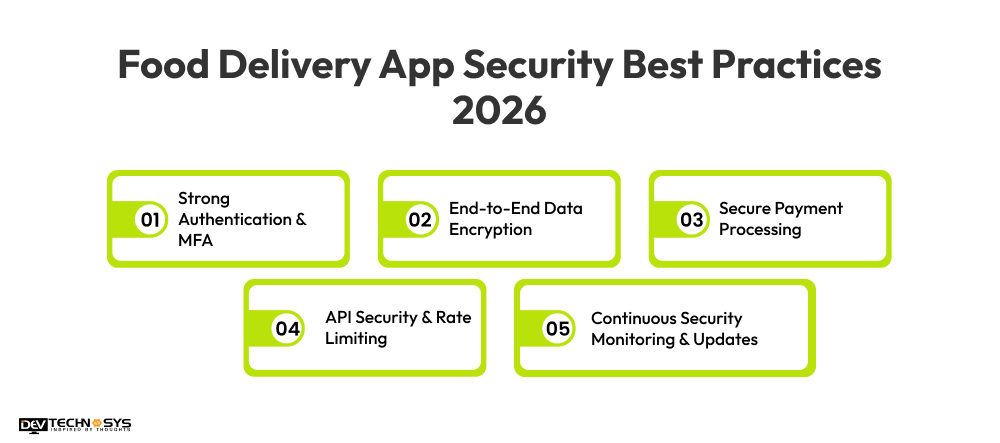
1. Strong Authentication & MFA
To reduce the risk of account takeovers, multi-factor authentication will be implemented for customers, delivery agents, and administrators: Passwords should always be used with either an OTP, biometrics, or authenticator applications.
In most systems, there will be strong password policies, and a review of the login activity in relation to potential or suspicious attacks will exist via tracking unusual locations or constant downgrading attempts.
2. End-to-End Data Encryption
The relevance of encrypting applicable fields both at rest and in-flight provides increased confidentiality protection for sensitive data such as user details, payment methods, and prior order history. Security protocols such as TLS 1.3, which use robust encryption, will also safeguard user data from interception, alteration, or unauthorized use while being transferred or stored.
3. Secure Payment Processing
By integrating PCI-DSS-compliant payment gateways while not retaining raw card data, you can ensure that only tokenized payments are processed, and fraud detection systems will have the capability to detect irregularities in patterns of payment transactions.
Ensuring that real-time monitoring is conducted on transactions that might appear fraudulent or have been deemed high-risk should also be established.
4. API Security & Rate Limiting
APIs should be secured by incorporating various agents so that regular penetration testing and vulnerability checks of APIs will identify basic vulnerability issues related to injection vulnerability, broken authentication, and insufficient protection for API endpoints. Also, it is recommended to have limitations on the number of requests made to an API to mitigate attempts at flooding or DDoS attacks.
5. Continuous Security Monitoring & Updates
You need to run ongoing scans for vulnerabilities, perform penetration tests, and implement real-time logging. Install software patches as they become available. Use AI to identify anomalies quickly and establish an incident response plan to quickly recover from any security breach.
GDPR, CCPA & PCI DSS: Legal Compliance Your Food Delivery App Must Follow
Build food delivery apps like Uber Eats, Postmates, and DoorDash must comply with consumers’ privacy requirements regarding their data through both regulations (GDPR, CCPA) and industry standard compliance (PCI DSS). By complying with these regulations, food delivery companies can provide consumers with a safe way to make payments online, protect themselves from identity theft, and keep their customers’ data secure.
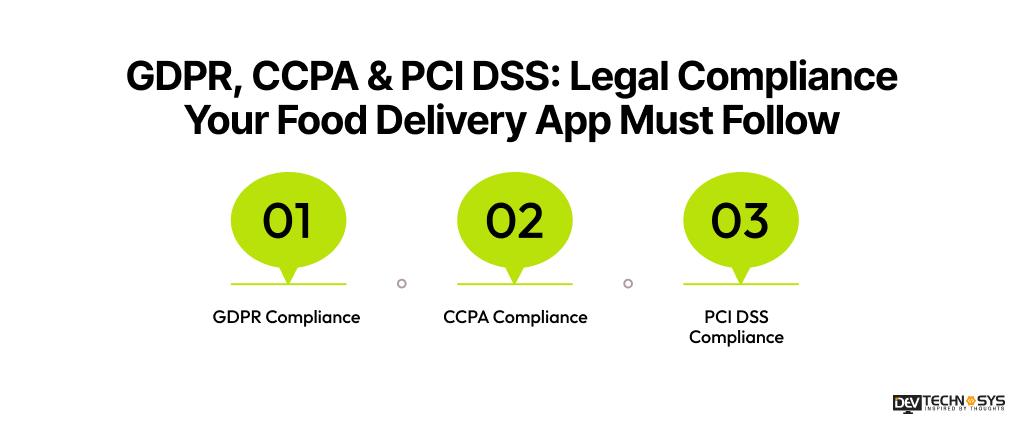
1. GDPR Compliance
The General Data Protection Regulation (GDPR) requires food delivery companies to process consumer data in accordance with local and national laws regarding GDPR. Following GDPR is not exception for us but a crucial part of a food delivery app development process.
The compliance requires that food delivery companies have specific permission from consumers before they can use their information for marketing and offers specific rights to consumers about their data (e.g., the ability to access, amend, or delete their data).
2. CCPA Compliance
Under California’s Consumer Privacy Act (CCPA), California residents have certain rights to know what personal information has been collected about them, the right to request that their personal information be deleted, and the right to object to the sale of their personal information. Our team applies the CCPA to ensure data confidentiality. As a result, food delivery apps must provide consumers with a clear and conspicuous privacy policy, a “Do Not Sell My Data” button, and they must also inform consumers about how they will use their personal information.
3. PCI DSS Compliance
All food delivery apps must have safeguards in place to properly keep Customer Credit Card data safe and in compliance with the Payment Card Industry Data Security Standard (PCI DSS). We apply PCI DSS principles to every project. This consists of several types of control mechanisms: secure storage of Credit Card Information/encryption; network access controls; vulnerability assessment controls; and monitoring controls.
Ghost Kitchens & Cloud Kitchens: How They’re Changing Food Delivery App Development
Ghost and Cloud Kitchens have changed the face of Food Delivery Application growth by eliminating dining rooms and emphasizing food delivery. They enable more rapid growth, at a lower cost, with better menus, and the use of data for predicting future demand.
Additionally, Delivery Applications include real-time order routing systems, cloud kitchen management software systems, and hyper-local delivery optimization tools. Additionally, ghost kitchen app development include real-time order routing systems, kitchen management systems, and hyper-local delivery optimization tools.
Aspect |
Traditional Restaurants |
Ghost/Cloud Kitchens |
Impact on Food Delivery Apps |
| Operations | Dine-in + delivery | Delivery-only kitchens | Apps focus on delivery-first workflows |
| Cost Structure | High (rent, staff, interiors) | Lower (no dine-in space) | More restaurant partners on the onboard apps |
| Scalability | Slow expansion | Rapid multi-brand scaling | Faster growth of listed brands |
| Order Management | Manual + POS systems | Centralized digital systems | Real-time API integration becomes essential |
| Menu Strategy | Fixed menus | Data-driven, flexible menus | Apps influence menu optimization via analytics |
| Delivery Efficiency | Variable | Highly optimized routing | Apps improve ETA accuracy and logistics |
| Customer Reach | Local footfall + delivery | Hyperlocal + cloud-based reach | Expansion into new micro-markets |
| Technology Use | Limited | High (AI, analytics, automation) | Strong dependency on app ecosystems |
Food Delivery App vs. Aggregator Platform: Which Model Should You Build?
The decision of whether to use a food delivery app or an aggregator platform is determined by your business objectives, budget, and desired audience. Understanding food delivery app vs aggregator helps business leaders to choose an effective model.
Food delivery apps allow you to have complete control over your operations and customer experience; however, aggregator platforms provide additional scalability, a wider array of restaurant partnerships, and many different sources of revenue.
Feature |
Food Delivery App |
Aggregator Platform |
| Business Model | Operates and manages food delivery services directly. | Connects customers, restaurants, and delivery partners on a single platform. |
| Ownership & Control | Full control over branding, customer experience, and operations. | Shared control with restaurant partners and delivery providers. |
| Initial Investment | Higher investment due to logistics, fleet management, and operations. | Moderate investment focused on platform development and partner onboarding. |
| Revenue Sources | Delivery fees, service charges, subscriptions, and commissions. | Restaurant commissions, advertising, subscriptions, and delivery fees. |
| Scalability | Slower expansion due to operational complexities. | Easier and faster scaling by adding new restaurant partners. |
| Customer Experience | Consistent service quality and brand experience. | Experience may vary depending on the restaurant and delivery partners. |
| Operational Complexity | High, requiring delivery management and customer support. | Lower, as restaurants and delivery partners handle many operational tasks. |
| Restaurant Relationships | Limited to owned or selected restaurant partnerships. | Supports multiple restaurants and cuisines on one platform. |
| Best For | Businesses seeking full operational control and brand ownership. | Entrepreneurs aiming to build a marketplace with diverse restaurant options. |
| Examples | Restaurant-owned delivery apps. | Uber Eats, DoorDash, Zomato, and Swiggy. |
Food Delivery App Trends You Can’t Ignore in 2026
The food delivery industry is continuously changing due to new trends, including AI-driven personalization, ultra-fast delivery, autonomous delivery methods, sustainable practices, and subscription-based loyalty programs. Food delivery app trends 2026 will influence customer expectations for service level, help to improve operational efficiency, and provide new growth opportunities for food delivery companies.
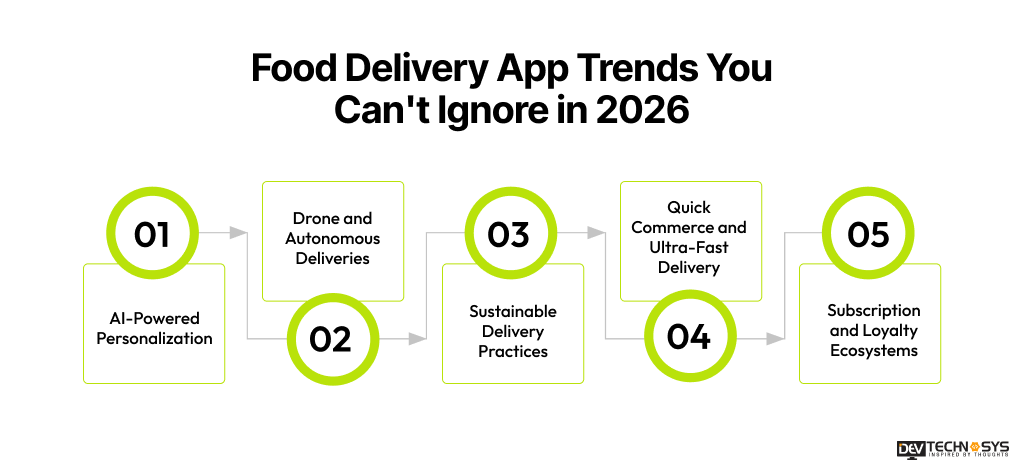
1. AI-Powered Personalization
With the help of advanced AI, food delivery apps are able to analyze your order history, dietary restrictions, past preferences, and spending habits. This allows them to provide you with restaurant suggestions that are ideal for you, offer tailored options to your unique preferences, and optimize search results, all in an effort to retain customers and enhance satisfaction.
2. Drone and Autonomous Deliveries
Using trucks and cars to make food deliveries is old news now that autonomous vehicles and drones have arrived on the scene. Because autonomous vehicles and drones can enhance delivery time, reduce delivery costs, and allow more efficient operations during peak times, companies that deliver food are investing heavily in automated last-mile delivery options throughout the world as regulations change to support both.
3. Sustainable Delivery Practices
Consumers want to do business with environmentally responsible companies and are looking for brands that take steps to be responsible stewards of our environment. Companies that deliver food are embracing new sustainable practices, including using environmentally friendly packaging, using electric vehicles to make deliveries, carbon offset programs, and optimizing delivery routes.
4. Quick Commerce and Ultra-Fast Delivery
Consumers continue to demand faster and faster deliveries of food and grocery orders. Food delivery app for restaurant business promote ultra-fast delivery that makes customers happy.
Companies are meeting this demand by adding new dark stores, micro-fulfillment centers, and local partnerships to support ultra-fast delivery service, which gives consumers access to meals, snacks, and essentials faster than ever before.
5. Subscription and Loyalty Ecosystems
Apps delivering food are introducing new membership plans where you will get to take advantage of perks such as: free delivery, discounts not available to non-member users, priority customer service, & partner company perks. All of the above-listed allow these delivery service providers to generate repeat purchases by creating a loyal customer base & increasing their overall customer lifetime value.
Planning a Food Delivery Project?
Get a tailored development cost estimate in a few simple steps.
- 3 quick steps
- 100% free
- Reply in 1 business day
2 Minutes Read
Build vs Buy vs Development Partner: Which Path Is Right for You?
There are different types of options available for a food delivery app development, and choose the type of development as per your requirement and demand.
Factor |
Build In-House |
Buy a Ready-Made Solution |
Hire a Development Partner |
| Initial Cost | High | Low to Medium | Medium |
| Time to Market | 6 – 18 months | 2 – 8 weeks | 3 – 8 months |
| Customization | Complete control | Limited | High |
| Scalability | Fully customizable | Depends on the vendor | Built to requirements |
| Technical Expertise Needed | Extensive internal team | Minimal | Moderate |
| Maintenance Responsibility | Internal team | Vendor | Shared or outsourced |
| Long-Term Cost | Moderate to High | Recurring subscription fees | Moderate |
| Ownership of Source Code | Full ownership | Usually vendor-owned | Full ownership (typically) |
| Best For | Large enterprises with dedicated tech teams | Startups needing a rapid launch | Businesses seeking speed and customization |
How to Monetize Food Delivery Applications in 2026?
There will be several methods of monetizing custom food delivery app solutions in 2026. These methods will depend on the strategies taken to add value to the customer and the holistic approach taken towards benefiting your customers. You can charge for delivery, recurring fees, sales commissions, and advertising.
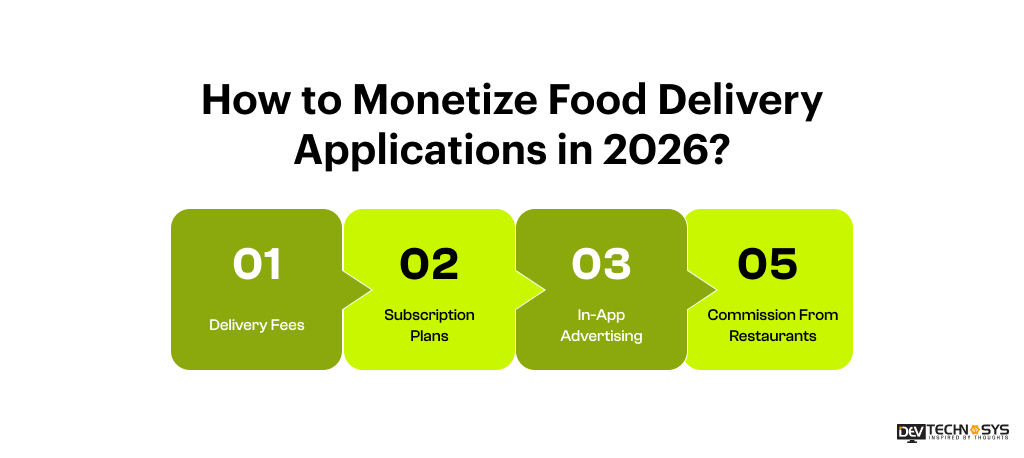
1. Delivery Fees
One of the simplest ways for an establishment to generate revenue is by using delivery fees. The delivery fees can be adjusted to accommodate demands, the distance between the business and customer, and peak and non-peak times for each delivery. Customers like the convenience of receiving their purchases quickly.
2. Subscription Plans
Establishments can offer customers either monthly or annual subscription programs, which would provide customers with free delivery, exclusive discounts, or faster shipping. This type of revenue generation allows businesses to have a consistent stream of income while simultaneously increasing customer loyalty, as customers who order food on a regular basis will likely be willing to subscribe.
3. In-App Advertising
Online takeaway apps can utilize advertising revenue and help promote restaurant or brand offerings within the application. There are various ways to do this, including sponsored listings, banner advertisements, and featured offers or placements. According to the iOS app development company, these advertising methods will provide visibility to restaurants or brands while generating additional revenue for the application.
4. Commission From Restaurants
Restaurants can pay a commission to the app every time an order is placed through the food courier app. This enables restaurants to be compensated by the app without having to charge their customers directly. In return, restaurants can receive more visibility and orders, which makes this model a very popular way for restaurants to receive an income.
Case Study: WannaEat – Food Delivery App Development
Client: Confidential, Saudi Arabia
Project: WannaEat – On-Demand Food Delivery Platform
Timeline: 28 Weeks
Challenge
The client wanted to build a scalable food delivery platform that connected customers and delivery partners through a single ecosystem. The primary challenges included implementing real-time order tracking, intelligent.
Solution
Developed a cloud-native food delivery platform with separate customer, restaurant, delivery partner, and admin applications using a scalable microservices architecture. Integrated real-time GPS tracking, AI-based meal recommendations, secure payment gateways and cloud infrastructure for seamless ordering and delivery experiences
Results Client Achieved:
90.8% player engagement growth
30% lower development cost
Launched in 28 weeks
4.2★ on App Store (1200+ downloads)
Improved user engagement with AI-powered meal recommendations
Why Choose Dev Technosys to Build a Food Delivery App?
Selecting the right technology partner is important to include multiple features in the food delivery app along with compliance & security. Dev Technosys brings 15+ years of industry experience, with more than 20 project deliveries and a 93% happy client rate.
We combine a privacy-first approach with intuitive UI/UX design, cloud infrastructure, artificial intelligence, and food delivery app API integration. With CMMI Level 3 certification, our experts follow a structured development process. We combine emerging technologies with modern client requirements to build a feasible solution. If you are ready to earn more with a food delivery app, request a quote.
Conclusion
When building a food delivery application in 2026, careful planning, implementing all of the essential features, and ensuring flawless execution are critical to success.
A successful food delivery app is dependent on having access to a reliable food delivery app development company, skilled developers, a user-friendly interface, secure payment processing, and the ability to produce a product that will grow with the user’s requirements. The key to creating a successful food delivery application is through strategic partnerships.
Frequently Asked Questions
Find answers to the most common questions related to this article.
The cost to develop a food delivery app in California lies between $8,000 and $25,000; it can go to a higher price because of several factors. It includes features, functions, project size & complexity, backend infrastructure, design UI/UX, deployment platforms, development team, and more.
In 2026, it typically takes 3 to 6 months to develop a basic version of an on-demand food service application. If you're looking for additional features such as complex processes, a custom UI/UX design, and the ability to utilize third-party integrations. You will likely find that the time for actual planning and completing the application takes about 6+ months.
Food delivery applications generate revenue from delivery charges, commissions received by the restaurant, and a subscription model, advertising within the app, premium features, etc. The form of monetization to choose will be dependent on your business plan, who your audience is, who your competitors are, and how scalable you believe your app is intended to be in the overall online food marketplace.
Some of the key challenges of developing a meal ordering app are having a seamless UI/UX, safe payment processing, real-time order tracking, and managing a successful delivery process. Providing sufficient server scalability, developing your application with third-party APIs integrations, and complying with regulatory requirements.
There are robust tech stacks used to make a food delivery app in 2026:
Java
React Native
HTML5
PHP
Python
C++
.NET
Yes, you can develop a basic food delivery app without coding by using no-code or low-code platforms. These platforms offer built-in templates, ordering features, payment integrations, and more. Integrating advanced or complex functionality requires professional development support.
Which option is best for your current budget and target users will determine what you should choose to build. By developing an app for iOS and Android, you reach the largest audience and collect the greatest number of potential customers. If you have limited resources, concentrate on building your application first on the most used platform by your target audience and then use cross-platform development post-launch to grow more rapidly.
Focus on finding local independent restaurant owners who are looking for other ways to generate income. Offer low-cost introductory commissions, marketing assistance, and other incentives for becoming partners. It is ideal to have at least 20-30 restaurant partnerships established before the official launch so that there are enough choices available for consumers on day one.
The errors that new entrepreneurs tend to make are launching the app without any partnerships with restaurants, failing to take into consideration logistics issues, and estimating too low an approximate number of orders during the peak hour period. Having a poor payment processing platform and creating excessive amounts of functionality before validating that there is enough demand for it.
Instead of trying to compete across the nation, identify a smaller niche segment or an area with very few competitors to offer better customer service, lower fees, exclusive partnerships with local restaurants, quicker delivery times than larger competitors, or unique offerings like healthy meals, local cuisine, and corporate catering.